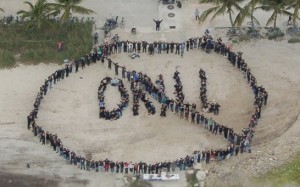
Houston Chronicle: Report says oil supplies in Fla. waters negligible

http://www.chron.com/disp/story.mpl/ap/tx/6887769.html

By BILL KACZOR Associated Press Writer © 2010 The Associated Press
Feb. 26, 2010, 3:21PM
TALLAHASSEE, Fla. – Estimated reserves in Florida waters would provide the United States with less than a week’s worth of oil and have no discernible effect on prices at the pump or U.S. reliance on foreign oil, says a report released Friday as part of a state Senate review of whether a ban on offshore drilling should be lifted.

The report is the latest indication that the push to open Florida waters as near as three miles from the state’s beaches may be waning, at least for this year.

Another is that all 12 lobbyists for Florida Energy Associates, a group pushing for lifting the ban have withdrawn, according to the Legislature’s lobbyist registry.

Also, no bill has yet been filed on drilling in Florida waters with the annual legislative session set to start Tuesday, but resolutions have been introduced in the House and Senate that would urge Congress to lift moratoriums on drilling in federal waters farther from shore.

Senate Energy, Environment and Land Use Committee Chairman Lee Constantine, R-Altamonte Springs, declined comment on the lobbyists leaving Florida Energy Associates and said legislation still could be passed by amending it onto another bill.

“Nothing is dead for this year,” Constantine said. “My job is to find the questions and answer those questions.”

Constantine has a pro-enviroment record but said he’s trying to stay neutral.
Frank Matthews, formerly the lead lobbyist for Florida Energy Associates, did not immediately return a call seeking comment.

The report was prepared by the Collins Center for Public Policy, a Florida think tank, in conjunction with the state’s Century Commission for a Sustainable Florida. Senate President Jeff Atwater, R-North Palm Beach, has asked the commission to submit information for the chamber’s examination of the issue.

The 40-page report is full of data gathered from government and private sources but makes no recommendations.

Government assessments suggest oil and gas reserves in state waters east of Apalachicola in the Panhandle are “modest,” the report says. The area west of Apalachicola has a separate geologic structure “that may contain natural gas fields at significant depths in the subsurface.”

Most of the total reserves east of Apalachicola also are gas. The oil estimated in state waters would boost U.S. supplies by less than 100 million barrels, or a small fraction of 1 percent.

“To put that in context, the total estimated amount of oil reserves in Florida would satisfy the U.S. demand for oil (approximately 20 million barrels a day) for less than a week,” the report says.
Constantine said he’s heard that before but it’s only one side of the debate.

“That’s speculation,” Constantine said. “It’s pretty much a guessing game.”

Estimated reserves off Florida in federal waters are more substantial at a bit less than 4 billion barrels but “pale in comparison” to the central and western regions of the Gulf of Mexico, the report says. It adds that drilling in federal waters off Florida would boost total U.S. production by only 1 or 2 percent and “have no discernible impact on the state’s or country’s dependence on foreign oil.”

The report also says the chances of accidental spills are low but that Florida’s coastline is especially sensitive because of its mangrove forests, sea grass beds and coral reefs.

The closer to shore a spill occurs the greater the hazard. The report says that makes drilling in federal waters less of a threat even than drilling in Cuban waters.

“Studies show the sea currents flowing off Cuba’s northwest coast could deposit oil from a significant spill anywhere from the Keys to Palm Beach,” the report says.

special thanks to Richard Charter, as ever!
Oil & Gas Journal: Obama reaffirms pledge of ‘tough decisions’ on new OCS areas

http://www.ogj.com/index/article-display/0873419187/articles/oil-gas-journal/general-interest-2/government/2010/02/obama-reaffirms_pledge/QP129867/cmpid=EnlDailyFebruary252010.html
Oil and Gas Journal  Feb 24, 2010
Nick Snow
OGJ Washington Editor

WASHINGTON, DC, Feb. 24 — Repeating a point that he made in his State of the Union address on Jan. 27, US President Barack Obama told business executives that his administration is willing to make tough decisions on opening new offshore areas for oil and gas development.

“A competitive America is also America that finally has a smart energy policy,” the president said in a Feb. 24 address to the Business Roundtable in Washington. “We know there’s no silver bullet here. We understand that to reduce our dependence on oil and the damage caused by climate change, we’re going to need more production in the short term, we’re going to need more efficiency, and we need more incentives for clean energy.”

He said that funding under the 2009 Economic Recovery Act already has helped jump-start the US clean energy industry with an investment which will lead to 720,000 jobs in that business by 2012. He also cited administration efforts to make homes and businesses more energy-efficient, loan guarantees to construct the first new US nuclear power plant in decades, and support for three of the world’s largest solar plants.

“And I’ve said that we’re willing to make tough decisions about opening up new offshore areas for oil and gas development,” Obama continued. “So what we’re looking at is a comprehensive strategy, not an either/or strategy but a both/and strategy, when it comes to energy.” But to actually make the transition to a clean energy economy, it will be necessary to put a price on carbon pollution, he added.

Bills including imposition of a cap-and-trade system which passed the full US House and the US Senate Environment and Public Works Committee in 2009 have drawn criticism for their treatment of oil refiners, chemical plants, and other large industries, which Obama acknowledged. “I am sympathetic to those companies that face significant potential transition costs, and I want to work with this organization and others like this to help with those costs and to get our policies right,” he said.

“What we can’t do is stand still,” the president maintained. “The only certainty of the status quo is that the price and supply of oil will become increasingly volatile, [and] that the use of fossil fuels will wreak havoc on weather patterns and air quality. But if we decide now that we’re putting a price on this pollution in a few years, it will give businesses the certainty of knowing they have the time to plan for the transition.”

Statesman Journal: Bill Would Extend Ban on Offshore Drilling in Oregon

http://www.statesmanjournal.com/article/20100219/LEGISLATURE/2190337/Bill-would-extend-ban-on-offshore-drilling

Statesman Journal

February 19, 2010
A bill that extends Oregon’s moratorium on offshore drilling for 10 more years passed the Oregon Senate on Thursday with a vote of 22-8. House Bill 3613, sponsored by Rep. Ben Cannon, D-Portland, protects Oregon’s Coast for three miles from shore from the threat of offshore oil and gas exploration for the next 10 years. Backers of the bill say there are no plans for drilling, but the state should take precautions to protect the beauty of the coastline and its fishing economies.
If signed into law, the moratorium would continue one that passed in the 2007 Legislative session which expired January 2.
– Beth Casper
_______________
LA Times

Oregon lawmakers extend moratorium on offshore drilling

Legislation halts oil and gas development for 10 more years, but it stops short of a permanent ban.

By Kim Murphy
February 19, 2010
Reporting from Seattle – A 10-year moratorium on offshore oil and gas development along the Oregon coast won final passage in the Legislature on Thursday, though lawmakers stopped short of adopting a permanent ban.

The bill extends a previous moratorium that had expired Jan. 2 for the three-mile-wide stretch of state coastal waters.

There are few known oil resources offshore and no big push for exploration, but environmental, fishing and tourism groups pressed to extend the ban, fearful that the federal government could move to open waters farther offshore to drilling.

“We think we’ve helped solidify the Oregon delegation into keeping the federal moratorium in place,” said Brock Howell, legislative advocate for Environment Oregon.

The state Senate’s 22-8 approval endorsed a version of the bill passed in the House last week.

Democratic Gov. Theodore R. Kulongoski has said he supports the legislation.

Opponents of the bill said technology might one day make it possible to find and safely drill for hidden reserves. “How can you create jobs without using natural resources in our rural communities?” said Republican state Rep. Wayne Krieger.

The Western States Petroleum Assn. opposed the bill while reaffirming that there was no current interest in drilling off Oregon.

“Our view is a long-term ban is just not sensible energy policy,” spokesman Tupper Hull said. “We do ourselves no favors by putting potentially valuable energy resources off-limits in an era when there seems to be consensus that we ought to improve our energy security.”

kim.murphy@latimes.com

Special thanks to Richard Charter

Sun-Sentinel: Florida legislators consider lifting ban on offshore drilling

http://www.theolympian.com/649/story/1144607.html
The Olympian By JOSH HAFENBRACK | Sun Sentinel * Published February 19, 2010

TALLAHASSEE, Fla. – By now, the arguments are well rehearsed. Offshore oil drilling is either a dangerous gamble with Florida’s beach-driven tourism industry, or a potential job creation and tax windfall.

Either way, an emotional and politically charged drilling debate is taking shape in the state Capitol, a slow-moving political drama that is likely to unfold over the next two years on whether to allow oil drilling in the Gulf of Mexico, three to 10 miles from Florida’s West Coast beaches.

Republican legislative leaders are holding hearings and producing reports on the economic and environmental impacts of offshore oil and natural gas exploration. Even supporters say the drill bill is unlikely to become law this year, with lawmakers skittish about the 2010 election, gas under $3 a gallon and a reluctant state Senate taking a go-slow approach to the issue.

But the subtext is clear: With more drilling-friendly leadership taking over the House and Senate this November, the legislative session that starts March 2 could lay the groundwork for allowing oil rigs to set up off Florida’s Gulf Coast.

After the November elections, staunch drilling advocates state Rep. Dean Cannon and state Sen. Mike Haridopolos, both Republicans, will take over as powerful presiding officers in their respective chambers.

Republican Gov. Charlie Crist, who once was against drilling, has been open to the idea but hasn’t made it a central part of his legislative platform.

“I think we’ll lay the predicate this year for next year,” said Barney Bishop, president of the Associated Industries of Florida, which is lobbying for offshore drilling.

Since 1990, Florida has banned exploration or drilling in its waters, which run from three miles to 10.3 miles off the Gulf Coast shoreline. Oilmen are lobbying to repeal that ban and authorize exploration in the Gulf, which is thought to be rich in oil and natural gas.
Atlantic Ocean waters off the South Florida coast would not be open to drilling. However, drilling critics argue that South Florida could see fewer tourists if people come to think of Florida beaches as oil production sites or if a West Coast oil spill gets national media attention.
Legislators won’t authorize drilling outright. Rather, they are seeking to lift the 1990 ban and leave the decision on whether to offer drilling leases to the state Cabinet, which is comprised of the governor, attorney general, chief financial officer and agriculture commissioner.
Supporters say drilling could create up to 20,000 jobs and bring billions in permitting and severance tax revenue over several decades. They note there hasn’t been a drilling-related oil spill in the United States since an incident off the California coast in 1969.

“The beaches is a moot issue,” said Bishop. “There hasn’t been a single drilling accident in 40 years.”

Opponents counter that revenue and job projections are inflated and could take a decade or more to materialize – and there’s no way to guarantee against a tourism-destroying oil spill. Even if the rigs are safe, a damaging spill could happen during a major hurricane or from a faulty pipeline, they note.

“Our view is, you can’t make it both safe and profitable,” said Eric Draper, a lobbyist for the Audubon Society.

The methodical approach legislators are taking this year is calculated to take away the argument that drill-bent Republicans are ramming through a sweetheart deal for the oil industry.

The results are dry, hours-long hearings in Tallahassee on the geological and practical aspects of drilling. More meetings are planned even before a bill is written. That’s a stark contrast to last year, when the House pushed through a drill bill in the last two weeks of session with little debate. The proposal stalled in the Senate.

“No one can say we didn’t have an in-depth discussion,” said Florida House Speaker Larry Cretul.

Democrat Rep. Keith Fitzgerald, who represents a coastal district in Sarasota, praised House Republicans for holding extensive hearings, but said he remained unconvinced that the financial benefits from drilling outweighed the risks.
“They’re not sweeping potential problems under the rug,” Fitzgerald said of legislative Republicans. Still, he said, “People have to decide – do the benefits outweigh the costs? I’m a long way from being convinced. If you look at where I live, the entire economy is based on the beach. Anything that might detract from that is very costly.”

Special thanks to Richard Charter