TampaBay.com: Crist says oil spill proves drilling isn’t safe, withdraws his support & more….

http://www.tampabay.com/news/environment/water/crist-says-oil-spill-proves-drilling-isnt-safe-withdraws-his-support/1090626
TampaBay.com
St. Petersburg Times
Crist says oil spill proves drilling isn’t safe, withdraws his support

By Marc Caputo, Mary Ellen Klas and Craig Pittman, Times/Herald Tallahassee Bureau
In Print: Wednesday, April 28, 2010

The oil spill spreading across the Gulf of Mexico is sending ripples through Florida and national politics, giving Gov. Charlie Crist a reason to withdraw his support for offshore drilling.

After a 90-minute plane flight Tuesday above the spill, which was spreading in an 80-mile by 42-mile blob, Crist said, “Clearly it could be devastating to Florida if something like that were to occur. It’s the last thing in the world I would want to see happen in our beautiful state.”

He said there is no question now that lawmakers should give up on the idea of drilling off Florida’s coast this year and in coming years. He has said previously he would support drilling if it was far enough from shore, safe enough and clean enough. He said the spill is proof that’s not possible.

“Clearly that one isn’t far enough and that’s about 50 to 60 miles out, it’s clearly not clean enough after we saw what we saw today – that’s horrific – and it certainly isn’t safe enough. It’s the opposite of safe,” Crist said.
Earlier in the day the Legislature’s main advocate of drilling, incoming House Speaker Dean Cannon, R-Orlando, said the disaster had him asking questions.

“It causes me to want to examine what happened and how it could have been prevented, and we need to figure that out before we make any further decisions,” said Cannon, who has proposed allowing rigs as close as 3 miles off Florida’s beaches.

Before the spill, Cannon had promised to bring the drilling proposal back up when he becomes speaker next year, touting the millions of dollars in revenue and thousands of jobs that would be created by near-shore drilling.

But Attorney General Bill McCollum, a fellow Republican running for governor, said Cannon should forget passing that bill in 2011 because “he’ll face a veto on my desk if he brings it up the way it is now. I know it’s a revenue producer, but that’s not a good enough reason.”

Meanwhile, in Washington, the spill “is going to have a chilling effect” on a plan by President Barack Obama to open up the eastern gulf to drilling, predicted U.S. Sen. Bill Nelson, D-Fla.: “It’s another reminder of the risks of offshore drilling.”

And the senator welcomed Crist back, after the governor in 2008 said he had become more open to the possibility of drilling off Florida. Nelson said he was “very glad the governor realized the realities of what an oil spill could do to the beaches of the Florida coast.”

The oil, which has been oozing out at a rate estimated at 42,000 gallons a day, is coming from the site of the Deepwater Horizon rig.

Deepwater Horizon exploded about 11 p.m. on April 20 and later sank. Eleven members of the 126-member crew remain missing and are presumed dead. The cause of the explosion at the rig remains under investigation.

Efforts to close off the leak using robot submarines have so far failed. Other options for ending the leak could take longer – up to three months, according to U.S. Coast Guard officials.

The marshes of southern Louisiana and Mississippi appear to face the most immediate risk from the spill because they are closest to it, oceanographers say. However, if the leaking oil drifts far enough east to get caught in the gulf’s powerful loop current, it could wind up coating beaches in the Florida Keys and then be swept north along the state’s Atlantic coast.

New Jersey Democratic Sens. Robert Menendez and Frank Lautenberg said the spill calls into question the credibility of safety claims by the oil industry. In a letter citing government figures, they said that since 2006 there have been 509 fires on rigs in the gulf, causing at least two fatalities and 12 serious injuries – all before Deepwater Horizon.

“Big Oil has perpetuated a dangerous myth that coastline drilling is a completely safe endeavor, but accidents like this are a sober reminder just how far that is from the truth,” the two senators said.
Despite the spill, White House spokesman Robert Gibbs said Friday that President Barack Obama is still sticking to his plan to open up part of the eastern gulf and areas of the Atlantic seaboard to oil drilling.

Times researcher Caryn Baird contributed to this report, which also includes information from the Associated Press.
_____________________________________________________
http://www.tampabay.com/news/environment/water/oil-spill-in-gulf-could-threaten-florida/1090491
TampaBay.com
Oil spill in gulf could threaten Florida

By Craig Pittman, Times Staff Writer
In Print: Tuesday, April 27, 2010

An image taken from a NASA satellite on Sunday shows the Mississippi Delta on the tip of Louisiana at the center. The oil slick is a silvery swirl to the right.
[Associated Press]
On Monday, weathered oil is seen near the coast of Louisiana from a leaking pipeline caused by last week’s explosion and collapse of the Deepwater Horizon oil rig in the gulf.
An oil spill from a rig that sank off the coast of Louisiana is threatening marshes and beaches across the Gulf Coast, and unless it’s contained it could wind up tainting the Florida Keys and perhaps the state’s Atlantic coast, oceanography experts said Monday.

As of Monday, the slick was about 48 miles by 39 miles, lying some 30 miles off the coast of Louisiana. So far high winds have kept the spill away from land. It’s about 80 miles from the nearest Florida beaches in Pensacola.

But the owner of the rig has been unable to shut off the oil flowing from 5,000 feet below the surface, so the slick continues to grow.

The marshes of southern Louisiana and Mississippi appear to face the most immediate risk from the spill because they are closest to it, said George Crozier, director of the Dauphin Island Sea Laboratory in Mobile, Ala.

What happens after that depends on how quickly the owners of the rig can shut off the flow of oil. On Sunday they began using robot submarines to try to shut off a valve called a blowout preventer on a leaking pipe deep underwater. If that fails, then they will drill new wells on either side of the leak to relieve the pressure there – a process that could take months.
“If it goes on for four months, then yeah, we’ve got a problem,” Crozier said.
 “But if they’re able to shut it down after a day or two, then the risk is minimal.”

“We can only hope that they can make that sucker stop very soon,” said Wilton “Tony” Sturges , a retired Florida State University oceanographer. The winds that would push the spill toward Tampa Bay’s beaches do not normally start until midsummer, he noted.

Officials with the National Oceanic and Atmospheric Administration are predicting that by today the slick will be pushed more toward the east, away from the Panhandle but pointed more toward Florida’s peninsula.

Robert Weisberg, a University of South Florida oceanographer who specializes in studying the gulf, said that while the Panhandle may be safe, he is concerned that if the winds push it far enough to the east, the oil slick could be caught in the gulf’s powerful loop current. The loop current flows north from Mexico’s Yucatan Peninsula but then makes a clockwise turn and flows south.

If that happens, Weisberg warned, then the oil could be carried “toward the Keys and points up the east coast.”

Florida Department of Environmental Protection officials are monitoring the spill, said DEP spokeswoman Dee Ann Miller, but “at this time there is not believed to be an immediate threat to Florida’s waters.”

Federal officials say they are doing their best to keep the growing oil slick from damaging any of the state’s beaches or marshes. “Our goal is to continue to fight this spill as far offshore as possible,” U.S. Coast Guard Rear Adm. Mary Landry said at a news conference Monday.

One idea: Put a dome over the leaks to catch oil and route it to the surface, where it could be contained. That has worked before with shallow wells. No one knows if it would work 5,000 feet below the surface.

A pod of sperm whales was spotted near the slick on Sunday. At this point no one knows what effect the spill may have on them, although there is a risk of respiratory and eye irritation, or stomach and kidney problems if they ingest the oil, said Teri Rowles, coordinator of NOAA’s marine mammal stranding program.

Planes that were dropping chemicals that break down the oil were told to steer clear of the whales. The chemicals, known as dispersants, can be as toxic to mammals as the oil itself, marine biologist Jackie Savitz told the New York Times. So far there are no reports of any dead or injured animals in or near the slick.

The oil, which has been leaking at a rate estimated at 42,000 gallons a day, is coming from the site of the Deepwater Horizon rig, which exploded about 11 p.m. on April 20 and later sank. Eleven members of the 126-member crew remain missing and are presumed dead. The cause of the explosion at the rig, which was under contract to BP, remains under investigation.

Initially Coast Guard officials said there appeared to be no leak from the sunken rig. But on Sunday they discovered oil was in fact leaking from pipes deep beneath the surface.
The rig’s owner, Transocean Inc., noted in a news release Monday that the rig – now on the sea floor about 1,500 feet northwest of the well center – was fully insured for $560 million. Transocean is the world’s largest offshore drilling contractor.

Information from the New York Times and the New Orleans Times-Picayune was used in this report.

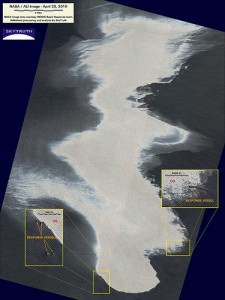
Skytruth: Gulf Oil Slick Dwarfs Response Vessels plus slide show of images

http://tinyurl.com/25xlerr

Detail from SkyTruth image showing response vessels and Gulf oil slick on April 25.
We just got a detailed ALI satellite image from NASA that was shot two days ago, on April 25, when the oil slick was about 817 square miles in size (it has since more than doubled to at least 1,800 square miles). You can see several response vessels working at the periphery of the slick. The magnitude of the job they have to do is plain to see.

See more in our growing image gallery for this incident (click below).


John Amos
John@skytruth.org
P.O. Box 3283
Shepherdstown, WV 25443-3283
phone: 304-260-8886
skype: skytruth.amos
*****************************************************************
SkyTruth:  Satellite images and digital mapping for
environmental protection, education and advocacy
A 501(c)(3) nonprofit organization – http://www.skytruth.org
Learn more at the SkyTruth Blog – http://blog.skytruth.org
Browse our image galleries at Flickr – http://tinyurl.com/yd576ep
Follow us on Twitter for the latest – http://twitter.com/skytruth

NASA/ALI image taken from the EO-1 satellite on April 25, 2010, showing some of the oil slicks and sheen (bright areas) resulting from the Deepwater Horizon drill rig blowout in the Gulf of Mexico. Slicks extend well beyond the image to the northeast (upper right); see NASA/MODIS image from April 25 for full extent of the oil slicks. Spill source is leaking well on the seafloor located near bottom center of this image. Insets show several response vessels working on the periphery of the slick. 

Houston Chronicle: Spill area triples as oil continues to leak

http://www.chron.com/disp/story.mpl/business/energy/6976990.html

By BRETT CLANTON and MONICA HATCHER HOUSTON CHRONICLE
April 26, 2010, 8:27PM
As a major oil spill in waters off Louisiana tripled in area, a growing task force led by BP kept trying and failing today to plug a leaking well one mile below, damaged when a massive drilling rig sank last week into the Gulf of Mexico.

Efforts remained focused on the quickest fix – using robot submarines to close valves sitting atop the well. BP also said it has made progress with back-up plans to build a dome-like device to collect seeping oil at the sea floor, which could be installed in as little as two weeks, and with a worst-case plan – possibly taking months – to drill relief wells into the damaged one to stop the bleeding.

“We don’t know which technique will ultimately be successful,” said Doug Suttles, BP’s chief operating officer of exploration and production, in a news conference. “Just like everyone, we want to bring this to conclusion absolutely as fast as possible.”
The leaking well was discovered Saturday after the Deepwater Horizon sank Thursday morning about 40 miles off the coast of Louisiana.

The rig, owned and operated by Swiss-based Transocean and under lease to BP, went down after an apparent blowout sent the hulking structure up in flames the night of April 20. Eleven of the 126 aboard at the time of the blast remain missing and are presumed dead.

The situation has cast a glaring light on the physical and environmental risks of offshore oil drilling at a time when the industry is pushing for greater access to domestic oil and gas resources and after the Obama administration recently called for opening more federal waters for energy exploration. And some political opponents of offshore drilling have seen an opening for attack.

“The explosion, ensuing fire, and continuing spill raise serious concerns about the industry’s claims that their operations and technology are safe enough to put rigs in areas that are environmentally sensitive or are critical to tourism or fishing industries,” Senate Democrats Robert Menendez and Frank Lautenberg of New Jersey and Bill Nelson of Florida wrote in a letter today to leaders of the Senate Commerce, Science and Transportation Committee and the Senate Energy and Natural Resources Committee.
They requested a hearing on the Deepwater Horizon incident. “This may be the worst disaster in recent years, but it’s certainly not an isolated incident,” they wrote.

Aware perhaps of what could be at stake for the industry, BP has gone to great lengths to ensure the cleanup goes smoothly and quickly.

As of today, the British oil giant had tapped an army of more than 1,000 people to brainstorm fixes for plugging the well, and had marshaled a small armada of boats, planes and other resources to fight the spill as far from the shore as possible. Under a 1990 U.S. oil pollution law, BP is required to foot the bill for the clean-up.

The Deepwater Horizon spill now covers an estimated 1,800 square miles, the Coast Guard said today, dramatically increasing its estimate of 600 square miles on Sunday. But it noted that the slick was not continuous over that entire area, and that 97 percent of it is a thin sheen that dissipates easily, while the rest is thicker oil.

Government forecasters said the spill posed no immediate threat of making landfall, based on three-day weather models.

“Our biggest concern is that it continues to spill,” said Doug Helton, incident operations coordinator for the National Oceanic and Atmospheric Administration. “We’re not expecting any landfall at this point, but at some point we’ll start to see some of the shoreline impacts.”
The Coast Guard has been working on contingency plans with state governments in Texas, Louisiana, Mississippi and Florida, which would have ample time to respond if the spill came ashore, said Rear Adm. Mary Landry, commander of Coast Guard District 8.

But Chuck Kennicutt, professor of oceanography at Texas A&M University, doubts it will come to that. “This is far enough offshore that at least for the time being the likelihood of it washing up into the sensitive areas on the shore is probably fairly low,” he said.

As a precautionary measure, Houston-based Diamond Offshore Drilling said it evacuated more than 100 employees from its Ocean Endeavor drilling rig because the oil sheen had moved within a few miles of a well it is drilling for Exxon Mobil.

BP and Coast Guard officials said they remain hopeful of sealing off the well, which is leaking up to 1,000 barrels or 42,000 gallons a day, in two places – from a section of drill pipe near the wellhead and from the end of the long riser column that had connected the rig to the well and broke when the rig sank.

Workers were using up to four remotely operated vehicles  in an effort to activate shut-off valves on a giant piece of equipment called a blowout preventer that rests on top of the well at the sea floor. None of the multiple attempts to activate the 50-foot stack of valves had been successful yet, BP’s Suttles said.
Separately, the company has begun constructing three of the dome-like oil-collection devices that could be deployed in two to four weeks, he said. Also, BP was expecting the arrival of a rig tonight night to drill relief wells should they be needed, Suttles said.

Special thanks to Richard Charter

BlogAllOverTheWorld.com: Oil Rig, Deepwater Horizon, Leaking into Gulf of Mexico

http://www.blogallovertheworld.com/2010/04/oil-rig-deepwater-horizon-leaking-into-gulf-of-mexico/
BlogAllOverTheWorld.com

NEW ORLEANS – The Coast Guard discovered Saturday that oil is leaking from the damaged well that fed a massive rig that exploded this week off Louisiana’s coast, while bad weather halted efforts to clean up the mess that threatens the area’s fragile marine ecosystem.

For days, the Coast Guard has said no oil appeared to be escaping from the well head on the ocean floor. Rear Adm. Mary Landry said the leak was a new discovery but could have begun when the rig sank on Thursday, two days after the initial explosion.

“We thought what we were dealing with as of yesterday was a surface residual (oil) from the mobile offshore drilling unit,” Landry said. “In addition to that is oil emanating from the well. It is a big change from yesterday … This is a very serious spill, absolutely.”

Coast Guard and company officials estimate that as much as 1,000 barrels – or 42,000 gallons – of oil is leaking each day after studying information from remotely operated vehicles and the size of the oil slick surrounding the blast site. The rainbow-colored sheen of oil stretched 20 miles by 20 miles on Saturday – about 25 times larger than it appeared to be a day earlier, Landry said.

By comparison, Exxon Valdez spilled 11 million gallons in Alaska’s Prince William Sound in 1989 – the worst oil spill in U.S. history.

BP PLC, which leased the rig and is taking the lead in the cleanup, and the government have been using the remotely operated vehicles to try to stop the leak by closing valves on the well deep underwater. If that doesn’t work, the company could drill what’s called an intervention well to control the oil flow. But the intervention drilling could take months.

“Over the next several days, we should determine which method is the best one to follow,” said Doug Suttles, chief operating officer for BP Exploration and Production. “A huge number of engineers from ourselves, working with (the government) and across the industry are putting together the best technology and know-how to solve this problem.”
Complicating efforts to stop the leak is well head’s depth at 5,000 feet underwater, said Lars Herbst, the regional director for the Minerals Management Service. Leaks have been fixed at similar depths before, but the process is difficult, he said.

The bad weather rolled in Friday, bringing with it strong wind, clouds and rain that interrupted efforts to contain the oil spill. Coast Guard Petty Officer John Edwards said he was uncertain when weather conditions would improve enough for the cleanup to resume. So far, crews have retrieved about 1,052 barrels of oily water, he said.

The sunken rig may have as much as 700,000 gallons of diesel on board, and an undetermined amount of oil has spilled from the rig itself. Suttles said the rig was “intact and secure” on the seabed about 1,300 feet from the well site.

BP said it has activated an extensive oil spill response, including the remotely operated vehicles, 700 workers, four airplanes and 32 vessels to mop up the spill. The Marine Spill Response Corp., an energy industry cleanup consortium, also brought equipment.
The 11 missing workers came from Texas, Louisiana and Mississippi. Neither the Coast Guard nor their employers have released their names, though several of their families have come forward.

Karl Kleppinger Sr., whose 38-year-old son, Karl, was one of the missing workers, said he doesn’t blame the Coast Guard for calling off the search.

“Given the magnitude of the explosion and the fire, I don’t see where you would be able to find anything,” said Kleppinger, of Zachary, La.

The other 115 crew members made it off the platform; several were hurt but only one remained hospitalized. The most seriously injured worker was expected to be released within about 10 days.

Federal officials had already been working on new safety rules for offshore drilling before Tuesday’s blast.

The U.S. Minerals and Management Service is developing regulations aimed at preventing human error, which it identified as a factor in many of the more than 1,400 offshore oil drilling accidents between 2001 and 2007. An MMS review published last year found 41 deaths and 302 injuries during that period.

The cause of Tuesday’s blast hasn’t been determined.

The Deepwater Horizon was the site of a 2005 fire found to have been caused by human error. An MMS investigation determined that a crane operator on the rig had become distracted while refueling the crane, allowing diesel fuel to overflow. Records show the fire was quickly contained, but caused $60,000 in damage to the crane.

Environmentalists said the rig explosion and oil spill should push the nation to develop new energy sources.

“This should be a wake-up call,” said David Helvarg, the president of the Blue Frontier Campaign, a marine conservation group, and author of “Rescue Warriors: The U.S. Coast Guard, America’s Forgotten Heroes.”
“I would rather risk a ‘wind spill’ than an oil spill offshore,” he said, ruefully pointing out that the source of wind-powered energy can’t sully the environment.

___
Associated Press Writer Noaki Schwartz reported from Los Angeles. Associated Press Writers Jason Dearen in San Francisco, Mike Kunzelman, Kevin McGill and Alan Sayre in Louisiana contributed to this report.
_________________
BBC NEWS
Published: 2010/04/25 09:18:09 GMT

‘Serious spill’ from US oil rig

Oil is leaking from a damaged well feeding a rig that sank off Louisiana on Thursday, in what US officials are calling “a very serious spill”.

The well is estimated to be leaking at a rate of about 1,000 barrels (42,000 gallons) of oil per day.

Although the US coastguard said on Friday that no leak was detected, the latest evidence suggests a spill. Bad weather has hampered efforts to fix it.

Eleven workers are still missing after an explosion and fire on Tuesday.

The Deepwater Horizon had been burning for 36 hours when it sank on Thursday in 5,000 ft (1,500m) of water, despite efforts to control the flames.

It was carrying out exploratory drilling 84km (52 miles) south-east of the Louisiana port of Venice when the blast occurred.

BP has deployed a number of ships and equipment to contain the leak by closing valves on the sunken well.

“A huge number of engineers from ourselves, working with [the government] and across the industry are putting together the best technology and know-how to solve this problem,” BP Exploration and Production Chief Operating Officer Doug Suttles was quoted by the Associated Press news agency as saying.

Oil sheen

The US Coastguard said it had thought it was dealing only with a surface residual oil spill from the rig.

“In addition to that, is oil emanating from the well. It is a big change from yesterday… This is a very serious spill, absolutely, ” said Rear Adm Mary Landry.

A sheen of oil covering an area of about 20 square miles was visible on the ocean’s surface after the explosion and subsequent blaze.

In 2009, BP PLC was fined a record $87m for failing to improve safety conditions following a massive explosion that killed 15 people at its Texas City refinery.

But the US Mineral Management Services found no violations on the Deepwater Horizon rig when it carried out routine inspections in February, March and April this year.

President Barack Obama said on Thursday that the government was providing “all assistance needed” for both the rescue and clean up efforts in the troubled area.

He described the crisis on the BP-leased rig as his administration’s “number one priority”.

No cause for the blast has yet been identified.

Story from BBC NEWS: http://news.bbc.co.uk/go/pr/fr/-/2/hi/americas/8642518.stm

Published: 2010/04/25 09:18:09 GMT