Oceana.org: Sign the petition to stop offshore oil drilling

http://na.oceana.org/en/stopthedrill?key=31485793

Demand a clean energy future: Help us reach 500,000 names on our petition to stop offshore drilling.

On April 20, 2010, the Deepwater Horizon oil rig exploded in the Gulf of Mexico.

Now, an oil spill on pace to be worse than Exxon Valdez is pumping at least 12,000 barrels of oil a day – that’s over 500,000 gallons – into the biologically diverse and commercially productive Gulf of Mexico. Thousands of sea birds, dolphins, whales, sea turtles, and other animals are threatened by the ever growing plume of toxic sludge.

Fresno Bee: As oil spill damages Gulf, will U.S. change energy use?

http://www.fresnobee.com/2010/05/30/1951665/as-oil-spill-damages-gulf-will.html

As oil spill damages Gulf, will U.S. change energy use?

Posted at 01:00 AM on Sunday, May. 30, 2010

By MARGARET TALEV AND SHASHANK BENGALI – McClatchy Newspapers 

WASHINGTON — The Gulf oil spill has triggered a crisis of confidence, shaking Americans’ views about BP, the oil industry, technology and President Barack Obama and slowing a planned expansion of domestic offshore oil drilling.

Are the worst spill in U.S. history and images of dead birds and toxic syrup lapping at Gulf shores shocking enough to be a tipping point for energy policy and consumer behavior, however?

Will Americans rush to smaller cars or spend more to buy hybrids? Will politicians embrace gas taxes and charges on large carbon polluters or adopt other measures to punish fossil-fuel burning and encourage alternative energy use?

It’s probably too soon to say. Public willingness to change – and the political courage to provoke change – may hinge on how long the spill continues, how the wind blows, how the cleanup goes and the extent of damage to wildlife, seafood, jobs, tourism and real estate.

The debate also comes as the nation is emerging from the worst economic crisis in decades, saddled with debt, trying to wrap up two wars and embarking on an experiment in health care that has left many Americans unsettled and businesses bracing for higher taxes. It also comes as key developing nations, including China and India, rely heavily on oil and coal to drive their expansions.
 
For now, many experts say Americans aren’t ready to change.

“I don’t think it’s a game-changer,” said Antoine Halff, the head of commodities research at Newedge, a New York-based brokerage firm.

“It drives home the risky nature of meeting the demand for oil,” but he predicted perspective largely would be offset by a more powerful reflex: “People like to have their cake and eat it too.”

Even the most cautious analysts expect the crisis to lead Americans to embrace greater government regulation of offshore drilling and perhaps to expedite higher fuel-efficiency standards for cars and trucks.

Advocates of a faster transition from an oil economy to alternative energy are seizing the opportunity to push for as much as they can get.

“Perhaps in the face of this terrible crisis we can find the political will and the political leadership to get it done,” said Kevin Knobloch, the president of the Union of Concerned Scientists. The National Resources Defense Council Action Fund has launched ads in eight states pressuring senators to pursue a “strong clean-energy climate bill.”

The searing images of the spill already are having some impact. In a USA Today/Gallup poll released this week, 55 percent of those polled said environmental protection should be prioritized, even if it meant limiting U.S. energy production.

In the same poll, however, 50 percent said they still supported increased offshore drilling, perhaps realizing the nation depends so heavily on oil that change will be difficult. The lion’s share of the oil used domestically goes to power cars, trucks and airplanes, and alternatives such as hybrid-powered engines remain too expensive and inefficient for most Americans.

“We’ve been through this sort of drill before with the oil embargo back in the 1970s, the various oil price shocks,” said Frank Felder, the director of the Center for Energy, Economic and Environmental Policy at Rutgers University in New Jersey.

“Everyone gets riled up … and then we go back to our ways. The reason we do it is that oil is just very, very useful.”

With the economy recovering gingerly and elections looming in November, politicians aren’t radically changing their rhetoric, either. 

President Barack Obama has said while the Gulf spill should be “a wake-up call” for the need to invest in renewable energy, he continues to support expanded domestic drilling as part of a national security effort to make the country less dependent on foreign oil.

Sen. John Kerry, D-Mass., the leading author of the major energy bill the Senate is considering this year, said this week that, “The sooner we can move off fossil fuels and to a new energy paradigm, the better for our nation.” At the same time, he said, “We’re not going to stop drilling in the Gulf. Let’s be realistic.”

“About 30 percent of our transportation fuel comes from the Gulf,” Kerry said. “You think Americans are suddenly going to stop driving to work tomorrow? You think people are going to stop driving trucks to deliver the goods to the department store? It’s not going to happen.”

Some say the challenges are overstated and that Americans can end their oil dependence with a few small lifestyle changes: promoting electric vehicles, investing in light rail, creating pedestrian- and bike-friendly communities and exploiting alternatives such as natural gas.

“Meeting this challenge will not be easy, but nor will it require tremendous sacrifices,” the American Security Project, a nonpartisan research center, and the Sierra Club, a leading environmental group, wrote in a report this week. “There is a powerful economic rationale for taking action now.”   

Sean Kay, a professor and the chairman of the international studies program at Ohio Wesleyan University, said even if the spill made Americans rethink how they used oil, it would take “a sustained campaign” by politicians, lasting years and with far more intensity than on display now, to shift behavior and spending.

Kay said expanding alternative energy was essential, not just for national security but also for preserving U.S. dominance, but Americans still considered the short-term costs more important than the long-term benefits.

“A press conference on a Thursday afternoon probably isn’t going to do the trick,” Kay said. “The actual movement and action on these things would cause near-term economic dislocation.”

“It begs the question: At what cost to American competitiveness?” said John Hofmeister, a former president of Shell Oil who’s founded an advocacy group, Citizens for Affordable Energy, and written a book called “Why We Hate the Oil Companies.”

“I understand the environmentalists’ issue with hydrocarbons. I don’t like hydrocarbons any more than they do, but the reality is we’re living off hydrocarbons,” Hofmeister said. “It would take us at least 50 years to get to where the environmentalists want to get, but they want to get there a lot faster.”

He said America was well on its way to developing alternative energy sources and didn’t need the BP spill to get people interested. The question, he thinks, is how quickly it’s practical to shift without hurting the economy and outpacing science.

In the interim, Hofmeister supports more domestic oil and gas exploration in shallow offshore areas or on federal land.

One pet cause he hopes will get more attention is moving away from the internal combustion engine.

“Let’s use batteries, let’s use hydrogen fuel technology for mobility,” he said. He notes moves by Germany and Japan in this direction. Even so, he said, “It would take 25 years to cycle away from the internal combustion engine if we start now.”

The pace of change that environmentalists and scientists want seems, for now, to be distant and extremely expensive.

According to PFC Energy, a consulting firm to energy companies, shifting 10 percent of U.S. electricity sources to wind power would require wind farms covering an area the size of South Dakota; shifting 10 percent to solar would require an investment of $16 trillion.

“I’m not trying to trivialize things,” said J. Robinson West, the firm’s founder. “It’s just the scale and cost are staggering.”

The “low-hanging fruit,” as West put it, is legislation requiring automobiles to become more fuel-efficient, which the Obama administration has slowly been trying to advance.

“I haven’t seen a vast movement in the last 20 years for everybody saying, ‘I want to buy this small car because I’m worried about national security,’” said James Sweeney, a management science and engineering professor who heads Stanford University’s Precourt Energy Efficiency Center. “They may be willing to say, ‘I’d like more fuel efficiency standards.’”

The 1989 Exxon Valdez spill didn’t stop Americans from driving, Sweeney pointed out, but it did force oil companies to adopt double-hulled tankers. In the same way, many experts said, the Gulf spill probably will lead to tougher government regulations on offshore drilling. That could cause production delays and raise costs to consumers, but even some limited-government advocates seem to agree now that that’s a worthy tradeoff.

“If the result of this is to determine a set of practices to make drilling much safer,” said Halff, the commodities researcher, “that would be a positive outcome.”
(Renee Schoof contributed to this article.) Special thanks to Richard Charter

CNN: Latest oil spill developments, BP vows to start again–soon

http://www.cnn.com/2010/US/05/31/gulf.oil.spill.developments

Latest oil spill developments

By the CNN Wire Staff
May 31, 2010 2:28 a.m. EDT
STORY HIGHLIGHTS

(CNN) — Here are the latest developments involving the BP oil spill in the Gulf of Mexico:

NEW:

Fisherman John Wutsell, Jr., has filed a temporary restraining order in federal court against oil company BP asking it to refrain from “altering, testing or destroying clothing or any other evidence or potential evidence” when workers, involved in the cleanup efforts, become ill. Graham MacEwen, a spokesman for BP, said he could not comment on the restraining order, or on allegations that BP confiscated clothing.

BP reported problems controlling the undersea well at the heart of the spill and won a delay in testing a critical piece of equipment in March, according to documents released Sunday. The company won a postponement from the New Orleans, Louisiana, district manager for the U.S. Interior Department’s Minerals Management Service, the documents show.
The New York Times reported Sunday that BP documents indicated the company had “serious problems and safety concerns” with the rig’s well casing and blowout preventer for months. Rep. Ed Markey, a Massachusetts Democrat who

leads an Energy and Commerce subcommittee, said he has seen documents that confirm the Times report.

PREVIOUSLY REPORTED:

The cleanup

BP’s CEO said he’s sorry for the oil spill and the “massive disruption” it has caused the Gulf Coast. He also said the company is trying to contain the spill offshore.

A team of oil spill experts were on standby in the United Arab Emirates, ready to help in the Gulf of Mexico cleanup efforts if called to do so, said Craig Buckingham of the Abu Dhabi National Oil Company.
Sen. Mary Landrieu, a Democrat from Louisiana, said Saturday night that BP should immediately invest $1 billion to protect marshes, wetlands and estuaries.
An independent contractor supplying workers to clean up an oil spill on the Gulf Coast denied that his company sent more workers to Grand Isle, Louisiana, on Friday just because Obama was going to visit that site. Donald Nalty of Environmental Safety and Health, hired by BP to supply clean-up workers, said, “I had no idea about the president” and that his company decided several days before it knew of Obama’s visit that it would send 400 workers to Grand Isle on Friday.

Interior Secretary Ken Salazar said that Bob Abbey would become acting director of the troubled Minerals Management Service even as he retains his role as director of the federal Bureau of Land Management. Salazar said previous director Elizabeth Birnbaum resigned, but two sources said she was fired. Abbey will begin to manage the reorganization of the Minerals and Management Service into three separate agencies. Salazar has unveiled plans to divide the agency’s energy development, enforcement and revenue collection divisions, saying they have “conflicting missions.”

Obama said the spill had sparked the “largest cleanup effort in U.S. history.”

The oil spill

The Obama administration questioned BP’s estimate of the oil spill rate, noting the company has a financial interest in the numbers. “They will pay a penalty based on the number of barrels per day,” Carol Browner, Obama’s assistant on energy and climate change, said.

BP Managing Director Robert Dudley said Sunday that after failing to plug the Gulf of Mexico oil leak, the next step is try to reduce the amount of oil spilling into the ocean while drilling a relief well intended to halt the leak by August.

Dudley said that oil would continue to flow “for a while” from the leaking well, and the company would strengthen efforts to

keep it from reaching Gulf beaches.

Browner said the oil spill is “probably the biggest environmental disaster we’ve ever faced in this country.”

BP’s “top kill” attempt to stop the flow of oil from a ruptured well in the Gulf of Mexico failed, the company’s chief operating officer said Saturday.

The next option will be to place a custom-built cap known as the “lower marine riser package cap” over the leak, Doug Suttles said. BP crews were working Saturday to ready the materials for that option, he said.

Subsea dispersants will be used in the next attempt to stop flow from breached well, the Coast Guard said. “The real solution, the end state, is a relief well,” Coast Guard Rear Adm. Mary Landry said.

Obama ordered Interior Secretary Ken Salazar, Environmental Protection Agency Administrator Lisa Jackson and NOAA Administrator Jane Lubchenco to return to the Gulf of Mexico as part of the federal response to the oil spill.

The spill is the largest in U.S. history. Government scientists said Thursday that as many as 19,000 barrels (798,000 gallons) of oil were spewing into the ocean every day, making this disaster perhaps twice the size of the 1989 Exxon Valdez spill.

Health problems

At least two more oil spill cleanup workers have been hospitalized after feeling ill on the job, according to local shrimpers who are assisting in the recovery effort along the Gulf Coast. The workers complained of nausea, headaches and dizziness after low-flying planes applied chemical dispersants within one mile of operating cleanup vessels.
Some people involved in cleaning up the oil spill “clearly” have become sick, but the reasons are not yet clear, Suttles said earlier Saturday.

Seven oil spill recovery workers who were hospitalized in New Orleans, Louisiana, after complaining of feeling ill were properly trained and had protective gear on, according to the federal on-scene coordinator for the oil spill response effort.

Landry said workers were treated for several symptoms, including headaches, nausea, vomiting and shortness of breath. Safety officials from the Coast Guard, BP and the federal Occupational Safety and Health Administration have responded.
BP said it has provided spill recovery workers with protective equipment, such as suits, steel-toed boots, gloves, hard hats and safety glasses. In addition, BP said, workers are conducting about 250 air-quality tests a day. They also are testing workers for exposure to irritants and other substances that could be harmful, BP said.
Economy

The commercial and recreational fishing closure is now 60,683 square miles, which is about 25 percent of the Gulf of Mexico exclusive economic zone, according to the National Oceanic and Atmospheric Administration. The closure went into effect at 6 p.m. ET Friday.

Images from the massive BP oil spill have prompted tourists to go to other destinations this Memorial Day weekend.

Hotels in Florida, Alabama and Mississippi are using everything from “beach cams” and money-back guarantees to constant updates on their websites to get the word out that their beaches are clean and open for business.

In Louisiana, hotels catering to sport fishermen are seeing a falloff in bookings, but that’s been offset by the masses of recovery workers, BP employees and journalists who have poured into the area.

Oil prices rose Friday for the third day in a row, as traders anticipate that a six-month moratorium on new offshore drilling permits and other responses to the spill could mean supply decreases in the long term.

Prior to the scrapping of the “top kill” effort, BP said Friday its costs have totaled $930 million to date. That includes expenditures on the spill response, containment, relief well drilling, grants to the Gulf States, claims paid and federal costs. 

http://www.cnn.com/2010/US/05/31/gulf.oil.spill/index.html?hpt=T1On heels of failure, BP vows to start again — soon

By the CNN Wire Staff
May 31, 2010 6:54 a.m. EDT
STORY HIGHLIGHTS

New attempt to stop gushing oil could start early this week
Method involves cutting lower marine riser package and lowering cap
BP’s CEO apologizes for “disruption,” says BP is boosting effort to contain oil
Spill is in its 42nd day
(CNN) — BP could try to cap a massive oil gusher again early this week in an attempt to solve what the Obama administration has called “probably the biggest environmental disaster we’ve ever faced in this country.”

As the oil spill entered its 42nd day Monday, efforts to clean up coastal areas and develop a new plan of attack continued.

All previous attempts at containing the crude gushing from BP’s undersea well have failed, including a “top kill” approach that many had pinned their hopes on.

BP said Sunday that it would strengthen its efforts to stop the flow and protect the coastline.

“As far as I’m concerned, a cup of oil on the beach is a failure,” BP CEO Tony Hayward told reporters in Venice, Louisiana.

Hayward said he was sorry for the spill and the “massive disruption” it has caused the Gulf Coast.

“There’s no one who wants this over more than I do. I would like my life back,” Hayward told reporters. But he said the company has about 30 aircraft searching for signs of oil and has moved more than 300 people to offshore “floatels” to speed up its response time.

Up to 19,000 barrels (798,000 gallons) of oil a day have been spewing out of a BP-owned undersea well since the late April sinking of the drill rig Deepwater Horizon. BP, rig owner Transocean Ltd. and oilfield services company Halliburton have blamed each other for the disaster, which left 11 workers dead, but BP is responsible for cleanup under federal law.
“We’re disappointed the oil is going to flow for a while, and we’re going to redouble our efforts to keep it off the beaches,” BP Managing Director Robert Dudley said on CNN’s “State of the Union.”

The most recent setback was the failure of the so-called “top kill” method of pumping mud to plug the leak.

Dudley said the next effort will involve placing a custom-built cap to fit over a piece of equipment called the “lower marine riser package.” The process will involve cutting the riser package to create a clean surface to cap, Dudley said, and warm water will be circulated around the cap to prevent the freezing that hindered a previous dome-cap effort.
If successful, the procedure will allow BP to collect most — but not all — of the oil spewing from the well. The long-term solution is the drilling of a relief well that will be in place by August.

“If we can contain the flow of the well between now and August and keep it out of the ocean, that’s also a good outcome as well,” Dudley said. “And then, if we can shut it off completely with a relief well, that’s not a bad outcome compared to where we are today.”
On Sunday, the Obama Administration questioned BP’s oil spill numbers.

On NBC’s “Meet the Press,” Carol Browner, Obama’s assistant on energy and climate change, said BP may have had an ulterior motive for underestimating the amount of oil leaking.

“BP has a financial interest in these numbers. They will pay a penalty based on the number of barrels per day,” she said.

BP had originally said about 5,000 barrels of oil per day were leaking.

The latest estimate, Browner said, is between 12,000 and 19,000 barrels per day.

“This is probably the biggest environmental disaster we’ve ever faced in this country,” she said.

More oil is leaking into the Gulf of Mexico than any other spill in U.S. history, including the 1989 Exxon Valdez oil spill in Alaska, according to the government.

Many systems are in place to manage and decrease the amount of oil coming on shore, Browner said.

Controlled burns of oil have been effective so far, she said, though they have been limited due to weather conditions.

As a consequence of the Gulf of Mexico oil spill, all deepwater operations in the gulf have been shut down for now, including operating wells, Browner said.

“At the end of the day we will make the right decisions ensuring that our environment is protected,” she said.

Special thanks to Richard Charter

NY Times: White House Tries to Regroup as Criticism Mounts over Leak, Reforms Slow to Arrive at Drilling Agency, Hurricane Season Raises New Fears, Op-Ed: Questions about the Gulf

http://www.nytimes.com/2010/05/31/us/31spill.html
May 30, 2010

By CLIFFORD KRAUSS, JOHN M. BRODER and JACKIE CALMES

This article is by Clifford Krauss, John M. Broder and Jackie Calmes.

HOUSTON — The Obama administration scrambled to respond on Sunday after the failure of the latest effort to kill the gushing oil well in the Gulf of Mexico. But administration officials acknowledged the possibility that tens of thousands of gallons of oil might continue pouring out until August, when two relief wells are scheduled to be completed.

“We are prepared for the worst,” said Carol M. Browner, President Obama’s climate change and energy policy adviser. “We have been prepared from the beginning.”
Even as the White House sought to demonstrate that it was taking a more direct hand in trying to solve the problem, senior officials acknowledged that the new technique BP will use to try to cap the leak — severing the riser pipe and placing a containment dome over the cut riser — could temporarily result in as much as 20 percent more oil flowing into the water during the three days to a week before the new device could be in place.

“This is obviously a difficult situation,” Ms. Browner said on NBC’s “Meet the Press” on Sunday, “but it’s important for people to understand that from the beginning, the government has been in charge.”   “We have been directing BP to take important steps,” including the drilling of a second relief well, she added.

The White House said that Interior Secretary Ken Salazar would make his eighth trip to the region and that the number of government and contract employees sent to work in areas affected by the spill would be tripled.   But despite the White House efforts, the criticism also intensified. Colin L. Powell, who served as secretary of state and chairman of the Joint Chiefs of Staff, told ABC’s “This Week” that the administration must move in quickly with “decisive force and demonstrate that it’s doing everything that it can do.”
Gov. Bobby Jindal of Louisiana, appearing on “Meet the Press,” again criticized the administration’s efforts, saying: “We need our federal government exactly for this kind of crisis. I think there could have been a greater sense of urgency.”
The administration has left to BP most decisions about how to move forward with efforts to contain the leak. But Ms. Browner made a point of saying that the administration, led by Secretary of Energy Steven Chu, had told BP that the company should stop the top kill. Government officials thought it was too dangerous to keep pumping drilling mud into the well because they worried it was putting too much pressure on it. BP announced Saturday evening that it was ending that effort.

BP engineers are now working on several containment plans, with the first being implemented over the next few days.   “According to BP, the riser cutting will likely start Monday or Tuesday,” the White House press secretary, Robert Gibbs, said in a statement on Sunday.    Using submarine robots, technicians intend to sever the riser pipe on top of the blowout preventer, the five-story-high stack of pipes above the well that failed to shut off the leak when the Deepwater Horizon rig exploded on April 20, killing 11 workers. A funnel-like containment device will be fitted above the cut riser to draw the escaping oil through tubing attached to a drilling ship.

But BP officials acknowledged that there was no certainty that this attempt would work. Robert Dudley, BP’s managing director, appearing on “This Week,” also said that if it did work, some oil would still seep out until relief wells provided “an end point” in August. The failure of the most recent effort — known as a top kill, which BP officials expressed great optimism about before trying it — has underlined the gaps in knowledge and science about the spill and its potential remedies. Ever since the explosion and the resulting leak, estimates of how much oil is escaping have differed by thousands of barrels a day. Both government and BP officials said on Sunday that they had no accurate idea of how much oil was spilling into the gulf.
“We honestly do not know,” Mr. Dudley said on “Meet the Press.” “We’ve always found this a difficult oil to measure because of the huge amounts of gas in the oil.”   “The one thing about this method that we’re about to go into — it will and should measure the majority of the flow,” he said.

Mr. Dudley said that the original estimates by the government and BP officials of 5,000 barrels a day were based on satellite pictures and that the current estimate of 12,000 to 19,000 barrels was “issued without an actual flow measurement.” If the leak is not contained or slowed and continues at the higher estimated flow rate of 19,000 barrels a day until Aug. 20 — four months after the accident — it could amount to close to 2.3 million barrels spilled into the gulf.

After more than a month of diagnostic tests and the pumping of tens of thousands of barrels of drilling fluids — and everything from golf balls to shards of rubber — into the broken blowout preventer, engineers are still debating about what they think may be the inner contours of the five-story stack of pipes and how to best contain its leaking gashes.

In the end, all the mysteries of what went wrong and caused one of the greatest environmental calamities of history may not be known until the well is finally killed and the ill-fated blowout preventer is brought up from the bottom of the sea.

The final plugging of the well will have to wait until August, when the two relief wells are scheduled be completed. Those wells are being drilled diagonally to intersect with the runaway well and inject it with heavy liquids and cement. Work could be slowed by storms in what is expected to be an active summer hurricane season.

Officials from BP and the administration announced on Saturday that the top kill was a failure and had been abandoned, and that engineers were once again trying to solve the problem with a containment cap. A similar operation was tried nearly four weeks ago, but it failed because a slush of icy water and gas, known as hydrates, filled the large containment device, blocking the escaping oil from entering it. This time, engineers will pump hot sea water around the new, smaller device to keep hydrates from forming, and there will be far less space between the cap and the well for any hydrates that do form to flow in.

BP officials expressed optimism on Sunday about the new operation, though one technician working on the project warned that there were concerns that hydrates could again stymie the containment effort. The technician and outside experts also warned that by cutting the riser, the engineers may increase the flow of escaping oil.

Donald Van Nieuwenhuise, director of petroleum geoscience programs at the University of Houston, said that he thought BP’s next plan had a good chance of succeeding, but that there was also a risk of increasing the flow of escaping oil by 10 percent.   “Then it just makes the situation worse for longer,” he said, unless the containment cap succeeds in collecting a substantial amount of oil.

Clifford Krauss reported from Houston, John M. Broder from Washington and Jackie Calmes from Chicago.

Protesters demonstrated in Jackson Square in New Orleans on Sunday against BP and the handling of the Gulf of Mexico oil spill and cleanup.

http://www.nytimes.com/2010/05/31/us/politics/31drill.html

May 30, 2010

Reforms Slow to Arrive at Drilling Agency

By JOHN M. BRODER and MICHAEL LUO

WASHINGTON — As President Obama and his top aides were convening a series of meetings that led to the announcement in March of a major expansion of offshore oil drilling, the troubled history of the agency that regulates such drilling operations was well known.

Mr. Obama, shortly after taking office, had assigned Interior Secretary Ken Salazar to clean up the agency, the Minerals Management Service. The office’s history of corruption and coziness with the industry it was supposed to regulate had been the subject of years of scathing reports by government auditors, lurid headlines and a score of Congressional hearings.

But the promised reforms of the agency were slow to arrive, and the subject of the minerals service never came up at the meetings leading to the new drilling policy, according to a senior administration official involved in the discussions.   “I don’t recall a conversation on how the offshore drilling and M.M.S. issues overlapped,” said the official, who spoke on the condition of anonymity to discuss confidential deliberations involving the president.
Defending the new policy on April 2, less than three weeks before the Deepwater Horizon oil rig blew up in the Gulf of Mexico, Mr. Obama emphasized the safety record of offshore operations.

“It turns out, by the way,” he said, “that oil rigs today generally don’t cause spills. They are technologically very advanced.”  In the weeks since the Deepwater Horizon explosion, the Minerals Management Service has come under intense scrutiny, and Mr. Salazar moved this month to essentially disband the agency, splitting it into three parts.

On Thursday, he asked for the resignation of the head of the service, S. Elizabeth Birnbaum, and named an interim successor on Friday.

But the question remains why Mr. Obama — and members of Congress charged with oversight of the agency — did not come to grips with its obvious problems before the accident occurred.

The answer may have as much to do with the workings of business as usual in Washington and the long-entrenched influence of the oil industry in Washington politics as it does with anything more sinister.

Political expediency may have played a role. In pushing offshore drilling, Mr. Obama was hoping to placate the oil industry and its supporters in Congress, who were demanding increased access to the outer continental shelf in exchange for their possible support for broader climate change and energy legislation that Mr. Obama wants.

That focus apparently eclipsed any concerns about the minerals agency, especially since at the time no oil rig had exploded and sent hundreds of thousands of barrels of oil into the gulf.

The breadth of the expansion stunned oil industry representatives, who were expecting a much more restrictive policy accompanied by tough new safety and environmental rules. They were prepared to attack the new policy; instead, the American Petroleum Institute, the industry’s main lobby, praised it.

“We saw the president’s announcement as a positive development,” said Jack Gerard, president of the institute, “a recognition that oil and natural gas play a critical role in our energy future.”  But there had been warnings for years from government auditors about the Minerals Management Service, including revelations just before Mr. Obama took office that agency personnel had accepted gifts, drugs and sexual favors from oil company representatives.

Shortly after he was appointed in 2009, Mr. Salazar visited the agency’s Denver office and declared at a news conference that he was the “new sheriff in town” who would bring significant changes. He issued new ethics guidelines and eliminated a controversial royalty program.   But it is now clear that he did little else, focusing his energies elsewhere, for example on offshore wind projects.

On Thursday, Mr. Obama acknowledged that he should have paid more attention to the problems at the service and moved more quickly to correct them.   At M.M.S., Ken Salazar was in the process of making these reforms,” Mr. Obama said at a news conference. “But the point that I’m making is that, obviously, they weren’t happening fast enough.”

For lawmakers on the Congressional committees that oversee the agency, there was also little to gain politically in taking it on. Many of those committee members come from states where the energy industry is important. And members also draw an outsize share of oil industry contributions.

Members of the Senate Energy and Natural Resources Committee, for instance, have taken in an average of about $52,000 from individuals and groups associated with the oil and gas industry this election cycle, compared with $24,000 for others in the Senate, according to data from the Center for Responsive Politics.

Senator Bill Nelson, Democrat of Florida, an ardent foe of offshore drilling who in 2008 introduced unsuccessful legislation to impose new ethics and disclosure guidelines on employees of the minerals service, said that the industry played a powerful role in shaping the agenda on energy legislation, and that overhauling the minerals service obviously was not on that agenda.   “They’ve got every interest in the world to have a cozy relationship with the regulators,” he said of the oil companies.   Still, Mr. Nelson added, the failure of his bill was more a function of poor timing. He proposed it toward the end of the legislative session, and in the rush to complete other business after the presidential election, it had no chance.  And, he said, the fact a Democratic administration was coming in reassured him that changes were coming.

The unusual structure of the agency has also helped thwart efforts to overhaul it, despite its problems. Established in 1982 by Interior Secretary James G. Watt, it was created by secretarial order, not legislation, a set-up that some lawmakers said made Congress pay less attention to it.

And because it is financed by the $13 billion a year it collects in oil royalties, it largely escapes the kind of scrutiny that other regulatory bodies get in the appropriations process.

Serious concerns about the agency were raised as early as 2006, when Representative Darrell E. Issa, Republican of California, led the House Committee on Oversight and Government Reform in a series of hearings on problems in deepwater oil leases during the Clinton administration that freed companies from paying billions of dollars in royalties.

Earl E. Devaney, the Interior Department’s inspector general, testified at those hearings about a culture of “managerial irresponsibility and a lack of accountability” at the agency.
But Mr. Issa recalled in an interview last week that he had trouble getting his fellow committee members, both Democrats and Republicans, to attend the hearings, because the agency operated in relative obscurity and its problems were not of intense interest on Capitol Hill.

“It was kind of lonely,” he said.  Two years later, the department’s inspector general released new reports of misconduct, this time accompanied by more attention from the news media and outrage in Congress. Both the House and Senate held hearings. Several lawmakers, including Mr. Issa, Mr. Nelson and Representative Nick Rahall, a West Virginia Democrat and chairman of the Natural Resources Committee, introduced bills to fix the minerals service.

But none of the measures went anywhere. Mr. Rahall drew parallels with the regulation of the coal mining industry, where changes often occur only after tragic accidents. “It’s unfortunate that it takes such before we enact safety legislation,” he said.

Griff Palmer contributed reporting from New York.

http://www.nytimes.com/2010/05/31/us/31cleanup.html

May 30, 2010

Cleanup Draws Critics Over Speed and Care

By LESLIE KAUFMAN and JAMES C. McKINLEY Jr.

PORT FOURCHON, La. — By dawn, the beach here looks like the staging area for a B-movie invasion.  As semi rigs unload equipment and dozens of all-terrain vehicles buzz up and down the sand, young men in blinding white protective suits listlessly shovel globs of rust-colored oil in the heat.

Operations here are just the forward tip of a growing army of cleanup workers, already thousands strong, that is advancing along hundreds of miles of Louisiana shoreline to combat the oily sludge that began washing up heavily here about two weeks ago.

Yet the cleanup effort is drawing some criticism as it unfolds on the beaches, in the bayous and in the marshes.

Environmentalists accuse workers of running roughshod over wildlife and delicate grasses. Conversely, state and local officials are worried that the crews are not doing enough, fast enough. And most agree that the effort has been wildly uneven.

Here in Port Fourchon, vehicles have not only flattened sand dunes, one of the few lines of defense against erosion by the gulf waves, but have also plowed through nesting sites of the least tern.

“There is a lot of collateral damage out there,” said C. Cathy Norman, who manages the nine-mile beachfront here and 35,000 acres of marshland behind it for a local trust.   At other points along the Louisiana coast, some officials complained that the companies hired by BP, which bears heavy responsibility for the cleanup, were not adequately supervising their workers.

On the western end of Grand Isle, where crews filled thousands of bags with oily debris before President Obama’s visit on Friday, local residents cited a dead dolphin that had been buried rather than removed and about a dozen large redfish, dead and still covered with oil, that had been thrown into the grasslands.    All dead wildlife are supposed to be bagged and counted. But local officials said incidents like the tossed redfish are perhaps unavoidable in such a large undertaking done mostly by a newly hired and quickly trained labor force.

Cleanup workers on the beach the day the president arrived declined requests for interviews, saying they had been instructed not to speak to reporters. “I need this job,” explained one man who asked not to be named.   Some local officials complained about delays in the crews’ arrival. In Plaquemines Parish, home to the Mississippi River Delta, the companies hired by BP to clean up the marshes have been slow to respond, sometimes waiting a week to 10 days after oil has been spotted in the marshes to attack the problem, officials there said.

And where they have acted, the workers have at times trampled on flora and fauna as they deployed large absorbent pads to sop up the oil, the parish president, Billy Nungesser, said in an interview.   “I classify it as a sloppy cleanup,” he said.   Some other parish leaders echoed his criticisms. In Terrebonne Parish, oil has fouled the delicate marshes on Timbalier Bay, Lake Felicity and Lake Barre, which are important spawning grounds for brown shrimp.

“Not only was the response not adequate, but the cleanup wasn’t adequate,” the parish president, Michel Claudet, said. “The oil goes into the marsh, and they would send 15 guys in who would trample on the marsh to get it out.”   But Mr. Claudet said contractors working for BP stepped up the number of cleanup crews working in his region late last week, recruiting unemployed people in Houma and New Orleans for $12 an hour. The response time is improving, he said.

He also welcomed the assignment of a Coast Guard officer to each parish last week to be a go-between with BP, saying it had helped improve coordination.   BP and the Coast Guard say that their biggest challenge is explaining to eager and desperate residents why some oil is being left instead of being mopped up.

“We are walking a real fine line between getting the oil removed and irreversibly harming the environment,” said Rear Adm. James Watson, a deputy federal on-scene commander.
The National Audubon Society, which owns beachfront property west of Port Fourchon, recently posted signs warning contractors not to act without its approval, said Paul Kemp, a vice president of the group. “We hope that will forestall the zealous cleanup folks from working without supervision.”    Dr. Kemp said he hoped the size and inaccessibility of many of the marshes would protect them. “The only saving grace is that they can’t get to most of the beaches,” he said of the workers.    But that is changing swiftly, too. On Saturday, in response to criticisms from eager parishes, Doug Suttles, BP’s chief operating officer for exploration and production, announced that they hoped to move 2,200 workers into the more inaccessible areas of the marsh using tent camp bases and floating hotels.

“It’s scary,” said Angelina Freeman, a coastal scientist with the Environmental Defense Fund who has been making boat inspections off the marsh area off Pass a Loutre. “You are seeing lots of wildlife disturbance.”    Some environmentalists assert that BP’s contractors seem more worried about giving the appearance of cleaning up than about cataloging the damage and taking care not to disturb the ecosystem more than necessary.

“The larger reason for these efforts seems to be to make it seem that they are doing everything they can,” said Joseph Smyth, a spokesman for Greenpeace, “when, tragically, there isn’t much that can be done to clean up a spill of this size and nature.”  The avoidable damage is what bothers Ms. Norman, the beachfront manager.   She has brought in her brother, Don Norman, a wildlife toxicologist, to evaluate the harm that the oil and the cleanup are doing to birds here.

He said he had seen the all-terrain vehicles that roam up and down the beach spin through nesting colonies and had even witnessed the occupants honking at baby Wilson’s plovers for fun.    “Nesting season will be over soon,” he said, sighing. “And that is a good thing.”
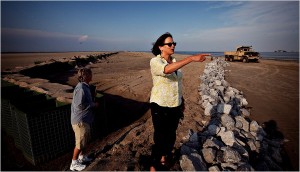
Chris Bickford for The New York Times

C. Cathy Norman, who manages the beach at Port Fourchon, La., for a local trust, and Don Norman, a wildlife toxicologist.

May 30, 2010

http://www.nytimes.com/2010/05/31/science/earth/31hurricane.html

Hurricane Season Raises New Fears    By KENNETH CHANG

As oil continues to gush from a broken well into the Gulf of Mexico, officials and scientists are worrying that the environmental disaster could be compounded later this year by a natural one.

The hurricane season starts Tuesday and runs through November, and forecasters expect one of the most turbulent seasons ever. If a hurricane rolled over the spill, the winds and storm surges could disperse the oil over a wider area and push it far inland, damaging the fragile marshlands.

“It would very definitely turn an environmental disaster into an unprecedented environmental catastrophe,” said Brian D. McNoldy, a tropical storms researcher at Colorado State University.  Specific predictions are impossible to make because the effects would depend on the path, strength and speed of a hurricane, as well as the size and location of the oil spill when the storm arrived. Because of the counterclockwise rotation of hurricane winds, a storm passing to the west of the slick would tend to push the oil to the coast, while a storm passing to the east would drive the oil away from land.

The winds churn water down only a few hundred feet, so a hurricane would probably not have a major effect on the large plumes of oil believed to be accumulating deep underwater.

The National Oceanic and Atmospheric Administration is predicting 14 to 23 named storms this season, of which 8 to 14 will turn into hurricanes and 3 to 7 of those will grow into major hurricanes with sustained winds of at least 111 miles per hour.

Last month, hurricane forecasters at Colorado State issued similar predictions: 15 named storms, 8 hurricanes and 4 major hurricanes.

The Colorado State team, Philip J. Klotzbach and William M. Gray, said there was a 43 percent chance that at least one hurricane would make landfall in Louisiana this year, based on the higher number of storms and the historical pattern of hurricane paths. (The atmospheric administration does not predict where the hurricanes will head.)

A hopeful speculation is that the oil might not be all bad news and that it might sap the storm’s energy. In 1966, a husband-and-wife team of federal hurricane researchers, Joanne and Robert H. Simpson, speculated that spraying an insoluble liquid like oil onto the ocean might even be a way to combat hurricanes by cutting off the evaporation that feeds energy into the storm.   But in a fact sheet issued last week, the atmospheric administration noted that hurricanes span 200 to 300 miles wide, much larger than the current size of the spill, and doubted that the oil could have much effect on the strength or path of a storm.

Hurricane winds would also minimize the evaporation effect.

A few years ago, when researchers at the Massachusetts Institute of Technology built a laboratory experiment to look at the flow of heat from water to air under different conditions, they, almost as a lark, followed up on the Simpsons’ suggestion. They applied fatty alcohols onto the water, and at very low wind speeds the alcohols did suppress evaporation.

“But when the winds get up to gale force or so, the surface gets torn apart,” said Kerry A. Emanuel, a professor of atmospheric science at M.I.T. “We just didn’t see any effect at high wind speeds.”   Conversely, other effects could intensify a storm, Dr. Emanuel said. By reducing evaporation, the oil could be heating the gulf waters, similar to a person wearing a rubber suit on a hot day.

Warmer water could then mean more energy to power a stronger hurricane, Dr. Emanuel said. But he said it was unclear what was actually happening, because the oil sheen fools satellite measurements of water temperature.
http://www.nytimes.com/2010/05/31/opinion/31mon1.html

May 30, 2010

Questions About the Gulf

BP’s latest failure to plug the leaking oil well in the Gulf of Mexico is one more crushing disappointment to Louisiana’s beleaguered people, one more strike against the company and one more signal to President Obama to redouble efforts to contain and clean the spill.

BP now pins its hopes — and those of the country — on yet another containment strategy, its fifth since the April 20 explosion. It does so amid mounting public anger and a report in The Times on Sunday that the company may have violated its own safety standards by ignoring warnings about design flaws in the well.   These disclosures add to the growing list of questions that must be addressed by the special commission President Obama has appointed to examine the root causes of the spill and recommend ways to prevent future catastrophes.

Here are others:

WHAT HAPPENED, AND WHY Five weeks after the blowout, there is no clear picture of the fatal sequence of events. Gas somehow escaped up the well, then exploded, collapsing the rig. The blowout preventer — a giant set of valves on the ocean floor — failed to work, and oil began spurting into the gulf at a rate recently estimated at 12,000 to 19,000 barrels a day. The total spill now exceeds the estimated 250,000 barrels that leaked from the stricken tanker Exxon Valdez in 1989. The public needs to get an honest accounting of the spill’s size, and BP’s word is not enough since it has to pay for the cleanup.

A joint Interior Department-Coast Guard investigative committee in Louisiana, and numerous Congressional panels, have been seeking clarity. Their search has not been helped by industry grandstanding and finger-pointing, with BP blaming the rig operator, Transocean, for the faulty blowout preventer.

It is also unclear which company was calling the shots on the rig, and there have been ominous suggestions that BP short-circuited standard drilling procedures to cut costs.

THE RESPONSE The questions about whether BP and the government responded quickly enough, and with the right weapons, could fill a book — and probably will. Both parties seem to have underestimated the size of the spill, and neither had a coherent underwater response plan in place. Though the oil industry had experienced blowouts at shallower depths, BP’s disjointed response suggested it had given little thought to the possibility of a blowout at 5,000 feet.

Partly as a result of laws passed after the Exxon Valdez, industry and the Coast Guard were better prepared to deal with the oil when it hit the surface. But the techniques — the controlled burns, the skimmers, the booms, the dispersants — were little more sophisticated than they were in 1989. Why no progress? And why was there only one dispersant available (and a toxic one at that) made by one company, Nalco?

REGULATORY FAILURE Much has been said — including by President Obama — about the incestuous relationship between the oil industry and its chief regulator, the Interior Department’s Minerals Management Service, which routinely ignored basic environmental laws and its own rules to fast track drilling permits.

But while these were terrible failures, and Interior Secretary Ken Salazar’s promise to reform the agency is overdue, it is hard to believe that other agencies in Washington, and even the Congressional oversight committees, were not also culpable.

NEW WEAPONS One outside-the-box question that looms large is whether the federal government should now develop its own capacity to deal with a huge blowout. As things stand now, industry has all the equipment and experience. In an interim report to the president on Thursday, Mr. Salazar suggested the creation of a kind of parallel technological universe in which government would have the robots, the coffer dams and the other tools necessary to help control a big blowout.

That could be expensive, but Mr. Obama indicated on Friday that he had been thinking along the same lines. As well he should be. The images from the last month — Washington essentially powerless, BP flailing away — has been deeply disheartening.


Special thanks to Richard Charter and Vivian Newman

Dept of Interior: Interior Issues Directive to Guide Safe, Six-month Moratorium on Deepwater Drilling

From: Rivera, Ray <Ray_Rivera@ios.doi.gov>
To: Rivera, Ray <Ray_Rivera@ios.doi.gov>
Sent: Mon May 31 11:43:46 2010

Subject: Interior Issues Directive to Guide Safe, Six-Month Moratorium on Deepwater Drilling

Interior Issues Directive to Guide Safe, Six-Month Moratorium on Deepwater Drilling

Washington, DC:  The U.S. Department of the Interior today issued a directive to oil and gas lessees and operators on the Outer Continental Shelf notifying them of requirements under the six month deepwater drilling moratorium that Secretary Salazar has ordered.

“The six month moratorium on deepwater drilling will provide time to implement new safety requirements and to allow the Presidential Commission to complete its work,” said Salazar.  “Deepwater production from the Gulf of Mexico will continue subject to close oversight and safety requirements, but deepwater drilling operations must safely come to a halt.  With the BP oil spill still growing in the Gulf, and investigations and reviews still underway, a six month pause in drilling is needed, appropriate, and prudent.”

The Moratorium Notice to Lessees and Operators (Moratorium NTL) issued today directs oil and gas lessees and operators to cease drilling new deepwater wells, including wellbore sidetrack and bypass activities; prohibits the spudding of any new deepwater wells; and puts oil and gas lessees and operators on notice that, with certain exceptions, MMS will not consider for six months drilling permits for deepwater wells and for related activities.  For the purposes of the Moratorium NTL, “deepwater”
means depths greater than 500 feet.

Operators that are currently drilling any well covered by the NTL must proceed at the next safe opportunity to secure the well and take all necessary steps to cease operations and temporarily abandon or close the well until they receive further guidance from the Regional Supervisor for Field Operations.

Activities necessary to support existing deepwater production may continue, but operators must obtain approval of those activities from the Department of the Interior.

The NTL issued today is based on a May 28, 2010 Memorandum from Secretary of the Interior Ken Salazar to the Director of the MMS finding that, under current conditions, deepwater drilling poses an unacceptable threat of serious and irreparable harm or damage to wildlife and the marine, coastal and human environment, as set forth in 30 C.F.R. 250.172(b).  The Secretary also determined that the installation of additional safety or environmental protection equipment is necessary to prevent injury or loss of life and damage to property and the environment, as set forth in 30 C.F.R. 250.172 (c).

Salazar’s determination that deepwater drilling activities on new wells must cease, and that MMS will not process APDs accordingly, is based on the recommendations in the May 27, 2010 report from Secretary Salazar to President Obama, Increased Safety Measures for Energy Development on the Outer Continental Shelf.

In addition to today’s NTL, Secretary Salazar again called on Congress to provide more time under the law for MMS to review exploration plans that oil and gas companies submit.  Under current law, MMS is currently required to review exploration plans within 30 days and determine whether the environmental analysis conducted at several previous stages in the leasing and planning process is sufficient.  In the oil spill response legislation submitted to Congress on May 12, the Obama Administration is proposing to change the 30-day congressionally-mandated deadline to a 90-day timeline that can be further extended to complete additional environmental and safety reviews, as needed.  (An exploration plan does not grant a company permission to drill a new well; companies must obtain additional and separate permits to gain permission to spud a well.)  The Department of the Interior, together with the Council on Environmental Quality, is also conducting a review of MMS’s use of categorical exclusions.

MEMORANDUM

To: Director, MMS

From: Secretary

Re: Suspension of Outer Continental Shelf (OCS) Drilling of New Deepwater Wells

Date: May 28, 2010

The recent blow-out and oil spill in the Gulf of Mexico is new evidence of the serious risks associated with deepwater drilling, and presents new challenges for the Department to assure the American public that OCS deepwater drilling can be accomplished in a safe and environmentally sound manner.

Yesterday, I presented recommendations to the President based on a 30-day review of the BP Explosion and Oil Spill that began on April 20, 2010. Based on that review, the recommendations contained in the report to the President, and further evaluation of the issue, I find at this time and under current conditions that offshore drilling of new deepwater wells poses an unacceptable threat of serious and irreparable harm to wildlife and the marine, coastal, and human environment as that is specified in 30 C.F.R. 250.172(b). I also have determined that the installation of additional safety or environmental protection equipment is necessary to prevent injury or loss of life and damage to property and the environment. 30 C.F.R. 250.172(c).

Therefore, I am directing a six month suspension of all pending, current, or approved offshore drilling operations of new deepwater wells in the Gulf of Mexico and the Pacific regions. This suspension does not apply to drilling operations that are necessary to conduct emergency activities, such as the drilling operations related to the ongoing BP oil spill. For those operators who are currently drilling new deepwater wells, they shall halt drilling activity at the first safe and controlled stopping point and take all necessary steps to close the well. In addition, MMS shall not process any new applications for permits to drill consistent with this directive. All applicable regulations shall apply to the implementation of this directive.

Please ensure that appropriate Letters of Suspension and any other appropriate documentation, including any additional instructions and details regarding this directive, are sent to all affected lessees, owners, and operators immediately.

Drilling Moratorium Guidance
Operations with Subsea BOP Stack –

Water Depth Greater Than 500 Feet

Activity type

6 Month No Drilling Moratorium Applies

Drilling of new well

Yes

Wellbore Sidetrack on current drilling operations

Yes

Wellbore Bypass on current drilling operations

Yes

Workover Operations

No

Completion Operations

No

Abandonment Operations

No

Intervention (Non emergency)

No

Intervention ( Emergency)

No

Waterflood, Gas Injection, Disposal Wells

No

Operations with Surface BOP Stack –

Water Depth Greater Than 500 Feet

Drilling of new well

Yes

Wellbore Sidetrack on current drilling operations

Yes

Wellbore Bypass on current drilling operations

Yes

Workover Operations with stack

No

Completion Operations with stack

No

Abandonment Operations

No

Intervention (Non emergency)

No

Intervention (Emergency)

No

Waterflood, Gas Injection, Disposal Wells

No


1

MINERALS MANAGEMENT SERVICE

UNITED STATES DEPARTMENT OF THE INTERIOR NTL No. 2010-N04 Effective Date: May 30, 2010

NOTICE TO LESSEES AND OPERATORS OF FEDERAL OIL AND GAS LEASES IN THE

OUTER CONTINENTAL SHELF REGIONS OF THE GULF OF MEXICO AND THE PACIFIC TO IMPLEMENT THE DIRECTIVE TO IMPOSE A MORATORIUM ON ALL DRILLING OF DEEPWATER WELLS

Background

The events resulting from the April 20, 2010, Deepwater Horizon included the deaths of 11 people, and an oil spill of national significance that continues to harm the marine ecosystem, wildlife, and property along the Gulf Coast. Although the causes are still under investigation, these events highlight the importance of ensuring safe operations on the Outer Continental Shelf (“OCS”).

Directives

The Six-Month Deepwater Moratorium as set forth in this Notice to Lessees and Operators (“Moratorium NTL”) directs you to cease drilling all new deepwater wells, including any wellbore sidetracks and bypasses; prohibits you from spudding any new deepwater wells; and puts you on notice that, except as provided herein, MMS will not consider for six months from the date of this Moratorium NTL drilling permits for deepwater wells and for related activities as set forth herein. For the purposes of this Moratorium NTL, “deepwater” means depths greater than 500 feet.

If you are currently drilling any well covered by this Moratorium NTL, you must proceed at the next safe opportunity to secure the well and take all necessary steps to cease operations and temporarily abandon or close the well until you receive further guidance from the Regional Supervisor for Field Operations. You must submit to the appropriate District Manager your plans to stop operations and secure the well before 5:00pm EDT, June 1, 2010.

If you have an approved Application for a Permit to Drill (“APD”) or other required permit for wells covered by this Moratorium NTL, but have not spud the well, you may not start drilling for the duration of this Moratorium NTL.

Under 30 C.F.R. 250.172, the Regional Supervisor for Production and Development will issue Suspensions of Operations (“SOO”) to all OCS Lessees and Operators currently drilling or proposing to drill new deepwater wells consistent with this Moratorium NTL. 2

Findings

This Moratorium NTL is based on a May 28, 2010, Memorandum from the Secretary of the Interior to the Director of the MMS finding that, under current conditions, deepwater drilling poses an unacceptable threat of serious and irreparable harm or damage to wildlife and the marine, coastal and human environment , as set forth in 30 C.F.R. 250.172(b). The Secretary also determined that the installation of additional safety or environmental protection equipment is necessary to prevent injury or loss of life and damage to property and the environment, as set forth in 30 C.F.R. 250.172(c).

The Secretary’s determination that deepwater drilling activities on new wells must cease for six months, and that MMS will not process permits for such activities accordingly, is based on the recommendations in the May 27, 2010, Report from the Secretary of the Interior to the President,

Based on the Secretary’s May 28, 2010, Memorandum, the recommendations in the Report, and the authority of 30 C.F.R. 250.172, the Director of MMS has determined that this Moratorium NTL is warranted because of the significant risks of OCS drilling in deepwater without implementation of the safety equipment, practices and procedures recommended in the Report.

Therefore, under 30 C.F.R. 250.172, the Regional Supervisor for Production and Development will issue SOOs to all OCS Lessees and Operators currently drilling or proposing to drill new deepwater wells covered by this Moratorium NTL.

Increased Safety Measures for Energy Development on the Outer Continental Shelf (“Report”). Activities Not Affected by This Moratorium NTL

This Moratorium NTL does not apply to intervention or relief wells for emergency purposes, including the 2 relief wells related to the ongoing BP spill.

This Moratorium NTL does not apply to operations that are necessary to sustain reservoir pressure from production wells.

This Moratorium NTL does not apply to workover operations.

This Moratorium NTL does not apply to waterflood, gas injections, or disposal wells.

This Moratorium NTL does not apply to drilling operations or other activities that are necessary to safely close or abandon a well, or to accomplish well completion operations under 30 C.F.R 250.500.

All activities not affected by this Moratorium NTL must be performed in compliance with all applicable regulations. For the duration of this Moratorium NTL, MMS will process only those APDs and other permits that are necessary to perform the activities not affected by this Moratorium NTL, as set forth above. 3

Requirements for Existing Deepwater Production

To obtain approval to conduct an activity in support of existing deepwater production, you must submit your request to the Regional Supervisor for Field Operations. Your request must include the following:

A new APD or Application for Permit to Modify, as appropriate;

Purpose of the well (disposal, injection, water flood);

Type of rig/BOP;

Water depth;

Safety systems in place; and

Location/placement of safety system devices (hydraulic accumulators located in a protected area).

In addition, you must submit a structured risk analysis that identifies and discusses the risks of the requested drilling or activity. The discussion must address risks of losing well control, risks of not conducting the requested activity, and your planned use of best practices. This analysis must be specific for each situation and include a detailed description of the activity.

Guidance Document Statement

The MMS issues NTLs as guidance documents in accordance with 30 C.F.R. 250.103 to clarify, supplement, or provide more detail about certain MMS requirements. NTLs may also outline what must be provided as required information in submissions to the MMS.

The MMS will provide additional guidance on this Moratorium NTL and the recommendations contained in the Report through the issuance of additional NTLs, rulemaking, or by other appropriate means.

Authority

This Moratorium NTL provides guidance and requirements pursuant to 30 C.F.R. 250.106, which requires safe lease operations, and pursuant to 30 C.F.R. § 250.172(b), which states that the Regional Supervisor may grant or direct a suspension when activities pose a threat of serious, irreparable, immediate harm or damage, this would include a threat to life, property, mineral deposit, or marine coastal or human environment and 30 C.F.R. § 172(c), which states that the Regional Supervisor may grant or direct a suspension when necessary for the installation of safety or environmental protection equipment.

Paperwork Reduction Act of 1995 Statement

This Moratorium NTL does not impose additional information collection requirements subject to the Paperwork Reduction Act of 1995. 4

Contact

If you have any questions regarding this Moratorium NTL, please contact Mike Saucier by e-mail at michael.saucier@mms.gov or by telephone at (504) 736-2503 in the Gulf of Mexico Region, or Rishi Tyagi by e-mail at rishi.tyagi@mms.gov or by telephone at (805) 389-7775 in the Pacific Region.

_______ __________________________

Dated Deputy Director

Minerals Management Service

Times Picayune: BP’s CEO disputes claims of underwater oil plumes in Gulf

http://www.nola.com/news/gulf-oil-spill/index.ssf/2010/05/bps_ceo_disputes_claims_of_und.html

By The Associated Press
May 30, 2010, 3:55PM

Patrick Semansky / The Associated Press

BP Chief Executive Tony Hayward on Fourchon Beach in Port Fourchon last week.
BP Chief Executive Officer Tony Hayward is refuting claims by scientists that there are large undersea plumes from the Gulf oil spill.

Hayward said Sunday the oil is on the water’s surface, and that BP’s sampling shows “no evidence” of oil in the water column.

Scientists from several universities have reported plumes of what appears to be oil suspended in clouds that stretch for miles and reach hundreds of feet beneath the Gulf’s surface.

Hayward also said the company is narrowing its response to the oil spill to the Louisiana coast and bulking up cleanup forces there for a fight that could last months.
Almost six weeks into the nation’s worst spill, no significant oil has hit other Gulf states, but they remain guarded.

Comments  (22 total)     RSS

Posted by Starmadillo
May 30, 2010, 4:38PM
Starting with this lying trash heap of corporate line tow-er, put execs in jail. One lying loser per week until they have cleaned up and paid for their greedy business practices. A year or two in prison might help get these yahoos to at least TRY to be honest. I say grab the little dude before he gets back on his yacht, lock his ass up.
It is the only way to get them to respond fast and clean up their mess.

Special thanks to Richard Charter

Baltimore Sun: Gulf oil seeps into Maryland politics

http://www.baltimoresun.com/news/maryland/politics/bs-md-candidates-drilling-20100530,0,7307876.story

May 31, 2010
O’Malley wants Obama’s administration to take harder line against drilling; Ehrlich says U.S. should explore Alaska refuge first.

With the Gulf of Mexico oil spill threatening to stain Maryland beaches with tar balls, talk of offshore drilling is seeping into state politics.

Gov. Martin O’Malley, who had offered only mild opposition initially to President Barack Obama’s plans earlier this year to open the waters off Virginia to exploration, held a public briefing last week on the state’s oil cleanup capacity, and then pressed the administration to take a harder line against drilling here.

Republicans, meanwhile, blasted the governor for raiding an oil cleanup fund to balance the state budget.

Analysts dismissed the back-and-forth as election-year posturing.

“There is no imminent danger to Maryland because there is no oil drilling going on,” said Donald F. Norris, who chairs the public policy department at the University of Maryland, Baltimore County. “The likelihood is that there won’t be, at least any time that anyone can see. This is electoral politics.”

The governor, who has been a staunch opponent of offshore drilling, surprised many in March when he was present for the event at which Obama unveiled a plan to sell oil exploration leases off Virginia’s coastline. At the time, O’Malley’s spokesman said the governor was confident the administration would be “guided by science” as it determined whether to allow the sale.

Since then, O’Malley has grown steadily more outspoken in his criticism. In a letter this week to Interior Secretary Ken Salazar, the governor requested an outright ban on Mid-Atlantic drilling; during an event touting a new oyster rehabilitation program, O’Malley said he was “opposed to any drilling off the Chesapeake Bay.”

“I can’t imagine anyone actually wanting to go forward with that given the disaster we are cooking up as a nation in the Gulf of Mexico,” O’Malley said.

Asked about Mid-Atlantic exploration, former Gov. Robert L. Ehrlich, who is challenging O’Malley to win back his old job, pointed to the Alaska National Wildlife Refuge. He said drilling there would eliminate any need to explore off Virginia.

“We have plenty of better venues,” Ehrlich said, then referred further questions to a spokesman.

While Ehrlich appears to have made few if any public statements about nearby drilling, his former lieutenant, Michael S. Steele, is an outspoken proponent of increasing exploration. Steele, the chairman of the Republican National Committee, led the “Drill, Baby, Drill,” chant during his party’s 2008 convention.

Ehrlich spokesman Andy Barth said the former governor would not want a repeat of the Gulf spill here.

“We don’t believe that pursuing offshore drilling is a realistic or sensible idea right now,” Barth said. About “Drill, Baby, Drill,” Barth said: “Governor Ehrlich didn’t say that and doesn’t really have anything to say about it.”

The point might be moot since Obama last week called off the Virginia lease sale amid criticism that his administration has failed to adequately regulate deepwater drilling.

Still, the same day Obama made that announcement, O’Malley fired off the letter to Salazar, writing that the “unprecedented” oil spill “raises serious questions about the ultimate cost and benefit” of exploration in the Mid-Atlantic. Ocean City beaches draw roughly eight million tourists a year, O’Malley wrote, a source of revenue that could be jeopardized by an accidental spill.

The governor also echoed a concern floated first by Rep. Jim Moran, a Virginia Democrat who says much of the proposed lease site would disrupt Department of Defense exercises.

Republicans criticized O’Malley for raiding a fund that was established to pay for cleaning up oil spills in order to balance the state’s budget.

Shaun Adamec, a spokesman for the O’Malley campaign, said any constraints on the fund would not prevent the state from making money available to clean up a spill.

“This winter, the snowstorms were a good example of when there is a disaster that needs rectifying, the budget is secondary,” Adamec said.

When the state quickly surpassed the snow removal budget, he said. “the plows did not stop. The same would be true for an oil spill.”

annie.linskey@baltsun.com

Baltimore Sun reporter Timothy Wheeler contributed to this article

Special thanks to Richard Charter

Times Picayune: Drilling relief wells to stop Gulf oil leak poses challenges

http://www.nola.com/news/gulf-oil-spill/index.ssf/2010/05/challenges_involved_in_drillin.html

By Rebecca Mowbray, The Times-Picayune
May 30, 2010, 10:07PM
JOHN MCCUSKER / THE TIMES-PICAYUNE
Ships surround the Deepwater Horizon rig Saturday at the site of oil spill in the Gulf of Mexico 50 miles from Louisiana. On Sunday, the White House said the government had insisted that BP drill two relief wells instead of one to ensure that it can reach the original well without problems. A BP spokesman said the company is making progress on the two wells.
With the “top kill” declared a failure and BP moving on to less-desirable options to stop its well from continuing to shoot thousands of barrels of oil each day into the Gulf of Mexico, the grim reality set in that the company may be unable to stop the oil until it completes the first of two “relief wells” in August.

BP has been attempting to contain or stop the flowing oil since its Macondo well exploded April 20, killing 11 people. But the ultimate solution to permanently cap the well is to inject concrete from wells drilled in from the side.

With short-term efforts failing, officials locally and in Washington are beginning to contemplate that the oil could spew until the height of hurricane season.

“There could be oil coming up until August, when the relief wells are dug, ” White House energy and climate change adviser Carol Browner said on NBC’s “Meet the Press” Sunday morning. “We are prepared for the worst. … We will continue to assume that we move into the worst-case scenario.”

Plaquemines Parish President Billy Nungesser said he got weak in the knees at the Plaquemines Parish Seafood Festival when he saw the news on a Blackberry that efforts to plug the raging well with drilling mud and rubber pieces had failed.

“We’re not counting on anything until this relief well is drilled, ” Nungesser told CNN Saturday night.

But relief wells are something that, fortunately, engineers don’t have to do very often. Drilling the relief well also can be fraught with challenges — especially working in deep water on a well that has already had problems with gas bubbles.

“You have to hit something the size of a dinner plate miles into the earth, ” said Richard Charter, a senior policy adviser at the nonprofit Defenders of Wildlife, who follows spills around the world. “Even in a shallow-water blowout, the drilling of a relief well can be complicated and problematic.”

On Sunday, the White House said the government had insisted that BP drill two relief wells instead of one to ensure that it can reach the original well without problems.

Making progress

The company appears to be making progress. Spokesman Graham MacEwen said Friday that the first relief well has now reached 12,090 feet below the floor of the rig, 5,000 feet from the sea floor.

BP interrupted drilling last week to install a blowout preventer, the safety device that’s supposed to seal a well in an emergency, but which failed to do so on the main well.

The second relief well, MacEwen said, is 8,650 feet below the floor of the rig.
The relief wells start about a half mile from the original site and try to meet the original at a diagonal.

Drilling a well involves using a pipe that unfolds section by section like an antenna, only upside down.

With each section, the company drills and then pulls out the pipe and puts in casings to form the sides of the well.

Drills are equipped with directional sensors that do three-dimensional surveys to help workers see where the drill bit is and what it’s encountering, while metal detectors help guide it toward the metal in the original well.

Once the drills intersect with the original well, typically just above or below where the problem occurred, cement is pumped in to seal it.

Dave Rensink, president-elect of the American Association of Petroleum Geologists, said that drilling a relief well is not that different from drilling a regular well, except that the target is much smaller.

“The only problem is really finding it, ” Rensink said of the original well. “You’re trying to intersect the well bore, which is about a foot wide, with another well bore, which is about a foot wide. The probability of finding it the first time … is probably pretty low.”

When the company drills into the well casing but misses the right spot, it will need to set a cement plug.

As BP tries to meet the original well, it will need to have plenty of mud on hand, because when the drill actually connects, the mud from the relief well will have a tendency to get sucked into the lower pressure of the original well, and drillers could lose control of the relief well.

“That clearly is a risk. They need to be very specifically prepared when they penetrate the existing well bore, ” Rensink said. “You want to make sure you’re not creating a problem in your relief well that’s the same problem as on your existing well.”

No guarantee on timing

With the failure of the top kill, BP plans to cut off the broken riser pipe and install a cap with a “straw” in it that could siphon oil up to a drill ship.

The company may also try installing a new blowout preventer on top of the broken one and using it to try to shut off the well.

Even if the company goes that route and it succeeds in stemming the flow of oil, BP will still move forward with drilling the relief wells because it will enable the company to seal off the top and bottom of the well, making the fix more durable.

But examples from elsewhere in the world show there’s no guarantee on the timing, and that drilling a relief well can be dangerous.

The world’s worst well blowout and oil spill, the Ixtoc I well in Mexico’s Bay of Campeche, was ultimately stopped with a relief well after a containment dome, junk shot and top kill failed, but it took nearly 10 months.

The oil platform sat in about 150 feet of water and blew out in early June 1979 at a depth of 11,625 feet.

According to a 1981 report from the Society of Petroleum Engineers detailing how Pemex, the Mexican state oil company, stopped the well, engineers decided to start drilling two relief wells at the end of June.

Progress was slow. It took one well until Nov. 20 to reach the original well, and the second took until Feb. 5, 1980.

Shutting down the main well took multiple attempts in February and March 1980 as Pemex shot drilling mud through both wells and gradually decreased the flow of oil.

The oil stopped flowing on March 17, and then it took a few more weeks to plug the wells with cement, wrapping up the operation in early April.

The blowout, according to the Society of Petroleum Engineers, lasted for nine months and 22 days.

Tyler Priest, a historian at University of Houston who has written a book about the history of offshore drilling, said Pemex thought it would go a lot faster. He cited a headline in the Aug. 6, 1979, issue of Oil & Gas Journal that reads, “Pemex: Ixtoc may flow until Oct. 3.”

“They initially estimated three months. It took them almost 10, ” Priest said.

‘More caution’ needed

Certainly, the technology today is much more advanced than when engineers fought to shut down Ixtoc, but even in modern context, relief wells don’t always go smoothly.

Last August, the Thai company PTT Exploration and Production Co. was drilling the Montara well in 260 feet of water in the Timor Sea off of Australia when it well blew up and began leaking oil into the ocean.

It took 10 weeks and five tries for the drilling rig brought in to drill the relief well to hit its target about 8,600 feet below the sea floor. On the last try, there was another rig explosion, which burned for two days.

The oil was finally stopped on Nov. 3, and it took until mid-January to cap the well, according to news reports.

A final report from the Australian government on the Montara incident is due June 18.

Like the Montara well, BP’s Macondo well has already shown itself to have pockets of gas big enough to interrupt drilling.

Weeks before the April 20 Deepwater Horizon rig explosion, workers on the rig experienced a gas kick so intense that they abandoned any “hot work” — smoking, welding, cooking or any other use of fire — for fear of an explosion.
Don Van Nieuwenhuise, a University of Houston geologist, said that BP will have to tread carefully to avoid the problems encountered at Montara.

“You have to be very careful, because you don’t want to have another blowout if you hit petroleum or gas in another level, ” Van Nieuwenhuise said. “Any relief or kill well needs to be drilled with more caution than the first well, because you don’t want a repeat performance.”

Van Nieuwenhuise speaks from experience. In 1979, he worked on killing a gas well in the Gulf of Mexico that blew up when workers ran out of drilling mud. Even though it was only in about 60 feet of water, it took about four and a half months to cap the well by drilling a relief well because of concerns about pockets of gas. “We had to stop drilling every 500 feet, ” said Van Nieuwenhuise, who was working for Mobil in New Orleans at the time.

Better drilling technology today, Van Nieuwenhuise said, should make the job easier, but the key is to know where the drill bit is in relation to formations of oil and gas in the area.

BP said it’s mindful of the risks and is proceeding cautiously with the relief wells.
“We’ve got many many safety systems in place, both procedural and technical, ” MacEwen said. “We’re constantly measuring the pressure in the well.”

********
Rebecca Mowbray can be reached at rmowbray@timespicayune.com or 504.826.3417.
WHAT TO KNOW ABOUT RELIEF WELLS

Q: What is a relief well?
A: It’s a well drilled in from the side to intercept the original well, fill it with cement and shut it down. It is considered to be a permanent way of closing off a well.

Q: How are things going so far on the relief well?
A: BP is drilling two relief wells in case it encounters any problems along the way. The first well is at 7,090 feet beneath the ocean floor, and the second well is 3,650 feet below the ocean floor. BP plans to drill to about 18,000 feet, or 13,000 feet into the earth.

Q: What’s so hard about drilling a relief well?
A: It’s basically the same as drilling a regular well, except that engineers have to hit a very specific target. They’re using a drill pipe that’s about a foot wide, and trying to hit another pipe that’s about a foot wide about 3 miles away. Experts say it is likely to take several tries to hit the well at the right spot.

Q: Is it risky?
A: When BP hits the well in the right spot, there will be a tendency for the drilling mud from the relief well to get sucked into the lower pressure of the original well. To make sure the company doesn’t lose control of the relief well, it will need to have huge amounts of drilling mud on hand. In a rig blowout last fall off of Australia, engineers did lose control of the relief well, which started a fire and consumed the original rig.

Q: When will the relief wells be completed?
A: BP predicts in early August, but sometimes it takes longer. When engineers tried to shut down the Ixtoc I well in the Gulf of Mexico in 1979, they thought it would take about three months, and it took almost 10. But technology is a lot better now.

Special thanks to Richard Charter

NY Times Op-ed: Swimming through the Spill

http://www.nytimes.com/2010/05/30/opinion/30shaw.html?adxnnl=1&ref=opinion&adxnnlx=1275224625-kfcosGPQ6O5crzOFeLBFXw

I’m with her on the use of dispersant; lose them now–they’re killing everything in the water column. DV

OP-ED CONTRIBUTOR
By SUSAN D. SHAW
Published: May 28, 2010

Blue Hill, Me.

FOR the last few days, attention has understandably been directed at the shores of the Gulf Coast as oil has started to wash up on beaches and in marshes. But last week I had the chance to see the effects of the spill from another perspective – when I dived into the oil slick a few miles off the Pass a Loutre wetlands in southern Louisiana. What I witnessed was a surreal, sickening scene beyond anything I could have imagined.

As the boat entered the slick, I had to cover my nose to block the fumes. There were patches of oil on the gulf’s surface. In some places, the oil has mixed with an orange-brown pudding-like material, some of the 700,000 gallons of a chemical dispersant called Corexit 9500 that BP has sprayed on the spreading oil. Near Rig No. 313, technically a restricted zone, the boat stopped and I (wearing a wetsuit, with Vaseline covering exposed skin) jumped in.

Only a few meters down, the nutrient-rich water became murky, but it was possible to make out tiny wisps of phytoplankton, zooplankton and shrimp enveloped in dark oily droplets. These are essential food sources for fish like the herring I could see feeding with gaping mouths on the oil and dispersant. Dispersants break up the oil into smaller pieces that then sink in the water, forming poisonous droplets – which fish can easily mistake for food.

Though all dispersants are potentially dangerous when applied in such volumes, Corexit is particularly toxic. It contains petroleum solvents and a chemical that, when ingested, ruptures red blood cells and causes internal bleeding. It is also bioaccumulative, meaning its concentration intensifies as it moves up the food chain.

The timing for exposure to these chemicals could not be worse. Herring and other small fish hatch in the spring, and the larvae are especially vulnerable. As they die, disaster looms for the larger predator fish, as well as dolphins and whales.

As I swam back to the surface, some big fish came up to the boat – cobia, amberjacks weighing up to 60 pounds – looking for a handout. These are the fish that have made the Gulf a famously productive fishing area. But they rely on the forage fish that are now being devastated by the combined effects of oil and chemical dispersants. In a short time, the predator fish will either starve or sicken and die from eating highly contaminated forage fish.

Yes, the dispersants have made for cleaner beaches. But they’re not worth the destruction they cause at sea, far out of sight. It would be better to halt their use and just siphon and skim as much of the oil off the surface as we can. The Deepwater Horizon spill has done enough damage, without our adding to it.

Susan D. Shaw is a marine toxicologist and the director of the Marine Environmental Research Institute, a nonprofit scientific research and educational organization.

Special thanks to Richard Charter

Joint Info Center: Top Officials to Return to the Gulf Coast

CONTACT:

Joint Information Center
(985) 902-5231
(985) 902-5240
 EPA CONTACT:

Brendan Gilfillan
gilfillan.brendan@epa.gov
 
FOR IMMEDIATE RELEASE

May 29, 2010

Trips by Top Leaders to Inspect All-Hands-on-Deck Response Total 28
 
WASHINGTON – At the direction of the President, Department of the Interior Secretary Ken Salazar, Environmental Protection Agency Administrator Lisa Jackson and NOAA Administrator Jane Lubchenco will return to the Gulf region next week as they continue their work, aggressively responding to the BP oil spill.
 
These officials’ actions on scene will be coordinated by National Incident Commander Admiral Thad Allen, who is leading the administration-wide response and directing all interagency activities.
 
Administrator Jackson will make her fourth trip to the Gulf Coast to inspect coastline protection and cleanup activities and meet with community members to discuss ongoing efforts to mitigate the oil’s impacts on public health and the environment. A native of the Gulf region, Administrator Jackson will spend a total of six days on the ground, visiting Louisiana, Mississippi and Alabama to review plans for cleanup of oil-impacted wetlands and marshes, analyze scientific monitoring of dispersant use, and ensure that recovery and cleanup plans are proceeding quickly.
 
Secretary Salazar will make his eighth trip to the area to meet with top BP officials, federal personnel and government scientists in Houston to get a firsthand account of the on-scene direction and oversight of BP’s efforts to cap the leaking well.  He will also participate in discussions with state, local and business leaders to discuss the ways the administration is supporting their communities during this catastrophe.
 
Administrator Lubchenco will make her third visit to the affected area to meet with top government and independent scientists and engineers who are working with BP and coordinating efforts across the federal government to ensure the best science is used to assess and mitigate the BP oil spill’s impacts to the environment.
 
President Obama visited the affected area for the second time yesterday to view the administration’s all-hands-on-deck response to this unprecedented disaster. He spoke to the frustration felt by those in the local community and across America and discussed extensively what he saw touring the tragedy this morning. The President also commended those in the area who have “rolled up their sleeves” to help with the clean up, saying that “we’re in this together.”
 
In total, senior administration officials have visited the region 28 times since BP’s oil rig exploded on April 20—including trips by the President, National Incident Commander Admiral Thad Allen, Interior Secretary Salazar, EPA Administrator Jackson, Homeland Security Secretary Janet Napolitano, Energy Secretary Steven Chu, Commerce Secretary Gary Locke, Chairman of the Joint Chiefs of Staff Admiral Mike Mullen, NOAA Administrator Lubchenco and SBA Administrator Karen Mills.

Special thanks to Richard Charter

Huffington Post: Gulf Oil Spill: Media Access ‘Slowly Being Strangled Off’

http://www.huffingtonpost.com/2010/05/29/gulf-oil-spill-media-access_n_594592.html?ref=fb&src=sp

MATTHEW BROWN | 05/29/10 05:25 PM |

NEW ORLEANS – Media organizations say they are being allowed only limited access to areas impacted by the Gulf oil spill through restrictions on plane and boat traffic that are making it difficult to document the worst spill in U.S. history.

The Associated Press, CBS and others have reported coverage problems because of the restrictions, which officials say are needed to protect wildlife and ensure safe air traffic.
Ted Jackson, a photographer for The Times-Picayune newspaper in New Orleans, said Saturday that access to the spill “is slowly being strangled off.”

A CBS news story said one of its reporting teams was threatened with arrest by the Coast Guard and turned back from an oiled beach at the mouth of the Mississippi River. The story said the reporters were told the denial was under “BP’s rules.”

U.S. Coast Guard and Federal Aviation Administration officials said BP PLC, the company responsible for cleaning up the spill, was not controlling access.

Coast Guard officials also said there was no intent to conceal the scope of the disaster. Rather, they said, the spill’s complexity had made it difficult to allow the open access sought by the media.

Coast Guard Lt. Commander Rob Wyman said personnel involved in the CBS dispute said no one was threatened with arrest.

Vessels responding to the spill are surrounded by a 500 yard “standoff area” with restricted access, he said.

“If we see anybody impeding operations, we’re going to ask you to move. We’re going to ask you to back up and move away,” he said.

BP contractors are operating alongside the FAA and Coast Guard at command centers that approve or deny flight requests. Charter pilots say they have been denied permission to fly below 3,000 feet when they have reporters or photographers aboard.

Those special flight restrictions, imposed on May 12, cover thousands of square miles of the Gulf and a broad swath of Louisiana’s coast. Normally there are no restrictions on flying.

The chief of the Coast Guard’s public affairs programs branch said access had been hampered by a cumbersome approval process that stretched all the way to the White House.

Chief Warrant Officer Adam Wine said White House officials had to sign off on requests for tours of the spill zone before they could proceed. The Coast Guard is attempting to increase access through guided boat and aircraft tours, he said. Still, there is no plan to lift restrictions on flights or boat traffic into offshore areas – including some barrier islands.

White House officials referred questions about their involvement to Wyman. He said Wine’s description of the chain of command was incorrect and that all requests from media were decided on by the command center in Robert, La. The Department of Homeland Security is notified, he said.

Two weeks ago, oceanographer Jean-Michel Cousteau was turned away from waters near a wildlife sanctuary after the Coast Guard discovered a reporter and a photographer from The Associated Press were on board.

Jackson, The Times-Picayune photographer, said he had been kept back from oil-covered beaches and denied a request to fly below 3,000 feet.

“The oil spill from there is just a rumor,” he said.
FAA spokeswoman Laura Brown said hundreds of flights related to the recovery effort go each day into the restricted airspace. She said aircraft from the oil industry and law enforcement also are allowed in those areas.

Special thanks to Richard Charter

laist: Caught on tape: Police Harass Bike Riders During BP Protest Ride (video)

http://laist.com/2010/05/29/caught_on_tape_police_harass_bike_r.php
By Lindsay William-Ross in News on May 29, 2010 10:00 AM

A large group bike ride was staged last night in protest of British Petroleum and the gulf oil spill. There were an estimated 200-1,000 bike riders in fluctuating numbers who took part in the ride that converged on the BP gas station at Robertson and Olympic, however encounters with LAPD officers signaled an end to the ride for a few in Hollywood.

The ride was described by WeHo Daily as being “loosely organized,” by Critical Mass. They did not stay at the BP station long, however, and both the LAPD and LAFD were aware of their presence on the street.

Many calls came in to the LAPD about the group, with one frustrated driver complaining that some riders around Olympic and Fairfax were hitting their vehicle as they passed, perhaps with their hands as the driver attempted to pull into their path.

The group traveled to Pan Pacific Park, where police thought the group had grown to be about 1,000 people strong, and they increased their presence as some riders began to head towards Hollywood.

Police were busy with the riders all evening, escorting them at different points with patrol cars. They became concerned about traffic and the possible resulting interference to emergency vehicle response times, especially when the riders were in the Hollywood area. Fire department units were notified of the disruption.

It was in Hollywood, however, that things seemed to turn ugly for the riders and the LAPD. A video sent to us by email shows a portion of the Hollywood segment of the ride, and an LAPD officer sticking his foot out deliberately in what appears to be a kick aimed at bringing down a cyclist or interfering in his ride. The rider making the video shouted out in protest, and moments later was taken down by police in a confusing tackle; one shouts “get up,” while the other shouts “get down.” The rider, whose camera has been dropped on the street, repeatedly yells “What’d I do?”

According to the email tipster:
The *vast majority* of the police along the way were helpful and accommodating. Even firefighters were out on the sidewalks outside of their stations giving high fives and waving hello. But for whatever reason the police in Hollywood were extremely aggressive and were harassing riders for no reason other than to get their kicks (I presume).

White House: Statement by the President on the Latest Efforts to Contain the BP Oil Spill

Is it time yet to contain the spill with tankers and oil skimmers at the source?  DV

THE WHITE HOUSE

Office of the Press Secretary

_______________________________________________________________________________________

FOR IMMEDIATE RELEASE

May 29, 2010

Statement by the President on the Latest Efforts to Contain the BP Oil Spill

Today, I’ve spoken with National Incident Commander Admiral Thad Allen, as well as Energy Secretary Steven Chu, Interior Secretary Ken Salazar, EPA Administrator Lisa Jackson, and senior White House advisors John Brennan and Carol Browner regarding the ongoing efforts to stop the BP oil spill.  From the beginning, our concern has been that the surest way to stop the flow of oil – the drilling of relief wells – would take several months to complete.  So engineers and experts have explored a variety of alternatives to stop the leak now.  They had hoped that the top kill approach attempted this week would halt the flow of oil and gas currently escaping from the seafloor.  But while we initially received optimistic reports about the procedure, it is now clear that it has not worked.  Rear Admiral Mary Landry today directed BP to launch a new procedure whereby the riser pipe will be cut and a containment structure fitted over the leak.

This approach is not without risk and has never been attempted before at this depth. That is why it was not activated until other methods had been exhausted.  It will be difficult and will take several days.  It is also important to note that while we were hopeful that the top kill would succeed, we were also mindful that there was a significant chance it would not.  And we will continue to pursue any and all responsible means of stopping this leak until the completion of the two relief wells currently being drilled.

As I said yesterday, every day that this leak continues is an assault on the people of the Gulf Coast region, their livelihoods, and the natural bounty that belongs to all of us.  It is as enraging as it is heartbreaking, and we will not relent until this leak is contained, until the waters and shores are cleaned up, and until the people unjustly victimized by this manmade disaster are made whole.

###special  thanks to Richard Charter

PBS: Oil Spill–How Much Oil Has Leaked into the Gulf of Mexico? view ticker with live video feed

How Much Oil Has Leaked Into the Gulf of Mexico?

By: Chris Amico

View ticker with live video feed. Last updated 11 a.m. ET on May 27.

Nobody knows for certain how much oil has leaked into the Gulf of Mexico since last month’s oil rig explosion. What we do have are estimates — from the National Oceanic and Atmospheric Administration, from outside experts, from British Petroleum — of how fast crude is flowing out of two remaining leaks (a third was plugged Wednesday).

Oil has been flowing out of ruptures in the Deepwater Horizon well on the ocean floor since around 10 a.m. on April 22, two days after the BP-leased rig exploded, leaving 11 workers missing and presumed dead.

According to NOAA, an estimated 210,000 gallons (5,000 barrels) a day is coming from the remaining ruptures. At that rate, this leak would surpass the 11 million gallons spilled by the Exxon Valdez in 1989 in mid-June if left unchecked.

Other estimates are far more grim. The New York Times reported that BP told members of Congress the rate could be much, much higher:

In a closed-door briefing for members of Congress, a senior BP executive conceded Tuesday that the ruptured oil well could conceivably spill as much as 60,000 barrels a day of oil, more than 10 times the estimate of the current flow.

A barrel of crude oil contains roughly 42 gallons. In a follow-up story, the Times talked to a BP spokesman for more on the estimate:

“The rate could go up to that,” Mr. Suttles of BP said, when asked to verify a report in The Times. “It’s not the situation we have at this moment, but it’s not impossible.”

Based on this range of figures, we built the meter atop this post to give a ballpark figure of how much oil may have leaked into the Gulf based on each scenario (by multiplying the rate of leakage by the amount of time passed since the rupture) and other possible rates between those estimates.

At the low end is NOAA’s estimate of 210,000 gallons per day. At the high end is what BP told Congress. Drag the slider between those poles to see other possible rates. Keep in mind that all of this is only an estimate.

You can also embed this meter on your own site or blog. We’ll keep monitoring the situation and check on updates to our calculations as needed.

Editor’s Note: An earlier version of the text of this story included a reference to NOAA’s estimate as 210,000 barrels of oil per day. The correct measure is 210,000 gallons. This is an updated version.

Vanessa Dennis contributed to this report.

NY Times: BP’s ‘Top Kill’ Effort Fails to Plug Leak; Company Readies New Approach

http://www.nytimes.com?emc=na

It’s kinda like the wars…..endless.   Is it time  yet to put tankers at the blowout site to capture the continuing flow of oil and gas?  How about skimmers all around them?  DV

Sat, May 29, 2010 — 6:37 PM ET
BP said Saturday that its latest attempt to stop the gushing
oil well in the Gulf of Mexico was unsuccessful, and the
effort, known as a “top kill,” was being scrapped in favor of
yet another maneuver to stem the flow spreading into the
waters.

The announcement marked the latest setback in the attempt to
plug the spill that is polluting gulf waters at an estimated
rate of 12,000 to 19,000 barrels a day.

Doug Suttles, BP’s chief operating officer, said the next
step is called a “lower marine riser package cap” and
involves sawing off the riser and placing a device atop it to
capture the escaping oil. Equipment has already been deployed
on land and on the sea bed, he said.

Special thanks to Richard Charter

Baltimore Sun: Gulf spill could send tar balls onto Md. beaches

http://articles.baltimoresun.com/2010-05-23/news/bs-md-oil-maryland-beaches-20100520_1_tar-balls-gulf-stream-atlantic-currents
Atlantic currents should keep most oil at sea
May 23, 2010|By Frank D. Roylance, The Baltimore Sun

Crude from the BP blowout in the Gulf of Mexico has now entered currents that will carry it out into the Atlantic Ocean and up the East Coast. But experts say the worst that beachgoers in Maryland are likely to encounter might be a few sandy tar balls – soft, asphalt-like blobs that can do little more than stain your feet.
Communities along the southeastern coast, especially in Florida, might have a close encounter with the oil, said Jim Carton, chairman of the Department of Atmospheric and Oceanic Science at the University of Maryland.
“But there’s good news for us,” he said. “The current leaves the continental shelf at about Cape Hatteras [N.C.], and heads northeast. Parts of North America north of Cape Hatteras should be fairly safe from this stuff.”

Barring a hurricane or some other storm that blows surface waters and tar balls westward from the Gulf Stream onto Delmarva beaches, Carton said, “it should pass us by.”
That’s what Ocean City officials expect, too.
“We’ve certainly been made aware that [the oil] could go out into the Gulf Stream,” said Donna Abbott, a spokeswoman for the Town of Ocean City. “But from what I’ve heard, there would be less than 1 percent, if it even made it this far, that would be of any significance to our beaches.”
“We Š feel for the people in the gulf who are going through this. Any coastal community would,” she said. “But we Š have not been led to believe there is any real potential there for harm to the coast.”
“If tar balls do appear,” Abbott said, “we Š have an outstanding public works department and other staff members who can handle any cleanup situation.”
Satellite radar imagery released Thursday by the European Space Agency showed a long tendril of the spilled oil reached the gulf’s Loop Current on Tuesday.
From there, Carton said, it will surely begin to flow south toward the Florida Straits and then up the East Coast. Moving at about 2 mph, it could reach Maryland’s latitudes in less than three weeks.
“Somebody asked whether this Memorial Day could be affected by this, and I figure there’s no way,” Carton said. “But it could be a summer issue for parts of the East Coast Š and Florida would get it before anyone else.”
Carton described the Loop Current as the key player in the Gulf of Mexico. Warm water from the Caribbean Sea streams into the gulf between Mexico’s Yucatan Peninsula and the western tip of Cuba. The only way out is through the Florida Straits – the passage between the Florida Keys and Cuba.
But while the current’s entrance into and exit from the gulf are constrained by geography, the loop itself is not, Carton explained. It moves around. Sometimes it pinches off and sends a ring current drifting westward.
“Some oil may circulate in one of those rings that tend to head west into Texas,” Carton said.

Special thanks to Richard Charter

NY Times: Obama’s News Conference on the Oil Spill and News Analysis: Responding to Spill, Obama Mixes Regret With Resolve

http://www.nytimes.com/2010/05/28/us/28obama-text.html

May 27, 2010

Obama’s News Conference on the Oil Spill

Following is a transcript of President Obama’s news conference Thursday on the government’s response to the oil spill in the Gulf of Mexico, as released by the White House:

THE PRESIDENT: Good afternoon, everybody. Before I take your questions, I want to update the American people on the status of the BP oil spill -– a catastrophe that is causing tremendous hardship in the Gulf Coast, damaging a precious ecosystem, and one that led to the death of 11 workers who lost their lives in the initial explosion.

Yesterday, the federal government gave BP approval to move forward with a procedure known as a “top kill” to try to stop the leak. This involves plugging the well with densely packed mud to prevent any more oil from escaping. And given the complexity of this procedure and the depth of the leak, this procedure offers no guarantee of success. But we’re exploring any reasonable strategies to try and save the Gulf from a spill that may otherwise last until the relief wells are finished -– and that’s a process that could take months.

The American people should know that from the moment this disaster began, the federal government has been in charge of the response effort. As far as I’m concerned, BP is responsible for this horrific disaster, and we will hold them fully accountable on behalf of the United States as well as the people and communities victimized by this tragedy. We will demand that they pay every dime they owe for the damage they’ve done and the painful losses that they’ve caused. And we will continue to take full advantage of the unique technology and expertise they have to help stop this leak.

But make no mistake: BP is operating at our direction. Every key decision and action they take must be approved by us in advance. I’ve designated Admiral Thad Allen -– who has nearly four decades of experience responding to such disasters -– as the National Incident Commander, and if he orders BP to do something to respond to this disaster, they are legally bound to do it. So, for example, when they said they would drill one relief well to stem this leak we demanded a backup and ordered them to drill two. And they are in the process of drilling two.

As we devise strategies to try and stop this leak, we’re also relying on the brightest minds and most advanced technology in the world. We’re relying on a team of scientists and engineers from our own national laboratories and from many other nations -– a team led by our Energy Secretary and Nobel Prize-winning physicist, Stephen Chu. And we’re relying on experts who’ve actually dealt with oil spills from across the globe, though none this challenging.

The federal government is also directing the effort to contain and clean up the damage from the spill -– which is now the largest effort of its kind in U.S. history. In this case, the federal, state, and local governments have the resources and expertise to play an even more direct role in the response effort. And I will be discussing this further when I make my second trip to Louisiana tomorrow. But so far we have about 20,000 people in the region who are working around the clock to contain and clean up this oil. We have activated about 1,400 members of the National Guard in four states. We have the Coast Guard on site. We have more than 1,300 vessels assisting in the containment and cleanup efforts. We’ve deployed over 3 million feet of total boom to stop the oil from coming on shore -– and today more than 100,000 feet of boom is being surged to Louisiana parishes that are facing the greatest risk from the oil.
So we’ll continue to do whatever is necessary to protect and restore the Gulf Coast. For example, Admiral Allen just announced that we’re moving forward with a section of Governor Jindal’s barrier island proposal that could help stop oil from coming ashore. It will be built in an area that is most at risk and where the work can be most quickly completed.

We’re also doing whatever it takes to help the men and women whose livelihoods have been disrupted and even destroyed by this spill -– everyone from fishermen to restaurant and hotel owners. So far the Small Business Administration has approved loans and allowed many small businesses to defer existing loan payments. At our insistence, BP is paying economic injury claims, and we’ll make sure that when all is said and done, the victims of this disaster will get the relief that they are owed. We’re not going to abandon our fellow citizens. We’ll help them recover and we will help them rebuild.

And in the meantime, I should also say that Americans can help by continuing to visit the communities and beaches of the Gulf Coast. I was talking to the governors just a couple of days ago, and they wanted me to remind everybody that except for three beaches in Louisiana, all of the Gulf’s beaches are open. They are safe and they are clean.

As we continue our response effort, we’re also moving quickly on steps to ensure that a catastrophe like this never happens again. I’ve said before that producing oil here in America is an essential part of our overall energy strategy. But all drilling must be safe.

In recent months, I’ve spoken about the dangers of too much — I’ve heard people speaking about the dangers of too much government regulation. And I think we can all acknowledge there have been times in history when the government has overreached. But in this instance, the oil industry’s cozy and sometimes corrupt relationship with government regulators meant little or no regulation at all.

When Secretary Salazar took office, he found a Minerals and Management Service that had been plagued by corruption for years –- this was the agency charged with not only providing permits, but also enforcing laws governing oil drilling. And the corruption was underscored by a recent Inspector General’s report that covered activity which occurred prior to 2007 — a report that can only be described as appalling. And Secretary Salazar immediately took steps to clean up that corruption. But this oil spill has made clear that more reforms are needed.

For years, there has been a scandalously close relationship between oil companies and the agency that regulates them. That’s why we’ve decided to separate the people who permit the drilling from those who regulate and ensure the safety of the drilling.

I also announced that no new permits for drilling new wells will go forward until a 30-day safety and environmental review was conducted. That review is now complete. Its initial recommendations include aggressive new operating standards and requirements for offshore energy companies, which we will put in place.

Additionally, after reading the report’s recommendations with Secretary Salazar and other members of my administration, we’re going to be ordering the following actions: First, we will suspend the planned exploration of two locations off the coast of Alaska. Second, we will cancel the pending lease sale in the Gulf of Mexico and the proposed lease sale off the coast of Virginia. Third, we will continue the existing moratorium and suspend the issuance of new permits to drill new deepwater wells for six months. And four, we will suspend action on 33 deepwater exploratory wells currently being drilled in the Gulf of Mexico.

What’s also been made clear from this disaster is that for years the oil and gas industry has leveraged such power that they have effectively been allowed to regulate themselves. One example: Under current law, the Interior Department has only 30 days to review an exploration plan submitted by an oil company. That leaves no time for the appropriate environmental review. They result is, they are continually waived. And this is just one example of a law that was tailored by the industry to serve their needs instead of the public’s. So Congress needs to address these issues as soon as possible, and my administration will work with them to do so.
Still, preventing such a catastrophe in the future will require further study and deeper reform. That’s why last Friday, I also signed an executive order establishing the National Commission on the BP Deepwater Horizon Oil Spill and Offshore Drilling. While there are a number of ongoing investigations, including an independent review by the National Academy of Engineering, the purpose of this commission is to consider both the root causes of the disaster and offer options on what safety and environmental precautions are necessary.

If the laws on our books are inadequate to prevent such a spill, or if we did not enforce those laws, then I want to know. I want to know what worked and what didn’t work in our response to the disaster, and where oversight of the oil and gas industry broke down.

Let me make one final point. More than anything else, this economic and environmental tragedy –- and it’s a tragedy -– underscores the urgent need for this nation to develop clean, renewable sources of energy. Doing so will not only reduce threats to our environment, it will create a new, homegrown, American industry that can lead to countless new businesses and new jobs.

We’ve talked about doing this for decades, and we’ve made significant strides over the last year when it comes to investing in renewable energy and energy efficiency. The House of Representatives has already passed a bill that would finally jumpstart a permanent transition to a clean energy economy, and there is currently a plan in the Senate –- a plan that was developed with ideas from Democrats and Republicans –- that would achieve the same goal.

If nothing else, this disaster should serve as a wake-up call that it’s time to move forward on this legislation. It’s time to accelerate the competition with countries like China, who have already realized the future lies in renewable energy. And it’s time to seize that future ourselves. So I call on Democrats and Republicans in Congress, working with my administration, to answer this challenge once and for all.

I’ll close by saying this: This oil spill is an unprecedented disaster. The fact that the source of the leak is a mile under the surface, where no human being can go, has made it enormously difficult to stop. But we are relying on every resource and every idea, every expert and every bit of technology, to work to stop it. We will take ideas from anywhere, but we are going to stop it.

And I know that doesn’t lessen the enormous sense of anger and frustration felt by people on the Gulf and so many Americans. Every day I see this leak continue I am angry and frustrated as well. I realize that this entire response effort will continue to be filtered through the typical prism of politics, but that’s not what I care about right now. What I care about right now is the containment of this disaster and the health and safety and livelihoods of our neighbors in the Gulf Coast. And for as long as it takes, I intend to use the full force of the federal government to protect our fellow citizens and the place where they live. I can assure you of that.

All right. I’m going to take some questions. I’m going to start with Jennifer Loven.

Q: Thank you, Mr. President. This is on, right?

THE PRESIDENT: Yes.

Q: You just said that the federal government is in charge, and officials in your administration have said this repeatedly. Yet how do you explain that we’re more than five weeks into this crisis and that BP is not always doing as you’re asking, for example with the type of dispersant that’s being used? And if I might add one more; to the many people in the Gulf who, as you said, are angry and frustrated and feel somewhat abandoned, what do you say about whether your personal involvement, your personal engagement, has been as much as it should be either privately or publicly?

THE PRESIDENT: Well, I’ll take the second question first, if you don’t mind. The day that the rig collapsed and fell to the bottom of the ocean, I had my team in the Oval Office that first day. Those who think that we were either slow on our response or lacked urgency don’t know the facts. This has been our highest priority since this crisis occurred.
Personally, I’m briefed every day and have probably had more meetings on this issue than just about any issue since we did our Afghan review. And we understood from day one the potential enormity of this crisis and acted accordingly. So when it comes to the moment this crisis occurred, moving forward, this entire White House and this entire federal government has been singularly focused on how do we stop the leak, and how do we prevent and mitigate the damage to our coastlines.

The challenge we have is that we have not seen a leak like this before, and so people are going to be frustrated until it stops. And I understand that. And if you’re living on the coast and you see this sludge coming at you, you are going to be continually upset, and from your perspective, the response is going to be continually inadequate until it actually stops. And that’s entirely appropriate and understandable.

But from Thad Allen, our National Incident Coordinator, through the most junior member of the Coast Guard, or the under-under-under secretary of NOAA, or any of the agencies under my charge, they understand this is the single most important thing that we have to get right.

Now, with respect to the relationship between our government and BP, the United States government has always been in charge of making sure that the response is appropriate. BP, under the Oil Pollution Act of 1990, is considered the responsible party, which basically means they’ve got to pay for everything that’s done to both stop the leak and mitigate the damage. They do so under our supervision, and any major decision that they make has to be done under the approval of Thad Allen, the National Incident Coordinator.

So this notion that somehow the federal government is sitting on the sidelines and for the three or four or five weeks we’ve just been letting BP make a whole bunch of decisions is simply not true.

What is true is that when it comes to stopping the leak down below, the federal government does not possess superior technology to BP. This is something, by the way — going back to my involvement — two or three days after this happened, we had a meeting down in the Situation Room in which I specifically asked Bob Gates and Mike Mullen what assets do we have that could potentially help that BP or other oil companies around the world do not have. We do not have superior technology when it comes to dealing with this particular crisis.

Now, one of the legitimate questions that I think needs to be asked is should the federal government have such capacity. And that’s part of what the role of the commission is going to be, is to take a look and say, do we make sure that a consortium of oil companies pay for specifically technology to deal with this kind of incident when it happens. Should that response team that’s effective be under the direct charge of the United States government or a private entity? But for now, BP has the best technology, along with the other oil companies, when it comes to actually capping the well down there.

Now, when it comes to what’s happening on the surface, we’ve been much more involved in the in-situ burns, in the skimming. Those have been happening more or less under our direction, and we feel comfortable about many of the steps that have been taken.

There have been areas where there have been disagreements, and I’ll give you two examples. Initially on this top kill, there were questions in terms of how effective it could be, but also what were the risks involved, because we’re operating at such a pressurized level, a mile underwater and in such frigid temperatures, that the reactions of various compounds and various approaches had to be calibrated very carefully. That’s when I sent Steven Chu down, the Secretary of Energy, and he brought together a team, basically a brain trust, of some of the smartest folks we have at the National Labs and in academia to essentially serve as a oversight board with BP engineers and scientists in making calculations about how much mud could you pour down, how fast, without risking potentially the whole thing blowing.
So in that situation you’ve got the federal government directly overseeing what BP is doing, and Thad Allen is giving authorization when finally we feel comfortable that the risks of attempting a top kill, for example, are sufficiently reduced that it needs to be tried.

I already mentioned a second example, which is they wanted to drill one relief well. The experience has been that when you drill one relief well, potentially you keep on missing the mark. And so it’s important to have two to maximize the speed and effectiveness of a relief well.

And right now Thad Allen is down there, because I think he — it’s his view that some of the allocation of boom or other efforts to protect shorelines hasn’t been as nimble as it needs to be. And he said so publicly. And so he will be making sure that, in fact, the resources to protect the shorelines are there immediately.

But here’s the broad point: There has never been a point during this crisis in which this administration, up and down up the line, in all these agencies, hasn’t, number one, understood this was my top priority — getting this stopped and then mitigating the damage; and number two, understanding that if BP wasn’t doing what our best options were, we were fully empowered and instruct them, to tell them to do something different.

And so if you take a look at what’s transpired over the last four to five weeks, there may be areas where there have been disagreements, for example, on dispersants, and these are complicated issues. But overall, the decisions that have been made have been reflective of the best science that we’ve got, the best expert opinion that we have, and have been weighing various risks and various options to allocate our resources in such a way that we can get this fixed as quickly as possible.

Jake Tapper.

Q: Thanks, Mr. President. You say that everything that could be done is being done, but there are those in the region and those industry experts who say that’s not true. Governor Jindal obviously had this proposal for a barrier. They say that if that had been approved when they first asked for it, they would have 10 miles up already. There are fishermen down there who want to work, who want to help, haven’t been trained, haven’t been told to go do so. There are industry experts who say that they’re surprised that tankers haven’t been sent out there to vacuum, as was done in ’93 outside Saudi Arabia. And then, of course, there’s the fact that there are 17 countries that have offered to help and it’s only been accepted from two countries, Norway and Mexico. How can you say that everything that can be done is being done with all these experts and all these officials saying that’s not true?

THE PRESIDENT: Well, let me distinguish between — if the question is, Jake, are we doing everything perfectly out there, then the answer is absolutely not. We can always do better. If the question is, are we, each time there is an idea, evaluating it and making a decision, is this the best option that we have right now, based on how quickly we can stop this leak and how much damage can we mitigate — then the answer is yes.

So let’s take the example of Governor Jindal’s barrier islands idea. When I met with him when I was down there two weeks ago, I said I will make sure that our team immediately reviews this idea, that the Army Corps of Engineers is looking at the feasibility of it, and if they think — if they tell me that this is the best approach to dealing with this problem, then we’re going to move quickly to execute it. If they have a disagreement with Governor Jindal’s experts as to whether this would be effective or not, whether it was going to be cost-effective, given the other things that need to be done, then we’ll sit down and try to figure that out.

And that essentially is what happened, which is why today you saw an announcement where, from the Army Corps’ perspective, there were some areas where this might work, but there are some areas where it would be counter-productive and not a good use of resources.

So the point is, on each of these points that you just mentioned, the job of our response team is to say, okay, if 17 countries have offered equipment and help, let’s evaluate what they’ve offered: How fast can it get here? Is it actually going to be redundant, or will it actually add to the overall effort — because in some cases, more may not actually be better. And decisions have been made based on the best information available that says here’s what we need right now. It may be that a week from now or two weeks from now or a month from now the offers from some of those countries might be more effectively utilized.
Now, it’s going to be entirely possible in a operation this large that mistakes are made, judgments prove to be wrong; that people say in retrospect, you know, if we could have done that or we did that, this might have turned out differently — although in a lot of cases it may be speculation. But the point that I was addressing from Jennifer was, does this administration maintain a constant sense of urgency about this, and are we examining every recommendation, every idea that’s out there, and making our best judgment as to whether these are the right steps to take, based on the best experts that we know of. And on that answer, the answer is yes — or on that question, the answer is yes.

Chuck Todd.

Q: I just want to follow up on the question as it has to do with the relationship between the government and BP. It seems that you’ve made the case on the technical issues. But onshore, Admiral Allen admitted the other day in a White House briefing that they needed to be pushed harder. Senator Mary Landrieu this morning said it’s not clear who’s in charge, that the government should be in charge. Why not ask BP to simply step aside on the onshore stuff, make it an entirely government thing? Obviously BP pays for it, but why not ask them to just completely step aside on that front?

And then also, can you respond to all the Katrina comparisons that people are making about this with yourself?

THE PRESIDENT: Well, I’ll take your second question first. I’ll leave it to you guys to make those comparisons, and make judgments on it, because what I’m spending my time thinking about is how do we solve the problem. And when the problem is solved and people look back and do an assessment of all the various decisions that were made, I think people can make a historical judgment. And I’m confident that people are going to look back and say that this administration was on top of what was an unprecedented crisis.

In terms of shoreline protection, the way this thing has been set up under the oil spill act of 1990 — Oil Pollution Act — is that BP has contracts with a whole bunch of contractors on file in the event that there is an oil spill, and as soon as the Deep Horizon well went down, then their job is to activate those and start paying them. So a big chunk of the 20,000 who are already down there are being paid by BP.

The Coast Guard’s job is to approve and authorize whatever BP is doing. Now, what Admiral Allen said today, and the reason he’s down there today, is that if BP’s contractors are not moving as nimbly and as effectively as they need to be, then it is already the power of the federal government to redirect those resources. I guess the point being that the Coast Guard and our military are potentially already in charge as long as we’ve got good information and we are making the right decisions.

And if there are mistakes that are being made right now, we’ve got the power to correct those decisions. We don’t have to necessarily reconfigure the setup down there. What we do have to make sure of is, is that on each and every one of the decisions that are being made about what beaches to protect, what’s going to happen with these marshes, if we build a barrier island, how is this going to have an impact on the ecology of the area over the long term — in each of those decisions, we’ve got to get it right.

Q: You understand the credibility of BP seems to be so bad — that there’s almost no trust that they’re getting –

THE PRESIDENT: I understand. And part of the purpose of this press conference is to explain to the folks down in the Gulf that ultimately it is our folks down there who are responsible. If they’re not satisfied with something that’s happening, then they need to let us know and we will immediately question BP and ask them why isn’t X, Y, Z happening. And those skimmers, those boats, that boom, the people who are out there collecting some of the oil that’s already hit shore, they can be moved and redirected at any point.

And so, understandably, people are frustrated, because, look, this is a big mess coming to shore and even if we’ve got a perfect organizational structure, spots are going to be missed, oil is going to go to places that maybe somebody thinks it could have been prevented from going. There is going to be damage that is heartbreaking to see. People’s livelihoods are going to be affected in painful ways. The best thing for us to do is to make sure that every decision about how we’re allocating the resources that we’ve got is being made based on the best expert advice that’s available.
So I’ll take one last stab at this, Chuck. The problem I don’t think is that BP is off running around doing whatever it wants and nobody is minding the store. Inevitably in something this big, there are going to be places where things fall short. But I want everybody to understand today that our teams are authorized to direct BP in the same way that they’d be authorized to direct those same teams if they were technically being paid by the federal government. In either circumstance, we’ve got the authority that we need. We just got to make sure that we’re exercising it effectively.

All right, Steve Thomma.

Q: Thank you, sir. On April 21st, Admiral Allen tells us the government started dispatching equipment rapidly to the Gulf, and you just said on day one you recognized the enormity of this situation. Yet here we are 39, 40 days later, you’re still having to rush more equipment, more boom. There are still areas of the coast unprotected. Why is it taking so long? And did you really act from day one for a worst-case scenario?

THE PRESIDENT: We did. Part of the problem you’ve got is — let’s take the example of boom. The way the plans have been developed — and I’m not an expert on this, but this is as it’s been explained to me — pre-deploying boom would have been the right thing to do; making sure that there is boom right there in the region at various spots where you could anticipate, if there was a spill of this size, the boom would be right there ready to grab.

Unfortunately, that wasn’t always the case. And so this goes back to something that Jake asked earlier. When it comes to the response since the crisis happened, I am very confident that the federal government has acted consistently with a sense of urgency.

When it comes to prior to this accident happening, I think there was a lack of anticipating what the worst-case scenarios would be. And that’s a problem. And part of that problem was lodged in MMS and the way that that agency was structured. That was the agency in charge of providing permitting and making decisions in terms of where drilling could take place, but also in charge of enforcing the safety provisions. And as I indicated before, the IG report, the Inspecter General’s report that came out, was scathing in terms of the problems there.

And when Ken Salazar came in, he cleaned a lot of that up. But more needed to be done, and more needs to be done, which is part of the reason why he separated out the permitting function from the functions that involve enforcing the various safety regulations.

But I think on a whole bunch of fronts, you had a complacency when it came to what happens in the worst-case scenario.

I’ll give you another example, because this is something that some of you have written about — the question of how is it that oil companies kept on getting environmental waivers in getting their permits approved. Well, it turns out that the way the process works, first of all, there is a thorough environmental review as to whether a certain portion of the Gulf should be leased or not. That’s a thorough-going environmental evaluation. Then the overall lease is broken up into segments for individual leases, and again there’s an environmental review that’s done.

But when it comes to a specific company with its exploration plan in that one particular area — they’re going to drill right here in this spot — Congress mandated that only 30 days could be allocated before a yes or no answer was given. That was by law. So MMS’s hands were tied. And as a consequence, what became the habit, predating my administration, was you just automatically gave the environmental waiver, because you couldn’t complete an environmental study in 30 days.

So what you’ve got is a whole bunch of aspects to how oversight was exercised in deepwater drilling that were very problematic. And that’s why it’s so important that this commission moves forward and examines, from soup to nuts, why did this happen; how should this proceed in a safe, effective manner; what’s required when it comes to worst-case scenarios to prevent something like this from happening.
I continue to believe that oil production is important, domestic oil production is important. But I also believe we can’t do this stuff if we don’t have confidence that we can prevent crises like this from happening again. And it’s going to take some time for the experts to make those determinations. And as I said, in the meantime, I think it’s appropriate that we keep in place the moratorium that I’ve already issued.

Chip Reid.

Q: Thank you, Mr. President. First of all, Elizabeth Birnbaum resigned today. Did she resign? Was she fired? Was she forced out? And if so, why? And should other heads roll as we go on here?

Secondly, with regard to the Minerals Management Service, Secretary Salazar yesterday basically blamed the Bush administration for the cozy relationship there, and you seemed to suggest that when you spoke in the Rose Garden a few weeks ago when you said, for too long, a decade or more — most of those years, of course, the Bush administration — there’s been a cozy relationship between the oil companies and the federal agency that permits them to drill. But you knew as soon as you came in, and Secretary Salazar did, about this cozy relationship, but you continued to give permits — some of them under questionable circumstances. Is it fair to blame the Bush administration? Don’t you deserve some of that?

THE PRESIDENT: Well, let me just make the point that I made earlier, which is Salazar came in and started cleaning house, but the culture had not fully changed in MMS. And absolutely I take responsibility for that. There wasn’t sufficient urgency in terms of the pace of how those changes needed to take place.

There’s no evidence that some of the corrupt practices that had taken place earlier took place under the current administration’s watch. But a culture in which oil companies were able to get what they wanted without sufficient oversight and regulation — that was a real problem. Some of it was constraints of the law, as I just mentioned, but we should have busted through those constraints.

Now, with respect to Ms. Birnbaum, I found out about her resignation today. Ken Salazar has been in testimony throughout the day, so I don’t know the circumstances in which this occurred. I can tell you what I’ve said to Ken Salazar, which is that we have to make sure, if we are going forward with domestic oil production, that the federal agency charged with overseeing its safety and security is operating at the highest level. And I want people in there who are operating at the highest level and aren’t making excuses when things break down, but are intent on fixing them. And I have confidence that Ken Salazar can do that.

Q: Is his job safe?

THE PRESIDENT: Yes.

Julianna.

Q: Thank you, Mr. President. We’re learning today that the oil has been gushing as much as five times the initial estimates. What does that tell you and the American people about the extent to which BP can be trusted on any of the information that it’s providing, whether the events leading up to the spill, any of their information?

THE PRESIDENT: Well, BP’s interests are aligned with the public interest to the extent that they want to get this well capped. It’s bad for their business. It’s bad for their bottom line. They’re going to be paying a lot of damages, and we’ll be staying on them about that. So I think it’s fair to say that they want this thing capped as badly as anybody does and they want to minimize the damage as much as they can.

I think it is a legitimate concern to question whether BP’s interests in being fully forthcoming about the extent of the damage is aligned with the public interest. I mean, their interests may be to minimize the damage, and to the extent that they have better information than anybody else, to not be fully forthcoming. So my attitude is we have to verify whatever it is they say about the damage.

This is an area, by the way, where I do think our efforts fell short. And I’m not contradicting my prior point that people were working as hard as they could and doing the best that they could on this front. But I do believe that when the initial estimates came that there were — it was 5,000 barrels spilling into the ocean per day, that was based on satellite imagery and satellite data that would give a rough calculation. At that point, BP already had a camera down there, but wasn’t fully forthcoming in terms of what did those pictures look like. And when you set it up in time-lapse photography, experts could then make a more accurate determination. The administration pushed them to release it, but they should have pushed them sooner. I mean, I think that it took too long for us to stand up our flow-tracking group that has now made these more accurate ranges of calculation.
Now, keep in mind that that didn’t change what our response was. As I said from the start, we understood that this could be really bad. We are hoping for the best, but preparing for the worst. And so there aren’t steps that would have taken in terms of trying to cap the well, or skimming the surface, or the in-situ burns, or preparing to make sure when this stuff hit shore that we could minimize the damage — all those steps would have been the same even if we had information that this flow was coming out faster.

And eventually, we would have gotten better information because, by law, the federal government, if it’s going to be charging BP for the damage that it causes, is going to have to do the best possible assessment. But there was a lag of several weeks that I think shouldn’t have happened.

Helen Thomas.

Q: Mr. President, when are you going to get out of Afghanistan? Why are we continuing to kill and die there? What is the real excuse? And don’t give us this Bushism, “if we don’t go there, they’ll all come here.”

THE PRESIDENT: Well, Helen, the reason we originally went to Afghanistan was because that was the base from which attacks were launched that killed 3,000 people — I’m going to get to your question, I promise. But I just want to remind people we went there because the Taliban was harboring al Qaeda, which had launched an attack that killed 3,000 Americans.

Al Qaeda escaped capture and they set up in the border regions between Pakistan and Afghanistan. Al Qaeda has affiliates that not only provide them safe harbor, but increasingly are willing to conduct their own terrorist operations initially in Afghanistan and in Pakistan, but increasingly directed against Western targets and targets of our allies as well.

So it is absolutely critical that we dismantle that network of extremists that are willing to attack us. And they are currently –

Q: — a threat to us?

THE PRESIDENT: They absolutely are a threat to us. They’re a significant threat to us. I wouldn’t be deploying young men and women into harm’s way if I didn’t think that they were an absolute threat to us.

Now, General McChrystal’s strategy, which I think is the right one, is that we are going to clear out Taliban strongholds; we are going to strengthen the capacity of the Afghan military; and we are going to get them stood up in a way that allows us then to start drawing down our troops but continuing to provide support for Afghan in its effort to create a stable government.

It is a difficult process. At the same time, we’ve also got to work with Pakistan so that they are more effective partners in dealing with the extremists that are within their borders. And it is a big, messy process. But we are making progress in part because the young men and women under General McChrystal’s supervision, as well as our coalition partners, are making enormous sacrifices; but also on the civilian side, we’re starting to make progress in terms of building capacity that will allow us then to draw down with an effective partner.

Jackie Calmes, New York Times.

Q: Thank you, Mr. President. I want to follow up on something — exchange you had with Chip. Leaving aside the existing permits for drilling in the Gulf, before — weeks before BP, you had called for expanded drilling. Do you now regret that decision? And why did you do so knowing what you have described today about the sort of dysfunction in the MMS?

THE PRESIDENT: I continue to believe what I said at that time, which was that domestic oil production is an important part of our overall energy mix. It has to be part of an overall energy strategy. I also believe that it is insufficient to meet the needs of our future, which is why I’ve made huge investments in clean energy, why we continue to promote solar and wind and biodiesel and a whole range of other approaches, why we’re putting so much emphasis on energy efficiency.

But we’re not going to be able to transition to these clean energy strategies right away. I mean, we’re still years off and some technological breakthroughs away from being able to operate on purely a clean energy grid. During that time, we’re going to be using oil. And to the extent that we’re using oil, it makes sense for us to develop our oil and natural gas resources here in the United States and not simply rely on imports. That’s important for our economy; that’s important for economic growth.
So the overall framework, which is to say domestic oil production should be part of our overall energy mix, I think continues to be the right one. Where I was wrong was in my belief that the oil companies had their act together when it came to worst-case scenarios.
Now, that wasn’t based on just my blind acceptance of their statements. Oil drilling has been going on in the Gulf, including deepwater, for quite some time. And the record of accidents like this we hadn’t seen before. But it just takes one for us to have a wake-up call and recognize that claims that fail-safe procedures were in place, or that blowout preventers would function properly, or that valves would switch on and shut things off, that — whether it’s because of human error, because of the technology was faulty, because when you’re operating at these depths you can’t anticipate exactly what happens — those assumptions proved to be incorrect.

And so I’m absolutely convinced that we have to do a thorough-going scrub of that — those safety procedures and those safety records. And we have to have confidence that even if it’s just a one-in-a-million shot, that we’ve got enough technology know-how that we can shut something like this down not in a month, not in six weeks, but in two or three or four days. And I don’t have that confidence right now.

Q: If I could follow up –

THE PRESIDENT: Sure.

Q: Do you — are you sorry now? Do you regret that your team had not done the reforms at the Minerals Management Service that you’ve subsequently called for? And I’m also curious as to how it is that you didn’t know about Ms. Birnbaum’s resignation/firing before –

THE PRESIDENT: Well, you’re assuming it was a firing. If it was a resignation, then she would have submitted a letter to Mr. Salazar this morning, at a time when I had a whole bunch of other stuff going on.

Q: So you rule out that she was fired?

THE PRESIDENT: Come on, Jackie, I don’t know. I’m telling you the — I found out about it this morning, so I don’t yet know the circumstances, and Ken Salazar has been in testimony on the Hill.

With respect to your first question, at MMS, Ken Salazar was in the process of making these reforms. But the point that I’m making is, is that obviously they weren’t happening fast enough. If they had been happening fast enough, this might have been caught. Now, it’s possible that it might now have been caught. I mean, we could have gone through a whole new process for environmental review; you could have had a bunch of technical folks take a look at BP’s plans, and they might have said, this is — meets industry standards, we haven’t had an accident like this in 15 years and we should go ahead.

That’s what this commission has to discover, is — was this a systemic breakdown? Is this something that could happen once in a million times? Is it something that could happen once in a thousand times, or once every 5,000 times? What exactly are the risks involved?

Now, let me make one broader point, though, about energy. The fact that oil companies now have to go a mile underwater and then drill another three miles below that in order to hit oil tells us something about the direction of the oil industry. Extraction is more expensive and it is going to be inherently more risky.

And so that’s part of the reason you never heard me say, “Drill, baby, drill” — because we can’t drill our way out of the problem. It may be part of the mix as a bridge to a transition to new technologies and new energy sources, but we should be pretty modest in understanding that the easily accessible oil has already been sucked up out of the ground.

And as we are moving forward, the technology gets more complicated, the oil sources are more remote, and that means that there’s probably going to end up being more risk. And we as a society are going to have to make some very serious determinations in terms of what risks are we willing to accept. And that’s part of what the commission I think is going to have to look at.

I will tell you, though, that understanding we need to grow — we’re going to be consuming oil for our industries and for how people live in this country, we’re going to have to start moving on this transition. And that’s why when I went to the Republican Caucus just this week, I said to them, let’s work together. You’ve got Lieberman and Kerry, who previously were working with Lindsey Graham — even though Lindsey is not on the bill right now — coming up with a framework that has the potential to get bipartisan support, and says, yes, we’re going to still need oil production, but you know what, we can see what’s out there on the horizon, and it’s a problem if we don’t start changing how we operate.
Macarena Vidal. Not here? Oh, there you are.

Q: Mr. President, you announced — or the White House announced two days ago that you were going to send 1,200 people to — 1,200 members of the National Guard to the border. I want to — if you could precise what their target is going to be, what you’re planning to achieve with that — if you could clarify a bit more the mission that they’re going to have.

And also on Arizona, after you have criticized so much the immigration law that has been approved there, would you support the boycott that some organizations are calling towards that state?

THE PRESIDENT: I’ve indicated that I don’t approve of the Arizona law. I think it’s the wrong approach. I understand the frustrations of the people of Arizona and a lot of folks along the border that that border has not been entirely secured in a way that is both true to our traditions as a nation of law and as a nation of immigrants.

I’m President of the United States; I don’t endorse boycotts or not endorse boycotts. That’s something that the private citizens can make a decision about. What my administration is doing is examining very closely this Arizona law and its implications for the civil rights and civil liberties for the people in Arizona, as well as the concern that you start getting a patchwork of 50 different immigration laws around the country in an area that is inherently the job of the federal government.

Now, for the federal government to do its job, everybody has got to step up. And so I’ve tried to be as clear as I could this week, and I will repeat it to everybody who’s here: We have to have a comprehensive approach to immigration reform. The time to get moving on this is now. And I am prepared to work with both parties and members of Congress to get a bill that does a good job securing our borders; holds employers accountable; makes sure that those who have come here illegally have to pay a fine, pay back taxes, learn English, and get right by the law.

We had the opportunity to do that. We’ve done — we’ve gotten a vote of a super majority in the Senate just four years ago. There’s no reason why we shouldn’t be able to recreate that bipartisan spirit to get this problem solved.

Now, with respect to the National Guardsmen and women, I have authorized up to 1,200 National Guardspersons in a plan that was actually shaped last year. So this is not simply in response to the Arizona law. And what we find is, is that National Guardspersons can help on intelligence; dealing with both drug and human trafficking along the borders; they can relieve border guards so that the border guards then can be in charge of law enforcement in those areas. So there are a lot of functions that they can carry out that helps leverage and increase the resources available in this area.

By the way, we didn’t just send National Guard. We’ve also got a package of $500 million in additional resources, because, for example, if we are doing a better job dealing with trafficking along the border, we’ve also got to make sure that we’ve got prosecutors down there who can prosecute those cases.

But the key point I want to emphasize to you is that I don’t see these issues in isolation. We’re not going to solve the problem just solely as a consequence of sending National Guard troops down there. We’re going to solve this problem because we have created an orderly, fair, humane immigration framework in which people are able to immigrate to this country in a legal fashion; employers are held accountable for hiring legally present workers.

And I think we can craft that system if everybody is willing to step up. And I told the Republican Caucus when I met with them this week, I don’t even need you to meet me halfway; meet me a quarter of the way. I’ll bring the majority of Democrats to a smart, sensible, comprehensive immigration reform bill. But I’m going to have to have some help, given the rules of the Senate, where a simple majority is not enough.

Last question, Major.

Q: Thank you, Mr. President. Good afternoon.

THE PRESIDENT: Good afternoon.
Q: Two issues. Some in your government have said the federal government’s boot is on the neck of BP. Are you comfortable with that imagery, sir? Is your boot on the neck of BP? And can you understand, sir, why some in the Gulf who feel besieged by this oil spill consider that a meaningless, possibly ludicrous, metaphor?

Secondarily, can you tell the American public, sir, what your White House did or did not offer Congressman Sestak to not enter the Democratic senatorial primary? And how will you meet your levels of expressed transparency and ethics to convey that answer to satisfy what appear to be bipartisan calls for greater disclosure about that matter? Thank you.

THE PRESIDENT: There will be an official response shortly on the Sestak issue, which I hope will answer your questions.

Q: From you, sir?

THE PRESIDENT: You will get it from my administration. And it will be coming out — when I say “shortly,” I mean shortly. I don’t mean weeks or months. With respect to the first –

Q: Can you assure the public it was ethical and legal, sir?

THE PRESIDENT: I can assure the public that nothing improper took place. But, as I said, there will be a response shortly on that issue.

With respect to the metaphor that was used, I think Ken Salazar would probably be the first one to admit that he has been frustrated, angry, and occasionally emotional about this issue, like a lot of people have. I mean, there are a lot of folks out there who see what’s happening and are angry at BP, are frustrated that it hasn’t stopped. And so I’ll let Ken answer for himself. I would say that we don’t need to use language like that; what we need is actions that make sure that BP is being held accountable. And that’s what I intend to do, and I think that’s what Ken Salazar intends to do.

But, look, we’ve gone through a difficult year and a half. This is just one more bit of difficulty. And this is going to be hard not just right now, it’s going to be hard for months to come. The Gulf –

Q: This –

THE PRESIDENT: This spill. The Gulf is going to be affected in a bad way. And so my job right now is just to make sure that everybody in the Gulf understands this is what I wake up to in the morning and this is what I go to bed at night thinking about.

Q: The spill?

THE PRESIDENT: The spill. And it’s not just me, by the way. When I woke this morning and I’m shaving and Malia knocks on my bathroom door and she peeks in her head and she says, “Did you plug the hole yet, Daddy?” Because I think everybody understands that when we are fouling the Earth like this, it has concrete implications not just for this generation, but for future generations.

I grew up in Hawaii where the ocean is sacred. And when you see birds flying around with oil all over their feathers and turtles dying, that doesn’t just speak to the immediate economic consequences of this; this speaks to how are we caring for this incredible bounty that we have.

And so sometimes when I hear folks down in Louisiana expressing frustrations, I may not always think that they’re comments are fair; on the other hand, I probably think to myself, these are folks who grew up fishing in these wetlands and seeing this as an integral part of who they are — and to see that messed up in this fashion would be infuriating.

So the thing that the American people need to understand is that not a day goes by where the federal government is not constantly thinking about how do we make sure that we minimize the damage on this, we close this thing down, we review what happened to make sure that it does not happen again. And in that sense, there are analogies to what’s been happening in terms of in the financial markets and some of these other areas where big crises happen — it forces us to do some soul searching. And I think that’s important for all of us to do.

In the meantime, my job is to get this fixed. And in case anybody wonders — in any of your reporting, in case you were wondering who’s responsible, I take responsibility. It is my job to make sure that everything is done to shut this down. That doesn’t mean it’s going to be easy. It doesn’t mean it’s going to happen right away or the way I’d like it to happen. It doesn’t mean that we’re not going to make mistakes. But there shouldn’t be any confusion here: The federal government is fully engaged, and I’m fully engaged.
All right. Thank you very much, everybody.
 
NEWS ANALYSIS
May 27, 2010

Responding to Spill, Obama Mixes Regret With Resolve

By PETER BAKER

WASHINGTON — President Obama uttered three words on Thursday that many of his 43 predecessors twisted themselves into knots trying with varying degrees of success to avoid: “I was wrong.”

He strode into the East Room to mount a robust defense of his handling of the largest oil spill in American history, reassuring the nation that he was in charge and would do “whatever is necessary” to stop and clean up the BP leak in the Gulf of Mexico. But by the time he walked out an hour later, he had balanced that with a fairly unusual presidential self-critique.

He was wrong, he said, to assume that oil companies were prepared for the worst as he tried to expand offshore drilling. His team did not move with “sufficient urgency” to reform regulation of the industry. In dealing with BP, his administration “should have pushed them sooner” to provide images of the leak, and “it took too long for us” to measure the size of the spill.

“In case you’re wondering who’s responsible, I take responsibility,” Mr. Obama said as he concluded the news conference. “It is my job to make sure that everything is done to shut this down. That doesn’t mean it’s going to be easy. It doesn’t mean it’s going to happen right away or the way I’d like it to happen. It doesn’t mean that we’re not going to make mistakes. But there shouldn’t be any confusion here. The federal government is fully engaged, and I’m fully engaged.”

The mix of resolve and regret served to erect a political berm that advisers hope may contain the damage from a five-week-old crisis that has challenged Mr. Obama’s presidency. Amid deep public frustration and criticism from both sides of the political aisle, the president sought to assert leadership in response to a slow-motion disaster emanating from a mile beneath the sea.

But critics were not mollified, and Republicans kept up their efforts to equate Mr. Obama’s problems in the gulf with President George W. Bush’s response to Hurricane Katrina in 2005. A Web video posted by the National Republican Senatorial Committee spliced Mr. Obama’s own “never again” words about Katrina together with liberal commentators demanding that he do something about the oil spill.

“And he just looks like he is not involved in this,” James Carville, the Democratic strategist and television pundit, said from Louisiana in the video. “Man, you got to get down here and take control of this and put somebody in charge of this thing and get this thing moving. We’re about to die down here.”

Mr. Obama brushed off the Katrina comparisons, arguing that the government has made “the largest effort of its kind in U.S. history” and was in charge of BP’s response. “Those who think we were either slow in our response or lacked urgency don’t know the facts,” he said. “This has been our highest priority since this crisis occurred.”

Indeed, he said, he too is “angry and frustrated” about the spill, and thinks about it as he wakes up in the morning and as he goes to sleep at night. As he shaved on Thursday morning, he said, his 11-year-old daughter, Malia, popped into the bathroom. “Did you plug the hole yet?” she asked.

Still, there were uncomfortable echoes of Katrina. Just as Mr. Bush cast aside Michael Brown, the head of the Federal Emergency Management Agency, Mr. Obama addressed reporters just hours after S. Elizabeth Birnbaum, his director of the Minerals Management Service, resigned under pressure.

Just as Mr. Bush was criticized for being on vacation in Texas when Katrina bore down on New Orleans, Mr. Obama has been criticized for golfing, fund-raising and, on Thursday night, heading to Chicago for a holiday weekend while oil laps up in the marshes and beaches of Louisiana.

Mr. Obama will try to defuse that by interrupting his Chicago homecoming on Friday for his second day trip to Louisiana. And he pointed a finger at the Bush administration for allowing the Minerals Management Service to get too close to the oil industry, citing an inspector general’s report on activity before 2007 “that can only be described as appalling.”
But the president’s concessions of missteps were striking. Admitting fault, after all, is not a common presidential habit, and happens only under great duress. The passive voice has been a favorite technique. President George Bush said “mistakes were made” during Iran-contra. President Bill Clinton said “mistakes were made” during campaign finance scandals. And President George W. Bush said “mistakes were made” during the firing of federal prosecutors.

When the younger Mr. Bush accepted responsibility for the response to Katrina, he did so by saying that the “results are not acceptable” and vowed “to address the problems.” Within hours, he modified his assessment by saying he actually was “satisfied with the response” if not “with all the results.”

Mr. Obama has shown a willingness to admit mistakes before. When his first nominee for secretary of health and human services, Tom Daschle, withdrew because of unpaid taxes, the president said with bracing bluntness, “I screwed up.”

He chose his words more carefully on Thursday, but he ticked off a list of ways his administration had not performed adequately. At one point, he suggested the April 20 explosion that killed 11 workers and touched off the leak might have been avoided had his administration cleaned up what he called the cozy and corrupt relationship between regulators and industry sooner.

“I take responsibility for that,” he said. “There wasn’t sufficient urgency in terms of the pace of how those changes needed to take place.” He added: “Obviously they weren’t happening fast enough. If they were happening fast enough, this might have been caught.”

As for his drive before the spill to expand off-shore drilling, he said he still thinks he was right and that more oil will be needed until enough alternative fuels can be developed. “Where I was wrong,” he said, “was in my belief that the oil companies had their act together when it came to worst-case scenarios.”

On that, at least, he and his critics could agree.

Special thanks to Richard Charter

NY Times: Worry About Dispersant Rises as Men in Work Crew Complain of Health Problems

May 27, 2010

By LESLIE KAUFMAN and ELISABETH ROSENTHAL

NEW ORLEANS — Concerns about the chemical dispersant being used to fight the gulf oil spill are suddenly spiking along the coast here, with workers fretting over exposure and health officials investigating a tiny cluster of complaints.

On Wednesday afternoon, seven crew members aboard fishing vessels who had been working to clean up Breton Sound, southeast of New Orleans, blamed the chemicals for health complaints including nausea, shortness of breath and high blood pressure.

All were working on a cleanup crew one hour south of Venice, La., by boat and were admitted to a hospital. Doctors who examined them said that their conditions were “related to some kind of irritant, combined with dehydration” and predicted that they would be discharged within a day or two.

Coast Guard officials said that the boats had been 50 miles northwest of any spraying of the chemicals and that the men had been wearing protective gear. They also noted that conditions were exceptionally hot and humid. Still, they called 125 boats in the area back to shore as they investigated before sending them out again on Thursday.

A spokeswoman for the Louisiana Department of Health and Hospitals said that no other hospital or poison control center in the region had reported ailments linked in any way to the dispersant.

Yet anxiety about the dispersant was alive and growing across many forums. Last week the Environmental Protection Agency asked BP to stop using the dispersant, known as Corexit, and find a safer alternative. BP disputed the agency’s assessment of its level of toxicity, and the environmental agency asked the oil giant to at the very least reduce the amount it was using.

An E.P.A. official said Thursday that BP was now using less than 15,000 gallons of Corexit dispersant a day, down from 70,000 a day over the weekend.

The National Oceanic and Atmospheric Administration, the government agency charged with monitoring the well-being of marine mammals, said that it had been fielding rumors for days of mass dolphin deaths relating to dispersants, but that it had seen no physical evidence of them.

At a Congressional hearing, Representative Jerrold Nadler, a New York Democrat, said that the use of dispersants “could result in thousands and thousands of people getting sick or dying as a result of the cleanup, not of the original disaster.”

Dispersants are used to break up oil spills to limit their effects on sea and shore life. They are themselves toxins, although they are rapidly diluted in the sea.

Still, there is little knowledge about their long-term effects on ecosystems, and they have never been applied in the quantity used in the Gulf of Mexico. More than 700,000 gallons of Corexit dispersants have now been sprayed on the gulf’s surface and injected onto the leaking wellhead below.

Suspicions have been fanned by the refusal of Nalco, the company that makes the dispersant, to disclose the chemical formula for Corexit, which it calls proprietary. Seeking to counter the criticism, the company released a statement on Thursday ticking off everyday consumer products “with specific ingredients in common with Corexit 9500.”

News of the sick workers brought consternation on Thursday at a BP safety training seminar in Chalmette, La., for fishermen planning to take part in the cleanup.

“Why are they using dispersants that are illegal in other countries?” asked one of the fishermen, who declined to be named, saying that BP had instructed the men not to speak to the news media. (Corexit is banned in Britain but approved for use in the United States and Canada.)

Several said BP officials had sought to reassure them about the safety of the dispersants during the morning session. “They say we don’t need respirators,” said another one, shaking his head. “I don’t know.”
At the West Jefferson Medical Center in Marrero, La., where the seven workers were hospitalized, doctors could not say for sure what caused the problem.

The first three workers were from a single boat, and one was sick enough that emergency services were summoned to airlift him off the vessel. The other two piloted the boat north to Venice, where an ambulance took them to the hospital. The other four in the same work crew were admitted later in the day.

They said they believed that they had been exposed to dispersant spray, according to Dr. Robert Chugden, an emergency room physician at the hospital.

They were complaining of a “bad, weak feeling,” he said. Their more specific complaints included nausea, dizziness, headaches, coughs and skin irritation.

Dr. Chugden said the men had been given intravenous fluid as well as medicine for nausea and headaches.

Taslin Alfonzo, a hospital spokesman, said that many workers had been out at sea in small boats day after day for 20 to 30 days and might not have had enough to drink.

Epidemiologists at the Louisiana department of health are investigating the cases at West Jefferson Medical Center, the department spokeswoman said.

Leslie Kaufman reported from New Orleans, and Elisabeth Rosenthal from New York. Amy Harmon contributed reporting from New Orleans, and Campbell Robertson from Venice, La.

Special thanks to Richard Charter

St Pete Times: Biologists worry about oil spill’s effects on nesting sea turtles

Mike Anderson of the Clearwater Marine Aquarium measures the first loggerhead turtle nest of the year, at Sunset Beach in Treasure Island, on Sunday. A beachgoer saw a turtle digging and alerted authorities. The nest will be monitored until the hatchlings emerge.
 
[JIM DAMASKE | Times

May 25, 2010
By Sara Gregory, Times Staff Writer

With the oil spill casting a shadow of danger, turtles begin making nests. Wildlife officials are cautiously waiting to see what impact the Deepwater Horizon oil spill will have on sea turtles as their nesting season gets under way. Biologists worry about oil spill’s effects on nesting sea turtles.

The number of loggerhead turtle nests along Pinellas beaches has grown moderately the past two years, recovering from an all-time low in 2007. Officials were hoping the growth would have continued or stayed the same, though what will happen now is anyone’s guess.
“Probably strange things,” said David Godfrey, executive director of the Caribbean Conservation Corporation, an organization dedicated to advocating on behalf of sea turtles. “It’s really impossible to guess what this spill may do to the nesting season.”
The oil spill could affect turtles in a number of ways.
Oil in the gulf could leave adult turtles too ill to mate or make it to the beach to lay their eggs. If the oil reaches the shore, it could contaminate nests, cutting off oxygen to the eggs buried in the sand.
Hatchlings that make it back to the water could face even more challenges. They spend the first years of their life swimming in the loop current, which could become contaminated with oil. If that happens, oil could burn their skin and they could mistake tar balls for food.
“You can imagine this little mouth with this marble-sized tar ball in its mouth,” Godfrey said. “It’s not coming out.”
Pinellas County’s first loggerhead turtle nest of the season was discovered Sunday morning on Sunset Beach Treasure Island. That’s on track with when the first nests are usually found, said Mike Anderson, Clearwater Marine Aquarium’s supervisor of sea turtle nesting.
Nesting season began May 1 and continues until Oct. 31, though most of the golf ball-sized eggs will have been laid by the end of September, Anderson said.
Throughout that time, Anderson and his staff will patrol the beaches, looking for the telltale signs of turtle nesting: drag marks in the sand from flippers, a mound of sand near where the eggs are buried and more drag marks as the female turtles make their way back to the water.
Both Godfrey and Anderson stress that the spill’s full effects might not be known for decades, when the hatchlings born this season reach maturity.
“This spill keeps me up at night,” Godfrey said.
There were signs before the spill that the loggerhead population was struggling.
“We’ve really had an unusual last 10 years,” said Anne Meylan, a research administrator with the Fish and Wildlife Research Institute. About 55,000 nests were laid statewide each year in the late 1990s, a number that dropped about 43 percent by 2006.
Unprecedented cold weather in January left thousands of turtles in “cold stuns,” unable to move.
And in March, the U.S. Fish and Wildlife Service and the National Marine Fishery Service declared its intent to change the status of loggerhead turtles from “threatened” to “endangered.”
Florida’s other two turtle species, the leatherback and green turtles, already are listed as endangered. If the loggerhead turtle joins their ranks, it could mean extra efforts to identify and preserve crucial loggerhead turtle habitats.
For now, there’s only wait-and-see, Meylan said.
“Everybody’s just heartsick about it,” she said. “Turtles are dead center in this particular mess.”
Sara Gregory can be reached at (727) 893-8785 or sgregory@sptimes.com.
By the numbers
Loggerhead nests found in Pinellas by Clearwater Marine Aquarium
2005 105
2006 115
2007 38
2008 108
2009 138

New York Times OpEd: Drilling for Certainty

http://www.nytimes.com/2010/05/28/opinion/28brooks.html

May 27, 2010

By DAVID BROOKS

In the weeks since the Deepwater Horizon explosion, the political debate has fallen into predictably partisan and often puerile categories. Conservatives say this is Obama’s Katrina. Liberals say the spill is proof the government should have more control over industry.

But the real issue has to do with risk assessment. It has to do with the bloody crossroads where complex technical systems meet human psychology.

Over the past decades, we’ve come to depend on an ever-expanding array of intricate high-tech systems. These hardware and software systems are the guts of financial markets, energy exploration, space exploration, air travel, defense programs and modern production plants.

These systems, which allow us to live as well as we do, are too complex for any single person to understand. Yet every day, individuals are asked to monitor the health of these networks, weigh the risks of a system failure and take appropriate measures to reduce those risks.

If there is one thing we’ve learned, it is that humans are not great at measuring and responding to risk when placed in situations too complicated to understand.

In the first place, people have trouble imagining how small failings can combine to lead to catastrophic disasters. At the Three Mile Island nuclear facility, a series of small systems happened to fail at the same time. It was the interplay between these seemingly minor events that led to an unanticipated systemic crash.

Second, people have a tendency to get acclimated to risk. As the physicist Richard Feynman wrote in a report on the Challenger disaster, as years went by, NASA officials got used to living with small failures. If faulty O rings didn’t produce a catastrophe last time, they probably won’t this time, they figured.

Feynman compared this to playing Russian roulette. Success in the last round is not a good predictor of success this time. Nonetheless, as things seemed to be going well, people unconsciously adjust their definition of acceptable risk.

Third, people have a tendency to place elaborate faith in backup systems and safety devices. More pedestrians die in crosswalks than when jay-walking. That’s because they have a false sense of security in crosswalks and are less likely to look both ways.

On the Deepwater Horizon oil rig, a Transocean official apparently tried to close off a safety debate by reminding everybody the blowout preventer would save them if something went wrong. The illusion of the safety system encouraged the crew to behave in more reckless ways. As Malcolm Gladwell put it in a 1996 New Yorker essay, “Human beings have a seemingly fundamental tendency to compensate for lower risks in one area by taking greater risks in another.”

Fourth, people have a tendency to match complicated technical systems with complicated governing structures. The command structure on the Deepwater Horizon seems to have been completely muddled, with officials from BP, Transocean and Halliburton hopelessly tangled in confusing lines of authority and blurred definitions of who was ultimately responsible for what.

Fifth, people tend to spread good news and hide bad news. Everybody wants to be part of a project that comes in under budget and nobody wants to be responsible for the reverse. For decades, a steady stream of oil leaked out of a drill off the Guadalupe Dunes in California. A culture of silence settled upon all concerned, from front-line workers who didn’t want to lose their jobs to executives who didn’t want to hurt profits.

Finally, people in the same field begin to think alike, whether they are in oversight roles or not. The oil industry’s capture of the Minerals Management Service is actually misleading because the agency was so appalling and corrupt. Cognitive capture is more common and harder to detect.
In the weeks and hours leading up to the Deepwater Horizon disaster, engineers were compelled to make a series of decisions: what sort of well-casing to use; how long to circulate and when to remove the heavy drilling fluid or “mud” from the hole; how to interpret various tests. They were forced to make these decisions without any clear sense of the risks and in an environment that seems to have encouraged overconfidence.

Over the past years, we have seen smart people at Fannie Mae, Lehman Brothers, NASA and the C.I.A. make similarly catastrophic risk assessments. As Gladwell wrote in that 1996 essay, “We have constructed a world in which the potential for high-tech catastrophe is embedded in the fabric of day-to-day life.”

So it seems important, in the months ahead, to not only focus on mechanical ways to make drilling safer, but also more broadly on helping people deal with potentially catastrophic complexity. There must be ways to improve the choice architecture — to help people guard against risk creep, false security, groupthink, the good-news bias and all the rest.

This isn’t just about oil. It’s a challenge for people living in an imponderably complex technical society.

Special thanks to Richard Charter

Wall Street Journal: Spill May Be Still Bigger

 http://online.wsj.com/article/SB10001424052748703957604575272880066140578.html?mod=WSJ_hpp_MIDDLETopStories

May 29, 2010

By CARL BIALIK

The Gulf oil spill may be a good deal bigger even than the numbers issued Thursday suggest, some of the scientists who worked on the estimate said.

BP PLC’s oil well is leaking between 12,000 and 19,000 barrels of oil a day, according to initial estimates announced by the U.S. Geological Survey on Thursday. Even using the more conservative figure, of 12,000 barrels a day, the spill already has become the largest in U.S. history, surpassing that of the Exxon Valdez accident in Alaska in 1989. The USGS statement Thursday called the numbers “the overall best initial estimate for the lower and upper boundaries.”

But some of the researchers who came up with the range of 12,000 to 19,000 say that is merely the minimum amount gushing out, not the lower and upper limits.

“It would be irresponsible and unscientific to claim an upper bound,” Ira Leifer, a researcher at the Marine Science Institute at the University of California, Santa Barbara, said in an interview. Dr. Leifer is a part of the National Incident Command’s Flow Rate Technical Group, which produced the estimate.

UC-Santa Barbara issued a statement Thursday in which Dr. Leifer said that “it’s safe to say that the total amount is significantly larger” than 12,000 to 19,000 barrels a day. He urged that the statement be issued because “I wanted to stand up for academic integrity,” he said in the interview.

The university is providing, upon request, a document that explains how scientists who reported to the USGS arrived at their estimate by observing the plume of oil from the leak site on videos provided by BP. In the document, the research team, led by William J. Lehr, senior scientist with the National Oceanic and Atmospheric Administration’s Office of Response and Restoration, states that it is providing “a range of values that represent an estimated minimum.”

“There are and will continue to be differing estimates and conclusions within the group,” USGS spokeswoman Julie Rodriguez said in a written statement. These disagreements “represent a healthy and important part of the process that will continue to help us get closer to more and more accurate estimates,” Ms. Rodriguez said.

Dr. Leifer, in an interview, and the report also said BP provided low-quality video of the leak site that hindered efforts to make an estimate. The footage had a resolution of 720 x 480 pixels, not much higher than that of a YouTube clip, and “appeared to be video of videos, rather than original high definition images,” the scientists wrote. BP later provided more videos, but too late for this round of estimates.

“After some initial hiccups around video resolution and file sizes, we have been supplying [researchers] with large quantities of data,” BP spokesman John Curry said.

The confusion over the initial estimate of flow rate highlights for Dr. Leifer the need, in the aftermath of such incidents, “for some kind of scientific SWAT team to go and collect data, independent of the cause of an incident,” he said. “That would be in everyone’s interest, because that would give everyone confidence in the numbers.”

Write to Carl Bialik at numbersguy@wsj.com

Society of Wetland Scientists: Statement on BP Gulf Blowout Disaster

 http://www.sws.org/ 

 Society of Wetland Scientists Mission 

The mission of the Society of Wetland Scientists is to promote understanding, scientifically based management, and sustainable use of wetlands. The current oil spill in the Gulf of Mexico has the potential to impact coastal wetlands and cause enormous short- and long-term damage to ecosystem services they provide. The potential short- and long-term economic costs are therefore massive and unprecedented.

Statement from the Environmental Concerns Committee

Society of Wetland Scientists

Dennis F. Whigham, Chair

Stephen W. Broome

Curtis J. Richardson

Robert L. Simpson

Loren M. Smith

May 18, 2010

Coastal wetlands are essential components of healthy and productive coastal fisheries, and nowhere within the lower 48 states has the critical linkage between wetlands and fisheries resources been more clearly demonstrated than in the Gulf Mexico (e.g., Chesney et al. 2000, Crain et al. 1979). Louisiana alone, for example, generates 30% of the nation’s seafood production (Day et. al., 2005) and accounts for 40% of the total wetlands in the conterminous United States (Richardson and Pahl 2006). The ongoing loss of wetland resources in the Gulf of Mexico and the potential economic and environmental costs, especially in Louisiana and Florida, is an issue of international concern. The impacts of the current oil spill are unknown but the potential for direct and indirect environmental damage to coastal ecosystem services are extraordinary. Both the oil and the activities used in the cleanup have the potential to adversely affect wetland flora and fauna.

Thus far, most of the oil has remained offshore but reports of oil reaching the coast have been geographically extensive ranging from Florida to Louisiana. The potential geographic extent of the spill could result in the exposure of many types of coastal wetlands to oil, ranging from mangroves in Florida, Texas, Mexico and islands in the Caribbean basin to tidal freshwater wetlands along the Gulf Coast. Most wetlands that will potentially be exposed to oil are saline and brackish tidal wetlands, which are nursery grounds for economically important coastal fish and shellfish. Seagrass beds are also at risk.

Experimental and monitoring studies around the world have found that oil commonly has a negative impact on emergent wetlands and the biota that reside in them (e.g., Lin et al. 2002). However, the degrees of impacts are variable and complex (Pezeshki et al. 2000), depending on the species composition of the wetland vegetation (e.g., Lin and Mendelssohn 1996), the amount and characteristics of the oil, the extent of weathering, and the geographic location of the wetland. Tropical and subtropical mangroves seem especially vulnerable to oil spills (e.g., Garrity and Levings 1993, Proffittt et al. 1995), as was demonstrated along the Persian Gulf following the Gulf War and in Panama following a major spill in 1986. Coastal wetlands in the Gulf of Mexico are also sensitive to oil as are species-rich tidal freshwater wetlands, although long term impacts span the gamut from rapid recovery within a growing season to delayed recovery for several years (Hester and Mendelssohn 2000). In

addition to direct impacts on emergent plants, oil that reaches wetlands also impacts animals that utilize the wetlands, especially benthic organisms that reside in the substrate.

Studies of impacted wetlands have demonstrated that wetlands can recover from the impacts of oil spills but the recovery process varies from extremely slow in mangroves swamps (e.g., Burns et al. 1993, 1994) to relatively rapid in grass-dominated marshes (Pahl et al. 2003). The recovery of coastal wetlands from the current oil spill will be further complicated due to current stress on wetland plant productivity from the ongoing 1 cm yr

The current oil spill in the Gulf of Mexico has also focused discussion on where offshore drilling should be allowed. The disaster at the Deepwater Horizon platform demonstrates that the placement of oil wells in deep offshore waters has the potential to have far-reaching geographic impact. The disaster has also demonstrated that current technologies are not adequate to assure that an accident of this magnitude in deep ocean areas can be effectively managed without enormous economic and environmental costs. While the short- and long-term impacts of the current oil spill on ecosystem services unfold, the Society of Wetlands Scientists supports (1) the immediate inspection of all offshore oil facilities and remediation, if required, to ensure that an accident of this type does not happen again and (2) a moratorium on all new deep-water oil exploration and extraction until further technological advances are available and tested to assure that the impacts of accidents of this sort can be managed efficiently to assure minimal negative impacts to coastal resources.

References

Burns, K.A., S.D. Garrity, and S.C. Levings. 1993. How many years until mangrove ecosystems recover from catastrophic oil spills? Marine Pollution Bulletin 26: 239-248.

Burns, K.A., S.D. Garrity, D. Jorissen, J. MacPherson, M. Stoelting, J. Tierney, and L. Yelle-Simmons. 1994. The Galeta Oil Spill. II. Unexpected persistence of oil trapped in mangrove sediments. Estuarine, Coastal and Shelf Science 38: 349-364.

Chesney, E.J., D.M. Baltz, and R. G. Thomas. 2000. Louisiana estuarine and coastal fisheries and habitats: perspectives from a fishse eye view. Ecological Applications 10: 350-366.

Craig, N.J. R.E. Turner, and J.W. Day Jr. 1979. Land loss in coastal Louisiana (U.S.A.) Environmental Management 3: 133-144.

Day, J.W., Jr., J. Barras, E. Clairain, J. Johnston, D. Justic, G.P. Kemp, J. Ko, R. Lane, W.J. Mitsch, G. Steyer, P. Templet, and A. Yañez-Arancibia. 2005. Implications of global climatic change and energy cost and availability for the restoration of the Mississippi delta.

Garrity, S.D. and S.C. Levings. 1993. Effecs of an oil spill on some organisms living on mangrove (

Hester, M. W. and I. A. Mendelssohn. 2000. Long-term recovery of a Louisiana brackish marsh plant community from oil-spill impact: vegetation response and mitigating effects of marsh surface elevation. Marine Environmental Research 49:233-254.

Lin, Q. and I.A. Mendelssohn, 1996. A comparative investigation of the effects of South Louisiana crude oil on the vegetation of fresh, brackish, and salt marshes. Marine Pollution Bulletin 32: 202-209.

Lin, Q., I.A. Mendelssohn, M.T. Suidan, K. Lee, and A.D. Venosa. 2002. The dose-response relationship between No. 2 fuel oil and the growth of the salt marsh grass,

Pahl, J. W., I. A. Mendelssohn, C. B. Henry, and T. J. Hess. 2003. Recovery trajectories after in-situ burning of an oiled wetland in coastal Louisiana, USA. Environmental Management 31:236-251.

Pezeshki, S.R., M.W. Hester, Q. Lin, and J.A. Nyman. 2000. The effects of oil spill and clean-up on dominant US Gulf coast marsh macrophytes: a review. Environmental Pollution 108: 129-139.

Proffitt, C.E., D.J. Devlin, and M. Lindsey. 1995. Effects of oil on mangrove seedlings grown under different environmental conditions. Marine Pollution Bulletin 30: 788-793.

Richardson, C. J. and J. W. Pahl. 2006. Katrina consequences assessment and projection Report. Chapter 23, in FEMA Report on Impacts of Hurricane Katrina. February 2006. Washington, D. C.

Stumpf, R. P. and J. W. Haines. 1998. Variations in tidal level in the Gulf of Mexico and implications for tidal wetlands. Estuarine, Coastal, and Shelf Science 46:165–173.

The Deepwater Horizon disaster and wetlands -1 relative sea level rise (Stumpf and Haines 1998) and land subsidence due to natural and human-related factors within the Louisiana coastal zone (Richardson and Pahl 2006). Ecological Engineering 24: 253-265. Rhizophora mangle L.) roots in Caribbean Panama. Marine Environmental Research 35: 251-271. Spartina alterniflora. Marine Pollution Bulletin 44. 897-902.

Special thanks to Richard Charter

Truthout: Obama’s Missing Moral Narrative

http://www.truthout.org/obamas-missing-moral-narrative59968
SUNDAY 30 MAY 2010
Saturday 29 May 2010
by: George Lakoff, t r u t h o u t | Op-Ed

photo

(Photo: jurvetson; Edited: Jared Rodriguez / t r u t h o u t)

Barack Obama may be one of the best communicators of this generation, but he is not living up to his own talents. In a year of disasters, communication failure doubles the disasters.

If, as he says, the monster spill was his highest priority from Day 1, he needed to communicate that from Day 1 – or at least Day 3 or 4. It took five weeks for him to tell the nation what he and his administration were doing. The result was visible in the press conference yesterday. He was on the defensive. He needed to be on the offensive – from early on. The choice is not doing or communicating. It is doing **and** communicating.

His narrative: This is a tough, unprecedented situation, but I’m in charge, and I’ve been very busy, in the Situation Room where I belong, not on TV. I’m fully competent. I’m a good policy wonk – ask me any question about details. I’m honest. I admit my few policy mistakes. I think about the details day and night. Don’t think I’m oblivious.

It’s defensive, trying to overcome criticism that should never have been allowed to accumulate. But worse, it’s weak when it needs to be strong.

The president did do the required minimum. He placed a moratorium on offshore drilling and cancelled oil leases in the Gulf and off Virginia. He appointed a commission to make safety recommendations. And he is reorganizing the Mining Management Service. All to the good, but…

Crises are opportunities. He has consistently missed them. Today was a grand opportunity to pull together the threads – BP and the spill, Massey and the mine disaster, Wall Street and the economic disaster, Anthem BlueCross and health care, the Arizona Immigration Law, Don’t Ask, Don’t Tell, even Afghanistan. The press threw him fastballs straight down the middle, and he hit dribblers every time.

It’s not that he said nothing to tie them together.  But there was no home run, no unifying narrative, no patriotic call to the nation on the full gamut of issues. Instead, there were only hints, suggestions, possible implications, notes of concern – as if he had been intimidated by the right-wing message machine.

And yet Obama, of all political leaders, could have done it, because he did before in his campaign.

The central idea is Empathy. Democracy is based on empathy, on people caring about one another and acting to the very best of their ability on that care, for their families, their communities, their nation, and the world. Government must also care and act on that care. Government’s job is to protect and empower its citizens.

That idea is what draws together all the threads. The bottom line for corporations (whether BP, Massey, Anthem or Goldman Sachs) is money, not empathy. The bottom line for those who hate (whether homophobes, the Arizona Legislature, or al Qaeda) is domination and oppression, not empathy.

Empathy, and acting on it effectively, is the main business of government. And Obama knows it in his heart.

Yet the right wing has intimidated Obama into dropping not just the word “empathy,” but the idea. Empathy is a positive deep connection with other people in general and with all living things, the ability to see and feel as they do.  The right wing, which shows little empathy, has confused empathy with a bleeding-heart sympathy for individuals, which they see as a weakness. And though Obama has repeatedly made the distinction clear, he has allowed the right wing to intimidate him into abandoning “the most important thing my mother taught me.”

At the very end of the press’ questions, there was a hint of the campaign Obama.
 
…I think everybody understands that when we are fouling the Earth like this, it has concrete implications not just for this generation, but for future generations.
I grew up in Hawaii where the ocean is sacred. And when you see birds flying around with oil all over their feathers and turtles dying, that doesn’t just speak to the immediate economic consequences of this; this speaks to how are we caring for this incredible bounty that we have.

And so sometimes when I hear folks down in Louisiana expressing frustrations, I may not always think that they’re comments are fair; on the other hand, I probably think to myself, these are folks who grew up fishing in these wetlands and seeing this as an integral part of who they are – and to see that messed up in this fashion would be infuriating.

So the thing that the American people need to understand is that not a day goes by where the federal government is not constantly thinking about how do we make sure that we minimize the damage on this, we close this thing down, we review what happened to make sure that it does not happen again. And in that sense, there are analogies to what’s been happening in terms of in the financial markets and some of these other areas where big crises happen – it forces us to do some soul searching. And I think that’s important for all of us to do.
 
Here, at the very end, he allows the empathy and the moral vision to come out. Future generations, the sacredness of nature over the immediate economic consequences, caring for this incredible bounty that we have, identifying with folks who see fishing as part of who they are, analogies to what’s been happening in the financial markets, soul searching.

That should have – and could have – been the central narrative drawing all the threads together. The narrative about the daily competence and effort should have been in service of the central narrative of his administration. It should be, and can be, the central narrative of American democracy.

But to make it central and powerful would be confrontational. It would bring him head-to-head with right-wing ideology – empathy-free, self-interest maximizing, with disdain or even hatred for those seen as lesser beings. It is self-reinforcing:  a value-system that above all promotes that value-system itself. That is why right-wing Republicans always vote no to his proposals. Because to vote yes would strengthen an empathy-based moral system and weaken their own.

Because right-wing ideology takes precedence over empathy, there will be little or any real bipartisanship with those on the hard-core right.  The right is provoking confrontation. It cannot be avoided. The president should be confronting the right wing on all issues – not issue-by-issue as a policy wonk, but with the master moral narrative that makes sense of our country’s values.

Here’s what that would mean. The following “shoulds” are not mine. They follow naturally from President Obama’s own values as he articulated them is his 2008 campaign, and as they leaked out, largely unnoticed, during his press conference.

The president recognizes that financial reform requires dealing with systemic risk, which means not mere regulation, but restructuring the financial system to minimize, and if possible eliminate, systemic risk. Applying the analogy to oil spills, it would mean no more deep-water drilling because major systemic risks (“worst case scenarios”) cannot be eliminated when you drill starting a mile down where no human being can go and drill three miles deeper.

Like other large corporations, BP uses cost-benefit analysis to maximize profits. It is no surprise that, to save money, BP chose inferior materials in Deepwater Horizon, materials whose defects may well have caused the explosion. The use of cost-benefit analysis for a corporation’s benefit (and not the public’s) is a dangerous practice in many industries.  Cost-benefit analysis itself, used this way, should be considered as an important component of systemic risk by the President’s commission on safety.

The president should support the Cantwell-Collins CLEAR ACT, which will actually cut gasoline consumption radically by 2050 and carbon emissions by 80% by 2050, while stimulating the economy by providing significant financial dividends to all adult citizens, eliminating government imposition on business, and making those who profit from selling polluting fuel pay to clean it up and develop alternative energy. CLEAR is far superior to cap-and-trade alternatives.

The president should generalize from oil spills to coal mining, banning the blowing up of mountaintops and the fouling of streams, and imposing serious safety restrictions on all mining.
The president should review the covert operations imposed by the military and cancel those that are inconsistent with American values.

The president should order military leaders under his command to support the elimination of Don’t Ask, Don’t Tell.

The president should ask the First Lady to sponsor a major government program to do research on and support empathetic parenting, along the lines of his 2008 Father’s Day speech.
And much more.  A great deal follows from a unified moral stance.

Empathy and the discipline to act effectively on it, when seen as the basis of democracy and American values, can be powerful. It can unify the major policies of the administration, and unify people of good will – and that is a majority of our citizens.  But only if the president communicates empathy effectively, and acts on it consistently.

Empathy Now!

Special thanks to Richard Charter

AP: Highlights of Obama’s orders on offshore drilling

http://www.google.com/hostednews/ap/article/ALeqM5h-3O699qQ-Lz_D4XuXiI_JWy3VZQD9FVGSK80

 1 hour ago May 28, 2010

 Highlights of President Barack Obama’s new orders on offshore oil drilling safety. Obama and Interior Secretary Ken Salazar discussed the measures Thursday and Salazar’s office released a 44-page report that night.
___
SAFER DRILLING?

Obama ordered a number of changes designed to ensure offshore drilling is safer going forward, based on a 30-day review by Salazar, including:

_Extending a moratorium on new deep water drilling leases for six months, until the presidential commission on the spill completes its work.

_Suspending Shell Oil’s plans to begin exploratory drilling this summer on Arctic leases as far as 140 miles off the Alaska coast. Now those wells will not be considered until 2011.

_Canceling pending lease sales off the coast of Virginia and in the western Gulf of Mexico.

_Suspending action on 33 deep water exploratory wells currently being drilled in the Gulf.

_Salazar announced additional safety measures, including requiring more thorough inspections of the “blowout preventers” designed to prevent oil spills. The blowout preventer on BP’s Deepwater Horizon rig failed.
___
Online:
Interior Department report:
http://www.doi.gov/deepwaterhorizon/loader.cfm?csModulesecurity/getfile&PageID33598

special thanks to Richard Charter

The Hill.com: BP Oil leak spills into Florida Senate Race

http://thehill.com/blogs/ballot-box/senate-races/100361-bp-oil-leak-spills-into-florida-senate-race

By Sean J. Miller – 05/27/10 06:55 PM ET

The deep-water oil leak in the Gulf of Mexico may emerge as a controversial pocketbook issue in the Florida Senate race.
Floridians are watching nervously as the oil slick in the Gulf drifts toward the state’s pristine beaches and rich fishing waters. The spill has made “Floridians more aware than ever how dependent we are on coastal industries,” said Susan MacManus, a professor at the University of South Florida.

Florida Gov. Charlie Crist wants to call state lawmakers into a special session in order to pass a constitutional amendment permanently banning drilling off Florida’s coast – a position supported by two of his Senate rivals but not Republican candidate Marco Rubio.

“He’s holding discussions with our legislative leadership to propose a constitutional ban on offshore drilling,” said Sterling Ivey, a spokesman for the governor’s office. “He would like to have the voters of Florida decide whether they want drilling off the coasts of Florida.”

Rubio said government’s focus should be on stopping the leak in the Gulf, not on passing a ban.

“Calling for an emergency special session to constitutionally ban something that is already prohibited by state law is nothing more than an election-year stunt,” he said in a statement.

Meanwhile, Rep. Kendrick Meek (D-Fla.) signed on to a letter from Florida’s congressional Democrats pushing Crist to call a special session.

“For Florida, it may yet mean full or partial destruction of the world’s third largest coral reef in the Florida Keys and a devastating hit to Florida’s beaches and tourism-driven economy,” the lawmakers wrote. “Governor, you have the authority to call the Legislature back to Tallahassee. We urge you to do so.”

A spokesman for real estate mogul Jeff Greene, who’s challenging Meek for the Democratic Senate nod, said he “100 percent supports calling a special session to ban” offshore drilling.

Florida already has a ban on offshore drilling in place, but observers say anything less than a state constitutional amendment could one day be overturned by state lawmakers.
The proposed amendment can move through the Legislature with a majority. It would then be placed on the state’s November ballot, where it would require a 60 percent vote to pass.

Ivey said the Republican leadership in the state Senate has expressed willingness to return to Tallahassee for a special session but those on the House side are reluctant. The GOP controls both chambers.

Ivey said Crist is working to convince the state House leadership to support the constitutional ban and return for a special session to pass it.

“The leadership in the Florida House is not interested in coming back to Tallahassee to support the issue,” Ivey said. The governor could summon them back, but Ivey said he’s reluctant to do that without the guarantee they’d work to pass the ban. “If they’re not going to pass the amendment, it may not be best to bring them back not to do any work,” Ivey said.

It could also be a political liability for Crist, who already has alienated Republicans by dropping out of the GOP Senate primary and launching an Independent bid.

Sources told The Hill that state House lawmakers’ patience with Crist is running short. They were already frustrated by Crist’s veto of an education bill last month and would be enraged by a summons to the capitol. Part of their frustration is that under Florida statute, lawmakers seeking state-level office can’t raise campaign money while the Legislature is in session. But that provision doesn’t apply to candidates for federal office, so Crist could still raise money while the lawmakers worked through what’s expected to be a special session that could last between four days and two weeks.

If the ban amendment does end up on the ballot, it could become a central issue of the campaign, forcing the candidates to stake out firm positions on the question. Moreover, if the oil reaches Florida’s beaches, “it would be one more huge pocketbook issue,” said MacManus.

Already, she added, “people are canceling hotel reservations, fishermen are freaking out.”
State tourism officials told The Associated Press that Panhandle-area businesses – those closest to the spill – have suffered a roughly 30 percent drop and that hotels in the Florida Keys have started to see a decrease in new bookings.

But there are also some risks with pushing for a permanent ban – the public’s mood could be different by November.
“Suppose gas prices by then are really, really high,” MacManus said. That would make a drilling ban unpopular. “There’s that uncertainty,” she noted.

Special thanks to Richard Charter

Washington Post editorial: In the wake of Deepwater, let’s put the environment first

http://www.washingtonpost.com/wp-dyn/content/article/2010/05/27/AR2010052704153.html?nav=hcmoduletmv
By Eugene Robinson
Friday, May 28, 2010

In June 1969, the stretch of the Cuyahoga River that runs through Cleveland was so polluted that it caught fire. Time magazine described the Cuyahoga this way: “Chocolate-brown, oily, bubbling with subsurface gases, it oozes rather than flows.”
The spectacle of a river in flames helped galvanize the environmental movement, and the following year, with Richard Nixon as president, the Environmental Protection Agency was established. In 1972, Congress passed the landmark Clean Water Act. Today, the Cuyahoga is clean enough to support more than 40 species of fish.

We still don’t know the full extent of the environmental disaster unfolding in the Gulf of Mexico — the impact on avian and aquatic life, on fisheries, on tourism, on the delicate ecology of coastal marshes and barrier islands. We do know, though, that it is the worst oil spill in our nation’s history, far surpassing the Exxon Valdez incident. And maybe the shocking images from the gulf of dead fish, oiled pelicans and shores lapped by viscous “brown mousse” will refocus attention on the need to preserve the environment, not just exploit it.

An oil-soaked bird struggles against the side of a ship near the oil-spill site. (Gerald Herbert/associated Press)

“Drill, baby, drill” isn’t just the bizarrely inappropriate chant that we remember from the Republican National Convention two years ago. It’s a pretty good indication of where the national ethos has drifted. Environmental regulation is seen as a bureaucratic imposition — not as an insurance policy against potential catastrophe, and certainly not as a moral imperative.
Yes, many Americans feel good about going through the motions of environmentalism. We’ve made a religion of recycling, which is an important change. We turn off the lights when we leave the room — and we’re even beginning to use fluorescent bulbs. Some of us, though not enough, understand the long-term threat posed by climate change; a subset of those who see the danger are even willing to make lifestyle changes to try to avert a worst-case outcome.

But where the rubber hits the road — in public policy — we’ve reverted to our pre-enlightenment ways. When there’s a perceived conflict between environmental stewardship and economic growth, the bottom line wins.

Barack Obama is, in many admirable ways, our most progressive president in decades. But as an environmentalist, let’s face it, he’s no Richard Nixon. Before the Deepwater Horizon rig exploded — allowing, by some estimates, as many as a million gallons of crude oil to gush into the Gulf of Mexico each day for more than a month — Obama had announced plans to permit new offshore drilling. “I don’t agree with the notion that we shouldn’t do anything,” Obama said at the time. “It turns out, by the way, that oil rigs today generally don’t cause spills. They are technologically very advanced.”

Obama has wisely backed away from that decision. The technology involved in deep-sea oil drilling turned out to be far more advanced than the technology needed to halt a spill if something goes wrong — essentially, like engineering a car to double its top speed without thinking to upgrade the brakes. This oversight apparently wasn’t noticed by anyone who had the power to correct it.
Calls for Obama to somehow “take over” the emergency response ring hollow.
Take it over with what? Hands-on intervention has never been government’s role in this kind of situation. BP and the other oil companies had the undersea robots and the deep-water experience. Other private companies owned and operated the skimmers that remove the oil from the surface. There is no huge government reserve of the booms that are needed to protect Louisiana’s beaches and marshlands; those are made by private firms and are being deployed by unemployed fishermen.
Obama has rethought his enthusiasm for offshore drilling. Now he, and the rest of us, should rethink the larger issue — the trade-off between economic development and environmental protection. In the long run, our natural resources are all we’ve got. Defending them must be a higher priority than our recent presidents, including Obama, have made it.

Energy policy is one of Obama’s priorities. He talks about “clean coal,” which I believe to be an oxymoron, and favors technologies — such as carbon capture and sequestration — that are new and untested. The environmental risks must be a central and paramount concern, not a mere afterthought. Let’s preclude the next Deepwater Horizon right now.

 eugenerobinson@washpost.com

special thanks to Richard Charter

Huffington Post: Gulf Oil Spill Scientists Discover Massive New Sea Oil Plume

<http://www.huffingtonpost.com/2010/05/27/gulf-oil-spill-new-plumes_n_591994.html>
MATTHEW BROWN AND JASON DEAREN 05/27/10 04:42 PM |

NEW ORLEANS – Marine scientists have discovered a massive new plume of what they believe to be oil deep beneath the Gulf of Mexico, stretching 22 miles (35 kilometers) from the leaking wellhead northeast toward Mobile Bay, Alabama.

The discovery by researchers on the University of South Florida College of Marine Science’s Weatherbird II vessel is the second significant undersea plume recorded since the Deepwater Horizon exploded on April 20.

The thick plume was detected just beneath the surface down to about 3,300 feet (1,000 meters), and is more than 6 miles (9.6 kilometers) wide, said David Hollander, associate professor of chemical oceanography at the school.

Hollander said the team detected the thickest amount of hydrocarbons, likely from the oil spewing from the blown out well, at about 1,300 feet (nearly 400 meters) in the same spot on two separate days this week.

The discovery was important, he said, because it confirmed that the substance found in the water was not naturally occurring and that the plume was at its highest concentration in deeper waters. The researchers will use further testing to determine whether the hydrocarbons they found are the result of dispersants or the emulsification of oil as it traveled away from the well.

The first such plume detected by scientists stretched from the well southwest toward the open sea, but this new undersea oil cloud is headed miles inland into shallower waters where many fish and other species reproduce.

The researchers say they are worried these undersea plumes may be the result of the unprecedented use of chemical dispersants to break up the oil a mile undersea at the site of the leak.

Hollander said the oil they detected has dissolved into the water, and is no longer visible, leading to fears from researchers that the toxicity from the oil and dispersants could pose a big danger to fish larvae and creatures that filter the waters for food.

“There are two elements to it,” Hollander said. “The plume reaching waters on the continental shelf could have a toxic effect on fish larvae, and we also may see a long term response as it cascades up the food web.”

Dispersants contain surfactants, which are similar to dishwashing soap.

A Louisiana State University researcher who has studied their effects on marine life said that by breaking oil into small particles, surfactants make it easier for fish and other animals to soak up the oil’s toxic chemicals. That can impair the animals’ immune systems and cause reproductive problems.

“The oil’s not at the surface, so it doesn’t look so bad, but you have a situation where it’s more available to fish,” said Kevin Kleinow, a professor in LSU’s school of veterinary medicine.

Special thanks to Richard Charter

St Pete Times: Biologists worry about oil spill’s effects on nesting sea turtles

http://www.tampabay.com/news/environment/wildlife/biologists-worry-about-oil-spills-effects-on-nesting-sea-turtles/1097536

May 25, 2010
By Sara Gregory, Times Staff Writer
With the oil spill casting a shadow of danger, turtles begin making nests.
Wildlife officials are cautiously waiting to see what impact the Deepwater Horizon oil spill will have on sea turtles as their nesting season gets under way.
Biologists worry about oil spill’s effects on nesting sea turtles
By Sara Gregory, Times Staff Writer
In Print: Wednesday, May 26, 2010

Mike Anderson of the Clearwater Marine Aquarium measures the first loggerhead turtle nest of the year, at Sunset Beach in Treasure Island, on Sunday. A beachgoer saw a turtle digging and alerted authorities. The nest will be monitored until the hatchlings emerge.
 
[JIM DAMASKE | Times]

The number of loggerhead turtle nests along Pinellas beaches has grown moderately the past two years, recovering from an all-time low in 2007. Officials were hoping the growth would have continued or stayed the same, though what will happen now is anyone’s guess.
“Probably strange things,” said David Godfrey, executive director of the Caribbean Conservation Corporation, an organization dedicated to advocating on behalf of sea turtles. “It’s really impossible to guess what this spill may do to the nesting season.”
The oil spill could affect turtles in a number of ways.
Oil in the gulf could leave adult turtles too ill to mate or make it to the beach to lay their eggs. If the oil reaches the shore, it could contaminate nests, cutting off oxygen to the eggs buried in the sand.
Hatchlings that make it back to the water could face even more challenges. They spend the first years of their life swimming in the loop current, which could become contaminated with oil. If that happens, oil could burn their skin and they could mistake tar balls for food.
“You can imagine this little mouth with this marble-sized tar ball in its mouth,” Godfrey said. “It’s not coming out.”
Pinellas County’s first loggerhead turtle nest of the season was discovered Sunday morning on Sunset Beach Treasure Island. That’s on track with when the first nests are usually found, said Mike Anderson, Clearwater Marine Aquarium’s supervisor of sea turtle nesting.
Nesting season began May 1 and continues until Oct. 31, though most of the golf ball-sized eggs will have been laid by the end of September, Anderson said.
Throughout that time, Anderson and his staff will patrol the beaches, looking for the telltale signs of turtle nesting: drag marks in the sand from flippers, a mound of sand near where the eggs are buried and more drag marks as the female turtles make their way back to the water.
Both Godfrey and Anderson stress that the spill’s full effects might not be known for decades, when the hatchlings born this season reach maturity.
“This spill keeps me up at night,” Godfrey said.
There were signs before the spill that the loggerhead population was struggling.
“We’ve really had an unusual last 10 years,” said Anne Meylan, a research administrator with the Fish and Wildlife Research Institute. About 55,000 nests were laid statewide each year in the late 1990s, a number that dropped about 43 percent by 2006.
Unprecedented cold weather in January left thousands of turtles in “cold stuns,” unable to move.
And in March, the U.S. Fish and Wildlife Service and the National Marine Fishery Service declared its intent to change the status of loggerhead turtles from “threatened” to “endangered.”
Florida’s other two turtle species, the leatherback and green turtles, already are listed as endangered. If the loggerhead turtle joins their ranks, it could mean extra efforts to identify and preserve crucial loggerhead turtle habitats.
For now, there’s only wait-and-see, Meylan said.
“Everybody’s just heartsick about it,” she said. “Turtles are dead center in this particular mess.”
Sara Gregory can be reached at (727) 893-8785 or sgregory@sptimes.com.
By the numbers
Loggerhead nests found in Pinellas by Clearwater Marine Aquarium
2005 105
2006 115
2007 38
2008 108
2009 138

National Journal: A Moratorium on new Drilling?

http://energy.nationaljournal.com/2010/05/a-moratorium-on-new-drilling.php
MONDAY, MAY 24, 2010

By Amy Harder
NationalJournal.com
Should the government clamp a moratorium on new offshore oil and natural gas drilling until more is known about how the Gulf of Mexico spill could have been prevented or minimized?
Key congressional Democrats are urging the Obama administration to halt current oil drilling in the gulf, postpone planned drilling off Alaska, and abandon plans to drill off the Virginia coast. Meanwhile, a group of Gulf Coast lawmakers from both chambers is asking the administration to lift the ban on shallow-water drilling. The month-long suspension imposed by the administration is set to expire May 28 when the Interior Department issues its safety report on offshore energy production. There are seven pending drilling permit applications, two in deep waters and five in shallow.
Should the administration extend the current suspension? Should it be broadened to current and/or future drilling operations in the Arctic Ocean, off the East Coast and other parts of the gulf? Can the U.S. afford to curb its offshore drilling, given its dependence on oil?
 

Leave a response
5 Responses
Expand all comments
MAY 24, 2010 7:37 AM
 
Do you agree?
Submit
Arctic Drilling Should Be Suspended
By Bill Eichbaum
Vice President of Marine and Arctic Policy, World Wildlife Fund

The Beaufort and Chukchi Seas off the coast of Alaska’s North Slope are two of nature’s most untamed places. Pristine, yet forbidding, the gale-force winds, dark skies and icy waves make these vast bodies of water appear desolate. Yet the region is teeming with wildlife, including polar bears, seals, walrus, birds, whales and more than 150 species of fish.

This remote corner of the Arctic feels a world away from the Gulf of Mexico, where more than 3,000 drilling rigs are in active service, and tens of thousands of gallons of oil continue to gush from the BP Deepwater Horizon blowout.

Yet if all goes as planned, in less than a week from now, a ship operated by the Shell Oil Co. will begin its journey to the Arctic, in preparation for drilling that is scheduled to start on July 1.

It may be months before we fully understand the underlying causes of the BP catastrophe. And as we’ve witnessed, oil spills are difficult to contain even under the best of circumstances. After more than a month, …
Read More
Link to this response:  http://energy.nationaljournal.com/2010/05/a-moratorium-on-new-drilling.php#1587325 Print | Share | E-mail

MAY 24, 2010 7:35 AM
 
Do you agree?
Submit
Suspend All New Drilling
By Frances Beinecke
President, Natural Resources Defense Council
Yes, the administration should impose a moratorium on all new offshore drilling activities. Existing plans to move ahead with projects were based on the assumption that the likelihood of a serious spill was virtually too remote to contemplate. The catastrophe in the Gulf of Mexico has shattered that assumption.
In light of the Gulf tragedy–now one-month old and counting–America should halt new offshore leasing, exploratory drilling, and seismic exploration.
The moratorium should remain in effect until the causes of the current spill and their ramifications are fully understood.
I am pleased that President Obama is establishing an independent commission to investigate the disaster and that two experienced and fair-minded figures, former Senator Bob Graham and Former EPA Administrator William Reilly, will lead it. The work of a fully independent commission is our best hope of finding out what caused this catastrophe and what we can do to make sure nothing like this ever happens again. No new offshore activities should be allowed until we receive the…
Read More
Link to this response:  http://energy.nationaljournal.com/2010/05/a-moratorium-on-new-drilling.php#1587323 Print | Share | E-mail

MAY 24, 2010 7:34 AM
 
Do you agree?
Submit
Room For Compromise?
By Mark Muro
Fellow and Director of Policy, Metropolitan Policy Program at Brookings

It goes without saying that the nation should legislate no new commitments to offshore oil drilling without first getting to the bottom of the colossal BP disaster in the Gulf of Mexico.
That means investigators, lawmakers, and the public at large need to really grapple with the Deepwater Horizon mess.
In this respect, lawmakers need to understand what technical things went wrong and get a grip on what regulatory failures played a role. But beyond that–and hardest–all of us need to take from this debacle a little more serious appreciation of the unavoidable costs of our oil addiction. Along these lines, it remains quite mystifying that President Obama only last weekend began to tie what Brad Plumer over at The Vine calls “the nasty side effects of our fossil fuel addiction”–from massive spills to the risks of catastrophic climate change–to a broader ca…
Read More
Link to this response:  http://energy.nationaljournal.com/2010/05/a-moratorium-on-new-drilling.php#1587322 Print | Share | E-mail

MAY 24, 2010 7:33 AM
 
Do you agree?
Submit
Oil Consumption Numbers
By Bill Snape
Senior Counsel, Center For Biological Diversity

In assessing whether to continue dangerous offshore oil drilling in the United States, let’s look at some numbers. First, Americans consume approximately 20 million barrels of oil daily, or 7.3 billion barrels annually. Second, the estimated amount of recoverable oil in the Gulf of Mexico is approximately 44 billion barrels, a number that is larger than the Pacific, Atlantic and Alaska waters put together. Further, the Gulf of Mexico now produces roughly 1.7 million barrels of oil daily, which is less than one-tenth of current American consumption (this does not count the 100,000 barrels daily that the BP blow out is currently spewing and wasting).
Put it all together and what does it mean? Even if we completely destroyed the Gulf of Mexico, it has only enough oil to satisfy our thirst for seven years. This, of course, ignores the billions, if not trillions, of dollars of damage we would do to fisheries, tourism, clean water, homes and wildlife were we to follow the Bush/Salazar logic of more drilling. Most of our oil does not come from oceans and outer …
Read More
Link to this response:  http://energy.nationaljournal.com/2010/05/a-moratorium-on-new-drilling.php#1587321 Print | Share | E-mail

MAY 24, 2010 7:32 AM
 
Do you agree?
Submit
Oil And Water Don’t Mix
By Carl Pope
Chairman, Sierra Club

If there is one lesson from the Deepwater Horizon it is that we should not be continuing to allow new oil drilling in the ocean. Such drilling will unavoidably continue to pollute the marine environment, poison fisheries, and devastate coastal economies dependent on recreation and tourism. The promise of “safe, clean” off-shore drilling is a chimaera, a myth — and a fraud.

This is not because off-shore drilling technology is ALWAYS inadequate. It is because oil companies are ALWAYS irresponsible.

It is because MOST OF THE TIME is not good enough.

It is because both the ocean and oil and gas strata geology are highly unpredictable, so technology which works most of the time won’t work all of the time. We don’t yet know what happened at Deepwater Horizon. But it’s clear that Blow Out Preventers, which are the final line of defense, don’t work all the time — and they didn’t work here. It’s clear that as the industry goes deeper and deeper the difficulties of testing the equipment…

Greenpeace: Felony charges for Gulf protest by Greenpeace

Any support from the community would be much appreciated! Here’s our release on this, with some news articles below that you could forward.

http://www.greenpeace.org/usa/press-center/releases2/charge-bp-not-greenpeace

Charge BP not Greenpeace

Today, seven Greenpeace activists were arrested for standing up to the oil industry, and sending a message to Secretary Salazar that we must stop offshore drilling. The activists were Lindsey Allen, Lauren Valle, Emma Cassidy, David Pomerantz, Georgia Hirsty, Scott Cardiff, and Paul Kelley. They have been charged with the felony charges of Unauthorized Entry of a Critical Infrastructure and Unauthorized Entry of an Inhabited Dwelling.

In response to the charges, Greenpeace Executive Director Phil Radford issued the following statement:

“Charging these activists with felonies is a disproportionate response to the peaceful protest that took place today at Port Fourchon. It is outrageous that prosecutors would confront peaceful protestors with such a heavy hand while not a single BP executive has been charged for the devastation they have wrought on the Gulf of Mexico and the people and animals that depend on it. Charge BP, not Greenpeace activists.

Greenpeace staff, scientists, and volunteers have been in Louisiana for weeks taking water samples, bearing witness, and documenting the devastation that has been unleashed on the Gulf of Mexico. We have seen firsthand the damage that this has done to the ecosystem, the community and the local economy, and have sympathized with the people who make Louisiana their home, or depend upon the Gulf for their livelihoods.

Today, activists used that same oil to ask Interior Secretary Ken Salazar to make sure this never happens again. We must not drill off the shores of Alaska when there is no way to prevent another blowout in the pristine Arctic waters.

I am proud of the action that these activists took today, and if we are to move past the mistakes of the past toward a clean energy future, we’ll have to heed today not only to the words they painted, but the urgency with which they painted them. We must act now to protect our oceans and the future of our planet.”

Nola.com: BP grant money expected to finance dispersant research at LSU

Gee, wonder what they’ll figure out at LSU?

http://www.nola.com/news/gulf-oil-spill/index.ssf/2010/05/bp_grant_money_expected_to_fin.html

Louisiana State University’s School of the Coast and Environment will be the first recipient of a grant from BP under what could become a $500 million, 10-year program to gather scientific information about the impact of the Deepwater Horizon oil spill and the response to the spill on the marine and shoreline environment of the Gulf of Mexico, BP officials announced Monday.
Christopher D’Elia is dean of LSU’s School of the Coast and Environment
Christopher D’Elia, dean of LSU’s School of the Coast and Environment, said he expects the first money to pay for research into what has become one of the most troublesome concerns of the spill response — determining the effects of using hundreds of thousands of gallons of toxic dispersants on oil at and below the surface of the ocean.

D’Elia said the school had proposed that and several other research areas to BP officials during a recent meeting, and the company seemed most interested in the dispersant work.

“They seemed most concerned in finding out where the dispersants were going, whether there was a good mix of water, oil and dispersant, and the effects of the dispersants on oil and then following through the recovery phase,” he said. “We gave them a pretty big dollar amount of possible things to fund, and I think they’re still trying to mull over which one of the options to fund.”

D’Elia said he and other LSU officials, in discussing the grants with BP, insisted on a process that would assure that, while BP could choose the general topics to be studied, the actual research would be conducted under the traditional scientific peer review process, with the results published in established scientific journals.

“We expect to be asked, ‘How do we know you’re not being pressured to be mouthpieces for BP?’ and the answer is that they may help us select the research topics, but the work is done by us and its publication is in our province,” he said.

D’Elia pointed out that he and other LSU scientists were the first to raise concerns about the use of dispersants a mile below the Gulf surface at the well site. Those concerns were adopted by Louisiana Department of Wildlife & Fisheries Secretary Joe Barham and then by Gov. Bobby Jindal, who demanded that dispersant use be dropped by BP.

EPA Administrator Lisa Jackson last week requested that BP use less toxic dispersants than the two chemicals they have been using, and after BP officials insisted that the two versions of Corexit it was using were still the safest alternatives, Jackson on Monday ordered the company to significantly reduce the use of dispersants on the Gulf water surface, and to carefully monitor the effects of their use in the deepwater environment.

At the same time, BP had asked LSU scientists to come up with ideas on how to study the dispersants’ effects on the environment, D’Elia said.

BP spokesman John Curry confirmed that the broader research program would be overseen by a committee of independent scientists that will be chosen by the company. The studies it produces also are expected to be used in federal-state natural resource damage assessments required under the Oil Pollution Act of 1990.

“This will be a robust research program to investigate the impacts of dispersed oil and the dispersants,” Curry said.

He said between $2 million and $3 million will be given to researchers at a number of colleges and universities in states along the Gulf of Mexico, in addition to LSU, to begin the program.

“They’ll be studying pathways for the dispersed oil from the Deepwater Horizon incident and the impacts on the seabed, water column, water surface and the shoreline,” Curry said, “and also will be considering the interaction of dispersed oil with tropical storms, and will be considering technical improvements to the remediation process.”

D’Elia said the injection of research money into Gulf Coast universities comes just as the scientists at those universities have been attempting to persuade federal officials to make better use of their research abilities in determining the depth and breadth of the oil spill effects.
“I’m not sure the feds realize that the real experts on our coastal wetlands are really down here,” he said. The exception has been Jackson, he said, a New Orleans native with a degree in chemistry from Tulane.

Special thanks to Richard Charter

TimesOnline: Oil spill brings “death in the ocean from top to bottom”

http://www.timesonline.co.uk/tol/news/environment/article7134581.ece

May 24, 2010

Oil spill brings ‘death in the ocean from top to bottom’

Frank Pope
It has been an hour since our sport-fishing boat started streaking through the freshly oil-soaked marshes of Pass a Loutre, but we’re still only halfway through the slick. Eighteen miles out and the stink of oil is everywhere. Rashes of red-brown sludge are smeared across vast swaths, between them a swell rendered faintly psychedelic with rainbow-coloured swirls.

Cutting the engines, we slide to a stop near Rig 313. We’re not supposed to be in the restricted zone, but other than the dispersant-spraying aircraft passing overhead there’s no one to see us. Despite the thick oil, we’ve seen only two clean-up boats out of the 1,150 that the response claims to have on site: one was broken down, the other was towing it.

Skimming and burning are the most visible elements of the clean-up operation, and that’s no accident. Over the past few days it’s become clear that far more oil is gushing from the seabed than BP had admitted. Oil has been prevented from reaching the surface by dispersants injected into the flow some 5,000ft below, but is spreading through the midwater in vast, dilute plumes.
Along with the marine toxicologist Susan Shaw, of the Marine Environmental Research Institute, I’ve come to peer into the hidden side of the Deepwater Horizon disaster. Wreathed in neoprene and with Vaseline coating the exposed skin around our faces, we slip into the clear water in the lee of the boat. Beneath the mats of radioactive-looking, excrement-coloured sludge are smaller gobs of congealed oil. Taking a cautious, shallow breath through my snorkel I head downwards. Twelve metres under, the specks of sludge are smaller, but they are still everywhere.

Among the specks are those of a different hue. These are wisps of drifting plankton, the eggs and larvae of fish and the microscopic plants and animals that form the base of almost all marine food webs. Any plankton-eating fish would now have trouble distinguishing food from poison, let alone the larger filter-feeders.

Onshore, small landfalls of the same sludge have started to cause panic among locals as they coat the marshes. Here, just a few feet beneath the surface, a much bigger disaster is unfolding in slow motion.

“This is terrible, just terrible,” says Dr Shaw, back on the boat. “The situation in the water column is horrible all the way down. Combined with the dispersants, the toxic effects of the oil will be far worse for sea life. It’s death in the ocean from the top to the bottom.”

Dispersants can contain particular evils. Corexit 9527 – used extensively by BP despite it being toxic enough to be banned in British waters – contains 2-butoxyethanol, a compound that ruptures red blood cells in whatever eats it. Its replacement, COREXIT 9500, contains petroleum solvents and other components that can damage membranes, and cause chemical pneumonia if aspirated into the lungs following ingestion.

But what worries Dr Shaw most is the long-term potential for toxic chemicals to build up in the food chain. “There are hundreds of organic compounds in oil, including toxic solvents and PAHs (polycyclic aromatic hydrocarbons), that can cause cancer in animals and people. In this respect light, sweet crude is more toxic than the heavy stuff. It’s not only the acute effects, the loss of whole niches in the food web, it’s also the problems we will see with future generations, especially in top predators.”

When a gap in the slick opens, I dive on one of the huge steel legs of the rig. Swirling around it are dozens of some of the biggest fish I’ve seen in nearly 20 years of diving. Huge cobia, amberjack, mangrove snapper and barracuda thrive on the shelter provided by the rig structures, creating some of the most sought-after game fishing in the United States: our skipper claimed that he’d hosted three world record-breaking catches last year.

“They’ll be healthy enough now, but it’s just a matter of time,” Dr Henry Bart, a fish biologist at Louisiana’s Tulane University, told me later. “Cobia feed on upper water-column species. The oil is going to magnify up through the food chain.”

What happens to marine species in the dark, unseen waters below us is less certain. In the Gulf the depths are better known than almost anywhere in the world, for the oil industry has to show what exists on the seabed before any drilling can begin. This, along with an on-going Census of Marine Life, has helped to reveal that life within seabed sediments is astoundingly varied.

A pod of sperm whales resides off New Orleans and is believed to be dining on giant squid. These ultimately depend on the tiny specks of life that are slowly being poisoned at the surface.
What happens next, no one can say for sure.

Special thanks to Richard Charter

E&E: Interior Probe finds fraternizing, porn and drugs at MMS office in La.

http://www.nytimes.com/gwire/2010/05/25/25greenwire-interior-probe-finds-fraternizing-porn-and-dru-45260.html

Date: May 25, 201

 Noelle Straub, E&E reporter

Federal officials who oversaw drilling in the Gulf of Mexico accepted gifts from oil companies, viewed pornography at work and even considered themselves part of industry, the Interior Department inspector general says in a new report.

Those revelations, sure to intensify criticism of federal oversight of offshore drilling as the massive Gulf leak continues, will take a starring role at a congressional hearing tomorrow.

The investigation uncovered violations of federal regulations and ethics rules by employees of the Lake Charles, La., office of the Minerals Management Service, the federal agency that oversees offshore drilling.

Interior Acting Inspector General Mary Kendall said her greatest concern is “the environment in which these inspectors operate — particularly the ease with which they move between industry and government.”

She added: “We discovered that the individuals involved in the fraternizing and gift exchange — both government and industry — have often known one another since childhood.”

MMS Lake Charles District Manager Larry Williamson told IG investigators that many of the MMS inspectors had worked for the oil and gas industry and continued to be friends with industry representatives.

“Obviously, we’re all oil industry,” he said. “Almost all of our inspectors have worked for oil companies out on these same platforms. They grew up in the same towns. Some of these people, they’ve been friends with all their life. They’ve been with these people since they were kids. They’ve hunted together. They fish together. They skeet shoot together. … They do this all the time.”

A source told IG investigators that oil and gas officials on the platform had filled out inspection forms, which would then be completed or signed by an MMS inspector.

The IG also “found a culture where the acceptance of gifts from oil and gas companies were widespread throughout that office,” although that has improved in recent years, the report says.

Two employees at the Lake Charles office also admitted to using illegal drugs during their employment at MMS. The IG found that many of the inspectors had e-mails that contained inappropriate humor and pornography on their government computers. And between June and July 2008, one MMS inspector conducted four inspections of offshore platforms while in the process of negotiating and later accepting employment with that company.

While the report was not due to be released yet, Kendall said in light of the Gulf disaster, she felt compelled to release it now. The investigation was sparked by an anonymous letter in October 2008 to the U.S. attorney’s office in New Orleans alleging that a number of MMS employees had accepted gifts from companies.

The IG presented the findings to the U.S. Attorney’s Office for the Western District of Louisiana, which declined prosecution, the report says.

The report is a follow-up to a blockbuster IG report released in 2008 that detailed a sex, drugs and illegal gifts scandal at MMS (E&ENews PM, Sept. 10, 2008).

Details

A former MMS inspector sent an e-mail with pictures of the company plane on which he, an oil company official and others flew to Atlanta for the 2005 Peach Bowl game.

“E-mails for MMS inspectors from the Lake Charles office revealed that in 2005, 2006, and 2007, various offshore companies invited MMS personnel to events such as skeet-shooting contests, hunting and fishing trips, golf tournaments, crawfish boils, and Christmas parties,” the report says.

One former MMS official wrote an e-mail saying he had “good friends” in the industry that he “wouldn’t write up.”
The gift culture declined after Don Howard, the former regional supervisor at the MMS office in New Orleans, was fired in 2007 for accepting a gift, the report says.

“Prior to our investigation of Howard, receiving gifts such as hunting trips, fishing trips, and meals from oil companies appears to have been a generally accepted practice by MMS inspectors and supervisors in the Gulf of Mexico region,” it says.

The IG found numerous instances of pornography and other inappropriate material on the e-mail accounts of 13 employees, six of whom have resigned. There were 314 instances in which the seven remaining employees received or forwarded pornographic images and links from their government e-mail.

An MMS clerical employee told investigators that she began using cocaine and methamphetamine with an inspector when she started working at the agency about two years ago. The MMS inspector admitted that while he did not use the drug at work, he might have been under the influence of crystal methamphetamine at work after using it the night before.

A source told IG inspectors that company personnel completed inspection forms using pencils, and MMS inspectors would write on top of the pencil in ink and turn in the completed form. While IG inspectors reviewed a total of 556 files to look for any alteration of pencil and ink markings, notations or signatures and found a small number with pencil and ink variations, they could not discern if any fraudulent alterations were present on these forms.

Interior response

Kendall will testify tomorrow before the House Natural Resources Committee at an oversight hearing on the oil spill, the panel announced today. Interior Secretary Ken Salazar had already been scheduled to appear before the committee.

“The Inspector General report describes reprehensible activities of employees of MMS between 2000 and 2008,” Salazar said in a statement. “This deeply disturbing report is further evidence of the cozy relationship between some elements of MMS and the oil and gas industry.”

“I appreciate and fully support the Inspector General’s strong work to root out the bad apples in MMS, and we will follow through on her recommendations, including taking any and all appropriate personnel actions,” he added. “In addition, I have asked the Inspector General to expand her investigation to determine whether any of this reprehensible behavior persisted after the new ethics rules I implemented in 2009.”

Salazar noted that within 10 days of becoming Interior secretary, he asked the Justice Department to reopen criminal investigations of employees involved in the 2008 report and promised to update departmental ethics policies and overhaul MMS’s royalty collection system (E&ENews PM, Jan. 29, 2009).

Several of the employees mentioned in the new report have resigned, been fired or been referred for prosecution, Interior said. Those who are still working at MMS will be placed on administrative leave pending the outcome of a personnel review, the department added.

Salazar also has asked the inspector general to investigate whether there was a failure of MMS personnel to adequately enforce standards or inspect the Deepwater Horizon offshore facility and whether there are deficiencies in MMS policies or practices that need to be addressed to ensure offshore operations are conducted in a safe and environmentally sensitive manner, Interior said.

Salazar has signed a secretarial order splitting MMS into three agencies to separate its energy development, enforcement and revenue collecting functions. The three jobs currently performed by MMS, which collects $13 billion in revenue every year, “are conflicting missions and must be separated,” he said last week (E&ENews PM, May 19).

Reaction

The report drew swift rebukes from lawmakers.

“As if catching MMS employees literally in bed with industry officials wasn’t enough, MMS safety inspectors were flying high in private jets taking bribes while allowing oil and gas companies to fill out their own safety inspection forms,” said House Natural Resources Committee Chairman Nick Rahall (D-W.Va.). “It’s past time for MMS to stop acting as a farm team for the industry — the Deepwater Horizon oil rig explosion is proof that this isn’t just a game.”
Senate Interior Appropriations Subcommittee Chairwoman Dianne Feinstein said her panel will hold a hearing on the administration’s proposed restructuring of MMS on June 16.

“This new Inspector General report is yet another black eye for the Minerals Management Service,” Feinstein said. “Once again, MMS employees have been found culpable of performing shoddy oversight of offshore drilling. The report reveals an overly cozy culture between MMS regulators and the oil industry. … The agency clearly falls short of providing effective oversight of the safety of deepwater drilling or the ethical collection of drilling royalties.”

Darrell Issa (R-Calif.), ranking member of the House Oversight and Government Reform Committee, said there have been 10 IG reports and nine Government Accountability Office reports on MMS, but it took a “massive catastrophe to get anyone to read these reports and agree on the need for a massive bureaucratic overhaul.”

“In typical Washington fashion, it takes something going horribly wrong, yet entirely avoidable before anyone pays attention to the long-standing need for reform,” Issa added in a statement. “The report released today echoes the same problems that have been exhaustively reported on for years. From Toyota to Tylenol to BP, we are seeing the consequences of what can happen when the Congress and the Administration abdicate their obligations to scrutinize the bureaucracy and conduct ongoing and vigilant oversight.”

Special thanks to Richard Charter

Washington Post: Five Questions for Obama on the oil spill

http://www.washingtonpost.com/wp-dyn/content/article/2010/05/26/AR2010052603800.html

By Karen Tumulty
Washington Post Staff Writer
Wednesday, May 26, 2010; 4:26 PM

As his administration comes under increasing criticism for its handling of the spreading environmental catastrophe in the Gulf of Mexico, President Obama will hold a White House news conference Thursday, his first since February, in an attempt to retake command of the message. He’ll do so as the crisis reaches yet another moment of high risk, both in the Gulf and in Washington.

At the scene of the oil spill, the oil firm BP — attempting the latest of inventive but thus far ineffective maneuvers to stop the gusher that has been spewing from the gulf floor for five weeks — has begun to pour 50,000 barrels of dense mud into the well. The exercise, known as a “top kill,” has effectively stopped other spills in the past but has never been tried at the mile-down depth of this one.

Meanwhile, Interior Secretary Ken Salazar is scheduled to deliver the results of a review demanded by Obama that gives an accounting of the federal government’s policies with regard to energy exploration on the outer continental shelf, including whether there are adequate safeguards with respect to regulations and inspections. Obama is expected to announce a series of new policies in response.

The news conference will also come on the day before the president travels to the gulf to inspect the scene and also to send a message of engagement. With reporters having their first opportunity to put a full range of questions to Obama about the spill and his administration’s handling of it, here are five that should be asked:

1. In explaining and defending your decision in March to open up additional offshore areas to drilling, you argued that improvements in technology have made drilling significantly less risky. Just 18 days before the explosion of the Deepwater Horizon drilling rig, you said: “It turns out, by the way, that oil rigs today generally don’t cause spills. They are technologically very advanced.” What kind of assurances were you given that this was the case and by whom? What do you think of those assumptions now?

2. BP is now in the position of making many of the key decisions on how to deal with it — a situation that is drawing growing criticism. White House officials note the administration is following a process established under the 1990 Oil Spill Act, which was passed in response to the Exxon Valdez incident; they also concede that the government, effectively, has no choice but to let BP take the lead because it lacks the equipment and expertise to do the job. In at least one instance in which the federal government has attempted to overrule BP, which was over its use of dispersant chemicals that the Environmental Protection Agency says are too toxic, the company has not complied. What do you say to those who say too much control has been ceded to BP? And what kind of changes, if any, should be made in the process for dealing with future oil spills?

3. Salazar has pledged reform of the Minerals Management Service, the agency responsible for offshore drilling, which is now recognized as having been too compliant with the wishes of the oil industry. But his proposals — for instance, splitting the agency into separate leasing, revenue collection and oversight — have dealt largely with the organizaton of the MMS. If the problem is, as you have said, a cozy culture in the agency, is it enough simply to redraw the organization chart? How can you quickly change a culture that has taken decades to develop?

4. On May 6, Salazar announced a moratorium on the issuance of final permits for “new offshore drilling activity.” Critics such as the Center for Biological Diversity note, however, that this policy has never been put into writing, and that its definition “has become steadily narrower as the Interior Department changes it to exclude whatever drilling permits MMS issues on any given day.” And the New York Times has reported that since the April 20 explosion on the rig, waivers have continued to be granted for drilling projects. What, exactly, does this moratorium cover?
5. Should anyone in the government be fired as the result of this disaster?

Washington Post staff writer Juliet Eilperin contributed to this report.

Special thanks to Richard Charter

Alaska Dispatch: Crews check risk after pump station oil spill in Alaska

Alaska Dispatch
May 26, 2010

 http://www.alaskadispatch.com/dispatches/energy/5464-crews-check-risk-after-pump-station-oil-spill

Joshua Saul | May 26, 2010
 
Alyeska Pipeline Service Co. photo
 http://www.alaskadispatch.com/images/media/photos/news/energy/oil-spill-pump-station-9-05-26-10.jpg
Several thousand barrels of crude have spilled into a containment area
at Pump Station 9 near Delta Junction.

While small amounts of oil kept leaking from the top of a damaged oil tank along the trans-Alaska oil pipeline Wednesday, workers examined the tank’s integrity and began estimating when the pump station could be powered back up.

The oil began spilling Tuesday morning from an oil tank at Pump Station 9 near Delta Junction, about a hundred miles south of Fairbanks. Alyeska Pipeline Service Co., which operates the line on behalf of BP and four other oil companies, said several thousand barrels have spilled into a containment area.

Alyeska spokesperson Michele Egan said they’re not used to actually seeing the crude.

“It’s very unusual for us, but it’s completely contained,” she said.

No oil was flowing through the line Wednesday afternoon. Risk assessment crews from Alyeska are looking at the station and at Tank 190, according to Tom DeRuyter, an on-scene coordinator for the Alaska Department of Environmental Conservation. One team completed a risk assessment on the station’s communication system, which caused the spill when it failed to shut off the oil flowing from the main pipeline back into the tank. The oil spilled out of the tank through vapor vents, and the tank was damaged near its top when the oil overflowed.

DeRuyter said two other risk assessment teams were working Wednesday: One was looking at reenergizing the pump station, and the other was examining the structural integrity of Tank 190.

Egan said while Pump Station 9 is shut down, North Slope producers are only pumping 16 percent of their normal output. There are tanks on the North Slope that can store the oil that would normally be flowing through the line, Egan said, and they have about 48 hours’ worth of capacity.

DeRuyter described the process Alyeska use to clean out their containment area: “They’ll be draining out the oil that’s in the secondary containment through the dewatering system. They’re going to hook into that and pull the oil out, and then they’ll need to go in and remove the oiled gravel that’s in there.”

DeRuyter said he hasn’t yet seen any startup plan for getting oil flowing again.

“From what I understand, there is still a light weeping of oil coming out of the vents,” he said.

Pump Station 9 provides the pressure that pushes crude over the Alaska Range and through Thompson Pass and complete its journey to Valdez, according to the agency that regulates the pipeline.

Contact Joshua Saul at jsaul@alaskadispatch.com.  Special thanks to Richard Charter

Orlando Sentinel: Documents, experts: BP strategy cheaper, riskier

May 24, 2010

 http://seattletimes.nwsource.com/html/nationworld/2011938864_oilcement24.htm

By Kevin Spear
The Orlando Sentinel

ORLANDO, Fla. ⤔ Oil company BP used a cheaper, quicker but potentially less dependable method to complete the drilling of the Deepwater Horizon well, according to several experts and documents.

“There are clear alternatives to the methods BP used that most engineers in the drilling business would consider much more reliable and safer,” said F.E. Beck, a Texas A&M University petroleum-engineering professor who testified recently before a Senate committee investigating BP’s blown-out well in the Gulf of Mexico.

He and other petroleum and drilling engineers who reviewed a log of the Deepwater Horizon’s activities described BP’s choice of well design as one in which the final phase called for a 13,293-foot length of permanent pipe, called “casing,” to be locked in place with a single injection of cement that often can turn out to be problematic.

A different approach more commonly used in the hazardous geology of the Gulf involves installing a section of what the industry calls a “liner,” then locking both the liner and a length of casing in place with one or, often, two cement jobs that are less prone to failure.

The BP well “is not a design we would use,” said one veteran deep-water engineer who would comment only if not identified because of his high-profile company’s prohibition on speaking publicly about the April 20 explosion aboard the Deepwater Horizon or the oil spill that started when the drilling rig sank two days later.

He estimated that the liner design, used nearly all the time by his company, is more reliable and safer than a casing design by a factor of “tenfold.”

But that engineer and several others said that had BP used a liner and casing, it would have taken nearly a week longer for the company to finish the well ⤔ with rig costs running at $533,000 a day and additional personnel and equipment costs that might have run the tab up to $1 million daily.

BP PLC spokesman Toby Odone in Houston said the London-based company chooses between the casing and liner methods on a “well-by-well basis” and that the casing-only method is “not uncommon.”

Investigators and Congress already have homed in on a series of suspected instances of recklessness or poor maintenance aboard the Deepwater Horizon ⤔ looking, for example, at why the well’s blowout preventer failed. Those instances, taken together, may have weakened the rig’s defenses and fueled the rig explosion, which killed 11 workers and caused the biggest offshore-drilling spill in U.S. history.

Hunting for enormously rich deposits of oil and natural gas in deep-water regions of the Gulf of Mexico entails some of the most formidable drilling in the world. And BP’s ill-fated Macondo exploratory well had more than its share of trouble and warning signs, according to the rig’s activity log, or “well ticket.”

Drilling began on Oct. 7, 2009, in water 4,992 feet deep and nearly 50 miles southeast of the tip of the Mississippi River Delta.

The first 4,023 feet of drilling was done by the rig Marianas, owned by Switzerland-based Transocean. That rig was damaged by Hurricane Ida a month later and was towed to a shipyard. Transocean’s Deepwater Horizon, fresh from drilling a record-deep well elsewhere in the Gulf, took over by early February.

The Deepwater Horizon, weighing about as much as the 900-foot-long Titanic and considered one of the most capable drilling rigs in the world, almost immediately encountered some of the problems for which the Gulf is known.

Beneath the Gulf’s seafloor is a mush of sand, shale and salt in formations that are geologically young, unsettled and fragile. Coupled with that are layers of sand that hold crude oil and natural gas under high pressure.

While boring into Earth’s crust, a rig pumps a chemical slurry called “mud” down the center of the drill pipe. The mud exits through the drill bit in a blast that washes cuttings out of the freshly cut hole and back up to the rig.

Mud also serves as a kind of liquid plug that can hold pressurized reservoirs of natural gas and crude oil within their formations.

If oil and gas show alarming signs of wanting to “kick” up and out of the well, as they did twice on Deepwater Horizon ⤔ once temporarily and later catastrophically ⤔ drillers can call for heavier mud.

In many of the world’s petroleum regions, heavier mud will counteract the threat of a blowout. In the Gulf, however, it can and often does make matters worse.

The classic and potentially perilous duel for drillers in the Gulf is to maintain a mud weight that keeps pressurized gas and oil underground but doesn’t crack open fragile formations.

According to the Deepwater Horizon’s well ticket, that struggle defined almost every foot of progress made by the rig ⤔ until the Gulf’s geology finally won.

In late February, the rig was losing mud in a weak formation, according to the well ticket. Among the variety of tricks drillers have at their disposal when that happens, the most reliable is to continually reinforce a well with permanent sections of casing or with liner and cement. Deepwater Horizon did that nine times.

In early March, the rig experienced a double dose of trouble, according to the well ticket: The pressure of the underground petroleum temporarily overwhelmed the mud, triggering alarms on the Deepwater Horizon. At nearly the same time, the rig’s drill pipe and drill bit became stuck in the well.

Just one of those occurrences would amount to a bad day.

Deepwater Horizon recovered, but only after losing hundreds of feet of drilling pipe ⤔ likely at an equipment cost of several million dollars ⤔ and losing nearly two weeks of rig time.

After rig workers ran the final section of casing into the well, they opted to fix it in place with cement modified to have foamlike consistency. That makes the cement lighter and less likely to fracture or break weak formations and, as can happen with overly heavy mud, drain away into underground voids.

At that point, said the big-oil engineer who reviewed the ticket, rig workers must have been “jumping for joy” at having completed a stubborn well and discovering petroleum. Based on the array of measuring instruments lowered into the well ⤔ and detailed by the well ticket ⤔ the rig most likely had made a significant discovery.

But among the several possible errors and failures involving the Deepwater Horizon well, that final cement job is widely suspected of having broken down, allowing oil and gas to erupt up into the rig. That is what apparently occurred as rig workers were pumping out the well’s costly and reusable mud ⤔ the liquid plug ⤔ and replacing it with seawater.

The well ticket’s last entry states: “10:00 PM 4-20-10, EXPLOSION & FIRE.”

Engineers interviewed by The Orlando Sentinel said it’s common knowledge among drillers operating in the Gulf of Mexico that final cement jobs rarely are perfect and often badly flawed. That’s a key reason, they said, why many of them rely on a liner to complete a well: It offers more options for injecting, testing and repairing cement, and so is more effective at keeping petroleum under control.

There are three major U.S. cementing companies: Halliburton, Schlumberger and BJ Services. Cementing typically is performed by such rig contractors as part of a broad range of drilling services.

Halliburton, which had the Deepwater Horizon job, mixes in nitrogen to make its slurry more elastic. The nitrogen also helps create a lightweight cement that resembles a gray, foamy mousse and bonds better to the casing.

Cement contractors work closely with oil and gas companies, and the oil and gas companies have the final say on the formulas.

Halliburton says it has used such a mix on scores of wells and told a congressional committee that the cementing on the Deepwater Horizon job was successful.

Information from The Associated Press is included in this report.  Special thanks to Richard Charter

Clean Water Network of Florida: Finally, there’s something you can do

 
May 26, 2010
 
Dear Friends of Florida’s Waters,
 
For more than a month now, we have all eagerly watched our news outlets for some shred of good news regarding the BP oil disaster in the Gulf of Mexico.  That good news has not materialized.  As we watch the image on TV or the internet of the millions of gallons of oil spewing into our beautiful Gulf waters, our hearts get heavier and heavier with grief and a sense of helplessness.  We are activists and helplessness is a feeling that doesn’t sit well in our hearts.
 
I have been watching and hoping to see aggressive preventive and protective measures put into place by local, state and national governments.  Some efforts are reported and some are obvious, but a full-scale, high-tech, top-shelf plan is not evident and apparently doesn’t exist.  Our Attorney General has put former Attorney General Jim Smith in a leadership role for guiding the state’s legal position.  Mr. Smith has been a registered lobbyist for BP in the recent past and clearly has a conflict of interest and has also never demonstrated any strong interest in protecting Florida’s natural resources. 
 
At DEP, Secretary Mike Sole is obviously in charge.  We know, without any doubt, that Mr. Sole has absolutely no interest in protecting Florida’s environment.  He proves that daily through his policy decisions and agency actions.  Mr. Sole has proven time and time again that his first and only allegiance is to politically powerful polluters that he has the ability to protect from us – the taxpayers and citizens of Florida who care about our resources.  In my opinion, Florida could not have a less reliable person in charge of coordinating an oil protection plan for Florida’s waters.
 
Many of you have called and emailed me to ask what I would recommend to help with this unprecedented disaster.  I’ve thought long and hard about what would be our best action, together as the Clean Water Network of Florida.  After discussing this with a number of scientists and my attorneys, we have decided that it is not good advice to encourage anyone to get personally in contact with the oil when it enters our waters.  It is toxic and hazardous to your health.  Why should you endanger your health when it is BP’s responsibility to hire professional, trained, well-supplied workers to deal with this problem?  I hope you will reconsider if you are thinking of doing anything that will put you in contact with the oil.
 
There is something you can do, however, and the Clean Water Network of Florida is happy to report that our board member and attorney Steven A. Medina has put together a citizen’s toolkit to help you have an effective voice in how Florida addresses the spill.  The toolkit provides a fill in the blank verified complaint that you can use to send a strong message to Mike Sole at DEP.  I served my complaint in person on Thursday when I was at the DEP building for the ERC meeting.  (That was the day Sole’s staff got the ERC to approve a 50 to 60 million gallon per day discharge to the Gulf of Mexico from the Buckeye Florida pulp mill and also to approve a new water classification/designated use for polluted waters that are unswimmable and barely fishable).  I hope that you will join me in filling it out, getting it notarized, and sending it to DEP.
 
 
The links to the toolkit can be found on the CWN-FL website:
 
The link to the Gulf of Mexico page is:
http://www.cleanwaternetwork-fl.org/issues_gulfmexico.php

The links to the documents themselves are:
http://www.cleanwaternetwork-fl.org/content/issues/Medina-Oil-Spill-WhitePaper-05062010.pdf
http://www.cleanwaternetwork-fl.org/content/issues/Medina-Oil-Spill-Grassroots-Kit-1-3.pdf
http://www.cleanwaternetwork-fl.org/content/issues/Medina-Oil-Spill-Grassroots-Kit-4.pdf
 
 
This complaint does not mean you have sued DEP.  It is a required first step before you can file suit against the agency.  I’m hoping that it won’t be necessary to ever file suit and that our state will get serious about making BP provide the required resources to protect our state waters before the oil gets to our shores.  I’m hoping that immediate economic assistance will be provided to all businesses and individuals who are being financially impacted by the oil spill.  BP should be doing anything and everything needed by the people of Florida to deal with the impacts of this spill. 
 
There are many lawsuits being filed in anticipation of damages that will be suffered both by businesses and individuals.  We are not interested in assessing the damages right now.  We want to prevent them.
 
I am asking you to do a few things as soon as possible to make our campaign to protect Florida from this disaster a success:
 
1) Please read the toolkit materials on our website and think through them carefully.  If you would like to do as I have done and send FDEP a verified complaint (30-day notice letter), then please follow your heart and take appropriate action.  You are not filing a lawsuit, but you are letting FDEP know that this is one of your options if they do not get serious about protecting our waters from the oil.
 
2)  If you choose not to send the notice letter then please write your own letter to FDEP and express your thoughts in that way.
 
3)  Whether or not you use our toolkit or write your own letter, please pass this campaign information on to everyone you know in Florida and encourage them to consider being a part of this statewide movement.
 
4)  If you have a website for your organization, please post a link to our campaign materials on the CWN-FL website.
 
5)  Make sure that your local government knows about the campaign and pass on the link to our materials.  We are encouraging local governments that are dissatisfied with the resources available to them for armoring their shorelines to join us in this proactive effort.
 
6)  Make a generous, special donation today to CWN-FL’s Fortress Florida Oil Disaster Fund by sending a check to the Clean Water Network of Florida, PO Box 254, Tallahassee, FL 32302.  Our legal team is working to keep the pressure on Florida officials in order to get the best possible protection for our state waters.  Remember the only rights you have are the ones you can enforce.  Your support of CWN-FL’s citizen enforcement campaign, Fortress Florida, will strengthen the only statewide effort to hold the state and BP accountable.
 
We are working on a list of pro-bono attorneys who are willing to represent citizens who want to take the next step in filing suit against the FDEP if that becomes necessary.  We hope that the Governor’s office and FDEP will make every effort to protect our waters from the oil and citizen suits will not become necessary.  You will be kept informed about everything that we learn and what we do along the way.  Please watch out website for updates in addition to email alerts that we will send to you.
 
Thank you in advance for reading this long email and for the time and attention that you devote to this matter.  Together we CAN have an impact and get better protection for our state and its amazing resources.
 
Your friend and fellow Floridian,
Linda L. Young, director

New York Times: Crisis Places Focus on Beleaguered Agency’s Chief


http://www.nytimes.com/2010/05/26/us/politics/26birnbaum.html 

May 25, 2010

By GARDINER HARRIS

WASHINGTON — She is the oil spill’s invisible woman.

When the Deepwater Horizon rig exploded last month, S. Elizabeth Birnbaum, director of the federal agency charged with ensuring the safety and environmental security of offshore oil rigs, stayed in Washington while others in the Interior Department rushed to the Gulf of Mexico to assess the situation.

When Ms. Birnbaum testified in Congressional hearings last week, her boss, Interior Secretary Ken Salazar, lavished praise on others who testified while largely ignoring her. And a day later, when he announced a plan to revamp the agency, it was one that would eliminate her job.
 

S. Elizabeth Birnbaum has faced criticism as director of the Minerals Management Service.Ms. Birnbaum, a Harvard-educated lawyer who has moved among staff jobs on Capitol Hill, the Interior Department and environmental organizations for 23 years, is described as smart, tenacious, persistent and tough by more than a dozen former colleagues and friends.

But even among those who describe themselves as her friends, there is uncertainty about whether she is up to the task of remaking the Minerals Management Service, an agency widely recognized as one of the most dysfunctional in government.

Agency scientists and other employees complained that since taking the post in July, Ms. Birnbaum has done almost nothing to fix problems that have plagued the minerals agency for over a decade. She rarely visited the agency’s far-flung offices, so few staff members have ever seen her. The same agency managers who during the Bush administration ignored or suppressed scientists’ concerns about the safety and environmental risks of some off-shore drilling plans are still there doing the same things, they said.

How much of that was her fault? “The problems at M.M.S. didn’t originate with President Obama or President Bush, but at some point when you’re the administration you end up taking ownership of them,” said Frederick Hill, a spokesman for Representative Darrell E. Issa, Republican of California, who has criticized the Obama administration’s response to the BP spill.

Ms. Birnbaum declined to comment for this article.

At a hearing of the House Transportation and Infrastructure Committee last week, she sat at the witness table next to Jane Lubchenco, the administrator of the National Oceanic and Atmospheric Administration, who wore a canary yellow suit and her invariably sunny disposition. By contrast, Ms. Birnbaum wore a gray blouse and a grim demeanor and spoke in a low monotone.

In her testimony, Ms. Birnbaum expressed regrets about the loss of life and damage to the environment from the disaster.

“Many of M.M.S.’s employees have worked their entire careers in an effort to prevent this kind of thing from happening, and we will not rest until we determine the causes,” she said. She said that the administration had “taken every step to improve ethics at M.M.S.” and to end the cozy relationship between the industry and agency, “although I have to say that I believe that almost all of M.M.S.’s 1,700 employees are, in fact, ethical.”

Ms. Birnbaum was largely spared the kind of tough questioning that committee members directed earlier against BP executives. Indeed, one congressman apologized for ignoring her. But Representative Gene Taylor, Democrat of Mississippi, asked her about reports of shoddy maintenance on the Deepwater rig. “Because it doesn’t sound to me, if that is true, that you folks were doing your job,” Mr. Taylor said.

She responded that she could not address those issues because they were the subject of an investigation. “There are a lot of rumors going on,” said Ms. Birnbaum, who is scheduled to face Congressional questioners again Wednesday at a hearing of House Natural Resources Committee.
Before she took the job at the minerals agency , Ms. Birnbaum, 52, had virtually no experience with the oil and gas industry, but that was seen as a plus, according to a top Interior Department official. She worked at the Interior Department in the last year two years of the Clinton administration on natural resource issues, leaving as an associate solicitor in 2001 to become a top lawyer and advocate for American Rivers, a conservation organization.

Ms. Birnbaum had never supervised more than a few dozen people, and the problems at the agency were daunting. A legal mistake that occurred during the Clinton administration and was ignored through much of the Bush administration may end up costing the federal government $10 billion in lost royalties owed by oil and gas companies from leases in the Gulf of Mexico. Investigations found that some employees at the minerals service literally got into bed with oil industry representatives, accepted lavish gifts from them and allowed companies to fill out their own inspection reports.

Those who know Ms. Birnbaum said they were puzzled that she failed to make a public push to fix these problems.

“We sent her a couple of letters and basically got nonresponses,” said Paula Dinerstein, senior counsel for the Public Employees for Environmental Responsibility, who knew Ms. Birnbaum before she was appointed. “We were disappointed that she wasn’t going in and trying to right the wrongs of the past.”

Agency employees have echoed this view, saying Ms. Birnbaum has done virtually nothing to address the problems.

Mr. Salazar has now announced a plan to split the minerals agency into three far-smaller parts. Whether Ms. Birnbaum would lead any of these three entities is still uncertain, but her role clearly will diminish. Even friends acknowledged that the BP spill has tarnished her reputation, saying that being connected with the spill in any way would look bad on anyone’s résumé.

But Jamie Fleet, who succeeded Ms. Birnbaum as staff director at the House Administration Committee, said Ms. Birnbaum never worried about getting credit or deflecting blame.

During preparations for President Obama’s inauguration, which the committee coordinated, Ms. Birnbaum slept in her office for several nights to make sure that every detail was handled, Mr. Fleet recalled. “I guarantee you that she is working around the clock right now,” he said. “This isn’t a cocktail party bureaucrat. This is someone you want on your team when disaster strikes.”

Luke Sharrett/The New York Times

S. Elizabeth Birnbaum has faced criticism as director of the Minerals Management Service.

Special thanks to Richard Charter

LA Times: Oil cleanup workers report illness

Los Angeles Times
May 26, 2010

 http://www.latimes.com/news/nationworld/nation/la-na-oil-workers-sick-20100526,0,4604887.story

Some fishermen hired by BP to mop up the gulf spill report nausea and breathing troubles after contact with oil and dispersant. A congressman calls for mobile health clinics to treat them.
By Nicole Santa Cruz and Julie Cart, Los Angeles Times
May 26, 2010
Reporting from Venice, La., and Los Angeles

Some fishermen who have been hired by BP to clean up the gulf oil spill say they have become ill after working long hours near waters fouled with oil and dispersant, prompting a Louisiana lawmaker to call on the federal government to open mobile clinics in rural areas to treat them.

The fishermen report severe headaches, dizziness, nausea and difficulty breathing. Concerned by the reports, Rep. Charlie Melancon (D-La.) wrote to Health and Human Services Secretary Kathleen Sebelius asking the agency’s help providing medical treatment, especially in Plaquemines Parish, a southern region where many fishermen live.

Melancon said he expected BP to fund the clinics, but his spokeswoman said Tuesday the company had not responded to last week’s request for financial assistance.

George Jackson, 53, has been fishing since he was 12 and took a BP cleanup job after the massive oil spill forced the closure of fisheries and left him unemployed. As he was laying containment booms Sunday, he said, a dark substance floating on the water made his eyes burn.

“I ain’t never run on anything like this,” Jackson said. Within seconds, he said, his head started hurting and he became nauseated.

Like other cleanup workers, Jackson had attended a training class where he was told not to pick up oil-related waste. But he said he wasn’t provided with protective equipment and wore leather boots and regular clothes on his boat.

“They [BP officials] told us if we ran into oil, it wasn’t supposed to bother us,” Jackson said. “As far as gloves, no, we haven’t been wearing any gloves.”

David Michaels, U.S. assistant secretary of labor for occupational safety and health, reviewed the conditions for cleanup workers, pledging this month that the federal government would ensure workplace safety in a toxic environment.

The Louisiana Department of Environmental Quality and Department of Health and Hospitals warned that oil cleanup workers “should avoid skin contact, and oral cavity or nasal passage exposure to oil spill products [by] using appropriate clothing, respiratory protection, gloves and boots.”

Meanwhile the U.S. Environmental Protection Agency has been cautioning since the April 20 offshore leak began in the Gulf of Mexico that the oil spewing from the undersea well is harmful to human and animal health.

Even the EPA’s monitoring of air quality on the gulf shoreline, 50 miles from the oil leak, has detected petroleum odors strong enough to cause sickness. The agency’s website warns coastal residents: “Some of these chemicals may cause short-lived effects like headache, eye, nose and throat irritation, or nausea.”

BP spokesman Graham McEwen said Tuesday he was unaware of any health complaints among cleanup workers, noting that the company had taken hundreds of samples of so-called volatile organic carbons, such as benzene, and all the levels were well within federal safety standards.

McEwen said the fishermen the company is training are not being deployed into areas that require respirators or breathing apparatus. Those who are working for BP laying booms or skimming oil are issued protective coveralls and gloves, he said.

To Riki Ott, a marine toxicologist who studied the 1989 Exxon Valdez spill off Alaska, it’s “deja vu.”

“What we saw with Exxon Valdez was a parallel track  sick animals and sick people. Harbor seals were looking like they were drunk and dying  and autopsies showed brain lesions. What are we exposing these poor fishermen to?” Ott said.

Some fishermen suspect that health problems are going unreported because, with so much of the gulf closed to commercial fishing, unemployed shrimpers and oystermen are grateful for the cleanup jobs.

“It an unwritten rule, you don’t bite the hand that feeds you,” said George Barisich, president of the United Commercial Fishermen’s Assn. in St. Bernard Parish, who said many fishermen have told him about feeling ill.

Barisich says he won’t risk going out, especially after a crew told him of working around the Chandeleur Islands, a barrier chain hit by the slick. “All the birds were walking around like a bunch of zombies,” he said.

At a recent meeting fishermen complained to a BP representative about illness, Barisich said, but got little response. “BP has the opinion that they are not getting sick,” he said. Barisich said the company is not providing respirators because “if they give us that type of equipment then they admit there are health hazards.”

He acknowledged that it was difficult for fishermen to prove their ailments since they seemed to recover after leaving the water. “It becomes a matter of honor,” Barisich said. “You left in the morning, you were OK. Out on the water, you’ve got a pounding headache, throwing up.”

George Arnesen was congested and coughing the day after he went shrimping off California Point. His wife, Kindra, 32, made him see a doctor. The 42-year-old was given a shot of antibiotics, an anti-inflammatory and a prescription for three medications.

“My husband’s never had a breathing problem in his life,” Kindra Arnesen said.

nicole.santacruz@latimes.com
julie.cart@latimes.com
Santa Cruz reported from Venice and Cart from Los Angeles.

Special thanks to Richard Charter

Boston.com: Oil Reaches Louisiana Shore — More images from the BP blowout

http://www.boston.com/bigpicture/2010/05/oil_reaches_louisiana_shores.html

May 24, 2010

Oil reaches Louisiana shores

Over one month after the initial explosion and sinking of the Deepwater Horizon oil rig, crude oil continues to flow into the Gulf of Mexico, and oil slicks have slowly reached as far as 12 miles into Louisiana’s marshes. According to Louisiana Governor Bobby Jindal, more than 65 miles of Louisiana’s shoreline has now been oiled. BP said it will be at least Wednesday before they will try using heavy mud and cement to plug the leak, a maneuver called a “top kill” that represents their best hope of stopping the oil after several failed attempts. Based on low estimates, at least 6 million gallons of crude have spewed into the Gulf so far – though some scientists have said they believe the spill already surpasses the 11 million-gallon 1989 Exxon Valdez oil spill off Alaska as the worst in U.S. history. (39 photos total)
Special thanks to Richard Charter

Monkeyfister.blogspot.com: Major Change Down Below — videos of BP Blowout

http://monkeyfister.blogspot.com/2010/05/major-change-down-below.html

I’ve put everything back into proper chronological order, and have begun adding images and video for documentary purposes.  I’ve been watching the live Spillcam, and discussing it with folks, here all day long. About 5pm last night, we all started taking note of gas bubbling out of the seabed floor. It started earlier than that, actually– see pic a few posts down. About 1am this morning, the eruptions began to increase in spew volume.

Pretty scary what’s happening down there that doesn’t make the mainstream news….

Tallahassee Democrat: Salons will continue to collect trimmed hair despite rejection from BP

http://www.tallahassee.com/article/20100525/BREAKINGNEWS/100524025/Salons-will-continue-to-collect-trimmed-hair-despite-rejection-from-BP

Through Wednesday, a group of Tallahassee beauty salons and pet groomers will offer discounted hair/fur trimming services, in order to collect hair and fur to donate to oil spill boom-making efforts.

The collected hair or fur will be donated to The Sunshine And Shores Foundation and Matter of Trust by the Tallahassee Cuts for Crude participants.

Local organizers say they are continuing with the effort despite reports from BP and the U.S. Coast Guard saying that they don’t intend to use the hair in booms to help stop any oil as it reaches coastlines.

The hair-for-oil effort was organized by the San Francisco-based nonprofit Matter of Trust, which after repeated requests for comment by telephone and e-mail released a statement over the weekend saying there had been a misunderstanding with BP.

The hair was collected to make homespun oil boom to contain the ooze as it invades deeper into coastal marshland.

Engineers said they concluded that using the hair was not feasible, and the organizations collecting the hair were asked to stop doing so.

“We foresee a risk that widespread deployment of the hair boom could exacerbate the debris problem,” said Coast Guard spokesman Petty Officer Shawn Eggert in Robert, La., at the main command center.

But Tamara McShane, one of the organizers of the Tallahassee effort, said the drive will continue.

“We are aware of the comments from BP that they weren’t going to use hair,” McShane said Monday night. “But we’re continuing with our plan to collect the hair. We have heard from other local entities that there is still an interest. We’re thinking it’s going to be last-minute. This way, we are going to continue to collect it.”

People interested in the discounted hair cut need to call one of the designated salons to set an appointment for today or Wednesday. Just indicate the Cuts for Crude cause to receive a discount.

Participating businesses include: A Cut Above, 400 SE Capital Circle, 656-5556; Artisan Salon, 1305 Paul Russell Road, 878-7722; Bella Hair Design, 2748 NE Capital Circle, 523-0153; Canopy Lane & PMS Styling Salon, 2522 NE Capital Circle, 422-1907; Cheveux, 2522-16 NE Capital Circle, 656-9333; Creative Design Hair Salon, 4377 Crawfordville Road, 656-3185; Designer Cuts Inc., 4225 W. Pensacola St., 576-7174 or 576-6671; Fuel a salon, 3425 Thomasville Road, Suite 7, 894-3835; Hair on Earth, 741 N. Monroe St., 681-7733; Hair House, 2500 Apalachee Unit D, 878-1300; Hair Works, 1355 Market St., 893-3121; Impressions by Trena Inc., 3415 N. Monroe St., 514-1223; Mane Event, Kaley McRae, 1409 Maclay Commerce Drive, 893-4407; Randazzles, 113 W. College Ave., 681-0854; Reflection Hair & Nail Beauty Salon, 3203 Apalachee, 878-8366; Tallahassee Chic Salon, 1690 Raymond Diehl Road Plaza 10 Suite 2A, 297-2442.

Participating pet groomers: The Pet Place, 1626 Capital Circle NE, 656-1512.

Updates of additional salons can be found on the Facebook page: http://www.facebook.com/group.php?gid=122191621142645&ref=ts&__a=23
Or website: http://sites.google.com/site/tallycuts4crude/salonsandgroomers.

For further information, or to find out how your salon can be a part of this event, call Kim Ross at 766-1300 or kimross72@yahoo.com, Tamara McShane at 274-9204, and for updates on Twitter: http://twitter.com/tallycuts4crude.

CNNMoney.com: Offshore Oil showdown looms

http://money.cnn.com/2010/05/24/news/economy/offshore_drilling/index.htm 
By Steve Hargreaves, senior writerMay 24, 2010: 2:19 PM ET
NEW YORK (CNNMoney.com) — Despite the massive oil leak in the Gulf of Mexico, the government is under pressure to issue new permits for offshore drilling as early as next week.

Permits to drill offshore were suspended last month pending an Interior Department safety review after the explosion of the Deepwater Horizon drill rig that left 11 workers dead and an uncapped oil well spewing millions of gallons of crude into the Gulf.

The safety review is due this Friday, and the Obama administration will use it to help decide when and how drilling should resume.

Many argue there should be no new drilling until the Deepwater Horizon investigation is complete. But that investigation will take months. In the meantime, there are thousands of workers who are literally running out of wells to drill unless new permits are issued.

“They’re already starting layoffs in some cases,” said Lee Hunt, president of the International Association of Drilling Contractors.

Oil spill: How much is a pelican worth?
Nearly 30,000 jobs are at stake by midsummer if new permits are not issued soon, said Hunt. Those include jobs on the drill rigs themselves and support positions such as crews on supply boats, caterers and construction yards.

The vast majority of those jobs are not on drill rigs operating in mile-deep water, like the BP (BP)-contracted rig was. The rigs are in 1,000 feet of water of less, and as such are much safer, he said.

Oil in the shallower water is under less pressure, and therefore easier to control, according to Hunt. In addition, the equipment used to cap the well in the event of an emergency is mounted on the drill rig bottom, not the bottom of the ocean as in the case of the Deepwater Horizon, meaning it can be better maintained.

“Please, don’t make it a blanket ban,” said Hunt. “There’s nothing to be gained.”

Hunt has support from many lawmakers.

In a letter sent out last week, 10 senators, including both from heavily impacted Louisiana, urged the Interior Department to begin issuing new permits as soon as possible.

“We are very concerned that the moratorium is far too broad and unnecessarily covers shallow-water drilling activities,” the senators wrote. “If the moratorium is continued through June, lost revenue from shallow water drilling is estimated at $135 million.”

If the moratorium is lifted, one of the first new permits in line for approval could be a Shell plan to drill in shallow water off the north coast of Alaska, in the Arctic Circle.

It would be one of the first offshore Arctic wells in U.S. waters, and Shell is confident it can drill there safely.

“We have put in place an unprecedented three-tier system consisting of an on-site oil spill response fleet, near-shore barges and oil spill response vessels, and onshore oil spill response teams staged across the North Slope,” a company spokeswoman said in an e-mail.

Shell wants to start exploratory drilling this summer, noting that it has hundreds of millions of dollars on the line, and that the nation needs the oil.

“Every year we don’t drill in Alaska delays the creation of tens of thousands of jobs, energy security and much-needed new oil for the Trans-Alaska Pipeline,” said the spokeswoman.

Opposition
Naturally, many people are against this idea.

“The idea of drilling in the Arctic is unconscionable,” said John Hocevar, oceans campaign director for the environmental activist group Greenpeace. “We’ve never dealt with an oil spill in these conditions. We don’t know how.”

Hocevar said Shell’s emergency plan is inadequate, noting the nearest Coast Guard base is 1,000 miles from their proposed drill site and there are no roads along the surrounding shoreline.
He also said drilling in any shallow water – be it in the Arctic or the Gulf of Mexico- is just as dangerous as deepwater drilling. Hocevar wants no Arctic drilling at all, and no new permits anywhere until a more through investigation is complete and the government agencies that oversee drilling are reformed.

“There have actually been more blowouts recently in shallow water than deep water,” Hocevar said. “The depth is less of a problem than the broken system of assessing, permitting and inspecting wells.”

At least one analyst thinks Hovecar will get his wish, noting that Interior Secretary Ken Salazar said there will be a delay in permits until the causes of the Gulf accident are understood.

“Although many investors have concluded that drilling will resume at the end of thirty days, it unlikely that Interior will resume approvals for drilling permits,” Kevin Book, a managing director at the research firm ClearView Energy Partners, wrote in a recent research note.

But the drilling association’s Hunt remains optimistic.

He said the group has lined up a delegation of at least 20 senators who support the resumption of drilling shortly after Friday’s report.

“We have a lot of support on the economic front,” he said. “There’s no reason to subject these shallow water rigs to the pause.”

Special thanks to Richard Charter

greenpeace_harvey.top.jpg

Greenpeace says it used oil from the Gulf spill to write messages on a vessel that will help drill in the Arctic.

Bignews.biz: New Menendez Bill Would Close Tax Loopholes enjoyed by Big Oil

http://bignews.biz/?id=875794&keys=Senator-Robert-Menendez-OilCompanies

Bill Nelson and Merkley co-sponsor legislation announced today; estimated to save taxpayers more than $20 billion over ten years
May 24, 2010
 
WASHINGTON – U.S. Senator Robert Menendez (D-NJ) today announced legislation that will close a number of corporate tax loopholes that allow oil companies to avoid paying billions of dollars in taxes. The Close Big Oil Tax Loopholes Act, co-sponsored by Senators Bill Nelson (D-FL) and Jeff Merkley (D-OR), targets a series of tax breaks related to drilling activities and revenues, as well as  foreign tax schemes. Menendez estimates that closing these loopholes will amount to more than $20 billion over ten years for the taxpayers.
 
“The flow of revenues to oil companies is like the gusher at the bottom of the Gulf of Mexico: heavy and constant,” said Menendez. “There is no reason for these corporations to shortchange the American taxpayer. They certainly aren’t using the extra money they get from exploiting these loopholes to help bring down the price of gas for our families. Unlike the underwater geyser in the Gulf, we can shut down these loopholes quickly and permanently when we pass this legislation.”
 
“I’d like to see us pay for an accelerated alternative-fuels program by ending the billions of dollars in giveaways to Big Oil,” said Nelson.  “Previous attempts to close these loopholes were dead-on-arrival, because of the industry’s clout.  Maybe that won’t be the case this time.”
 
“At a time when millions of Americans are struggling to find work, oil companies that are making billions in profit are still receiving billions more in government subsidies,” Merkley said.  “It’s time that we stop handing over cash to the big oil companies and start investing in clean energy solutions that will strengthen our national security and create American jobs.”
 
Among its provisions, the legislation would accomplish the following:
 
·        Recoup royalties that oil companies avoided paying for oil and gas production on public lands
·        Prevent oil companies from manipulating the rules on foreign taxes to avoid paying full corporate taxes in the U.S.
·        End a number of tax deductions and relief afforded to the oil industry, such as the deductions for classifying oil production as manufacturing, for the depletion of oil and gas through drilling and for costs associated with preparing to drill.
 
Oil companies make up four of the top ten spots on the Fortune 100 list of largest corporations. In the first three months of this year alone, the top 5 oil companies made over $23 billion in profits.
 
The Close Big Oil Tax Loopholes Act is based upon provisions in President Obama’s Budget in which he signaled the need to stop subsidizing polluting industries. The bill does contain important safeguards to allow refineries and oil companies with yearly revenues of less than $100 million to retain certain tax credits and deductions.
 
Background on legislation:
 
·        Recoup Royalty Revenue Lost to Contract Loopholes: This proposal would create an excise tax on oil and gas produced on federal lands on the Outer Continental Shelf (OCS) in order to pay back American taxpayers for contract loopholes whereby oil and gas companies avoided paying royalties on certain oil and gas produced in the Gulf of Mexico.  This would save an estimated $5.3 billion.
 
·        End Oil Companies Abuse of Foreign Tax Credits: Would require that a dual capacity taxpayer establish that the foreign country generally impose an income tax to be able to claim a foreign levy as a creditable tax, saving $8.2 billion.
 
·        Repeal Expensing of Intangible Drilling Costs: Would repeal the deduction for IDCs and require such costs be capitalized as a cost of the well or tangible property and recovered through depreciation or depletion, as applicable.  Oil companies with yearly revenues of less than $100 million would retain the use of this deduction. In the President’s Budget this provision saved $10.9 billion, but the grandfathering of smaller companies will lower that score.
 
·        Repeal Percentage Depletion for Oil and Gas Wells: This proposal would repeal percentage depletion for oil and gas properties. Oil companies with yearly revenues of less than $100 million would retain the use of this deduction. In the President’s Budget this provision saved $9.6 billion, but the grandfathering of smaller companies will lower that score.
 
·        Repeal Deduction for Tertiary Injectants: The proposal would repeal the current deduction and instead allow oil companies to capitalize and depreciate or deplete costs for tertiary injectants.  For example, supply costs would be capitalized and deducted when consumed or as part of cost of goods sold. Oil companies with yearly revenues of less than $100 million would retain the use of this deduction.  In the President’s Budget this provision saved $57 million, but the grandfathering of smaller companies will lower that score.
 
·        Repeal Exemption of Passive Loss Limitations for Interests in Oil and Gas Properties:  The proposal would end the exemption from passive loss rules for oil companies so they must operate under the same tax rules as other corporations.  Oil companies with yearly revenues of less than $100 million would retain the use of this exemption. In the President’s Budget this provision saved $217 million, but the grandfathering of smaller companies will lower that score.
 
·        Repeal Domestic Manufacturing Deduction for Oil and Gas Production: This proposal would repeal the ability of oil and gas companies to claim oil and gas production as manufacturing, thus making the production activities ineligible for the domestic production activities deduction.  Oil companies with yearly revenues of less than $100 million would retain the use of this deduction.  The deduction would also be retained for oil refining and natural gas processing. This exact proposal has not been scored, but could easily save billions.
 
·        Match Geological and Geophysical Amortization Periods for All Oil and Gas Companies: This proposal would create more uniform amortization rules for geological and geophysical costs.  G&G costs are costs incurred in obtaining and accumulating data that serves as the basis for acquiring and retaining oil and gas properties.  Oil companies with yearly revenues of less than $100 million could amortize geological and geophysical costs over two years.  All others would amortize these costs over 7 years. In the President’s Budget this provision saved approximately $1 billion, but the grandfathering of smaller companies will lower that score.

Special thanks to Richard Charter

Wall Street Journal: Venezuela’s Chavez Sends Crew to Cuba as Gulf Oil Spill Nears

http://online.wsj.com/article/BT-CO-20100523-703884.html?mod=WSJ_latestheadlines
MAY 23, 2010, 3:28 P.M. ET
By Dan Molinski    Of DOW JONES NEWSWIRES
CARACAS (Dow Jones)–Oil-rich Venezuela’s President Hugo Chavez derided the U.S. Sunday over last month’s drilling rig accident in the U.S. Gulf of Mexico, and said he sent oil experts to help its ally Cuba as the spill moves toward the island’s northern coast.
“This is very, very bad,” Chavez said, regarding the oil spill and its environmental implications. “It’s now threatening the coast of Cuba, so yesterday I sent a team to Cuba.”
Speaking during his weekly “Hello, President” television show, Chavez said Eulogio Del Pino, the head of production and exploration at state-run Petroleos de Venezuela, is leading a team of Venezuelan oil experts that will advise Cuba on how to handle the oil spill.
The Venezuelan crew is already on the ground with the Cubans “doing some drills, because the Cubans don’t have experience in this,” Chavez said.
The oil spill, Chavez added, “is gushing, and they haven’t been able to stop it.”
A U.S. State Department official earlier this week said it was in contact with Cuba regarding the spill and the possibility that the oil would reach the island nation.
The comments Sunday by Chavez, a frequent critic of the U.S. government, were his first extended public statements about the spill.
The accident happened April 20, beginning with a deadly explosion on the Macondo deepwater well, which Transocean Ltd. (RIGN.EB, RIG) was drilling for London-based BP PLC (BP.LN, BP).
Chavez, a socialist and recently-declared Marxist, also said he thinks the accident will derail U.S. President Barack Obama’s plans to expand offshore oil exploration in the U.S.
“This is going to demolish those plans by Obama,” Chavez said.
Venezuela had its own rig accident earlier this month, when a natural gas exploration rig leased by PDVSA began taking in water on May 12. Within hours the rig, owned by India-based Aban Offshore Ltd., had completely sunk. The nearly 100 workers on the rig were safely evacuated and the Venezuelan government has said there is no environmental risks and say there have been no signs of any leaks.
-By Dan Molinski, Dow Jones Newswires; 58-414-120-5738; dan.molinski@dowjones.com

Special thanks to Richard Charter

NY Times: BP Kept Using Toxic Chemical in Gulf after EPA deadline

http://www.nytimes.com/2010/05/25/science/earth/25spill.html?pagewanted=1
By ELISABETH ROSENTHAL and ANAHAD O’CONNOR
Published: May 24, 2010

The effort to stanch the vast oil spill in the Gulf of Mexico was mired by setbacks on Monday as state and federal officials feuded with BP over its failure to meet deadlines and its refusal to stop spraying a chemical dispersant.

The oil company had indicated that it could stem the flow of oil on Tuesday by trying a procedure known as a top kill, in which heavy fluid would be pumped into the well. But on Monday morning the company’s chief operating officer said the procedure would be delayed until Wednesday.At the same time, BP was locked in a tense standoff with the Environmental Protection Agency, which had ordered the company last week to find a “less toxic” chemical dispersant than the one it was using and to make the switch by Sunday evening. But BP continued spraying the chemical on Monday after informing the agency why it believed that the dispersant it has been using, called Corexit, was the safest available. 

At a news conference Monday in Louisiana, state and federal officials continued to hammer BP over its response to the spill. 

“BP in my mind no longer stands for British Petroleum — it stands for Beyond Patience,” said Sen. Richard J. Durbin of Illinois, the No. 2 Democrat in the Senate. “People have been waiting 34 days for British Petroleum to cap this well and stop the damage that’s happening across the Gulf of Mexico.” 

“What we need to tell BP,” he added, “is excuses don’t count anymore. You caused this mess, now stop the damage and clean up the mess. It’s your responsibility.” 

At a news conference on Monday afternoon, the E.P.A.’s administrator, Lisa P. Jackson, said that she was “dissatisfied with BP’s response” to her agency’s order to switch to a “less toxic” dispersant. She said she had responded by ordering BP to take “immediate steps to scale back the use of dispersants,” saying that the amount being used could probably be reduced by 50 to 75 percent. 

Since the Deepwater Horizon rig exploded a month ago and began spewing oil a mile under surface, BP has applied about 700,000 gallons of the dispersants on the gulf’s surface and in experimental undersea applications directly on the leaking well head. That is the largest quantity of dispersant deployed to date to break up an oil spill in United States waters. 

Ms. Jackson said that in theory, BP’s deployment of dispersant directly onto the leaking well head — a novel and experimental use of the chemicals — would reduce the amount of oil on the surface and lessen the need for application there. 

Calling BP’s safety data on dispersants “insufficient,” she said that government scientists would conduct their own scientific tests to decide which type was best to use. Ms. Jackson said the amount of dispersant applied to control the oil was “approaching a world record.” 

Rear Adm. Mary Landry of the Coast Guard said that while the government had pre-approved the use of dispersant, “no one anticipated that is would ever be used at this scale and this scope.” 

She said the preferred method of treating oil on the ocean was to burn it or to soak it up with devices like absorbent booms and that dispersant applications should be a second line defense for when the weather was too severe to rely on those other techniques. 

Rep. Edward J. Markey, Democrat of Massachusetts, praised the E.P.A.’s action, saying, “Just like many aspects of their spill response, BP gets an ‘F’ on its analysis of dispersants, and E.P.A. has rightly told it to redo its assignment and this time, show all its work.” 

He added, “Despite the assertions made by BP that dispersants can be safely used, we know almost nothing about the potential harm from the long-term use of any of these chemicals on the marine environment in the Gulf of Mexico, and even less about their potential to enter the food chain and ultimately harm humans.” 

At the morning news conference, Mr. Durbin was joined by Interior Secretary Ken Salazar and Homeland Security Secretary Janet Napolitano, who were sent to the region Monday by President Obama in response to increasing criticism that the White House was not acting aggressively enough on the spill. 

“BP is the responsible party, but we need the federal government to make sure they’re held accountable,” Gov. Bobby Jindal of Louisiana, a Republican, said Monday. 

Mr. Salazar insisted that the federal government was not “sitting on the sidelines and letting BP do what BP wants to do.” He pointed out that the government had deployed more than 1,000 vessels to the region and more than 20,000 workers, burned oil off the surface of the Gulf and deployed miles of protective boom to protect and clean up the shorelines.  

While the Corexit products, made by Nalco of Naperville, Ill., are the time-tested old faithfuls of oil spill treatment, developed in the 1980s and 1990s, critics say that less toxic and more effective products are now available.

The purpose of the chemicals is to break up the oil into tiny droplets that drop under the water and can be more readily dispersed by ocean currents so that the oil does not have so great an effect on sea life.

Complicating the standoff between the company and regulators, there are many methods for estimating the toxicity of chemical oil dispersants and no single standard prevails.

The original E.P.A. order instructed BP “to identify a less toxic alternative — to be used both on the surface and under the water at the source of the oil leak, but it also said that if BP were “unable to identify available alternative dispersant products,” it could instead provide the Coast Guard and the E.P.A. with a detailed description of the dispersants it had investigated and the reason it did not believe they met the required standards.” On Thursday night BP invoked that latter option.

The letter ticked off some of the alternative dispersants BP had considered, and outlined why the company felt each was problematic, often because of other toxicity issues.

An official with the environmental agency, speaking on condition of anonymity, said that the E.P.A. was “not satisfied with the response it received from BP” and had demanded several meetings with the company since then, including one at which BP scientists were instructed to brief their counterparts in the federal government about some of what was included in their letter.

Last week, after receiving the initial E.P.A. order, BP contacted a number of dispersant manufacturers, including the U.S. Polychemical Corporation — which makes a product called Dispersit SPC 1000 — asking about product composition and how quickly the mix could be produced. In the end, BP did not place an order, an official at U.S. Polychemical said.

The Corexit dispersants were removed from a list of approved dispersants in Britain a decade ago because one type of test used in that country found them to be dangerous to animals like limphets near rocky shores.

Corexit dispersants are still approved for use in the United States and Canada, which rely on different types of testing.

Brian Knowlton contributed reporting from Washington, Campbell Robertson from Venice, La., and Daisuke Nakai from New York.

Special thanks to Dave Curtis

John Moore/Getty Images

A BP cleanup crew working Sunday to remove oil in Port Fourchon, La. State officials say the company and federal government have not acted quickly enough.

Larry Lawhorn: Join us for the Oil Spill Awareness March in Daytona Beach May 30th

Date:
Sunday, May 30, 2010
Time:
10:00am – 12:00pm
Location:
Frank Rendon Park
Street:
2705 S. Atlantic Ave.
City/Town:
Daytona Beach Shores, FL
 

Description

Come support the fight against Big Oil! We must end our addiction to dirty fuels and convince the government we are ready for alternative energy sources. We will meet at Frank Rendon Park and then walk north on the beach towards Mainstreet Pier. Bring a sign or a banner and be prepared to talk to the media. Please contact Helena Cunningham for more info.

Facing South–Institute for Southern Studies: Black clouds over Gulf: Is burning the BP oil slick really a good idea? (video)


Black clouds over the Gulf: Is burning the BP oil slick really a good idea? (video)

black_cloud_gulf.pngHurricane Creekkeeper John Wathen of Alabama flew over the Gulf of Mexico this week with pilot Tom Hutchings of SouthWings to continue documenting the unfolding ecological catastrophe from the BP oil spill.

Share/Bookmark

Leaving the coast of Alabama and looking toward Florida, they saw clear seas. But they soon ran across the first tideline of red oil. About 14 miles out they saw a thin, glossy sheen, and at 38 miles deep streaks of red.

“The color seems to have changed somewhat,” Wathen reports. “It’s not the bright red it was before; it’s more brown. It’s as if the dispersant they’re putting on it is merely hiding it from sight.”

Yesterday the Environmental Protection Agency — which initially approved the use of the dispersant Corexit — directed BP to use a less toxic chemical. The move came after EPA released BP testing data that showed areas of significant toxicity in the water where the dispersant had been used.

The closer they got to source, the more oil there was on water — and the more cloud cover there was above. Wathen says it was as if the spill were creating its own weather pattern.

“Nothing could have prepared me though for what I saw next,” Wathen continues. “Looking out across the tops of the clouds, there was one that stood out all by itself — a long, black, ugly-looking thing. It seemed to come straight up out of nowhere. This is the burn at the source of the BP slick.”

The massive black cloud (pictured above in a photo by Wathen) stretching across the horizon is coming from relatively small fires, he points out. It would take thousands of fires like that to burn all the oil on the surface.

“Is the tradeoff for what we’re putting in the atmosphere worth what we’re burning off the surface of the Gulf of Mexico?” he asks. “Can we really afford to do that?”

Air tests from the Louisiana coast have already shown a serious threat to human health from the airborne chemicals released by the underwater oil gusher. While BP is now collecting some of that oil, most of it continues to be released to the environment.

As Wathen and Hutchings headed back to land, they witnessed the massive slick — now estimated to cover about 16,000 square miles — making landfall along the Louisiana coast. They also saw the booms that had been placed in hopes of stopping the oil being tied up in knots and destroyed by the seas.

“It’s plain to see this is a futile gesture to protect the shorelines of Louisiana, Mississippi, Alabama, Florida, but what can we do? We have to do something,” Wathen says.

“We need every scientific mind in the country working on this — and not just those at BP who are trying to protect the resource,” Wathen concludes.

Watch the video here:

Huffington Post: Gulf Oil Spill: Vast Majority Of Pollution Could Lurk Below Surface For Months Or Years

http://www.huffingtonpost.com/2010/05/21/gulf-oil-spill-vast-major_n_584813.html
Dan Froomkin
froomkin@huffingtonpost.com | HuffPost Reporting

 First Posted: 05-21-10 11:09 AM   |   Updated: 05-21-10 11:09 AM 

As little as 1/60th of the oil belching from a blown-out deep-sea BP well could be making it all the way up to the surface of the Gulf of Mexico right away, judging from the results of a field test of a similar scenario conducted in 2000 by a consortium including the Department of the Interior’s Mineral Management Service and BP.

The test results provide yet another indication that the government and BP were insufficiently prepared for the wide-ranging repercussions associated with a deep-water leak.

The findings suggests that oil from the spill could continue to emerge months if not years from now, and hundreds if not thousands of miles away.

And the study also provides yet more evidence that the initial official spill estimates were off by at least an order of magnitude.

BP on Thursday finally abandoned its 5,000 barrel (or 210,000 gallons) a day estimate, after finding that a tube inserted into a leaking pipe over the weekend and capturing only a fraction of the spill was itself capturing 5,000 barrels a day — along with 15 million cubic feet of natural gas.

The National Oceanic and Atmospheric Administration, amazingly enough, appears to be sticking to its own 5,000 barrel a day estimate, which was initially based on the size of the oil slick. But if only a tiny fraction of the spill is actually visible on the surface, then that estimate is obviously very badly off.

McClatchy Newspapers reported Thursday night that BP’s low-ball estimate, “which the Obama administration hasn’t disputed, could save the company millions of dollars in damages when the financial impact of the spill is resolved in court, legal experts say.”

Ten years before BP’s well blew up and started disgorging oil and gas, the Department of the Interior’s Mineral Management Service, along with 23 oil companies and the Norwegian government conducted a test deep under the Norwegian Sea, releasing nearly 16,000 gallons of diesel oil and then carefully watching what happened to it. (See the the Powerpoint presentation of the test, which was first brought to my attention by seminal.firedoglake.com.)

Only some of that diesel was ever accounted for — somewhere in the range between 250 and 5,000 gallons. The rest presumably either evaporated, dissolved away — or, in the form of smaller droplets, was carried far away from the observers. Those droplets “would have been carried much further by residual plume effects, and then would have risen to the surface much more slowly,” the study found.

Eric Adams, an environmental engineer at MIT, wrote the final report on the study in 2004.

The controlled release was just over half as deep as the Deepwater Horizon spill, and was, relatively speaking, tiny. Yet the lessons were clear, Adams told HuffPost.

“Not very much of it was recovered at the surface,” Adams said. “It’s probable that a lot of it did ultimately get to the surface, it just got to the surface so far away it was never accounted for.”

As a result, Adams said, “I think you should be prepared for more oil to surface over time.”

Adams said he was surprised that federal officials weren’t more prepared to deal with a deep-sea leak and its consequences, given how much was known ahead of time. Officials should have been aware that oil released so far below the surface would quickly spread out and become unrecoverable unless they did something about it.

“I would have tried to corral it, I guess,” Adams said. “Knowing how ill-behaved the oil could be in an ocean that is not quiescent, I’m really chagrined that their efforts to contain it didn’t work.”
The initial containment effort amounted to an ill-fated attempt to drop a lid on the well, three weeks after the initial explosion.

“I would have proposed at least careful consideration of some sort of a flexible shroud, or a shower curtain, some sort of flexible device that could be anchored above the leak, to form like a chimney to bring the oil up,” Adams said.

“Basically what that’s doing is preventing the oil from scattering. It would bring it up into a relatively confined area on the surface, and it would be thick enough it could be easily contained with booms and sucked up into tankers,” he said.

“It wouldn’t be spreading all over the place.”

Special thanks to Richard Charter

BP won’t use Hair Booms for Deepwater Horizon clean-up

….it appears they don’t know how to use it for absorbing oil from wetlands and for recovering oil off of beaches….

http://www.deepwaterhorizonresponse.com/go/doc/2931/558807/

DATE: May 21, 2010 20:02:10 CST
Unified Area Command announces it will not use hair boom in its Deepwater Horizon/BP response efforts
Key contact numbers
        *       Report oiled shoreline or request volunteer information: (866) 448-5816
*       Submit alternative response technology, services or products: (281) 366-5511
   *       Submit your vessel for the Vessel of Opportunity Program: (281) 366-5511
        *       Submit a claim for damages: (800) 440-0858
        *       Report oiled wildlife: (866) 557-1401
Deepwater Horizon Incident
Joint Information Center
Phone: (985) 902-5231
(985) 902-5240
ROBERT, La. – The Unified Area Command for the Deepwater Horizon/BP Response announces it will not use hair boom in its response efforts.

While this suggestion was submitted to BP as an alternative method for containing and recovering the oil spill, it was not deemed feasible after a technical evaluation.

In a February 2010 side-by-side field test conducted during an oil spill in Texas, commercial sorbent boom absorbed more oil and much less water than hair boom, making it the better operational choice.

“Our priority when cleaning up an oil spill is to find the most efficient and expedient way to remove the oil from the affected area while causing no additional damage.  One problem with the hair boom is that it became water-logged and sank within a short period of time,” said Charlie Henry, NOAA’s Scientific Support Coordinator in Robert, La.

Commercial sorbent boom is readily available and scientifically designed and tested for oil containment and absorption on the water.  Additionally, response teams are familiar with and properly trained to safely deploy, maintain, recover, and dispose commercial sorbent boom.

Individuals and organizations are asked to discontinue the collection of hair for the hair boom.
 
We appreciate the overwhelming response from the American and Canadian people who want to help in the response to this spill.  Please continue to send suggestions for alternate cleanup solutions.  All proposals are reviewed by technical experts for their feasibility and proof of application.  Among those recommendations submitted was the successful subsea dispersion process that is now helping break up oil before it reaches the surface.

We encourage the public to continue volunteering to help with this response.  People interested in volunteering can call 866-448-5816.
For information about the response effort, visit www.deepwaterhorizonresponse.com.

NY Times: Conflict of Interest Worries Raised in Spill Tests: BP to control animal rescue/damage assessments

 
http://www.nytimes.com/2010/05/21/science/earth/21conflict.html
 

Jim Wilson/The New York Times

Taylor Kirschenfeld, an environmental official in Escambia County, Fla., got a waiver to have another lab test his samples.
Enlarge This Image

Jim Wilson/The New York Times
“I’m not a conspiracy theorist, but there is just too much overlap between these people,” Mr. Kirschenfeld said.
Hundreds of millions of dollars are at stake, since those readings will be used by the federal government and courts to establish liability claims against BP. But the laboratory that officials have chosen to process virtually all of the samples is part of an oil and gas services company in Texas that counts oil firms, including BP, among its biggest clients.

Some people are questioning the independence of the Texas lab. Taylor Kirschenfeld, an environmental official for Escambia County, Fla., rebuffed instructions from the National Oceanic and Atmospheric Administration to send water samples to the lab, which is based at TDI-Brooks International in College Station, Tex. He opted instead to get a waiver so he could send his county’s samples to a local laboratory that is licensed to do the same tests.

Mr. Kirschenfeld said he was also troubled by another rule. Local animal rescue workers have volunteered to help treat birds affected by the slick and to collect data that would also be used to help calculate penalties for the spill. But federal officials have told the volunteers that the work must be done by a company hired by BP.

“Everywhere you look, if you look, you start seeing these conflicts of interest in how this disaster is getting handled,” Mr. Kirschenfeld said. “I’m not a conspiracy theorist, but there is just too much overlap between these people.”

The deadly explosion at the Deepwater Horizon oil rig last month has drawn attention to the ties between regulators and the oil and gas industry. Last week, President Obama said he intended to end their “cozy relationship,” partly by separating the safety function of regulators from their role in permitting drilling and collecting royalties. “That way, there’s no conflict of interest, real or perceived,” he said.

Critics say a “revolving door” between industry and government is another area of concern. As one example, they point to the deputy assistant secretary for land and minerals management at the Interior Department, Sylvia V. Baca, who helps oversee the Minerals Management Service, which regulates offshore drilling

She came to that post after eight years at BP, in a variety of senior positions, ranging from a focus on environmental initiatives to developing health, safety and emergency response programs. She also served in the Interior Department in the Clinton administration.

Under Interior Department conflict-of-interest rules, she is prohibited from playing any role in decisions involving BP, including the response to the crisis in the gulf. But her position gives her some responsibility for overseeing oil and gas, mining and renewable energy operations on public and Indian lands.

Officials in part of what will remain of the Minerals Management Service, after a major reorganization spurred by the events in the gulf, will continue to report to her.

“When you see more examples of this revolving door between industry and these regulatory agencies, the problem is that it raises questions as to whose interests are being served,” said Mandy Smithberger, an investigator with the nonprofit watchdog group Project on Government Oversight.

Interior officials declined to make Ms. Baca available for comment. A spokeswoman said Ms. Baca fully disclosed her BP ties, recused herself from all matters involving the company and was not currently involved in any offshore drilling policy decisions.

Patrick A. Parenteau, a professor at Vermont Law School, said that concerns about conflicts of interest in the cleanup are cropping up for reasons beyond examples of coziness between the industry and regulators.

He noted that because of the Oil Pollution Act of 1990, which was passed after the Exxon Valdez spill, polluters must take more of a role in cleanups.

“I do think the law brings the polluter into the process, and that creates complications,” Professor Parenteau said. “That doesn’t mean, however, that the government has to exit the process or relinquish control over decision-making, like it may be in this case.”

Dismissing concerns about conflicts of interest at his lab, James M. Brooks, the president and chief executive of TDI-Brooks International, said his company was chosen because of its prior work for the federal government.

“It is a nonbiased process,” he said. “We give them the results, and they can have their lawyers argue over what the results mean.” He added that federal officials and BP were working together and sharing the test results.

Federal officials say that they remain in control and that the concerns about any potential conflicts are overblown.

Douglas Zimmer, a spokesman for the United States Fish and Wildlife Service, said the agency simply did not have the staff to handle all the animals affected by the oil spill. BP has more resources to hire workers quickly, he said, and letting local organizations handle the birds would have been impractical and costly.

“I also just don’t believe that BP or their contractor would have any incentive to skew the data,” he said. “Even if they did, there are too many federal, state and local eyes keeping watch on them.”

But Stuart Smith, a lawyer representing fishermen hurt by the spill, remained skeptical, saying that federal and state authorities had not fulfilled their watchdog role.

Last month, for example, various state and federal Web sites included links that directed out-of-work fishermen to a BP Web site, which offered contracts that limited their right to file future claims against the company.

This month, a federal judge in New Orleans, Helen G. Berrigan, struck down that binding language in the contracts.

Collaboration between industry and regulators extends to how information about the spill is disseminated by a public affairs operation called the Joint Information Center.

The center, in a Shell-owned training and conference center in Robert, La., includes roughly 65 employees, 10 of whom work for BP. Together, they develop and issue news releases and coordinate posts on Facebook and Twitter.

“They have input into it; however, it is a unified effort,” said Senior Chief Petty Officer Steve Carleton, explaining BP’s role in the shared command structure.

He said such coordination in oil spill responses was mandated under federal law.

But even if collaboration were not required, Mr. Zimmer said, it would be prudent because federal and state authorities could only gain from BP’s expertise and equipment.

“Our priority has been to address the spill quickly and most effectively, and that requires working with BP — not in some needlessly adversarial way,” he said.

In deciding where to send their water, sediment and tissue samples, state environmental officials in Florida and Louisiana said NOAA instructed them to send them to BB Laboratories, which is run by TDI-Brooks.

Though Florida has its own state laboratory that is certified to analyze the same data, Amy Graham, a spokeswoman for the Department of Environmental Protection there, said the state was sending samples to B & B “in an effort to ensure consistency and quality assurance.”

Scott Smullen, a spokesman for NOAA, said that two other labs, Alpha Analytics and Columbia Analytical Services, had also been contracted, but officials at those labs said B & B was taking the lead role and receiving virtually all of the samples.

The samples being collected are part of the Natural Resource Damage Assessment, which is the federal process for determining the extent of damage caused by a spill, the amount of money owed and how it should be spent to restore the environment.

The samples are also likely to be used in the civil suits — worth hundreds of millions of dollars — filed against the companies and possibly the federal government.

While TDI-Brooks and B & B have done extensive work for federal agencies like NOAA and the E.P.A., TDI-Brooks is also described by one industry partner on its Web site as being “widely acknowledged as the world leader in offshore oil and gas field exploration services.”

The Web site says that since 1996, it has “collected nearly 10,000 deep-water piston core sediment samples and heat flow stations for every major oil company.”

Hundreds of millions of dollars are also likely at stake in relation to the oil-slicked animals that are expected to wash ashore in coming weeks.

While Fish and Wildlife Service officials say that BP’s contractor will handle virtually all of the wildlife and compile data about how many — and how extensively — animals were affected by the spill, they add that they will oversee the process.

The data collected will likely form the basis for penalties against BP relating to the Migratory Bird Treaty Act. In the case of the Exxon Valdez spill, Exxon was fined more than $100 million, partly for violations of that federal law.

John M. Broder, Andrew W. Lehren and Michael Luo contributed reporting.

A version of this article appeared in print on May 21, 2010, on page A1 of the New York edition.
 Special thanks to Ashley Hotz

The Bocanut Telegraph:EcoWatch: The oil spill

May 21, 2010

BY DELORES SAVAS – Is it time to write an obituary for the Gulf of Mexico? Not yet, although hospice is standing in the wings.

Boca Grande is alive and well for now. So tourists should not stay away. Come to the island and enjoy the shores while everything is how it should be. You may not be so fortunate in the future.

Many are wondering: Can the oil reach the island’s beaches? Domenica Ventura, director, Provitapax Marine Research Association independent volunteer researcher) and area resident said, “Major surface currents in the Gulf of Mexico are essentially the same distribution and direction in winter, although average velocities may differ (in summer).

The west Florida gyre (vortex) may split into two circulations; the northernmost to the west of Cape St. George, the southernmost forming off the Tampa area. Think of where the “dead zone” landed a couple years back off Tampa south of Englewood. However, the wind direction today as opposed to then, is a variable that cannot be predicted but is a potential factor.”

Right now residents in the Keys are apprehensive and watch the sea, while other Gulf shore residents are keeping a vigil, hoping that all will be well.

It seems like all involved in this spill have gone into overdrive to put the blame on others and to downplay the seriousness of what is exactly happening, and the amount of oil reportedly spewing out of the site has been questioned by experts. There seems to be no doubt the amount of leakage has also been downplayed as many are referring to this event as “the 911 oil spill.”

The New York Times reports, “The oil that can be seen from the surface is apparently just a fraction of the oil that has spilled into the Gulf of Mexico since April 20, according to an assessment by the Natural Institute for Undersea Science and Technology. Significant amounts of oil are spreading at various levels throughout the water column. Scientists looking at a video of the leak suggest that as many as 3.4 million gallons of oil could be leaking into the Gulf every day – 16 times more than the current 210,000-gallon-a-day estimate.” (csmonitor.com)

Now there is another major concern that experts claim is just as damaging to all sea life – the use by BP of oil spill dispersants. These dispersants are chemicals applied to the spilled oil to break down the oil into small droplets. However, some say this is creating a toxic soup in the Gulf capable of killing off many species of the sea. See motherjones.com.

Many countries have banned the chemicals that are being used. Reportedly 308,885 gallons of dispersant have been spread over the oil site.

Dr. James M. Cervino, visiting scientist for the Woods Hole Oceanographic Institute said, “The chemicals that are being disbursed on the sea surface remove oil in the form of clumping it up so that it can then be removed by bacteria; however, my concerns are that these chemicals pass toxins up the food chain into fish and shellfish.

“Corexit 9500, Corexit 9527, and Corexit 9580 have moderate toxicity to early stages of marine embryos, fish, crustaceans and mollusks. They say that lower water temperatures in lab investigations reveal much lower toxicity and lowered intake of the chemical dispersant.

“BUT the problem is that we’re going to be seeing an increase in higher sea surface temperatures, not a decrease in sea surface temperatures.

“The higher the food chain fish that will be severely affected, are the silver-sided fish that are heavily used as bait, not to mention a primary source of food for other large fish all the way up the food chain that humans consume.

“Oil is toxic at 11ppm while Corexit 9500 is toxic at only 2.61ppm; Corexit 9500 is four times as toxic as oil itself. This is the approach the oil companies are taking, which are the lesser of two evils, as both situations kill primary producing phytoplankton and zooplankton, which are at the VERY top of the food chain. Exposing these creatures locally could collapse the LOCAL food chains next week.

“I have not even discussed if this material makes it to the coastal zone, as the ecological disaster and persistence of these chemicals will destroy the wetlands and ecological niches for a long long time. If this ever happened in NYC, it would wipe out the 30 plus years that it took to clean these waters up and place them in the same polluted waters that were back in the ’50s and ’60s. Let’s hope this never happens here.”

Cervino is headed to the Florida Keys to conduct experiments on the side effects of these chemicals on coral and seagrasses.

Just recently 150 sea turtles have been found washed up or dying along the Gulf Coast. All scientists are concerned about the safety of all sea turtles as they are heading into their nesting season.

Other animals at risk in the open water, along the coast and wetlands are sharks, whales, dolphins, brown pelicans, oysters, shrimp and blue crab, menhaden and marsh-dwelling fish, beach-nesting and migratory shorebirds and migratory songbirds, warblers, orioles, buntings, flycatchers, swallows and others.

Fishermen are also endangered as the National Oceanic and Atmospheric Administration has extended the boundaries of the closed fishing area in the Gulf. The closed area now represents 45,728 square miles, which is approximately 19 percent of the Gulf of Mexico federal waters. The newly closed area is more than 150 miles from the nearest port and primarily in deep water used by pelagic longline fisheries that target highly migratory species.

Will a call be made to hospice, like in many bedside vigils? Time will tell.

email: gaiasvigil@gmail.com

Special thanks to James Cervino

AP: Month after Spill, Why is BP Still in Charge?

http://www.google.com/hostednews/ap/article/ALeqM5gMDwSQxnNOslGs1meZXx3ssFqxKAD9FRJL6O4
By MATTHEW DALY (AP) – 1 hour ago May 22, 2010
WASHINGTON – Days after the Gulf Coast oil spill, the Obama administration pledged to keep its “boot on the throat” of BP to make sure the company did all it could to cap the gushing leak and clean up the spill.

But a month after the April 20 explosion, anger is growing about why BP PLC is still in charge of the response.

“I’m tired of being nice. I’m tired of working as a team,” said Billy Nungesser, president of Plaquemines Parish in Louisiana.

“The government should have stepped in and not just taken BP’s word,” declared Wayne Stone of Marathon, Fla., an avid diver who worries about the spill’s effect on the ecosystem.

That sense of frustration is shared by an increasing number of Gulf Coast residents, elected officials and environmental groups who have called for the government to simply take over.

In fact, the government is overseeing things. But the official responsible for that says he still understands the discontent.

“If anybody is frustrated with this response, I would tell them their symptoms are normal, because I’m frustrated, too,” said Coast Guard Commandant Thad Allen.
“Nobody likes to have a feeling that you can’t do something about a very big problem,” Allen told The Associated Press Friday.

Still, as simple as it may seem for the government to just take over, the law prevents it, Allen said.

After the 1989 Exxon Valdez spill in Alaska, Congress dictated that oil companies be responsible for dealing with major accidents – including paying for all cleanup – with oversight by federal agencies. Spills on land are overseen by the Environmental Protection Agency, offshore spills by the Coast Guard.

“The basic notion is you hold the responsible party accountable, with regime oversight” from the government, Allen said. “BP has not been relieved of that responsibility, nor have they been relieved for penalties or for oversight.”

He and Coast Guard Adm. Mary Landry, the federal onsite coordinator, direct virtually everything BP does in response to the spill – and with a few exceptions have received full cooperation, Allen said.

White House press secretary Robert Gibbs was even more emphatic.

“There’s nothing that we think can and should be done that isn’t being done. Nothing,” Gibbs said Friday during a lengthy, often testy exchange with reporters about the response to the oil disaster.

There are no powers of intervention that the federal government has available but has opted not to use, Gibbs said.

Asked if President Barack Obama had confidence in BP, Gibbs said only: “We are continuing to push BP to do everything that they can.”

The White House is expected to announce Saturday that former Florida Sen. Bob Graham and ex-EPA Administrator William K. Reilly will lead a presidential commission
investigating the oil spill. Graham is a Democrat. Reilly served as EPA administrator under President George H.W. Bush. The commission’s inquiry will range from the causes of the spill to the safety of offshore oil drilling.

BP spokesman Neil Chapman said the federal government has been “an integral part of the response” to the oil spill since shortly after the April 20 explosion.

“There are many federal agencies here in the Unified Command, and they’ve been part of that within days of the incident,” said Chapman, who works out of a joint response site in Louisiana, near the site of the explosion of the Deepwater Horizon oil rig.

Criticism of the cleanup response has spread beyond BP. On Friday, the Texas lab contracted to test samples of water contaminated by the spill defended itself against complaints that it has a conflict of interest because it does other work for BP.

TDI-Brooks International Inc., which points to its staffers’ experience handling samples from the Exxon Valdez disaster, said the National Oceanic and Atmospheric Administration and the U.S. Fish and Wildlife Service helped audit the lab and approved its methods.

“A typical state laboratory does not have this experience or capacity,” TDI president James M. Brooks said.

The company’s client list includes federal and state agencies along with dozens of oil companies, among them BP, a connection first reported by The New York Times. TDI-Brooks said about half of the lab’s revenue comes from government work.

Test results on Deepwater Horizon samples will figure prominently in lawsuits and other judgments seeking to put a dollar value on the damage caused by the spill.

Deputy Interior Secretary David Hayes, who traveled to the Gulf the day after the explosion and has coordinated Interior’s response to the spill, rejected the notion that BP is telling the federal government what to do.

“They are lashed in,” Hayes said of BP. “They need approval for everything they do.”
If BP is lashed to the government, the tether goes both ways. A large part of what the government knows about the oil spill comes from BP.

The oil company helps staff the command center in Robert, La., which publishes daily reports on efforts to contain, disperse and skim oil.

Some of the information flowing into the command center comes from undersea robots run by BP or ships ultimately being paid by BP. When the center reported Friday that nearly 9 million gallons of an oil-water mixture had been skimmed from the ocean surface, those statistics came from barges and other vessels funded by BP.

Allen, the incident commander, said the main problem for federal responders is the unique nature of the spill – 5,000 feet below the surface with no human access.

“This is really closer to Apollo 13 than Exxon Valdez,” he said, referring to a near-disastrous Moon mission 40 years ago.

“Access to this well-site is through technology that is owned in the private sector,” Allen said, referring to remotely operated vehicles and sensors owned by BP.

Even so, the company has largely done what officials have asked, Allen said. Most recently, it responded to an EPA directive to find a less toxic chemical dispersant to break up the oil underwater.

In two instances – finding samples from the bottom of the ocean to test dispersants and distributing booms to block the oil – BP did not respond as quickly as officials had hoped, Allen said. In both cases they ultimately complied.
“Personally, whenever I have problem I call (BP CEO) Tony Hayward” on his cell phone, Allen said.

Associated Press writers Frederic J. Frommer and Ben Feller in Washington, Janet McConnaughey in New Orleans, Matt Sedensky in Marathon, Fla., Ray Henry in Atlanta and Holbrook Mohr in Jackson, Miss., and Michelle Roberts in San Antonio contributed to this story.

Thanks to Richard Charter as ever!

AP: BP says ‘top kill’ unlikely before Tuesday: Sierra Club calls for pause in new drilling permits

http://www.google.com/hostednews/ap/article/ALeqM5gIXWYBTpLtSayJtg41LKXpxSxVPAD9FRDUHG0

By GREG BLUESTEIN (AP) – 6 hours ago–May 22, 2010
ROBERT, La. – BP now says it will likely be at least Tuesday before engineers can shoot heavy mud into a blown-out well spewing oil into the Gulf of Mexico.

Three ultra-deepwater rigs and other equipment are at the site where the Deepwater Horizon oil platform exploded April 20. They’re preparing for a delicate procedure called a “top kill” that BP hopes will stop the flow of oil from the well.

Crews will pump in heavy drilling mud, which is a thick, viscous fluid that’s twice the density of water. That should stop the oil, and then they’ll use cement to keep more from gushing out.

BP’s Doug Suttles says this hasn’t been tried at 5,000 feet underwater before, so engineers want to make sure everything is just right.

THIS IS A BREAKING NEWS UPDATE. Check back soon for further information. AP’s earlier story is below.
GRAND ISLE, Louisiana (AP) – Officials closed the public beach here Friday as thick gobs of oil resembling melted chocolate washed up, a very visible reminder of the blown-out well that has been spewing crude into the Gulf of Mexico for a month.

Up to now, only tar balls and a light sheen had come ashore. But oil was starting to hit the beach at this island resort community in various forms – light sheens, orange-colored splotches and heavier brown sheets – said Chris Roberts, a local official who surveyed the area Friday morning.

At least 6 million gallons (22 million liters) have gushed into the Gulf since the explosion, more than half of what the Exxon Valdez tanker spilled in Alaska in 1989. A growing number of scientists believe it’s more.

BP PLC was leasing the Deepwater Horizon rig when it exploded April 20, killing 11 workers and triggering the massive spill. The company conceded Thursday what some scientists have been saying for weeks: More oil is flowing from the leak than BP and the Coast Guard had previously estimated.

Brown and vivid orange globs and sheets of foul-smelling oil the consistency of latex paint have also begun coating the reeds and grasses of Louisiana’s wetlands, home to rare birds, mammals and a rich variety of marine life.

A deep, stagnant ooze sat in the middle of a particularly devastated marsh off the Louisiana coast where Emily Guidry Schatzel of the National Wildlife Federation was examining stained reeds.

Ralph Morgenweck of the U.S. Fish and Wildlife Service said countless animals could be feeling the effects of the spill, though workers have found only a handful hurt or injured.
The BP executive in charge of fighting the spill, Chief Operating Officer Doug Suttles, said he understands the public is frustrated with the response. He told the CBS “Early Show” on Friday that in the worst case scenario, the gusher could continue until early August, when a new well being drilled to cap the flow permanently could be finished.

But Suttles said he believes the rich Gulf environment will recover, in part because it is a large body of water and has withstood other oil spills.
“I’m optimistic, I’m very optimistic that the Gulf will fully recover,” Suttles said on CBS.

A live video feed of the underwater gusher, posted online after lawmakers exerted pressure on BP, shows what appears to be a large plume of oil and gas still spewing into the water next to the stopper-and-tube combination that BP inserted to carry some of the crude to the surface. The House of Representatives committee website where the video was posted promptly crashed because so many people were trying to view it.

BP spokesman Mark Proegler told The Associated Press that the mile-long tube inserted into a leaking pipe over the weekend is capturing 210,000 gallons (800,000 liters) of oil a day – the total amount the company and the Coast Guard have estimated is gushing into the sea – but some is still escaping. He would not say how much.

Washington, meanwhile, has turned up the pressure on BP.

The Obama administration asked the company to be more open with the public by sharing such information as measurements of the leak and the trajectory of the spill. BP has been accused of covering up the magnitude of the disaster.

Also, the Environmental Protection Agency directed BP to employ a less toxic form of the chemical dispersants it has been using to break up the oil and keep it from reaching the surface.

BP is marshaling equipment for an attempt as early as Sunday at a “top kill,” which involves pumping heavy mud into the top of the blown-out well to try to plug the gusher.

If it doesn’t work, the backup plans include a “junk shot” – shooting golf balls, shredded tires, knotted rope and other material into the well to clog it up.
“We’re now looking at a scenario where response plans include lighting the ocean on fire, pouring potent chemicals into the water, and using trash and human hair to stop the flow of oil,” said Michael Brune, executive director of the Sierra Club, in a letter to President Barack Obama calling for a formal moratorium on new offshore drilling permits. “If this is the backup plan, we need to rethink taking the risk in the first place.

Special thanks to Richard Charter

Sunherald.com: Currents keep Gulf oil spill farther from Fla.

http://www.sunherald.com/2010/05/22/2201349/currents-keep-gulf-oil-spill-farther.html

by Matt Sedensky

KEY WEST, Fla. — A powerful current forecast to bring oil from the massive Gulf of Mexico spill to the Florida Keys has shifted, though fears remain that the slick will inevitably hit the state.

At a public meeting Saturday, officials tried to allay residents’ fears, saying the so-called “loop current” expected to send the oil to Florida had moved west. That could delay the arrival of tar balls and other forms of oil to the Keys.

“Are we out of the woods? No. The loop current does eventually come into the Florida Straits and this way,” said Sean Morton, superintendent of the Florida Keys National Marine Sanctuary, which is overseen by the National Oceanic and Atmospheric Administration.

The loop current is a ribbon of warm water that begins in the Gulf of Mexico and wraps around Florida. Like the oil, the loop’s position is constantly changing based on winds and currents, meaning predictions on its trajectory are also ever-fluctuating.

Capt. Pat DeQuattro, commander of the Coast Guard station in Key West, said NOAA projections do not forecast the oil arriving in the Keys before Monday. “There is no imminent threat to the Keys at this point,” he said.

Even a small amount of oil spreading to the Keys could be catastrophic for sea life, mangroves and the already weakened coral reefs, not to mention an economy that revolves around tourism and commercial fishing. That keeps residents on edge, including Mila deMier, a 37-year-old real estate agent in Key West.

“I do not believe it,” she said of officials’ optimism about the spill’s effect on the Keys. “We are being lied to.”

L.A. Times: Engineering a Solution to the Oil Spill

“Poorly executed, the top kill could blow the top of the blowout preventer and dramatically increase the oil spill’s volume.”
http://www.latimes.com/news/nationworld/nation/la-na-oil-spill-houston-20100522,0,3428621.story
Los Angeles Times
At BP’s Houston offices, hundreds of scientists are at work on the Gulf of Mexico spill. They have an unlimited budget, an international team of the sharpest minds in modern engineering – and they have no time.

By Jim Tankersley, Tribune Washington Bureau
May 22, 2010

Reporting from Houston

More than a week into their quest to stop the oil pouring into the Gulf of Mexico from a damaged BP well, several dozen of the brightest minds in the engineering world gathered to watch a 100-ton failure unfold in slow motion.
The engineers packed into a repurposed research center dubbed the Hive, which houses a dozen video screens and, most days, about as many scientists.

Beside a bustling freeway, in a drab Houston office park bedecked with nearly every name in Big Oil, BP had launched a 21st century version of “Apollo 13.”

On this evening, an overflow crowd stared for three hours at one screen as a ghostly four-story dome sank nearly a mile into the water.

The lowering of the dome encapsulated the round-the-clock effort to end what is rapidly becoming the worst oil spill in U.S. history. Brimming with engineering firepower, the effort was painstakingly slow to execute.

It ultimately failed to stanch the daily flow of thousands of barrels of light, sweet Louisiana crude into the gulf.

Hundreds of engineers from universities, rival oil companies and the federal government immediately went back to work, in shifts lasting 13 hours or more.

“Anyone who we think could make a difference, we brought in,” said Kent Wells, BP’s senior vice president for exploration and production.

Then came the “dream team” that President Obama had ordered his Nobel-winning energy secretary, Steven Chu, to assemble: out-of-the-box thinkers including a nuclear physicist, a pioneer on Mars drilling techniques, an MIT professor whose research interests include “going faster on my snowboard,” an expert on the hydrogen bomb, and a controversial astrophysicist who was later booted over a past essay defending homophobia.

Those involved say they are crafting and deploying in a matter of days what under normal circumstances would take a year or more.

And yet a limitless budget and all that brainpower have failed to fix the pipe 5,000 feet below the sea surface that has leaked oil for more than a month, spewing at least 6 million gallons, possibly far more.

That may be about to change.

As early as Sunday, BP engineers will launch their “top kill,” their most ambitious attempt to overpower the oil flow and seal the 13,000-foot-deep well. The operation will be the culmination of weeks of sleuthing and calculation, daylong practice runs and nonstop contingency planning.

Once again, engineers will watch nervously in Houston, acutely aware of the hazards that have encumbered their mission: the crushing pressure of ocean depths so great that divers cannot survive, of a spewing well that could blow all its restraints.

Perhaps most intense of all, the pressure of a nation that is watching and wondering: What’s taking so long?

On the walls of BP’s Houston campus, glossy pictures of Gulf of Mexico offshore platforms hang like family portraits along hallways carpeted in flecks of green and yellow, the colors of BP’s corporate emblem.

When the Deepwater Horizon drilling rig, leased by BP, exploded on the night of April 20 and sank 36 hours later, killing 11 men, workers swarmed the third floor of the building that houses the company’s permanent crisis center. They strung wires wrapped in yellow police tape from ceilings to tables filled with fleets of laptops.

Initially a small space designed to respond to disasters such as hurricanes, the crisis center soon overtook the entire floor and parts of several others. BP filled it with 500 workers, mostly men, assigned to containing and shutting off the oil from the Mississippi Canyon 252 well.

They wear casual-Friday uniforms: polo shirts, oxfords with the collars open, and various shades of khaki and dark slacks. The Coast Guard officers wear blue jumpsuits. Some BP workers don blue vests, with their job titles handily stitched in white letters on the back. No one wears a tie.
At BP’s Houston offices, hundreds of scientists are at work on the Gulf of Mexico spill. They have an unlimited budget, an international team of the sharpest minds in modern engineering – and they have no time.

Elsewhere on the floor, two massage therapists stand in scrubs beside specialized chairs, ready to rub kinks from the backs and necks of weary workers. There’s a kitchen that would look small in a two-bedroom apartment. By midafternoon, it’s stacked with cookies and Rice Krispies treats.

New arrivals start with a safety briefing, including how to evacuate in the event of a fire. They park in a garage that posts instructions for safe navigation of a few flights of concrete steps: Hold handrail. One step at a time. Walk, don’t run. Do not use a cellphone.

The warnings foreshadow the meticulous caution inside the building, where the guiding principle is borrowed from the medical profession: “First, do no harm.”
The early visitors included Lt. Kirtland Linegar and Lt. Christopher O’Neil, a pair of stocky Coast Guard engineers. O’Neil once helped rebuild a Coast Guard base flattened by Hurricane Katrina. Linegar started his career as an engineer on an aging drug-enforcement ship in the Caribbean that routinely left port with two of its four engines broken; Linegar and his crewmates would fix them en route.

In Houston, O’Neil and Linegar found other engineers already deep into several plans to fight the blowout.

Two dozen times they tried and failed to revive the blowout preventer, a massive apparatus of rams and valves designed to pinch off the well pipe in case of an unexpected surge of petroleum. Throughout the process, a small-scale model of the device sat on a table in one of the rooms. It seemed every time someone touched it, something fell off.

Early in May, the team moved to Option 2: the containment dome.

The dome dropped toward the seafloor for hours on the evening of May 7, as O’Neil and Linegar watched with 50-odd fellow engineers. Finally, the dome reached the spill source. Oil spilled out of the dome’s door. Robot cameras showed what appeared to be shadows on the dome’s underside – “until you realized,” O’Neil said, “that the way the light was, shadows shouldn’t be there.”

When the cameras shifted, the engineers could see sooty black beehives under the dome – icy gas formations of methane that buoyed the structure and left it useless. Near 1 a.m., officials called off the mission. Engineers who had worked 20 straight hours went home, discouraged.

They returned to the command center by 6 a.m. Three hours later, the team had settled on half a dozen fresh ideas.

Because money is no object, engineers order parts as soon as they dream up a new plan. “If we build a $100,000 piece of equipment and we don’t use it, it’s not the end of the world,” Wells said.

There’s no shortage of government help, either. Customs and immigration officials have helped expedite import of parts that didn’t exist in the United States – and the arrival of scientists from other countries.

Chu’s team settled into a diagnostic role, using supercomputers, gamma-ray imagers and other cutting-edge tools to help BP engineers answer fundamental and vexing questions about the pressure levels in the pipe and how much force it could handle.

They helped BP build “decision trees” – “Choose Your Own Adventure” books of the scientific process, where engineers plan responses for every contingency they can imagine. In the day-to-day operation of the command center, Chu’s team members are always whispering in BP’s ear: Did you think of this? What will you do if it happens?

The government engineers say they’re energized by the challenge. “These are the kind of problems I love,” Chu said, adding later: “It’s really roll-up-your-sleeves, detailed stuff.”

Diagnostics aren’t the only big problem for the engineers in Houston, though. There’s the maddening task of managing boat traffic above the leak, so ships can stay nearly still to manage their robot workers underwater.

There’s the frustration of watching deep-water robots plod through even the simplest tasks, such as tightening bolts.

“It’s a different world,” said team leader Tom Hunter, the director of Sandia National Laboratories, who has worked on shallow-water oil rigs and set up containment systems for underground nuclear weapons tests. “The thing that I notice mostly is the things you think would be simple, a mile beneath the surface.”

But evidence of the difficulty flashes every day on video screens in the Hive: clouds of black crude billowing unabated from the pipe.

“It’s like trying to do an operation on the moon,” said Thomas Bickel, deputy chief engineer at Sandia and a member of Chu’s team. “It’s the same complexity. It’s the same difficulty. And you don’t have the luxury of being in an academic environment where you can work on it for three years. Everybody’s very aware of that pressure.”

Lately, engineers have rehearsed the “top kill,” which will pump drilling fluid, or a rubbery mixture dubbed the “junk shot,” or both, into the well. They have made dry runs on a blowout preventer elsewhere in Houston. In the command center, they’ve been “killing it on paper,” Linegar said, going step by step through the process, game-planning for every possible problem. The stakes are high: Poorly executed, the top kill could blow the top of the blowout preventer and dramatically increase the oil spill’s volume.

If there’s irony in a company and a government taking such pains to avoid missteps – after not having a detailed response plan in the first place – the engineers have no time to focus on it.

They’re so busy, in fact, that hardly anyone gathered in the Hive one night last weekend as the team notched its biggest success, inserting a catheter-like tube into the leak and piping some of the oil to a holding ship on the surface.

When engineers reported at 6 a.m. the next day, there were no big celebrations.
They still had a leak to plug.

jtankersley@latimes.com

special thanks to  Richard Charter

CNN: Experts testify on grim ecological fallout from Gulf oil spill

http://www.cnn.com/2010/US/05/21/gulf.oil.spill.environment/index.html?eref=rss_topstories&utm_source=feedburner&utm_medium=feed&utm_campaign=Feed%3A+rss%2Fcnn_topstories+%28RSS%3A+Top+Stories%29
By Paul Courson, CNN
May 21, 2010 6:03 p.m. EDT

“There are so many unknowns” about the effects of oil dispersants, researcher Carys Mitchelmore testified Friday.
STORY HIGHLIGHTS
        * Effects of spill to be felt in Europe and Arctic, one expert testifies to House panel
        * “Asking BP for answers is the wrong place to look,” one scientist says
        * Expert: Multiple forms of marine life from across the Atlantic “come into the Gulf to breed”
        * Researchers dispute value of using dispersants underwater; one calls it a PR tool
Washington (CNN) — The damaging effects of the massive oil spill in the Gulf of Mexico will be felt all the way to Europe and the Arctic, a top scientist told a congressional panel Friday.

Other scientists and researchers — invited to brief members of the House Energy and Commerce Committee — warned that the thousands of barrels of oil still gushing into the Gulf are contributing to a potential ecological disaster of unknown proportions.

The briefing was part of an ongoing effort to draw on a broad range of expertise for what has been, in the eyes of many observers, a frustrating and ineffective cleanup effort.

“This is not just a regional issue for the wildlife,” said Carl Safina, the president of the Blue Ocean Institute. Noting common migratory patterns, he warned that multiple forms of marine life from across the Atlantic Ocean “come into the Gulf to breed.”

Safina blasted BP, the company in control of the well responsible for the spill.
“I think asking BP for answers is the wrong place to look,” he said. “They seem to have cut corners on some critical junctures. We keep asking their permission to go down and measure the oil that’s coming out. … This mystifies me, because they are on our property now.”
BP, he said, “blew it in a really huge way. Unfortunately, it’s now up to all of us to figure out exactly what to do next.”
The National Geographic Society’s Sylvia Earle said that asking for BP to play a leading role in containment efforts was akin to “relying on the foxes to look after the chicken coop.”
“The lack of knowing [the extent of the spill and the damage] is something that we should fear,” she said. There is a “lack of understanding what the consequences of this action really will be to the ocean and then back to ourselves.”

The researchers disputed the value of trying to break up the spill by injecting chemicals into the column of pressurized crude oil erupting from the seabed floor.

“We don’t know effects of dispersants applied a mile underwater. There’s been no laboratory testing at all,” Earle noted.

“Adding the dispersants … is causing other problems” because the quantity used is likely to be toxic to marine life, she warned.

Researcher Carys Mitchelmore of the University of Maryland agreed that there is a risk of doing more harm than good with the chemicals.

“I’m very concerned, because I don’t know,” she said. “There are so many unknowns. We can’t see these organisms dying and dropping to the sea bed.”

Mitchelmore noted that both the crude oil plume and the chemicals used to counteract it are “so hard to follow. It’s much easier to see a surface slick.”
Safina argued that BP was using the dispersants as a public relations tool, so cameras can’t see the extent of the oil slick.

Special thanks to Richard Charter

Bloomberg Businessweek: Obama Replaces Offshore Agency Faulted in BP Spill

Bloomberg Businessweek
May 19, 2010

 http://www.businessweek.com/news/2010-05-19/obama-replaces-offshore-agency-faulted-in-bp-spill-update2-.html
May 19, 2010, 3:06 PM EDT

(Updates with Salazar comment in fourth paragraph.
By Jim Efstathiou Jr.

May 19 (Bloomberg) — The Obama administration replaced the Minerals Management Service, faulted for lax regulation of offshore drilling before the BP Plc spill last month, with three offices to oversee leases, drilling safety and fee collection.

Interior Secretary Ken Salazar signed an order today creating the Bureau of Ocean Energy Management, the Bureau of Safety and Environmental Enforcement and the Office of Natural Resources Revenue.

President Barack Obama said on May 15 that he would end the “cozy relationship” between companies that drill for oil and gas and the Minerals Management Service, part of the Interior Department. Its track record has been scrutinized since the BP well blew up on April 20, killing 11 workers and creating an oil spill that continues to spread toward Gulf Coast states from Louisiana to Florida.

“Theses three missions — energy development, enforcement and revenue collection — are conflicting missions and must be separated,” Salazar said on a conference call with reporters. “So today I’m ordering the division of MMS into three distinct entities.”

The MMS generates about $13 billion a year for the U.S. Treasury by partnering with companies such as BP and Exxon Mobil Corp. to develop oil and natural gas, trailing only the Internal Revenue Service in revenue.

“The same group of people, the same agency getting that $13 billion are also for doing everything else,” Salazar said. “It’s from my point of view an important organizational change.”

Lawmakers from both parties have questioned the MMS’s ability to enforce safety and environmental regulations at the same time it promotes energy development.

Criticism in Congress

The agency, created in 1982, is too close to the companies it regulates, said Representative Darrell Issa, a California Republican. The relationship discouraged the MMS from demanding better systems to prevent well blowouts like the one spewing an estimated 5,000 barrels of oil a day into the Gulf of Mexico, Issa said.

Lawmakers also have questioned the government’s enforcement of safety standards and regulations to ensure that companies can respond effectively after spills.

Senator Lisa Murkowski, a Republican from Alaska, said she was “stunned” to learn that chemical dispersants used to break up oil as it flows from a well weren’t tested before the BP explosion.

‘Lost Days’

“We probably lost days here,” Murkowski said at a May 11 hearing. “It’s more than just a little bit frustrating.”

Lamar McKay, chairman of BP America Inc., told a House panel today the company would use all available resources to stop the gushing well and clean up the Gulf and shoreline. Measures to stop the flow of oil so far have been only partially successful.

The new safety office will employ about 300 people, Salazar said in a statement May 11 when he announced his intention to overhaul MMS. The Interior secretary said he will seek an additional $29 million from Congress for rig inspections and enforcement, including $20 million for examination of oil- drilling platforms in U.S. coastal waters.

–Editors: Steve Geimann, Larry Liebert

To contact the reporter on this story: Jim Efstathiou Jr. in New York at jefstathiou@bloomberg.net

To contact the editor responsible for this story: Larry Liebert at lliebert@bloomberg.net

Special thanks to Richard Charter

Code Pink Brings Public Outrage to BP in Houston, Exposed the Naked Truth behind “Drill baby Drill”

May 21, 2010  FOR IMMEDIATE RELEASE

www.codepink.org

Contact: Dana Balicki, 202-422-8624, dana@codepink.org,  Diane Wilson, 361-218-2353, wilsonalamobay@aol.com 

WHERE: BP Headquarters 501 Westlake Park Blvd., Houston
 
WHEN: May 24, 2010 at 11:30am
 
Naked, dripping with oil and dragging nets full of dead fish, CODEPINK activists will expose the atrocities of BP’s latest and greatest drilling disaster on the Gulf Coast.  “We will lay bare the naked truth of ‘drill baby drill’,” says CODEPINK cofounder and environmentalist Jodie Evans. “What is more indecent–our bodies or the horrific effects of BP’s naked greed and our nation’s obsession with oil?”  The protesters will mourn the deaths of the 11 workers and devastation of wildlife and livelihoods all along the Gulf Coast. They will call for BP to be held accountable, for an end to offshore drilling and for a total restructuring of our energy towards renewable sources.    “At the BP headquarters we will put our bodies on the line to hold BP accountable for the rape and plunder of our planet,” says Diane Wilson, a fourth generation fisherwoman from the Gulf. “We call for stripping BP of its corporate charter and seizing its assets to pay the victims, clean up the Gulf and try to restore the devastated wildlife.”  “We’ll be exposing BP for what it is-a criminal company that ignored crucial safety issues, cut corners, and spent millions lobbying Congress to fight regulations,” says CODEPINK cofounder Medea Benjamin. “BP has a sordid history of recklessly pursuing profits at the expense of workers’ lives and the environment, and it’s got to stop.”

Greenlight: Mapping the Slick: Oil in Loop Current Threatens Florida Keys and Delicate Coral Reefs

http://www.onearth.org/node/2142

by Osha Gray Davidson  May 20, 2010

Oil Flow

Photo credit: The Institute for Marine Remote Sensing (IMaRS at USF).

WHERE’S THE OIL NOW? A month after the Deepwater Horizon drilling platform explosion, a heavy blanket of crude oil has hit the Louisiana wetlands, and the National Oceanic and Atmospheric Administration confirms that a small portion of the slick has reached the Loop Current that slings water around Florida and into the Atlantic, further increasing the possibility that the disaster won’t be confined to the Gulf of Mexico.

WHERE’S IT GOING? Dr. Hu Chuanmin, executive director of the Institute for Marine Remote Sensing (IMaRS) at the University of South Florida, is convinced that the Florida Keys are now in danger. Hu is an expert in optical oceanography — using light from remote imaging sources (such as satellites) to understand what is going on in the ocean. “It may be one week, or two or even more, but there is no doubt that (oil) will reach the Florida Keys,” Hu said in an interview.

In the image above, generated from satellite data on Tuesday, it’s easy to track the Gulf Loop Current as it flows into the Florida Straits, the body of water between Florida and Cuba. Water in the current flows at speeds approaching 100 miles a day, and it produces eddies that spin off and move in a counter-clockwise motion. “By tracking flood waters from the Mississippi River, we know that whatever flows from there comes through the Florida Straits and will impact the Keys,” Hu says.

Hu wrote a journal article about this pattern, tracking flood waters as they flowed from the Mississippi delta in July 2004. By August 4, 2004, a dark plume 6 to 15 miles wide was clearly visible (image right) flowing through the Florida Straits and over portions of the barrier reef tract.

WHAT’S AT RISK? If oil reaches the Florida Keys, it could cause major damage to the only coral reefs off the coast of the continental United States. Reefs are a vital part of the marine ecosystem, providing shelter, food and breeding sites for many plants and animals and providing natural storm protection for the coast. The reefs are also important to southeast Florida’s economy, according to the state’s Department of Environmental Protection, bringing in millions of dollars annually from recreational and commercial fishing.

Even before hitting the Keys, the millions of gallons of oil that have already leaked from the seafloor will have a profound effect on life in the Gulf of Mexico for “years, potentially decades,” said Rowan Gould, the acting director of the U.S. Fish and Wildlife Service, at a press conference on Tuesday.

The potential threat to Bluefin tuna is a particularly stark example of the dangers to marine life. Bluefin populations are already devastated by overfishing, and the oil currently spilling into the Gulf poses a direct threat to the tuna larvae currently hatching in their spawning grounds, which are near the oil’s source.

If oil enters the Florida Straits, no one knows for sure how much damage it will do in the Keys or on Cuba’s northern coastline, which is also likely to be hit. The longer that the oil floats, the more likely it is that volatile substances in it will evaporate — a positive side effect of getting caught in the eddies. Of course, that merely puts the compounds into the air, where they can also do damage.

If the oil flows over the coral reef, the damage will depend in large part on whether it stays at the surface. “Under no circumstances should dispersants be used on an oil slick in the vicinity of a coral reef,” says Eugene Shinn, who recently retired from the U.S. Geologic Service, where he specialized in reef ecology. Dispersants would cause oil droplets to sink, he says, which could prove fatal to the tiny coral polyps. 
 

Special thanks to Osha Davidson

Seattle Times: Graham, Reilly to head panel on spill

http://seattletimes.nwsource.com/html/businesstechnology/2011924624_apusoilspillcommission.html

May 21, 2010
The White House plans to name former Florida Sen. Bob Graham and former EPA administrator William K. Reilly to lead a presidential commission investigating the oil spill in the Gulf of Mexico.
By ERICA WERNER and KEN THOMAS
Associated Press Writers

WASHINGTON -
The White House plans to name former Florida Sen. Bob Graham and former EPA administrator William K. Reilly to lead a presidential commission investigating the oil spill in the Gulf of Mexico.

The appointments were confirmed by two people familiar with the decisions speaking on condition of anonymity ahead of a formal announcement.

Graham is a Democrat and Reilly served in a Republican administration, a bipartisan model that follows presidential panels that investigated the 1986 space shuttle Challenger disaster and the nuclear power plant accident at Three Mile Island in 1979.

Graham served in the Senate from 1987 to 2005 and previously served two terms as Florida governor. Reilly served as EPA administrator under President George H.W. Bush.
The commission’s inquiry will range from the causes of the spill to the safety of offshore oil drilling and the functioning of the Minerals Management Service, the government agency that grants drilling rights.

THIS IS A BREAKING NEWS UPDATE. Check back soon for further information. AP’s earlier story is below.
WASHINGTON (AP) – The White House plans to name former Florida Sen. Bob Graham to co-chair a presidential commission to investigate the oil spill in the Gulf of Mexico.

A person familiar with the decision said Graham would help lead the commission, which will be similar to panels that investigated the 1986 space shuttle Challenger disaster and the nuclear power plant accident at Three Mile Island in 1979. The person spoke on condition of anonymity ahead of a public announcement.

Graham served in the Senate from 1987 to 2005 and previously served two terms as Florida governor.
The commission’s inquiry will range from the causes of the spill to the safety of offshore oil drilling and the functioning of the Minerals Management Service, the government agency that grants drilling rights.

CBS: Factoring in the Real Cost of Oil….plus poll on drilling–vote now!

  http://www.cbsnews.com/stories/2010/05/19/opinion/main6497841.shtml

click on the link to participate in the poll

CBS   May 19, 2010

Michael T. Klare is a professor of peace and world security studies at Hampshire College. His most recent book is Rising Powers, Shrinking Planet: The New Geopolitics of Energy. This piece originally appeared on TomDispatch.


Yes, the oil spewing up from the floor of the Gulf of Mexico in staggering quantities could prove one of the great ecological disasters of human history. Think of it, though, as just the prelude to the Age of Tough Oil, a time of ever increasing reliance on problematic, hard-to-reach energy sources.

Make no mistake: we’re entering the danger zone. And brace yourself, the fate of the planet could be at stake.

It may never be possible to pin down the precise cause of the massive explosion that destroyed the Deepwater Horizon drilling rig on April 20th, killing 11 of its 126 workers. Possible culprits include a faulty cement plug in the undersea oil bore and a disabled cutoff device known as a blow-out preventer. Inadequate governmental oversight of safety procedures undoubtedly also contributed to the disaster, which may have been set off by a combination of defective equipment and human error.

But whether or not the immediate trigger of the explosion is ever fully determined, there can be no mistaking the underlying cause: a government-backed corporate drive to exploit oil and natural gas reserves in extreme environments under increasingly hazardous operating conditions.

The New Oil Rush and Its Dangers

The United States entered the hydrocarbon era with one of the world’s largest pools of oil and natural gas. The exploitation of these valuable and versatile commodities has long contributed to the nation’s wealth and power, as well as to the profitability of giant energy firms like BP and Exxon.

In the process, however, most of our easily accessible onshore oil and gas reservoirs have been depleted, leaving only less accessible reserves in offshore areas, Alaska, and the melting Arctic. To ensure a continued supply of hydrocarbons — and the continued prosperity of the giant energy companies — successive administrations have promoted the exploitation of these extreme energy options with a striking disregard for the resulting dangers. By their very nature, such efforts involve an ever increasing risk of human and environmental catastrophe — something that has been far too little acknowledged.

The hunt for oil and gas has always entailed a certain amount of risk. After all, most energy reserves are trapped deep below the Earth’s surface by overlying rock formations. When punctured by oil drills, these are likely to erupt in an explosive release of hydrocarbons, the well-known “gusher” effect. In the swashbuckling early days of the oil industry, this phenomenon — familiar to us from movies like There Will Be Blood — often caused human and environmental injury. Over the years, however, the oil companies became far more adept at anticipating such events and preventing harm to workers or the surrounding countryside.

Now, in the rush to develop hard-to-reach reserves in Alaska, the Arctic, and deep-offshore waters, we’re returning to a particularly dangerous version of those swashbuckling days. As energy companies encounter fresh and unexpected hazards, their existing technologies — largely developed in more benign environments — often prove incapable of responding adequately to the new challenges. And when disasters occur, as is increasingly likely, the resulting environmental damage is sure to prove exponentially more devastating than anything experienced in the industrial annals of the nineteenth and early twentieth centuries.

The Deepwater Horizon operation was characteristic of this trend. BP, the company which leased the rig and was overseeing the drilling effort, has for some years been in a rush to extract oil from ever greater depths in the Gulf of Mexico. The well in question, known as Mississippi Canyon 252, was located in 5,000 feet of water, some 50 miles south of the Louisiana coastline; the well bore itself extended another 13,000 feet into the earth. At depths this great, all work on the ocean floor has to be performed by remotely-controlled robotic devices overseen by technicians on the rig. There was little margin for error to begin with, and no tolerance for the corner-cutting, penny-pinching, and lax oversight that appears to have characterized the Deepwater Horizon operation. Once predictable problems did arise, it was, of course, impossible to send human troubleshooters one mile beneath the ocean’s surface to assess the situation and devise a solution.

Drilling in Alaska and the Arctic poses, if anything, even more perilous challenges, given the extreme environmental and climatic conditions to be dealt with. Any drilling rigs deployed offshore in, say, Alaska’s Beaufort or Chukchi Seas must be hardened to withstand collisions with floating sea ice, a perennial danger, and capable of withstanding extreme temperatures and powerful storms. In addition, in such hard-to-reach locations, BP-style oil spills, whether at sea or on land, will be even more difficult to deal with than in the Gulf. In any such situation, an uncontrolled oil flow is likely to prove lethal to many species, endangered or otherwise, which have little tolerance for environmental hazards.

The major energy firms insist that they have adopted ironclad safeguards against such perils, but the disaster in the Gulf has already made mockery of such claims, as does history. In 2006, for instance, a poorly-maintained pipeline at a BP facility ruptured, spewing 267,000 gallons of crude oil over Alaska’s North Slope in an area frequented by migrating caribou. (Because the spill occurred in winter, no caribou were present at the time and it was possible to scoop up the oil from surrounding snow banks; had it occurred in summer, the risk to the Caribou herds would have been substantial.)

If It’s Oil, It’s Okay

Despite obvious hazards and dangers, as well as inadequate safety practices, a succession of administrations, including Barack Obama’s, have backed corporate strategies strongly favoring the exploitation of oil and gas reservoirs in the deep waters of the Gulf of Mexico and other environmentally sensitive areas.

On the government’s side, this outlook was first fully articulated in the National Energy Policy (NEP) adopted by President George W. Bush on May 17, 2001. Led by former Halliburton CEO Vice President Dick Cheney, the framers of the policy warned that the United States was becoming ever more dependent on imported energy, thereby endangering national security. They called for increased reliance on domestic energy sources, especially oil and natural gas. “A primary goal of the National Energy Policy is to add supply from diverse sources,” the document declared. “This means domestic oil, gas, and coal.”

As the NEP made clear, however, the United States was running out of conventional, easily tapped reservoirs of oil and natural gas located on land or in shallow coastal waters. “U.S. oil production is expected to decline over the next two decades, [while] demand for natural gas will most likely continue to outpace domestic production,” the document noted. The only solution, it claimed, would be to increase exploitation of unconventional energy reserves — oil and gas found in deep offshore areas of the Gulf of Mexico, the Outer Continental Shelf, Alaska, and the American Arctic, as well as in complex geological formations such as shale oil and gas. “Producing oil and gas from geologically challenging areas while protecting the environment is important to Americans and to the future of our nation’s energy security,” the policy affirmed. (The phrase in italics was evidently added by the White House to counter charges — painfully accurate, as it turned out — that the administration was unmindful of the environmental consequences of its energy policies.)

First and foremost among the NEP’s recommendations was the development of the pristine Arctic National Wildlife Refuge, a proposal that generated intense media interest and produced widespread opposition from environmentalists. Equally significant, however, was its call for increased exploration and drilling in the deep waters of the Gulf, as well as the Beaufort and Chukchi Seas off northern Alaska.

While drilling in the Arctic National Wildlife Refuge was, in the end, blocked by Congress, an oil rush to exploit the other areas proceeded with little governmental opposition. In fact, as has now become evident, the government’s deeply corrupted regulatory arm, the Minerals Management Service (MMS), has for years facilitated the awarding of leases for exploration and drilling in the Gulf of Mexico while systematically ignoring environmental regulations and concerns. Common practice during the Bush years, this was not altered when Barack Obama took over the presidency. Indeed, he gave his own stamp of approval to a potentially massive increase in offshore drilling when on March 30th — three weeks before the Deepwater Horizon disaster — he announced that vast areas of the Atlantic, the eastern Gulf of Mexico, and Alaskan waters would be opened to oil and gas drilling for the first time.

In addition to accelerating the development of the Gulf of Mexico, while overruling government scientists and other officials who warned of the dangers, the MMS also approved offshore drilling in the Chukchi and Beaufort Seas. This happened despite strong opposition from environmentalists and native peoples who fear a risk to whales and other endangered species crucial to their way of life. In October, for example, the MMS gave Shell Oil preliminary approval to conduct exploratory drilling on two offshore blocks in the Beaufort Sea. Opponents of the plan have warned that any oil spills produced by such activities would pose a severe threat to endangered animals, but these concerns were, as usual, ignored. (On April 30th, 10 days after the Gulf explosion, final approval of the plan was suddenly ordered withheld by President Obama, pending a review of offshore drilling activities.)

A BP Hall of Shame

The major energy firms have their own compelling reasons for a growing involvement in the exploitation of extreme energy options. Each year, to prevent the value of their shares from falling, these companies must replace the oil extracted from their existing reservoirs with new reserves. Most of the oil and gas basins in their traditional areas of supply have, however, been depleted, while many promising fields in the Middle East, Latin America, and the former Soviet Union are now under the exclusive control of state-owned national oil companies like Saudi Aramco, Mexico’s Pemex, and Venezuela’s PdVSA.

This leaves the private firms, widely known as international oil companies (IOCs), with ever fewer areas in which to replenish their supplies. They are now deeply involved in an ongoing oil rush in sub-Saharan Africa, where most countries still allow some participation by IOCs, but there they face dauntingly stiff competition from Chinese companies and other state-backed companies. The only areas where they still have a virtually free hand are the Arctic, the Gulf of Mexico, the North Atlantic, and the North Sea. Not surprisingly, this is where they are concentrating their efforts, whatever the dangers to us or to the planet.

A History to Consider

Take BP. Originally known as the Anglo-Persian Oil Company (later the Anglo-Iranian Oil Company, still later British Petroleum), BP got its start in southwestern Iran, where it once enjoyed a monopoly on the production of crude petroleum. In 1951, its Iranian holdings were nationalized by the democratic government of Mohammed Mossadeq. The company returned to Iran in 1953, following a U.S.-backed coup that put the Shah in power, and was finally expelled again in 1979 following the Islamic Revolution. The company still retains a significant foothold in oil-rich but unstable Nigeria, a former British colony, and in Azerbaijan. However, since its takeover of Amoco (once the Standard Oil Company of Indiana) in 1998, BP has concentrated its energies on the exploitation of Alaskan reserves and tough-oil locations in the deep waters of the Gulf of Mexico and off the African coast.

“Operating at the Energy Frontiers” is the title of BP’s Annual Review for 2009, which proudly began: “BP operates at the frontiers of the energy industry. From deep beneath the ocean to complex refining environments, from remote tropical islands to next-generation biofuels — a revitalized BP is driving greater efficiency, sustained momentum and business growth.”

Within this mandate, moreover, the Gulf of Mexico held center stage. “BP is the leading operator in the Gulf of Mexico,” the review asserted. “We are the biggest producer, the leading resource holder and have the largest exploration acreage position… With new discoveries, successful start-ups, efficient operations, and a strong portfolio of new projects, we are exceptionally well placed to sustain our success in the deepwater Gulf of Mexico over the long run.”

Clearly, BP’s top executives believed that a rapid ramp-up in production in the Gulf was essential to the company’s long-term financial health (and indeed, only days after the Deepwater Horizon explosion, the company announced that it had made $6.1 billion in profits in the first quarter of 2010 alone). To what degree BP’s corporate culture contributed to the Deepwater Horizon accident has yet to be determined. There is, however, some indication that the company was in an unseemly rush to complete the cementing of the Mississippi Canyon 252 well — a procedure that would cap it until the company was ready to undertake commercial extraction of the oil stored below. It could then have moved the rig, rented from Transocean Ltd. at $500,000 per day, to another prospective drill site in search of yet more oil.

While BP may prove to be the principal villain in this case, other large energy firms — egged on by the government and state officials — are engaged in similar reckless drives to extract oil and natural gas from extreme environmental locations. These companies and their government backers insist that, with proper precautions, it is safe to operate in these conditions, but the Deepwater Horizon incident shows that the more extreme the environment, the more unlikely such statements will prove accurate.
The Deepwater Horizon explosion, we assuredly will be told, was an unfortunate fluke: a confluence of improper management and faulty equipment. With tightened oversight, it will be said, such accidents can be averted — and so it will be safe to go back into the deep waters again and drill for oil a mile or more beneath the ocean’s surface.

Don’t believe it. While poor oversight and faulty equipment may have played a critical role in BP’s catastrophe in the Gulf, the ultimate source of the disaster is big oil’s compulsive drive to compensate for the decline in its conventional oil reserves by seeking supplies in inherently hazardous areas — risks be damned.

So long as this compulsion prevails, more such disasters will follow. Bet on it.

(The opinions expressed in this commentary are solely those of the author.)

Special thanks to Richard Charter

Washington Post: EPA informs BP to use less toxic chemicals to break up oil spill

http://www.washingtonpost.com/wp-dyn/content/article/2010/05/20/AR2010052002142.html?hpid=topnews
 
The dispersants they were using at unprecented volumes will undoubtedly have extensive long term impacts on the marinelife in the water column and benthic community of the Gulf, beyond the impact of the oil itself.  This was scientifically proven prior to the blow-out.   It’s about time….DV 

By Juliet Eilperin
Washington Post Staff Writer
Thursday, May 20, 2010; 10:10 AM
The Environmental Protection Agency informed BP officials late Wednesday that the company has 24 hours to choose a less toxic form of chemical dispersants to break up its oil spill in the Gulf of Mexico, according to government sources familiar with the decision, and must apply the new form of dispersants within 72 hours of submitting the list of alternatives.
The move is significant, because it suggests federal officials are now concerned that the unprecedented use of chemical dispersants could pose a significant threat to the Gulf of Mexico’s marine life. BP has been using two forms of dispersants, Corexit 9500A and Corexit 9527A, and so far has applied 600,000 gallons on the surface and 55,000 underwater.
“Dispersants have never been used in this volume before,” said an administration official who asked not to be identified. “This is a large amount of dispersants being used, larger amounts than have ever been used, on a pipe that continues to leak oil and that BP is still trying to cap.”
The new policy applies to both surface and undersea application, according to sources, and comes as the EPA has just posted BP’s own results from monitoring the effect that underwater application of chemical dispersants has had in terms of toxicity, dissolved oxygen and effectiveness
.
The EPA declined to comment on the matter.
After BP conducted three rounds of testing, federal officials approved the use of underwater dispersants late last week, but environmentalists and some lawmakers have questioned the potential dangers of such a strategy.
On Monday, Rep. Edward J. Markey (D-Mass.) sent a letter to EPA administrator Lisa P. Jackson questioning the approach, given that Britain banned more than a decade ago some formulations of the dispersant, Corexit, that is now being used.
In the letter, Markey warned, “The release of hundreds of thousands of gallons of chemicals into the Gulf of Mexico could be an unprecedented, large and aggressive experiment on our oceans, and requires careful oversight by the Environmental Protection Agency (EPA) and other appropriate federal agencies.”

Special thanks to Richard Charter

Washington County News: Fla Fish & Wildlife Conservation Commission (FWC) hears updated on oil spill response

Didn’t read anything about putting out booms NOW. ……….to protect the fragile coral reef ecosystem of the Keys.   What are they waiting for?  DV
May 20, 2010 12:56 PM

Florida is open for business. This was the recurring theme at the Florida Fish and Wildlife Conservation Commission’s (FWC) emergency workshop May 19 in St. Pete Beach. The Commission met to discuss agency plans and actions and public concerns related to the ongoing Deepwater Horizon oil spill.

“We need to let the world know Florida is open for business,” FWC Chairman Rodney Barreto told more than 100 people and media representatives attending the meeting. “Our beaches are open, hotels are open, and commercial and recreational fishing is open.”

Barreto emphasized that Florida has had absolutely no impacts from the oil spill and that the current spill trajectories show no impacts in the immediate future.

The Commissioners heard reports from FWC staff and state and federal agency partners on the status of the oil spill. They also learned what the FWC and other agencies are doing in response.

“It’s all hands on deck for wildlife,” Barreto said.

Capt. Tim Close of the U.S. Coast Guard, the lead federal agency for oil spill response, gave the Commission a status report on the oil spill. Timyn Rice of the Florida Department of Environmental Protection, the state’s designated lead agency in this effort, commended BP for stepping up to the plate to provide all necessary resources. Rice acknowledged the response has been a collaborative effort. 

FWC division leaders reported that the agency has established two-way communications with fishermen, assessed legal options, and conducted scientific pre-impact sampling of wildlife, habitats and fisheries. 

After the staff reports, Commissioners opened the floor to public comment. Representatives from various groups expressed frustration about oil affecting their livelihoods and the possibility of oil impacts on fish and wildlife. But the speakers’ biggest concern involved the lack of accurate information reaching the public.

Barreto received applause from the audience when he said, “Let’s spend a little of BP’s money and get the information out there” about fishery openings and closings. He also stressed the importance of quickly putting into action the $25 million BP gave to the state to promote tourism. “We need to launch an advertising campaign that targets both Floridians and potential visitors to Florida.” 

Meanwhile, staff reported that the FWC is ready to act should oil in any form move into Florida waters.

Mark Robson, director of the FWC’s Division of Marine Fisheries Management, said the FWC will close fisheries only if there are clear and compelling reasons. The FWC will close only the smallest area needed and reopen areas as quickly as possible. Commissioners gave Robson the green light to that approach.

Col. Jim Brown, director of the FWC’s Division of Law Enforcement, assured the Commission by stating, “The division is experienced in emergency response.  The governor has declared a State of Emergency from Escambia County down to Sarasota County, and FWC teams are prepared to assist if oil comes ashore.”

Gil McRae, director of the FWC’s Fish and Wildlife Research Institute (FWRI) in St. Petersburg, said FWRI uses digital maps that pinpoint areas important for wildlife. These maps guide response efforts.

Oil spill response partners are conducting observation flights to monitor fish and wildlife and to help identify the changing oil boundary.

FWC experts are imbedded in all Unified Command Centers around the Gulf.

Because of the impact to red snapper season, the FWC is working with NOAA to collect data to redouble sampling efforts of recreational species – a major priority for the FWC. Commissioner Brian Yablonski said if the FWC and NOAA can establish that the fishing effort is much lower than normal, the FWC may be able to consider a supplemental season.

            For the latest updates on the oil spill and Florida’s response, go to MyFWC.com/OilSpill or www.dep.state.fl.us/deepwaterhorizon. These sites contain information on where and how to report oiled wildlife or shorelines, provide information on volunteer opportunities and link to the Florida Emergency Operations Center daily reports.

Miami Herald: Florida Keys dodge tar ball bullets, but oil spill enters loop current

I find it highly unusual that the “experts”  found tarballs on four beaches in the Keys.    And now the tests of the tarball samples, which could have been air shipped instead of sending them on a jet to deliver  them,  still can’t confirm where they came from.  A friend indicated that the oil will undergo changes as it is carried in the currents.   I am not convinced the tarballs weren’t from the BP Blowout.   DV

http://www.miamiherald.com/2010/05/19/v-print/1636938/officials-florida-keys-tar-balls.html#ixzz0oU7u9MIt
 

Posted on Wed, May. 19, 2010
BY TOLUSE OLORUNNIPA And CAROL ROSENBERG
crosenberg@MiamiHerald.com

TIM CHAPMAN/MIAMI HERALD STAFF
Jennifer DeMaria picks up garbage off the wild shoreline on Big Pine Key on Wednesday.
News spread quickly Wednesday that tar balls found on beaches in the Lower Florida Keys were not from the Gulf of Mexico spill, a welcome reprieve for residents still fearful about the fate of their vacation mecca.

The development was tempered by a Coast Guard announcement that “a small portion” of Deepwater Horizon’s oil slick had entered the Gulf’s loop current and could reach the Florida Straits in seven or eight days.    Or, a National Oceanic and Atmospheric Association bulletin reported at day’s end, “the oil may get caught in a clockwise eddy in the middle of the gulf, and not be carried to the Florida Straits at all.”
It all added to an air of uncertainty about how and when the Sunshine State would grapple with fallout from the gulf catastrophe that could threaten both the state’s fragile ecosystem as well as its lifeblood industry: tourism.

“That’s a concern and we are monitoring it,” Gov. Charlie Crist told The Miami Herald editorial board, adding that state officials still have no fixed date on when spill pollution might hit the Keys, or anywhere else.   The governor said he had been in touch with federal officials, among them White House senior advisor Valerie Jarrett.   He said he could deploy up to 2,500 National Guard members, if need be, under a state of emergency he declared last month for the Florida Panhandle — and was considering widening the emergency sector to include Monroe County and possibly Miami-Dade.

Wednesday’s developments offered a mixed message — relief on the one hand that the catastrophe had not yet come to Florida, but dread that it still might come.  The Coast Guard outpost in the Keys revealed that it had rushed samples to its lab in Groton, Conn., by Falcon jet from Miami and determined that 50 or so three- to eight-inch tar balls did not come from the Deepwater Horizon.

It said the findings were conclusive, even as the source of the spill that spawned the tar balls remained unknown.    Specially trained pollution-control experts scooped up the hazardous waste on Monday and Tuesday in four locations: Smathers Beach in Key West; Big Pine Key; Loggerhead Key in the Dry Tortugas National Park, and the Fort Zachary Taylor State Park.

On Wednesday, Jeff Bryant, 44, was among a knot of swimmers at a near-empty beach cleared by rain showers at Fort Zachary Taylor.  “The tar balls aren’t from the Gulf, but we still could see oil remnants here,” said Bryant, a Key West resident who was gripping flippers and a heavy oxygen tank. “I’m hoping for the best, but my mind keeps going to the worst-case scenario.”

Monroe County Sheriff’s Office spokeswoman Becky Herrin, likewise, said she was relieved to learn that this week’s oil contaminants hadn’t come from the Deepwater Horizon. But, she said, “You have to keep in mind we’re still preparing for the possibility and keeping a close eye.”

And so Keys environmentalists redoubled efforts to organize coastal cleanups to clear the shores of litter that, if mixed with contaminated oil, could become toxic along the 120-mile string of islands that stretch south of Miami, part of a fragile interdependent ecosystem of mangroves and seagrass. “Preemptively removing artificial debris from the shoreline of the preserve will reduce potential impacts from oil, and it is good for the environment in any event,” a Nature Conservancy of Florida statement said, asking volunteers with kayaks and canoes to help clean up Little Torch Key on Saturday.

From Washington, Miami Republican Rep. Ileana Ros-Lehtinen, whose district includes the Keys, lamented that the tar ball discovery had triggered “premature panic” and issued a stern warning: “It is imperative that the Coast Guard and other national agencies work to ensure that information related to the path of the spill is delivered in a timely fashion.”

Constituent Jodi Weinhofer, president of the Keys Lodging Association, reported that the anxious tourist industry was in “wait-and-see mode” with “all the plans in place on how to manage this.”   She added that she was assured that the Coast Guard lab finding reinforced earlier NOAA reports that the currents had not yet brought the slick from the oil spill to South Florida. “The good news is that the information that we’ve been getting is accurate,” she said. “And that’s big. It’s really encouraging.”

Miami Herald staff writers Sergio Bustos, Jennifer Lebovich and Kenny Malone contributed to this report.

AP: Syrupy oil washed into La. marshes for first time

Associated Press
May 20, 2010

 http://m.apnews.com/ap/db_8559/contentdetail.htm?contentguid=AK8JaqtP

GRAND ISLE, La. (AP) – The spectacle many had feared for a month finally began unfolding as gooey, rust-colored oil washed into the marshes at the mouth of the Mississippi for the first time, stoking public anger and frustration with both BP and the government.

The sense of gloom deepened as BP conceded what some scientists have been saying for weeks: that the oil leak at the bottom of the Gulf of Mexico is bigger than the company previously estimated.

Up to now, only tar balls and a sheen of oil had come ashore. But on Wednesday, chocolate brown and vivid orange globs, sheets and ribbons of foul-smelling oil the consistency of latex paint began coating the reeds and grasses of Louisiana’s wetlands, home to rare birds, mammals and a rich variety of marine life.

There were no immediate reports of any mass die-offs of wildlife or large numbers of creatures wriggling in oil, as seen after the Exxon Valdez disaster, but that was the fear.

Billy Nungesser, president of Louisiana’s Plaquemines Parish, toured the oil-fouled marshes Wednesday and said: “Had you fallen off that boat yesterday and come up breathing that stuff, you probably wouldn’t be here.”

A live video feed of the underwater gusher, posted online Thursday after lawmakers exerted pressure on BP, is sure to fuel the anger.

It shows what appears to be a large plume of oil and gas still spewing into the water next to the stopper-and-tube combination that BP inserted to carry some of the crude to the surface. The House committee website where the video was posted promptly crashed because so many people were trying to view it.

“These videos stand as a scalding, blistering indictment of BP’s inattention to the scope and size of the greatest environmental catastrophe in the history of the United States,” said Rep. Edward J. Markey, D-Mass.

At least 6 million gallons have gushed into the Gulf – more than half the amount the Exxon Valdez tanker spilled in Alaska in 1989 – since the Deepwater Horizon drilling platform exploded 50 miles off the coast April 20. Eleven workers were killed.

The slow-motion disaster could become far wider. Government scientists said a small portion of the slick had entered the so-called loop current, a stream of fast-moving water that could carry the mess into the Florida Keys and up the state’s Atlantic Coast, damaging coral reefs and fouling beaches.

“It’s anger that the people who are supposed to be driving the ship don’t have any idea what’s going on,” E.J. Boles, a musician from Big Pine Key, Fla., said of both BP and the government. “Why wouldn’t they have any contingency plan? I’m not a genius, and even I would have thought of that.”

BP spokesman Mark Proegler told The Associated Press that the mile-long tube inserted into the leaking well pipe over the weekend is capturing 210,000 gallons of oil a day – the total amount the company and the Coast Guard had estimated was gushing into the sea – but that some is still escaping. He would not say how much.

The National Oceanic and Atmospheric Administration said an interagency team using ships and planes is working on a new estimate of how much oil is gushing from the well. Agency officials would not speculate on how big the leak might be.

Washington, meanwhile, turned up the pressure on BP.

The Obama administration asked the company to be more open with the public by sharing such information as measurements of the leak and the trajectory of the spill. BP has been accused of covering up the magnitude of the disaster.

Also, the Environmental Protection Agency directed BP to employ a less toxic form of the chemical dispersants it has been using to break up the oil and keep it from reaching the surface.

BP is marshaling equipment for an attempt as early as Sunday at a “top kill,” which involves pumping heavy mud into the top of the blown-out well to try to plug the gusher. A top kill has been used before above ground, but like other methods BP is exploring, it has never been attempted 5,000 feet underwater.

If it doesn’t work, the backup plans include a “junk shot” – shooting golf balls, shredded tires, knotted rope and other material into the well to clog it up.

But Chris Roberts, a member of Louisiana’s Jefferson Parish Council, complained bitterly: “We don’t have time for BP to use the Gulf of Mexico as an experiment.”

BP officials have said repeatedly that no one could have predicted or prepared for such a disaster. But some lawmakers and others aren’t buying it.

Commercial fisherman Pete Gerica of New Orleans, a member of the Louisiana Seafood Promotion and Marketing Board, said the oil industry “needed to have a better tool box.” As for the government, he said, “The watchdog people failed us miserably.”

In Washington, environmental groups urged the government to take greater control of the situation from BP.

“The Gulf of Mexico is a crime scene,” said Larry Schweiger, president of the National Wildlife Federation, “and the perpetrator cannot be left in charge of assessing the damage.”
___
Associated Press writers Mike Kunzelman, Kevin McGill, Greg Bluestein and Janet McConnaughey in Louisiana, Ben Evans in Washington, Holbrook Mohr in Mississippi, and Tamara Lush and Matt Sedensky in Florida contributed to this report.
___
Online:
 http://globalwarming.house.gov/spillcam

Ancorage Daily News: Lawsuit by stockholders filed against BP in Alaska

Anchorage Daily News
May 20, 2010

 http://www.adn.com/2010/05/20/1287470/lawsuit-against-bp-filed-in-alaska.html

By BECKY BOHRER
The Associated Press
Published: May 20th, 2010 04:24 PM
Last Modified: May 20th, 2010 04:25 PM

JUNEAU — BP stockholders are suing top company officials, claiming in a lawsuit filed in Alaska that “gross mismanagement” has tarnished the company’s reputation and hurt its value.

The lawsuit, filed in Superior Court in Anchorage on Thursday, alleges officials did not take the necessary steps to ensure BP compliance with safety rules and environmental safeguards. It cites cases including last month’s oil rig explosion in the Gulf of Mexico and concerns that U.S. lawmakers raised earlier this year about BP operations on Alaska’s North Slope.

The lawsuit seeks unspecified damages, and appointment of an “independent corporate monitor” to implement safety and environmental compliance measures.

Named defendants include BP chief executive Tony Hayward and members of BP’s board of directors.

Special thanks to Richard Charter

Kansas City Star: Low oil spill estimate could save BP millions in court experts say

Kansas City Star
May 20, 2010

 http://www.kansascity.com/2010/05/20/1959836/low-oil-spill-estimate-could-save.html

By MARISA TAYLOR, RENEE SCHOOF AND ERIKA BOLSTAD
McClatchy Newspapers

BP’s estimate that only 5,000 barrels of oil are leaking daily from a well in the Gulf of Mexico, which the Obama administration hasn’t disputed, could save the company millions of dollars in damages when the financial impact of the spill is resolved in court, legal experts say.

A month after a surge of gas from the undersea well engulfed the Deepwater Horizon offshore drilling rig in flames and triggered the massive leak that now threatens sea life, fisheries and tourist centers in five Gulf Coast states, neither BP nor the federal government has tried to measure at the source the amount of crude pouring into the water.

BP and the Obama administration have said they don’t want to take the measurements for fear of interfering with efforts to stop the leaks.

That decision, however, runs counter to BP’s own regional plan for dealing with offshore leaks. “In the event of a significant release of oil,” the 583-page plan says on Page 2, “an accurate estimation of the spill’s total volume … is essential in providing preliminary data to plan and initiate cleanup operations.”

Legal experts said that not having a credible official estimate of the leak’s size provides another benefit for BP: The amount of oil spilled is certain to be key evidence in the court battles that are likely to result from the disaster. The size of the Exxon Valdez spill in Alaska, for example, was a significant factor that the jury considered when it assessed damages against Exxon.

“If they put off measuring, then it’s going to be a battle of dueling experts after the fact trying to extrapolate how much spilled after it has all sunk or has been carried away,” said Lloyd Benton Miller, one of the lead plaintiffs’ lawyers in the Exxon Valdez spill litigation. “The ability to measure how much oil was released will be impossible.”

“It’s always a bottom-line issue,” said Marilyn Heiman, a former Clinton administration Interior Department official who now heads the Arctic Program for the Pew Environment Group. “Any company wouldn’t have an interest in having this kind of measurement if they can help it.”

The size of the spill has become a high stakes political controversy that’s put the Obama administration and the oil company on the defensive. In congressional testimony Wednesday, an engineering professor from Purdue University in West Lafayette, Ind., said that based on videos released Tuesday he estimated that the well was spewing at 95,000 barrels of oil, or 4 million gallons, a day into the gulf.

The Obama administration Thursday demanded that BP publicly release all information related to the disaster.

BP officials had pledged in congressional testimony to keep the public and government officials informed, Homeland Security Secretary Janet Napolitano and Environmental Protection Agency Administrator Lisa Jackson said in a letter to BP chief executive officer Tony Hayward.

“Those efforts, to date, have fallen short in both their scope and effectiveness,” they wrote.

That letter came after members of Congress made similar demands of BP, leading to the release Tuesday of the new videos. One showed oil still billowing from one underwater pipe, despite an insertion tube BP now says is capturing 5,000 barrels of crude a day – its entire initial estimate of the spill. The other showed a previously unseen leak spewing clouds of crude from just above the well’s dysfunctional blowout preventer.

The EPA on Thursday ordered BP to switch to a less toxic version of the chemical mix it’s using to disperse the oil. The EPA also for the first time posted on its website BP’s test data of the dispersant’s use in deep water. Those orders came days after McClatchy Newspapers reported doubts about the dispersant’s safety and members of Congress made a similar demand.

Scientists and environmentalists praised the government for demanding that more information be made public.

“This is exactly the role the government needs to be playing – they need to be overseeing BP’s actions to assure that health and natural resources are protected, as much as possible, and that information is available to the public,” said Gina Solomon, a senior scientist with the Natural Resources Defense Council.

National Oceanic and Atmospheric Administration head Jane Lubchenco told reporters on Thursday that a team of government scientists was assembled this week, a month after the spill began, to try to come up with a better estimate of the leak’s volume.

She said the 5,000-barrel estimate was based on visual observations on the surface. “As the spill increased in size and began to break up it was no longer possible to use that effort, which is why we have shifted to using multiple paths to try to get at better estimates,” she said.

Scientists have the instruments and the knowledge needed to figure out the flow rate, and several have complained publicly that they were turned down when they offered to help, as McClatchy reported Tuesday.

“The decision was made that the first priority had to be to stop the flow,” Lubchenco said. Robotic vehicles were being used for that purpose and there was limited space for more of them to operate there at the same time, she said.
John Curry, a BP spokesman, said he hadn’t seen the letter from Napolitano and Jackson and couldn’t comment specifically, but added: “We’re just trying to provide the information people are asking for at the same time we are trying to position a lot more resources to stop the flow of oil.”

Curry offered no new estimate of how much oil is flowing from the leaks, but acknowledged that capturing 5,000 barrels of oil a day in the insertion tube is evidence that the official 5,000-barrel per leak estimate is low.

“We’ve said at best it’s a highly imprecise estimate,” Curry said.

Curry said he knew of no efforts by BP to use its robotic equipment on the sea floor to measure the flow, but said that the efforts were entirely focused on containing the spill.

BP agreed Thursday to allow the posting of a live feed of the video of the oil spill, which lawmakers said would help scientists arrive at independent estimates of the spill.

“I’m sitting here looking at it right now, and it ain’t 5,000 barrels a day. I’ll guarantee it,” said Bob Cavnar, a Houston engineer and blogger who’s been involved in oil and gas exploration and production.

“In Houston, there’s about 125,000, 150,000 engineers,” he said. “And all the engineers can calculate what the flow is.”

The feed eventually was overwhelmed by the number of people trying to view it and was removed from congressional websites.

Calling the disaster site a “crime scene,” Larry Schweiger, the president of the National Wildlife Federation, accused BP of a cover-up.

“BP cannot be left in charge of assessing the damage or controlling the data from their spill,” Schweiger said. “The public deserves sound science, not sound bites from BP’s CEO.”

White House Press Secretary Robert Gibbs denied that the government was trying to cover up the size of the spill.

“The best and brightest minds in all of this government, and in the scientific community and in the world of commerce are focused on this problem. Everything that can be done is being done,” he said.

Sens. Bill Nelson of Florida and Barbara Boxer of California, both Democrats, called on the Justice Department to investigate BP’s drilling permits to determine whether the company had misled the government by claiming it had the technology needed to handle a big spill.

Since the spill, BP has announced five different approaches to sealing the leak. Three of those have been at least partially used: a 78-ton containment dome that failed; a small “top hat” dome that was placed on the seafloor May 11 but hasn’t been used, and the insertion tube now siphoning a fraction of the spill. Of the two others, the “junk shot,” which would fire shredded tires and debris into the damaged blowout preventer, is rarely mentioned, and the “top kill,” which would force mud into the blowout preventer, may be tried this weekend.

National Oceanic and Atmospheric Administration head Jane Lubchenco told reporters on Thursday that a team of government scientists was assembled this week, a month after the spill began, to try to come up with a better estimate of the leak’s volume.

She said the 5,000-barrel estimate was based on visual observations on the surface. “As the spill increased in size and began to break up it was no longer possible to use that effort, which is why we have shifted to using multiple paths to try to get at better estimates,” she said.

Scientists have the instruments and the knowledge needed to figure out the flow rate, and several have complained publicly that they were turned down when they offered to help, as McClatchy reported Tuesday.

“The decision was made that the first priority had to be to stop the flow,” Lubchenco said. Robotic vehicles were being used for that purpose and there was limited space for more of them to operate there at the same time, she said.

 
(Margaret Talev and David Lightman contributed to this article.)

Montreal Gazette: Oil cleanup unlikely off N.L. coast: a lesson for the Gulf???

http://www.montrealgazette.com/news/todays-paper/cleanup+unlikely+coast/3049464/story.html
Montreal Gazette 
Drilling under way; Spill redress ‘difficult,’ Chevron said in 2005
 
BY ANDREW MAYEDA, CANWEST NEWS SERVICE MAY 20, 2010
 
 
Chevron Canada warned regulators five years ago it would be unable to clean up the vast majority of any big oil spill at a rig off the coast of Newfoundland that is poised to set a record for the deepest offshore oil well drilled in Canada.

Chevron began exploratory drilling this month in the Orphan Basin, about 430 kilometres northeast of St. John’s. The project is known as Lona O-55. At 2,600 metres below sea level, it is considerably deeper than the existing White Rose, Terra Nova and Hibernia rigs off the Newfoundland coast. Those three rigs are the only active offshore projects in Canada.

The well at BP’s Deepwater Horizon rig in the Gulf of Mexico is about 1,500 metres deep.
The unprecedented nature of the Lona O-55 project has raised concerns among environmentalists and industry observers about how Chevron would respond were the well to blow out, as it did in the Deepwater Horizon case.

An environmental assessment commissioned by Chevron and its partners in 2005 estimated there is only a 0.0086 per cent probability of an “extremely large” oil spill of more than 150,000 barrels. The probability of a “very large” spill, defined as greater than 10,000 barrels, was pegged at 0.026 per cent.

There is considerable dispute over the size of the Gulf Coast spill, but U.S. government officials believe it is leaking at a rate of 5,000 barrels a day, meaning it is approaching 150,000 barrels. The Chevron report notes that, before the Gulf Coast disaster, there were only five extremely large spills in offshore drilling history.

However, the report also concedes that, were a large spill to occur on the rough seas off Newfoundland, the company would be hard pressed to clean it up.

“Physical recovery of spilled oil off the coast of Newfoundland will be extremely difficult and inefficient for large blowout spills,” the report states.” First, the generally rough sea conditions mean that containment and recovery techniques are frequently not effective. Second, the wide slicks that result from subsea blowouts mean that only a portion of the slick can be intercepted.”

The Chevron report estimates that only two to 12 per cent of an offshore spill could be retrieved under “typical wind and wave conditions.”

Stephen Hazell, a lawyer with environmental-law organization Ecojustice, said big offshore projects such as the Lona O-55 should be subject to tougher reviews.
Last week, the Newfoundland government appointed a marine safety and environmental management expert to review the province’s prevention and response plans.

Special thanks to Richard Charter

Huffington Post: Gulf Oil Spill: Gov’t remains blind to underwater oil hazard

This makes me so angry; our government is joining BP in leading this greatest of environmental mishaps with further incompetence and lies…..DV

http://www.huffingtonpost.com/2010/05/18/gulf-oil-spill-government_n_580815.html 

First Posted: 05-18-10 06:14 PM   |   Updated: 05-20-10 09:15 AM
SEE UPDATE BELOW

The Obama administration is actively trying to dismiss media reports that vast plumes of oil lurk beneath the surface of the Gulf of Mexico, unmeasured and uncharted.

But the National Oceanic and Atmospheric Administration, whose job it is to assess and track the damage being caused by the BP oil spill that began four weeks ago, is only monitoring what’s visible — the slick on the Gulf’s surface — and currently does not have a single research vessel taking measurements below.

The one ship associated with NOAA that had been doing such research is back in Pascagoula, Miss., having completed a week-long cruise during which scientists taking underwater samples found signs of just the kind of plume that environmentalists fear could have devastating effects on sea life of all shapes and sizes.

Meanwhile, the commander of the NOAA vessel that the White House on Friday claimed in a press release “is now providing information for oil spill related research” told HuffPost on Tuesday that he’s actually far away, doing something else entirely.

“We are in the Western Gulf doing plankton research,” said Commander Dave Score, reached by satellite phone on his research vessel, the Gordon Gunter. “So I really don’t know. I’m just on orders.”

Indeed, you can track the Gordon Gunter right here.

Two other NOAA research vessels are also in the area, but not monitoring the spill: The Thomas Jefferson, which has spent the last five days in Galveston, Texas; and the Oregon II, which has been under repair in Pascagoula for almost six months.
NOAA director Jane Lubchenco on Monday decried media reports about plumes of underwater oil as “misleading, premature and, in some cases, inaccurate.” (See the Huffington Post and New York Times coverage.)

Lubchenco implicitly criticized scientists on the Pelican, a research vessel operated by the NOAA-affiliated National Institute for Undersea Science and Technology (NIUST), for being hasty in its pronouncements to the media.

“No definitive conclusions have been reached by this research team about the composition of the undersea layers they discovered,” Lubchenco said in her statement. “Characterization of these layers will require analysis of samples and calibration of key instruments. The hypothesis that the layers consist of oil remains to be verified.”

NIUST, while partially funded by NOAA, is a cooperative venture with the University of Mississippi and the University of Southern Mississippi. And it was the Pelican crew’s idea — not NOAA’s — to start taking underwater measurements, although NOAA was perfectly happy to take credit for it, initially.

NOAA officials did not respond to repeated questions from the Huffington Post on Tuesday, and therefore did not explain how they could possibly assess or track underwater oil without having any vessels out taking measurements. Nor did they explain how the Gordon Gunter showed up in an administration press release.

Doug Helton, the emergency response coordinator in Seattle who is NOAA’s trajectory expert, answered his phone but wouldn’t say much. “It’s still a pretty dynamic situation as to what’s in the field today, as opposed to yesterday,” he hedged, before saying he would call back after getting clearance from NOAA’s public affairs office. There was no call back.

“The fact that NOAA has missed the ball catastrophically on the tracking and effects monitoring of this spill is inexcusable,” said Rick Steiner, a University of Alaska marine conservationist who recently spent more than a week on the Gulf Coast advising Greenpeace. “They need 20 research ships on this, yesterday.”

Steiner explained: “This is probably turning out to be the largest oil spill in U.S. history and the most unique oil spill in world history,” on account of it occurring not on or near the surface, but nearly a mile below.

“They should have had a preexisting rapid response plan,” he told HuffPost. “They should have had vessels of opportunity — shrimp vessels, any vessel that can deploy a water-column sampling device — pre-contracted, on a list, to be called up in an event that this happened. And they blew it. And it’s been going on for a month now, and all that information has been lost.”

Steiner gave credit to the scientists on the Pelican, but noted that at most they had sampled less than 1 percent of the affected waters. “The Pelican happened to drop some of their sampling devices into a plume and found it, but there have to be plumes elsewhere, and the biological implication are vast.”

NOAA officials “haven’t picked it up because they haven’t looked in the right places,” he said. “There have to be dozens of these massive plumes of toxic Deepwater Horizon oil, and they haven’t set out to delineate them in any shape or form.”

Frank Muller-Karger, an oceanography professor at the University of South Florida who will be testifying before the House Energy Committee on Wednesday, said that testing for oil beneath the surface should be a top priority.

“I think that should be one of our biggest concerns, getting the technology and the research to try to understand how big this amorphous mass of water is, and how it moves,” he said.

“It’s like an iceberg. Most of it is below the surface. And we just have no instruments below the surface that can help us monitor the size, the concentration and the movement.”

Muller-Karger said there are all sorts of implements that researchers should be deploying, including optical sensors and current meters. “I think that now people are really scrambling to get some vessels out there,” said Muller-Karger. “I think we’re going to need a fleet of research vessels.”

In addition to measuring the amount of oil, researchers need to study the effect on fish larvae and bacteria, he said. “Very big fish and very prized fish are moving in to spawn — it’s a critical time of the year,” he told HuffPost. “Larvae from the fish may end up eating droplets of oil.

On Tuesday, Sen. Bill Nelson (D-Fla,) released four new videos showing oil billowing out of the Deepwater Horizon blowout site.

Steiner said NOAA is not only failing to fully measure the impact of the spill, but, he said, “if they rationally want to close and open fisheries, then they need to know where this stuff is going.”

As it happens, NOAA announced Tuesday that it is doubling its Gulf fishing ban to encompass 19 percent of the federal waters.

But Steiner said it is quite possible, for instance, that some plumes are being carried by a slow deepwater southwest, toward the coast of Texas. More oil than is already visible could be entering the Loop Current, which could carry it past the Florida Keys and up the Atlantic coast.

“And truly, they really need 20 or 30 vessels out there yesterday,” Steiner said. “And I think they know that. And so all the spin — that they have this under control, that there’s no oil under the surface to worry about — they’re wrong, and they know it.”

UPDATE:

The New York Times on Thursday reported that boats under contract to BP have taken some underwater samples, and top ocean scientists are complaining that the government has failed to make public a single test result:

Tensions between the Obama administration and the scientific community over the gulf oil spill are escalating, with prominent oceanographers accusing the government of failing to conduct an adequate scientific analysis of the damage and of allowing BP to obscure the spill’s true scope….
The administration acknowledges that its scientific resources are stretched by the disaster, but contends that it is moving to get better information, including a more complete picture of the underwater plumes.

“We’re in the early stages of doing that, and we do not have a comprehensive understanding as of yet of where that oil is,” Jane Lubchenco, the NOAA administrator, told Congress on Wednesday. “But we are devoting all possible resources to understanding where the oil is and what its impact might be.”

And according to the Times, it’s not just independent scientists who are pressing for more information — it’s also other branches of the federal government:

Lisa P. Jackson, administrator of the Environmental Protection Agency, told Congress on Wednesday that she was pressing for the release of additional test results, including some samples taken by boats under contract to BP.

The Phoenix Sun: Enough, Mr. President


20 May 10
Written by The Phoenix Sun


Word on the street is that the White House is preparing to get tough with oil giant BP. The Administration sent a letter Thursday to BP chief Tony Hayward strongly urging him to create a website on which to post data about the oil disaster and to keep the information current.

Not good enough. Not nearly.

And here’s why: BP no longer resembles a responsible corporation — or even an irresponsible one. With each new revelation, BP looks more and more like a criminal enterprise. I don’t care how strongly or harshly the request is delivered, one doesn’t ask criminals to provide information, they are compelled to do so using the full force of the law. BP is already held in contempt by the majority of the American people. Let’s just make it official.

Larry Schweiger, president of the NWF 

“The Gulf of Mexico is a crime scene,” observed Larry Schweiger, head of the National Wildlife Federation, yesterday.”And the perpetrator cannot be left in charge of assessing the damage.”

Well put.

The NWF joined ten other environmental organizations yesterday in urging President Obama to “exercise more direct oversight of public safety protection, environmental monitoring, and environmental testing in response to the disaster in the Gulf of Mexico.” (The groups include the Natural Resources Defense Council. I’m the environment and energy correspondent for the NRDC’s magazine, OnEarth)

According to Mark Spaulding, president of the Ocean Foundation, part of the president’s response may include an Executive Order, already in the works, to improve ocean governance in general. The Interagency Ocean Policy Task Force was appointed last June to make such recommendations. Spaulding, who is not a member of the Task Force, tells me he thinks the EO should be issued.

I’ve known Mark for many years and he has done outstanding research and writing about oceans in general and coral reefs in particular. If he says Obama should issue the EO, then I’m all for it.

But, it’s still not good enough. Not nearly.

Given the magnitude of this event — Tom Friedman rightly called it Obama’s “environmental 9/11” — I think it is not just appropriate but necessary for the federal government to take control of operations in the Gulf. The Feds are the nation’s Top Cops. That responsibility has not been evident in their actions so far.

BP oil rig on fire 

If it takes the declaration of a national emergency for the administration to do its job, fine. If the wholesale destruction of marine life, entire fisheries, wetlands, beaches and mangroves doesn’t qualify as a national emergency I shudder to think what would.

While pursuing a different part of this story, I happened upon one of those revelatory incidents that illuminate the scope of things far beyond themselves.

When BP announced that it had inserted a four-inch tube into the gushing pipeline I wondered, like many others, how much oil it would capture. When BP announced that it was bringing 1,000 barrels of oil to the surface each day to be safely stored on a vessel, it was deja vu all over again. The interminable numbers game that began with widely varying estimates of the oil’s outflow seemed to be ripe for repetition in the “inflow” tally. Who, I wondered, was checking their figures?

I called the Deepwater Horizon Response Unified Command, the conflation of industry sources and government spokespeople who are the backbone of official disaster information. I had called several times before and talked with petty officers in the Coast Guard. This time, the person on the other end of the line worked for BP. I asked him who, other than BP employees, actually saw the instruments monitoring the flow of oil up the “riser.”

“We share all that data with the Coast Guard,” said the man, who didn’t want to be identified by name, because he was a subcontractor hired for BP, but not an official spokesman.

Oil Slick Oil slick, May 15, 2010 

I pressed him, does the Coast Guard or any other federal representative actually see the data as it comes in? He had to check with a real BP spokesman for that. After a minute or two of silence, he was back on the phone.

“To my knowledge,” he said, “it’s not being observed or confirmed involving any other agency. It’s just like all sorts of other information we’re putting out.”

That last part did nothing to inspire confidence.

I spent most of yesterday and today trying to determine if what I had been told was accurate. A public information specialist with the Coast Guard didn’t know. He took down my number and promised to get back to me.

I’m still waiting.

Ditto for his counterpart at the National Atmospheric and Oceanic Administration.

Still waiting.

This morning, Bloomberg BusinessWeek was reporting that the capture rate stood at 5,000 barrels a day.

“That’s 5,000 barrels a day of oil that is not going onto the seabed,” BP spokesman Mark Salt told the publication.

I called Salt and put the question to him. Does the Coast Guard really not have access to information on the amount of oil recovery other than what BP gives them?

Salt was quite certain. “BP is working very closely with the Coast Guard,” he said.

Yes, but…I repeated the question.

Salt said he didn’t know whether or not the Coast Guard — or any other federal agency — was monitoring the measurements. But, he said, if the Coast Guard had asked to monitor the flow, he was pretty certain BP would have said yes.

Had they asked?

Salt couldn’t say if such a request had been made. But, if it had, the answer would have surely been “yes.”

He promised to look into the matter and get back to me.

And I’m still waiting.

I don’t know for sure whether the United States government simply accepts the information BP decides to share without verifying it, as the man representing BP at the Command Center said. But, after a month enduring BP’s spinning, obfuscating and lying, I don’t think we should have to wait any longer to find out.

Enough, Mr. President.

You are the Commander in Chief. Take command of the Gulf war BP has unleashed.

Special thanks to Osha Davidson 

Florida DEP: Tar Balls Collected from Fort Zachary Taylor State Park in Key West Not Related to Deepwater Horizon Incident

 Memorandum
DATE:      May 19, 2010
TO:           Interested Media
FROM:     ESF14 Public Information: (850) 921- 0217
RE:           Tar Balls Collected from Fort Zachary Taylor State Park Not Related to Deepwater Horizon Incident.
 
On Monday, May 17 the US Coast Guard obtained the tar balls found in the Keys and sent the tar balls for analysis to determine if they are related to the Deepwater Horizon oil spill.  On Wednesday, May 19, the Coast Guard received a report that stated the tar balls collected from Fort Zachary Taylor State Park are not related to the Deepwater Horizon incident. To view the United States Coast Guard’s press release, visit www.deepwaterhorizonresponse.com/go/doc/586/554303/
 
In 2008 and 2009 there were 667 and 681 reports respectively of oil and petroleum incidents along Florida’s waterways and beaches so these types of occurrences are not as unusual as one might think. Specifically in the Florida Keys (Monroe County) there were 53 incidents in 2008 and 72 incidents in 2009 of oil and petroleum products being reported in their coastal waters.
 
For more information regarding Florida’s response to the Deepwater Horizon incident, please visit www.deepwaterhorizonflorida.com
 
###
 
 
The Department of Environmental Protection values your feedback as a customer. DEP Secretary Michael W. Sole is committed to continuously assessing and improving the level and quality of services provided to you. Please take a few minutes to comment on the quality of service you received. Simply click on this link to the DEP Customer Survey. Thank you in advance for completing the survey.

Keysnet.com: Crist Declares State of Emergency for Keys

http://www.keysnet.com/2010/05/20/221372/crist-declares-state-of-emergency.html

by Keysnet staff.  May 20, 2010

Gov. Charlie Crist on Thursday added Monroe and Miami-Dade counties to the list of Florida counties where a state of emergency exists due to the Deepwater Horizon oil-rig explosion and subsequent Gulf of Mexico oil spill.

He initially declared a state of emergency for Escambia, Santa Rosa, Okaloosa, Walton, Bay and Gulf counties on April 30, eight days after the explosion.

He extended that to 13 other counties on May 3 and, on Thursday, added Monroe, Miami-Dade and five other counties. There are 67 counties in Florida.

The oil has made it to the Loop Current, which circulates down the west coast of the state, around the Keys and up the East Coast. Officials say that current could bring tar balls from the oil spill down to the Keys within days.

Many officals and business owners are fearful of lost business down here due to the misperception that oil had made it to Keys shores or the reef. An official state of emergency means there might be government financial help not only for businesses, but for the local government in case any cleanup efforts are expended.

The Key West City Commission will convene an informational workshop at 10 a.m. Saturday at Old City Hall at 510 Greene St. to address issues related to the spill. Representatives of federal agencies involved in the response, as well as representatives of BP, which owns the Deepwater Horizon, have been invited.

NY Times: Obama and the Oil Spill

http://www.nytimes.com/2010/05/19/opinion/19friedman.html?emc=tnt&tntemail0=y

NEW YORK TIMES

May 18, 2010

By THOMAS L. FRIEDMAN

President Obama’s handling of the gulf oil spill has been disappointing.

I say that not because I endorse the dishonest conservative critique that the gulf oil spill is somehow Obama’s Katrina and that he is displaying the same kind of incompetence that George W. Bush did after that hurricane. To the contrary, Obama’s team has done a good job coordinating the cleanup so far. The president has been on top of it from the start.

No, the gulf oil spill is not Obama’s Katrina. It’s his 9/11 – and it is disappointing to see him making the same mistake George W. Bush made with his 9/11. Sept. 11, 2001, was one of those rare seismic events that create the possibility to energize the country to do something really important and lasting that is too hard to do in normal times.

President Bush’s greatest failure was not Iraq, Afghanistan or Katrina. It was his failure of imagination after 9/11 to mobilize the country to get behind a really big initiative for nation-building in America. I suggested a $1-a-gallon “Patriot Tax” on gasoline that could have simultaneously reduced our deficit, funded basic science research, diminished our dependence on oil imported from the very countries whose citizens carried out 9/11, strengthened the dollar, stimulated energy efficiency and renewable power and slowed climate change. It was the Texas oilman’s Nixon-to-China moment – and Bush blew it.

Had we done that on the morning of 9/12 – when gasoline averaged $1.66 a gallon – the majority of Americans would have signed on. They wanted to do something to strengthen the country they love. Instead, Bush told a few of us to go to war and the rest of us to go shopping. So today, gasoline costs twice as much at the pump, with most of that increase going to countries hostile to our values, while China is rapidly becoming the world’s leader in wind, solar, electric cars and high-speed rail. Heck of a job.

Sadly, President Obama seems intent on squandering his environmental 9/11 with a Bush-level failure of imagination. So far, the Obama policy is: “Think small and carry a big stick.” He is rightly hammering the oil company executives. But he is offering no big strategy to end our oil addiction. Senators John Kerry and Joe Lieberman have unveiled their new energy bill, which the president has endorsed but only in a very tepid way. Why tepid? Because Kerry-Lieberman embraces vitally important fees on carbon emissions that the White House is afraid will be exploited by Republicans in the midterm elections. The G.O.P., they fear, will scream carbon “tax” at every Democrat who would support this bill, and Obama, having already asked Democrats to make a hard vote on health care, feels he can’t ask them for another.

I don’t buy it. In the wake of this historic oil spill, the right policy – a bill to help end our addiction to oil – is also the right politics. The people are ahead of their politicians. So is the U.S. military. There are many conservatives who would embrace a carbon tax or gasoline tax if it was offset by a cut in payroll taxes or corporate taxes, so we could foster new jobs and clean air at the same time. If Republicans label Democrats “gas taxers” then Democrats should label them “Conservatives for OPEC” or “Friends of BP.” Shill, baby, shill.

Why is Obama playing defense? Just how much oil has to spill into the gulf, how much wildlife has to die, how many radical mosques need to be built with our gasoline purchases to produce more Times Square bombers, before it becomes politically “safe” for the president to say he is going to end our oil addiction? Indeed, where is “The Obama End to Oil Addiction Act”? Why does everything have to emerge from the House and Senate? What does he want? What is his vision? What are his redlines? I don’t know. But I do know that without a fixed, long-term price on carbon, none of the president’s important investments in clean power research and development will ever scale.

Obama has assembled a great team that could help him make his case – John Holdren, science adviser; Carol Browner, energy adviser; Energy Secretary Steven Chu, a Nobel Prize winner; and Lisa Jackson, chief of the Environmental Protection Agency. But they have been badly underutilized by the White House. I know endangered species that are seen by the public more often than them.

Obama is not just our super-disaster-coordinator. “He is our leader,” noted Tim Shriver, the chairman of Special Olympics. “And being a leader means telling the rest of us what’s our job, what do we need to do to make this a transformative moment.”

Please don’t tell us that our role is just to hate BP or shop in Mississippi or wait for a commission to investigate. We know the problem, and Americans are ready to be enlisted for a solution. Of course we can’t eliminate oil exploration or dependence overnight, but can we finally start? Mr. President, your advisers are wrong: Americans are craving your leadership on this issue. Are you going to channel their good will into something that strengthens our country – “The Obama End to Oil Addiction Act” – or are you going squander your 9/11, too?

Special thanks to Richard Charter

Earthjustice, Gulf Restoration Network, Sierra Club: FIshermen & Conservationists Sue US Interior for Illegal Waivers of Blowout & Spill Response Planning in Gulf of Mexico Disaster

FOR IMMEDIATE RELEASE: May 18, 2010

Contact:
David Guest, Earthjustice, (850) 681-0031, ext 103
Robert Wiygul, Waltzer& Wiygul, (228) 990-1228
Joel Waltzer, Waltzer & Wiygul, (504) 430-0844
Cynthia Sarthou, Gulf Restoration Network, (504) 525-1528 ext. 202
Kristina Johnson, Sierra Club, (415) 977-5619

No blowout scenario or oil spill response  produced as required

New Orleans, LA -The Gulf Restoration Network and the Sierra Club filed a lawsuit against the U.S. Minerals Management Service for exempting oil companies drilling in the Gulf of Mexico from disclosing blowout and worst case oil spill scenarios, as well as formulating detailed plans for such. The groups are represented by Earthjustice, an environmental law firm, and the New Orleans law firm of Waltzer & Wiygul.

“I’ve worked for 15 years to protect and restore the beaches, wetlands and wildlife of the Gulf of Mexico,” said Cynthia Sarthou of the Gulf Restoration Network. “We are bracing ourselves against the environmental catastrophe this will bring. BP’s drilling disaster will
likely destroy countless victories we’ve won for a healthy Gulf.”

By law, MMS is required to include blowout and worst case oil spill scenarios before approving exploratory offshore drilling plans. These blowout and worst case scenario disclosures must include the maximum volume of oil, the maximum flow rate, the maximum duration of the blowout, and an estimate of the time it would take to contain the resulting oil spill.

For the BP Deepwater Horizon rig exploration plan, MMS approved the plan without this required step because MMS had issued a notice to oil companies telling them that they didn’t have to comply with those blowout and worst case oil spill rules. Additionally, MMS was required by law to produce an analysis of potential environmental impacts in the event of a blow-out; but failed to take that necessary step as well.

“The basic problem here is that the Minerals Management Service tried to change the law without telling anybody,” said Robert Wiygul, an environmental lawyer involved in the lawsuit. “That’s bad policy, and the BP mess proves it’s a disaster for the environment.”

This legal challenge asks the court to invalidate the MMS practice of sending notices to oil companies informing them that they don’t have to comply with the rules and to order review of existing offshore drilling plans that do not comply with existing rules.

“This case is about lax regulation by the Minerals Management Service” said Earthjustice attorney David Guest.  “It is actually easier to get a permit for an offshore oil well than for a hot dog stand.”

“The MMS failed to protect us from the worst-case scenario of offshore drilling and now we are watching this scenario play out before our eyes,” said Sierra Club executive director Michael Brune. “Response to the blowout has included desperate measures like lighting the sea on fire, pouring potent chemicals into the water, using trash and human hair to prevent the flow of oil, and proposals to dredge the sea and create new barrier islands. If oil companies aren’t capable of responding to a blowout, they shouldn’t be permitted to drill.”

“Our government clearly missed the painful engineering lessons taught by the design failures that caused our levees to collapse in Hurricane Katrina.  When analysis of real data is abandoned in favor of assumption, disaster is sure to follow,”  said Joel Waltzer, a New Orleans lawyer who lost his home to failed floodwalls in Katrina. “Is the bottom of the ocean that different south of Louisiana and Mississippi?”

Special thanks to Richard Charter

New York Times: Scientists Fault U.S. Response in Assessing Gulf Oil Spill

New York Times
May 19, 2010

 http://www.nytimes.com/2010/05/20/science/earth/20noaa.html

By JUSTIN GILLIS
Tensions between the Obama administration and the scientific community over the gulf oil spill are escalating, with prominent oceanographers accusing the government of failing to conduct an adequate scientific analysis of the damage and of allowing BP to obscure the spill’s true scope.

The scientists assert that the National Oceanic and Atmospheric Administration and other agencies have been slow to investigate the magnitude of the spill and the damage it is causing in the deep ocean. They are especially concerned about getting a better handle on problems that may be occurring from large plumes of oil droplets that appear to be spreading beneath the ocean surface.

The scientists point out that in the month since the Deepwater Horizon oil rig exploded, the government has failed to make public a single test result on water from the deep ocean. And the scientists say the administration has been too reluctant to demand an accurate analysis of how many gallons of oil are flowing into the sea from the gushing oil well.

“It seems baffling that we don’t know how much oil is being spilled,” Sylvia Earle, a famed oceanographer, said Wednesday on Capitol Hill. “It seems baffling that we don’t know where the oil is in the water column.”

The administration acknowledges that its scientific resources are stretched by the disaster, but contends that it is moving to get better information, including a more complete picture of the underwater plumes.

“We’re in the early stages of doing that, and we do not have a comprehensive understanding as of yet of where that oil is,” Jane Lubchenco, the NOAA administrator, told Congress on Wednesday. “But we are devoting all possible resources to understanding where the oil is and what its impact might be.”

The administration has mounted a huge response to the spill, deploying 1,105 vessels to try to skim oil, burn it and block it from shorelines. As part of the effort, the federal government and the Gulf Coast states have begun an extensive effort to catalog any environmental damage to the coast. The Environmental Protection Agency is releasing results from water sampling near shore. In most places, save for parts of Louisiana, the contamination appears modest so far.

The big scientific question now is what is happening in deeper water. While it is clear that water samples have been taken, the results have not been made public.

Lisa P. Jackson, administrator of the Environmental Protection Agency, told Congress on Wednesday that she was pressing for the release of additional test results, including some samples taken by boats under contract to BP.

While the total number of boats involved in the response is high, relatively few are involved in scientific assessment of the deep ocean.

Of the 19 research vessels owned by NOAA, 5 are in the Gulf of Mexico and available for work on the spill, Dr. Lubchenco said, counting a newly commissioned boat. The flagship of the NOAA fleet, the research vessel Ronald H. Brown, was off the coast of Africa when the spill occurred on April 20, and according to NOAA tracking logs, it was not redirected until about May 11, three weeks after the disaster began. It is sailing toward the gulf.

At least one vessel under contract to BP has collected samples from deep water, and so have a handful of university ships. NOAA is dropping instruments into the sea that should help give a better picture of conditions.

On May 6, NOAA called attention to its role in financing the work of a small research ship called the Pelican, owned by a university consortium in Louisiana. But when scientists aboard that vessel reported over the weekend that they had discovered large plumes undersea that appeared to be made of oil droplets, NOAA criticized the results as premature and requiring further analysis.

Rick Steiner, a marine biologist and a veteran of the 1989 Exxon Valdez disaster, assailed NOAA in an interview, declaring that it had been derelict in analyzing conditions beneath the sea.

Mr. Steiner said the likelihood of extensive undersea plumes of oil droplets should have been anticipated from the moment the spill began, given that such an effect from deepwater blowouts had been predicted in the scientific literature for more than a decade, and confirmed in a test off the coast of Norway. An extensive sampling program to map and characterize those plumes should have been put in place from the first days of the spill, he said.

“A vast ecosystem is being exposed to contaminants right now, and nobody’s watching it,” Mr. Steiner said. “That seems to me like a catastrophic failure on the part of NOAA.”

Mr. Steiner, long critical of offshore drilling, has fought past battles involving NOAA, including one in which he was stripped of a small university grant financed by the agency. He later resigned from the University of Alaska at Anchorage and now consults worldwide on oil-spill prevention and response.

Oceanographers have also criticized the Obama administration over its reluctance to force BP, the oil company responsible for the spill, to permit an accurate calculation of the flow rate from the undersea well. The company has refused to permit scientists to send equipment to the ocean floor that would establish the rate with high accuracy.

Ian MacDonald of Florida State University, an oceanographer who was among the first to question the official estimate of 210,000 gallons a day, said he had come to the conclusion that the oil company was bent on obstructing any accurate calculation. “They want to hide the body,” he said.

Andrew Gowers, a spokesman for BP, said this was not correct. Given the complex operations going on at the sea floor to try to stop the flow, “introducing more equipment into the immediate vicinity would represent an unacceptable risk,” he said.

Thad W. Allen, the Coast Guard admiral in charge of the response to the spill, said Wednesday evening that the government had decided to try to put equipment on the ocean floor to take accurate measurements. A technical team is at work devising a method, he said. “We are shoving pizzas under the door, and they are not coming out until they give us the answer,” he said.

Scientists have long theorized that a shallow spill and a spill in the deep ocean  this one is a mile down  would behave quite differently. A 2003 report by the National Research Council predicted that the oil in a deepwater blowout could break into fine droplets, forming plumes of oil mixed with water that would not quickly rise to the surface.

That prediction appeared to be confirmed Saturday when the researchers aboard the Pelican reported that they had detected immense plumes that they believed were made of oil particles. The results were not final, and came as a surprise to the government. They raise a major concern, that sea life in concentrated areas could be exposed to a heavy load of toxic materials as the plumes drift through the sea.

Under scrutiny from NOAA, the researchers have retreated to their laboratories to finish their analysis.

In an interview, Dr. Lubchenco said she was mobilizing every possible NOAA asset to get a more accurate picture of the environmental damage, and was even in the process of hiring fishing vessels to do some scientific work.

“Our intention is to deploy every single thing we’ve got,” Dr. Lubchenco said. “If it’s not in the region, we’re bringing it there.”
Robert Gebeloff, Andrew W. Lehren, Campbell Robertson and Matthew L. Wald contributed reporting.

Special thanks to Richard Charter

Business Week: Republicans put taxpayers on hook for oil damage, Obama says

http://www.businessweek.com/news/2010-05-19/republicans-put-taxpayers-on-hook-for-oil-damage-obama-says.html
Business Week May 19, 2010, 12:04 AM EDT

By James Rowley and Jeff Plungis

May 19 (Bloomberg) — Senate Republicans threaten to leave taxpayers “on the hook” for damages from the BP Plc spill in the Gulf of Mexico by blocking legislation to raise the liability limit, President Barack Obama said.

“This maneuver threatens to leave taxpayers, rather than the oil companies, on the hook for future disasters like the BP oil spill,” Obama said yesterday in a statement. “I urge the Senate Republicans to stop playing special-interest politics and join in a bipartisan effort to protect taxpayers and demand accountability from the oil companies.”

A Democratic bid to pass a bill raising liability to $10 billion from $75 million was blocked yesterday by Republican Senator Jim Inhofe of Oklahoma. Inhofe said a higher limit would make it impossible for independent producers to drill in the Gulf, where they account for 63 percent of natural-gas production and 36 percent of oil pumped from wells.

“Big Oil would love to have these caps there so they can shut out all the independents,” Inhofe said.

The legislation would apply retroactively to companies, such as BP and Transocean Ltd., in the April 20 explosion of the Deepwater Horizon drilling platform. The rig sank two days later about 40 miles (64 kilometers) off Louisiana’s coast, triggering a spill that threatens the Gulf Coast with oil.

Obama plans to consult with Congress on setting an appropriate level to cap economic damages in spills, Interior Secretary Ken Salazar said yesterday at a Senate Environment and Public Works Committee hearing.

BP Pledge

BP has pledged to compensate for losses even if costs exceed the $75 million limit without seeking aid from taxpayers, Salazar said, citing the company’s response to a May 14 letter he sent with Homeland Security Secretary Janet Napolitano.

“In our view, that liability limitation doesn’t apply to BP because they have affirmatively stated that they will pay for all damages,” Salazar told Inhofe during the hearing.
Salazar in a separate appearance told the Senate Energy Committee that U.S. drilling companies are resisting efforts by the administration to beef up oversight of offshore oil and natural-gas operations on federal leases.

An overhaul at the Minerals Management Service, which oversees platforms such as the Deepwater Horizon, “raised the ire” of companies, Salazar said in remarks at the energy panel’s hearing. Lawmakers have said the MMS failed to ensure that BP and other drillers were operating under proper safety guidelines.

‘Impediments, Roadblocks’

“In the past 16 months, our efforts at reform have been characterized as impediments and roadblocks to the development of our domestic oil and gas resources,” Salazar said.

Obama has vowed to end the “cozy relationship” between companies and regulators. The administration is splitting MMS to separate inspection and safety enforcement from leasing and royalty collection. The agency generates about $13 billion a year for the U.S. by partnering with companies to develop oil and gas, trailing only the Internal Revenue Service in revenue.

Obama is planning to create a commission to investigate the accident, similar to presidential probes of the 1979 Three Mile Island nuclear accident and the 1986 Space Shuttle Challenger disaster. The president has suspended issuing offshore drilling permits for 30 days.

“There’s plenty of responsibility to go around,” Salazar said. “That responsibility, I will say, starts first with the Department of Interior and the Minerals Management Service. We need to clean up that house.”

Oil Collecting

The well is leaking an estimated 5,000 barrels of oil a day, according to BP, the U.S. Coast Guard and the National Oceanic and Atmospheric Administration. BP yesterday said it doubled the amount of oil it’s able to collect from the leak using a mile-long pipeline connecting the well to a ship on the surface.

Regulators have authorized BP to employ a technique that uses chemicals under water to disperse oil near the seabed, EPA Administrator Lisa Jackson told the Senate Environment and Public Works Committee. The dispersants are toxic and must be monitored, she said.

“Dispersants are generally less toxic than the oils they break down,” Jackson said. “However, the long-term effects of dispersants on aquatic life are unknown.”

‘Scot Free’

Florida Democratic Senator Bill Nelson said “there is no logic” to the Republican opposition on the liability limit because it suggests that a small oil company that causes a big disaster should get off “scot-free.”

“The Republican opposition will collapse because they simply cannot stand there with a straight face and support the oil industry and say the taxpayers going to have to pay for all these economic devastations,” Nelson told reporters.
The National Oceanographic and Atmospheric Administration had confirmed that some of the oil slick is now in the loop current that flows around the edges of the Gulf, “and professors at the University of South Florida are telling us it will be in the Keys in five days,” Nelson said.

–With assistance from Julianna Goldman and Jim Efstathiou Jr. in Washington. Editors: Steve Geimann, Larry Liebert
To contact the reporters on this story: James Rowley in Washington at jarowley@bloomberg.net; Jeff Plungis in Washington at jplungis@bloomberg.net.
To contact the editors responsible for this story: Mike Tackett at mtackett@bloomberg.net; Larry Liebert at lliebert@bloomberg.net. Special thanks to Richard Charter

Ventura County Star: (Calif.) State Lands Commission reaffirms opposition to offshore drilling

http://www.vcstar.com/news/2010/may/18/state-lands-commissions-reaffirms-opposition-to/
Ventura County Star
By Timm Herdt
Posted May 18, 2010 at 6:56 p.m.
SACRAMENTO – Delivering what could be the knockout punch to a Texas-based oil company’s plans to drill for oil in state waters off Santa Barbara County, the State Lands Commission on Tuesday said the proposal remains fatally flawed.

The Plains Exploration and Production Co. and its environmental supporters in Santa Barbara had hoped that a revised agreement, under which the company pledges a long-term cessation of all oil activities in the area in exchange for short-term permission to tap into state reserves, would lead state regulators to remove their opposition.

But in a memo to commissioners on Tuesday, Executive Director Paul Thayer concluded, “The new agreement does not cure the factors that led the commission to determine the proposed leases were not in the best interests of the state.”

That opinion, coming on the heels of Gov. Arnold Schwarzenegger’s decision earlier this month to abandon his support for the Tranquillon Ridge project, makes it unlikely the company will ask the commission to reconsider its January 2009 decision to reject the project.

“I really think this is the final nail,” said Susan Jordan, founder of the nonprofit Coastal Protection Network and a leading opponent of the plan. “Given the staff’s very thorough analysis, I don’t know how PXP moves forward at this point.”

Last month the Santa Barbara-based Environmental Defense Center released its revised agreement with PXP in the hope it would satisfactorily address concerns previously expressed by the commission.

EDC attorney Linda Krop said she was disappointed with Thayer’s analysis.
“We responded to specific complaints,” she said. “Now they say that’s not good enough.”

A key point of contention is whether the federal Minerals Management Service – the agency now under intense national scrutiny in the wake of the ongoing Deepwater Horizon oil spill in the Gulf of Mexico – would be obliged to accept a decision by PXP to walk away from its federal oil leases as it promises to do under the agreement.

Krop said that after discussions with MMS officials she determined the federal government’s only recourse if it felt PXP prematurely abandoned a lease would be to impose fines to recapture any lost royalty payments.

“The MMS confirmed to us that PXP has the right to relinquish its lease at any time,” she said. “They cannot force them to continue to drill. If they decide there are still recoverable reserves, their remedy would be monetary.”

The Lands Commission memo, however, said federal regulations allow the MMS to take more severe steps. “Money damages may not be sufficient for the service, as it sees energy supply as an important aspect of offshore oil development,” the memo says.

In an interview, Thayer said it would not be possible for the federal government to commit in advance to accept the drilling end dates called for in the agreement.

“When she says she has a definitive answer from MMS, I disagree with that,” Thayer said, referring to Krop’s assurances.

“The fundamental problem is that the unbound partner to the agreement is the MMS. The federal government controls those leases.”

Thayer said that although PXP pledges under the agreement to abandon three platforms and ask the owners to take them down, the incentive to keep them in place would be strong because there are an estimated 150 million barrels in unleased federal reserves that could be accessed in the future by slant-drilling from those platforms.

Alaska Dispatch OpEd:Offshore Oil industry in Gulf of Mexico needs citizen oversight

Alaska Dispatch
May 18, 2010

 http://www.alaskadispatch.com/voices/tundra-talk/5381-offshore-oil-industry-in-gulf-of-mexico-needs-citizen-oversight

Commentary by  Mark Swanson | May 18, 2010

Alaskans who were here for the Exxon Valdez oil spill of 1989 are surely dismayed by recent events in the Gulf of Mexico.

There, as in Prince William Sound, the oil industry and its government regulators promised Americans the chance of disaster was negligible. They promised that, if there was a spill, they could clean it up with a minimum of harm.

Once again, they were wrong on both counts.

Once again, a beautiful body of water has been fouled by a catastrophic oil spill, damaging the natural and human environments.

Once again, government and industry have shown themselves incapable of fast, effective response. Nearly a month has passed since BP’s Deepwater Horizon drilling rig blew up and killed 11 workers. Despite the valiant efforts of tens of thousands of responders, the leak has not been stopped, nor have the millions of gallons of oil spewed out been effectively cleaned up. Some has been skimmed off or burned, but, clearly, the majority of it is still in the water, in either raw or dispersed form.

While Alaskans should be dismayed by this sorry spectacle, they shouldn’t be surprised. We’ve come to expect the worst when it comes to effective regulation of big business by government. That certainly seems to have been the case in the Gulf, where the oil industry and its regulators appear to have learned almost nothing about the need for prevention and preparedness from the disaster in Prince William Sound 21 years ago.

In the Sound itself, though, the picture is different. There, the lessons of the Exxon Valdez are still in active effect today.

In the Sound, prevention is still a high priority. Single-hull oil tankers like the Exxon Valdez no longer operate there. Every loaded oil tanker is escorted by two powerful rescue tugs in case of emergency. In addition, a radar system near Bligh Reef detects icebergs like those that played a role in the Exxon Valdez grounding.

Response also remains a high priority. The oil industry must be ready to clean up 300,000 barrels of oil within 72 hours. A major part of the system for doing so is Alaska’s commercial fishermen. Alyeska Pipeline, in charge of the first 72 hours of response to tanker spills in the Sound, keeps over 300 fishing vessels under contract for oil-spill response; some are required to be ready to respond within six hours of notification.

Why are the lessons of the Exxon Valdez still actively debated and enforced in Prince William Sound?

When Congress passed the Oil Pollution Act of 1990, it identified complacency as a cause of the Exxon spill. “One way to combat this complacency,” Congress declared, “is to involve local citizens in the process of preparing, adopting, and revising oil spill contingency plans.”

As in Alaska, the oil industry in the Gulf of Mexico comprises a large segment of the region’s economy, employment, and tax base. That dependency creates some reluctance to compel costly safeguards or business-impeding environmental controls.

Citizen oversight operates on a basic moral imperative: Those with the most to lose from pollution must have a voice in decisions that put their livelihoods and communities at risk. In Prince William Sound, the citizen voice has been crucial in numerous safety improvements since the Exxon spill, from double-hull requirements to the adoption of high-performance escort tugs to the development of iceberg detection technology, and even elimination of the release of toxic benzene vapors when tankers load oil.

The legislation sure to grow out of the Gulf spill will likely address the need for better regulation of offshore oil development and perhaps raise liability limits on oil spillers.

We think Congress should also consider making citizen oversight a key part of the system to ensure nothing like BP’s Gulf spill happens again.

Citizen oversight isn’t good just for the environment — it’s also good for the affected industry, because it helps the industry get things right the first time.

And that’s absolutely crucial in preventing catastrophes like the Exxon and BP oil spills.

Mark Swanson is executive director of the
Prince William Sound Regional Citizens’ Advisory Council.’

.The views expressed are the writer’s own and are not endorsed by Alaska Dispatch.

Special thanks to Richard Charter

Propublica: In Gulf Spill, BP Using Disperants Banned in UK

http://www.propublica.org/ion/blog/item/In-Gulf-Spill-BP-Using-Dispersants-Banned-in-UK

The ProPublica Blog

In Gulf Spill, BP Using Dispersants Banned in U.K.

by Marian Wang, ProPublica – May 18, 2010 2:24 pm EDT
The two types of dispersants BP is spraying in the Gulf are banned for use [1] on oil spills in the U.K. As EPA-approved products [2], BP has been using them in greater quantities than dispersants have ever been used [3] in the history of US oil spills.
BP is using two products from a line of dispersants called Corexit [4], which EPA data [2] appears to show is more toxic and less effective [5] on South Louisiana crude than other available dispersants, according to Greenwire.
We learned about the U.K. ban from a mention on the New York Times’ website. (The reference was cut from later versions of the article, so we can’t link to the Times, but we found the piece [6] elsewhere.) The Times flagged a letter [7] Rep. Edward Markey, Chairman of the House Subcommittee on Energy and Environment, sent to the EPA yesterday. The letter pointed out that both the Corexit products currently being used in the Gulf were removed from a list of approved treatments for oil spills in the UK more than a decade ago. (Here’s the letter [7].)
As we’ve reported, Corexit was also used after Exxon Valdez [8] and was “later linked with health impacts in people including respiratory, nervous system, liver, kidney and blood disorders.” One of the two Corexit products also contains a compound associated with “headaches, vomiting and reproductive problems at high doses [9].”
Given that the dispersants are EPA-approved, the choice on which ones to use was left to BP, which had stockpiled large amounts of Corexit and is now ordering more.
BP has defended its choice to use Corexit. A BP spokesman called the product [5] “pretty effective,” and said it had been “rigorously tested.” It is not testing other dispersants, said [5] a spokesman, because it’s focusing on stopping the spill. Mani Ramesh, Nalco’s chief technology officer, disputed claims that its product is harmful to the environment [10], telling Reuters that Corexit’s active ingredient is “an emulsifier also found in ice cream.”
Although Corexit seems to be one of the more toxic choices available, dispersants themselves have the effect of breaking up oil into droplets that linger longer in the water instead of collecting at the surface.
The choice to use them is inherently an environmental tradeoff. Their use in the Gulf spill has limited the instances-and images-of oil-covered seabirds, but has kept effects of the spill mostly underwater. Scientists have discovered giant plumes of dispersed oil [11] in the deep waters of the Gulf, though the EPA has said “there is no information currently available [12]” to link the dispersants to those deep-sea plumes. The plumes are now fast approaching the Gulf loop current [13], which could spread the oil into the Atlantic Ocean.
In a hearing this afternoon, EPA Administrator Lisa Jackson told the Senate Committee on Environment and Public Works that the EPA is working with BP to get less toxic dispersants [14] to the site as quickly as possible, according to Kate Sheppard of Mother Jones.
The EPA, while recognizing long-term effects on the environment are unknown [15], has said that the federal government will regularly analyze [16] the effect of dispersants, and that it will discontinue the application of dispersants underwater [17] “if any negative impacts on the environment outweigh the benefits.”
Write Marian.Wang@propublica.org [18].

Special thanks to Richard Charter

Oil & Gas Journal: BP says it’s collecting 2,000 barrels of 5,000 barrels per day from spill

http://www.ogj.com/index/article-display/0688605868/articles/oil-gas-journal/general-interest-2/hse/2010/05/bp-says_it_s_collecting/QP129867/cmpid=EnlDailyMay182010.html

of course if the flowrate is really 17,000 bbl per day….

May 17, 2010
(This story was updated with 2,000 b/d figure, Loop Current details on May 18)
Paula Dittrick
OGJ Senior Staff Writer

HOUSTON, May 17 — A riser insertion tool was estimated to be collecting 2,000 b/d of oil leaking from a deepwater well off Louisiana, which was double the volume that spill response crews had collected the previous day from the estimated 5,000 b/d oil spill.

Doug Suttles, chief operating officer of BP Exploration & Production, told reporters during a May 17 news conference from Robert, La., that the tool was collecting 1,000 b/d. Early on May 18, BP updated that figure to 2,000 b/d.

The tool is a 4-in. steel pipe inserted about 5 ft into a 21-in. damaged riser on the seabed. Oil and gas have been leaking out of the end of the damaged riser, which is about 600 ft from the runaway Macondo well on Mississippi Canyon Block 252. A blowout resulted in a fire and explosion on Transocean Ltd.’s Deepwater Horizon semisubmersible rig on Apr. 20, leaving 11 crew members missing and presumed dead. BP operates the block.

On May 16, BP successfully started collecting oil and gas from the end of the damaged riser. The hydrocarbons are being transported by a riser to the Transocean Discoverer Enterprise drillship on the surface 5,000 ft above the seabed.

“This remains a new technology, and both its continued operation and its effectiveness in capturing the oil and gas remain uncertain,” BP said.

Meanwhile, Suttles said a “top kill” technique could be used possibly during the weekend to stop the flow from the well. Heavy fluids will be pumped through choke and kill lines on the existing blowout preventer into the well.

The choke and kill lines are two 3-in. lines. Weight of the heavy fluids is much heavier than the oil. The mud will be followed by cement to seal the well.

“We will never produce oil from this well,” Suttles said. “We want to very clear about that.” The well has flowed in an uncontrolled manner, and it cannot be repaired, he said. “The right thing to do is to permanently plug this well.”

Ultimately, a relief well will intersect the well at 18,000 ft where cement will be pumped to permanently seal the bottom of the well.

Work on the first relief well, which began on May 2, was interrupted to test the BOP, Suttles said, adding that the semi is expected to resume drilling soon. The first relief well is being drilled by the Transocean Development Driller III semi.

Transocean’s Development Driller II drilling rig began drilling the second relief well on May 16. A relief well takes 3 months to complete. The second relief well is being drilled as a backup in case of the first relief well encounters problems.

Tip of spill very close to Loop Current
National Oceanic and Atmospheric Administration scientists said ocean models indicate tar balls leading the southern edge of the surface oil slick could begin moving more to the southwest and potentially into the Loop Current, possibly beginning in the evening of May 18. The Loop Current would pull the slick toward the Florida Keys and the east coast of Florida.

Suttles said, “There are not large quantities of thick, heavy oil anywhere around the spill. Most of the spill is this thin sheen.”

Speaking at the news conference, NOAA scientist Charlie Henry said information from research vessel R/V Pelican has yet to be analyzed. “Layers of oil are totally untrue,” Henry said of some weekend media reports regarding possible underwater plumes of oil.

NOAA Administrator Jane Lubchenco issued a news release May 17 saying some media reports were, “misleading, premature, and in some cases, inaccurate.”  On May 18, she had a news conference to tell reporters that the leading-edge tip of the sheen was very close to the Loop Current.
“A lot depends on what the ocean currents do and what the winds do,” Lubchenco said. “A lot will depend on local surface winds and surface conditions.”

Surface spill response
Suttles announced BP has spent more than $500 million on the oil spill response as of May 17.

More than 650 vessels are involved in the response effort on the surface of the sea. Vessels include skimmers, tugs, barges, and recovery vessels. Skimming efforts as of May 17 had recovered 151,000 bbl of oily liquid.

The total length of boom deployed as part of efforts to prevent oil reaching the coast was almost 1.7 million ft, including over 400,000 ft of sorbent boom.

More than 19,000 people from BP, other companies, and government agencies were involved in the response as of May 17.

Contact Paula Dittrick at paulad@ogjonline.com.

Senate Energy & Natural Resources Committee: Administration Response to Deepwater Horizon Disaster


Opening Statement – May 18, 2010
 
Administration Response to Deepwater Horizon Disaster
 
“This is our second hearing on the continuing disaster in the Gulf of Mexico.  The purpose of this and future hearings is to understand the cascade of failures that caused the catastrophic blowout of the oil well being drilled by the Deepwater Horizon rig, and to determine what Congress needs to do to ensure that it never happens again.
 
“Last week, we heard from two distinguished technical experts and heads of the three companies responsible for the disaster on what some of those failures might have been.
 
“Next week we will have a hearing on the issue of liability for damages.
 
“Today, we will hear from Secretary of the Interior Salazar and his senior team in charge of responding to this catastrophic failure.  I would like to focus this hearing on the role of regulatory failure in causing this catastrophe.  Along with the failure of technological systems, and failure of the people operating those systems, regulatory failure is one of the three key interlocking breakdowns that I believe are at the heart of the problem.
 
“I believe that there are several dimensions to regulatory failure in this case.
 
“President Obama suggested one, last week, when he cited a ‘cozy’ relationship between the Minerals Management Service, or MMS, and the industry it was regulating.
 
“There are three other regulatory areas that I think bear some close examination in this hearing:
 
1.     Whether we had the right technical standards in place to govern the drilling being undertaken by the Deepwater Horizon rig;
 
2.     Whether we have been taking a ‘systems’ approach to oversight of deepwater drilling operations, with sufficient staff resources and training to match the complexity of what was being undertaken; and
 
3.     Whether we had adequate mechanisms to follow-up on changes being made to the complex drilling operation for this well, as drilling was proceeding.
 
“The first of these forms of possible regulatory failure – the failure to have the right technical standards in place – may be exemplified by the problems in the cementing of the well.  It’s possible that the extent of the cementing was inadequate for this particular well given its other design features.  However, the amount of cement appears to have met the MMS’s technical standard.  In some ways, having a prescriptive standard that is inadequate in certain systems might be worse than not having a standard at all.
 
“The second form of possible regulatory failure – not having a proper ‘systems approach’ – could be a result of a limited and reactive role that MMS seems to have taken over the years toward these highly complex wells.  Many MMS employees do have relevant expertise and are involved in research in key areas of well safety.  In my view, they need to be more fully engaged with industry in reviewing overall design and implementation of these challenging deepwater wells.
 
“Finally, the third form of possible regulatory failure is exemplified by the lack of follow-through on how approved plans are implemented, including the detection and response to unusual occurrences that might warn of bigger problems.  There appear to have been a number of changes in the well plan during its construction, including those involving the number of structural ‘centralizers’ being used and the point at which drilling mud was withdrawn from the well.  These decisions can be driven by cost and the desire to make up lost time on the drilling project, and it is important to ensure that safety is paramount.  This raises an important question — where was the MMS in this process?  Was it consulted?  Does it have an established role that ensures that it will scrutinize major changes to previously approved plans?
 
“We know that MMS inspectors visit rigs to review activities taking place on them, and while the documentary record of inspections on this particular rig appears somewhat cloudy, it was inspected approximately on a monthly basis.  Is this enough?  How are unusual occurrences and abnormal events, which might indicate the need for more frequent inspections, communicated to the MMS in between inspections?  And are inspectors asking the right questions when they do these visits?
 
“Having identified these three broad categories of possible regulatory failure, the question before us all is, what should we be doing next?
 
“First, I believe that we should find out all we can about problems that existed on the Deepwater Horizon are present in other deepwater drilling operations in the Gulf.
 
“Second, that there should be a comprehensive and independent technical review of the precise drilling plan that was proposed for this well.  I hope the Department of the Interior should make the full drilling plan available for peer review by other industry experts.  
 
“Finally, while I have sketched out some broad areas of obvious failure, we are still learning more about the potential root causes of this disaster on a daily basis.  I believe that we need a more thoroughgoing and independent review of the safety and regulation of OCS oil and gas operations generally.  We have profited by such independent assessments after other major disasters, such as Three Mile Island and the loss of the space shuttle Challenger. I am glad to learn that the President intends to charter such a Commission on his own authority, and look forward to it beginning its work soon.”
 
#   #   #
 
Contact Bill Wicker at 202.224.5243 or bill_wicker@energy.senate.gov
Visit our website at http://energy.senate.gov/public/

JustNews.com: Florida Keys Prepare for Oil Spill Response

BP Rep Speaks About Oil Spill At Keys Meeting

http://www.justnews.com/news/23520030/detail.html

http://www.justnews.com/video/23522867/index.html

POSTED: Tuesday, May 11, 2010
UPDATED: 6:57 am EDT May 12, 2010


Chris Graythen/Getty Images


KEY LARGO, Fla. — A representative of BP traveled to Monroe County on Tuesday to answer tough questions about the oil spill and the possibility that the leaked oil will make it to the Florida Keys. 

The public was invited to the meeting in Key Largo where county commissioners met with experts from various agencies to discuss plans to protect the Florida Keys from the oil that has been leaking into the Gulf of Mexico for the last few weeks. 

“I don’t know what they’re going to do. That’s why we’re having the meeting today, so everybody can speak up,” said Monroe County Mayor Sylvia Murphy. 

Although millions of gallons of oil have poured into the Gulf, none has made it to Monroe County yet. But that could change if the wind changes direction, so Murphy is tapping into local resources to devise a plan. 

“All of the alphabet soups you can name are here — Fish and Wildlife, South Florida Water Management District, the Coast Guard commander, representatives from British Petroleum, Department of Environmental Protection, our own emergency manager, the emergency manager from Key West,” Murphy said. 

Officials said they believe there is a good chance the oil will not make it to the Keys, but if it does, it could devastate the coral reefs and the economy. BP representatives said the company would do whatever it takes to prevent that from happening and to clean it up if it does. 

BP representative Keith Seilhan said that if the oil does come toward the Keys, it will most likely come in the form of tar balls. 

“It’s oil that has been exposed to the weather, both the sun, the wind, as well as the physical movement of the ocean,” Seilhan said. 

Seilhan is the first BP representative to make it to the Florida Keys since the oil spill. He said booms may do more harm than they are worth in the Keys because tar balls do not float. 

“What we’re trying to do now is work with different groups to identify other technologies that may impede the movement of tar balls,” Seilhan said. 

Representatives of the U.S. Coast Guard said their plan remains fluid. 

“We will not let our guard down on this, no matter how long it lasts,” said U.S. Coast Guard Capt. Pat DeQuatro. 

With no visible solution in place, Keys residents remain uneasy. 

Tourism has already taken a hit. The coral reefs are vulnerable, and community members said they feel helpless. Residents want answers and solutions, specifically from BP. 

“Anything that’s impacted will be restored,” Seilhan said. 

The mayor said she wants to make a solid plan for the oil slick response before it gets anywhere near the Keys. She stressed preparation, but warned against overreaction. 

“Tourism is our main industry, thank you very much. But there’s nothing wrong with the Florida Keys at this moment,” Murphy said. 

The public was not allowed to speak at the meeting, and the commission did not cast a vote. The meeting served as an event where the experts could discuss their opinions and make decisions for a response plan.

Senator Bernie Sanders: Offshore Drilling: Costs vs. Benefits

http://www.sanders.senate.gov/newsroom/news/?id=BBA6351E-F324-475D-95FE-B3D9D57B2D45

May 18, 2010

The benefits of offshore oil drilling are far outweighed by the risks, Senator Bernie Sanders argued at a Senate Energy and Natural Resources Committee hearing on Tuesday.
The senator questioned U.S. Energy Secretary Ken Salazar about a moratorium on offshore drilling in the aftermath of the April 20 blowout at the Deepwater Horizon oil rig in the Gulf of Mexico. At the hearing, Sanders noted that the U.S. Energy Information Administration has calculated that opening Atlantic and Pacific coastal waters to offshore drilling would increase the supply of oil by 2030 only enough to shave three-cents per gallon off the price of a gallon of gas. An easier, smarter way to bring down the price of gasoline – without the risks of catastrophic environmental and economic damage – is to raise fuel economy standards for new cars and light trucks sold in the United States.
Making cars that get 35.5 miles per gallon of gas, as federal regulations will require, will save a dollar per gallon by 2030.
To watch the senator at the energy committee hearing, click here. (available shortly)

NY Times E&E Daily: GULF SPILL: Oil Tendril ‘likely’ headed into Loop Current–NOAA 5/18/10

http://www.nytimes.com/gwire/2010/05/18/18greenwire-noaa-oil-tendril-likely-headed-into-loop-curre-32417.html

E & E Daily

Paul Voosen, E&E reporter

A thin stem of oil stretching east from BP PLC’s spill is increasingly likely to enter the Loop Current, a powerful Gulf of Mexico flow that runs past the Florida Keys and up the Atlantic Seaboard, the National Oceanic and Atmospheric Administration chief said today.
Stark satellite imagery released yesterday revealed that, while the large majority of oil remains bobbing off the Louisiana coast, “a tendril of light oil has been transported down toward the Loop Current,” NOAA Administrator Jane Lubchenco said.
In fact, oil may already be entrained in the current, Lubchenco said, and NOAA is sending imagery aircraft out today to determine the extent of the oil’s drift.
Once oil is in the current, it would likely reach the Florida Keys within 10 days. By month’s end, the oil could reach Miami, oceanographers have also warned.
“The oil, if it gets into the Loop Current, will become very, very dilute and will be highly weathered,” she said, arriving at the Keys most likely in the form of tar balls and emulsified streamers.
Any oil or dispersants pulled south to the Florida Straits could pose an environmental hazard, especially for coral reefs, said Nan Walker, the director of the Earth Scan Laboratory at Louisiana State University.
“The dispersants could kill corals,” Walker said earlier this month. “Obviously, oil is not going to be good for corals. That is probably one of the biggest concerns if [the oil] was entrained.”
Reflecting this spread, NOAA has expanded its fishing restrictions over a larger portion of the Gulf. The closed area is 24,241 square miles, covering some 10 percent of the Gulf’s exclusive economic zone. The restrictions apply to commercial and recreational fishing, the agency said, but not transit.
It is impossible to predict how much oil will travel southward. Currently, the tendril sits in a sinuous line between the northern boundaries of the Loop Current and the southern limits of a small, counterclockwise current, known as an eddy, that could draw the oil back north.
The oil can be thought of as a stream of cars traveling on an eastward-running highway that is about to turn north, with an exit peeling off south toward the Loop Current. Scientists have little certainty about the size of the exit or how much oil will take that turn. All that is certain is that exit leads, eventually, to Florida.
Federal agencies have been monitoring the current from the spill’s outset and are now preparing for potential impacts around the southern Florida coast, Coast Guard Rear Adm. Peter Neffenger said yesterday during congressional testimony. Tar balls, he said, would be a “more manageable piece” to clean up in Florida than the vast oil deposits now spreading in the Gulf.
Homeland Security Secretary Janet Napolitano added that the government is treating the Loop Current “as if it’s its own coastline,” meaning the government will undertake prevention and response efforts as if the Loop Current were a piece of shoreline, she said.

Florida Keys in bull’s-eye

The Keys would likely be the first coastline to feel the oil’s effects in Florida. The current sits far off Florida’s western coastline and will likely spare areas like Tampa, according to Steve Murawski, NOAA’s chief science adviser for fisheries.
The Coast Guard said yesterday that 20 tar balls have already washed ashore at Fort Zachary Taylor State Park in Key West. The tar balls, which were found by park rangers, range from 3 to 8 inches in diameter. They will be sent to a laboratory for analysis to determine whether they are associated with the Deepwater Horizon spill.
The Coast Guard and NOAA will conduct shoreline surveys beginning today in the Florida Keys National Marine Sanctuary.
Whether or not the tar is connected to the BP spill, Lubchenco said, it is “safe to say that the tar balls washing ashore in the Florida Keys are an example of what might happen should oil become entrained in the Loop Current.”
Independent oceanographers are now practically certain some of the oil will enter the current and have long warned that the unpredictable flow posed a threat (Greenwire, May 5). All four forecast models at the University of South Florida now predict that at least a portion of the oil slick’s branch will migrate from the eddy into the current.
How much oil takes that path will depend on how the eddy, which has been growing stronger over recent days, evolves, said Villy Kourafalou, a Gulf of Mexico modeler at the University of Miami’s Rosenstiel School of Marine and Atmospheric Science.
“Any pathways along the Loop Current strongly depend on the evolution of the eddy field,” Kourafalou said. “It is clear that the north cyclone has started to entrain oil. It is not in the Loop Current main front yet. It is a high possibility that it will.”
There is a possible positive sign, in that imagery yesterday from NASA seemed to indicate that a portion of the slick’s eastward-facing “tail” seems to be turning northward, said Tony Sturges, an oceanographer at Florida State University.
“The only good part is that right at the end, the ‘tail’ appears to curve out and back away from the main flow,” he said. Still, he added, the current imagery is “not a good sign.”
It is less clear how oil deeper underwater and closer to the spill’s main body will behave, NOAA’s Murawski said. Past 1,500 meters underwater, he said, the currents drop dramatically and do not pull toward the Loop Current, at least currently.
Reporters Noelle Straub and Katie Howell contributed. Special thanks to Richard Charter

AP:MMS drilling official retires in oil spill fallout

http://www.google.com/hostednews/ap/article/ALeqM5hSsGsiZ18JYxHwuLGeC7Tu4T2nLwD9FOT3000

Associated Press

By EILEEN SULLIVAN and MATTHEW DALY (AP) – 1 hour ago

WASHINGTON – The federal official overseeing offshore drilling announced his departure Monday in a fallout from the Gulf oil spill and criticism that federal regulators have been too cozy with industry.

President Barack Obama, meanwhile, has decided to have a presidential commission investigate the cause of the rig explosion that unleashed millions of gallons of oil into the Gulf of Mexico, where engineers are struggling after three weeks to stop the flow.

The presidential panel will be similar to ones that examined the Challenger space shuttle disaster and Three Mile Island nuclear power plant accident, said a White House official, speaking on condition of anonymity because the decision had not been formally announced. The commission also will examine the safety of offshore oil drilling and the effectiveness of its regulations.

In Congress, more attention was focused on the Gulf spill.

Sen. Barbara Boxer, D-Calif., and seven other senators asked the Justice Department to determine whether BP PLC made false and misleading claims to the government about its ability to prevent a serious oil spill when it applied for permission last year to drill the Deepwater Horizon well that has unleashed environmental havoc along the Gulf coast.

But lawmakers are taking aim not only at BP at hearings this week, but also the Interior Department’s regulation of offshore drilling that allowed BP to operate without assurance a massive spill could be prevented.

On Monday, the fallout from the Gulf spill began having its impact on the agency charged with regulating offshore drilling.

Chris Oynes, the associate Minerals Management Service administrator for offshore drilling programs, informed colleagues he will retire at the end of the month, according to an e-mail sent to agency officials and obtained by The Associated Press.

Oynes, who was regional director in charge of Gulf offshore oil programs for 13 years before he was promoted in 2007 to head all offshore drilling programs, has come under criticism for being too close to the industry.

He told colleagues unexpectedly that he will retire on May 31. A person in Oynes’ office said he was in meetings and unavailable for comment. Oynes had earlier indicated his plans to retire, but decided to accelerate his departure, said an administration official, who spoke on condition of anonymity because the issue involved a personnel matter. It was unclear what pressure, if any, was made.

The departure was welcomed on Capitol Hill.

Rep. Nick Rahall, D-W.Va., chairman of the House Natural Resources Committee, said he hoped Oynes’ retirement signaled an understanding that wholesale changes “will be necessary to fundamentally reform MMS.”

“It represents an opportunity to begin anew with a clean slate,” said Rahall, whose committee is investigating MMS’ regulation of offshore drilling activities.

Rep. Darrell Issa, R-Calif., a longtime MMS critic, said the agency has been corrupt for more than a decade, a period spanning three administrations, and that its shortcomings were not the fault of one person. The agency “is in need of an exhaustive overhaul and comprehensive reform,” he said.

At a Senate hearing Monday, Coast Guard Rear Adm. Peter Neffenger says the Gulf oil spill is beyond what anyone anticipated and demonstrates that response plans for future spills will have to be changed. Neffenger, the deputy national incident commander at the Coast Guard, testified before the Committee on Homeland Security and Government Affairs.

Boxer, whose Environment Committee will hold hearings Tuesday, said BP claimed to have the capability to prevent a serious oil spill in case of a well blowout.

“In the wake of the Deepwater Horizon oil spill … it does not in any way appear there was ‘proven equipment and technology’ to respond to the spill” as BP claimed, she and the other senators wrote Attorney General Eric Holder. They asked the Justice Department to determine whether any criminal or civil laws may have been violated as to misleading the government.

Anticipating tough questioning on Capitol Hill at hearings this week, Interior Secretary Ken Salazar on Monday announced a tightening of requirements for onshore oil and gas drilling. The new measures would not apply to oil rigs at sea.
“The BP oil spill is a stark reminder of how we must continue to push ahead with the reforms we have been working on and which we know are needed,” Salazar said.

Associated Press writer Erica Werner contributed to this report.

Special thanks to Richard Charter

Times Online: Engineer accuses BP of ignoring damaged oil well safety gear

Times Online
May 17, 2010

 http://www.timesonline.co.uk/tol/news/world/us_and_americas/article7129225.ece

Tim Reid, Washington

The critical piece of safety equipment that failed to shut down the oil well after the Deepwater Horizon rig exploded last month was damaged before the accident, it emerged yesterday.

According to a survivor’s account that could prove devastating to BP as it struggles to stop millions of gallons of oil spewing into the Gulf of Mexico, the safety device  known as a blowout preventer  was punctured in the weeks before the blast but nothing was done to fix it.

Mike Williams, the rig’s chief electronics technician, also said that in the lead-up to the disaster BP officials, concerned that the project was behind schedule and costing the company $1 million (£680,000) a day, ordered a faster pace of drilling.

Since the rig exploded on April 20, BP has been asked repeatedly why the blowout preventer, designed to seal off a well in the event of an explosion, failed to activate. That failure has led to crude oil pouring into the Gulf for a month, a spillage set to eclipse the 1989 Exxon Valdez accident.

Mr Williams said that shortly before the explosion workers were conducting a test on the blowout preventer. While it was shut a crewman accidentally nudged a joystick, which sent 15ft of the oil pipe through the closed device, whose key component is a rubber gasket that can close tightly around the well head, sealing it off in the event of an explosion.

Mr Williams added that a crewman “discovered chunks of rubber in the drilling fluid”. He thought that it was important enough to bring them into the driller shack. “I recall asking the supervisor if this was out of the ordinary. And he says, ‘Oh, it’s no big deal’. I thought, how can it not be a big deal? Chunks of our seal is now missing,” Mr Williams told 60 Minutes on CBS.

He added that one of the two control pods that operate the blowout preventer had lost some of its function weeks before the explosion, and the batteries on the device were weak. With the schedule slipping, Mr Williams said that a BP manager ordered a quicker pace. The faster drilling had caused the bottom of the well to split open, swallowing tools. “There’s always pressure [on the crew], but yes, the pressure was increased,” he said.

BP said that it was now capturing about a fifth of the oil gushing from the ruptured well after a suction tube had been inserted into the well riser pipe on the ocean floor. The Obama Administration said that it was unimpressed. In a letter to BP, Janet Napolitano, the Homeland Security Secretary, and Ken Salazar, the Interior Secretary, said that the insert pipe “is not a solution to the problem and it is not yet clear how successful it will be”.

Edward Markey, Democrat chairman of the House Sub-Committee on Energy and the Environment, said BP had failed to respond to repeated requests for information about the scale of the spill. Officials said that the White House would set up a presidential commission to investigate the disaster.

Special thanks to Richard Charter

E&E: Gulf Spill: Feds admit shortcomings, create independent panel to avoid other disasters

http://www.eenews.net/eed/

Noelle Straub, E&E reporter

Federal officials yesterday acknowledged that the government did not have adequate regulations in place for an oil spill the magnitude of the ongoing Gulf of Mexico leak.

Homeland Security Secretary Janet Napolitano said that before the disaster there was an assumption that a blowout preventer — the fail-safe device on the Deepwater Horizon rig — would never fail. Drilling plans were submitted to the Minerals Management Service, the federal agency that oversees offshore drilling, based on that assumption, she added. But she said there were “extensive plans” prepared to respond once the spill happened.

Coast Guard Rear Adm. Peter Neffenger told the Homeland Security and Governmental Affairs Committee the spill “raises a lot of questions” about preparations for a well blowout and that there will have to be a “good hard look” at federal contingency plans and related issues. “We certainly never anticipated an ongoing release of this magnitude over this period of time,” he said.

Chairman Joe Lieberman (I-Conn.) said that while he wished BP PLC had done more to prepare for the possibility of a blowout, MMS ultimately was responsible for ensuring adequate planning. Drilling in deep water, which is more technologically challenging than in shallow water, has increased significantly, but MMS did not put in place any new regulations, he said. And MMS only required a regional response plan rather than one specific to each well.

“I hold the federal government responsible for continuing to issue permits for deepwater drilling without demanding the companies … be prepared to deal with the effects of an accident, an explosion,” Lieberman said.

Lieberman also said there were two “enormous problems” that neither industry nor the government was prepared to deal with: what to do if a well blows and what to do about oil accumulating under water.

Ranking member Susan Collins (R-Maine) said neither federal nor industry officials seem to know how to handle such a large spill and told a BP official that “it feels like you’re making it up as you go along.”

Lamar McKay, chairman and president of BP America Inc., said there are no major regulations requiring a “subsea intervention plan.” He agreed that regulations, planning and the types of capabilities and resources available for a blowout will need to be examined in the wake of the spill.

“What I would say is we’re learning a lot from this,” McKay said. “Anything that would make this a safer and lower probability event should be looked at.”

Lieberman and Collins blasted MMS for choosing not to testify before the committee. Acknowledging that BP officials have fully cooperated with the panel’s inquiry, Collins said, “Sadly, that stands in sharp contrast with the government agency, the MMS, which refused to come testify today.”

Interior Secretary Ken Salazar is scheduled to testify this morning before the Senate Energy and Natural Resources Committee.

Collins also slammed the lack of requirement for MMS to share oil spill response plans with the Coast Guard. “How can that be?” she asked, saying the government should change that immediately. She also criticized an administration-proposed $75 million cut to the Coast Guard budget.

Napolitano staunchly defended the federal government’s response efforts, saying it prepared for the worst-case scenario since day one and has been bringing all resources to bear against the spill.

The Obama administration has been criticized because Napolitano declared the spill an event of national significance, which allows a greater federal response, nine days after the explosion. But Napolitano said no leaks were apparent for the first few days, that the government sprang into action anyway and that the declaration only built on operations already under way.
Sen. John McCain (R-Ariz.) pressed Napolitano on the worst-case scenario and her level of optimism as to when the leak might be stopped.

“Worst-case scenario is that we’ll be at this quite a while,” she responded. “I’m just taking it day by day, and I think that’s what we need to do.”

Lieberman told reporters that he and Sen. John Kerry (D-Mass.), who co-authored a climate and energy bill, along with Senate Majority Leader Harry Reid (D-Nev.) are talking to their colleagues about offshore drilling provisions in the measure. The bill includes a moratorium on new drilling pending a federal 30-day review of the cause of the spill, and Lieberman said he and Kerry are open to adding other provisions such as proposals to raise the $75 million cap oil companies must pay for economic damages.

White House to launch independent panel

The White House will create an independent commission to investigate the massive Gulf of Mexico oil spill and make recommendations to avoid such disasters in the future, an administration official confirmed yesterday.

The commission will be similar to those established after the Three Mile Island nuclear incident and the Challenger space shuttle explosion and examine a wide range of issues. President Obama is expected to sign an executive order to create the panel soon.

Interior and the Coast Guard are conducting a joint investigation into the spill, but the White House commission would have no current government officials.

Reps. Lois Capps (D-Calif.) and Ed Markey (D-Mass.), who earlier this month introduced legislation to create such a commission, welcomed the news. Their measure would establish a 15-member commission that would hold public hearings and have subpoena power.

“To ensure that our scrutiny matches the depth and breadth of this human, economic and environmental disaster, we need an independent commission that can determine exactly what went wrong and make recommendations to prevent future tragedies,” Capps said in a statement.

Markey added, “Whether it’s a nuclear meltdown at Three Mile Island or an oil blowout one mile deep, appointing an independent review panel is critical to reduce the risks of future accidents.”

Thanks to Richard Charter, as ever!

Defenders of Wildlife & Southern Environmental Law Center: Minerals Management Service’s complicity in Gulf oil disaster challenged in court

For Immediate Release: May 17, 2010
Map available

Environmental review and safeguards required, says conservation groups’ filing

ATLANTA-Defenders of Wildlife and the Southern Environmental Law Center today filed suit challenging the Minerals Management Service’s (MMS) complicity in the Gulf oil disaster and continued lax oversight of oil drilling operations, including its failure to require a thorough examination of spill risks from exploratory drilling operations like the Deepwater Horizon. The legal filing seeks to prohibit the MMS from continuing to exempt from environmental review new exploratory drilling operations in the Gulf of Mexico.

“It’s unconscionable that after the Deepwater Horizon blew and began spewing oil into the Gulf of Mexico, MMS continues to approve new drilling at even deeper depths without environmental review,” said Catherine Wannamaker, senior attorney with the Southern Environmental Law Center. “Through our lawsuit today, we’re seeking an immediate halt to new exploratory drilling in the Gulf of Mexico proceeding without environmental review.”

According to documents filed by the two groups in court, the MMS’ continued exemption of over 20 new structures and exploratory wells-including four at almost twice the depth (over 9,000 feet) of the one currently hemorrhaging in the Gulf of Mexico (almost 5,000 feet)-from environmental review of the risks after the current oil spill is a violation of the National Environmental Policy Act.  The agency’s continued issuance of these waivers – known as categorical exclusions – must be halted in light of the environmental harm caused by the British Petroleum Deepwater Horizon spill.

“As demonstrated by the continuing disaster in the Gulf, the magnitude of potential damage posed by risky offshore drilling operations is just too great to require anything less than close scrutiny by a competent and discerning agency,” said Sierra Weaver, staff attorney for Defenders of Wildlife. “MMS should appreciate that as it oversees drilling projects off of U.S. shores, it holds the very health and safety of our oceans and coastal waters in its hands.”
The MMS 2004 guidance creating a categorical exclusion for exploratory drilling operations in the Gulf of Mexico made clear that the exclusion should not apply to proposed operations in certain areas, including in “relatively untested deep water.” Yet, MMS granted Deepwater Horizon a categorical exclusion from environmental review despite the fact that the exploratory drilling was to take place in almost 5,000 feet of water.  Since the Deepwater explosion and spill and with no explanation, MMS authorized over 20 new categorical exclusions for exploratory oil drilling operations in the Gulf, at least eight of which would be at depths deeper than the Deepwater Horizon.

The National Environmental Policy Act requires federal agencies to prepare an in-depth environmental impact statement to fully analyze the environmental impacts of a proposed federal action significantly affecting the environment, as well as reasonable alternatives to that action that might have lesser environmental impacts.  That analysis forms the basis for the agency’s decision making, as well as whether to require further safeguards that will minimize environmental risks.

This is only the latest, though unfortunately the most environmentally devastating, example of MMS being institutionally incapable of ensuring any meaningful oversight of the oil industry. For years the agency has been too close with the oil industry for which it was issuing permits. During the Bush administration, Inspector General Earl Devaney detailed the agency’s “managerial irresponsibility and lack of accountability.”

Agencies are allowed to grant “categorical exclusions” from NEPA-required environmental analysis and documentation for certain activities, if it is determined that the actions “do not individually or cumulatively have a significant effect on the environment.”
According to recent news reports, the current oil spill may be ten times greater than official estimates. Oil spills can devastate coastal and marine environments for years, damaging communities, beaches, critical wetlands and fisheries, and wildlife.
The groups also notified MMS that they would file suit against violations of the Endangered Species Act related to insufficient analysis of the impacts of exploratory drilling on threatened and endangered species.

The challenge was filed today in U.S. District Court for the Southern District of Alabama by Defenders of Wildlife and the Southern Environmental Law Center.

###
Note to editors:
A map of the new structures and exploratory wells approved by MMS since the Deepwater Horizon blowout is available to accompany press stories based on this release with appropriate credit by contacting ksullivan@selcnc.org<mailto:ksullivan@selcnc.org>

About Defenders of Wildlife
Defenders of Wildlife is dedicated to the protection of all native animals and plants in their natural communities. With more than one million members and activists, Defenders of Wildlife is a leading advocate for innovative solutions to safeguard our wildlife heritage for generations to come. For more information, visit www.defenders.org<http://www.defenders.org/>.

Contacts:
SELC: Catherine Wannamaker, attorney, 404-521-9900, cwannamaker@selcga.org<mailto:cwannamaker@selcga.org>; Kathleen Sullivan, communications, 919-945-7106, ksullivan@selcnc.org<mailto:ksullivan@selcnc.org>, 301-832-0080 (cell), Derb Carter, Carolinas director, 919-967-1450
Defenders of Wildlife: Sierra Weaver, attorney, 202-772-3274, sweaver@defenders.org<mailto:sweaver@defenders.org>: Caitlin Leutwiler, communications, 202-772-3226, cleutwiler@defenders.org<mailto:cleutwiler@defenders.org>; or Richard Charter, senior policy advisor, 707-875-2345, rcharter@defenders.org<mailto:rcharter@defenders.org>

Palm Beach Post: Tar Balls Reported at Key West Beach; surveys continue Tuesday & more….

Richard Charter says: Let’s see if it fingerprints back to the Deepwater Horizon blowout….
http://www.palmbeachpost.com/news/tar-balls-reported-at-key-west-beach-surveys-693727.html

 
Tar balls reported at Key West beach; surveys continue Tuesday

Palm Beach Post Staff Report
Updated: 8:17 a.m. Tuesday, May 18, 2010
Posted: 11:23 p.m. Monday, May 17, 2010
The U.S. Coast Guard and marine scientists will be surveying shorelines in the Keys Tuesday morning to see if they find more tar balls after many were found today on Key West beaches.

Park rangers at Fort Zachary Taylor State Park found tarballs throughout the day – about three an hour – at the park and nearby Navy beach at Truman annex, according to a Coast Guard news release late tonight.

The balls were 3-to-8 inches in diameter.

Coast Guard pollution investigators responded to this morning’s report of 20 tar balls at Fort Zachary, but found no additional tar balls. Samples were sent to a laboratory to determine where their origin.

In the month since an offshore drilling platform exploded, killing 11 workers, BP PLC has struggled to stop the leak from a blown-out underwater well. Over the weekend, engineers finally succeeded in using a stopper-and-tube combination to siphon some of the gushing oil into a tanker.

Scientists have warned that oil from the Deepwater Horizon rig may have entered currents in the Gulf that would bring oil to the Keys and eventually the East Coast of Florida.

The Keys surveys Tuesday will involve Coast Guard officials, including aerial surveys, and Florida Keys National marine Sanctuaries personnel, the Coast Guard reported.

In the meantime, Coast Guard officials say not to pick up any tar balls you find and to report them at (800) 424-8802. Oiled shorelines can be reported to (866) 448-5816.
____________________________________
http://www.businessweek.com/news/2010-05-18/coast-guard-says-tar-balls-found-at-key-west-florida-update1-.html
Business Week
Bloomberg
Coast Guard Says Tar Balls Found at Key West, Florida (Update1)
May 18, 2010, 9:26 AM EDT
MORE FROM BUSINESSWEEK
(Updates with quantity and size in second paragraph. For more on the Gulf of Mexico oil spill, see {EXT4 <GO>}.)

By Jim Polson

May 18 (Bloomberg) — Tar balls collected by Key West, Florida, park rangers yesterday have been shipped for analysis to determine if they came from BP Plc’s leaking well in the Gulf of Mexico, the U.S. Coast Guard said.

A Coast Guard helicopter will carry a trained pollution investigator over the area today to search for more oil, Petty Officer Luke Pinneo said in a telephone interview. Park staff found 20 tar balls ranging in diameter from 3 inches (7.6 centimeters) to 8 inches, Pinneo said.

The discovery at Fort Zachary Taylor, a state park at Key West’s western tip, follows assertions yesterday by William Hogarth, dean of the University of South Florida College of Marine Science. Hogarth said “filaments’ of oil from the BP slick had entered the Loop Current, a river of salt water that exits the Gulf around Key West and becomes the Gulf Stream in the Atlantic Ocean. Hogarth said his comments were based on satellite photos and computer models.

The Coast Guard yesterday disputed Hogarth’s finding. The spill began after an April 20 explosion and fire aboard the Deepwater Horizon drilling rig, which BP leased from Transocean Ltd. Eleven workers were killed.

“The oil has not entered the Loop Current,” Mary Landry, the U.S. Coast Guard rear admiral who serves as on-scene federal coordinator for the spill response, said yesterday at a press conference in Robert, Louisiana. “There might be some leading- edge sheen that’s getting closer.”

No oil coming ashore, including tar balls, is “imminent” on Florida’s west coast, from Pensacola to Naples, Dave MacDowell, a BP spokesman in St. Petersburg, Florida, said today in an interview.

–Editors: Tony Cox, Kim Jordan.
To contact the reporter on this story: Jim Polson in New York at jpolson@bloomberg.net.
To contact the editor responsible for this story: Susan Warren at susanwarren@bloomberg.net.
______________________________
http://edition.cnn.com/2010/US/05/18/gulf.oil.tar.balls/index.html?eref=rss_topstories&utm_source=feedburner&utm_medium=feed&utm_campaign=Feed%3A+rss%2Fcnn_topstories+%28RSS%3A+Top+Stories%29
CNN
Coast Guard: Tar balls recovered from Key West, Florida
By the CNN Wire Staff
May 18, 2010 — Updated 1509 GMT (2309 HKT)
(CNN) — The Coast Guard and the National Oceanic and Atmospheric Administration will conduct shoreline surveys in Key West, Florida, on Tuesday after tar balls were found on a beach there, officials said.

The Coast Guard said in a statement it responded to the Florida Park Service report of 20 tar balls on the beach at Fort Zachary Taylor State Park about 5:15 p.m. Monday.

“Park rangers conducted a shoreline survey of Fort Zachary Taylor and the adjacent Navy beach at Truman Annex and recovered the tar balls at a rate of nearly three tar balls an hour throughout the day, with the heaviest concentration found at high tide,” the Coast Guard statement said.
Samples of the tar balls were sent to a laboratory for analysis to determine their origin. An aerial search of the area with a pollution investigator is also planned for Tuesday.
Although the source of the tar balls was unclear Tuesday, they could be an ominous sign that oil from a massive spill into the Gulf of Mexico off the coast of Louisiana has spread south and east.
Meteorologist Jeff Masters, in a blog post Monday night on the Weather Underground website, said satellite imagery has confirmed that “a substantial tongue of oil” from the spill has entered the Gulf of Mexico’s Loop Current.
The current flows through the Yucatan Channel between Cuba and Mexico, then northward, where it loops southeast just south of the Florida Keys and travels to the west side of the western Bahamas, he said.

However, whether or not the oil is actually in that current is the subject of debate. In a briefing Monday, Coast Guard Rear Adm. Mary Landry told reporters that while some oil sheen was migrating toward the current, there was no oil in it.

“There’s a very small stream of oil that has a very light sheen that is getting close to the Loop Current,” NOAA administrator Jane Lubchenco told PBS’ “NewsHour” on Monday. “It’s likely that at some point it will be entrained by the Loop Current.”

However, if the oil enters the current, it would take an estimated nine to 12 days to reach Florida, she said. Along the way, it would also become “highly diluted” and undergo natural weathering.

“Any oil that would be reaching [the] Florida Strait might be in the form of tarballs, for example, and whether it ever comes ashore or not would be a function of onshore winds.”
Masters said that portions of the Loop Current travel at about 4 mph, meaning the oil could take four to five days to reach Florida.
However, neither of those time frames would explain the tar balls found on the Keys on Monday. Researchers say it’s unlikely, although not impossible, that the tar balls are from the Gulf oil spill.

Special thanks to Richard Charter

The Weather Channel.com: Oil Spill Encounters Loop Current

Satellite image speaks volumes

There have been conflicting rumblings across the newswire services and across social media outlets whether the Gulf oil spill has been entrained into the Gulf of Mexico Loop Current.

The images below from NASA’s MODIS satellite speaks volumes and confirms many people’s worst fears.

Per The Weather Channel’s tropical expert Dr. Richard Knabb, “based on satellite images, model simulations, and on-site research vessel reports, I think it is reasonable to conclude that the oil slick at the surface is very near or partially in the loop current.  The loop current is responsible in the first place for extending that stream of oil off to the southeast in satellite imagery.”

Oil spill streaks southeast due to influence from the Loop Current
Image credit: NASA/GSFC, MODIS Rapid Response

Oil streak close-up view
Image credit: NASA/GSFC, MODIS Rapid Response

Why is the Loop Current a big deal?

It’s a big deal because it’s a mode of transportation for the oil spill.  No longer will it be confined in the northern Gulf Coast.

The oil spill has discovered its exit strategy and that exit is now in progress.

The Loop Current’s influence has pulled the oil at the ocean surface toward the southeast away from the original oil spill area. 

This influential “pull” has now positioned the oil either just at the doorstep of the Loop Current or it is indeed now inside the current.


Gulf of Mexico Loop Current


Where will it go?

With its proximity to the northern edge of the Loop Current it may be only a matter of weeks or even days before the ocean surface oil is transported toward the Florida Keys and southeast Florida.

Clicking on the image below will open up an ensemble model computer forecast of the potential oil pathway in the coming days.

Unfortunately, three out of the four computer models show that the oil will indeed be caught in the current and swept to the south.


Click to animate ensemble computer model forecasts
Courtesy of The Ocean Circulation Group at the University of South Florida’s College of Marine Science

Keys Impact and Oil Concentration

“This can’t be passed off as ‘it’s not going to be a problem,’” said William Hogarth, dean of the University of South Florida’s College of Marine Science. “This is a very sensitive area. We are concerned with what happens in the Florida Keys.”

Per a report from The Associated Press, Hogarth said it’s still too early to know what specific amounts of oil will make it to Florida, or what damage it might do to the sensitive Keys or beaches on Florida’s Atlantic coast.

He said claims by BP that the oil would be less damaging to the Keys after traveling over hundreds of miles from the spill site were not mollifying.

Damage is already done, with the only remaining question being how much more is to come, said Paul Montagna, from the Harte Research Institute for Gulf of Mexico Studies at Texas A&M University.

Special thanks to John@Skytruth.org and Richard Charter

NOAA: Current location of Gulf Stream near the Florida Keys

In the event that the Loop Current carries Gulf oil southward into the Florida Keys, it could then be carried by the Gulfstream northward along the coral reef tract of the Keys and further north along Florida’s east coast.   Click onto the link to NOAA’s website below to see an image of the Gulfstream.  Special thanks to Dennis Henize for this who notes:

Down here near Key West, the location (of the Gulfstream) varies greatly, depending on just how the squiggles of the Loop Current are configured.  At times it’s way down near Cuba, and other times (like now) much closer to the Keys.

http://www.srh.noaa.gov/rtimages/key/gulfstream.png

Texaskaos.com: The Love Fest Between U.S. Regulators and Big Oil ………..What about all the gas in the blowout????

http://texaskaos.com/diary/6536/the-love-fest-between-us-regulators-and-big-oil

Sun May 16, 2010 at 16:25:08 PM CDT

by Libby Shaw

This is what happens when lobbyists are put in charge of our regulatory agencies. It is the same as appointing Bernie Madoff the Sheriff of Wall St.An article in the New York Times reveals the Minerals Management Services gave permission to BP and other oil companies to drill in the Gulf without requiring permits that are obtained at another agency.  The MMS also put a muzzle on the agency’s scientists.

The Minerals Management Service, or M.M.S., also routinely overruled its staff biologists and engineers who raised concerns about the safety and the environmental impact of certain drilling proposals in the gulf and in Alaska, according to a half-dozen current and former agency scientists.Those scientists said they were also regularly pressured by agency officials to change the findings of their internal studies if they predicted that an accident was likely to occur or if wildlife might be harmed.

Under the Endangered Species Act and the Marine Mammal Protection Act, the Minerals Management Service is required to get permits to allow drilling where it might harm endangered species or marine mammals.

Meanwhile BP, Deepwater Horizon and Halliburton refuse to take responsibility for the devastating link by pointing fingers at one another. What an irresponsible, disgraceful and disgusting bunch.  

 
The President’s wrath, just like that of most of us has not been noticed by the CEO of BP. Last week he carried on with his PR sham games and lying campaign. On Friday Tony Hayward claimed that the leak is just a tiny little ol’ thing when compared to the size of the ocean. 

BP’s chief executive Tony Hayward said he felt under no pressure to stand down but admitted his future depends on how the company deals with the crisis.In an interview with The Guardian newspaper he said: “The Gulf of Mexico is a very big ocean.

“The amount of volume of oil and dispersant we are putting into it is tiny in relation to the total water volume.”

But speaking to The Times newspaper he said: “I think I will be judged by the response. I don’t feel my job is on the line but of course that might change.”

Meanwhile the little ol’ leak continues to spell an unmitigated disaster for regions in the Gulf.  

Mr. Hayward does not want us to know that there is a gas leak that is 3000 times worst than oil.

This repost of a diary from 2 days ago describes the fact that there is 3000 times more natural gas coming out of the leak than oil.  All of the gas is currently staying in the water because the ocean has the capacity to hold large quantities of methane in solution.When methane breaks down it depletes oxygen in the water.  Then, when it continues to break down it produces hydrogen sulfate.

After some discussions with people who are currently working to determine the extent of this undersea damage, I decided we need to revisit this topic:  The damage of the massive amounts of Gas being released into the gulf is worse than the oil.

The diary linked above is a substantive one that includes charts that give us a glimpse into the long term and devastating consequences of this “little ol’ leak.”

A number of diaries about this calamity have been posted on Daily Kos by folks who have worked in oil and gas for over 30 years.  Others are geologists and scientists who appreciate the devastating significance of this apparently unstoppable oil volcano.  Unfortunately we will not see the same kind of exhaustive reporting in most of our newspapers and on TV.

This horror would have never happened had not such a cozy relationship existed between U.S. Regulators and the oil industry.  It is as if the Bernie Madoff of big oil ran the agency that was supposed to have regulated it.  A thorough purging of all complicit players in the Interior Dept., especially the MMS, should take place immediately.  Any Reagan, G.H.W. Bush and W. holdover should be fired yesterday.  And any complacent Clinton and/or Obama appointees should also be shown to the door.

Finally, BP should be fired and thrown out of the entire Gulf b/c it remains clueless as to how to stop the carnage it has inflicted upon our environment and economy.  It is time for a team of federally appointed scientists and O&G experts to take over. Such a team would have far more credibility than the likes of a reckless and irresponsible BP.

Special thanks to Dave Curtis 

Associated Press: Models indicate Gulf spill may be in major (Gulf Loop) current

http://www.google.com/hostednews/ap/article/ALeqM5jwYFoBlYjTHWsi1MaarZvk_C_ljwD9FO4PGO6

May 16, 2010
By JASON DEAREN
Associated Press Writer
Researchers tracking the massive oil spill in the Gulf of Mexico say computer models show the black ooze may have already entered a major current flowing toward the Florida Keys, and are sending out a research vessel to learn more.
William Hogarth, dean of the University of South Florida’s College of Marine Science, told The Associated Press Sunday that one model shows that the oil has already the loop current, which is the largest in the Gulf. The model is based on weather, ocean current and spill data from the U.S. Navy and the National Oceanic and Atmospheric Administration, among other sources.
Hogarth said a second model shows the oil is 3 miles from the current – still dangerously close.
The current flows in a looping pattern in the Gulf, through the area where the blown-out well is, east to the Florida Keys National Marine Sanctuary.

Special thanks to Richard Charter