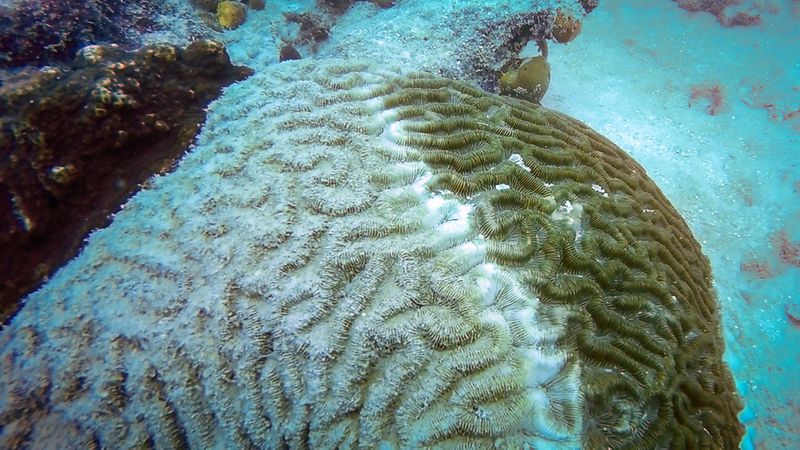
Coral-List: Peter Sale: warming, acidification, reefs and CO2

Tuesday, May 14, 2013


Hi all,
If any of you have yet to see Reef Reminiscences, download a copy and think about what we are losing:
http://www.inweh.unu.edu/Coastal/Publications/ReefReminiscencesBooklet_WEB.pdf    The current discussions re acidification got to me.

Last week, CO2 concentration above Mauna Loa reached 400 ppm for the first time since continuous records commenced in 1958.  The long-term trend since 1958 is becoming steeper (the rate of increase is growing). Atmospheric CO2 was last at this level over 3 million years ago, well before Homo sapiens evolved.

Growing atmospheric concentrations of CO2 lead to warming, and to ocean acidification.  Ocean surface  temperatures have warmed measurably since the start of industrialization, and pH of surface waters is declining at a rate which appears to be more rapid than at any time in the last 450 million years.  pH was virtually unchanged throughout the last 10,000 years, but has fallen 0.1 pH unit since start of industrialization, and is expected to fall as much as 0.7 pH units over the next couple of centuries if we do not wean our economies off fossil fuels (Zeebe 2012).

There are already studies showing effects of reduced pH on growth of some corals, as well as studies showing deleterious effects on a range of other marine species.  Bleaching due to warming has had significant impacts on coral cover on reefs worldwide, although mass bleaching was unknown until first described by Peter Glynn in Panama and Galapagos in the early 1980s. Bleaching-caused mortality and acidification-cause slowed growth act in consort to further reduce the status of coral reefs (many of which are already severely degraded by overfishing, pollution and inappropriate coastal development).  Live coral cover in shallow regions (~10m depth) of the Great Barrier Reef has declined by 50% over the past 27 years, due partly to bleaching losses.  Data for the Caribbean are less robust, but tell an equally or more depressing tale.

This week, the Prime Minister of Canada, Stephen Harper, will journey to New York to give a speech in which he will extoll the value to the United States of building the Keystone XL pipeline (jobs and oil for USA), while also claiming a strong commitment by his government to the environment. That commitment is hard to discern.  Tar sands oil extraction is by far the most polluting form of oil production around, both in CO2 emissions and in other forms of pollution (chiefly heavy metals in waterways). Canada is third, globally, in its per capita emissions of CO2.  The Harper government pulled Canada out of Kyoto, has no plan to achieve its own (weak) target for emissions reductions by 2020, and still has not put in
place emissions regulations for the tar sands industry.  This government is also the one that keeps getting written up in Science and Nature for its anti-science agenda.

True, not building Keystone XL will only slow, not stop, Canada’s tar sands industry.  and Canada’s total emissions of CO2 are a tiny percentage of the world total.  But as someone who would like coral reefs to persist, I think we have to start somewhere if we are going to change our ways. Stopping one pipeline is one small step on a long road to save coral reefs.  Some things in life are more important than the bottom line.

Peter Sale

www.uwindsor.ca/sale           www.petersalebooks.com
______________________________

Reef Rescue volunteers in action

Reef Rescue new testing equipment arrived just in time to catch contractor dredging violations.

In February we unpacked and calibrated our new turbidity meter (paid for with your donations) and put it right to work monitoring contractor permit compliance. Turbidity standards are built into the dredging permits by FDEP to protect our nearshore coral reefs from siltation. Reef Rescue volunteers were onsite daily monitoring the Palm Beach Inlet, Boynton Inlet and Delray Beach dredging projects.


Volunteers immediately began to witness violations and report their findings to FDEP. They found and documented boulders pumped on the beach in Palm Beach, making it unsuitable for sea turtle nesting. The Army Corp of Engineers ordered the contractor back to remove the rocks. After the first cleanup was performed improperly volunteers reported them a second time and they were forced to go back and do it again.


After finishing the Palm Beach Inlet dredge the contractor towed their equipment away and dragged cables across a three mile swath of coral reef. Local dive boats spotted the damage and turned them in to the FDEP. Under the 2009 Florida Coral Reef Protection Act, the contractor faces hundreds of thousands in fines, must repair the damage and pay for monitoring of the restoration for the next ten years.


Next the dredge arrived in Delray Beach on March 2nd to nourish 1.9 miles of beach. On March 3rd we caught them violating the projects turbidity standard. During the 27 days of the project 12 turbidity violations were documented, forcing the project to shut down on several occasions. On April 9, a joint Reef Rescue and FDEP site inspection found turbidity levels far above permitted levels. Volunteer dives are now in the process of monitoring the nearby reefs for any sign of project related damage.


You can learn more about these and other issues by following the updates on the Reef Rescue Blog.


What is the best way to stay in touch with Reef Rescue happenings?


.


Reef Rescue on Facebook where we post updates on a nearly daily basis.


And at the Reef Rescue Coral Reef Blog where you will find more in depth reporting on reef related issues updated several times a month.


Here is some local news coverage from just the last week:


Palm Beach Daily News May 3, 2013


Reef restoration work to resume next week


http://www.palmbeachdailynews.com/news/news/national/reef-restoration-work-to-resume-next-week/nXfZy/


Coastal Star May 2, 2013


Delray Beach: Divers monitor reef for human-caused damage


http://thecoastalstar.ning.com/profiles/blogs/along-the-coast-divers-monitor-reef-for-human-caused-damage?xg_source=msg_mes_network


Palm Beach Daily News April 30, 2013


DEP says town must build artificial reef; costs yet unknown


http://www.palmbeachdailynews.com/news/news/dep-says-town-must-build-artificial-reef-costs-yet/nXbr8/


Palm Beach Post April 28, 2013


Beach boulder cleanup ordered to be redone in Palm Beach


http://www.mypalmbeachpost.com/news/news/local/beach-repair-redo-being-redone-on-stretch-of-palm-/nXY9z/


Two great fundraising events to show your support for Reef Rescue are coming up:


Party to Help Florida Reefs Fundraiser


May 18th, 2013


A fundraiser for two very special organizations that help protect the health of our Florida Reefs. We all want to keep diving on beautiful coral reef, so lets make sure to support Reef Rescue and Vone Research in what they do to keep our reefs thriving.


.


Fundraiser will be from1 to 6 pm at Hurricanes in Delray Beach


Located at 640 E. Atlantic Ave


.


We will have food, 2 for 1 drink special, live band, and raffles on items from Force-E, Aqua Lung, Mares, Diver’s Alert Network and more.


.


All proceeds will go to Reef Rescue and Vone Research to help them fund their organizations to keep up the good work!


Pre-buy your tickets for this event at any Force-E Scuba Centers= $10, plus get one FREE raffle ticket at the door…. Or Buy your tickets at the door $12


And


The always popular Kayak-a-thon Fundraiser


The date is set for the 8th annual Kayak-a-thon fundraiser.


On Saturday June 1, 2013, kayakers will paddle their way along a 7 mile course from the Riviera Beach Marina to Munyon and Peanut Islands then back to the marina.


This annual event is one of the most exciting fundraising activities of the year for Reef Rescue. Not only does the Kayak-a-thon help raise funds to support Reef Rescue coral reef conservation projects, but it also brings together our family of supporters for a fun filled day of outdoor activity.


Like a walk-a-thon, kayakers raise money by collecting donations or pledges for completing the predetermined course. It is similar in format to other physical activity based fundraising events such as marathons and cycling races, but this low intensity, non-competitive event is ideal for mobilizing broad-based community support.


Click here to learn more, see photos and watch video from previous years events.


Kayakers signup now!


If you do not have a kayak there are some available, but the supply is limited, so act fast.


Go to: www.kayakathon.com


If you have any questions about the event or how your organization can become involved contact Brian Lee (561) 843-4109


.


.


Not able to make either fundraiser, but still want to support our efforts?


Consider making an online donate to Reef Rescue:


     PO Box 207 * Boynton Beach, FL 33425

SpeakUpForBLue.com: Online Resource for building Career Marine Science by Andrew Lewin

Hi Coral Listers,

I am a marine spatial ecologist and I’ve been a long time subscriber to this list, but an infrequent poster. I love this list as a resource!

I see job postings on this list every once and a while so I thought I would share with the Coral lister group of a Web Show and a premium online membership program that I created to provide people with information on finding jobs and building careers in Marine Science and Conservation. It’s a resource that I wished I had when I was first starting out.

The Web Show is called OCC TV and I post videos every week where I either offer tips on building a career in Ocean Conservation and/or I interview a professional in the industry where they share their experiences, successes, and failures as well as offer advice to help you build your career.

Here is the link to all the episodes so far: http://www.speakupforblue.com/category/ocean-conservation-careers

The online membership program that I recently launched is called Ocean Conservation Careers, which is designed to offer you strategies to help you build your career, and continue to build your career in Ocean Conservation. Also included in the program is an online community where you, as a member, can ask specific questions pertaining to your career and can meet other people who are in a similar position and build your own network of people help you out to build a successful career.  There is a small cost associated with this membership.

You can get more information on the membership program here: http://www.oceanconservationcareers.com/

I speak to every new member who registers for the membership over Skype/Phone to discuss their career goals and try and point them in the right direction for their future. My current members love this part of the membership!

Feel free to contact me if you have any questions.

Please forward this message to anyone who you might think would benefit from this resource.

Best Regards,

Andrew

Andrew Lewin, M.Sc., Adv. Dipl. GIS

Founder, SpeakUpForBlue.com

President, Spatial-Conserve Inc.

Email: alewin@spatialconserve.com
Tel: (905) 639-4646
Mobile: (905) 630-8441
Skype: andrew.lewin99

******************************

****************
Twitter:  @speakupforblue
Facebook: Speak Up For Blue
YouTube: SUFB TV

Join My LinkedIn Group:
Speak Up For Blue

Florida Today by Jim Wayner: Oceana: Sonic blasts planned off Brevard could kill dolphins, whales

Whales and other marine mammals rely on hearing to navigate. / FLORIDA TODAY


Thank you for voting!


Total Votes: 62

Oil off Brevard?

• The Bureau of Ocean Energy Management is considering allowing seismic surveys for oil and gas in the waters of the Southeastern United States. For information, visit:
boem.gov/oil-and-gas-energy-program/GOMR/GandG.aspx
• Read Oceana’s report here:


Oil and gas companies want to blast sound pulses 100,000 times more intense than a jet engine to the ocean floor, in hopes of finding fossil fuels off Brevard County and other southeastern American waters.

But environmentalists say the sonic blasts could injure and possibly kill an estimated 138,500 dolphins and whales, and put thousands of tourism and fishing jobs at risk.

A report released Tuesday by the nonprofit group Oceana highlighted federal estimates of wildlife and economic impacts from oil and gas exploration along the Atlantic Outer Continental Shelf.

According to the report, the seismic airguns would put at risk more than $15 billion in economic activity and 400,000 tourism, recreation and fishing jobs in Florida.

“Imagine a rocket being launched out of your living room every 10 seconds, 24 hours a day, for days to weeks at a time,” said Matthew Huelsenbeck, report author and marine scientist at Oceana. “You could go deaf or be forced to move. That’s what it’s like for sea life that is subjected to seismic testing, but unlike in people, a deaf whale is a dead whale.”

The federal Bureau of Ocean Energy Management is considering allowing seismic surveys from Cape Canaveral to Delaware in federal waters, from three to 350 nautical miles out to sea. But the geological surveys and impacts could cross into state waters closer to shore as well. A decision on the tests is expected in October.

Survey ships would tow arrays of the seismic airguns, which produce compressed air bubbles under extreme pressure to create sound.

Hydrophones towed near the surface record the sound that bounces back from the ocean bottom to reveal a 3-D image of bottom formations that may hint at oil or gas deposits.

But any resulting hearing loss in whales and dolphins could harm the mammals’ ability to navigate, feed and care for their young. The sounds also can disturb breeding and feeding and inhibit marine mammals’ ability to communicate with one another.

“Airgun blasts threaten marine life of all sizes from tiny fish eggs to large whales, and people too,” Huelsenbeck said. “730,000 East Coast jobs depend on a healthy ocean in the region that could be harmed by airguns or drilling. But we don’t have to turn the Atlantic into a blast zone.”

A draft federal environmental study released last year includes several alternatives for ways to avoid harming whales, sea turtles and other wildlife. Proposals include closing areas up to about six nautical miles offshore to seismic surveying during the main sea turtle nesting season — May 1 to Oct. 31. An additional area 20 nautical miles out could be off-limits for the sound surveying during right whale migration — Nov. 15 to April 15.

Most research revolves around sound impacts on marine mammals. The impacts on sea turtles are less clear. Sea turtles don’t have ear drums or external ears, but their auditory sense is adapted to vibrations in the water.

Oceana wants the government to phase out the use of airguns in federal waters and to do more to promote renewable energy such as wind instead of oil.

“In the long-run, it’s only going to keep us more addicted to fossil fuels,” Huelsenbeck said of more oil exploration in the Atlantic.


Contact Waymer at 321-242-3663 or jwaymer@floridatoday.com. Follow him on Twitter @JWayEnviro


Special thanks to  Richard Charter


Coral-list: Pan-American Coral Reef Congress Oct 8–11th, 2013, Merida Mexico

Mar 22 (1 day ago)

Joaquín Rodrigo Garza Pérez <rgarza@ciencias.unam.mx>

http://redoctober.sisal.unam.mx/1CPAC/Panamerican_Coral_Reef_Congress/Resumenes___Abstracts.html

http://redoctober.sisal.unam.mx/1CPAC/Panamerican_Coral_Reef_Congress/Merida_2013.html

Dear Colleagues:

New information on the congress venue, official hotel, registry fees and airfare discounts is available at the Congress website! See you in Mérida!

Greetings from the Local Organizing Committee

ES

Estimados Colegas:

Ya está disponible la información de la sede del congreso, el hotel
oficial, las cuotas de inscripción y descuento en boletos de avión, en el
sitio web del Congreso.

Nos vemos en Mérida!

Saludos cordiales de parte del Comité Organizador Local


ES


  1. *Los resúmenes deberán ser enviados a través del sistema de envío de resúmenes en el portal web del congreso.


  1. *Para accesar este sistema de envío de resúmenes el autor principal deberá darse de alta en el sistema.


  1. *Se deberá escoger la modalidad en la que se desea presentar (oral ó póster)


  1. *Se deberá escoger el tema de las sesiones en donde el resúmen sea más adecuado

Los temas podrán ser consultados en la página: Sesiones del Congreso


  1. *Los resúmenes para presentaciones orales y pósters deberán ser enviados para su revisión y eventual aprobación tanto en Español como en Inglés (Incluyendo títulos y cuerpo del resumen).


  1. *Cada versión del resumen podrá tener una extensión máxima de 2,200 caracteres.


  1. *No se deben incluir citas en los resúmenes


  1. *NOTA IMPORTANTE: Los resúmenes y sus títulos deben ser escritos y modificados en un programa de editor de texto. Cuando se cuente con su versión final deberán ser copiados desde el documento y pegados en los campos apropiados en el sistema de envío. Una vez envíado el resumen, este no podrá ser modificado en el sistema.


Preguntas y comentarios: panamcoralreefs@outlook.com


EN


  1. *Abstracts must be submitted using the Online Abstract Submission Form in the Congress’ Website.


  1. *In order to access this system, corresponding authors must register on the system.


  1. *A modality for presentation must be chosen.


  1. *A theme session were the abstract could be most relevant must be chosen.

Theme sessions can be consulted on the congress sessions page


  1. *Abstracts for oral presentations and posters will be accepted in Spanish with its mandatory translation in English (or viceversa), both for titles and body of the abstract.


  1. *Each abstract version might have a maximum length of 2,200 characters.


  1. *No references should be included on the abstracts.


  1. *IMPORTANT: Abstracts and titles must be written and modified in a text editing software. When you have your final version, you must copy from the document and paste on the appropriate fields of the abstract submission form. Once submitted the abstract cannot be modified on the system.


Question or Comments: panamcoralreefs@outlook.com

7th Mexican &

1st Pan-American

Coral Reef Congress

Perspectivas Arrecifales: Manejo Local, Impactos Globales


Reef Perspectives: Local Management, Global Impacts

Days Hours Mins Secs

Abstracts Reception Period Ends In:

El Período de Recepción de Resúmenes Termina en:


Costo de Inscripción / Registry Fees


INTERNACIONAL / INTERNATIONAL


ON-LINE EARLY-BIRD (Abril / April – Julio/July, 2013)


Profesores / Professors   $200.00 USD


Estudiantes / Students  $100.00 USD


ON-LINE (Agosto / August – Septiembre / September, 2013)


Profesores / Professors   $220.00 USD


Estudiantes / Students  $110.00 USD


NACIONAL (EN MÉXICO / WITHIN MÉXICO )


Depósito a Cuenta BBVA Bancomer

(Abril a Septiembre)


Profesores   $2,400.00 MXP


Estudiantes   $1,200.00 MXP


En la Puerta / At The Door (Oct. 7-11, 2013)


Profesores / Professors  $2,800.00 MXP


Estudiantes / Students  $1,400.00 MXP


White House Petition Drive: We need 100,000 signatures by March 19th

Ok, this isn’t about the ocean or coral reefs but it is an issue that is near and dear to my heart.    My husband was cured of Hepatitis C in a Phase 2 clinical trial involving two medicines owned by two different companies. They achieved an astounding 100% cure rate in all patients with little to no side effects.   One of the pills was sold to Gilead Sciences, that now refuses to go to Phase 3 trials, FDA approval and to market with the drugs.

I’m working with HCV: Coalition for the Cure  to help get the cure out.  Hep C now kills 1000 people a day in America–exceeding that of AIDS.  Please sign our White House petition seeking the President’s involvement in urging the release of this important way to save lives.  Go to http://www.hepc-cured.org  and sign today. You’ll have to register but it’s worth it.

Many thanks,   DeeVon    ps here’s our press release:


 Hepatitis C Coalition (HCV Coalition for The Cure) Launches White House Petition to End Hepatitis C

According to the World Health Organization (WHO) 350,000 people a year are dying from Hepatitis C. Gilead Sciences and Bristol-Myers Squibb together developed a promising cure and HCV advocates are outraged at lack of its development

“We had never, ever imagined – even in our wildest dreams – we could treat HCV so quickly, effectively and without serious side effects,” said Paul Thuluvath, physician at Mercy Medical Center in Baltimore, Md., who had six patients on the new treatment.

San Antonio, Texas (PRWEB) February 23, 2013

According to the World Health Organization, (WHO) 350,000 people die each year from Hepatitis C and it is the most widespread blood borne infection in the country. (http://www.who.int/mediacentre/factsheets/fs164/en/). The disease now kills more people than AIDS (http://www.reuters.com/article/2012/02/23/us-hepc-idUSTRE81M1HR20120223).

San Antonian, Margaret Dudley, was diagnosed with Hepatitis C in 2011. Dudley is leading a charge to make a cure available to the four million Americans living with the disease. “We feel Gilead Sciences has a moral responsibility to work with Bristol-Myers to put an end to this epidemic disease,” says Dudley.

She established the HCV Coalition for The Cure to raise awareness about Hepatitis C and the cure that exists. She says the greatest frustration is knowing that a treatment is available without toxic ribavirin and/or interferon, but it’s not being used. She says two pills from two different drug makers have shown remarkable results, but their use against Hepatitis C is stalled. Dudley says drug company Gilead Sciences has balked at further development with Bristol-Myers Squibb rather than moving forward with the medications they created together to cure the most common forms of Hepatitis C, which is a combination of Gilead Sciences’ sofosbuvir combined with Bristol’s daclatasvir (Bristol urges combo hepatitis C study with Gilead http://www.reuters.com/article/2012/05/31/us-bristolmyers-gilead-idUSBRE84U0WC20120531)

On February 19, 2013, Dudley, with the support of her husband, Gary Dudley, co-owner of San Antonio based corporation, SWBC, and a number of other advocates announced a drive to obtain a hundred thousand signatures, that would get the White House to help move things along.

“They can stop this disease by collaborating on this cure for a disease that’s reached epidemic proportions,” says 61 year old Dudley – a mother and grandmother.

The Hepatitis C virus resides in the liver. Over time, cysts and scar tissue form, causing liver cirrhosis. Tumors can develop and the liver can fail. This is the number one reason for liver transplants. “We feel very strongly with help of the nation and the White House, we can get these drug companies to come together with their previously proven treatment to cure the disease.”

“You have the cure, you developed it, give us access to it,” says Margaret directing her plea to the drug companies.

Dudley is urging everyone to go to http://www.hepc-cured.org and sign the White House petition.

Blue Vision Summit 4 & 6th Annual Peter Benchley Ocean Awards: What does the ocean mean to you?

http://www.bluefront.org/


2013 Summit

BVS save the date13

Facebook

RegisterNowCircle
REGISTRATION IS NOW OPEN

Be a part of the rising wave of citizen activism for our ocean, coasts and the communities that depend on them. Join the groundswell of support for common sense solutions from your community to the halls of Congress.

Two years ago over 300 Seaweed Rebels from dozens of states and overseas helped advance marine conservation and U.S. ocean policy at BVS3 in Washington, D.C.  This year we’re returning to our nation’s capital in greater numbers.

In the wake of a critical election, a still weak economy and a Super-Storm we’re seeing some progress, but also major cuts to NOAA, the U.S. Coast Guard and other frontline ocean agencies as well as local programs that protect and restore our public seas. That’s why it’s critical that we come together as a movement and a growing constituency of marine conservationists, businesses, scientists, recreational users, coastal youths and others to turn the tide. We’ll do this over the course of our 4th Blue Vision Summit that will include these opportunities:

  • Celebration of the Seas, our opening night party
  • A day of strategizing and skills development led by young and veteran ocean advocates
  • Themed dinners around D.C.
  • Meeting with members of Congress on Capitol Hill
  • 6th Annual Peter Benchley Ocean Awards
  • Building grassroots power
  • Talks from Ocean Heroes

Please join with Senator Sheldon Whitehouse, Representative Sam Farr, Dr. Sylvia Earle, Dr. Jane Lubchenco, Ralph Nader, Jim Toomey, Wyland, leaders from Google, Blue Frontier Campaign, NRDC, Ocean Champions, Oceana, Ocean Conservancy, U.S. Coast Guard, Taylor Shellfish, major aquariums and marine labs, surfers, divers, fishermen, educators, artists, writers, explorers and many other salty folk at BVS4. Make History. Join the upsurge!


breaksponsorsbreak agenda break register break TravelInfobreak PBCA_Logo


Coralwatch: New Coral Reefs & Climate Change Guide for Education & Awareness book & DVD

CoralWatch would like to announce that we have just released the second edition of our book “Coral Reefs and Climate Change – the Guide for Education and Awareness”.

This book is beautifully illustrated and aims to bring coral reef science to students and general public.   It is 262 pages and has chapters on oceanography, coral reef biology and ecology, climate change and approaches to conservation.

Our educational DVD series was also recently released – this contains 22 short videos (3-8 minutes each) covering key topics from the book, and incorporates interviews with scientists and animated diagrams to bring the science to life.  These products are available alone, combined, or as part of a reef education package.

Here is a link to the current book order form.  We will include 2012 prices until the end of February.
http://coralwatch.org/c/document_library/get_file?uuid=fdbfc738-114f-451b-986b-4b843b9e709b&groupId=10136

CoralWatch is a non-profit organisation, based at The University of Queensland.  CoralWatch integrates volunteer monitoring of coral bleaching with education about coral reef conservation.  For more information about CoralWatch activities or other products, email info@coralwatch.org or visit our website www.coralwatch.org

Cheers
Angela

Dr Angela Dean I Project Manager I CoralWatch I The University of Queensland l Phone: +61 7 3365 3127 l Fax +61 7 3346 6301 l Email a.dean@uq.edu.au<mailto:a.dean@uq.edu.au>


Special thanks to Coral-list.

Sierra Club: Florida Water Quality Rules; Hearing Jan 17 in Tampa

Dear Friends:

We are at a major turning point in the battle over Clean Water Act enforcement in Florida. 

Most of you are aware that on November 30, EPA made a complex decision on setting numeric nutrient standards for Florida’s waters.  Environmental leaders and the media initially reported it as a major victory, but so did many of the state’s biggest water polluters.  

So what really happened?  

The plaintiffs in the litigation which forced EPA’s action -  Earthjustice, Florida Wildlife Federation, the Conservancy of Southwest Florida, St. John’s Riverkeeper and the Environmental Confederation – spent the past few weeks analyzing EPA’s full decision and reading the political tea leaves.

Here’s a quick summary of what we know:

1.  EPA approved Florida DEP’s nutrient rules for 15% of the state’s waters.  DEP’s rules contain “thresholds” and standards that are less stringent than EPA had proposed.

2.  EPA proposed strong rules for the remaining 85% of Florida’s waters, but it also has signaled that it is prepared to withdraw those rules and transfer that authority to Florida DEP.  – That would turn a major clean water victory into defeat.

This is the worst possible time to put the Florida Department of Protection in charge of enforcing the Clean Water Act. As the media have reported, the DEP is firing experienced staffers and replacing them with people who represent polluting industries.

Polluter lobbyists, in fact, crafted the DEP’s ineffective rules. They hold enormous influence in the Scott Administration and in Legislature. It is simply irresponsible to turn this over to the DEP. 

See the attached fact sheet for our detailed assessment of EPA’s action.

EPA also announced that it would hold public information sessions in Tampa on January 17-18 to answer questions and take comments on the rules.   It is of vital importance that hundreds of clean water advocates gather in Tampa to demand that EPA not turn clean water enforcement over to Florida DEP.  Details follow below in our action alert.

EPA will soon decide whether it will enforce the Clean Water Act or hand a “get out of jail free card” to Florida’s polluters.  The moment is now to let our voices be heard and take action together. 

- Frank


Demand Environmental Protection!

by Cris Costello

Florida Slime
 RSVP today!
Last November, the U.S. Environmental Protection Agency adopted strong standards to combat sewage, manure, and fertilizer pollution in our waterways. What first sounded like a big victory could turn into a crippling defeat for our water and our way of life. You can make sure that doesn’t happen, and that the EPA does not cave to polluter pressure.
The EPA has announced it is handing over protection of 15% of Florida’s waterways to the state’s Department of Environmental Protection (DEP). The DEP’s rules are far less strict, and enforcement has been left to friends of big polluters rather than environmental professionals1. It’s no joke that people say DEP stands for “Don’t Expect Protection.”
What’s worse: the EPA is considering handing over the rest of Florida’s water to the DEP. This would be a huge setback to all of us working to protect our water from toxic pollution and the telltale slime that comes with it. You can make sure the EPA stands strong by joining us for this critical event.
Event Information:
WHAT: Demonstration, press conference, and march to an EPA information session

WHEN:
 Thursday, January 17 from 11:30 a.m. to 1 p.m.

WHERE: 
Downtown Tampa, N. Franklin Street Pedestrian Mall, between Kennedy Blvd and E. Jackson St, across from 211 N. Tampa Street, Tampa FL 33602 (map)
The EPA is holding a public information session in Tampa and we plan on being there to make crystal clear (think Silver Springs before it was choked with algae) that Floridians will not let the EPA weasel out of its own strong rules to protect our water resources.
After the press conference, we will march across the street to the Tampa Hotel where the EPA is holding the public information session from 1 p.m. to 7 p.m. We will then participate in the session by bringing photos, slime stories and comments to the EPA.
This is the worst possible time to put DEP in charge of enforcing the Clean Water Act. The EPA must do its job and uphold strong protections for Floridians. The threat to public health from this green slime and polluted drinking water needs to be addressed aggressively and right away.
Thanks for all you do for the environment,
Cris Costello
Florida Sierra Club
P.S. The more people who attend this event, the stronger our message. Can you share this invitation with five people today?
Share this page on FacebookShare this page on TwitterShare this page with other services
1. Craig Pittman, “Florida environmental agency lays off longtime employees and hires from regulated industries,”The Tampa Bay Times, December 25, 2012.  http://www.tampabay.com/news/environment/florida-environmental-agency-lays-off-longtime-employees-and-hires-from/1267557
Sierra ClubSierra Club Florida
1990 Central Avenue
St. Petersburg, FL 33712
  NEWS:  sierraclubfloridanews.org
HOME:  florida.sierraclub.org/

Frank Jackalone

Senior Organizing Manager
Sierra Club
1990 Central Avenue
St. Petersburg, FL 33712

Center for Biologic Diversity: Save Vanishing Corals

http://action.biologicaldiversity.org/p/dia/action3/common/public/?action_KEY=12219

Support the effort to add corals to the endangered species list.  Sign the action alert and check out the list of public hearings and where to send comments at Center for Biologic Diversity website above.  DV

Our coral reefs are in trouble, and the proposal from the federal government to protect 66 corals under the Endangered Species Act is a wakeup call on the urgency of this crisis.

Under the proposal, 12 coral species would be listed as endangered and 54 as threatened. Seven of the most imperiled in live in Florida and the Caribbean, and many of the others are found in the Pacific Ocean near Hawaii.

The decision is the most sweeping effort ever by the National Marine Fisheries Service to protect imperiled marine animals. It’s also an important step toward raising public awareness about the plight of corals and providing them lifesaving protections.

Help make sure this proposal becomes a reality. Send a message in support of protections for corals.

The government has also set up a number of meetings to take public comments about its plans to protect the 66 corals. Click here to see the full list of events and to RSVP.


Blue Frontier Campaign: BLue Notes #106: Political Tide Turning?, Whales, Oregon Shore, & More….

Join Us

Blue Notes #106


BLUE NOTES #106: Political Tide Turning?, Whales, Oregon Shore, & More

December 17, 2012

By David Helvarg


In this issue
Is the Political Tide Turning?
It’s Not Just About the Whales
Back to the Oregon Shore
Seaweed Spotlight: Cook Inletkeeper
Last Chance to Name a Hero: Peter Benchley Ocean Awards


Is the Political Tide Turning?

We just had an election in which the public seemed to see the need for larger changes in society. And of course changes of any kind tend to come in waves. Along with the emergence of a new demographic profile of the U.S. electorate we saw people in a number of states voting for Gay marriage equality, legalized use of marijuana and in California, a tax increase to help save public education. At the same time Super Storm Sandy’s impact on the shore put climate change front and center on the public policy agenda for any politician willing to take the heat from the fossil fuel industry. Unfortunately, while average people may be open to big changes the two party political system has become far more polarized and incremental than it once was. That’s why the keystone laws that protect America’s ocean like the Clean Water Act, Marine Mammal Protection ActCoastal Zone Management Act and others are now close to middle age. The Clean Water Act is celebrating its 40th anniversary this year.

The way in which our system has bogged down in a quagmire of waste fraud and unregulated corporate abuse can be hugely frustrating when working for ocean and coastal protection. One example: In 2000, I wrote about EPA efforts to impose Total Maximum Daily Loads (TMDLs) for pollution – nitrogen and sediment from factory farm waste and construction sites – running into the Chesapeake Bay following the failure of a voluntary multi-state effort that has been ongoing since 1983. In 2010 the EPA finalized its plan to put the bay on a “pollution diet,” that’s supposed to clean it up by 2025. This was one of the items the Obama campaign bragged about in its response to our ocean letter to the Presidential Candidates (see Blue Notes #104). However within weeks of the EPA announcing its TMDL plan the American Farm Bureau FederationNational Association of Home Builders and others filed suit. The lawsuit went to court in October 2012 where the judge told the contending parties, “Don’t expect a decision soon.” This means attempts to clean up the bay are destined to be stalled for at least 40 years (1983-2025), mostly by industrial chicken producers and shore side developers whose paid politicians can then point to this failure as proof that government doesn’t work. By contrast the free market has worked well for algae blooms and bacterial mats but not so much for oysters, striped bass and kids who like to swim without getting sick. For more on the TMDL lawsuit see the November issue of the Chesapeake Bay Journal.

On a more hopeful note ocean friendly policies in coastal states like California, Massachusetts and Rhode Island demonstrate that good governance in places where the public cares deeply for its waters can still make a positive difference.

At the first Blue Vision Summit back in July 2004 there was talk of a BOB, a ‘Big Ocean Bill,’ to codify the recommendations of two major ocean commissions into federal law. But as Congress became ever more polarized and turned even ocean conservation into a partisan issue, blue movement strategy shifted to executive action. This led, thanks to lots of grassroots pressure, to President Obama signing off on a National Ocean Policy (NOP) in the summer of 2010. Today NOP looks good on paper but still needs to be implemented through nine Regional Planning Bodies, to be made up of representatives from federal, state and tribal authorities.

The first 2-day meeting for the first body was held in Portland, Maine, this November. It promises to better coordinate a range of ocean uses across New England while reducing their environmental impacts. The many tribal representatives attending emphasized the need to improve regional water quality. The meeting also attracted lots of public comment and participation from both the Northeast Regional Ocean Council, made up of New England states already involved in efforts to restore their coastal waters and the New England Ocean Action Network, a seaweed coalition of conservationists, fishing groups, the New England Aquarium and others committed to, “Healthy Oceans, Thriving Communities.” It is because of this multi-stakeholder citizen involvement that the first regional body, rather than simply a meeting place for government employees, holds promise to actually improve the health and habitats of the Northeast’s public seas.

But lack of transparency and clarity in the setting up of the next eight regional bodies, including in the storm battered mid-Atlantic, suggests the NOP will only work if ocean folks from all regions of the nation are at the table and at every public hearing working as advocates and gadflies for the sea.

When hundreds of us march onto Capitol Hill this May 15 as part of the movement’s 4th Blue Vision Summit, we should also be demanding large change from our elected leaders. Along with full funding for marine science, exploration and frontline ocean agencies such as NOAA and the Coast Guard, how about a Healthy Oceans Act at the level of the Clean Air and Clean Water acts of the last century? Why not make, “healthy oceans, thriving communities,” the law of the land and the sea for the 21st Century? That might not seem politically feasible in 2013, but it’s what would be in the public interest.
Top


It’s Not Just About the Whales

“Support for Blue Frontier Campaign translates directly to actions aimed at a better, healthier ocean – good news for fish, whales and coral reefs, and for the future of humankind.” – Dr. Sylvia Earle, National Geographic Explorer-in-Residence.

Like our friends in the Coast Guard, Blue Frontier Campaign does more with less; Blue Vision Summits, the Peter Benchley Ocean Awards, Blue Notes, the Blue Movement Directory, 50 Ways to Save the Ocean, along with additional books, videos, articles, public speaking and most important, public action.

As we continue our campaign we ask you to consider making an end of year, tax-deductable donation to Blue Frontier Campaign. This will allow us to continue into our second decade inspiring both awe of our blue marble planet and citizen action to protect it. Thank you for your support and best fishes for the holiday sea sun.
Top


Back to the Oregon Shore

In February Dr. Jane Lubchenco will be retiring as Administrator of NOAA to return to her marine research and to her family in Oregon. During her sometimes controversial tenure she helped restore NOAA’s focus on a range of ocean issues including overfishing, illegal fishing, marine debris, restoring damaged ecosystems including the Gulf of Mexico in the wake of the BP disaster and addressing major new climate-linked challenges like ocean acidification. In 2010 she was awarded the Peter Benchley Ocean Award for her work advancing U.S. National Ocean Policy.
Top


Seaweed Spotlight: Cook Inletkeeper

A regular feature of Blue Notes where we shine the light on a group from the Blue Movement Directory in order to create a more self-aware and collaborative movement. This month we feature Cook Inletkeeper

Formed in 1994, with Sedna the Inuit goddess of the sea as its logo, the Cook Inletkeeper works to protect the 220 miles of Alaska’s Cook Inlet that separates the Kenai Peninsula south of Anchorage from the mainland. Over half the state’s population of 723,000 live within its watershed that’s the size of Virginia.

Despite a spectacular marine setting the Cook Inletkeeper, a member of the Waterkeeper Alliance, grew out of a settlement by three oil companies operating in the area that were facing huge fines over 4,200 Clean Water Act violations. Since its founding the group’s hallmark accomplishments have included working with tribes to get the EPA to study oil pollutants effects on Native people’s subsistence foods (salmon, moose, etc.), carrying out an oil pipeline study that led to new rules that have reduced leaks and spills 90 percent, protecting beluga whale habitat from offshore oil leases, gaining new protections for Kenai salmon rivers, fighting a major proposed strip mine for coal and launching the state’s first clean harbors certification program.

“Climate change is the biggest issue for Alaska’s oceans and our people – and yet there’s an oil boom going on here,” Inletkeeper Bob Shavelson points out. “The state has created massive incentives for oil and gas development with complete disregard for climate issues of course. There are two jack-up rigs doing exploratory drilling in the inlet right now, the first time in 20 years. There’s talk of adding a 16th production platform (to the 15 pumping oil in the Inlet),” he tells me. Shavelson patrols the area on a 25-foot rigid hull inflatable Zodiac when the ice isn’t too thick, or catches rides with local fishermen in the winter if something’s amiss. In the fall he likes to surf in a thick neoprene wetsuit.

Bob Shavelson, Executive Director and Inletkeeper

Along with offshore oilrigs there’s a massive onshore production facility on the inlet that dump over 2 billion gallons of oily waste into local waters every year, a practice not allowed elsewhere. In 2009 the Redoubt Volcano erupted sending torrents of ash, ice and rubble downslope on either side of a major Chevron oil tank storage farm built at its base. Big oil tankers also transit the turbulent ice-chocked waters of the Inlet without the tugboat escorts that are required in Alaska’s Prince William Sound where the Exxon Valdez spill took place in 1989. “As a regulatory backwater, Alaska just doesn’t take a precautionary approach,” Bob explains. “What we want to do is to keep oil, gas and coal in the ground. Some of our most important work now (carried out by a staff of nine and 1,200 Inletkeeper members and volunteers) is monitoring the effects of climate change on salmon streams,” he explains. “We got the governor to make a promise not to trade one resource for another so one of our big fights is the Chuitna coal mine that would (strip)mine completely through a salmon stream.”

While admitting Alaska is, “a resource colony with 90 percent of state revenue coming from oil and gas,” Bob remains hopeful in his 17th year as Cook Inletkeeper. “Mine is a wonderful job and opportunity in a beautiful place to try and make a difference. I grew up on the Jersey shore and saw the impacts of ocean dumping and think Alaska can have more sensible development.”

As part of that vision he points to the area’s active volcanoes, huge tidal shifts (26 feet between high and low tide the day we spoke), abundant winds and solar summers as having the potential to make Alaska truly self-reliant as a renewable energy frontier.
Top


Last Chance to Name a Hero: Peter Benchley Ocean Awards

Nominations for the 6th annual Peter Benchley Ocean Awards close at the end of this month. Consider who you think should join the 32 past winners and heroes who represent the best in solution-oriented ocean protection across a range of endeavors. And we hope to see you May 15 in Washington, D.C., for the awards.
Top


World Ocean Radio on climate change

World Ocean Radio

“As we have argued here on World Ocean Radio too often before, we can no longer protect ourselves from the cause and effect of climate change through indifference, contrived ignorance, and lack of action. That response is irresponsible to the victims, the coastal communities, and to the rest of the nation who are being asked to finance the reparation this time and next.”
~ Peter Neill from WOR 198: Some Answers for Sandy

KITV.com: Scientists investigate reports of a massive coral deaths off Kauai

http://www.kitv.com/news/hawaii/Scientists-investigate-reports-of-a-massive-coral-deaths-off-Kauai/-/8905354/16699168/-/item/0/-/hetcuo/-/index.html

Rapid response team to try and determine extent of damage, cause

UPDATED 9:54 AM HST Sep 22, 2012
HONOLULU —A mysterious coral die-off on Kauai’s north shore is prompting a team of scientists to take a closer look at what may be killing large areas of coral reef.Marine biologist Terry Lilley has been monitoring and documenting Kauai’s marine environment for the last decade or more.

This summer he was struck at how fast he was seeing something kill off what he estimates are millions of coral colonies.

“Something is damaging the reefs in the whole part of the island so it has to be something relatively big,” said Lilley.

Lilley contacted scientists with the U.S. Geological Survey who’ve determined the diseased coral is different from what killed coral heads in Kaneohe Bay last year.

The Kauai outbreak is believed to be due to a type of cyano bacteria and fungus which has compromised the health of the reef, according to researcher Thierry Work.

Work said he took samples from the reef earlier this month and will be back to collect more coral and fish to conduct toxicology tests.

Lilley has sounded the alarm which he hopes will trigger action to get the disease in check, and prevent its spread.

“We have a billion dollar industry tourist industry in Hawaii with snorkels who want to see the reefs. If we let them die on the north shore of Kauai, that’s going to be a huge impact financially on the resources, and the money coming in,” said Lilley.

The Kauai resident is also concerned about what he saw on a recent dive where he documented evidence of diseased turtles and fish.

“The other day at Annini, we counted eight turtles,seven of the eight had eye infections, two had noticable tumors and oneof the eight, had its eyes missing completely,” Lilley said.

The video he shot of a blind turtle knocking into the reef was what saddened and worried him.


But he has also been finding a growing number of sick puffer fish too.

“The tobys are turning black. Their fins are turning black, and rotting and falling off, and then they die,” said Lilley.

So, is there a connection between the diseased marine life and the distressed coral?

A rapid response team of scientists is headed to Kauai next week to find out.

In the meantime, Lilley hopes the video on his website will help educate and encourage ocean users statewide to be on the alert.

“Then, they can report in other parts of the Hawaiian Islands. That will help us scientists in a huge way; where else it, if anywhere, so we can put a picture together as to what’s causing this problem,” said Lilley.

Special thanks to Coral-list:   Guin contact@guinapora.com via coral.aoml.noaa.gov

Hill E2 Wire: Gore seeks November splash with event “The Dirty Weather Report.”


By Ben Geman    - 09/23/12 01:38 PM ET
Hill E2 Wire
Al Gore hopes to show links between climate change and the effects of extreme weather worldwide with an online and social media-fueled event built around the idea of “dirty weather.”   Gore’s advocacy group, the Climate Reality Project, announced Sunday that its second multi-media “24 Hours of Reality” event will occur Nov. 14-15 and bear the title “The Dirty Weather Report.”
“We are in a new era where the . . . extreme weather that is occurring is not fully caused by the natural cycles of time and natural events, but by dirty energy, so it is really important to articulate that and name it more precisely,” said Maggie Fox, the CEO of the Climate Reality Project, in an interview Saturday.
Organizers call the November event part of an effort to counter the lobbying and financial power of oil and coal interests by using social media and other tools to engage people directly.  Gore said on Sunday that “dirty weather” is weather that’s enabled by emissions from fossil fuels and “misinformation” about climate change.”This crisis has to be understood in order to be stopped. The misinformation includes messaging that it is not happening, that we can’t solve it, that we can’t afford to act,” Gore said in a videotaped announcement.”However, together with your help and the full force of our 21st Century technology and media, we can stop the misinformation and the dirty weather, and we can solve the climate crisis,” he said in remarks to a conference in New York City on technology and social change.

The live-streamed online event in November is slated to provide content from nations all over the world, and will encourage participation through social media sites including Twitter. It will include expert commentary, as well as “crowd-sourced videos about how weather is altering our lives and homes, and profiles of communities developing solutions to the climate crisis,” the group said.

The strong push to use social media to boost interest in addressing climate change comes as advocates are playing defense politically in Washington, D.C.

Climate change legislation is dead – at least for now – on Capitol Hill, and Republicans are pushing to block Environmental Protection Agency greenhouse gas regulations.

Organizers hope to build political momentum with the event, which will occur just a week after November’s U.S. elections. Fox said “24 Hours of Reality” is “explicitly intended to connect people everywhere and activate them to take action and to advocate for system-wide solutions with their elected officials.”

Gore announced the event to the Social Good Summit that’s taking place in New York City.

The summit is aimed at exploring ways to harness new media and technology to address environmental problems, poverty and development, disease and other issues.

Environmentalists are citing extreme weather – including recent heat waves and drought in the U.S. – to seek to show that climate change is not an abstract, future problem, but rather something that’s already underway with damaging effects.

Climate experts say that while individual weather events can’t be laid at the feet of climate change, more frequent and intense drought, violent storms and extreme heat waves are expected in a warming world.And some scientists are now ditching the caveat about individual weather events.
James Hansen, director of NASA’s Goddard Institute for Space Studies, and colleagues published a paper in August that claims certain heat waves and droughts in recent years are the direct result of climate change.
“We find ourselves living in what the scientists call a ‘new normal’ of more extreme weather that is happening all over the world with increasing frequency,” Gore said Sunday.”The results – fire, flood drought crop and livestock devastation, refuges, just to mention a few – impact everyone, everywhere,” he said.
Special thanks to Richard Charter

TOF: Bay of Turtles: Bahía de Jiquilisco, El Salvador

http://www.oceanfdn.org/blog/?p=766


Great post on The Ocean Foundation blog about sea turtles at a very special place: Bahia de Jiquilisco.  DV

by Brad Nahill, Director & Co-Founder of SEEtheWILD

Bay of Turtles: Bahía de Jiquilisco, El SalvadorTo arrive to a new place in the dark is like tasting a new food with a blindfold on. You can feel the edges, but a full color appreciation isn’t possible until daylight arrives. Night time in the small town of La Pirraya on an island in Jiquilisco Bay is quiet; the fishermen and their families gather in small compounds preparing the days catch and saving energy for an early rise the next day. But hiding outside the lights of the town is the beginning of a conservation movement that could save one of the world’s most endangered populations of ocean wildlife.

My arrival to Jiquilisco Bay in southern El Salvador started at the small port town of Puerto Parada. We waited for the boat to arrive on a small concrete dock at the end of the main road into town. There was little indication that we were on the edge of the largest wetland in the country other than the mangrove trees across the channel. The dark boat ride was punctuated by distant lightning that was more entertainment than threat. Once our group, an international team of sea turtle conservationists, was settled into our rustic cabins, our night began. We received word of hatchlings at a nearby hatchery and set off on a short boat ride up the beach.

The few dozen hatchlings in the blue bucket at the hatchery were the first newborn hawksbill turtles I’d ever seen. With a red flashlight to protect their eyes, we inspected this healthy group who were eager to get to the water. No sooner had we released them on the beach than we received a call of a nesting female hawksbill on a nearby island. We hopped back into the boat for another short ride across the calm water.

Hawksbills are well known for their preference for nesting much further up the beach, normally venturing into the beachside vegetation to lay their eggs. That knowledge didn’t prepare me for the location of this turtle, probably more than 50 feet inland on the other side of a barbed wire fence that was tall enough to keep people out but let turtles through underneath. That turtle was the perfect illustration of why this population remained hidden for so long; many turtle experts had considered the hawksbills of the Eastern Pacific functionally extinct until just a few years ago.

That turtle decided not to nest so a few of us broke off from the group to visit another hatchery where we waited for sunrise to inspect three hawksbills that were being held to put satellite transmitters on the next day. Along the way, we stopped the boat to see another hawksbill that was on another isolated stretch of beach. Finally, we arrived at the hatchery with an hour or so left in the evening. I stole off to find a hammock and was asleep before I could even take off my sandals.

I wish I could accurately describe my first impressions of Jiquilisco Bay in the daylight but after the long night, I was so disoriented my vision was pretty blurred. Stumbling out of the hammock, I walked over to a four-foot deep hole where three large hawksbills were calmly waiting to be released. These turtles were much larger (their shells measured about 3 feet long) than the one small hawksbill I had worked with years before in Costa Rica; if I didn’t know better I would have thought they were a different species. In addition, there were more hatchlings to release.

Our visit to Jiquilisco was organized by ICAPO (The Eastern Pacific Hawksbill Initiative) and these turtles are part of an ongoing study looking to unlock the mysterious life cycles of these turtles. There are estimated to be fewer than 500 nesting females hawksbills left in their range, which goes from southern Baja California, Mexico to Peru. Until recently, researchers assumed that hawksbills only lived in and around coral reefs, of which there are relatively few along the Pacific coast of the Americas. However, research by ICAPO and their partners has shown that these turtles live primarily in mangroves, a fact that surprised many turtle experts.

Bay of Turtles: Bahía de Jiquilisco, El SalvadorJiquilisco Bay is estimated to harbor nearly half of their nests and most of the rest are found in Padre Ramos Estuary, not far south in northern Nicaragua. Through the hard work of several organizations working in these two hotspots, there is a growing group of people working hard to ensure these turtles are around for a long time. ICAPO and its partners coordinate a local team of 75 residents, known as “careyeros” (carey is Spanish for hawksbill) who patrol key beaches around the bay, looking for nesting turtles and relocating their eggs to hatcheries.

Once I finished photographing these turtles and headed out to the beach, the incredible beauty of this area hit me full force. Across the water, a series of perfectly shaped volcanoes rose up over the bay. As the baby turtles slid into the water, the human residents of Jiquilisco were just getting started. Fishing boats crossed the water, heading to preferred spots in the brightening day.

Bay of Turtles: Bahía de Jiquilisco, El SalvadorAs we arrived back to La Pirraya, the town was in full swing, preparing for their annual hawksbill festival, complete with parade, dignitaries, throngs of media, and more. The parade got off to a loud start with the Navy’s marching band and a parade of more than a hundred local students. The students held home made signs about protecting turtles and keeping trash out of the ocean and a few wore turtle costumes despite the quickly rising temperature.

While I was pleasantly surprised at the large turnout to the festival, the sheer number of media outlets in attendance was shocking. Roughly 30 people from seemingly every media outlet in the country was there including TV news, radio stations, newspapers, magazines, and more. Many citizens of El Salvador are proud of its role in protecting hawksbills and the mix of cutting-edge technology, international turtle experts, and beautiful children was a potent combination that media outlets could not ignore.

Bay of Turtles: Bahía de Jiquilisco, El SalvadorMany of the students stood outside a canopy, looking over the shoulders of the researchers to catch a glimpse of the turtles being prepared for attaching the transmitters. It took more than an hour to clean and sand down the shells, place several layers of epoxy around the transmitter, and allow them to dry. Once completed, the turtles were taken to the water and released. The crowds were kept back to give the turtles room and once they had their bearings, they went directly to the cool water.

I wish this story could have a neat and tidy ending with the turtles heading off into the water, their transmitters providing valuable information for years to come. However, less than a week later I got word that one of the hawksbills was already found dead. The likely culprit was blast fishing, a barbaric practice where fishermen use homemade bombs to kill everything in their range of impact. Read more about this tragedy on our partner EcoViva’s website here.

That news was a reminder that, despite a tremendous amount of progress studying and protecting Jiquilisco’s turtles over the past few years, there is still a lot of work to do. The first order of business is to ensure that the bay receives protection; there are currently no regulations in place for this spectacular wildlife hotspot. ICAPO is hoping to guarantee protection of the critical hawksbill habitat, namely the 50 meter fridges along the primary nesting beaches as well as all the waters within the estuary. These actions by the government of El Salvador are the minimum necessary to give hawksbills the best shot at survival in the eastern Pacific.

Get Involved:

SEE Turtles is supporting this work by raising funds to help pay for the egg collection. Last year, we donated more than $5,000 and hope to exceed that this year. To help support this effort, visit our website; for every $1 donated, we can save 2 hawksbill hatchlings at this project.

Read more about ICAPO’s efforts to protect Jiquilisco Bay and how to volunteer with the program here.

Come visit Jiquilisco Bay in November with EcoViva.

Brad Nahill is a wildlife conservationist, writer, activist, and fundraiser. He is the Director & Co-Founder of SEEtheWILD, the world’s first non-profit wildife conservation travel website.  To date, we have generated more than $300,000 for wildlife conservation and local communities and our volunteers have completed more than 1,000 work shifts at sea turtle conservation project. SEEtheWILD is a project of The Ocean Foundation. Follow SEEtheWILD on Facebook or Twitter.

Common Dreams: ‘A Great Silence Is Spreading Over the Natural World’ by John Vidal

http://www.commondreams.org/view/2012/09/05-2
Published on Wednesday, September 5, 2012 by The Guardian/UK

Bernie Krause has spent 40 years recording nature’s sounds. But such is the rate of species and habitat loss that his tapes may become our only record of the original diversity of life

“The birds are silent in the woods.
Just wait: Soon enough
You will be quiet too”

- Robert Hass

When musician and naturalist Bernie Krause drops his microphones into the pristine coral reef waters of Fiji, he picks up a raucous mix of sighs, beats, glissandos, cries, groans, tones, grunts, beats and clicks.Musician and naturalist Bernie Krause has spent 40 years recording over 15,000 species in many of the world’s pristine habitats. (Photograph: Courtesy of Hachette Book Group)

The water pulsates with the sound of creatures vying for acoustic bandwidth. He hears crustaceans, parrot fish, anemones, wrasses, sharks, shrimps, puffers and surgeonfish. Some gnash their teeth, others use their bladders or tails to make sound. Sea anemones grunt and belch. Every creature on the reef makes its own sound.

But half a mile away, where the same reef is badly damaged, he can only pick up the sound of waves and a few snapping shrimp. It is, he says, the desolate sound of extinction.

Krause, whose electronic music with Paul Beaver was used on classic films like Rosemary’s Baby and Apocalypse Now, and who worked regularly with Bob Dylan, George Harrison and The Byrds, has spent 40 years recording over 15,000 species, collecting 4,500 hours of sound from many of the world’s pristine habitats.

But such is the rate of species extinction and the deterioration of pristine habitat that he estimates half these recordings are now archives, impossible to repeat because the habitats no longer exist or because they have been so compromised by human noise. His tapes are possibly the only record of the original diversity of life in these places.

“A great silence is spreading over the natural world even as the sound of man is becoming deafening,” he writes in a new book, The Great Animal Orchestra. “Little by little the vast orchestra of life, the chorus of the natural world, is in the process of being quietened. There has been a massive decrease in the density and diversity of key vocal creatures, both large and small. The sense of desolation extends beyond mere silence.

“If you listen to a damaged soundscape … the community [of life] has been altered, and organisms have been destroyed, lost their habitat or been left to re-establish their places in the spectrum. As a result, some voices are gone entirely, while others aggressively compete to establish a new place in the increasingly disjointed chorus.”

Hawaii, he says, is the extinction capital of the world. “In a couple of centuries since the islands were populated by Europeans, half the 140 bird species have disappeared. In Madagascar, 15 species of lemur, an elephant bird, a pygmy hippo and an estimated half of all the animals have gone extinct.”

Even partially disturbed habitats lose much of their life for many years, says Krause. Recordings of a meadow in the Sierra Nevada mountains east of San Francisco before the surrounding forest was selectively logged in the 1980s sounds very different to when Krause returned a year later.

“The overall richness of sound was gone, as was the thriving density and diversity of birds. The only prominent sounds were the stream and the hammering of a Williamson’s sapsucker. Over the 20 years I have returned a dozen times to the same spot at the same time of year but the bio-acoustic vitality I had captured before logging has not yet returned.”

One in four mammals is threatened with extinction, he says. With the exception of a few sites, frog populations are in decline worldwide and birds are beginning to show radical signs of territorial shifting.

“Things are beginning to quiet down in the pristine habitats. The combination of shrinking habitat and increasing human pandemonium have produced conditions under which the channels … necessary for creature survival are being completely overloaded. The voices of the wild in their purest states where no [human] noise is present are splendid symphonies.”

But the wild natural world, comprised of vast areas not managed by humans, rarely exists now except in a few isolated places such as the Alaskan wilderness, the far Canadian north, Siberia, the pampas of Argentina and Uruguay, and the Brazilian Pantanal which are still rich with natural sound, he says.

“The fragile weave of natural sound is being torn apart by our seemingly boundless need to conquer the environment rather than to find a way to abide in consonance with it.”

© 2012 Guardian News and Media Limited
John Vidal

Care2: 5 Ways the GOP’s New Platform Fails the Environment by Treehugger

Just the beginning of a full-tilt anti-green agenda….………..DV

Written by Brian Merchant

The Republican Party just approved its 2012 platform at its national convention in Tampa, and predictably, it includes some decidedly anti-environment directives. So, I present to you a handful of the most notably reckless objectives the GOP has now enshrined into its official mission statement:

Stop the EPA from addressing climate change

From the GOP Platform’s text:

“We call on Congress to take quick action to prohibit the EPA from moving forward with new greenhouse gas regulations that will harm the nation’s economy and threaten millions of jobs over the next quarter century. The most powerful environmental policy is liberty, the central organizing principle of the American Republic and its people. Liberty alone fosters scientific inquiry, technological innovation, entrepreneurship, and information exchange. Liberty must remain the core energy behind America’s environmental improvement.”

Bring on the coal

“Coal is a low-cost and abundant energy source with hundreds of years of supply. We look toward the private sector’s development of new, state-of-the-art coal-fired plants that will be low-cost, environmentally responsible, and efficient. We also encourage research and development of advanced technologies in this sector, including coal-to-liquid, coal gasification, and related technologies for enhanced oil recovery.”

Approve Keystone XL

“We are committed to approving the Keystone XL Pipeline and to streamlining permitting for the development of other oil and natural gas pipelines.”

Ban Agenda 21

This one might require some explaining: GOP is now officially unified in rejecting Agenda 21—a decades-old, entirely non-binding sustainability initiative signed by George H.W. Bush. It’s now the basis for the GOP’s third most rampant mainstream conspiracy theory; somewhere behind birtherism and death panels.

“We strongly reject the U.N. Agenda 21 as erosive of American sovereignty, and we oppose any form of U.N. Global Tax,” the Republican platform.

End high-speed rail and Amtrak funding

“It is long past time for the federal government to get out of the way and allow private ventures to provide passenger service to the Northeast Corridor. The same holds true with regard to high-speed and intercity rail across the country.”

There’s other stuff in there too—expand offshore drilling, push for more fracking, etc, none of which should surprise anyone familiar with modern Republican politics. If the GOP keeps this up, it may just live up to its ‘Most Anti-Environment Congress in History’ moniker after all.

This post was originally published by TreeHugger.


Read more: http://www.care2.com/causes/5-ways-the-gops-new-platform-fails-the-environment.html#ixzz25MeQAtku


Romney & Obama on Ocean Rise and Healing the Planet: A contrast to say the least!

Obama - Biden
Deevon –

Here’s something Mitt Romney actually joked about with pride — and plenty of scorn — while formally accepting the Republican nomination for president of the United States:

“President Obama promised to begin to slow the rise of the oceans and heal the planet.”

And the crowd went wild.

It is nothing short of terrifying to imagine a party that openly mocks climate change taking back the White House.

But that’s what we’re up against. If you’re on Facebook, share this graphic to spread the word to your friends and family — or forward this email along:

Share this graphic

The contrast between our candidate and theirs couldn’t be any clearer.

President Obama has more than doubled the amount of electricity we get from wind and solar over his first term — and his plans for wind power are expected to help grow the wind industry to support 100,000 jobs by 2016. Both Romney and Ryan want to kill the wind production tax credit, which could come at the expense of 37,000 American jobs. Oh, but they would keep giving $4 billion in tax breaks to Big Oil every single year.

And just this week, while President Obama’s administration finalized historic fuel economy standards to double our vehicles’ mileage by 2025 and cut carbon pollution from vehicles in half, the GOP adopted a platform that could kill investments in clean energy, and calls on Congress to prohibit the EPA from moving forward with new greenhouse gas regulations.

Surprise, surprise — according to the Los Angeles Times, the platform “was written at the direction of the Romney campaign,” making it heavily influenced by Big Oil interests.

So there you have it — the stakes for clean air, clean water, and clean energy jobs couldn’t be higher. Make sure your friends and family know what we’re fighting for:

http://my.barackobama.com/Wind-Power-Share

Thanks, and stay tuned.

Buffy

Buffy Wicks
National Operation Vote Director
Obama for America

The Ocean Foundation: Tracking Cuban Sea Turtles Like Never Before

Posted on August 28, 2012 by admin

by Fernando M. Bretos, Research Fellow, Cuba Marine Research and Conservation Program

On August 2nd, 2012, the first of five satellite tags was deployed on the carapace of a nesting green turtle at Guanahacabibes National Park and UNESCO Biosphere Reserve, located on the westernmost tip of Cuba. Named Harriet, this turtle along with its four brethren, is being tracked from space for the first time. This research is revealing clues on the origin and life history of a significant population of green turtles (Chelonia mydas), whose migratory patterns, according to basic research already conducted, could range as far as Florida, Central America or even South America.

for more go to:  http://www.oceanfdn.org/blog/?p=752

The Atlantic: Why Young Environmentalists Still Have Hope

By Billy Parish

When it comes to climate change, it’s not surprising that many millennials have settled into a fatalistic stupor. But there are ways to make a difference — and they’re already working.


Ten years ago, I was between my sophomore and junior years at Yale, and on a journey that would profoundly alter the course of my life. I was spending the summer in India, and had decided to hike to the Gaumukh glacier, the source of the Ganges River that rests at the far end of a massive ice sheet deep that extends into the Himalayas.

On the way up, my guide, Anand, and I encountered a barefoot man in an orange robe–a reminder of the fact that we were headed to the holiest place in India. The Ganges accommodates some 450 million people who come to its banks to drink, eat, farm, bathe, and worship. For thousands of years, the great river has been at the center of Indian political, economic, and spiritual life.

Closer to the glacier, we encountered a different kind of sight: a white plastic tent with a satellite dish beside it. Nearby, we found a scientist sitting on a boulder. A quarter century earlier, he told us, we would have been standing on the glacier. It had been retreating for years. As soon as 2030, he said, Gaumukh could disappear altogether.

That fall, I took a leave from college, determined to do something about the insanity of global warming. I would never return, choosing instead to co-found the Energy Action Coalition and grow it into the world’s largest youth advocacy organization working on the climate crisis. As we won thousands of small victories, getting cities, college campuses, and companies to begin reducing their carbon footprints, I and those around me felt empowered — confident that we would prevail in the greatest challenge of our generation.

Then came 2008. After the election, we saw an opportunity to win both federal climate legislation and to secure an international climate deal in Copenhagen. When both went down in flames, many climate activists (myself included) fell into a kind of depression.

Fast forward to 2012. We’re living through the warmest year in American history. Wildfires and droughts are plaguing the West, prompting experts to warn of a looming food crisis, and Bill McKibben’s tour-de-force Rolling Stone piece “Global Warming’s Terrifying New Math” has been viewed 1.2 million times in two weeks. The listervs I’m on are filling up with huge threads with subject lines like, “I’m scared.”

What happened? What do we do now? I and many other members of the millennial generation have spent the past few years developing answers to these questions. The good news is that we now know a great deal about what works, and we know what we need to do.

First, it’s important to recognize that this not only a dangerous time, but also a time of immense opportunity. We are living in a world of dueling exponential curves. On one hand, there are the hockey stick slopes, the terrifying and skyrocketing lines of environmental degradation and carbon. But not far behind is another wave of fast-growing curves representing a solution set that could sustainably feed, shelter, and power the planet.

In his Rolling Stone piece, McKibben mentions that Germany recently met nearly half its noonday power demand with solar energy. What he didn’t mention was that as recently as 2000, solar power comprised only 0.01 percent of Germany’s power supply. A similar story of renewable energy growth has played out around the world. Late last year, the International Energy Agency came out with a stunning revision of its forecast for the future energy mix of the planet, saying solar could produce most of the world’s power in less than 50 years. In the U.S., the rate of uptake of wind and solar technologies has blown expert predictions out of the water.

Taking note of new realities, the National Renewable Energy Laboratory recently issued a statement that would have been unimaginable five years ago: “Renewable electricity generation from technologies that are commercially available today is more than adequate to supply 80% of total U.S. electricity generation in 2050 while meeting electricity demand on an hourly basis in every region of the country.”

So how do we, as a generation that will be grappling with these issues far into the future, ensure that the good curves win out?

1. Support local fights to keep fossil fuels in the ground

McKibben calls for turning our full attention to fighting fossil fuel companies. To this I would add that we need to double down on local campaigns targeted at specific mining or energy development projects. Why? Because they work. On the ground, surrounded by friends and family, fighting both for our planet and the places we love, we’re already finding our power.

With little fanfare, grassroots groups around the country have turned the tide on fossil fuel development. They have been supported by smart national groups like the Sierra Club, 350.org, and the Energy Action Coalition. To take one example, the Sierra Club’s Beyond Coal Campaign has supported volunteers across the country as they’ve successfully fought to halt two thirds of all proposals for new coal-fired power plants put forth since 2001. The campaign is now aiming to close all of the nation’s 530 existing coal plants by 2030.

Going forward, special attention needs to be paid to the areas with the biggest concentrations of hydrocarbons — places like Wyoming’s Powder River Basin, Alberta’s Tar Sands, Appalachia, the Arctic National Wildlife Refuge, and the Navajo and Hopi Nations’ Black Mesa. There are dozens of well-organized groups on the ground, many of them indigenous led, that are starved for funding. Focused efforts to fund these groups and help them develop and finance clean economic alternatives could go a long way towards keeping the fossil fuels they live on top of under the ground, where they belong.

2. Keep funding innovation

We must also ensure that the government continues to back energy innovation. In a recent NY Times piece, David Leonhardt highlighted government-driven clean energy innovation as the silver lining of the past decade. Even while efforts to put a price on carbon have failed, smart funding policies at every level of government have been remarkably successful in building out a clean energy system. Yet the same funding that has driven this build out is now drying up.

As Leonhardt notes, government funding is critical for clean energy because the basic research that has already brought down the cost of wind and solar, and which stands to create the next generation of breakthrough technologies, is often initially unprofitable. Similarly, a 2011 report from the American Energy Innovation Council argued for a strong government role in driving energy innovation. “We know the federal government has a vital role to play in energy innovation…. There are no excuses,” write the authors. “If the United States fails … we will have lost an opportunity to lead in what is arguably the largest and most pervasive technology sector in the world.”

What is particularly notable about this report is the list of names affixed to it. It includes some of the most prominent entrepreneurs and capitalists of our time–people like Bill Gates, John Doerr, Ursula Burns, Norman Augustine, and Jeff Immelt. Titans of industry in every industry but fossil fuel are ready for America to take part in the clean energy revolution. They know it’s going to require strong government support. That means it’s going to take the support of all of us.

3. Lead by example

Speaking at a New York League of Conservation Voters annual gala fundraiser several years ago, I asked the audience members how many had gotten energy-efficiency work done on their homes, or powered some area of lives with renewable energy. Fewer than 5 in 500 raised their hands. It’s not enough to fight our current system, or to develop next generation technologies — we have to rapidly deploy every solution we already have. And we do have many of the tools we need. It’s time to start to picking them up and build.

On the renewable energy front, leading by example means delving into ways to reduce our own dirty energy footprints. When the climate debate first heated up, solutions in this area pretty much came down to “change your light bulbs.” This is no longer the case. Declining costs and the invention of “solar leases” have made it possible for millions of Americans to go solar with little or no upfront cost. Many more are getting involved with community-scale renewable energy projects. Still others are investing in energy retrofits that will pay back huge financial dividends over time.

It’s also essential to start putting our collective savings toward building a clean energy future. Many of us invest the money we save for our children’s futures in funds that are heavy on the same companies that are putting their future at risk. Again, while we didn’t used to have many options on this front, the world is changing fast. With a little thought, it’s possible to do well for your family while also doing good for your community and the planet. We need leaders in every walk of life to prove this principle.

So, do the most revolutionary thing you can: build. Take your money out of the banks and stocks that support coal and invest it in impact funds, credit unions, renewable energy projects, and bonds projects for your community. You’ll find that many dedicated people have spent the better part of the past few decades building tools that make it easy. And put up a solar array on your own roof, or join together with the people building a community wind project. States without good community energy laws are becoming fewer and further between; across the country, entrepreneurs are building businesses to meet the demand they already see for renewable energy.

Fight, fund, build. It’s that simple–and that difficult. We may be young and scared, but we have power. We are making progress. Now is not the time to slow down.


Special thanks to Mark Spalding, The Ocean Foundation

Coral-list: New Identification Guide for Coral Reef Sponges at Glover’s Atoll Belize

Dear coral-listers

I would like to draw your attention about a picture identification guide for common coral reef sponges of Glover’s Atoll Belize, produced by the Wildlife Conservation Society – Belize.

Although proper identification often requires microscopic examination, the images herein may help you get close and provide a starting point.

This guide may be copied and used freely for educational purposes from:

http://www.marinespatialecologylab.org/resources/sponges/

http://www.gloversreef.org/picture_guides_to_organisms.html

Cheers

Manuel González-Rivero

Manuel González-Rivero
Postdoctoral Fellow

Coral Reef Ecosystems Laboratory
The University of Queensland
Tel  +61 7 334 69576 | Fax +61 7 3365 4755
Skype nano_magr | W www.coralreefecosystems.org

Sierra Club: Don’t pump sugar’s polluted water into Lake Okeechobee

We must not begin backpumping dirty water into Lake Okeechobee again. Nor can we afford to avoid cleaning the water prior to releasing it downstream to run through the Everglades to the coral reefs of the Florida Keys. That mistake in the 80′s  led to massive coral losses on the Florida reef tract.  DV
by Sierra Club’s Everglades Team
August 8, 2012
Dear South Florida Water Management District Governing Board members,
Thank you for looking into alternatives that could provide water to the Caloosahatchee River.
More than a century of drainage, channelization and diking plus climate-induced drought has led us to the current dilemma. However, backward pumping polluted water is not the solution.
The Sierra Club, the country’s oldest and largest grassroots environmental organization, opposes any plan to pump agricultural pollution into Lake Okeechobee.
Under the plan to boost water levels, untreated EAA run-off, laden with nitrogen, phosphorus, pesticides and herbicides, would be pumped backwards into Lake Okeechobee.
According to a recent South Florida Sun-Sentinel report, the pollutants “could lead to a dead zone in the lake, resulting in algae blooms and low oxygen levels that kill fish, aquatic insects and disrupt other aspects of the lake’s food chain.”
Polluted runoff would run through the heart of the City of Belle Glade and be pumped into Lake Okeechobee at Torry Island, home to the community’s public fishing area and recreational space. Backpumping would be detrimental to the local public’s enjoyment of the area and would all but eliminate any tourism in this community.
In addition, pumping water into Lake Okeechobee diverts water critically needed in the Everglades, water that the State of Florida is proposing to spend an additional $890 million to clean. Instead of cleaning the water and allowing it to flow south to the Everglades naturally, the District would force the water back north, cutting off a vital water supply to the water-starved wetlands and native species. Diverting water that would otherwise go to the Everglades and replenish the aquifer would reduce water available to Southeast Florida’s urbanized areas.
The Sierra Club supports supplying more water to the Caloosahatchee by modifying the adaptive protocols to eliminate the tributary hydrologic conditions restraint, prioritizing the Lake Hicpochee project, expediting the C-43 reservoir, and greater water conservation measures.
Taking these steps – not backpumping – will protect the Greater Everglades, as well as the people and the economies that depend upon a healthy ecosystem.
Again, thank you for your attention to this important matter.
Sincerely,
Jonathan Ullman,
Sierra Club Everglades Team
Sierra Club South Florida/Everglades Office, 2600 SW 3rd Ave., 5th Floor, Miami, FL 33129, 305-860-9888

Future Forum: Can Coral Reefs Survive the next century? Video by ABC


http://www.abc.net.au/news/abcnews24/programs/future-forum/

The Great Barrier Reef and the other great coral reefs are the largest living structures on the planet and among the world’s most diverse ecosystems. It has been estimated that more than 250 million people depend on the world’s coral reefs to provide their income, sustenance and livelihoods. Now the triple threat of overfishing, pollution and climate change is threatening the existence of many coral reefs, with some suggesting that up to a fifth of the world’s reefs have already been destroyed.

So how can we ensure the continued survival of the remaining coral reefs? Are marine parks the only solution? And while the world’s population continues to expand, how can we meet the growing food and energy demands while still protecting fragile coral reefs?

Leading experts and practioners meet in Cairns to debate these issues in front of an informed audience.

The Future Forum is presented by ABC News 24 in partnership with James Cook University.

Sierra Club Florida News: National Environmental CEO’s Ask EPA to Reject Florida’s Nutrient Standards


American Rivers ● Clean Water Action ● Earthjustice ● Environment America ● Friends of the Earth ● Izaak Walton League of America ● League of Conservation Voters ● National Parks Conservation Association ● National Wildlife Federation ● Natural Resources Defense Council ● Physicians for Social Responsibility ● Sierra Club
July 19, 2012
The Honorable Lisa Jackson, Administrator     The Honorable Nancy Sutley, Chair
U.S. Environmental Protection Agency             White House Council on Environmental Quality
Ariel Rios, 1200 Pennsylvania Ave., N.W.        722 Jackson Place N.W.
Washington, DC 20004                                       Washington, DC 20506
Dear Administrator Jackson and Chair Sutley,
As leaders of the nation’s largest environmental organizations concerned with public health and clean water, we write you on behalf of our millions of members and supporters to urge you to protect Florida’s waters from toxic algae outbreaks and disapprove Florida’s proposed standards that fail to achieve that goal. This is both a regional and national imperative, as nitrogen and phosphorous pollution from sewage treatment plants, fertilizer and manure runoff, and other sources foul not only Florida’s waters but also rivers, streams, lakes, and beaches across the country.
Passage of the Clean Water Act forty years ago was one of the most important and popular environmental achievements in our history, creating a legacy of cleaner water in the United States. The growing numbers of toxic algae outbreaks in Florida and beyond demonstrates that the job of ending the pollution of the nation’s waters is still far from complete.  In Florida, 70 percent of freshwater springs have nutrient concentrations at least 500 percent higher than historic background concentrations.   Just last month, Northern Florida’s Santa Fe River experienced it’s first ever massive algae bloom along the most popular canoeing section of the river. Last month, Glades, Hendy, and Lee counties all issued public health advisories warning the public to stay out of the algae infested waters of the Caloosahatchee River in the southwest part of the state.
Reducing nutrient pollution is a critically important issue for the environmental community in Florida and it has been a long fought battle with polluting industries and their friends in state government to address it. EPA must act to protect Florida’s waters from toxic algae outbreaks to avoid economic impacts in addition to the environmental ones. Tourism at Florida’s famous beaches is vulnerable if swimming means risking respiratory distress from red tide toxins. Waterfront property owners are faced with “Algae Alert” signs warning people not to swim in, drink, or eat fish from those waters, or even let their pets near the water. People who swam, fished, and went boating in these lakes, rivers, and streams as children are shocked by their current condition.
At issue today is whether EPA will approve Florida’s state standards. Governor Scott’s administration is asking EPA to approve state rules written for the polluting industries.  While the state claims to have adopted EPA-approvable rules, it has not.
We understand that a great deal of lobbying pressure is being applied to get EPA to approve Florida’s standards.  We urge that you do not. At a minimum, EPA must look carefully at whether the state’s rules will meet acceptable pollution limits and protect Florida’s waters.
As the 40th anniversary of the Clean Water Act approaches, EPA is asking the public “Water, Is It Worth It?”  We believe the answer in Florida and across the country is a resounding “Yes.”  EPA can demonstrate its commitment to clean water by ending toxic algae pollution in Florida.   We urge you to protect America’s legacy of clean water so that future generations may benefit fromthese important resources.  .

Thank you for your continued commitment to protecting our nation’s waters.
Respectfully,
Trip Van Noppen
President
Earthjustice
Wm. Robert Irvin
President and CEO
American Rivers
Margie Alt
Executive Director
Environment America
Michael Brune
Executive Director
Sierra Club
Robert Wendelgass
President and CEO
Clean Water Action
Erich Pica
President
Friends of the Earth
Frances Beinecke
President
Natural Resources Defense Council
Catherine Thomasson, MD
Executive Director
Physicians for Social Responsibility
Thomas C. Kiernan
President
National Parks Conservation Association
Larry J. Schweiger
President and CEO
National Wildlife Federation
David W. Hoskins
Executive Director
Izaak Walton League of America
Gene Karpinski
President
League of Conservation Voters

Interpress Service News Agency: Scientists Declare State of Emergency for World’s Coral Reefs

http://www.ipsnews.net/2012/07/scientists-declare-state-of-emergency-for-worlds-coral-reefs/

By Stephen Leahy Reprint |       | Print | Send by email |En español
Pristine coral reef situated in a Jordanian marine reserve wrapped by a drifting fishing net. Credit: Malik Naumann/Marine PhotobankPristine coral reef situated in a Jordanian marine reserve wrapped by a drifting fishing net. Credit: Malik Naumann/Marine Photobank

CAIRNS, Australia, Jul 10 2012 (IPS) – Coral reef scientists urged local and national governments to take action to save the world’s coral reefs and said they’d be “on call 24/7″ to assist politicians and officials.

Without global action to reduce carbon dioxide emissions and greatly improve local protection, most of the world’s coral reefs will be devastated and the benefits they provide billions of people will be lost in the coming decades, scientists warned at the opening of 12th International Coral Reef Symposium (ICRS) in Cairns, Australia.

The international coral reef science community is in 100 percent agreement on the urgent need for action to protect reefs and more than 2,500 marine scientists have signed a consensus statement to that effect, said Stephen Palumbi, director of Hopkins Marine Station at Stanford University in California.

“It will take strong leadership by policy makers to make changes to protect reefs. We want them to know we are here to help, to provide the science to support those changes,” Palumbi told IPS.

Protecting reefs locally may mean reducing fishing, preventing pollution, constraining coastal development and other measures that may be seen as politically risky or difficult, he acknowledged. However, scientists stand ready to back up local and global efforts to save reefs.

“We have the science to defend those decisions. There is very good data on how to protect reefs and we know what works,” he said.

For more than 2.6 billion people, seafood is their main source of protein, said Jane Lubchenco, a marine scientist and head of the U.S. National Oceanic and Atmospheric Administration (NOAA). Corals act as the nurseries and habitat for many fish species in addition to providing shoreline protection from storms.

“Corals are extraordinarily valuable to humanity,” Lubchenco said in her address to the more than 2,100 attendees from more than 80 countries.

“A study from Belize estimated that without reefs protecting the shoreline, storms would cause 240 million dollars in damages,” she said.

Over the past decade threats to reefs have gone from “worrisome to dire”, she said. Before mid-century, half of the remaining reefs will experience severe bleaching due to rising ocean temperatures. Healthy corals can recover if bleaching does not last too long.

Bleaching, overfishing, pollution and disease have largely wiped out the fabulous coral communities of the Caribbean. The region has lost 80 percent of its corals since the 1970s, said Jeremy Jackson, professor of oceanography emeritus, Scripps Institution of Oceanography.

A few small well-protected areas like those around the island of Bonaire are doing okay, Jackson told IPS. Otherwise it is only “coral reefs that are too remote to be polluted or plundered that look great,” he said.

However, in future, bleaching and increasingly acidic oceans will impact even the remotest reefs.

Carbon dioxide (CO2) emitted from using fossil fuels like coal, oil and natural gas has made the oceans about 30 percent more acidic, researchers discovered less than 10 years ago. Oceans absorb one-third of this CO2, which has slowed the rate of global warming.

The bad news is oceans are now more acidic and it will get worse as more CO2 is emitted. This is basic, well-understood ocean chemistry.

There is no scientific disagreement on these points. The “Consensus Statement on Climate Change and Coral Reefs” states that: “CO2 emissions at the current rate will warm sea surface temperatures by at least 2-3°C, raise sea-level by as much as 1.7 meters, reduce ocean pH from 8.1 to less than 7.9, and increase storm frequency and/or intensity. This combined change in temperature and ocean chemistry has not occurred since the last reef crisis 55 million years ago.”

Without major reductions in CO2 emissions, climate change’s “evil twins” of hotter oceans and more acidic oceans will leave perhaps only 10 percent of world’s reefs alive by 2070, said Robert Richmond, president of the International Society for Reef Studies and a marine biologist at the University of Hawaii at Manoa.

Reefs have recovered from nuclear bomb testing in 1950s so they are tough, but the chronic impacts of pollution, overfishing, sedimentation and overfishing leave them weakened and incapable of withstanding disease outbreaks and the stresses of bleaching and acidification, he said.

“What we leave to our grandchildren will directly reflect what we do here and over the next few years.”

Pew Environment Group: Australia Announces World’s Largest System of Marine Parks

Date: Fri, 15 Jun 2012 08:55:51 -0500
From: advocacyemail@pewtrusts.org
To: gaillima@hotmail.com
Subject: SPECIAL EDITION: Australia Announces World’s Largest System of Marine Parks

Having trouble viewing this email? Click here to read this email in your browser.
logo

  June 15, 2012

This week marked an exciting moment in marine conservation history, with Australia’s decision to create the world’s largest system of marine parks that would circle the country and cover more than 3 million square kilometres, including a massive fully protected marine reserve in the Coral Sea.
Coral Sea
Please take the time to share this message with your family and friends.
 Facebook
Coral Sea by the Numbers:

  • 504,000 square kilometres (194,000 square miles): Area designated as Coral Sea no-take marine reserve. This is about the size of Spain or 25 percent larger than California.
  • 486,900: Number of comments to Australia’s government from around the world declaring support for Coral Sea protection.
  • 300+: Number of marine scientists (from 35 countries) who endorsed a high level of protection for the Coral Sea.

Additional Conservation Milestones:

  • The government announced it would establish an additional 35 reserves in the south-western, north-western, and northern marine regions with a total of 282,000 square kilometres (175,226 square miles) in fully protected sanctuaries, an area larger than New Zealand.
  • With these additions, 13 percent of Australia’s ocean would be designated as fully protected marine national parks and sanctuaries. Before, it was 4 percent.
  • The habitat of many endangered species—including the pygmy blue whale, Australian sea lion, and green turtle—would be protected.

By protecting the Coral Sea, a marine jewel and one of the world’s last intact tropical ocean ecosystems, as well as parts of its south-western, northern, and north-western marine regions, Australia has again proved itself to be a leader in ocean protection. On the eve of the U.N. Conference on Sustainable Development in Rio de Janeiro, the country has sent a clear message: Strong ocean conservation and management are critical to the health of the global economy and our environment.
Since 2007, the Pew Environment Group has worked in Australia to conserve its globally significant marine and terrestrial environment with our Global Ocean Legacy and Outback Australia campaigns. We congratulate Australia for its groundbreaking announcement and look forward to more efforts to conserve the special places in the sea.Learn more here.

CONTACT US:
Please use our feedback form to send us comments or contact us via email at info@pewenvironment.org
SIGN UP:
If this issue was forwarded to you and you would like to begin receiving a copy of your own, sign up for The Latest here.
CONNECT:
Twitter
Facebook
YouTube
Visit The Pew Sites: The Pew Charitable Trusts Pew Center on the States Pew Environment Group Pew Health Group Pew Research Center
Copyright© 1998-2012 The Pew Charitable Trusts. All rights reserved
Update your subscription settings or unsubscribe
To forward this email to a friend or colleague, use this link.

New Times: Coral Reefs Are Being Decimated, All for a Few Gaudy Trinkets

http://www.miaminewtimes.com/2012-05-03/news/coral-reefs-are-being-decimated-all-for-a-few-gaudy-trinkets/
By Chris Sweeney Thursday, May 3 2012

Kate Lunz didn’t know what to expect as she piloted her white Florida Fish and Wildlife Conservation Commission truck to the Port of Tampa in July 2010. The day before, customs authorities had called the 32-year-old, PhD-toting marine biologist and asked her to inspect the contents of two 40-foot shipping containers that had been sent from the Solomon Islands and pulled for investigation.

Ken Nedimyer of the Coral Restoration Foundation shows off a piece of coral.

Tim Grollimund
Ken Nedimyer of the Coral Restoration Foundation shows off a piece of coral.
Divers check on corals that were transplanted from a nursery to the Florida Reef Tract.

Tim Grollimund
Divers check on corals that were transplanted from a nursery to the Florida Reef Tract.

Related Content

More About

Like this Story?

Sign up for the Weekly Newsletter: Our weekly feature stories, movie reviews, calendar picks and more – minus the newsprint and sent directly to your inbox.

This marked the first time Lunz had been summoned to the port to do her job. To look official, she wore her white FWC shirt, pulled back her short blond hair, and packed an employee badge, a professional accouterment she rarely used. A federal escort met Lunz at the port’s entry and led her past rotund oil tanks and looming smokestacks toward a secure Customs and Border Protection warehouse the size of a football field. Lunz walked inside to find piles of what appeared to be white rubble wrapped in damp beer boxes and foreign newspapers. She snapped on a surgical mask to stave off the stench of mold and dust and began surveying the haul.

The sight devastated Lunz. The rubble was actually a giant batch of stony coral — an order scientifically known as Scleractinia — an exceptionally fragile animal that’s vital to the health of the world’s oceans. Thousands of pieces had been plundered from the South Pacific and shipped halfway around the world to be cleaned, turned into tourist trinkets, and sold down the coast of Florida at a staggering markup.

“Heartbreaking,” Lunz says. “It made my stomach sink.”

They were spectacular specimens; some looked like inverted jellyfish turned to stone; others were hardened, porous blobs of a deep-maroon hue. Lifeless starfish and expired crabs still dangled from the skeletons, aquatic detritus indicating the coral had been part of a thriving reef.

Curious warehouse workers paused as they strolled by and asked if this discovery was a bad thing. Yes, Lunz explained, it was a terrible thing.

Over the next three days, Lunz and a handful of colleagues sorted the coral piece by piece to ensure that the species listed on the boxes matched the species listed on the shipping documents. Only about half the shipment was labeled accurately. Agents seized the other, mislabeled half and estimated it to be worth upward of a million bucks. “The sheer magnitude of this shipment was just overwhelming,” Lunz says. “This was a substantial part of a reef.”

Over the next two years, four more suspicious shipments — of similar magnitude and similarly mislabeled — would arrive in U.S. ports, with the most recent having come to Tampa earlier this year. Lunz was called in to inspect each shipment, and each resulted in the seizure of misidentified coral.

The former reef material was bound for the curio trade, an off-the-radar market that spans from low-end, roadside shell shops to posh interior-design companies. The shipping containers and the repeated pattern of mislabeled coral are now at the center of a federal investigation being led by the U.S. Fish and Wildlife Service that could result in criminal charges and stiff financial penalties against the people who were importing it. Sources familiar with the ongoing investigation would not reveal the names of those involved but say the same Solomon Islands-based company exported all of the containers to several American importers.

“Every time I walk into that warehouse at the Port of Tampa, I’m flabbergasted by the size of the shipment,” Lunz says. “I’m seeing shipments of coral in such large quantities that it’s potentially devastating entire reefs.”

Coral has a PR problem. It’s not cute, so the public isn’t fired up about saving it. Mounds of it piled in a warehouse don’t stir the same visceral reaction as a dead rhino with its face gutted out for its horn or a bulldozer plowing through the Amazon. Most people don’t even know coral is an animal. But corals hunt, eat, poop, and have sex. They even have huge orgies. For many species, once a year, shortly after sunset on the night of a full moon, masses of coral simultaneously release sacs of reproductive cells, turning the water into a cloudy primordial soup of sperm and eggs.

“Most people think of corals as rocks or some sort of plant life,” says Andrew Baker, a University of Miami marine biologist with a British accent and supple black hair. “After all, they don’t swim around like an animal should, they look like they’re rooted to the bottom, and they grow like plants. But the cool thing about them is that they are… close relatives of anemones and jellyfish. Corals are covered in tiny stinging cells called nematocysts, which they use to help catch their prey. When a piece of potential food wafts by, corals use their tentacles to trap it; then they sting it to death and eat it. It’s rather savage, actually.”

Baker gets genuinely excited when explaining that many species maintain a delicate symbiotic relationship with algae called zooxanthellae that absorb sunlight, convert it to food, and help the coral produce its calcium carbonate skeleton. Coral by itself is white; it’s the zooxanthellae living on its tissue that give coral the famous hues of bright pink, purple, and orange.

It’s often said that reefs are the rain forests of the ocean — they cover less than one-tenth of 1 percent of the world’s surface area, yet a quarter of all marine life exists in these ecosystems. But we’re losing reefs four times faster than we’re losing rain forests.

All the coral reefs in the world combined cover about 250,000 square kilometers — an area about the size of Michigan. But 75 percent of reefs are now threatened. There are the usual culprits — coastal development, climate change, diseases, and ocean acidification — and, in developing countries, additional destruction from fishermen who kill their catch by blasting the water with dynamite or cyanide. Reefs generate about $375 billion annually through tourism, fishing, and recreation. In South Florida alone, reefs are said to bring in more than $4 billion a year. They also provide natural protection against hurricanes, flooding, and tsunamis.

George Melissas, CEO of Shell Horizons

George Melissas, CEO of Shell Horizons

Related Content

More About

Like this Story?

Sign up for the Weekly Newsletter: Our weekly feature stories, movie reviews, calendar picks and more – minus the newsprint and sent directly to your inbox.

One need only stroll around South Florida to see how people undervalue coral by treating it as decoration. The lobby of the Ritz-Carlton in Manalapan is adorned with intricate, bright-white, branching colonies, including one piece that’s a display stand for a pair of cheap pink flip-flops. A little farther north, at the Ralph Lauren boutique in West Palm Beach, a handful of pieces fills a decorative fireplace. In Dania Beach, dozens of coral skeletons line the windows of Alex’s Gift Shop, a few with price tags tipping the $4,000 mark. Over in the display case are coral necklaces, earrings, and bracelets.

Baker points out an absurdity: There’s no real connection between Florida waters and the coral for sale in stores.

“I can understand the appeal of curio and shell stores,” he says. “People come down here and they want to take something away to remind them of their holidays. [But ] virtually everything for sale in those stores comes from Southeast Asia. They have absolutely nothing to do with Florida, the Florida Keys, or anything even remotely local. Ninety-nine percent of coral in the curio stores is from Southeast Asia. As a souvenir, it’s illogical.”

Why isn’t Florida coral for sale? Because the species in our waters are protected, and two of the most important ones — staghorn coral and elkhorn coral — were placed on the Endangered Species List in 2006. They’re now afforded the same amount of protection as an African elephant or a bald eagle. This designation, as well as the recent addition of more species as candidates for protection, was spurred by a more than 85 percent decline in coral cover on Florida’s reefs since the ’70s, mostly due to pollution and disease.

Bleaching is another problem. When water gets too warm, coral essentially vomits out the colorful zooxanthellae living in its tissue. The white skeleton becomes visible underneath. Sometimes reefs recover from bleaching; sometimes they don’t. In 1997-98, a single bleaching event wiped out one-sixth of the world’s shallow-water corals, mostly in the western Indian Ocean, Baker says.

An optimist might say there’s an upside to coral’s sad plight: It has spurred an entire body of research aimed at replenishing the reefs. Under the American Recovery and Reinvestment Act of 2009, $15 million was handed out to coral restoration projects, including one aimed at restoring “136 Olympic-size swimming pools” worth of coral in the Florida Keys and Virgin Islands.

One of the world’s most impressive coral nurseries, situated about 30 minutes off the coast of Key Largo, is part of that project. Rows of seven-foot-tall PVC poles are secured to the ocean floor and submerged in about 30 feet of water. Each pole is equipped with several long fiberglass crossbars, and tied to each crossbar are slivers of coral that sway gently in the limpid sea. From a snorkeler’s perspective, it looks like a vast underwater farm of hot dogs dangling from 1980s TV antennas.

The mastermind behind this underwater coral farm is Ken Nedimyer: part conservationist, part aquarist, part amateur scientist. He runs a small nonprofit organization called the Coral Restoration Foundation. Over the past ten years, he has developed arguably the most effective and simple method for growing reef-building coral: He ties a fragment to one of the crossbars and just lets it be. A specimen that starts out at three centimeters, or roughly the size of a pinkie finger, will grow into a healthy branching coral that measures 75 centimeters in a year. When large enough, these specimens are taken out of the nursery and transplanted onto select natural reefs.

Whereas many of his peers in the coral-research world come from academia, Nedimyer’s business background sets him apart. Before he made a full-time gig out of growing coral to put back on reefs, he sold exotic fish and saltwater live rock for the aquarium trade.

“I was seeing reefs die for sure in the mid-’80s,” he says. “By ’98, they were just decimated.” Now, he says, “I’m looking at how we can go full-on, 100 miles per hour forward, and industrialize this idea so it’s massively successful. In the end, the scientists are going to have some really nice papers and interesting findings coming out. And I’m going to have put 100,000 corals back on the reef.”

He’s now busy transplanting 50,000 pieces of coral from his nursery to the Florida Reef Tract, the world’s third-largest coral reef ecosystem, which spans from the Dry Tortugas to Martin County. He hopes his aquaculture approach and do-whatever-it-takes mentality can alleviate at least some of the damage, both here and abroad.

“One of our passions would be to go into Southeast Asia and work with some of these coral exporters [on a nonprofit basis],” he says. “There’s no reason why all these people who are harvesting and exporting wild corals couldn’t be growing them. The writing is on the wall. There’s going to be more and more restrictions on the harvest and trade of wild corals and more controversy. If I was in the business, I would be very worried.”

Ken Nedimyer of the Coral Restoration Foundation shows off a piece of coral.

Tim Grollimund
Ken Nedimyer of the Coral Restoration Foundation shows off a piece of coral.
Divers check on corals that were transplanted from a nursery to the Florida Reef Tract.

Tim Grollimund
Divers check on corals that were transplanted from a nursery to the Florida Reef Tract.

Related Content

More About

Like this Story?

Sign up for the Weekly Newsletter: Our weekly feature stories, movie reviews, calendar picks and more – minus the newsprint and sent directly to your inbox.

Lunz and the federal agents working on the case of the seized coral examined the documents that had arrived with the shipment. Paperwork indicated the coral had come from the Solomon Islands, an island nation in the South Pacific between Hawaii and Australia. There, the average person makes only $1,350 a year, and some local divers scrape together a living by pulling coral off nearby reefs.

Coral changes hands about five times between the ocean floor and a Florida tourist trap. Harvesters in the Pacific sell it to their local exporters, who pack up big shipments for sale to foreign markets. In the United States, there are a few scattered importers who buy these large shipments of coral skeletons. The importers in turn sell to wholesalers — again, there are just a few — who fashion coral into necklaces, lamps, and trinkets. From the wholesalers, coral makes its way to curio shops, jewelry stores, and design firms, where it is sold at retail prices.

Because coral is increasingly imperiled, the worldwide trade is supposed to be highly regulated. Shipments need to be properly marked and accompanied by permits as they move through ports around the world. The species that landed in front of Lunz were protected by the Convention on International Trade in Endangered Species of Wild Fauna and Flora, more commonly known as CITES. This agreement gives stony coral the same protected status as the great white shark and the Bornean peacock pheasant — not yet endangered but close.

In countries that permit the export of coral, such as the Solomon Islands, scientists are supposed to determine whether coral harvesting will damage the species or the environment. If the all-clear is given, countries can issue permits to exporters, who are supposed to include with each shipment a detailed list of which species are being sold so authorities can monitor the populations. When a container of coral gets to the United States, the regulatory burden shifts to customs and federal wildlife officials. They either trust the information on the permits or, when in doubt, call in experts such as Lunz.

When Lunz encountered that initial shipment in the summer of 2010, authorities weren’t sure if it was just an accident that half the goods had been mislabeled or whether there was criminal intent. But then over two years, at least four more shipments containing misidentified coral arrived in the States — all from the same shipper — stoking suspicion and sparking the ongoing federal investigation.

This isn’t the first time coral shipments have come under investigation. U.S. courts handed down their first felony conviction for illegal coral trafficking in 1999, to Petros Leventis, a Florida man who received 18 months in jail and two years’ probation for importing coral from the Philippines, which had banned the sale of its coral decades ago. A U.S. law called the Lacey Act makes it illegal to handle wildlife collected in violation of other countries’ laws.

In 2009, the U.S. Department of Justice prosecuted a German national for shipping 40 tons of coral from the Philippines to Portland, Oregon. In 2011, officials in Cebu, Philippines, confiscated 1.4 tons of poached coral bound for export. Weeks later, an additional 440 skeletons were seized in the same city.

One of the largest coral-smuggling cases is working its way through U.S. courts. In October 2011, a Virgin Islands-based company called GEM Manufacturing pleaded guilty to seven counts of smuggling black coral. GEM is the parent company of Bernard K. Passman, the world’s premier supplier of black coral jewelry. Presidents and royal families have commissioned work from his company. He died several years ago, but his namesake company is still operating under GEM’s umbrella, with boutiques in Las Vegas, Maui, and St. Thomas.

Investigators found that GEM ordered the slow-growing black coral from a Taiwanese couple. The orders were then forwarded to mainland China, where containers were packed, labeled as plasticware, and sent to St. Thomas, a U.S. territory. After being busted, GEM was ordered to hand over nearly 14,000 pounds of raw black coral — representing presumably millions of years of collective growth — and pay $4.5 million in fines.

Scientists such as Lunz are worried that the global demand for coral — legal and illegal — is hastening the death of reefs around the world. “There are so many forces acting against coral reefs right now,” she says. “For us to still be harvesting coral for the sake of having it on a bookshelf is outrageous at this point. It’s just sad.”

George Melissas is the king of curio. He reigns over an empire built on coral colonies, scallop shells, alligator heads, and shark jaws. He’s made a small fortune on starfish dyed blue, crabs mounted to coconuts, seashell wind chimes, and other nautical tidbits sold in bulk.

His home in the secluded, luxurious Gulf Coast town of Boca Grande — where there’s a $5 toll to cross the one causeway in and out of town — is easy to recognize. Down the quiet, breezy side street a few hundred yards from the beach, it’s the home with a long display of maroon coral, giant clams, assorted shells, and a well-placed vintage anchor. The electric gate featuring a Greek key pattern gives way to another, waist-high stack of coral, stone, and shells that surrounds a front-yard pool. At the bottom of the front porch, near the candy-apple-red Corvette, is an even larger display of coral and shells, a mermaid statue topping this one.

Ken Nedimyer of the Coral Restoration Foundation shows off a piece of coral.

Tim Grollimund
Ken Nedimyer of the Coral Restoration Foundation shows off a piece of coral.
Divers check on corals that were transplanted from a nursery to the Florida Reef Tract.

Tim Grollimund
Divers check on corals that were transplanted from a nursery to the Florida Reef Tract.

Related Content

More About

Like this Story?

Sign up for the Weekly Newsletter: Our weekly feature stories, movie reviews, calendar picks and more – minus the newsprint and sent directly to your inbox.

Melissas is the founder and CEO of Shell Horizons, a Clearwater-based company that claims on its website to be the “largest wholesaler of seashells and seashell products.” The balding 57-year-old, who looks like a slightly taller, slightly slimmer Danny DeVito, with a thin gray mustache, says he’s not sure if he’s actually the largest wholesaler; it just sounds good.

A proclivity for profiting from the sea lingers in his genetic composition.

“My grandparents were in the sponge industry in Greece,” he says, leaning over his kitchen counter. He’s wearing striped shorts, a button-up tan shirt, and a slender black coral necklace with an expensive-looking sheen. “They came here from Greece [in the early 1900s], and they came here because there was a blight on sponges in the Mediterranean at the time. It was like a red tide.”

Before the advent of cheap synthetic materials, people used natural sponges harvested from the sea, and sales of them were good. The Mediterranean blight was like a mini potato famine in the sense that it drove a tight-knit ethnic community to the shores of Florida’s Gulf Coast to chase sponges. Scuba gear had yet to be invented; divers wore cumbersome lead boots and metal helmets. “Both my grandfathers had the bends and died of the bends,” Melissas says. “They gave their life to the sea.”

This risk-taking, moneymaking, fresh-off-the-boat subculture inspired Hollywood films such as 1953′s Beneath the 12-Mile Reef, featuring Robert Wagner as “Mike Petrakis,” the elder, sexier half of a Greek father-son sponge-diving team in Florida. An uncle of Melissas’s starred in the film.

As a kid, Melissas worked in warehouses around Tarpon Springs, baling bundles of sponges and packing them in burlap bags to be shipped around the world. “Greeks work; they don’t collect welfare,” he barks. “It wasn’t a fun job, but it was something that was family.”

He discovered that the occasional oyster shell on the side of a sponge could be plucked, cleaned, and sold for a few cents to the tourists who frequented restaurants owned by his family. By the time he was a teenager, Melissas was buying crates of curios at wholesale prices from a shop in Fort Myers. He fashioned the shells into trinkets and centerpieces to sell at a restaurant where he waited tables.

Tired of dealing with a middleman, Melissas decided at age 17 to go directly to the source. It was a risky move. He blew his life savings on a plane ticket to the Philippines, much to his father’s dismay. “We’re trying to get away from what your grandfathers did and the stinking packaging houses. Who’s gonna buy shells?” he recalls his dad lamenting.

The wholesaler in the Philippines expected to meet a 50-year-old businessman, not a brash teenager running a shop in his parents’ back yard with barely enough money to make it back to the States. This young-and-dumb approach struck a chord of sympathy, compelling the wholesaler to give Melissas a batch of Pacific shells and 90 days to sell what he could.

Dead sea life has treated Melissas well in the four decades since that inaugural trip. He’s well-off and well-traveled and says he owns a bone-fishing club in the Bahamas and has a partnership with a factory in the Philippines.

Melissas doesn’t conceal his disdain for his critics. He launches into tirades against Tony Cruz, a Filipino news correspondent who has accused Melissas of smuggling coral from the Philippines; and Anna Oposa, a Filipina activist who went before the Philippines Senate in 2011 to levy allegations that Shell Horizons had poached protected coral from the country’s waters. Melissas says they are “totally false” allegations based on outdated, 1970s pictures of free divers dismantling a reef that were once posted on his website. He stresses that he has never been arrested for smuggling or any illegal activity in the Philippines.

“For environmentalists, it’s broccoli or nothing,” he says. “The environmentalists are concerned about everything. They’re weirder than Michael Jackson.”

Melissas insists there’s plenty of coral left in the sea and that scientists are exaggerating news of reef decline to secure funding. “Take the square footage of all the coral in the world and it’s three times the size of the United States,” he says. (The World Resource Institute, meanwhile, estimates the total area covered by coral reefs is “roughly equivalent to the size of the United Kingdom.”) If coral is so rare, Melissas asks, why is he paying the same price for it that he was paying in the 1980s?

While there’s enough coral in the ocean for Melissas, he says other people shouldn’t import or export it because “it’s a fragile ecosystem that needs to not be messed with.” Although his website sells lamps made from coral for $375 each and eight-piece assorted coral collections for $368, he points the finger at a curio wholesaler in Texas that he says supplies to Walmart and Michaels, the retail craft chain. They’re doing the real damage, he implies, going on to state there “must be some ethical limits to the dollar bill.”

Asked about the seized coral from the Solomon Islands, Melissas looks uneasy at first. His wife wanders into the kitchen and, seemingly sensing the subject has been broached, comments it’s good that New Times is recording the interview. Melissas says he never imports coral directly but admits he buys “from people who import from there,” though he won’t identify those people. “If the price was right, I bought it. I wasn’t the only one buying it.”

Ken Nedimyer of the Coral Restoration Foundation shows off a piece of coral.

Tim Grollimund
Ken Nedimyer of the Coral Restoration Foundation shows off a piece of coral.
Divers check on corals that were transplanted from a nursery to the Florida Reef Tract.

Tim Grollimund
Divers check on corals that were transplanted from a nursery to the Florida Reef Tract.

Related Content

More About

Like this Story?

Sign up for the Weekly Newsletter: Our weekly feature stories, movie reviews, calendar picks and more – minus the newsprint and sent directly to your inbox.

Melissas spews disgust for Fish and Wildlife’s investigation. It took about eight people to pull that batch of coral from the water, he says, and it was perfectly fine because shipping channels were being cut through the area and the coral was being reseeded (sources familiar with the investigation say that is doubtful given the volume of coral and species targeted for collection).

Most important, he says, there was no intentional mislabeling of the coral. Rather, overzealous inspectors “hyped it to the max” to appear as though they had made a big bust.

“A piece of lace coral looks a little bit like a piece of bird’s-nest coral,” he says. “And these are uneducated island people, almost Aborigines, packaging it up. And you’re expecting them to know [how to label it?]”

Melissas claims that other containers, packed with the same species and labeled the same exact way as the July 2010 shipment, have passed through different ports without any hindrance.

His face contorts into an exaggerated expression of alarm when he’s told that the coral seized in July 2010 at the Port of Tampa has an estimated worth of $500,000 to $1 million. Lowering his head so that his mouth is positioned an inch from a tape recorder, he booms, “They lied. They lied!” His voice blasts through the kitchen. “Fish and Wildlife definitely threw up on the American public when they said it was worth that much… A 40-foot semi, completely full, average price is 18 grand. My Greek cross to God.”

Melissas raises his caterpillar eyebrows, pats his back pocket, and likens the $1 million appraisal to cops who exaggerate a weed bust by appraising it at street value, not its wholesale price. (Sources familiar with the ongoing investigation readily admit that some of the shipments were accompanied by invoices that were about $30,000 for a full container; the $500,000 to $1 million estimate is the retail value, they say.)

“Coral is not expensive, because it is plentiful — especially corals that are dying to begin with,” he says. “There’s a company in California that doesn’t lose one piece of coral, and they bring in a 40-footer every 30 days… I could never buy all the coral offered to me.”

Whether a container of coral is worth $18,000 or $1 million seems like petty quibbling when one considers it could soon be extinct. Although Melissas may be accustomed to bulk purchases of coral, scientists are not, and most are dismayed when told about the shipments in Tampa.

Lunz is still heartbroken about the quantity of coral she has inspected over the past two years. After the federal investigation wraps up, she intends to publish a scientific paper detailing the extent of ecological destruction represented by these shipments.

“The curio trade is alive and well, and I don’t think people, scientists included, realize the magnitude of it,” Lunz says. “From my scientific, expert opinion, I’m seeing a trade… that may no longer be sustainable.”

As for that first giant batch of coral she inspected, it took two tractor-trailers to move the seized portion to Nova Southeastern University‘s Oceanographic Center in Dania Beach, where it remains today. There are still moldy boxes bearing the logo of SolBrew, a lager from the Solomon Islands, wrapped around a few of the skeletons. A dead lizard and dust have replaced the dead starfish and crabs. Some of the colonies are neatly packaged in large Tupperware-like bins, some are strewn across a table, and a few are being cleaned so they can be used for coral-education efforts. So much coral was sent to the university that a small team of graduate students had to be assembled to sort through and organize it.

And still, that’s only one-half of one shipment to one port.

Lahaina News: Community groups sue county over sewage discharges

May 3, 2012

http://www.lahainanews.com/page/content.detail/id/508104/Community-groups-sue-county-over-sewage-discharges.html?nav=19

MARK VIETH – EDITOR , Lahaina News

HONOKOWAI – Four Hawaii community groups recently filed suit under the national Clean Water Act, asking the federal district court to direct Maui County to secure a National Pollutant Discharge Elimination System permit that would set limits on the pollutants that can be discharged from injection wells at the Lahaina Wastewater Reclamation Facility.

Earthjustice filed the complaint last month on behalf of Hawaii Wildlife Fund, Surfrider Foundation, West Maui Preservation Association and Sierra Club-Maui Group.

The action follows years of unsuccessful efforts to resolve the issue out of court, the groups reported.

County Communications Director Rod Antone said the administration cannot comment on pending legal issues.

Each day, millions of gallons of treated wastewater are sent into the ground through injection wells at the Honokowai facility.

The groups contend that the wastewater contains pollutants like nitrogen and phosphorous, bacteria and other pathogens in violation of the federal Safe Drinking Water Act.

They believe the treated wastewater surfaces in the ocean makai of the plant, killing the coral reef and triggering outbreaks of invasive algae.

“We notified Maui County last June that its Lahaina facility was damaging the reef and operating illegally in hope that the county would voluntarily seek the required permit for wastewater discharges from the injection wells,” said Earthjustice attorney Caroline Ishida.

“Unfortunately, it apparently takes an enforcement action to get the county to do anything, which is why we’re now seeking relief from the court.”

Maui County has been discharging partially treated sewage into injection wells at the West Side plant for 30 years. Currently, three to five million gallons are sent down the wells each day.

In August 2011, the U.S. Environmental Protection Agency announced that it determined that the wastewater discharged into the underground injection wells at the Lahaina Wastewater Reclamation Facility contains levels of coliform bacteria that could exceed federal standards protecting the drinking water aquifer.

EPA issued a compliance order requiring Maui County to monitor its injected effluent, improve disinfection of the treated wastewater within 30 days and install and operate an approved non-chlorine disinfection system by Dec. 31, 2013.

After December 2013, the injected wastewater may not exceed the R-1 level for fecal coliform. (R1 is the highest quality of reclaimed water specified in Hawaii State Regulations.)

Dean Higuchi, EPA’s Hawaii-Pacific press officer, said a tracer study at the plant is underway, and “the county is meeting the requirements of complying with our consent order for disinfection at the Lahaina facility.”

“While disinfection is a step in the right direction, it won’t remove nitrogen and phosphorous from the wastewater, so it won’t get rid of the harmful algae growth at Kahekili (Beach),” said Hannah Bernard of the Hawaii Wildlife Fund.

“Algae smother the coral and upset the ecosystem, because fish and other marine animals depend on the reef for food and need the crevices within the reef for shelter.”

According to the community groups, researchers from the University of Hawaii (U.H.) analyzed the specific type of nitrogen found in the algae growing in the waters offshore of Kahekili Beach and were able to positively identify it as the same type of nitrogen being pumped into the injection wells.

The ongoing tracer dye study conducted by EPA and U.H. scientists has further confirmed the connection between the wells and the ocean, the groups contend, and that pollutants injected into the wells make their way into the nearshore waters of Kahekili Beach Park via freshwater seeps.

“Algae growth and infectious diseases aren’t the only problems the injection wells cause,” explained Tim Lara, chair of Surfrider Foundation-Maui Chapter.

“Studies have shown that chemicals like pharmaceuticals and fire retardants also travel from the injection wells into nearshore waters, posing additional threats to the delicate ecosystem and to local residents and tourists swimming and surfing at Kahekili Beach.”

Lance D. Collins of the West Maui Preservation Association commented, “The Lahaina wastewater facility must cease using the public nearshore waters to dispose of its waste. In the face of the scientific evidence, continuing to pretend the injected effluent magically disappears is no longer acceptable.”

Chris Taylor of Sierra Club-Maui Group added, “The county should be treating and reusing the millions of gallons of wastewater for irrigation at resorts, golf courses and other areas of West Maui, not dumping it onto the reef. Reusing the water would not only save the reef but also address West Maui’s increasingly severe water shortages.”


Special thanks to Richard Charter

Environmental News Service: Maui County Sued to Stop Sewage Discharges to Popular Beach

http://www.ens-newswire.com/ens/apr2012/2012-04-23-092.html

LAHAINA, Maui, Hawaii, April 23, 2012 (ENS) – Four Hawaii community groups have filed suit under the federal Clean Water Act to stop Maui County from discharging wastewater into the ocean from its Lahaina treatment plant without a permit.

After years of unsuccessful efforts to resolve the issue out of court, the nonprofit public-interest law firm Earthjustice filed the complaint in federal district court April 16 on behalf of the four groups.

The plaintiff groups – Hawaii Wildlife Fund, Surfrider Foundation, West Maui Preservation Association, and Sierra Club-Maui Group – complain that three to five million gallons of wastewater are injected into wells at the facility every day. The tainted water surfaces offshore of Kahekili Beach Park in West Maui, killing corals, triggering outbreaks of invasive algae and endangering the health of people swimming and surfing there.

The green alga Ulva fasciata covers the ocean floor offshore of Kahekili Beach, Maui, 2004. (Photo by Jennifer Smith courtesy Earthjustice)

“We notified Maui County last June that its Lahaina facility was damaging the reef and operating illegally, in hope that the county would voluntarily seek the required permit for wastewater discharges from the injection wells,” said Earthjustice attorney Caroline Ishida.

“Unfortunately, it apparently takes an enforcement action to get the county to do anything, which is why we’re now seeking relief from the court,” Ishida said.

This beach is the northernmost beach in the Ka’anapali Beach Resort, less crowded and commercialized than Ka’anapali Beach to the south. It is a favorite place for tourist services to take beginning divers and first-time snorkelers.

The lawsuit alleges that Maui County has been discharging partially treated sewage into injection wells at the Lahaina wastewater treatment plant for 30 years, knowing that the wastewater would eventually reach the ocean, but has refused to apply for, much less comply with, the required federal wastewater discharge permit.

“The Lahaina wastewater facility must cease using the public nearshore waters to dispose of its waste,” said Lance Collins of West Maui Preservation Association. “In the face of the scientific evidence, continuing to pretend the injected effluent magically disappears is no longer acceptable.”

The red “X” marks the approximate location of Kahekili Beach on this map of Maui. (Map courtesy Hawaii DLNR)

The groups are asking the court to direct Maui County to secure a National Pollutant Discharge Elimination System permit, which would set limits on the pollutants that can be discharged from the injection wells.

In addition to pollutants like nitrogen and phosphorous, the wastewater contains bacteria and other pathogens, in violation of the federal Safe Drinking Water Act.

In September 2011, the U.S. Environmental Protection Agency required the county to disinfect all of the wastewater pumped into the injection wells at the Lahaina facility by the end of 2013.

The county’s failure to adequately disinfect the water over the past several years has been linked to staph infections among swimmers and other users of Kahekili Beach Park, the groups complain.

“While disinfection is a step in the right direction, it won’t remove nitrogen and phosphorous from the wastewater, so it won’t get rid of the harmful algae growth at Kahekili,” said Hannah Bernard of Hawaii Wildlife Fund.

“Algae smother the coral and upset the ecosystem because fish and other marine animals depend on the reef for food and need the crevices within the reef,” said Bernard.

Sewage treatment plant, Lahaina, Maui (Photo by Warren Gretz courtesy NREL)

“Algae growth and infectious diseases aren’t the only problems the injection wells cause,” explained Tim Lara, who chairs the Surfrider Foundation’s Maui Chapter.

“Studies have shown that chemicals like pharmaceuticals and fire retardants also travel from the injection wells into nearshore waters, posing additional threats to the delicate ecosystem and to local residents and tourists swimming and surfing at Kahekili Beach,” warned Lara.

Researchers from the University of Hawaii analyzed the specific type of nitrogen found in the algae growing in the waters offshore of Kahekili Beach and identified it as the same type of nitrogen being pumped into the injection wells at the Lahaina treatment plant.

An ongoing tracer dye study conducted by the U.S. EPA and UH scientists has confirmed the connection between the wells and the ocean, showing that pollutants injected into the wells enter the nearshore waters of Kahekili Beach Park via freshwater seeps.

“The algal growth and damage to the reefs have a major, negative impact on the West Maui economy,” said Ishida. “People check out of hotels early and avoid the beach when there are algal blooms, costing Maui’s businesses millions of dollars in lost tourism revenue.”

“The County should be treating and re-using the millions of gallons of wastewater for irrigation at resorts, golf courses and other areas of West Maui, not dumping it onto the reef,” commented Chris Taylor of Sierra Club-Maui Group. “Reusing the water would not only save the reef, but also address West Maui’s increasingly severe water shortages.”

Coral-list: Public Comment period opens on Florida Keys National Marine Sanctuary & Key West and Great White Heron National Wildlife Refuge boundaries, zones, etc.–comments due 6/29/12.

Florida Keys National Marine Sanctuary and its advisory council<http://beta2.w1.floridakeys.woc.noaa.gov/sac/welcome.html> are seeking public comment on issues related to sanctuary boundaries, marine zones <http://beta2.w1.floridakeys.woc.noaa.gov/zones/welcoe.html?s=zones>, Key West and Great White Heron National Wildlife Refuge’s Backcountry Management Plan <http://www.fws.gov/nationalkeydeer/backcountry.html>, and associated regulations <http://floridakeys.noaa.gov/regs/welcome.html>. The comments received will guide a review of the marine zones<http://beta2.w1.floridakeys.woc.noaa.gov/zones/welcome.html> and regulations<http://beta2.w1. floridakeys.woc.noaa.gov/regs/welcome.html>, and shape Florida Keys marine conservation for decades to come. Public comments are being accepted through June 29, 2012. Comments may be submitted electronically and via mail, and during five meetings in south Florida and the Florida Keys.

June 19: Marathon, FL; Monroe County Government Center; Emergency Operations Center
June 20: Key Largo, FL; Key Largo Library
June 21: Key West, FL; Doubletree Grand Key Resort; Tortuga Ballroom
June 26: Miami, FL; Florida International University; Graham University Center; Room GC243
June 27: Fort Myers, FL; Joseph P. Alessandro Office Complex; Rooms 165 C and D*

*For more information visit: floridakeys.noaa.gov

We also have a new listserve at Marine Zoning and Regulatory Review List Serve <http://floridakeys.noaa.gov/review/email-list.html> where you can receive updates on the marine zoning and regulatory review in your email inbox. This service provides subscribers with recent news and information about public meetings and ways to participate in the review process. Marine zoning and regulatory review email updates are one-way forms of communication, not discussion forums.

We have provided a page on our website detailing the various ways to provide public comment during the scoping period.  This can be found at Public Comment <http://floridakeys.noaa.gov/review/scoping.html>.  I encourage all of you to express your opinions!

Thanks,
-
Sean Morton
Sanctuary Superintendent
Florida Keys National Marine Sanctuary
National Oceanic and Atmospheric Administration
33 East Quay Road
Key West, Florida 33040
305-809-4700 x233
http://floridakeys.noaa.gov
http://www.facebook.com/floridakeysnoaagov
______________________________

Center for Biological Diversity: Protect Corals, Fish & Whales from Ocean Acidification

http://action.biologicaldiversity.org/p/dia/action/public/?action_KEY=10080


Protect Corals, Fish and Whales From Ocean Acidification

Endangered Oceans logo
Bookmark and Share

Your beach may be more polluted than you think. Each hour we dump one ton of invisible pollution into the ocean; if it were a visible, tangible substance like oil, we would demand that the spill be halted. Even though you can’t see it, this pollution threatens our sea life — from the smallest of plankton to the greatest of whales.

The pollution is carbon dioxide, and it’s making our oceans more acidic. Ocean acidification is linked to global warming in that both are caused by CO2 buildup and both threaten to cause unprecedented devastation to the planet’s biome. The early effects are already here: Baby oysters cannot survive in waters off the Pacific Northwest, coral growth has been stunted in Florida, and polar waters have eroded the shells of prey that sustain Alaska’s salmon and whales.

Sign the petition at link above and tell the President and EPA we must act now to end ocean acidification. The science is in, and there’s no debate: Ocean acidification threatens our marine life and coastal communities. The EPA has the tools to prevent ocean acidification from hurting corals, sea otters, salmon and whales, but it must act swiftly.


United Nations Conference on Sustainable Development (UNCSD): A Roadmap for Ocean Sustainability

UNCSD March informal-informal Side Event Annoucement:

Date:
  • UNCSD First round of informal-informal negotiations on the zero draft of the outcome document
  • Mar 22, 2012
Location:
  • United Nations Headquarters
  • North Lawn Building, Conference Room 7
  • New York City, New York
Description:

1.      A green economy in the context of sustainable development and poverty eradication and

2.      the institutional framework for sustainable development.


Specifically the side event will aim to provide a roadmap for ocean sustainability by:
  • addressing why high seas biodiversity is important for achieving sustainable development objectives;
  • outlining the failings of current management of high seas biodiversity; and
  • discussing the implications of paragraph 80 for closing governance gaps relating to the conservation and sustainable use of marine biodiversity in areas beyond national jurisdiction.
List of Speakers:Moderator:  Lisa Speer, Director of the International Oceans Program, The Natural Resources Defense Council
Speaker: Dr. Tony Haymet, Director of Scripps Institution of Oceanography, University of California San Diego
Speaker:  Ambassador Jean-Pierre Thébault, Roving Ambassador for the Environment and Rio+20, France
Speaker:  Dr. Diré Tladi, Counsellor, Permanent Mission of the Republic of South Africa to the United Nations
Speaker: Dr. Susan Lieberman, Director of International Policy, Pew Environment Group

Please visit the link below for more information:

http://www.pewenvironment.org/get-involved/events/id/85899377036

Special thanks to Richard Charter

Center for Biologic Diversity: Lawsuit Seeks Plan to Save Florida’s Corals, Urgently Threatened by Ocean Warming and Acidification

http://www.biologicaldiversity.org/news/press_releases/2012/corals-03-15-2012.html

So glad the Center for Biological Diversity is paying attention to this.  We worked so hard to achieve the threatened species designation for Elkhorn and Staghorn; it’s sad that NOAA has failed to meet their responsibility to actually follow through with a plan to  increase protection for these endangered corals.   DeeVon


For Immediate Release, March 15, 2012

Contact: Miyoko Sakashita, (415) 632-5308, miyoko@biologicaldiversity.org


SAN FRANCISCO— The Center for Biological Diversity filed a formal notice of intent to sue the National Marine Fisheries Service today for failing to develop a recovery plan for two species of coral, elkhorn and staghorn, that live off the coast of Florida and in the Caribbean. Although these corals have been protected under the Endangered Species Act since 2006, the Fisheries Service still has not yet developed a crucial, and legally required, recovery plan to avoid extinction and secure their future survival.

“These elegant corals are heading toward an ugly end if we don’t act soon,” said Miyoko Sakashita, oceans director at the Center. “We need to start with halting their decline — only then will corals have a chance.”

Following a petition from the Center, elkhorn and staghorn corals in 2006 became the first species to be protected under the Endangered Species Act due to the threat of global warming and ocean acidification.

Reefs in Florida and the Caribbean were once dominated by the beautiful, branching staghorn and elkhorn corals. In a few short decades, these corals have declined by more than 95 percent. Unusually warm waters have caused bleaching and mass mortality of elkhorn and staghorn; pressures from disease, fishing and pollution also have led to coral decline. And Caribbean waters are rapidly turning more corrosive because of ocean acidification.

“If we want to bring our oceans’ rich coral reefs back to life, we’ll need to take really decisive action to reduce greenhouse gas emissions. Otherwise that pollution will wipe out the reefs by mid-century,” said Sakashita.

Recovery plans are the main tool for identifying actions necessary to save endangered species from extinction and eventually be able to remove their protection under the Endangered Species Act. Species that have had dedicated recovery plans for two or more years are far more likely to be improving than those without recovery plans. The timely development and implementation of a plan is critical to saving elkhorn and staghorn corals because it will specifically identify what’s necessary to save them, such as habitat restoration and protection.

Today’s 60-day notice of intent to sue is a prerequisite to filing a lawsuit under the Endangered Species Act.

The Center for Biological Diversity is a national, nonprofit conservation organization with more than 350,000 members and online activists dedicated to the protection of endangered species and wild places.


Reef Rescue: FLORIDA CORAL REEFS VICTORIOUS: REEFS – 2, SEWAGE – 0

I am so happy to learn that the effort  to weaken existing legislation that would end the discharge of sewage onto South Florida’s coral reefs  has,  for a second year in a row, failed to pass.  Some times the good guys win!  DeeVon

Tallahassee: For a second year in a row public outcry blocked passage of pro-sewage legislation. Bill 724, filed by Miami Senator Miguel Diaz de la Portilla, died in committee as the 2012 Florida legislative session ended at midnight March 9.

This years attempt to roll back compliance deadlines intended to end the discharge of over 300,000,000 gallons a day of inadequately treated sewage dumped into Southeast Florida coastal waters almost made it to the Senate floor for a vote. A companion bill easily passed the Florida House of Representatives without opposition from so-called pro-environmental lobbyists who were caught sleeping on the job.

In February outraged coral reef advocates and conservationists sent a joint letter to the Florida Senate urging representatives to vote against the bill. At the same time many hundreds of individuals responding to Action Alerts flooded the legislature with emails requesting the rules committee not advance the bill to the Senate floor for final passage.

It worked, for the second time in as many years the attempt to weaken the 2008 Florida Outfall law was blocked.

In the future we need to more carefully scrutinize the allegiance of the Tallahassee lobbyists who should have vociferously opposed this bill, said Ed Tichenor Director of Palm Beach County Reef Rescue. It was not until an article appeared in the Miami Herald that we learned there was no one at bat for us.


Sign on letter to the Florida Senate: http://www.scribd.com/doc/84820810/Sign-on-letter-SB-724

Reef Rescue Action Alert: http://reefrescuealert.wordpress.com/

Miami Herald: Efforts by the utilities to water down or delay deadlines in the last few years have stalled in the Legislature. The current proposals, a House version sponsored Reps. Erik Fresen, R-Miami, and Eddy Gonzalez, R-Hialeah, and identical Senate bill introduced by Sen. Miguel Diaz de la Portilla, R-Miami-Dade  have sailed through committees without opposition or criticism from environmental groups. (Read more: http://www.miamiherald.com/2012/01/27/2612159/utilities-seek-break-on-ocean.html#storylink=cpy)


Like what we are doing – consider making a donation to Reef Rescue – because this fight will never be over.


Palm Beach County Reef Rescue

PO Box 207 * Boynton Beach, FL 33425

Special thanks to Palm Beach County Reef Rescue

Coral-list: Seakeys Network shuts down long term monitoring of Florida Keys coral reefs

Jim Hendee
11:43 AM (6 minutes ago)

to Coral-List

This sad bit of news comes from a recent SECOORA (Southeast Coastal Ocean
Observing Regional Association) bulletin.  The station referred to that
AOML will maintain is located on the Molasses Reef lighthouse.

*SEAKEYS Assets Removed from Water

The SEAKEYS network has been operational for over 20 years and provides a
long time series of observations in the Florida Keys. The program provides
a framework for long-term monitoring and research along the 220 mile
Florida coral reef tract and in Florida Bay at a geographical scale
encompassing the Florida Keys National Marine Sanctuary (FKNMS).
Compounding the problem of limited funding, the instruments are primarily
on a series of stationary platforms (lighthouses, towers), the structural
integrity of which has now becoming questionable due to age. The US Coast
Guard do not have plans to repair the lighthouses but intend to sell. It is
anticipated that non-profit entities will purchase these for their
historical value.

To address the future of SEAKEYS and its infrastructure and funding, the
Florida Institute of Oceanography (FIO) held a meeting at the Keys Marine
Lab in November 2011. The user community was invited and included
representatives from many areas of NOAA (Florida Keys National Marine
Sanctuary; National Weather Service; Atlantic Oceanographic and
Meteorological Laboratory; Great Lakes Environmental Research Laboratory),
the National Park Service, the Ocean Reef and Gun Club, and FIO. The
NOAA/National Data Buoy Center, Coast Guard, FL Fish and Wildlife Research
Institute, and representatives from Audubon, the dive and fishing
communities, and staff from a local legislative office were unable to
attend, but some sent letters of support. Following the meeting other
funding sources were sought but were not successfully identified.

At the end of 2011, due to a lack of financial support, FIO made the
difficult decision to terminate the SEAKEYS program, and are withdrawing
all FIO assets from the water. NOAA/AOML, with assistance from NOAA/FKNMS,
has agreed to take over maintenance of one station (FIO is loaning an
instrument to NOAA/AOML for this purpose); NOAA/GLERL are investigating the
possibility of maintaining a second station; and a limited subset of
meteorological sensors will be visited every two years by NOAA/NDBC, with
no maintenance support between visits.
______________________________

Sun Sentinel: Change in law could save South Florida utility ratepayers $1.3 billion by dumping sewage in the ocean

By Ariel Barkhurst, Sun Sentinel12:09 p.m. EST, February 23, 2012

A bill making its way through the Legislature would dump 5 billion gallons of treated sewage into the ocean every year, but save South Florida’s utility ratepayers at least $1.3 billion.

The bill changes a 2008 law that told utilities to completely stop flushing treated sewage into the ocean through pipes by 2025, to save coral reefs and marine ecosystems. A 2008 DEP study decided “the weight of the evidence” showed the sewage was harming South Florida’s coastal marine life.

The amendment allows utilities to pump a reduced amount of sewage into the ocean annually after the 2025 deadline. They could pipe out 5 percent of their annual sewage flow, which totals over 5 billion gallons a year. Right now, utilities pump a total of about 71 billion gallons of treated sewage into the ocean a year.

All the pipes affected by the bill, which is in the Senate Budget Committee and has passed the House unanimously, are located in Palm Beach, Broward and Miami-Dade counties. If the bill passes the committee, it goes to the full Senate, where it would be likely to pass.

“This is done in the best interest of the public, because it’s such significant savings to them,” said Alan Garcia, Broward’s water and wastewater director. “We’re still meeting most of the original goal.”

A University of Florida study in 2008 estimated that a household using an average of 7,500 gallons a month could pay an extra $19.80 per month if utilities have to shut down the pipes completely. That number would go down if this bill passes, utility directors said.

Miami-Dade would save $820 million, Hollywood $160 million and Broward County $300 million, utility directors said.

The change to the 2008 law doesn’t affect ratepayers in Palm Beach County as much. Delray Beach‘s pipe shut down in 2008 and Boca Raton has reduced its ocean flow by half, and plans to shut its pipe down by 2015.

The original ban also aimed to save reusable water from being lost into the ocean.

It told utilities to find a way to reuse 60 percent of sewage for irrigation, watering lawns and even recharging the drinking water aquifer. The amendment doesn’t change that.

But Divon Quirolo, founder of Reef Relief, an activist organization that pushed for the 2008 law, wonders whether utilities hope to slowly get out of the original law.

She cites the fact that the current bill also pushes back a deadline for utilities to have a permitted plan for meeting the law’s requirements from July 2013 to October 2014. None of the three utilities pushing for the bill has gotten beyond the planning stages of their major water reuse projects over the past four years.

“They’re trying to delay, avoid and weaken,” Quirolo said.

The reason South Florida would save so much money if utilities could pump just 5 percent of sewage out to sea has to do with “peak flow events,” utility directors said, which are heavy rains or other events that suddenly overburden regular sewage treatment systems.

Hollywood, Miami-Dade County and Broward County say they would have to build multimillion dollar wells to inject that “peak flow” into the ground unless they can just keep dumping into the Atlantic. They all already have wells to inject water into the ground, but would need another to deal with peak flow.

While the amendment is good news for anyone with a sewage bill in Broward or Miami-Dade counties, the change is bad news for fish, coral and beaches.

Saving reefs and ecosystems was a major reason lawmakers passed the 2008 law.

Many scientists say the treated sewage, which contains chemicals from human pharmaceuticals and bathrooms products and nutrients that can cause algae blooms, has destroyed the ocean environment off South Florida’s coasts.

The water is screened of solids but doesn’t meet standards for watering a lawn or a field of crops.

“When the money isn’t there, the government wants to argue there’s no need for it,” said Matthew Schwartz, environmental activist and executive director of the South Florida Wildlands Association. “Meanwhile, our coral reefs and marine ecosystems are being destroyed.”

The amendment was sponsored by representatives and senators from Miami-Dade and Broward counties.

But since Delray Beach shut down its pipe in 2008, it has had to open it again on three occasions.

They’ve pumped out about 1 percent a year out to sea, “nowhere near 5 percent,” said Dennis Coates, executive director of the plant.

Still, he does hope to keep pumping that much after the deadline. They wouldn’t need nearly 5 percent, but for peak flows it would be nice to use the ocean pipe.

“This change allows us to not build a duplicate injection system that we would use a few days a year,” Garcia said. “That gives us a lot more efficiency for our dollars.”

abarkhurst@tribune.com or 954-356-4451

Conservation Community Unites to oppose Fla Senate Bill 724, Domestic Wastewater Discharged Through Ocean Outfalls

This bill, if passed, will weaken the Outfall Legislation passed by the Florida Legislature 4 years ago which gave municipalities in Dade, Broward and Palm Beach Counties 10 years to phase out ocean outfalls that reduced water quality for the area’s coral reefs. They were mandated to implement advanced wastewater treatment and re-use that would be beneficial because it would increase much-needed fresh water supplies.  Now efforts are underway once again to weaken these standards and allow some pollution to be discharged on the coral reefs that support the area’s dive and tourism industry.  We don’t need more closed beaches; we need clean water for the corals to thrive.  This is an ideal opportunity to begin needed infrastructure projects that will boost the economy as well.  Now is not the time—vote no on this bill. Please add your name and send in your own letter to the Senators listed below.     DeeVon


From: Reef Rescue <etichscuba@aol.com>
To: alexander.jd.web <alexander.jd.web@flsenate.gov>; altman.thad.web <altman.thad.web@flsenate.gov>; benacquisto.lizbeth.web <benacquisto.lizbeth.web@flsenate.gov>; bennett.mike.web <bennett.mike.web@flsenate.gov>; bogdanoff.ellyn.web <bogdanoff.ellyn.web@flsenate.gov>; braynon.oscar.web <braynon.oscar.web@flsenate.gov>; bullard.larcenia.web <bullard.larcenia.web@flsenate.gov>; dean.charles.web <dean.charles.web@flsenate.gov>; detert.nancy.web <detert.nancy.web@flsenate.gov>; dockery.paula.web <dockery.paula.web@flsenate.gov>; evers.greg.web <evers.greg.web@flsenate.gov>; fasano.mike.web <fasano.mike.web@flsenate.gov>; flores.anitere.web <flores.anitere.web@flsenate.gov>; gaetz.don.web <gaetz.don.web@flsenate.gov>; garcia.rene.web <garcia.rene.web@flsenate.gov>; gardiner.andy.web <gardiner.andy.web@flsenate.gov>; gibson.audrey.web <gibson.audrey.web@flsenate.gov>; haridopolos.mike.web <haridopolos.mike.web@flsenate.gov>; hays.alan.web <hays.alan.web@flsenate.gov>; jones.dennis.web <jones.dennis.web@flsenate.gov>; joyner.arthenia.web <joyner.arthenia.web@flsenate.gov>; latvala.jack.web <latvala.jack.web@flsenate.gov>; lynn.evelyn.web <lynn.evelyn.web@flsenate.gov>; margolis.gwen.web <margolis.gwen.web@flsenate.gov>; montford.bill.web <montford.bill.web@flsenate.gov>; negron.joe.web <negron.joe.web@flsenate.gov>; norman.jim.web <norman.jim.web@flsenate.gov>; oelrich.steve.web <oelrich.steve.web@flsenate.gov>; norman.jim.web <norman.jim.web@flsenate.gov>; oelrich.steve.web <oelrich.steve.web@flsenate.gov>; rich.nan.web <rich.nan.web@flsenate.gov>; richter.garrett.web <richter.garrett.web@flsenate.gov>; ring.jeremy.web <ring.jeremy.web@flsenate.gov>; sachs.maria.web <sachs.maria.web@flsenate.gov>; simmons.david.web <simmons.david.web@flsenate.gov>; siplin.gary.web <siplin.gary.web@flsenate.gov>; smith.chris.web <smith.chris.web@flsenate.gov>; sobel.eleanor.web <sobel.eleanor.web@flsenate.gov>; storms.ronda.web <storms.ronda.web@flsenate.gov>; thrasher.john.web <thrasher.john.web@flsenate.gov>; wise.stephen.web <wise.stephen.web@flsenate.gov>
Sent: Thu, Feb 23, 2012 9:06 am
Subject: Senate Bill 724, Domestic Wastewater Discharged Through Ocean Outfalls


Clean Water Network of Florida,                                            February 23, 2012                                   
Cry-of-the-Water,
Eastern Surfing Association,
Global Coral Reef Alliance,
Greater Fort Lauderdale Dive Operators Association,
Nature Travelers Club,
Ocean Rehab Initiative Inc.,
Palm Beach County Dive Industry Association,
Palm Beach County Reef Rescue,
Public Employees for Environmental Responsibility,
Surfrider Foundation,
Reef Relief,
Reef Relief Founders
 
Re: Senate Bill 724, Domestic Wastewater Discharged Through Ocean Outfalls
 
Dear Senator:
We, the undersigned ocean advocacy, industry and conservation organizations, on behalf of our ten’s of thousands of members and supporters strongly urge you not to support Senate Bill 724 (Domestic Wastewater Discharged Through Ocean Outfalls). SB 724 is intended to delay implementation of the 2008 Florida Ocean Outfall legislation which was enacted to phase out the archaic practice of discharging inadequately treated sewage into southeast Florida’s coastal coral reef ecosystem.
According to the Florida Department of Environmental Protection, 239,000 acres of coral reefs and associated reef resources lie within the four-county area affected by SB 724. This northern portion of the Florida Reef Tract stretches more than100 miles from the northern boundary of Biscayne National Park in Miami-Dade County to the St. Lucie Inlet in Martin County. These reefs are part of the third longest reef system in the world which annually sustains more than 71,000 jobs and generates $6.3 billion dollars in sales and income for Florida. (http://www.dep.state.fl.us/secretary/news/2009/02/files/0212_02.pdf)
 
Florida’s corals are dying at an alarming rate; between 1996 and 2001 the Keys experienced a 40 percent decrease in coral cover. Since the 1980’s, 97% of Florida’s Staghorn and Elkhorn reef building corals have died prompting the federal government to elevate these species to threatened status under the Endangered Species Act. Recent studies have linked Elkhorn coral white pox disease with Serratia marcescens, a human pathogen found in sewage, (Sutherland KP, Shaban S, Joyner JL, Porter JW, Lipp EK (2011) Human Pathogen Shown to Cause Disease in the Threatened Eklhorn Coral Acropora palmata. PLoS ONE 6(8): e23468. doi:10.1371/journal.pone.0023468).
Along with the mix of nutrient pollution and pathogens spewing from south Florida’s ocean outfalls, EPA reports Personal Care Products and Pharmaceuticals (PCPP’s) now represent and ever increasing threat to the environment. Recent studies have found Prozac in fish organs and disrupted sexual development in fish cause by estrogen.
The 2008 Florida Ocean Outfall legislation was not all about saving coral reefs. A key driver of the legislation was the need to conserve water in south Florida. Water needed for agriculture, population growth and Everglades restoration. The southeast counties have one of the lowest water reclamation and reuse records in Florida. Everyday 396,000,000 gallons of wastewater is discharged into the coastal waters of Palm Beach, Broward and Miami-Dade counties. The 2008 legislation mandates that 60% of this wastewater be allocated for reuse.
We strongly urge you not to turn back the clock; time is running out for Florida’s coral reefs. Please vote no on SB 724.
Sincerely,
Clean Water Network of Florida
Linda Young, Director
 
Cry-of-the-Water
Dan Clark, President
 
Eastern Surfing Association National Head Quarters
Eastern Surfing Association South Florida District
Eastern Surfing Association Palm Beach County District
Tom Warnke, Chairman of the Board
 
Global Coral Reef Alliance
Thomas J. Goreau, PhD, President
 
Greater Fort Lauderdale Diving Association
Jeff Torode, President
 
Nature Travelers Club, Delray Beach
Hope Fox, President
 
Ocean Rehab Initiative Inc.
William Djubin, President
 
Palm Beach County Dive Industry Association
Van Blakeman, Director
 
Palm Beach County Reef Rescue
Ed Tichenor, Director
 
PEER, Public Employees for Environmental Responsibility
Jerry Phillips, Director Florida Chapter
 
Surfrider Foundation
Miami Chapter
Broward Chapter
Treasure Coast Chapter
Sebastian Inlet Chapter
Cocoa Beach Chapter
Volusia Flagler Chapter
First Coast Chapter
Suncoast Chapter
Central Florida Chapter
Emerald Coast Chapter
Ericka Canales, Florida Regional Manager
 
Surfrider Foundation Palm Beach County Chapter
Todd Remmel, Chapter Chair
 
Reef Relief
Peter Anderson, Chairman & President
 
Reef Relief Founders
Craig & DeeVon Quirolo
Special thanks to Reef Rescue of Palm Beach.   Learn more and read their action alert at:  http://reefrescuealert.wordpress.com/


Elevate the Gulf: Interview with Mark Spalding, President of The Ocean Foundation

Submitted by elevate on February 22, 2012 – 12:43 pm

On April 9, 2012, Elevate Destinations and The Ocean Foundation will bring a team of volunteers to the Gulf Coast to participate in a week long service trip to help revitalize an eco-system that was devastated by the BP oil spill. These travelers will take part in restoration of the oyster reef, seagrass bed and coastal marsh habitats while experiencing the culture and culinary arts of this unique destination!


Mark Spalding (photo courtesy of The Ocean Foundation) will be joining this team to participate first-hand in this incredible opportunity and partnership. Not only is Mark the president of The Ocean Foundation, but he is also a practicing lawyer and policy consultant. In the past he has worked with organizations like the Consultative Group on Biological Diversity, the International Bering Sea Forum, the Council of the National Whale Conservation Fund, the Alaska Conservation Foundation, the San Diego Foundation, the International Community Foundation, the William and Flora Hewlett Foundation, Fundacion La Puerta, and a number of family foundations. Because of this work, Mark is seen as a major contributor to some f the most significant ocean conservation campaigns in recent years.

The Elevate Destinations team was lucky to catch up with Mark to get his thoughts on his work with The Ocean Foundation and the upcoming Elevate the Gulf trip. Below is a transcript of our interview. A big thank you to Mark for your time and your contribution to the oceans of the world! We cannot wait for April to get here!

How did you become involved with the Ocean Foundation?

Back when the Ocean Foundation was created, I was a professor in the International Relations program at UC San Diego, and like many faculty members, I took some consulting jobs on the side to pay the rent.  Many of those jobs involved international conservation objectives, in particular international ocean conservation and occasionally, international ocean conservation and philanthropy.  So some folks found me and asked if I would I help design the Ocean Foundation and I agreed to do so.  We built the whole thing around a set of models of community foundations, obviously in our case without a geographic set of boundaries and in our case with a very narrow subject matter.  Once I got done designing it, they offered me the opportunity to run it and eight years later, here I am!

With the oceans being a non-geographic area in terms of national ownership, what do you think is the biggest challenge that your foundation faces in terms of conservation?

I think the big thing that we face, that any of us in ocean conservation faces, is that no one lives in the ocean. At best our view of the ocean is very surface.  Sadly that means if you are out on a deck having drinks looking out over the ocean, it doesn’t look different if all the fish are gone and the sea grass is dead and all of the coral reefs are dead.  The water is still there, the color of the sunset is still the same, and the sounds of the waves are probably still the same.  It’s getting people more connected to the fact that a tremendous amount of protein comes from the ocean, half of our oxygen supply comes from the ocean, and a whole lot of other functions of the ocean protect us from extreme cold and extreme heat, sequestered carbon and all of those ecosystems services are irreplaceable and yet out of sight.  They just aren’t at the forefront of people’s minds.


What are some unexpected human actions that directly affect the health of our oceans?

Well the biggest threat to the ocean is climate change.  Therefore all of our use of vehicles and consumption that results from the burning of fossil fuels is contributing to climate change, which in turn is changing the ocean’s chemistry, circulation patterns, and temperature.  So that’s the biggest thing that we all do.  In addition, we as people have done a pretty poor job of managing our fisheries so over-fishing of the ocean has been a severe human impact on the ocean.  Third is basic pollution, and while climate change is related to pollution as well, and the carbon going into the ocean is a pollutant per se, when we talk about pollution we are talking about plastics and oils and all that stuff in the ocean that just shouldn’t be there.  I’ll often say we really have two problems with the ocean.  We take too much out and put too much back in and all we have to do is stop taking too much good stuff out and stop putting too much bad stuff in.  It all boils down to that.

How does your work with the Ocean Foundation, and perhaps Elevate’s upcoming trip to the Gulf, attempt to combat these problems?

Fundamentally what we need to do is restore the resilience of the ocean.  We need to reverse the harm done to the ocean, which is basically our mission statement at the Ocean Foundation.  So looking at something like this trip, if we can replace oysters and have the reefs that they at one time occupied be rebuilt, all of those systems in front of and behind those reefs could recover.  Many of those systems recover quite naturally without us doing much else.  Thus we will have oysters as filter feeders, cleaning the water, and making it possible for other plants and animals to survive in these places.  We will have more marsh grasses growing which will take up carbon out of the atmosphere and sequester it, which will be a good thing when dealing with climate change.  And we’ll have a healthier place.  We have had dramatic things that happened like the BP oil disaster in the Gulf, but you know, we have, for a long time, been damaging the Gulf with a little prick here, a little cut there: a relocation here, building a pier there.  The old saying, a death by a thousand cuts is really what we are seeing here and we have the opportunity now to react.  I think this is truly about the future and it gives us something to work on.  This gives us hope.  Therefore the restoration of the ocean’s capacity to do things for us, again, ecosystem services stuff, is something positive that we can be doing about our future and our children and grandchildren’s futures.


Because oceans are so seemingly disconnected from our daily lives, ocean conservation is the most difficult form of conservation for sustaining hope and I think that’s the most dangerous part about its long-term restoration.

Yes, I think that’s right.  There was this assumption on one hand that it was so big that the resources in it were so big that we could take anything we wanted.  And that it was so big that dumping oil in it here or there couldn’t do it any harm.  So there was this blithe assumption that it was so big and so powerful that we couldn’t do it any harm.  And ironically now, it flips, right?  The change that we have brought is so big and so powerful that it seems intimidating to try and do anything about it.  But we have to undo the harm the same way we did the harm, one little bit at a time.

How did you originally become involved with Elevate?

I actually went on a trip that was sponsored by a charter club, The Center for Responsible Tourism, and met the Executive Director of Elevate.  Dominique and I learned that we had a lot of interests in common and that we had a lot of opportunities for collaboration.  So we have been looking for those opportunities ever since and I am really excited that this came together!

What are you most looking forward to during your trip to the Gulf this year?

I am looking forward to being out of the office, being out of Washington D.C. and getting out into some of the places that we care about.  I am looking forward to seeing old friends and colleagues in the Gulf area that we work with or support, but I also am really excited because this is an opportunity for new friends to come along with us on a trip and see what a beautiful place this is.  To help us restore it and make it even more beautiful, as beautiful as it was before we messed it up.  We have to start somewhere working on restoration, we have to accomplish some things and if we don’t we are fundamentally failing ourselves going forward.  I am not ready to give up and I am not ready to feel overwhelmed.  Getting started on this now is the time to do it.

For more details on the trip and how to get involved please visit the Elevate Destinations website or contact info@elevatedestinations.com. Reserve your  space now as April is just around the corner.


MiamiHerald.com: Utilities seek break on ocean flushing

Posted on Friday, 01.27.12

Read more here: http://www.miamiherald.com/2012/01/27/2612159_utilities-seek-break-on-ocean.html#storylink=addthis#storylink=cpy

Environment

Citing more than $1 billion in costs, Miami-Dade and Broward utilities are pushing a bill that would let them continue to use ocean outfalls as back-up for big sewage days

By CURTIS MORGAN

CMorgan@MiamiHerald.com

Four years ago, Florida ordered utilities in Miami-Dade, Broward and Palm Beach counties to phase out the decades-long practice of pumping some 300 million gallons a day of sewage into the Atlantic Ocean.

Two bills under consideration by the Legislature would push back the deadline for upgrading pollution treatment for the ocean outfalls by two years to 2020 and keep the pipelines flowing after a shutdown deadline of 2025 — but mainly as occasional relief valves.

South Florida utility managers contend the changes would result in big savings for customers and produce little environmental impact.

The bill would cap the annual flow at 5 percent of current volumes. That’s enough, utility managers say, to help them handle sporadic “peak flow” events when heavy storms can quickly triple the typical volume flowing from toilets and sinks. Building injections wells and treatment systems to handle those peaks could cost $1 billion-plus, they say.

“There is just a huge expenditure for that last 5 percent,’’ said, Doug Yoder, deputy director of the Miami-Dade Water and Sewer Department. “This is a very clear example of the point of diminishing returns.’’

Miami-Dade estimates it would cost the county $820 million to build injection wells, treatment systems and other projects to meet the current law.

Alan Garcia, director of Broward’s water and wastewater services, echoed the view, saying that the county would have to spend an estimated $300 million on deep wells and treatment to handle peak discharges.

“The reality is we might have only 20 or 30 days a year when we’d be using those wells,’’ Garcia said.

The City of Hollywood estimates the change would save it $142 million in construction costs.

Utilities have long defended the outfalls, saying the sewage was quickly diluted as currents carried it away from outfalls one to three miles offshore in 90 to 100 feet of water. But environmentalists and scuba divers, supported by many scientists, pushed state environmental regulators for years to halt the ocean dumping, arguing that the practice had tainted reefs, marine life and beaches.

The stuff that flows out of five remaining pipelines is screened of its foulest components but isn’t clean enough to sprinkle on a lawn and is rich in nutrients, nitrogen and phosphorus that can trigger explosions of damaging algae that have been found on Southeast Florida reefs.

The Department of Environmental Protection, in a 2008 report, didn’t make a direct link between sewage and reef damage but said the “weight of the evidence… calls into question the environmental acceptability.”

Efforts by the utilities to water down or delay deadlines in the last few years have stalled in the Legislature. The current proposals —a House version sponsored Reps. Erik Fresen, R-Miami, and Eddy Gonzalez, R-Hialeah, and identical Senate bill introduced by Sen. Miguel Diaz de la Portilla, R-Miami-Dade — have sailed through committees without opposition or criticism from environmental groups.

The Florida Department of Environmental Protection also supports the bill, said spokeswoman Dee Ann Miller. The changes would give utilities more flexibility, she said, reduce costs and ease rate hikes for customers.

The proposal would also give utilities two additional years — until 2020 — to install advanced treatment systems that were designed to reduce nutrient volumes until the outfalls would be closed in 2025. Both Miami-Dade and Broward are taking other measures to meet the nutrient standards to avoid having to install those expensive systems — diverting sewage flows or using other treatments to reduce nutrients.

“Nobody wanted to build expensive facilities that would not be needed after seven years,’’ said Miami-Dade’s Yoder.

The 5 percent limit on ocean dumping would apply on a yearly basis, meaning that on those days of high demand the pipes could flow to permitted capacity. That’s about 37 million gallons a day for Broward and 196 million a day for the two Miami-Dade pipelines.

Read more here: http://www.miamiherald.com/2012/01/27/2612159_utilities-seek-break-on-ocean.html#storylink=addthis#storylink=cpy


Special thanks to Reef Rescue

Florida Coastal and Ocean Coalition: Updated Blueprint released

http://flcoastalandocean.org/blueprint


Blueprint

Blueprint Update

The Florida Coastal and Ocean Coalition addresses the most pressing issues affecting Florida’s coastal and marine environments in Florida’s Coastal and Ocean Future: An Updated Blueprint for Economic and Environmental Leadership. This report updates the Coalition’s previous document, Florida’s Coastal and Ocean Future: A Blueprint for Economic and Environmental Leadership, and recommends actions for protecting and restoring Florida’s natural resources and economic engine.

Major topics include: Lessons Learned from the BP Oil Spill and Steps Needed for Restoration; Protecting the Coast; Florida’s Marine Ecosystems, Fisheries, and Wildlife; Restoring The Quality of Our Coastal Waters; Achieving Our Ocean Priorities – Developing the Tools to Plan For a Healthy Future for Out Coasts and Oceans.

Coralations: SEA DREAM CRUISE SHIPS REPORTED ANCHORING OFF USFWS REFUGE CAY of CULEBRITA…again

Sunday Dec 18th 2011: 


One of the Sea Dream ships left Ensonada Honda Sat., Dec 17th, 2011, but did not head directly to the USFWS Refuge Cay Saturday night.  We are not sure where it anchored over-night.


One of the vessels was reported anchored at the refuge cay on Sun., Dec 18th, 2011.  Based on yesterday’s report, it appears that despite the public out-cry, USFWS continues to issue federal permits for the Sea Dream Cruise Ships to disembark passengers on the public National Wildlife Refuge Cay of Culebrita.    There is no mooring or pier at the cay – only Critical Habitat listed sea grasses and corals.
Sea Dream markets the Culebrita stop as “off the beaten path” tourism – as this unsustainable brand of tourism beats Culebra’s corals and sea grasses to death.


The ships obviously cannot control wind direction and swing.  When not directly anchoring atop corals and sea grass, easterly and south eastery winds swing the boat so the stern faces the reef. As their huge propellors engage to make way –  sand and debris known as “prop wash” sand blast what’s left of these Culebrita corals.    The Sea Dream disembarks passengers to the cay off speeding zodiacs, and provides wave runners to passengers which disturb and threaten the Caribbeans few remaining sea turtles and manatees.  Photos of corals damaged as anchor passed over them were submitted to NOAA.  Like with the mud impacting the reefs of Flamenco Beach – the NOAA Restoration Center made a site visit but took no action.


But wait – there’s more….
Sea Dream captains are environmentally reckless throughout the Caribbean.  On Culebrita we have reported the Sea Dream vessels to the U.S. Coast Guard for reckless endangerment of their passengers as they anchor these vessels in waters marked on nautical charts as
SeaDream II Yacht Visits SeaDream I Guests at Prickly Pear Beach Party
Above you can see what the Sea Dream Yachts (both I and II) are doing
as they shore anchor on the beach at beautiful Prickly Pear Beach in the BVIs.


Multiple written complaints have been issued to the U.S. Fish and Wildlife Service, U.S. Coast Guard, U.S. Army Corps of Engineers, U.S. EPA, and the U.S. National Oceanic and Atmospheric Administration – all with jurisdictional authority to stop this permit, environmental impact and threat to passengers!


<>< <>< <>< <>< <>< <>< <>< <>< <><

 
Piratas Playa Flamenco 
NOTICIAS – NEWS PLAYA FLAMENCO  
 
Primera Hora, lunes, 5 de diciembre de 2011
                       
(Online Google Translation) 
                                       Follow the Environmental Damage on Flamenco Beach
 
 
Primera Hora, jueves, 8 de diciembre de 2011

DRNA investigarla supuesto movimiento ilegal de terreno en Culebra


English (Online Google Translation) 

                                        DNER investigate alleged illegal movement of land on Culebra


CONTACT INFORMATION: 


Edwin Muñiz,

Field Supervisor

United States Fish and Wildlife Service

Boqueron Field Office

P.O. Box 491,

Boquerón, Puerto Rico 00622

Jack Arnold

Deputy Assistant Regional Director

United States Fish and Wildlife Service

Regional Office

1975 Century Boulevard, Suite 400

Atlanta, Georgia 30345-3319

Lisamarie Carrubba

National Oceanic and Atmospheric Administration

Protected Resources

Caribbean Field Office

Cabo Rojo, PR 00622


Erik Hawk

National Oceanic and Atmospheric Administration

Protected Resources

Southeast Regional Office

St. Petersburg, FL 33701


Carl Soderberg, Director

U.S. EPA Region II

Caribbean Environmental Protection Division

Edif Centro Europa Apt 417

1492 Avenida Ponce de Leon

San Juan PR 00907-4127


Judith Enck

Regional Administrator

U.S. Environmental Protection Agency

EPA Region 2

290 Broadway

New York, NY 10007-1866

coralations logo

P.O. Box 750  Culebra,  Puerto Rico  00775

CORALations is a registered non-for-profit organization in Puerto Rico and a registered 501 (C) 3 organization in the United States.
All donations tax deductable to extent allowed by law. 
donate to coralations using paypal

Seeking Your Input on the U.S. Open Government National Action Plan


On September 20, 2011, on the margins of the U.N. General Assembly, the President announced the U.S. Open Government National Action Plan.  The Plan was developed through a process that involved extensive consultations with external stakeholders, including a broad range of civil society groups and members of the private sector, to gather ideas on open government.  As we continue our work to implement the National Action Plan, we want your help.  Specifically, we’d like your input and recommendations on how to improve and help facilitate public participation – your participation – in government.
The United States committed to undertake 26 Open Government initiatives in the National Action Plan, and we are working to implement each of them now.  For example, the White House recently announced that Secretary of the Interior Ken Salazar will be the senior U.S. official to lead implementation of the Extractive Industries Transparency Initiative, an effort to ensure that taxpayers receive every dollar due for extraction of our natural resources.  A major milestone was also reached in the development of an open government platform that will enable governments around the world to stand up their own open government data sites. And just last week, the President fulfilled a commitment made in the National Action Plan to begin a government-wide effort to reform and modernize records management policies and practices.
We are now requesting your assistance with one of the initiatives in the U.S. National Action Plan designed to promote public participation:
Develop Best Practices and Metrics for Public Participation. We will identify best practices for public participation in government and suggest metrics that will allow agencies to assess progress toward the goal of becoming more participatory. This effort will highlight those agencies that have incorporated the most useful and robust forms of public participation in order to encourage other agencies to learn from their examples.”
Given the focus of this initiative, we thought it would be most appropriate to invite you to provide input and ideas on best practices and metrics for public participation, including but not limited to suggestions and recommendations that address the following questions:
·         What are the appropriate measures for tracking and evaluating participation efforts in agency Open Government Plans?
·         What should be the minimum standard of good participation?
·         How should participation activities be compared across agencies with different programs, amounts of regulatory activity, budgets, staff sizes, etc.?
·         What are the most effective forms of technology and web tools to encourage public participation, engage with the private sector/non-profit and academic communities, and provide the public with greater and more meaningful opportunities to influence agencies’ plans?
·         What are possible mechanisms for agencies to increase the level of diversity of viewpoints and backgrounds brought to bear in their activities and decisions?
·         What are the most effective strategies for ensuring that participation is well-informed?
·         What are some examples of success stories involving strong public participation, as well as less-than-successful efforts, and what lessons can be drawn from them?
Please send your thoughts to us at opengov@ostp.gov or use the web form provided, by January 3, 2012.  We will consider your ideas and input as we continue to implement the U.S. National Action Plan and develop this best practices guidance on public participation.
Special thanks to Richard Charter

The Guardian: Australia announces plans for world’s largest marine park

theguardian 28.11.11
Updated 22.55
Coral Sea park is the size of France and Germany combined and will help protect fish, coral reefs and nesting sites
The Australian marine park will protect green turtle nesting sites

The Australian marine park will protect green turtle nesting sites. Photograph: Getty Images
Reuters

The Guardian, Fri 25 Nov 2011 15.32 GMT

Australia has announced plans for the world’s biggest marine park, intended to protect vast areas of the Coral Sea off the north-east coast and the site of naval battles during the second world war.  The environment minister, Tony Burke, said the park would cover an area almost the size of France and Germany combined and would help to protect fish, coral reefs and nesting sites for seabirds and the green turtle.
“The environmental significance of the Coral Sea lies in its diverse array of coral reefs, sandy cays, deep sea plains and canyons,” Burke said. “It contains more than 20 outstanding examples of isolated tropical reefs, sandy cays and islands.”
The park would also cover ships sunk in the Battle of the Coral Sea, a series of naval engagements between Japanese, US and Australian forces in 1942, considered the world’s first aircraft carrier battles. Three US ships were known to have sunk in the north-eastern area of the Coral Sea – the USS Lexington, the USS Sims and the USS Neosho, Burke said.
The government will finalise the limits that will be imposed on the Coral Sea marine park, which will be within Australia’s economic zone, in 90 days.  The world’s current largest reserve was established by Britain last year around the Chagos Archipelago in the Indian Ocean, which includes coral atoll The Great Chagos Bank.

Center for Biologic Diversity: Gas-mileage Rules Small Step Forward; Fall Short of What’s Needed

FOR IMMEDIATE RELEASE
November 16, 2011
3:41 PM

CONTACT: Center for Biological Diversity

Vera Pardee, (858) 717-1448

http://www.commondreams.org/newswire/2011/11/16-11


I post this story here in Reef News because the effects of ocean acidification are destroying coral reefs.  It is one of the effects of global climate change that can be diminished through greater reductions in fuel emissions.  DeeVon

WASHINGTON – November 16 – The Obama administration proposed new vehicle fuel-emission standards today that fall far short of what is needed to make significant reductions in greenhouse gas pollution — and also short of what is achievable. The standards announced today, for tailpipe emissions and gas mileage for passenger vehicles and light trucks in 2025, are below the European Union’s proposed standards for 2020. Gas mileage would reach a maximum of 54.5 miles per gallon by 2025; the Center for Biological Diversity advocated for standards exceeding 60 miles per gallon.

“While we applaud progress, these weak standards simply don’t reflect the urgency of the climate crisis,” said Vera Pardee, an attorney at the Center’s Climate Law Institute. “The United States has long had some of the weakest fuel-economy standards in the industrialized world, and today’s announcement does little to change that.”

Earlier this month, a sobering report from the highly respected International Energy Agency warned that the door is closing on our ability to avert the worst impacts of climate change. The IEA concluded that “[t]here are few signs that the urgently needed change in direction in global energy trends is underway.” Today’s announcement does little to improve the status quo.

Current laws require the government to set fuel-efficiency standards at the “maximum feasible” level and are designed to spur technological innovation by requiring that standards be set beyond what is achievable today. Despite these requirements, the administration’s rulemaking, driven by negotiations with the industry being regulated, would lock the nation into an inadequate pace of progress for the next 14 years.

The transportation sector accounts for about a third of total U.S. greenhouse emissions — and passenger vehicles account for about two-thirds of transportation emissions, spewing nearly 1.2 billion metric tons of “carbon dioxide equivalent” emissions each year. Technologies are available today to make significant reductions, including more efficient and less-polluting engines and transmissions, strong but lightweight materials, improved aerodynamics, and hybrid and electric vehicles.

“Setting fuel-economy standards for 14 years from now that are lower than what we can achieve with technology on the road today is not the kind of progress we urgently need,” said Pardee.

###

At the Center for Biological Diversity, we believe that the welfare of human beings is deeply linked to nature – to the existence in our world of a vast diversity of wild animals and plants. Because diversity has intrinsic value, and because its loss impoverishes society, we work to secure a future for all species, great and small, hovering on the brink of extinction. We do so through science, law, and creative media, with a focus on protecting the lands, waters, and climate that species need to survive.

NOAA: U.S. residents say Hawaii’s coral reef ecosystems worth $33.57 billion per year

http://coralreef.noaa.gov/aboutcrcp/news/featuredstories/oct11/hi_value/

A peer-reviewed study, commissioned by NOAA, reveals the estimated total economic value the American people hold for the coral reefs of the main Hawaiian Islands is $33.57 billion.

Coral Reefs off Maui

This is a small moray eel in the Hawaiian Islands Humpback Whale National Marine Sanctuary off the coast of Maui. Photo credit: NOAA

Report Executive Summary
Report Chapters
Study Background
Summary of Values
Socioeconomic Factors

“Hawaiians, as well as residents from across the United States, treasure Hawaii’s coral reefs, even those citizens who never get to visit,” said Jane Lubchenco, Ph.D., under secretary of commerce for oceans and atmosphere and NOAA administrator. “This study illustrates the economic value of coral reefs to all Americans, and how important it is to conserve these ecosystems for future generations,”

“We are pleased that research is being done to look at the value of Hawaii’s coral reefs, but before we consider any potential applications of the study we will consult closely with local communities,” said William J. Aila, Jr., chairperson of the State of Hawaii Department of Land and Natural Resources.

The study employed a scientifically developed national Internet survey of more than 3,200 households – a representative sample of all U.S. residents, not just Hawaiians or coastal dwellers. From June through October 2009, the survey allowed the public to express its preferences and values for protection and restoration of the coral reef ecosystems around the main Hawaiian Islands. In this study, total economic value includes passive use values, such as the willingness to pay to protect the coral reef ecosystem for future generations, and direct use values– snorkeling over a coral reef or consuming fish supported by coral reef ecosystems.

To estimate the public’s underlying values of coral reef ecosystems, the study team presented survey participants with two specific measures to protect and restore coral reef ecosystems. One measure aimed at reducing effects to coral ecosystems from fishing, and another to repair reefs damaged by ships.

A panel of independent university and private scientists, from both Hawaii and the continental US, provided facts to the survey design team about the Hawaiian coral reef ecosystems and provided estimates of how the coral reef ecosystems would change in response to the two possible management options. The descriptions, including illustrations, of improvement to coral ecosystems gave survey respondents a clear understanding of what they were being asked to value and how the ecosystems would change as a result of the protection measures.

The main Hawaiian Islands consist of eight volcanic islands that range in age from active lava flows on the east side of the Big Island to seven million-year-old Kauai. Despite their economic significance, reefs near urbanized areas, such as Honolulu, Wailuku, and Kahului, have experienced increasing stress from ever-increasing population pressures.

The national survey was funded by NOAA and the National Science Foundation, and was designed to address the issue of Internet bias. The survey was conducted through two Internet panels; one recruited participants using controlled random digit dialing telephone surveys and the other using standard U.S. Bureau of the Census methods of randomly selecting households and going to each household to recruit participants via face-to-face interviewing.

News media inquiries: Ben Sherman, (301) 713-3066, Ben.Sherman@noaa.gov

Justice Dept: U.S. Virgin Islands Company Sentenced for Illegal Trade of Protected Coral Gem Manufacturing Sentenced to Highest Financial Penalty for Illegal Coral Trade

Congratulations to all who made case this a success!  Our law enforcement and legal teams are a vital part of any successful reef conservation, for  without prosecution there would not likely be effective deterrence.  Three cheers!!  hip, hip, hip – hooray!   “The aggregate financial penalty of $4.47 million makes this the largest for the illegal trade in coral, the largest non-seafood wildlife trafficking financial penalty and the fourth largest for any U.S. case involving the illegal trade of wildlife.”  per Susan White on Coral-list 11/1/11

Office of Public Affairs:  Wednesday, October 26, 2011

WASHINGTON – A U.S. Virgin Islands company was sentenced Wednesday in federal court in St. Thomas, U.S.V.I., for knowingly trading in falsely-labeled, protected black coral that was shipped into the United States in violation of the Endangered Species Act and the Lacey Act, the Department of Justice announced.

On July 15, 2011, GEM Manufacturing LLC, headquartered in St. Thomas, pleaded guilty to seven counts of v iolations of both the Endangered Species Act and the Lacey Act.   The Lacey Act makes it a felony to falsely label wildlife that is intended for international commerce. The Endangered Species Act is the U.S. domestic law that implements the Convention on International Trade in Endangered Species of Wild Fauna and Flora (CITES).  Each of the species of black coral is listed in Appendix II of CITES and is subject to strict trade regulations.

GEM was sentenced to pay a criminal fine of $1.8 million.   The criminal fine will be apportioned between the Lacey Act Reward Fund and the National Oceanic and Atmospheric Administration (NOAA) Asset Forfeiture Fund, accounts established by Congress to assist U.S. Fish and Wildlife Service (FWS) and NOAA in the enforcement of federal conservation laws. GEM was sentenced to pay an additional $500,000 in community service payments for projects to study and protect black coral.

GEM was also ordered to forfeit dozens of jewelry items, ten artistic sculptures and over 13,655 pounds of raw black coral, the total value of which, at current prices, exceeds $2.17 million. The aggregate financial penalty of $4.47 million makes this the largest for the illegal trade in coral, the largest non-seafood wildlife trafficking financial penalty and the fourth largest for any U.S. case involving the illegal trade of wildlife.

“We face a growing challenge to preserve the world’s coral, which serves as essential habitat for marine biodiversity,” said Ignacia S. Moreno, Assistant Attorney General for the Environment and Natural Resources Division at the Department of Justice. “We will continue to work with our federal partners to aggressively investigate and prosecute those who violate U.S. law by illegally trading in protected species.”

“I have stated before and reiterate that the U.S. Attorney’s Office will vigorously protect the environment,” said U.S. Attorney Ronald W. Sharpe for the District of the U.S. Virgin Islands. “It is critical that we do everything we can to prevent the decline and depletion of coral and other protected flora and fauna so that the environment, in this case the marine environment, may be preserved for our enjoyment and that of future generations.”

“Illegal trade further threatens already fragile coral reef ecosystems. The penalties here should make it clear that the United States will not tolerate trafficking in these protected resources,” said William C. Woody, Chief, U.S. Fish and Wildlife Service (FWS) Office of Law Enforcement.

“Black corals are valuable resources that serve as habitat for a myriad of species in the deep sea,” said Eric Schwaab, assistant NOAA administrator for NOAA’s Fisheries Service. “They are slow-growing, and some species can live for hundreds to thousands of years. Effective enforcement and regulation of their trade in support of CITES are among our most important tools in ensuring that collection of these species is sustainable and that their survival in the wild is assured.”

“CBP Officers and Agriculture Specialists in the Caribbean work hand in hand with the U.S. Fish and Wildlife Service to detect and intercept falsely labeled and concealed wildlife from illegally entering into U.S. commerce,” said Marcelino Borges, U.S. Customs & Border Protection (CBP) Director of Field Operations for the Caribbean.  “Cooperation and collaboration between U.S. Customs & Border Protection and U.S. Fish & Wildlife Service were critical in the success of this investigation.”

“This sentence sends a clear message to black coral traffickers that we and our federal law enforcement partners are in the business of preventing illegal wildlife trade,” said Roberto Escobar Vargas, special agent in charge of U.S. Immigration and Customs Enforcement’s Homeland Security Investigations (ICE-HSI) in Puerto Rico. “We will continue to identify and apprehend those who exploit protected species for commercial gain.”

GEM was sentenced to three and a half years of probation and a 10-point compliance plan that includes an auditing, tracking and inventory control program.   GEM was also banned from doing business with its former coral supplier, Peng Chia Enterprise Co. Ltd. and its management team of Ivan and Gloria Chu.   GEM was the entity known as “Company X” in the related case of U.S. v. Gloria and Ivan Chu, Case No. 2010-003 (D. Virgin Islands).    In January 2010, federal agents arrested the Chus as part of a sting operation in Las Vegas.   The Chus were subsequently indicted in 2010 for illegally providing black coral to GEM.   On June 23, 2010, Ivan Chu was sentenced to serve 30 months in prison and pay a $12,500 fine. Gloria Chu was sentenced to serve 20 months in prison and pay a $12,500 fine.

Black coral is a precious coral that can be polished to a high sheen, worked into artistic sculptures, and used in inlaid jewelry.   Black coral is typically found in deep waters, and many species have long life spans and are slow-growing.   Using deep sea submersibles, scientists have observed that fish and invertebrates tend to accumulate around the black coral colonies. Thus, black coral communities serve important habitat functions in the mesophotic and deepwater zones.   In the last few decades, pressures from overharvesting, due in part to the wider availability of scuba gear, and the introduction of invasive species have threatened this group of coral.   Recent seizures of illegal black coral around the world have led many to believe that black coral poaching is on the rise.

GEM is a manufacturer of high-end jewelry, art, and sculpture items that contain black coral.   The vast majority of GEM’s sales are through retail stores called “galleries.”   In order to facilitate its operations, GEM Manufacturing LLC operated through several subsidiaries that did business in Florida, Nevada, California, Hawaii, U.S. Virgin Islands, Alaska and the Cayman Islands.

Prior to 2010, GEM’s primary supplier of black coral was a Taiwanese company, Peng Chia Enterprise Co., Ltd., located in Taipei, Taiwan.   Peng Chia was, at times, able to obtain CITES export permits from the Taiwanese government, but by 2007, the Taiwanese government had increased scrutiny of the trade and insisted on a proper certificate of origin.   Because much of the black coral was of, at best, undeterminable, if not legally questionable origin, it was basically impossible to arrange for a legitimate certificate of origin to be issued.

According to the plea documents, in order to be able to continue to supply GEM with raw black coral, Peng Chia sought other black coral sources in mainland China, routing them through Hong Kong on their way to GEM facilities.   None of the shipments from Hong Kong had the required CITES certificates.   Instead of being labeled “wildlife,” each shipment was labeled “plastic of craft work” or something similarly deficient.   The scheme had been running for at least two years by the time the year 2009 black coral shipments were sent to St. Thomas.   The 2009 shipments form the basis of the charges contained in the bill of information.

A GEM company officer (terminated in early 2010) procured black coral from Peng Chia knowing that there were no CITES certificates.   Under the supervision of this company officer, other GEM personnel confirmed that it was part of their jobs to receive and sort through incoming boxes of black coral and that none of those boxes arriving from Hong Kong contained CITES certificates.   During the period 2007-2009, those same individuals reported seeing boxes containing black coral that were externally labeled as “plastic of craft work.”   GEM never ordered plastic and does not use plastic in any of its manufacturing.

In January 2009, GEM agreed to pay Peng Chia $38,965.00 for an order of black coral.   After the funds were received in February 2009, Peng Chia used its Chinese supplier and Chinese intermediary to send six separate shipments of black coral to GEM in St. Thomas.   Through a then company officer, GEM knew about the false labeling and lack of CITES certificates through emails with Peng Chia.   On Aug. 19, 2009, Peng Chia sent a shipment comprised of 10 boxes of black coral that were labeled “plastic of craft work” to GEM.    A CBP Contraband Enforcement Team flagged the shipment as suspicious and contacted FWS based in San Juan, Puerto Rico.  As part of “Operation Black Gold,” boxes from all six of the 2009 shipments were seized as evidence during a search of GEM’s St. Thomas facility in September 2009.   None of these six shipments was accompanied by CITES certificates.   Boxes from the Aug. 19, 2009, May 10, 2009, and other shipments were falsely labeled as “plastic of craft work.”

The case was investigated by agents of the FWS and NOAA with support from ICE-HSI and CBP.   Analysis of coral samples by the FWS’s National Forensics Laboratory in Ashland, Ore., was critical to the investigation. The case is being prosecuted by Christopher Hale of the Justice Department’s Environmental Crimes Section, Environment and Natural Resources Division, and Nelson Jones of the U.S. Attorney’s Office in St. Thomas.

11-1410
Environment and Natural Resources Division

Special thanks to:

Susan White,   Project Leader
Pacific Reefs National Wildlife Refuge Complex
email:  susan_white@fws.gov             ph:  808/792-9560
http://www.fws.gov/marinenationalmonuments/
><>   ><>   ><>   ><>   ><>   ><>   ><>   ><>   ><>   ><>
Pacific Remote Islands Marine National Monument
Baker, Howland, Jarvis, Palmyra Atoll, Kingman Reef,
Johnston Atoll, Wake Atoll NWRs
Rose Atoll Marine National Monument
Rose Atoll NWR
Marianas Trench Marine National Monument
Marianas Arc of Fire, Mariana Trench NWRs
><>   ><>   ><>   ><>   ><>   ><>   ><>   ><>   ><>   ><>
U.S. Fish & Wildlife Service
300 Ala Moana Blvd.  Rm 5-231
Honolulu, HI  96850
fax:  808/792-9585


Gulf Coast Ecosystem Restoration Task Force Releases Plan; Public Comment Open Until Oct 26

The Gulf of Mexico provides seafood, oil, and biological and cultural diversity that benefit the whole country.  Those of you who do not live near it may have noticed that those who do have had a rough couple of years with natural and human-caused disasters.  In response to the Deepwater Horizon oil spill, President Obama created the Gulf Coast Ecosystem Restoration Task Force “charged with development of a restoration strategy that proposes a Gulf Coast ecosystem restoration agenda.”  After one year, the task force has released its plan for the Gulf Coast.  Public comments are welcome from October 5-26 and the Gulf Coast would benefit from a broad distribution of public commenters.  Visit the website below to read the Plan (Spanish and English available), and provide comments.
Many thanks,
Jessie
Jessica A. Kastler, Ph.D.
Coordinator of Program Development
Marine Education Center
Gulf Coast Research Lab
703 East Beach
Ocean Springs, MS 39564
228 872 4269 (phone)
Special thanks to Richard Charter

Huffington Post: Ultimate Game Changer in “Green” Category: Bill McKibben

http://www.huffingtonpost.com/2009/10/01/huffpost-game-changers-wh_n_302959.html


BILL MCKIBBEN
Current Status: Author-turned-impassioned environmental activist

Changing the Game By: Taking an apocalyptic piece of scientific data and using it to launch a worldwide grassroots campaign — 350.org — to fight global warming. McKibben’s goal is to have “350” become symbolic of a life-and-death effort to reduce the presence of CO2 in the earth’s atmosphere to a safe level: 350 parts per million. 350.org uses the Internet to help people organize in the flesh: On October 24th in the run-up to major climate talks that will take place in Copenhagen in December, McKibben has orchestrated what he hopes will be the largest day of climate-centered protests in history — complete with scuba divers in the Maldives and monks in Tibet.

Scary Stat: Percentage that 2008′s Arctic seasonal sea ice melt outpaced normal levels: 34%.

Key Kudos: “McKibben is one of the main drivers in moving this thing from the cafes and blogs into the streets,” says ousted White House adviser Van Jones.

Must Click Link: 350.ORG

E&E: OCEANS: Coastal senators form new caucus


Allison Winter, E&E reporter
Published: Tuesday, September 13, 2011
A bipartisan group of senators will meet today to form an oceans caucus that could press their colleagues on issues including ocean conservation, fishing, ports, National Oceanic and Atmospheric Administration spending and offshore energy development.
The new Senate Oceans Caucus comprises 18 coastal lawmakers, including four Republicans.
The group has coalesced over recent weeks and will become official today, when they hold their first meeting, select chairmen and approve a “founding charter,” according to Senate aides.
As Washington focuses on jobs, the group is already pitching ocean issues as a part of that platform. A spokesman for one of the key senators who helped form the new group, Sen. Sheldon Whitehouse (D-R.I.), yesterday said economic issues will be key for the group. Oceans advocates claim the sea contributes more to the country’s gross domestic product than the entire farm sector.
“The oceans are a significant contributor to our economy and affect the livelihood of millions of people across the country,” said Whitehouse spokesman Seth Larson.
Members of Congress can organize to form a caucus without any official sanction. There are dozens of such caucuses, from the influential Congressional Black Caucus to the Sportsmen’s Caucus to the Congressional Bike Caucus, a group started by cycling advocate Rep. Earl Blumenauer (D-Ore.) that now claims more than 100 members.
The groups often introduce bills or send letters to their colleagues to highlight how legislation would affect their areas of interest.
The House Oceans Caucus formed about 10 years ago and is currently chaired by Reps. Sam Farr (D-Calif.), Connie Mack (R-Fla.) and Jay Inslee (D-Wash.). In past years, the group has pushed — with little success — for sweeping legislation that would reform ocean governance at the federal and regional levels.
The new Senate caucus could potentially take up some of the oceans issues championed by its members. Whitehouse and Sen. Olympia Snowe (R-Maine), another member of the group, introduced legislation earlier this year that seeks to create a National Endowment for the Oceans that would pay for conservation efforts on U.S. coasts and ocean waters.
Other founding members of the caucus include Democratic Sens. Daniel Akaka and Daniel Inouye of Hawaii, Tom Carper and Chris Coons of Delaware, Mark Begich of Alaska, Richard Blumenthal of Connecticut, Barbara Boxer of California, Maria Cantwell of Washington, Ben Cardin of Maryland, John Kerry of Massachusetts, Mary Landrieu of Louisiana and Ron Wyden of Oregon. Republicans in the caucus are Sens. Scott Brown of Massachusetts, Lindsey Graham of South Carolina, Lisa Murkowski of Alaska and Snowe.
Special thanks to Richard  Charter

Coral-list: WPBT’s “Lionfish & Panko Thyme” film short

Hi All,

I thought we could all use a little lionfish fun for a change.  This is from WPBT’s Changing Seas TV crew.  Enjoy and feel free to circulate!

The newly re-edited video of “Lionfish and Panko Thyme” is now available on our YouTube channel, ChangingSeasTV.

To watch this video, please click on the link below.

http://youtu.be/fUh46605zPs>>

Lad

**************************


Special thanks to  Lad Akins, Director of Special Projects, REEF, P O Box 246, 98300 Overseas Hwy, Key Largo FL 33037 www.REEF.org Lad@REEF.org

Keysnet.com: Dredging plan gets public airing Wednesday

http://www.keysnet.com/2011/07/12/357913/dredging-plan-gets-public-airing.html


Actually, for my quote at the end of this, I said the corals should be strongly protected, not projected.  There’s another typo there, but you get the idea.  DeeVon

Last Stand says cruise ship issues clouded

By SEAN KINNEY

skinney@keynoter.com

Posted – Wednesday, July 13, 2011 11:00 AM EDT

Environmental groups are turning to Facebook to raise awareness of dredging and impacts from larger cruise ship vessels in Key West Harbor.

This comes in advance of Wednesday’s public workshop to discuss possible expansion of Key West’s shipping channel.

The proposal calls for widening the channel by 150 feet, allowing larger cruise ships to safely navigate in a 450-foot wide channel leading into Key West Harbor.

David Lybrand, a vice president of Last Stand, said the city could not readily accommodate the 5,000-plus passengers that can fit on new, larger cruise ships like Royal Caribbean’s the 1,187-foot Oasis of the Seas.

Lybrand also rejected arguments from those who say that not dredging would deter cruise lines from future ports-of-call in the Southernmost City.

” A lot of people are trying to cloud the issue, implying that if we don’t do this the cruise ship industry will just shut down here, ” Lybrand said. ” If we don’t dredge, all these people will be out of jobs. That’s just ridiculous. ”

Beginning at 6 p.m. Wednesday, members of the Key West City Commission will hear from dredging experts from the U.S. Army Corps of Engineers and environmental reps from the Florida Keys National Marine Sanctuary. The meeting will be held at Old City Hall on Greene Street.

Resident watchdog Christine Russell told the Keynoter that, ” Instead of a discussion on widening the channel on Wednesday, we should be talking about other more basic things like our island image. ”

” Do we operate out of fear of losing [cruise ships]? Decisions made on the basis of fear are never a wise choice, ” she said.

In November, the U.S. Army Corps of Engineers released what’s called a reconnaissance study that deemed the widening economically viable and set the price tag at $35 million. The next step is a feasibility study that would cost about $5.5 million, half of which has to come through a four-year federal appropriation and the other half, $2.75 million, from non-federal dollars, according to City Manager Jim Scholl.

Reef Relief founder DeeVon Quirolo, in a written statement, said widening the channel, ” would be a terrible idea of Key West’s coral reef ecosystem. ”

” It would further threaten endangered corals and sea turtles and destroy live bottom in existing areas adjacent to the channel and at the reef. This is a coral reef that is already under tremendous stress from other impacts and is showing the strain; there is little living coral coverage left and all that is there should be strongly projected. ”

Scholl estimated the city schedules about 350 cruise ship visits each year, totaling around 800,000 visitors.


Jeff Burnside, NBC Miami: INVITATION TO ENVIRONMENTAL JOURNALISM CONFERENCE IN MIAMI OCT. 19-23

As reported on Coral-list July 13, 2011:

I’ve been a part of this listserv for years and know you’d want to learn about a massive environmental journalism conference coming to Miami Oct. 19-23 that I will be co-chairing. It’s the annual gathering of the Society of Environmental Journalists featuring more than 1,000 attendees including hundreds of top working reporters from throughout the hemisphere and Europe who specialize in environmental and science issues, along with scientists, policymakers, opinion leaders, NGOs, funders and more. In essence, some of the biggest names in news, science, and government. Early registration suggests it might be the largest such gathering ever held, anywhere. Reefs and other ocean issues will be front and center including the absolute very latest info on reef protection, adaptation, acidification, sharks, marine spatial planning, remote sensing, climate science, overfishing, sea level rise, and more – plus a dive tour onto a reef in the Sanctuary and Aquarius.


Frankly, there may never be a better networking opportunity. And we are planning synergies with concurrent meetings of the US Coral Reef Task Force, Nat’l Association of Hispanic Journalists, Center for Strategic and Int’l Studies, and Pew Environment Group. Go to www.sej.org to register and get a discount rate at the InterContinental while they last. You are all encouraged to re-post!

CONFERENCE OVERVIEW:
http://www.sej.org/sites/default/files/SEJ-SAM2011.pdf

Jeff Burnside
Reporter
NBC Miami
SEJ Miami Conference Co-Chair
jeff.burnside@nbc.com
>

Last Stand.org: Action alert on Key West Harbor Channel Dredge Proposal

If you’re in Key West and interested in protecting the reefs, try to attend this public workshop at City Hall on Wednesday,  July 13th at 6pm.  Speak out against this proposal.  DeeVon


From: Mark Songer
Sent: Jul 10, 2011 3:52 PM
To: mark_songer@comcast.net
Subject: Wednesday July 13 – 6pm

Dear Last Stand members and supporters:


This Wednesday at 6:00pm at Old City Hall, 510 Greene Street there is a workshop to consider whether the mayor and city commissioners should support efforts to dredge the Key West Harbor Channel to allow larger cruise ships.


Last Stand opposes the proposal for new dredging to widen the Key West Harbor Channel.


I am expecting that there will be a number of Chamber of Commerce and Harbor Pilot speakers to support this effort.  The commission needs to hear your opinion.  I urge you to come to the meeting or call/write your commissioner to let them know your thoughts.


Last Stand has developed a few talking points below that may help you express how you feel.  Thanks!


Public Law 101-605 established the Florida Keys National Marine Sanctuary.  This law allows maintenance dredging but prohibits a number of activities including new dredging.  In order to fund a study of the environmental impacts and feasibility of new dredging, the United States House and Senate will need to pass a waiver to this law.


The proposed area to be dredged currently has live coral and sponge colonies, many of which are threatened or endangered.  Last Stand feels the preservation of this marine life is important to our tourist based economy, in particular the dive destination visitors to Key West and the Florida Keys.


The Army Corps of Engineers Reconnissance Study justifies the next steps towards a $35 million dredging project based on forecasting between 134,000 and 1.1 million incremental visitors annually.  If this forecast is correct, it will increase congestion on Old Town streets.  Preliminary findings from the traffic carrying capacity study point to less than optimum function of Southard Street.  Any incremental cruise ship visits docking at the Outer Mole pier will increase the congestion on Southard as trolleys and trains move passengers to and from the pier.


A significant number of incremental visitors would also use Pier B.  The City of Key West only receives 25% of the disembarkation fee from this pier as it is privately owned.  Because this pier is privately owned, it is difficult for the City of Key West to regulate the number of daily cruise ship visits.  The City cannot say no to a Pier B docking when reservations have already been accepted for the Outer Mole and Mallory.


Last Stand expects that a majority of the incremental cruise ship visits would use Pier B.  Because this pier is privately owned, it is not required to provide the same security measures that Homeland Security regulations require at publicly owned Mallory and Outer Mole piers.  The cruise lines prefer this convenience for their passengers.  So we expect that the increase in passengers will not be a financial boom for the City of Key West budget.


We understand that tourism is essential to the economy of Key West.  However, not all tourists are equally desirable.  Inn keepers report that their guests stay off Duval Street and away from other old town attractions during the hours that cruise ships are in town.  These long term tourists spend 16 times as much per visit as cruise ship passengers who generally are on the island between 4 and 8 hours.  When the “Key West Experience” of long term visitors is negatively impacted by cruise ship visitors, that is the time to look for the reasons why and solutions.


Passengers on “boutique” ships may be the type of visitor we should try to attract for longer visits.  These ships are smaller than the newest vessels being constructed and will be able to call on Key West without any modification to the channel width.  Generally these ships are 750 feet or less and will dock at Mallory.  Although these visitors may be better customers, city staff reports that the costs associated with security at Mallory often exceed the disembarkation revenues from the smaller number of passengers.  Longer stays can also interfere with the sunset celebrations.  So even though desirable for our tourism dollars, the net result to the city needs to be carefully considered.


If the channel width is not increased, the cruise ship industry will continue to be able to call on Key West for years to come.  The useful life of a cruise ship is at least 20 years.  Of the major cruise lines with calls to Key West during the 2011 winter season, most of their existing fleet could navigate safely in the existing channel width.  Carnival has 22 ships in their fleet and 21 fit in the Key West Channel.  Of the 15 Carnival ships operating in the Caribbean, 7 did call on Key West.  Norwegian and Costa cruise lines are similarly situated.  Royal Caribbean has the largest ships, with 13 of their 22 vessels available to safely enter the Key West Harbor.  Six of the 15 ships operating in the Caribbean could call on Key West, but only two of these are actually scheduled to visit Key West.


Cruise ships under construction today will not fit in Key West Channel.  Although some of these ships have similar number of passengers to ships calling today, they will carry significantly more passengers.  Carnival’s fleet calling on Key West during winter 2011 averaged 3,179 passenger capacity.  Carnival’s two ships under construction will have a maximum of 3,646 and 3,690 passengers.  The Costa Atlantica called on Key West with a maximum of 2,680 passengers.  Costa’s two ships under construction will carry 3,780 passengers.  Disney’s two ships calling on Key West carry a maximum of 2,700 passengers, but the Disney Fantasy scheduled for 2012 delivery will carry 4,000.  Although the justification for the channel dredging may be to maintain the number of passengers visiting Key West, Last Stand expects that the impact of new ship visits will be an increase in the number of passengers.


The reason that the channel is not wide enough to safely accommodate the new ships is not because the ship is too wide.  Instead the currents and wind in the channel require the boats to travel at an angle.  As the forward speed of the ship decreases to stop at the pier, the angle often increases.  Safety concerns dictate that a margin of 25 feet on each side of the channel be maintained.  That reduces the 350 foot channel to a useable 300 feet.  Using publicly available information, Last Stand has estimated that at a 6 degree angle, the newest ships would require the Key West channel to be six to 23 feet wider than it currently is to maintain the 50 foot safety margin.  The dredging proposal is to add 75 feet to each side of the channel for an increase in width of 150 feet.  Last Stand believes the proposed solution is way out of proportion to the problem.


The next steps for studying the impacts of channel dredging are estimated at $5.5 million.  At most 50% of this will come from the Federal government.  The City of Key West does not have funds available to pay the other half, and state sources of funding are also strained with other projects.  Last Stand objects to reliance on the cruise ship industry for funding as this would increase pressures to find a particular result.  Likewise, if found feasible, the $35 million (measured in 2010 dollars but several years into the future before spending could start) cost will need a 50% match from local sources.  Last Stand does not believe that the positive impacts to a limited number of tourist businesses justifies this amount of federal and local taxpayer support.


Mark E. Songer

mark_songer@comcast.net


Coral-list: Experienced dive volunteers with degree needed for Curacao Coral Reef Monitoring in Autumn, 2011

*Volunteer placement* *on Curaçao*

The Leibniz Center for Tropical Marine Ecology (www.zmt-bremen.de) is searching for volunteers to join its field expedition in Curaçao in Automn
2011. Volunteers will help and participate actively in various research projects related to the ecology of benthic algae on coral reefs and their
interactions with corals. They will have the opportunity to vastly expand their knowledge of the coral reef environment and gain research diving and coral reef survey skills.

*Research Area: *The field trip will take place in Curaçao, Netherlands Antilles, Southern Caribbean at the Carmabi biological research station (
www.carmabi.org)

*Dates: *September 14, 2011 – December 14, 2011, flexibility of +/- 1 week

*Requirements: *Diving certification with a minimum of 50 logged dives; BSc or MSc in biology or a related field. Candidate should be physically
fit, willing to work long hours, comfortable working in and on the water, fluent in English, and have good communication skills.

* *

*Financial contributions:* Volunteers are required to pay for their own travel and stay on Curaçao and to provide for their own travel and diving
insurance. All other expenses (e.g. boating, diving, travel on the island itself) will be covered.

To apply, please provide a letter of interest and C.V. before the 20th of July 2010 to gaelle.quere@zmt-bremen.de

Environmental Reasons to Oppose the Widening of the Channel into Key West Harbor by DeeVon Quirolo

The City of Key West is considering another effort to widen the channel leading into Key West Harbor to accommodate larger cruise ships.  Here are my comments on why this is not a good idea.  DeeVon Quirolo dquirolo @gmail.com

Updated July 9th, 2011


Despite the implementation of best efforts to prevent it, sedimentation created by the outright removal of habitat during the project to widen the channel  heading into Key West Harbor will have immediate and long term negative impacts on nearby coral reefs such as Sand Key, Rock Key and Eastern Dry Rocks.


The amount of sediment that will be generated will be significant.  Not the natural sediment that is stirred up during a storm, but by the significant amount of matter created by the outright removal and destruction of the bottom and loosening of sand, coral, and rock that will be suspended and carried by the outgoing tides to the reef.   There will be an immediate, complete loss of marine life to portions of the channel and harbor during the project.  And there will be chronic re-suspended sediment whenever a large ship navigates the newly-excavated portions of the channel.


Whether by blasting or other means, no matter how carefully it is done and to what degree this bottom material is removed, it will generate significant turbidity and sediment that–depending on the currents– will be carried to the offshore coral reefs.  The plume of sediment will cloud the water and prevent photosynthesis from occurring that reduces the conditions needed for healthy coral and marinelife.  Key West Harbor is home to endangered sea turtles and dolphins. Their habitat will be degraded  as well.

The sediment will cover hard and soft corals such as Elkhorn and Staghorn, branching corals that are incapable of sloughing it off.  Elkhorn and Staghorn corals have been placed on the U.S. Endangered Species list.  These once common corals at Eastern Dry Rocks and other local reefs have experienced massive losses that have been documented here by Craig Quirolo.  Corals need clear, clean, nutrient-free waters to thrive. The coating of sediment will prevent  these and other corals from feeding under such conditions and they cannot survive. This will further reduce the few remaining endangered colonies in the area and should be a major reason why the harbor should not be widened.


Soft corals such as purple sea fans will also become stuffed with sediment.  Significant losses of sea fans have already been documented at Key West-area coral reefs.   Sponges filter and clean the ocean and provide habitat for spiny lobster and other crustaceans.  The sediment will overwhelm them as well.   Seagrasses, which are protected under state and federal law, and which stabilize the ocean bottom, will be removed, causing more sedimentation.

If the dredging is done during the coral spawning period in August, it could do significant damage to corals that are attempting to propagate, as the new corals must settle on a clean surface to take hold and grow.  Sediment would prevent that from happening.  If permitted, no dredging should be allowed during coral spawning.


In short, dredging the channel leading to Key West Harbor to widen it for cruise ships would be a terrible idea for Key West’s coral reef ecosystem.  It would further threaten endangered corals and sea turtles and destroy live bottom in existing areas adjacent to the channel and at the reef.  This is a coral reef that is already under tremendous stress from other impacts and is showing the strain; there is little living coral coverage left and all that is there should be strongly protected.

This dredge project is exactly the type of activity that is prohibited by the Florida Keys National Marine Sanctuary.  The rules of the sanctuary explicitly prohibit dredging.   The additional protection of the U.S. Endangered Species Act designation of corals that will be destroyed add another layer of protection that should strengthen the ability to just say “NO” to a project that will destroy acres of living marine life.


National Business Forum on Marine Spatial Planning by World Ocean Council July 13-14, 2011 in D.C.


BLANK ROME SPONSORS BUSINESS FORUM ON MARINE

SPATIAL PLANNING


Senior Federal Government Officials To Engage Ocean Industries at Marine Planning Conference

Blank Rome Maritime, the largest maritime and admiralty law practice in the United States, has agreed to become a sponsor of the National Business Forum on Marine Spatial Planning (MSP). Blank Rome is a member of the World Ocean Council, which is organizing the Forum in Washington D.C. on 13-14 July.


There is still time to register for the National Business Forum, where the ocean business community will have a unique opportunity to engage in dialogue directly with key Federal government officials involved in the U.S. National Ocean Council:


·   Kristen Sarri, Deputy Director, Department of Commerce

·   Sally Yozell, Policy Director, NOAA, Department of Commerce

·   Alan Thornhill, Science Advisor to the Director, BOEMRE, Department of Interior


The Forum on MSP is an unprecedented opportunity for businesses that care about their future use of marine space and resources to understand the government plans for managing marine space. The Forum will conclude with a 2-hour session – for business representatives only – to develop the industry strategy and action plan for engaging in CMSP as it moves forward. 


Engaging with the government on MSP is critical to the planning for future maritime business activity. The operational context for commercial activities in the marine environment is becoming more complex, creating risk and liabilities for even the most responsible company.


Blank Rome Maritime serves the shipping industry around the world and regularly handles complex, multi-jurisdictional, and international maritime and admiralty matters. The firm’s maritime practice is consistently ranked at the top by Chambers Global, Chambers Asia, Asia Legal Pacific, and Chambers USA.  Blank Rome LLP is among the fastest growing law firms in the country and is the only U.S.-affiliated maritime practice with a local license to practice Hong Kong law.


Join your industry colleagues for the National Business Forum on Marine Spatial Planning - the first-ever business community meeting on MSP – to develop a strategy and action plan for industry involvement in Coastal and Marine Spatial Planning on 13-14 July in Washington D.C.


The Forum program includes: a unique government update on CMSP directly to business from senior administration officials, briefings on MSP from the country’s leading experts in business, government and environment NGO’s, case studies on the business experience in MSP in the US and abroad.

The National Business Forum on MSP is being co-organized by the WOC and Battelle Memorial Institute. It is a non-profit event, which is co-sponsored by the Battelle Memorial Institute and the National Ocean Industries Association (NOIA), and now by Blank Rome as well. A limited number of seats remain available; click here to register today.

To view the complete Forum Agenda and list of Confirmed Speakers click here or visit www.oceancouncil.org

Welcome Forum Silver Sponsor Blank Rome LLP 


Founded in 1946 in Philadelphia by a small group of entrepreneurial corporate and commercial lawyers, Blank Rome LLP has grown to be ranked 87th in the Am Law 100 and is among the fastest growing law firms in the country.
Blank Rome Maritime serves the shipping industry around the world and regularly handles complex, multi-jurisdictional, and international maritime and admiralty matters.  Strategic mergers with the maritime practices of Dyer Ellis & Joseph in 2003 and Healy & Baillie in 2006 gave Blank Rome Maritime a solid foundation as the largest maritime and admiralty law practice in the United States.  Blank Rome Solicitors & Notaries, in Hong Kong, offers maritime services and is well positioned to assist clients in China and throughout Asia and Oceania.  Blank Rome is the only U.S.-affiliated maritime practice with a local license to practice Hong Kong law and regularly appears before the Hong Kong courts.
Blank Rome’s maritime practice is consistently ranked at the top by Chambers Global, Chambers Asia, Asia Legal Pacific, and Chambers USA. For more information click here or visit www.BlankRome.com
  

 REGISTER TODAY

National Business Forum 

on Marine Spatial Planning

When

Wednesday July 13, 2011

Opening Reception at 6:00 PM EDT

Thursday July 14, 2011

8:30 AM EDT to 5:00 PM EDT

Where

Hotel Monaco 700 F Street Washington, D.C.

Click Here To Learn More and Register 

Registration Rates

World Ocean Council Member = $450

                           Non-Member =  $550


Questions?

Contact Leona Roach, Forum Coordinator

LSRMarine@aol.com or + 781.248.4306


The World Ocean Council is grateful for the generous support offered by Battelle Memorial Institute, National Ocean Industries Association and Blank Rome LLP.  Together we look forward to welcoming you to the National Business Forum on MSP in Washington next month.  

A Limited Number of Sponsorships Remain Available!  

Click Here For More Information.


Sponsors


About the World Ocean Council (WOC)


The WOC is the only international, cross-sectoral alliance for private sector leadership and collaboration in “Corporate Ocean Responsibility”. Companies and associations worldwide are distinguishing themselves as leaders in ocean sustainability and stewardship by joining the WOC. Members to date include over 35 leadership organizations from a wide range of ocean industries: oil and gas, shipping, seafood, tourism, ocean technology, maritime law, marine environmental services and other areas.


Contact: Paul Holthus +1 (808) 277-9008 paul.holthus@oceancouncil.org

Web: www.oceancouncil.org

To subscribe to future WOC News or to update your contact information, click here.

To share this issue of WOC News with others (on Facebook, Twitter, etc), click here.

World Ocean Council | 3035 Hibiscus Drive, Suite 1 | Honolulu | HI | 96815


Dredging Today.com: Key West Officials Want Another Harbor Dredging Study

http://www.dredgingtoday.com/2011/01/20/usa-key-west-officials-want-another-harbor-dredging-study/


Posted on Jan 20th, 2011


Key West city leaders are continuing to explore widening the shipping channel that leads into the city’s commercial harbor to accommodate newer, larger cruise ships.

The most recent step was authorization from the Key West City Commission for staff and lobbyists to push for federal authorities to authorize a $5.48 million study taking a detailed look at the economic and environmental impacts of widening the half-mile Cut B from 300 feet to 450 feet, allowing for bigger ships.

In a study released in November, the U.S. Army Corps of Engineers pegged the total cost of such a project at $35 million.

Welcoming bigger ships with more passengers has long been controversial in Key West, pitting two old foes: Old Town quality of life versus a reliance on a tourism-based economy.

“I think this is going quietly along,” Commissioner Teri Johnston said, but it needs to be a major discussion.”

She mentioned an April 2010 panel discussion sponsored by environmental group Last Stand; of six panelists representing stakeholders including the Florida Keys National Marine Sanctuary and small business, the Key West Chamber of Commerce was the only group in favor.

Johnston drove that point home in an exchange with City Manager Jim Scholl at a special City Commission meeting on Jan. 13.

“It’ll take years,” Scholl said of widening the harbor, “but we need to start if the community believes we need to continue to support a level of cruise-ship activity that we know the industry is going to evolve to.”

“Do we know if the community supports that?” Johnston asked.

“I don’t know if everybody believes that,” Scholl came back, adding that he knew the chamber supported it. “When do we hit that point where it’s too far to turn back?” Johnston asked. “Where do we hit that point where we’re no longer able to say we’ve decided to pull the plug on this?”

“Obviously the city of Key West is going to have to support the process from start to finish,” Scholl said. “If it doesn’t get resourced, it won’t happen.” He said there would have to be some money coming from the city but at this early point, no exact figure is clear.

“I want to proceed,” Johnston said on Tuesday, “knowing exactly where we’re at, when we can pull the plug if we decide to pull the plug as a community, and what the total impact is going to be.”

On the other hand, Commissioner Mark Rossi, who owns a large bar and entertainment complex on tourist-friendly Duval Street, supports the prospective dredging.

“If we don’t stay on top of widening that channel,” he said, “we’re going to be left in the wake of this and you’re going to be looking at more taxes to push on people. This is something that needs to be done. If you lose the cruise-ship business, the devaluation of Duval Street — it’s going to be a major impact here. I want to push it.”

By SEAN KINNEY (keysnet)

Traffic

Source: keysnet, January 20, 2011; Image: Picasa, October 6, 2008

CBS News: U.S. dirtiest and cleanest beaches named, NRDC Annual Beach Report

http://www.cbsnews.com/stories/2011/06/29/earlyshow/main20075354.shtml
June 29, 2011 10:10 AM

By Amanda Cochran

The upcoming Fourth of July weekend means many Americans will be hitting their local beaches.

But a new report by the environmental action group, the Natural Resources Defense Council (NRDC) – which ranks the nation’s beaches by cleanliness each year – shows that 2010 saw the second-highest number of beach closings on record – and the economic impact is devastating to communities who rely on tourism as their main source of income.

A factor in those closures, CBS News Business and Economics Correspondent Rebecca Jarvis noted on “The Early Show,” has been the BP oil spill.

“One hundred and seventy million gallons of oil flowed into the Gulf as a result of the BP oil spill,” Jarvis said on “The Early Show.” “It affected 1,000 plus miles of shoreline, and in particular, it really hit Louisiana, Alabama, Mississippi and Florida — those were the worst impacted but Louisiana was number one.”

Louisiana alone, Jarvis said, estimates losses could exceed $295 million by 2013, according to the state’s Department of Tourism.

“That is a huge number,” Jarvis remarked. “Alabama has seen its beach traffic go down 41 percent. Mississippi has seen traffic go down, and in particular Mississippi, for example, they rely on revenue from the gambling industry, and they’ve lost more than $100 million, they expect from all of this.”

In addition to the effects of oil, contamination from other forms of pollution also helped put certain beaches on the NRDC’s list.

Jarvis explained, “(They’re the types of things) that we see every single day in the country, the runoff from rain water, in addition to that, human and animal waste, and these are things, it sounds nasty, it can translate to significant diseases, things like respiratory problems, flu-like symptoms, and it’s worse when you’re a senior citizen or a child and you have an immune system that is in a worse position.”

Check out the NRDC’s “Top 10 Repeat Offender” beaches:

According to the NRDC, “Over the last five years of this report, sections of 10 U.S. beaches have stood out as having persistent contamination problems, with water samples exceeding health standards more than 25 percent of the time for each year from 2006 to 2010:


California: Avalon Beach in Los Angeles County (3 of 5 monitored sections):
Avalon Beach – Near Busy B Cafe
Avalon Beach – North of GP Pier
Avalon Beach – South of GP Pier

California: Cabrillo Beach in Los Angeles County

California: Doheny State Beach in Orange County (2 of 6 monitored sections):
Doheny State Beach – North of San Juan Creek
Doheny State Beach – Surfzone at Outfall

Florida: Keaton Beach in Taylor County

Illinois: North Point Marina North Beach in Lake County

New Jersey: Beachwood Beach West in Ocean County

Ohio: Villa Angela State Park in Cuyahoga County

Texas: Ropes Park in Nueces County

Wisconsin: Eichelman beach in Kenosha County

Wisconsin: South Shore Beach in Milwaukee

The NRDC also named these so-called “Superstar Beaches,” ranked highly for water quality, testing and public notifications:

Delaware: Rehoboth Beach-Rehoboth Avenue Beach, in Sussex County
Delaware: Dewey Beach, in Sussex County
Minnesota: Park Point Lafayette Community Club Beach, in St. Louis County
New Hampshire: Hampton Beach State Park in Rockingham County

Commondreams.org: If the Sea Is in Trouble, We Are All in Trouble by Sylvia Earle

http://www.commondreams.org/view/2011/06/25-5

Published on Saturday, June 25, 2011 by The Independent/UK

The report that the ocean is in trouble is no surprise. What is shocking is that it has taken so long for us to make the connection between the state of the ocean and everything we care about – the economy, health, security – and the existence of life itself.

If the ocean is in trouble – and it is – we are in trouble. Charles Clover pointed this out in The End of the Line, and Callum Roberts provided detailed documentation of the collapse of ocean wildlife – and the consequences – in The Unnatural History of the Sea.

Since the middle of the 20th century, more has been learned about the ocean than during all preceding human history; at the same time, more has been lost. Some 90 per cent of many fish, large and small, have been extracted. Some face extinction owing to the ocean’s most voracious predator – us.

We are now appearing to wage war on life in the sea with sonars, spotter aircraft, advanced communications, factory trawlers, thousands of miles of long lines, and global marketing of creatures no one had heard of until recent years. Nothing has prepared sharks, squid, krill and other sea creatures for industrial-scale extraction that destroys entire ecosystems while targeting a few species.

The concept of “peak oil” has penetrated the hearts and minds of people concerned about energy for the future. “Peak fish” occurred around the end of the 1980s. As near-shore areas have been depleted of easy catches, fishing operations have gone deeper, further offshore, using increasingly sophisticated – and environmentally costly – methods of capture.

The concern is not loss of fish for people to eat. Rather, the greatest concern about destructive fishing activities of the past century, especially the past several decades, is the dismemberment of the fine-tuned ocean ecosystems that are, in effect, our life-support system.

Photosynthetic organisms in the sea yield most of the oxygen in the atmosphere, take up and store vast amounts of carbon dioxide, shape planetary chemistry, and hold the planet steady.

The ocean is a living system that makes our lives possible. Even if you never see the ocean, your life depends on its existence. With every breath you take, every drop of water you drink, you are connected to the sea.

I support this report and its calls to stop exploitative fishing – especially in the high seas – map and reduce pollution and reduce greenhouse gas emissions. But I would add three other actions.

First, only 5 per cent of the ocean has been seen, let alone mapped or explored. We know how to exploit the sea. Should we not first go see what is there?

Second, it is critically important to protect large areas of the ocean that remain in good condition – and guard them as if our lives depend on them, because they do. Large marine-protected areas would provide an insurance policy – and data bank – against the large-scale changes now under way, and provide hope for a world that will continue to be hospitable for humankind.

Third, take this report seriously. It should lift people from complacency to positive action – itself cause for hope.

© 2011 Independent/UK
Sylvia Earle

Sylvia Earle is ‘National Geographic’ explorer in residence, the author of ‘The World is Blue: How Our Fate and the Oceans Are One’, and the former chief scientist for the US National Oceanic and Atmospheric Administration

Common Dreams.org: Warming Oceans Cause Largest Movement of Marine Species in Two Million Years by Richard Gray

Published on Sunday, June 26, 2011 by The Telegraph/UK

Warming ocean waters are causing the largest movement of marine species seen on Earth in more than two million years, according to scientists.

Warming ocean waters are causing the largest movement of marine species seen on Earth in more than two million years, according to scientists. (AP Photo/Guillermo Arias, file) In the Arctic, melting sea ice during recent summers has allowed a passage to open up from the Pacific ocean into the North Atlantic, allowing plankton, fish and even whales to into the Atlantic Ocean from the Pacific.

The discovery has sparked fears delicate marine food webs could be unbalanced and lead to some species becoming extinct as competition for food between the native species and the invaders stretches resources.

Rising ocean temperatures are also allowing species normally found in warmer sub-tropical regions to into the northeast Atlantic.

A venomous warm-water species Pelagia noctiluca has forced the closure of beaches and is now becoming increasingly common in the waters around Britain.

The highly venomous Portuguese Man-of-War, which is normally found in subtropical waters, is also regularly been found in the northern Atlantic waters.

A form of algae known as dinoflagellates has also been found to be moving eastwards across the Atlantic towards Scandinavia and the North Sea.

Huge blooms of these marine plants use up the oxygen in the water and can produce toxic compounds that make shellfish poisonous.

Plankton sampling in the north Atlantic over the past 70 years have also shown that other species of plankton, normally only found in the Pacific ocean, have now become common in Atlantic waters.

The scientists, who have been collaborating on the Climate Change and European Marine Ecosystems Research project, found the plankton species, called Neodenticula seminae, traveled into the Atlantic through a passage through the Arctic sea ice around that has opened up a number of times in the last decade from the Pacific Ocean.

Larger species including a grey whale have also been found to have made the journey through the passage, which winds it’s way from the Pacific coast of Alaska through the islands of northern Canada and down past Greenland into the Atlantic Ocean, when it opened first in 1998, and then again in 2007 and 2010.

Professor Chris Reid, from the Sir Alister Hardy Foundation for Ocean Science at the Plymouth Marine Laboratory, said: “It seems for the first time in probably thousands of years a huge area of sea water opened up between Alaska and the west of Greenland, allowing a huge transfer of water and species between the two oceans.

“The opening of this passage allowed the wind to drive a current through this passage and the water warmed up making it favourable for species to get through.

“In 1999 we discovered a species in the north west Atlantic that we hadn’t seen before, but we know from surveys in the north Pacific that it is very abundant there.

“This species died out in the Atlantic around 800,000 years ago due to glaciation that changed the conditions it needed to survive.

“The implications are huge. The last time there was an incursion of species from the Pacific into the Atlantic was around two to three million years ago.

“Large numbers of species were introduced from the Pacific and made large numbers of local Atlantic species extinct.

“The impact on salmon and other fish resources could be very dramatic. The indications are that as the ice is continuing to melt in the summer months, climate change could lead to complete melting within 20 to 30 years, which would see huge numbers of species migrating.

“It could have impacts all the way down to the British Isles and down the east coast of the United States.”

He added: “With the jellyfish we are seeing them move further north from tropical and subtropical regions as a result of warming sea temperatures.”

Researchers say the invading plankton species is likely to cause widespread changes to the food web in the Atlantic ocean as the invading species are less nutritious than native species, which are eaten by many fish and large whales.

Changes in populations of tiny animals called copepods, which are an essential food source for fish such as cod, herring and mackerel, are already being blamed for helping to drive the collapse of fish stocks as the native species of copepods have been replaced with smaller less nutritious varieties.

This has resulted in declines in North Sea birds, the researchers claim, while Harbour porpoises have also migrated northwards North Sea after sand eels followed the poleward movement of the copepods they ate.

Scientists taking part in the project from the Institute for Marine Resources & Ecosystem Studies, in the Netherlands, found that warmer water would also lead more species in the North and Irish sea as species move from more southerly areas.

But they found that the Atlantic ocean west of Scotland would have fewer species.

Dr Carlo Heip, director general of the Royal Netherlands Institute for Sea Research, which led the project that is a collaboration of more than 17 institutes in 10 different countries, said: “We need to learn much more about what’s happening in Europe’s seas, but the signs already point to far more trouble than benefit from climate change.

“Despite the many unknowns, it’s obvious that we can expect damaging upheaval as we overturn the workings of a system that’s so complex and important.

“The migrations are an example of how changing climate conditions cause species to move or change their behaviour, leading to shifts in ecosystems that are clearly visible.”

The researchers conclude that these changes will have serious implications for commercial fisheries and on the marine environment.

Among the other species to have migrated from the Pacific Ocean into the Atlantic was a grey whale that was spotted as far south as the Mediterrean off the coast of Spain and Israel.

Grey whales have been extinct in the Atlantic Ocean for more than a hundred years due to hunting and scientists found the animal had crossed through openings in the Arctic sea ice.

Dr Katja Philippart, from the Royal Netherland’s Institute for Sea Research, added: “We have seen very small plankton and large whales migrating from the Pacific into the North Atlantic, so there will certainly be many other species, including fish, that we haven’t detected yet.

“To see a whale in this part of the world was quite remarkable and when we looked at it we concluded it can only have come from one place.”


Mangrove Action Project: Children’s Mangrove Art Needed for Calendar Art Competiton

banner.jpg

IMPORTANT ANNOUNCEMENT:
Children’s Mangrove Artwork Needed
For Calendar Art Competition!

Dear Friends,
MAP’s 11th Annual Children’s Mangrove Art Calendar Competition for 2012 is now in progress. We are accepting children’s artwork from around the world that answers the basic question: “What does the mangrove forest mean to my community and me?”
Via this art competition, MAP has been able to stimulate provocative thought as well as creative, colorful artwork that has brought results far beyond our original expectations, producing each year quality calendars with beautiful paintings and drawings, each uniquely representative of the country they come from.
We are in need of your help this year because we may be short of children’s art. Please send artwork our way before our August 15th deadline! THANKS!
A fun and exciting Art Contest for children 7 to 14 years old
We invite all primary school children from tropical and sub-tropical nations, and whose schools are located near mangroves, to create art telling us “why mangroves are important to me and my community”.
Selected winners will be published in our 2012 calendar to be distributed internationally to raise awareness of mangrove forest ecology. This creative contest aims to promote appreciation and awareness of mangrove forests, and to encourage and listen to creative voices of children living in mangrove areas.
Help us launch this program in your school by contacting science and art teachers in your area and encourage them to work together on this fun and innovative project.
**********************************
What kind of art can be submitted? Paint, color pencil, ink, collage, pastel, crayons, etc
Dimensions : Canvas, or paper, 45 cms x 30 cms. (18 in. x 12 in.)
The Art Work should be formated as landscape (horizontal) We have received wonderful art work in the past, but it was portrait (vertical) and we are unable to use it.
Artist Identification: On the back of each artwork please write. Full Name, age, school, address, city or town, country, and title of artwork.
Age Limit: from 7-14 years old
Mailing instruction: The Art work have to be mailed in a tube. Make sure is sent in certified or register mail. Please don’ t fold the artwork because it will not reproduce well.
How will entries be judged?
Each school will hold its own exhibition and select 3 winners in art. Winning entries will be collected in each country by a participating NGO and sent to MAP office in USA, where the top entries will selected for the calendar by a panel of judges based on content, aesthetic appeal and uniqueness.
What are the prizes?
1st Prize will receive a certificate of award, plus 2 calendars and the recognition of being published in a International calendar with global distribution.
2nd Prize receives a certificate of award and a calendar
3rd Prize receives a certificate of award and a calendar
School will receive 5 Calendars
NGOs will receive 6 Calendars
When is the deadline?
Please, we must receive the art work in MAP’s office by August 15, 2011
Where do we send artwork?
Mailed to : 4872 Deer Park Road
Port Angeles, WA 98362-0279 USA
Please mail in a tube.
Who do I contact?
Please let us know if your school plans to participate by contacting:
Monica Gutierrez-Quarto,
Calendar Project Coordinator
Mangrove Action Project
PO Box 1854
Port Angeles, WA 98362-0279, USA
tel./ fax (360) 452-5866
======================
Some suggested Field Trip and Classroom Lessons
It is suggested that this contest could coincide with an Associated Mangrove Ecology Educational Project with the children. This lesson will highlight the importance of mangrove forests for the environment, for their community, for fishermen and/or for the associated mangrove forest fauna. The intent of this educational project is to help the participating children better comprehend the important role mangroves play in their
lives and for their communities.
1.- Information and guidance in the classroom, aided by text books, mangrove curriculum, slides and videos.
2.- Eco-Study Field trips for firsthand observation with the teacher and/or a local resource person, where they can observe the myriad forms of life that inhabit the mangroves, such as the many colored birds, fish, crabs, mollusks, reptiles, mammals, and insects, while also learning about the unique characteristics of the associated mangrove plants and trees.
3.- As a result of this research, the children may wish to create art work for the 2012 calendar art competition.

For the Mangroves

and Mangrove Communities,
Monica Gutierrez-Quarto
Art Director
Mangrove Action Project

HuffPost Green: Looking for a Sea Change on World Oceans Day by Vikki N. Spruill, Ocean Conservancy

Vikki N. Spruill

Vikki N. Spruill

CEO, Ocean Conservancy


Posted: 06/ 7/11 11:40 AM ET


Last year on World Oceans Day, our nation was facing the largest oil spill in U.S. history. Since then, the well has been capped, oil-covered wildlife have been scrubbed, and experts have told us how to prevent another offshore oil disaster. But the truth is, not much has changed.

The Gulf of Mexico is facing an ongoing human and environmental tragedy that didn’t end when the well was capped. Oil is still washing ashore and showing up in fishermen’s nets. Unusual numbers of dead dolphins and diseased fish continue to be found in the Gulf, and unanswered questions remain about the long-term health effects from exposure to oil and the dispersants used to combat it.

Last year, I thought the BP oil disaster might serve as a wake-up call about the importance and vulnerability of our ocean, but instead, it seems many lessons learned have since been forgotten — prompting Secretary of the Interior Ken Salazar to declare that Congress seemed to have “amnesia” about the BP oil disaster as the House rushed to prioritize oil development and production over safety and environmental safeguards.

Concern over that approach goes double for drilling in the Arctic where the icy waters pose unique challenges to oil and gas operations, raising serious questions about oil spill response, containment, and search and rescue capabilities. I believe we need a long-term science and monitoring plan in place before making any new decisions about offshore drilling in the Arctic; we must forge a cautious and deliberate path forward.

Thankfully, the efforts to expedite oil production at the cost of safety haven’t made it out of Congress so far, but neither have any other pieces of legislation that address drilling reform or the need for restoration in the Gulf of Mexico. The United States must continue to develop new energy sources, but we need to make responsible choices, coupled with sensible conservation measures and investments, that will ensure we are protecting people, the economy, and the environment in the process.

There are many opportunities for progress toward greater responsibility and fairness.

Thanks to the bipartisan group of senators who introduced the National Endowment for the Oceans Act, we could soon have a blueprint for investing in healthier oceans. The bill would take the common-sense step of directing a portion of the funds the government already gets from economic activities on our ocean toward keeping it clean and healthy.

With more funding, we can continue to make smart choices about how we manage our marine resources. Last summer, President Obama established a National Ocean Policy to create a big-picture framework to guide the planning process, empowering local governments and stakeholders to coordinate use of our ocean resources. And Congress still has the opportunity to reform how we manage oil and gas development in our ocean and ensure the Gulf is restored.

In many ways, what lies ahead for our ocean is still unknown. Warming water temperatures could be affecting ocean wildlife habitat and migration patterns in ways we are only starting to see. Ocean acidification, caused by increased concentrations of carbon dioxide in seawater, is changing the chemistry of the ocean — making it more difficult for marine animals to create shells, which could impact the ocean’s complex food web and result in mass extinctions.

Thinking about our challenges on World Oceans Day can make the work that remains seem overwhelming, but I try to focus on the power of an individual to make a difference, and I know from personal experience that it’s possible.

Just last year, more than half a million individuals volunteered their time to participate in our 25th Annual International Coastal Cleanup, helping pick up trash at their local waterways. They also cataloged everything they found, helping us amass 25 years of marine debris data that can be used to influence manufacturers, legislators, and individuals like you and me.

From our personal actions to the laws that govern our seas, it’s time to follow the science and improve the way we care for our ocean. And perhaps next year, we’ll look back on World Oceans Day and really see a sea change.


Special thanks to Richard Charter

Coral-list: REEF Cayman Islands Grouper Moon Project PSA

We are happy to share with you a short (3-minute) Public Service Annoucement (PSA)  from the REEF Grouper Moon Project, talking about the importance of protections for spawning aggregations and the work that REEF and our collaborators at the Cayman Islands Department of the Environment (CIDOE) and Oregon State University have done on this important conservation issue.

The PSA is on REEF’s We Speak Fish YouTube channel — http://www.youtube.com/user/WeSpeakFish

Cayman Island spawning aggregations have been seasonally protected from fishing for the last 8 years at all current and historic aggregation sites. This protection expires at the end of 2011. The status of future protections for the aggregations is still uncertain. Based on the research and findings of the Grouper Moon Project, the CIDOE has recommended a permanent seasonal closure during spawning season for Nassau grouper. There has been some vocal opposition, but we are hopeful that science and common sense will prevail.

The primary objective of the Grouper Moon Project is to evaluate the importance of Nassau grouper spawning aggregations to local fisheries and coral reef ecosystems. Little Cayman Island in the Cayman Islands is home to one of the last known, and largest, spawning aggregations of the endangered Nassau grouper. For ten days following winter full moons, thousands of large grouper meet at known reef sites for short periods of time (days to weeks) and release their gametes in massive spawning bursts. Since 2002, REEF has coordinated annual efforts to monitor and study the Little Cayman Nassau grouper aggregation. The project has grown in scope to include an ambitious acoustic tagging research project, juvenile habitat and genetics studies, and oceanographic connectivity research. For more information on the Grouper Moon Project, see http://www.REEF.org/groupermoonproject

Contacts:
Brice Semmens, Ph.D., Grouper Moon Project PI, brice.semmens@gmail.com
Christy Pattengill-Semmens, Ph.D., Director of Science, Reef Environmental Education Foundation (REEF), christy@REEF.org

Christy Pattengill-Semmens, Ph.D.
Director of Science
Reef Environmental Education Foundation (REEF)
www.REEF.org

2011 Hands Across the Sand–seeking sponsors

2011 Hands Across the Sand_Sponsor

Building on the success of last year, I would like to invite your organization to be

a sponsor of Hands Across the Sand in 2011 so that we may broaden the reach

and impact of the event.

I believe the collective efforts of clean energy and environmental organizations

have immense power of combined membership and expertise to create real

change in our national and world energy policy.

Please review the information below and contact Dede Shelton at

dedeshelton@gmail.com

to join hands through your sponsorship.Sponsoring Hands Across the Sand will require a minimum of effort for each

organization to have a powerful outcome. Please join hands with us on June 25,

2011!

Very best,

Dave Rauschkolb, Founder, Hands Across The Sand

850-865-1061

http://www.handsacrossthesand.org

http://www.facebook.com/HandsAcrossTheSand?ref=ts

46,700 members currently

Flikr photo slide show – June 26, 2010 event

http://www.flickr.com/search/groups/show/?q=handsacrossthesand&m=pool&w=

1467020%40N23

Mangrove Action Project: Action Alert on Farmed Shrimp

May 3, 2011

Dear Friends of Mangroves:

Mangrove Action Project is asking for your help with our latest campaign against shrimp farm certification. We are preparing a compiled statement of protest from the conservation world against World Wildlife Foundation’s proposed Shrimp Aquaculture Dialogue, with its intended Aquaculture Stewardship Council.  This well intentioned effort is seriously flawed due to standards that will never insure the health of mangroves from such farming activities.  Please sign on to show your support for healthy mangroves!
Please sign onto this letter on your behalf in addition to as many of your affiliated organizations as possible. We need lots of signatures to show we have wide support for this critical initiative to insure the health of mangroves and related ecosystems from the damaging effects of shrimp farming. 

Please also distribute this to any lists available to you and to any others you know who care about marine biodiversity. We plan to send out our initial letter with sign-ons very soon, so the more signatures we have the better!  Although we would like to hear from you immediately, in the event you need more time to obtain additional sign-ons, please do forward them to us also when you obtain them, as we will be gathering additional signatures over the next few months.

Yours for the mangroves,

Alfredo Quarto

Executive Director
Mangrove Action Project

<mangroveap@olympus.net>

Here’s the letter: 

WWF Press Release Draft3 AQ 5-3-11-1

Special thanks to Alfredo Quarto

Blue Frontier.org: Join us for Blue Vision Summit 3

Passionate about the marine environment?  www.bluefront.org

BVS3FLYER-fullpage041511 1

A four-day gathering of 500 leaders from the marine community including Dr. Jane
Lubchenco, Sylvia Earle, Carl Safina, Admiral Thad Allen (USCG -Ret.), Ralph Nader, Barton Seaver, Wyland, Jim Toomey, Louie Psihoyos, Celine Cousteau and many others!
May 20-23, 2011 * Washington, D.C.
This year’s major themes include Restoring the Gulf of Mexico and other endangered waters and seeing the President’s new Ocean Policy enacted in areas where people are already working for change and making the links between a healthy ocean and healthy economy.
This an action-oriented summit is aimed at further building the ocean community, influencing policy makers and developing a common plan of action for healthy seas. It will include Capitol Hill Ocean Day on Monday with visits to members of Congress.

Summit sponsors include: Blue Frontier Campaign, The Curtis & Edith Munson
Foundation, KBS Living Oceans Foundation, Ocean Champions, Center for Ocean
Solutions, NRDC, One World One Ocean Foundation, Gordon & Betty Moore Foundation,
Wendy Benchley, National Geographic Society, Code Blue, Herbert W. Hoover
Foundation, Blue On Tour, Ocean Conservancy, Henry Foundation, PEW Environment
Group, American Littoral Society, Oceana, Clean Ocean Action, EDF, Barefoot Wine,
Wyland Foundation, The Ocean Foundation, Ocean Inspiration, Digital Ocean, Boulder
Community Foundation, Surfrider – DC Chapter, Care2, IFAW, Shark Research Institute, Danielle Meitiv’s Brave Blue Words and Whale Tail Chips, Legal Sea Foods, Whole Foods.
For moreinformation and registration, visit www.bluefront.org

Surfrider Action Alert: Florida Outfall Bill reduces wastewater treatment standards for South Florida

This is so foolish, since the injected wastewater will not only foul drinking water supplies, but it will also deliver nitrogen-loaded wastewater to offshore coral reefs via upwelling. This bill overrides earlier important legislation that established a standard of advanced wastewater and reuse to replace ocean outfalls in South Florida.   And it is a joke to define injection as a method of reuse.  DV

Surfrider Foundation Action Alert:  OUTFALL BILL -SB796/HB 61

The proposal, House Bill 613 by Rep. Carlos Trujillo (R-Miami) and Senate Bill 796 by Senator Miguel Diaz de la Portilla (R-Miami) and Senator Sobel (D-Broward) , allows for less wastewater treatment, an increase in the amount ofsecondarily treated sewage being discharged directly into South Florida coastal marine waters and the injection of sewage into the Biscayne and Upper Floridian Aquifers  shallow drinking water supplies for South Florida and the Keys. Thisbill is trying to undo the efforts we took 2 years ago in passing this bill and delays the requirement for compliance with a state mandate to eliminate ocean outfall, improve wastewater treatment and beneficially reuse a portion of thatwastewater by five years.

Florida’s tremendous growth over the past decade has raised critical concern in the Legislature over how we manage our water, not only for drinking but also for waste disposal.  Communities throughout Florida have seen the benefits ofembracing readily available and proven technology for advanced wastewater treatment and re-use, with some communities reaching upwards of 80 percent efficiency. Unfortunately, this legislation would reverse these trends and detrimentallyimpact the treatment and reuse of water of the largest municipalities in our state, Miami-Dade, Broward and Palm Beach.

These Bills allow wastewater disposal to be accomplished by:
1. Treating Less (to a lower standard) -If a facility reuses 100% of its wastewater it is exempt from the AWT treatment standard. (HB-­‐613/ 73-­‐79 + page 2 of staff analysis.)

2. Injecting More ( Redefining Reuse) -The bills provide a means to achieve 100% reuse by redefining reuse as Recharge into the Biscayne and Upper Floridan Aquifers ( HB-­‐613/ lines 6,7-­‐ 91,92 )

3. Injecting into Shallow Drinking Water Aquifers- More troubling, these bills redefine “reuse” to allow for injection into the Biscayne and Upper Floridan Aquifers. (HB-­‐613
/Lines 6,7 – 91,92.) These are shallow drinking water aquifers. This means, under this legislation reused water will be injected into the drinking water resources for a significant portion of South Florida. While they say it is to”drinking water standards” that doesnt take into consideration that the nitrogen level is far too high for our reef which will be effective by offshore upwellings.

BOTTOM LINE!: This legislation significantly lowers the water quality standards and treatment requirements in the state allowing water treatment facilities to treat less, inject more, and inject into shallow drinking water aquifers.

Questions to have Senators Ask One-Pager

Our Senators are in recess. PLEASE CALL THEM while they are back in your home districts. While the bill has passed in the House, our goal is to see to it that the Senator Budget Committee and other Senators to ask the hard questions beforeletting this bill move to the Senate Floor for voting. The following key members are on the committee:

Chair:
Senator JD Alexander (R)
Vice Chair:
Senator Joe Negron (R)

* Senator Thad Altman (R)
* Senator Lizbeth Benacquisto (R)
* Senator Ellyn Setnor Bogdanoff (R)
* Senator Mike Fasano (R)
* Senator Anitere Flores (R)
* Senator Don Gaetz (R)
* Senator Alan Hays (R)
* Senator Arthenia L. Joyner (D)
* Senator Evelyn J. Lynn (R)
* Senator Gwen Margolis (D)
* Senator Bill Montford (D)
* Senator Nan H. Rich (D)
* Senator Garrett Richter (R)
* Senator David Simmons (R)
* Senator Gary Siplin (D)
* Senator Eleanor Sobel (D)
* Senator John Thrasher (R)
* Senator Stephen R. Wise (R)

Please contact your Senators and Representatives, ESPECIALLY if they are on this Budget Committee. Simply Log on to myfloridahouse.gov or myfloridasenate.gov and find your elected official or Call Toll free 1 (800) 342-2172begin_of_the_skype_highlighting              1 (800) 342-2172      end_of_the_skype_highlighting begin_of_the_skype_highlighting              1 (800) 342-2172      end_of_the_skype_highlightingbegin_of_the_skype_highlighting              1 (800) 342-2172      end_of_the_skype_highlighting begin_of_the_skype_highlighting       1 (800) 342-2172     end_of_the_skype_highlighting and have your Zip Code ready to be directedto your Representative or Senator.

Other relevant websites:

http://www.watereuse.org/files/s/docs/Layla_Llewelyn__Compatibility_Mode_.pdf
http://static-lobbytools.s3.amazonaws.com/pres /20110207_outfall_fact_sheet_2011updated.pdf
http://www.reefrelieffounders.com/news/2011/03/01/reef-rescue-florida-invites-northerns-to-come-and-swim-in-our-sewage/
http://www.freedivingspearfishing.com/forum/florida/3146-florida-legislature-is-moving-to-derail-the-ocean-outfall-legislation.html
http://www.miamidade.gov/greenprint/planning/library/milestone_one/water.pdf
http://blueoceaninitiative.com/2011/03/03/florida-invites-northerners-to-come-and-swim-in-sewage/

Special thanks to Surfrider and the Florida Coastal & Ocean Coalition

Miami Herald: Bill Eases Sewage Restrictions in South Florida

http://www.miamiherald.com/2011/04/11/2162515/bill-eases-sewage-restrictions.html#ixzz1JQ97p0uD

Posted on Monday, 04.11.11
 
POLITICAL CURRENTS | THE LEGISLATURE
 
A measure advancing in the Legislature would give three South Florida counties and one city more time and leeway in phasing out how much sewage they flush into the Atlantic Ocean.
 

A diver writes down observations of marine species in the Dry Tortugas National Park in Florida.
 AFP/GETTY IMAGES

Related Content
 House, Senate rush to move bills before Easter break
Medical malpractice bill again before subcommittee
Bill gives ‘dangerous’ dogs another chance
Naked Politics blog: The raw truth about power
 On Twitter | Please use #PoliticalCurrents when discussing this story
 
By Patricia Mazzei
 
Herald/Times Tallahassee Bureau
 

TALLAHASSEE — Three years ago, state lawmakers set a timeline for South Florida to stop pumping 300 million of gallons of sewage a day into the ocean — and to treat most of the region’s wastewater to reuse for irrigation, industry and other purposes.
 
But that was before population growth stalled, reducing the need for more water, and before local governments felt the full impact of the economy’s dive, leading to fresh sticker shock for the pricey water-treatment projects.
 
Now two Miami Republicans are pushing to loosen the sewage restrictions and extend the deadlines for six plants in Miami-Dade, Broward and Palm Beach counties to comply with the rules.

The measure put forth by Sen. Miguel Diaz de la Portilla and Rep. Carlos Trujillo would give the plants five more years – from 2018 to 2023 – to upgrade from minimal to advanced treatments for wastewater reuse.
 
The sewage discharged into the Atlantic Ocean is screened of its worst components but still rich in nutrients like nitrogen and phosphorus dangerous for, say, watering lawns.
 
Environmentalists, divers and some scientists say the wastewater has damaged beaches, marine life and coral reefs. And more of the treated sewage, they say, could be recycled for other uses, including recharging the underground aquifers that supply fresh water.
 
Under the bill, as the ocean-dumping practice is phased out, the plants would be given more leeway on what and how much sewage would have to be treated — a move that could result in more wastewater being spewed into the ocean than originally stipulated in state law.
 
The entire practice is still scheduled to shut down, with provisions for limited backup use, by 2025.
 
An original draft of this year’s proposal would have pushed back that date by five years. But the diving industry fought back and now favors the amended version.
 
“We just want the outfall pipes closed,” said Bob Harris, a lobbyist for the Diving Equipment and Marketing Association. “It has been for a long time an embarrassment, and our divers see the impact on the reefs.”
 
The measure also has the backing of Florida’s cities and counties associations. Miami-Dade, Broward, Palm Beach and the city of Hollywood, which operates one of the plants in question, would save hundreds of millions of dollars with the changes — including $867 million in capital outlay costs for infrastructure in Miami-Dade alone.
 
Savings to operating costs, Diaz de la Portilla said, would amount to $4 billion to $5 billion over two decades.
 
At the bill’s second Senate committee stop Monday, Diaz de la Portilla characterized the bill as one that would keep consumers from seeing rate hikes on their water bills.
 
“Folks need some relief,” he said.
 
The bill, which has advanced to the House floor, faced no opposition at the Senate community affairs committee. But a couple of lawmakers from both sides of the aisle have voted against the proposal in other panels.

The rest of the state recycles more water than Southeast Florida, home to the last remaining pipes dumping sewage one to three miles out into the Atlantic.
 
One of them, Sen. Dennis Jones, R-Seminole, said he feared South Florida officials would lobby for another extension down the line.
 
“Sometimes,” he said at a committee last month, “you’ve just got to bite the bullet to clean this thing up.”
 
Patricia Mazzei can be reached at pmazzei@miamiherald.com.

Breaking News – FDEP Slams Hillsboro Beach Renourishm​ent Project

Learn more at www.reef-rescue.org

Friday April 8, FDEP Enforcement issued a letter to the Town of Hillsboro Beach warning they may be facing fines of hundreds of thousands of dollars for misrepresenting turbidity monitoring data and for damaging coral reefs and shoreline habitat.

Link to FDEP letter of noncompliance: http://www.scribd.com/doc/52607956/WarningLetter-4-8-11
This would not have been possible without the days and nights of tireless effort by Reef Rescue, Cry-of-the-Water, STOP  and Vone Research volunteers, local scuba dive boat operators and divers who all helped collect evidence of permit violations. 
We hope this is the last beach renourishment project that is allowed to run wild and lay waste to the coastal ecosystem. Because, the only thing different on this dredge and fill project was not the flagrant disregard for the environmental permit requirements it was the number of witnesses who stepped forward to demand enforcement action. 
Continue to follow the Hillsboro renourishment saga at the Reef Rescue Coral Reef Blog.
.
Thank you to everyone,
Palm Beach County Reef Rescue

Special thanks to Reef Rescue

WWF Announces 2011 International Smart Gear Design Competition to Reduce Fisheries Bycatch

Fisherman, Backyard Inventors and Students Encouraged to Submit Entries

The World Wildlife Fund (WWF), is pleased to announce the launch of the 2011 International Smart Gear Competition<http://www.smartgear.org>, to find innovative ways to reduce the amount of fisheries bycatch. The National Oceanic and Atmospheric Administration, Fondation Segré, ISSF, and the Canadian Department of Fisheries and Oceans are supporting the 2011 competition which will take place from March 1 to August 31, 2011 and is open to anyone from fisherman to backyard inventors and students.

The 2011 International Smart Gear Competition is offering a grand prize of $30,000 and two $10,000 runner-up prizes. Additionally, in partnership with the International Seafood Sustainability Foundation (ISSF), the competition is offering a $7,500 special tuna prize that will be awarded to the idea that will reduce the amount of bycatch found in tuna fisheries. Tuna sustainability is the top WWF global fisheries conservation priority.

Since its launch in 2004, the Smart Gear competition has grown more competitive with the winning entries gaining traction with many fisheries around the world. Flexi Grids, which won in 2006, are now mandatory in blue whiting fisheries in the Faroe Islands, and are used in an increasing number of countries all over the world. A winning idea from 2007, a net designed to reduce the bycatch of cod, “The Eliminator” is now being used by more than a dozen fishermen in the northeastern U.S. haddock fishery, as well as being adopted by the EU as a mandatory measure in cod bycatch reduction under certain conditions. Vessels throughout the U.K are also using a modified version of the net.

The International Smart Gear Competition has demonstrated that conservation and industry can successfully work together to identify and eventually implement solutions to bycatch issues in different types of fisheries around the world.

The competition begins March 1, 2011 and ends on 31 August 2011.  Employees, agents, current contractors, and relatives of employees of WWF are ineligible. Judges and relatives of judges are also ineligible. The competition is void where prohibited. Odds depend on number of entries received. No purchase is necessary.

For more information, official competition rules and instructions on how to enter, visit www.smartgear.org<http://www.smartgear.org>
Or Contact:
International Smart Gear Competition
c/o Mike Osmond
World Wildlife Fund
171 Forest Ave
Palo Alto, CA 94301
U.S.A.
smartgear@smartgear.org<mailto:smartgear@smartgear.org>

Posted by:

Susanna Wingard Brian
Fisheries Program Officer
World Wildlife Fund
1250 24th Street, NW
Washington, DC 20037-1193
Office: 202-495-4703 ext. 703
susanna.brian@wwfus.org<mailto:email@wwfus.org>
worldwildlife.org<wwf.worldwildlfe.org>

Special thanks to Coral-list

Reef Rescue: Florida Governor Rick Scott invites northerners to come and swim in our sewage

www.reef-rescue.org

This is so counter intuitive. We worked so hard to achieve the outfall legislation; now it may be undone.   DV

Feb 28 2011-Tallahassee, FL  After a brutally harsh winter for many Americans, Florida Governor Rick Scott and VISIT FLORIDA®, the states official tourism marketing corporation, have organized the Share a Little Sunshine Tour to invite those hit hardest by this years unseasonably cold weather to defrost in sunny Florida.  Governor Scott and the rest of the Sunshine Ambassadors will start their two-day tour March 1 in Orlando and make stops in Washington, D.C., Philadelphia, New York City and Chicago.  Read more.
.
.
What they are not telling their audience is that along the southeast Florida coast five ocean outfall pipes spew over 300,000,000 gallons-a-day (MGD) of partially treated sewage into the coastal waters.
In a July 2008 ceremony held at the 11th International Coral Reef Symposium, Ft. Lauderdale, then Florida Governor Charlie Crist signed into law legislation ending the practice of dumping inadequately treated sewage from ocean outfall pipes into Florida coastal waters.  The signing was hailed by hundreds of coral reef scientists gathered from across the globe who attended the international conference.

Now the Florida Legislature is moving to derail the ocean outfall legislation.  Three years later newly elected Florida State Senator Miguel Diaz de la Portilla of Miami introduced bill SB 796 designed to delay the implementation of the 2008 legislation and allow the continued dumping of sewage into Florida waters until 2030. An identical House bill HB 613 was filed by Representative Carlos Trujillo, also of Miami.
SB 796 does not deny the sewage is killing the costal environment, in fact the bill states:The Legislature also finds that discharge of domestic wastewater through ocean outfalls compromises the coastal environment, quality of life, and local economies that depend on those resources. The Legislature declares that more stringent treatment and management requirements for such domestic wastewater and the subsequent, timely elimination of ocean outfalls as a primary means of domestic wastewater discharge are in the public interest.

What the pro-sewage lobby, led by Miami-Dade County, is saying is that it just costs too much to protect Floridas coral reefs and coastal tourism economy. This is the same county that can afford to build a new half billion dollar sports stadium for the Florida Marlins baseball team (as long as the team agrees to change their name to the Miami Marlins).

Thinking about South Florida as a Spring Break destination?
In 2004 NOAA performed a tracer study on the Hollywood Florida ocean outfall that pumps 42 MGD into the coastal waters. They found the sewage effluent flowed northward parallel to the coast with a broadening of the width of the plume to about 3 km at the farthest point sampled, 66 km from the outfall.  That 40 miles (66km) delivers the Hollywood poo to the doorstep of ritzy Palm Beach. And the Hollywood 42 MGD is less than 15% of the 300 million gallons dumped everyday into south Florida coastal waters
Source: http://www.aoml.noaa.gov/themes/CoastalRegional/projects/FACE/PDF/EST_2004.pdf

Killing coral costs jobs
According to the Florida Department of Environmental Protection: 239,000 acres of coral reefs and associated reef resources lie within the four-county area that stretches more than100 miles from the northern boundary of Biscayne National Park in Miami-Dade County to the St. Lucie Inlet in Martin County. These reefs are part of the third longest reef system in the world which annually sustains more than 71,000 jobs and generates $6.3 billion dollars in sales and income for Florida.
Source: http://www.dep.state.fl.us/secretary/news/2009/02/files/0212_02.pdf

Tell Gov.Rick Scott what you think about Senate Bill SB 796: Rick.Scott@eog.myflorida.com
Tell the Florida official tourism marketing corporation VISIT FLORIDA: http://www.visitflorida.com/feedback/
Please forward this to everyone on your email list that cares about protecting coral reefs or is thinking about taking a dip in South Florida waters. Thank you for your support!
Palm Beach County Reef Rescue

Special thanks to Reef Rescue

Coral-list: CARMABI Foundation provides 2011 coral spawning predictions for Southern Caribbean

Based on last year’s surveys a prediction is now available of expected times and dates that some of the more abundant Caribbean coral species will release the next generation of corals during the annual coral spawning. The dates are only applicable to the Southern Caribbean. Be aware that the coral spawning is becoming more difficult to predict each year and that this schedule of estimated spawning times provides no guarantees.  To see the 2011-spawning prediction for the Southern Caribbean,  go to:

http://www.researchstationcarmabi.org/images/stories/file/Mark%20PDFs/SPAWNING%20PREDICTIONS%202011.pdf

Special thanks to:  Coral-list and: 
__________________________________
Dr. M.J.A. Vermeij
Science Director
Carmabi Foundation
Piscaderabaai z/n
Curaçao, Netherlands Antilles
Phone: +5999-5103067
Email: m.vermeij@carmabi.org
Skype: markvermeij
Web:http://www.researchstationcarmabi.org/

Jamaica Observer: NEPA gets flak over Falmouth Port

http://www.jamaicaobserver.com/environment/NEPA-gets-flak-over-Falmouth-Port_8318051

Some things never change.  DV

Agency rejects criticism

BY PETRE WILLIAMS-RAYNOR Environment editor williamsp@jamaicaobserver.com

Wednesday, January 26, 2011 

THE National Environment and Planning Agency (NEPA) has come in for yet more heavy criticism over its monitoring of the Historic Falmouth Port Development in Trelawny.

But NEPA has come out swinging, insisting that it has done all that was within its power to protect the environment.


A section of the Historic Falmouth Port Development in Trelawny. (Photo: Marlon Reid)
MCCAULAY… there seems to be no co-ordination between all the various reports and they do not seem to lead to any kind of regulatory decisionmaking or effective action (Observer file photo)
Men at work on the Historic Falmouth Port Development in Trelawny.

A section of the Historic Falmouth Port Development in Trelawny. (Photo: Marlon Reid)

1/3

Diana McCaulay, chief executive officer for the Jamaica Environment Trust (JET), is, however, not impressed. She said the environmental regulatory agency had failed to safeguard the historic town’s natural resources, notably the corals and wetlands, from the $7.5-billion development. And NEPA’s failure, she said, is reflected in the monitoring reports for the project.

“Using the Access to Information Act, JET has sought and received a large number of monitoring reports for Falmouth, done by at least four different sets of people — consultants, divers, NEPA officers. “They range from being professional and detailed with appropriate water quality tests and observations — these reports clearly and repeatedly describe the failures to handle the relocated coral properly and the “accidental” damage referred to by Ainsley Henry of NEPA — to reports of such brevity and lack of specificity as to be almost useless,” McCaulay told Environment Watch.

“There seems to be no co-ordination between all the various reports and they do not seem to lead to any kind of regulatory decision-making or effective action,” said McCaulay. “The breaches they describe include illegal removal of wetlands, insufficient dust control, non-functional silt screens, silt screens not deployed in the appropriate area, dredging beginning before corals were removed, silt plumes trailed across coral reefs, repeated failure to handle and relocate corals correctly, debris, and silt running off into the marine environment (as well as) the illegal dumping of sewage on land by vessels carrying out the work.”

The JET boss’ comments come in the wake of NEPA’s assertion that it had invested some $12 million to see to the effective monitoring of the $7.5-billion development.

Henry himself has challenged McCaulay’s statements.

“The statements about (the adequacy of NEPA’s efforts) are disingenuous at best. How much is enough? Recognising the scale of the project before us, the specific conditions mandated by NEPA resulted in monitoring being necessary at three levels — in addition to the regular monitoring capabilities of the agency,” he said.

“The contractors were required to monitor as a part of the contract from the PAJ (Port Authority of Jamaica); the PAJ was also required to perform monitoring independent of that conducted by the contractor; NEPA hired consultants to monitor; and teams from the agency’s permanent staff also supplemented this monitoring force. While it is accurate that there are assertions in some of the monitoring reports that would support some of those statements being made, it is flawed to assume that the entire story is evident as a consequence.”

Henry, the director of NEPA’s Applications Management Division, noted further that “During the course of the relocation of corals, the agency, through its monitoring teams, sought to ensure that due care was being taken with the handling of the corals being replanted and this was in fact evidenced by the regular briefing sessions that were conducted for the divers by the diving company that undertook the work”.

“Also, on every occasion that NEPA had divers in the water, this was an area to which particular attention was being paid. As a consequence, any infringement resulted in discussions with the diving company to modify behaviour/methods to ensure that the desired results would be achieved,” he told Environment Watch.

“The “accidental” damage that I referred to was as a consequence of a dislocated pipeline and grounding by a barge and not the handling of the corals. The Doc Centre at NEPA has a copy of each of the 11 monitoring reports produced by CL Environmental, which can be perused by the public. These reports all make reference to both the handling and corrective steps that were taken during the relocation,” Henry said.

“Action, and effective action at that, was therefore assured in each instance. Further, it must also be recognised that it was the monitoring activities that allowed for the detection of the “accidents” for which restitution has been required and is being implemented,” he added.

More than 145,000 pieces of coral have been relocated, in accordance with provisions to limit the impact on the environment, Henry told the Sunday Observer earlier this month.

“We have relocated all the corals that met the size class limitations that were in the impact footprint (the area affected by the project). The size class limitations in the permit were for all corals at five centimetres and above (to) be relocated, and there was a concession granted during the process for 10 centimetres and above to be relocated first,” he said at the time.

But the relocation is itself something with which JET and other conservationists have also taken issue.

“Relocation of some of the larger corals is considered a mitigation measure to coral reef destruction and this is what was supposed to be done in Falmouth. In fact, the success of coral reef replanting in general is by no means assured and there are many cases where it was completely failed. In the case of Falmouth, all corals over five centimetres in size were supposed to be removed. This was arbitrarily changed to all corals over 10 centimetres in size,” McCaulay said.

“The corals were supposed to be secured with a certain type of adhesive; this too was arbitrarily changed to cement. The corals were supposed to be relocated in specific areas before dredging some of the days divers went down to tag the corals for removal, the visibility was so poor from the dredging taking place that they had to abandon their efforts,” she added.

Henry has offered no guarantees concerning the survivability of the relocated corals, but said the relocation had been the best option.

“There are no guarantees that are possible. As with any other sessile organism, when moved they are subject to some stress and as a consequence some mortality is expected. Despite this however, the degree of mortality expected is still far less than that which would have occurred if the project had not been mandated to do the relocation,” he said.

“There is an ongoing monitoring component to the relocation works that will seek to determine the levels of survival over a five-year period and this will also help the agency to refine these processes. The relocation activities that were attempted at Rackham’s Cay in Kingston had served to teach us many lessons that were applied to Falmouth and that we believe served to enhance the activities that were done there and which ought to result in higher rates of survival,” he added.

McCaulay has also protested the use of corals, dead or alive, the dredge material being used for land reclamation in the historic town.

“Coral reefs do have a mixture of live and dead corals. A pristine coral reef would have live coral cover of between 50 and 70 per cent. A relatively healthy coral reef in Jamaican today would have live coral cover between 20 and 40 per cent because most of our reefs are somewhat to severely degraded. It is incorrect, however, to say that the dead coral is of no value and can be dredged and used as fill on land without there being any effect on the marine environment,” the JET boss said.

“A coral reef is a community of plants and animals interacting with each other — the parts of the reef that are dead still provide habitat for a range of organisms. Dredging of a reef, both its live coral and its dead coral on which the live coral attaches and grows, destroys the entire reef structure, plain and simple, and NEPA knows or should know this,” she added.

To this Henry said that the dead corals being used for land reclamation were those that formed a part of the “dredge spoil”.

“At no point did I suggest that only live corals serve an ecological function and in fact I was at pains to point out that it was in recognition of this fact that the agency mandated that artificial reef “superstructures” be included as a part of the mitigation,” he said.

“The dead corals that were used in the development works are those portions that would have been dredge spoil, that is, material that would have otherwise been dumped. The agency is by no means suggesting that it is acceptable to use corals as fill material under ordinary circumstances,” Henry added.

JET is, nonetheless, insistent that NEPA has not adequately done its work.

“Despite the many breaches, the only recorded responses from NEPA were verbal and written warnings — paperwork, in other words. The natural resources NEPA is supposed to protect were simply a casualty of the construction work and that for NEPA was the end of the matter… (The project) has devastated a functioning, reasonably healthy coral reef, destroyed 40 hectares of functioning wetlands and will remove over 20 hectares of reasonably healthy seagrass beds,” McCaulay said.

“NEPA’s extravagant promises of the permit conditions being strictly enforced were broken and many permit conditions were breached without meaningful sanctions. The effects on the town of Falmouth and the success of the environmental mitigation measures can only be evaluated in the future, but even were they to be miraculously successful, the fact still remains that Falmouth has lost a significant portion of its natural resources because of this cruise ship pier,” she added.

Henry contends that NEPA has done its job.

“Throughout the project the agency utilised many of the tools in our compliance arsenal to encourage compliance — several stop orders were issued, modifications of processes ordered, additional mitigation and restitution negotiated and implemented, all of which were “legal”,” he told Environment Watch.

“The agency does not view the “court” as the only mechanism to achieve desired results and in the interest of the protection of the environment viewed the immediate modification of the activities/situation on the ground as preferable to engaging in a protracted and slow court proceeding. It must be highlighted that in each instance where there was an injurious activity identified, it was brought to a stop quickly and hence prevented further damage from occurring,” Henry added.

Read more: http://www.jamaicaobserver.com/environment/NEPA-gets-flak-over-Falmouth-Port_8318051#ixzz1CSuH04py

Keysnews.com: Scientists say coral reefs offer hope for cancer cure

http://keysnews.com/node/28295

December 8th, 2010

BY ROBERT SILK Free Press Staff
rsilk@keysnews.comKEY LARGO — Most would agree that preserving the reefs of the Florida Keys are important for reasons ranging from the economic to the esoteric to the ecological.

But the discovery of a compound off Key Largo that could help cure colon cancer is illustrative of a less discussed imperative for preserving the reefs: the potential their genetic diversity holds for medical science.

“I think we’ve just skimmed the surface of what is out there,” says Kate Semon, a coral research scientist with the Florida Fish and Wildlife Conservation Commission, who has been involved with the emerging field of marine biotech.

Humans have used plants for medicinal purposes for thousands of years. In fact, plant compounds are the genesis of many modern pharmaceuticals. Quinine, used to treat malaria, for example, comes from the bark of a tree native to the South American rainforest. Aspirin comes from willow tree bark. Numbing agents, like Novocain and its more infamous cousin cocaine, come from the coca plant.

But it is only in the past few decades that scientists have turned toward the sea in search of new medications.

Part of that quest includes scouring the coral reefs, where species ranging from sponges to cyanobacteria, often called blue-green algae, are engaged in chemical warfare to fight off predators as well as competitors.

It was on Pickles Reef off of Key Largo in 2003 that Valerie Paul of the Smithsonian Marine Station in Fort Pierce gathered a sample of a seaweed called symploca, which uses its own witch’s brew of toxins to compete for space on the reef.

Her team took the puff-ball like plant back to the lab and extracted the active ingredients. Those ingredients were eventually sent off to the lab of Hendrik Luesch, an assistant medicinal chemistry professor at the University of Florida, who found that the extract was potent to cancer cells but far more benign for healthy ones.

In 2007 Luesch isolated the compound that was taking down the cancer cells. He called it “largazole” after Key Largo. Just months later, Duke University chemist Jiyong Hong was able to synthetically reproduce largazole, a crucial step that allows the drug to be manufactured in large quantities, and without constant trips to the reef.

Armed with enough of the synthetic compound to begin experimentation, Luesch tested largazole first in Petri dishes. Then he implanted it in tumor-bearing mice. In a study published last month in the peer-reviewed Journal of Pharmacology and Experimental Therapeutics, he and seven co-authors reported that screening the compound against the National Cancer Institute’s 60 cell lines “revealed that largazole is particularly active against several colon cancer cell types.”

The benefits could well be major, as colon cancer is the second largest cancer killer in the United States, according to the National Cancer Institute.

“It is potentially an additional weapon in the fight against cancer,” Luesch said, adding that he plans to do more research on how other cancers respond to largazole.

He’ll also eventually up the ante on his studies to include human cancer patients. And if all goes well he estimates largazole could be approved by the Food and Drug Administration in about a decade.

If so, it would join Yondelis and eribulin mesylate as FDA-approved cancer fighting medications that were derived from the marine environment. The active ingredient in Yondelis is modeled after the extract of a sea squirt while eribulin mesylate is a synthetic remake of a toxin found in a type of sea sponge.

Paul, from Smithsonian, says that with the oceans so vast, compounds like largazole, culled from an obscure type of seaweed on a coral reef in the Florida Keys National Marine Sanctuary, are most certainly just the tip of the iceberg.

“I think there is really tremendous potential,” she said.

For FKNMS Superintendent Sean Morton it is one more reason to preserve healthy ecosystems and coral reefs in the Keys.

“I think it is fantastic,” he said. “Biotech is certainly a growing field and I’m happy that preserving the coral reef can contribute to that.”

rsilk@keysnews.com

World Ocean Day at UN Climate Change Conference, new educational materials, and more from the World Ocean Observatory

Here’s the link to all the presentations….DV

http://www.oceansday.org/presentations.html

UN Climate Change Conference – Cancún
Dear W2O Subscribers, 

UN CLIMATE CHANGE CONFERENCE-CANCÚN-OCEAN DAY
The 2010 United Nations Climate Change Conference is taking place in Cancún, Mexico, now through the 10th of December. The two-week meeting is the sixteenth Conference of the 194 Parties to the United Nations Framework Convention on Climate Change (UNFCCC) and the sixth meeting of the 192 Parties to the Kyoto Protocol. Close to 15,000 participants, including government delegates from the 194 Parties to the UNFCCC and representatives from business and industry, environmental organizations and research institutions, are attending the two-week gathering in Cancún.
Today, Monday, December 6, the Global Forum on Oceans, Coasts and Small Islands, along with other partners, will host an OCEAN DAY event to present and discuss ocean issues relevant to the discussions and to advocate for inclusion of such issues in the Conference outcomes. For additional information and reports on the meeting, go to www.global-forum.edu.
The WORLD OCEAN OBSERVATORY, in collaboration with the Global Forum, has created a special website—oceanclimate.org—to  address the profound interrelation between ocean and climate to include video interviews, on-line links and resources, a new feed, and interactive forum for comment. Issues addressed are: CO2 emissions, polar melt, extreme weather, acidification, fresh water, disease, biodiversity, coastal resources, economic effects, and impacts on small island nations. Responses addressed are: mitigation, adaptation, invention, and public participation.
We hope you will visit and use these resources in your educational and outreach endeavors.


OCEAN CLIMATE AND THE W2O SUBSCRIPTION SERVICE FOR PUBLIC OUTREACH
During the past year, the W2O has been building upon a concept–an institutional cost sharing for the production of audio-visual and educational services on key ocean issues for use by aquariums, maritime museums, and other ocean-related organizations worldwide. The W2O Subscription Project offers two such modules per year at an astonishingly low cost, pro-rated among what we hope will be many institutions around the world. The first module on OCEAN CLIMATE is complete and contains a  video overview and interviews on ocean climate issues; a second video on Ocean Acidification, narrated by Sigourney Weaver, and produced in collaboration with the Natural Resources Defense Council; a live webcast event (to be scheduled) on Extreme Ice; and a catalogue of related educational resources.

The second module—on marine biodiversity and coral reefs—is now in production. Thus, both modules will be available to you for your 2011 program. Watch the trailer for OCEAN CLIMATE here.

This new resource is an on-going series of provocative, affordable, up-to-date video and associated materials to enrich your audio-visual presentations on key ocean issues. Our materials are produced (in HD and additional formats) to be viewed in your theaters, in exhibits, on kiosks, on your website, and in your educational programs. Our license restricts you only from any commercial use or transfer for any reason in any form to any third party. A full contract document and access to the current module is available upon request.

As a subscriber, your institution will gain not only valuable interpretive resources but also contribute to the self-sustaining continuity of these materials into the future. In these times of financial restriction, I submit this unique cooperative approach will efficiently and economically improve your educational services and extend the presentation of responsible ocean science and policy through your aquarium, maritime museum, science center, or environmental organization to a collective audience of millions worldwide committed to the sustainable ocean. For further details, and to subscribe, please contact : director@thew2o.net.

Best wishes,
Peter Neill, Director
 
You may also find this newsletter online at: http://www.thew2o.net/newsletter/un-climate-change-conference-canc-n

Key West Citizen: Feds adopt clean water rules & Keynoter: No-discharge zone expanded to federal waters of Florida Keys National Marine Sanctuary

http://keysnews.com/node/28125

I am so happy to see that this rule is finally being adopted to improve water quality for the Florida Keys coral reefs.    Craig Quirolo first proposed it in his comments on the creation of the Florida Keys National Marine Sanctuary in the late 1980′s.  While a director at Reef Relief, I pursued the creation of a No Discharge Zone in the Florida Keys by drafting and helping the City of Key West establish the first Keys No Discharge Zone in the late 1990′s. Next we supported the effort to extend it to all waters of the Florida Keys National Marine Sanctuary–and it was done for state waters of the sanctuary by 2002. At that time, I was part of a sanctuary working group effort and directed the launch of an educational campaign entitled Pump it. Don’t Dump it.   As a member of the county Marine and BOating Committee, I  worked to find funding to install additional pumpout facilities in the Keys to make compliance easier.  Next my focus went to all county waters of the Florida Keys (including marinas and liveaboards)—and that was adopted by the county commission in 2008.   Now—finally—after many years of pressing sanctuary officials and promises to do so (and almost two years after my retirement from Reef Relief), the NDZ  is being extended to all federal waters of the Florida Keys National Marine Sanctuary this year,  2012.  What a long road to cleaner water.   DeeVon Quirolo

To read the final rule, go to: http://www.regulations.gov/search/Regs/home.html#documentDetail?R=0900006480ba42c0

Feds adopt clean water rules

Sewage discharge ban now includes all of sanctuary

BY TIMOTHY O’HARA Citizen Staff
tohara@keysnews.com

A ban on discharging sewage in state waters within the Florida Keys National Marine Sanctuary is expanding to include federal waters.  The goal is to increase water quality on the Keys reef tract, where excessive amounts of sewage-related nutrients stimulate growth of aquatic plants and algae, which in turn smother live coral.
Of the 2,900 square nautical miles that make up the sanctuary, 60 percent falls under state jurisdiction and 40 percent is federal. Sewage discharge from vessels has been prohibited in state waters of the sanctuary since its designation as a no-discharge zone by the U.S. Environmental Protection Agency in 2002.
Under the new rule, which will go into effect Dec. 27, sewage discharge will be illegal in both state and federal sanctuary waters. The rule also requires that marine sanitation systems be secured in a way that prevents discharges within sanctuary boundaries.
“This rule is another important step in restoring the water quality of the Florida Keys,” said Sean Morton, sanctuary superintendent. “Combined with other strategies, such as increased pump-out facility availability and ongoing progress in advanced wastewater treatment, this new rule brings us closer to reversing the trends of declining water quality associated with human sources of pollution.” 
The sanctuary plans an aggressive public outreach campaign “to get the word out on the docks,” he said. The sanctuary also will work with the Coast Guard and Florida Fish and Wildlife Conservation Commission (FWC) on enforcing the no-discharge rule, Morton said. 
While conducting routine boat inspections, FWC and Coast Guard officers can inspect a boater’s sanitation system to make sure it is functional and secured so sewage goes in a holding tank.
The fine for violating no-discharge laws in the sanctuary range from $500 to $1,000, Morton said.
There is no reason to not pump out, Morton said, as there are 36 pump-out facilities in the Keys, and three of them — Key West, Stock Island and Key Colony Beach — are mobile.

Marine sanitation treatment devices do not kill all pathogens found in wastewater, nor do they remove nutrients such as phosphorous and nitrogen. The new rule will help prevent these pollutants from entering the ecosystem, said sanctuary spokesman Emily Crum.

The National Oceanic and Atmospheric Administration’s Office of National Marine Sanctuaries received more than 1,400 written comments during a 90-day comment period for the proposed rule, which was published in the Federal Register on Nov. 16, 2009.

 tohara@keysnews.com


http://www.keysnet.com/2010/12/01/284149/no-discharge-zone-expanded-to.html

Sun-Sentinel.com: Broward wants to keep dumping treated sewage in ocean

http://www.sun-sentinel.com/health/fl-waste-outfall-broward-20101025,0,2211108.story

Reef Relief’s Paul Johnson worked hard to get this bill passed using rigorous science that demonstrated the negative impacts of sewage on coral reefs; the benefits of meeting fresh water demands alone, beyond the obvious issue of providing clean water for the area’s coral reefs, make it a win-win for any responsible community. What are they thinking?  DV

County says state law would double residents’ sewage bills

By David Fleshler and Brittany Wallman, Sun SentinelPompano Beach outfall pipe video:http://www.sun-sentinel.com/videobeta/0396149c-9a3d-4677-94a2-7dd4591db657/News/Pompano-Beach-outfall-pipe

6:08 p.m. EDT, November 1. 2010

Broward County wants to escape a state mandate to shut down a pipe that discharges treated sewage into the ocean off Pompano Beach, saying the cost would be huge and the environmental payoff negligible.

The pipe is one of six in Broward, Miami-Dade and Palm Beach counties ordered closed by a 2008 state law, after a campaign by environmentalists who argued the pipes were polluting coral reefs and wasting fresh water.

The law, which set a deadline of 2025, requires wastewater authorities to improve treatment systems so the water can be used for purposes such as irrigating golf courses, watering lawns and recharging underground water supplies.

The Broward County Commission learned last month that it would cost about $800 million to construct such systems. Sewage bills for the pipe’s northern Broward users would more than double, with the average customer’s bill rising from $33.09 to $69.48.

Now the county is aiming for a way around the requirement — by a change in the law, a waiver or some other exemption.

Thomas Hutka, Broward’s public works director, said spending hundreds of millions to pump the water into the Floridan aquifer or to lay pipes to spray it on lawns “is not a cost-effective use of taxpayer funds.”

“The county will continue to work with the state as we have since the year 2007 so that we can continue using the ocean outfall, which we believe to be both cost-effective and environmentally sound,” Hutka said.

Alan Garcia, the county’s water and wastewater director, said the water already is 90 percent clean.

“If you take a jar out of our treatment plant it’s as clear as can be,” he said. “There are no solids in it. It’s not yellow or green.”

Ed Tichenor, director of Palm Beach County Reef Rescue, an environmental group that led the campaign to close the pipes, said environmental advocates would put up “quite a fight” to prevent Broward from keeping the pipe in service.

“Solids aren’t the problem,” Tichenor said. “It’s the nutrients, it’s the pharmaceuticals, it’s the pathogens and viruses that survive the initial treatment. And one reason they passed this legislation was a water shortage in southeast Florida, and southeast Florida doesn’t recycle water like the rest of the state.”

The pipe off Delray Beach shut down last year. Boca Raton expects to be reusing 100 percent of its water by 2015, using the pipeline only for seasonal overflows, said Chris Helfrich, the city’s utilities director. Hollywood and Miami-Dade County are exploring options, both saying the change would require a massive investment in new treatment systems.

The Broward-operated pipe, installed in the mid-1970s, discharges 32 million to 34 million gallons of treated sewage daily from Parkland, Pompano Beach, Deerfield Beach, Coral Springs, Tamarac, Oakland Park, Lauderhill, North Lauderdale, Coconut Creek, Lauderdale Lakes, part of unincorporated Broward and a small part of Fort Lauderdale.

Environmentalists have blamed this and other pipes for discharging nutrients such as ammonia that fertilize the growth of algae that smothers coral reefs. State legislators said the region can’t afford to dump that much fresh water at sea when the region is facing permanent water-use restrictions.

Broward Vice Mayor Sue Gunzburger said, “If there’s anything we can do to avoid meeting that standard by 2025,” Broward wants to do it.

“It’s a very expensive, unfunded mandate that I don’t think would make much difference when it comes to the ocean,” Gunzburger said. “The most telling fact is that most of the nutrients that go into the sea are not from the wastewater effluent but from storm water discharge.”

Although there have been several swimming advisories in Broward for high bacteria levels over the past year, environmental officials inspected the pipes and plants and found no malfunctions. Health officials say the more likely source of contamination was animal waste washed into the water from birds and other wildlife.

Broward Commissioner Kristin Jacobs, who is known as an environmentalist, said the state mandate was not based on sound science and the alternatives have their own environmental issues.

“It is not the intent of Broward County to slip one past the people,” said Jacobs. “What we’re looking for is a science-based solution.”

But she said she doubts the county will be allowed to keep using the outfall.

“There are politicians who used this in their brochure for their next election: ‘I shut off the ocean outfall.’ They’re going to come back and give us some grace to deal with this issue? I’m skeptical.”

David Fleshler can be reached at dfleshler@sunsentinel.com or 954-356-4535.

Coral-list: UNEP’s Cartagena Convention LBS Protocol enters into force at last

Montego Bay, Jamaica
7th October 2010

At  the  Fourteenth Intergovernmental Meeting on the Action Plan for the Caribbean Environment Programme and Eleventh Meeting of the Contracting Parties to the Convention for the Protection and Development of the Marine Environment of the Wider Caribbean Region  being held in  Montego Bay, Jamaica, today the Bahamas announced its accession to the Cartagena Convention as well as its Protocol Concerning Pollution from Land-Based Sources and Activities in the Wider Caribbean (LBS).  After Guyana’s recent accession to the Cartagena Convention and all three of its protocols (Oil Spills, SPAW and LBS) becoming the 8th Party to the LBS Protocol, the accession by the Bahamas as its 9th Party means that the LBS now officially enters into force as a legal instrument and that there will be stronger pollution control measures in place in Caribbean waters at a time when the effects of sea temperature rise and climate change are of major concern to coastal communities with regard to the  conservation of the region’s marine biodiversity.

The Cartagena Convention now has 25 member countries, out of a total of 28 countries in the Wider Caribbean, only Haiti, Suriname, and Honduras have not yet acceded. SPAW now has 14 contracting parties.

Special thanks to Paul Hoetjes

CRISP (Coral Reef InitiativeS for the Pacific) in New Caledonia has released a gorgeous new field guide: A guide to the decapod crustaceans of the South Pacific, by Joseph Poupin and Matthieu Juncker. 2010. 318 pp.

It is available online for free, and there is one edition in English, and another in French.

Go to:
www.crisponline.net/CRISPPRODUCTS/Biodiversityknowledgeandconservation/tabid/317/Default.aspx

You will find a number of other informative publications on a variety of reef topics as well at this web page, all free to download.

 There is also a printed version of the crustacean guide which has both languages, not sure how to get that, best to contact CRISP.

The photos are gorgeous, and the text informative, it covers 223 species.  There is a section of general information on crustaceans at the beginning of the book.  The book covers reef, shore, mangrove, stream, and terrestrial species.

Enjoy!
Doug Fenner, Australian Institute of Marine Sciences

Special thanks to Doug Fenner and the Coral-list.

Blue Frontier Campaign: Third Blue Vision Summit May 21-23, 2011 – Washington, D.C.

http://us1.campaign-archive.com/?u=fb7357aafe4ce51894c41682b&id=d65f181b07&e=1c101f3bc0

For the more than 400 of us who participated in the March 2009 Blue Vision Summit in Washington, D.C., it was both an inspiration and a practical chance to develop strategies and begin solving ocean problems early in the new administration. (See the Summit video narrated by Sylvia Earle and directed by David McGuire).

Summit participants take the message to the White House.Following this historic gathering, we’ve seen the launch of the first U.S. Ocean Policy based on ocean health, but we’ve also seen an oily catastrophe in the Gulf of Mexico and continued declines in the health of our public seas and waterways.  That’s why we hope you’ll SAVE THE DATES and be part of a much needed third Blue Vision Summit in Washington, D.C. May 21-23, 2011.

This will follow the fourth annual Blue Frontier/Peter Benchley Ocean Awards that will take place on Friday, May 20, 2011 also in Washington, D.C.  SAVE THE DATE!

Planning meetings for the next Summit are scheduled for Wednesday, November 10 at the Carnegie Institution in Washington, D.C. and Wednesday, November 17 at the California Academy of Sciences in San Francisco.

For more information or if you’re group wants to be a sponsor and planner of the summit or the Benchley awards, please contact info@bluefront.org.

Special thanks to David Helvarg.

Conservation International announces release of three new publications on Marine Managed Areas

Colleagues:

I am pleased to announce the release of 3 new publications promoting
solutions to the global ocean crisis. Produced by the Science-to-Action
partnership, which includes more than 75 organizations led by Conservation
International’s Marine Management Area Science Program, the publications are
based on 5 years of natural and social science research in over 70 marine
managed areas in 23 tropical countries.

Drawing on the results of more than 50 studies, the Science-to-Action
partnership offers recommendations for successful implementation of marine
managed areas (MMAs) to maximize the benefits to people and nature. The
findings and recommendations are presented in 3 reader-friendly, richly
illustrated booklets:

• People and Oceans explores the role of people in marine managed areas,
including the human well-being benefits and challenges of MMAs, and how
socioeconomic conditions affect success.
http://www.science2action.org/peopleandoceans

• Living with the Sea examines the role of MMAs in restoring and sustaining
healthy oceans, particularly the importance of local management efforts.
http://www.science2action.org/livingwiththesea

• Marine Managed Areas: What, Why, and Where defines MMAs and discusses the
challenges of implementation.
http://www.science2action.org/mmas-whatwhyandwhere

I encourage you to use these booklets to advance discussions with government
agencies, non-government organizations, user groups, and other stakeholders
to influence better decisions for coastal and ocean resources and about how
and why to implement integrated management systems for the ocean.

These and other publications may be downloaded in pdf format at our new
website http://www.science2action.org. Please contact Septiana Rustandi at
s.rustandi@conservation.org if you would like printed copies of the
booklets. Figures and illustrations from the booklets are provided on the
website in jpeg format for use in presentations and documents. Additional
information on marine managed areas and the Science-to-Action global
learning network is also available at http://www.science2action.org.

The MMAS Program welcomes feedback on the utility of these documents.

With kind regards,
John J.Tschirky
Conservation International
Marine Managed Areas Science Program
2011 Crystal Drive, Suite 500
Arlington, VA 22202  USA
office: 703 341 2628
email: j.tschirky@conservation.org
_______________________________________________
Special thanks to Coral-List mailing list
Coral-List@coral.aoml.noaa.gov
http://coral.aoml.noaa.gov/mailman/listinfo/coral-list

National Conference on Science, Policy and the Environment: Our Changing Oceans forum January 2011, Wash DC

Richard Charter notes:  Perhaps of interest to various groups, major National Council for Science and the Environment conference in DC in January 2011 with the first day (January 19, called the “Oil and Oceans Symposium”) to incorporate a focus in the plenary sessions on offshore drilling, including the Arctic Ocean:

“Our Changing Oceans”  Draft Agenda http://ncseonline.org/conference/Oceans/cms.cfm?id=4028

Also inviting “Collaborators” without fiscal commitment: http://ncseonline.org/conference/Oceans/cms.cfm?id=3702

NCSE’s 11th National Conference on Science, Policy and the Environment: Our Changing Oceans will provide a forum to address the crisis facing our oceans, new knowledge and innovative tools to effectively face this challenge, and the policy and governance needed to restore and protect the oceans.

Expecting over 1,000 attendees, Our Changing Oceans will bring together scientists, professionals, policy makers, university faculty and students, and educated citizens from a wide range of disciplines to share their perspectives and work to address the topic at hand. This year, all three days of the event will be held at the Ronald Reagan Building and International Trade Center.

NCSE utilizes a multi-disciplinary and multi-sectoral approach to convene involved scientists and decision-makers from various sectors of society. Our conferences include renowned speakers, topical symposia to explore issues in depth, and breakout sessions to develop a set of recommendations on how to advance science and connect it to policy and decision-making.

We welcome you to join us in our 11th year of this impactful event!

Special thank to Richard Charter

Richard Dunne, Coral-list: Chagos Marine Protected Area – UK Government drops case in ECtHR and will uphold the right of the expelled Chagossians to return.

Dear Listers

Earlier this year there was a debate on Coral List concerning the Chagos
Archipelago and the proposal by the UK Government to implement a Marine
Protected Area (MPA). Readers may recall that the indigenous population
was expelled in the 1960s to make way for the US Military Base on Diego
Garcia. Since that date the Chagossians have been denied a right of
abode and most recently had pursued their case to the European Court of
Human Rights (ECtHR). The case was due to be heard later this year.

On 1 April 2010 the former Foreign Secretary, David Milliband, announced
the UK’s intention to implement a MPA in the Chagos Archipelago. To date
no further action had been taken pending a Judicial Review of that
declaration by the Chagossians which was filed in the UK Courts in August.

In a remarkable about turn, the new Coalition Government revealed in a
letter from Rt Hon Dr Vince Cable MP dated 9 September that it is
abandoning its defence of the ECtHR case, “opting instead for a friendly
settlement” with the Chagossians. Furthermore the letter declared that
“The Foreign Secretary, William Hague, is also committed to a fair
settlement of this long-standing dispute. Steps have already been taken
to ensure their [Chagossians] return.”

This is wonderful news for everyone. It ensures that the Marine
Protected Area now has a real chance of being implemented, that the
islanders will be entitled to return and indeed could participate in the
enforcement of the MPA, preventing it from just becoming a “paper park”.
Although the concept of a complete “no-take zone” throughout the MPA,
and an archipelago devoid of any human habitation (apart from the
massive base on Diego) was attractive to certain conservationists and
heavily lobbied by some parties, it was also naive and patently unjust.
Although it is still early days and there will be many issues to be
resolved, we now have the opportunity to move forward with this
important decision, whilst including all the stakeholders.

In addition it has been announced that a Swiss billionaire, Ernesto
Bertarelli, and his British wife are in talks with the UK Government
about providing some of the funding which will be necessary to police
the MPA. It was feared that the spending cuts which the UK Government
has had to make might have prevented the implementation.  For the full
report see:
http://www.independent.co.uk/environment/nature/billionaire-saves-marine-reserve-plans-2077437.html

It is an important day for both conservation and human rights.


Richard P Dunne

_______________________________________________
Special thanks to:  Coral-List mailing list
Coral-List@coral.aoml.noaa.gov
http://coral.aoml.noaa.gov/mailman/listinfo/coral-list

NOAA Fisheries: Acropora Spawning blogspot

http://acroporaspawn.blogspot.com/

All,
For three years we’ve had a blog to track the Caribbean Acropora
Spawning event – http://acroporaspawn.blogspot.com.  Please consider
posting your observations from this years event.  If you posted last
year, you should be able to post again this year.  If you would like to
be added to the blog, so that you can post, please email me at
jennifer.moore@noaa.gov.  You can post by email or mobile phone if you
set it up in advance here:
http://draft.blogger.com/blog-options-email.g?blogID=8665528881479697885.
I hope we have a successful spawn this year and look forward to your
observations.
Cheers,
Jennifer

**********************************************************************************************

Jennifer Ann Moore
ESA-listed Corals Listing and Recovery Coordinator
NOAA Fisheries Service
Southeast Region
263 13th Ave S
Saint Petersburg, FL 33701
(727)551-5797  office
(727)824-5309  fax
jennifer.moore@noaa.gov

To those who sacrificed careers of adventure in the wide-open spaces to wrestle for conservation in the policy arena.

Special thanks to Coral-list

2nd International Marine Conservation Congress/Making Marine Science Matter: May 14-18, 2011

The  deadline for proposals for symposia, workshops, and focus groups for the 2nd International Marine Conservation Congress/Making Marine Science Matter/, which will be held from 14-18 May 2011 at the Victoria Convention Centre, Victoria BC, Canada, is quickly approaching.  All proposals must be submitted by 5pm (GMT) on  31 August 2010.  You can find the proposal guidelines and link to the electronic submission page on the IMCC web site:  http://www.conbio.org/IMCC2011/.   For additional information contact the program committee at IMCCprogram@gmail.com.

We appreciate your support and look forward to working with you on this very exciting conference.

Sincerely,
Dr. Ellen Hines
Conference Chair
IMCC2Chair@gmail.com
Ms. Laura Joan Feyrer, Local Secretariat
IMCC.Victoria@gmail.com
cc: Dr. Chris Parsons, and Dr. John Cigilano
Scientific Programme Chairs

Project Macaronesia: launch of Ecological Diving from the Azores to Cabo Verde

CONTACT:  N. Collingwood.
Lista de Correos s/n Antigua
E-35630 Las Palmas
Canary Islands, Spain
+34 690 162439
nigel@dive-macaronesia.eu

 
Project Macaronesia – Ecological Diving Adventures from the Azores to Cabo Verde
An exclusive live-aboard program with limited membership, Project Macaronesia will set sail later this year to explore pristine dive sites throughout the Macaronesian Archipelago of the eastern Atlantic seaboard.
FUERTEVENTURA, SPAIN – Project Macaronesia is set to offer its members a live-aboard diving experience combining exclusivity, adventure and outstanding value for money. It is a form of “time-share” diving based on a well-appointed motor sailing craft, the project will focus on ecologically-oriented diving well away from the masses, plying the waters of the “islands of the fortunate” – the Azores, the Salvage Islands, Madeira, the Canaries and Cabo Verde. The project has been structured to ensure that no more than eight participants will be on board at any given time, while guaranteeing its members at least 30 days on board per year over the five-year membership period. Membership is limited to 60 participants to ensure maximum flexibility and a relaxed, exclusive atmosphere.
In addition to seeking out ecological diving adventures in new, unknown locations of the Macaronesian Archipelago, Project Macaronesia will also focus on underwater photography. The goal here is to build a collection of images with which to provide educational opportunities and hands-on activities to raise the environmental awareness of children in the region – initially on Boa Vista, Cabo Verde, the island of nesting turtles.
The organizer, Nigel Collingwood, will be acquiring a suitable motor sailing vessel – 14 m (46 ft.) or larger with ten berths – in Florida in late 2010. Diving operations for the project’s founding members are set to commence in January 2011, initially in the Caribbean (South Bahamas, Turks & Caicos Islands) for six months. After crossing the Atlantic in summer 2011, the craft will be at home in the waters of the Macaronesian Archipelago – the Azores, Salvage Islands, Madeira, the Canaries and Cabo Verde. The project will be tentatively based in Lanzarote or Madeira, islands that are well-suited not only for their good air connections to Europe, but also the organizer’s extensive knowledge of their terrain and diving opportunities.
The organizer is currently seeking members from the UK, Germany and Spain. Twenty founding members are needed to launch the project.
Full members are guaranteed at least 30 days a year of flexibly scheduled access for five years. The price of a full membership for the first five years is €3,500.
Reduced memberships are also available, guaranteeing at least 15 days of access per year for five years for €2,000.
Guests accompanied by a member are welcome on board for only €300 (divers) or €200 (non-divers) a week – including food.
Based on a schedule of three dives per day, the cost per dive thus amounts to a mere €10 for members – truly unbeatable value for money. After the first five-year period has elapsed, memberships may be renewed for a further five years for only €1,500, alternatively €500 per year.
The project would also like to hear from any potential sponsors of 1-6 persons who would recieve a return over the first 5 years. Project base line is US70.000.
For more information, please visit www.dive-macaronesia.eu or contact the organizer, Nigel Collingwood, at nigel@dive-macaronesia.eu.
 
ABOUT THE ORGANIZER:
Nigel Collingwood was born in Brazil, grew up in England, spent many years in Germany, and currently lives on Fuerteventura. He has decades of experience as a NAUI/SAA diving instructor and has logged over 8,000 dives. Nigel is a dedicated underwater photographer who can look back on several exhibitions of his work in various countries. He is also a passionate environmentalist, devoted to protecting the oceans and their inhabitants. With this project, he would like to make a lasting contribution towards promoting awareness among the younger generation for this vital concern.

Special thanks to Nigel.

July Fish Update from Leda Dunmire, Campaign to End Overfishing in the Southeast

Dear Friends,
 
Summer is a great time to think beyond our overfishing work and learn about innovative initiatives in other parts of the marine world. Here are a few updates from colleagues in the state, regional, federal and even presidential realm:
 
1.       North Carolina launches online angler catch log. Earlier this month, the N.C. Division of Marine Fisheries launched an Internet-based electronic reporting system where anglers can log saltwater catches to help state fisheries managers with recreational fishing surveys. This is a great way for fishermen to contribute to conservation and management. For more information, visit the NC DMF website and click under Hot Topics.
 
2.       Scientists, managers develop fishery independent monitoring program. Recognizing the need for increased data, the Southeast Fisheries Science Center, National Marine Fisheries Service and South Atlantic Fishery Management Council convened a workshop last November to begin design of a multi-species, fishery independent survey program within the South Atlantic snapper grouper complex. Importantly, fishermen and other stakeholders took part in the workshop, the results of which can be viewed in the attached final report.
 
3.       NOAA wants your input on its strategic plan. NOAA, the National Oceanic and Atmospheric Administration, has been developing its Next Generation Strategic Plan, including its mission statement, vision of the future, long-term goals and five-year objectives. This is a great opportunity to weigh in on the future of how the U.S. manages its ocean resources-click here to provide feedback.
 
4.       Obama administration announces first National Ocean Policy. Last week the president signed an historic Executive Order that establishes a plan for conservation and sustainable use of U.S. ocean, coastal and Great Lakes resources. The policy emphasizes ecosystem-based management and is an important step for the long-term health of our nation’s oceans and fish, as well as communities that depend on them. Please click here for more information. 
 
Please pass on other news of note that you think others should hear about in an upcoming newsletter. Until then, I hope you’re getting lots of time in and on the water this summer!
 
Leda
 
             
Leda Dunmire
Senior Associate, Campaign to End Overfishing in the Southeast  |  The Pew Charitable Trusts, Pew Environment Group
93 Marina Avenue, Key Largo, FL 33037
p: 305.393.0934  |  e: LDunmire@pewtrusts.org  |  www.sustainablesoutheastfisheries.org | www.pewenvironment.org

TCPalm.com: Students use their artistic skills to create mural at Stuart Beach

  • Posted July 22, 2010 at 12:57 a.m.

After adhering a clay angelfish to the wall of the restrooms at Stuart Beach, Christy Schneyman, 16, removes excess cement from around the edges of the sculpture. Photo by Alex Boerner

After adhering a clay angelfish to the wall of the restrooms at Stuart Beach, Christy Schneyman, 16, removes excess cement from around the edges of the sculpture.

STUART — A group of Jensen Beach High School students spent most of the day at Stuart Beach Wednesday creating a sculpted, mosaic mural for the surface of the public restrooms.

Part of the county’s art in public places program, the mosaic has brought together community members, local artists, county government and Treasure Coast businesses in a beautification that is shaping up to be a city landmark.

Beach-goers stop and stare as they pass the restrooms on their way to the sand, calling out encouragement to the students. County commissioners have been out to photograph the work in progress and many local residents have participated by donating materials from shell rock to seashells for the walls and strands of pearls, which will be carefully arranged in a mermaid’s hair. Local artists have stopped by to help and many merchants have brought over bins of tiny glass tiles.

“The Living Reef” has become a true community project.

”These students are my Sculpture 1 kids,” said Tracy Canada, art teacher at JBHS. “They have not had a lot of experience, but this project worked right into the curriculum. They learned how to work with clay making fish, glazing them and firing them. Today we are attaching their fish to the mural.”

The 300 fish are magnificent, as are the moray eels, sea horses, manta rays, dolphin, sea turtles, coral and starfish.

“The students made one fish and then created a mold and were required to make 10 more fish,” said Canada. “They learned a lot about Florida reef fish and our marine biology teacher worked with them on making them as close to the real species as possible.”

Drawing student Tara Pusateri, 18, who worked on the project, said it was a great project and very environmental. “I love it.”

The original design for the mural, which will be completed by Aug. 31, is by Taylor Komara, 18, who won a design competition and internship that brought in more than 120 submissions.

“I wanted to do an underwater scene with a mermaid and use items from the beach to make the mural look realistic,” said Komara. “Then we started sculpting. It’s really amazing, it’s become something else.”

Stuart artist Brenda Leigh was named the artist on the project and has worked with the students to make the restrooms a masterpiece. Her expertise in mural painting has added a whole other dimension to the project, as has her pet African gray parrot, who sits on a branch watching all the activity.

“You can see that we took a beautiful piece of artwork from Taylor and then transformed the concept into a complete design,” she said while buttering the back of a ceramic fish to be mounted just above the bas relief of coral. “I have loved every single day I have come out here. Building the reef was so fantastic.”

Leigh will continue working on the project fitting in the glass tiles and painting the coral reef in Stuart and then moving down to Hobe Sound to work on the second installation, a three-dimensional work about nesting sea turtles. The Hobe Sound project will begin Aug. 15 and be completed in early fall.

Linda Fasano, public arts administrator for Martin County, was the lightning rod behind the project. She sent out the call to artists an, worked on allocating the $15,000 for the Stuart project and securing an additional $5,000 from the Jupiter Island Art Committee for Hobe Sound. When she realized most of the student applications were from Jensen Beach High School, she reached out to Canada to include more of her class in the project.

“We want these murals to educate the public on turtle nesting, costal reef preservation and beach restoration,” Fasano said. “When we decided not to continue taking shells and coral from the beach, we worked with New Wave Taxidermy who taught the students how to make rubber molds of the coral and shells.”

“It was fun,” said Nicole McDonald, 17, while deciding exactly where to place a large pink grouper. “The mural is related to our area and it was interesting to learn about the fish.”

Ocean Champions: Thank Obama for new National Policy for our oceans

Please take a minute to click your personal thanks to Obama on the link provided.  DV

https://mail.google.com/mail/?shva=1#inbox/129f0e89ea9b1799

Dear Friends ,
At a time when our nation continues to struggle with the heartbreaking devastation of BP’s Gulf oil spill, good news for the future health of oceans and coasts has been delivered.  Yesterday, President Obama issued an Executive Order establishing a National Policy for our oceans, coasts, and Great Lakes.  Like the Clean Air Act for our air and the Clean Water Act for our water, now, at long last, we have a policy for our oceans.    

This simple act was anything but.  With a stroke of a pen, the President made healthy oceans a national value, and laid out a vision of healthy, safe and productive coasts and oceans for ours and for future generations.  This vision now becomes the operational mission of the 20 federal agencies that manage our oceans and coasts, and they will be required to coordinate their efforts under a mandate to protect, maintain and restore ocean health.

This paradigm shift seemed to happen so fast, but it was years in the making.  On June 12th, 2009, Obama charged the Interagency Task Force to make recommendations for this policy and how to implement it, and to define a framework for coastal and marine spatial planning.  The Task Force, led by CEQ Chair Nancy Sutley, did incredible work over the course of the year, engaging a broad array of stakeholder groups and citizens, and delivering the well framed documents that were finalized today.  However, the foundations of this milestone were established even earlier with the 2003 Pew Oceans Commission Report and the 2004 U.S. Commission on Ocean Policy Report, which largely agreed and highlighted the need for a national ocean policy. Congressman Sam Farr (D-CA) has been fighting for Oceans-21, a bill intended to turn the commission recommendations, including enactment of a National Ocean Policy, into law since 2005.

So, today’s announcement is neither small nor sudden.  It is a massive achievement built on years of passion and commitment.  Ocean Champions applauds President Obama for his leadership.  We recognize the good work of the Interagency Ocean Policy Task Force, including Chairwoman Nancy Sutley and NOAA Administrator Dr. Jane Lubchenco.  We also salute the leadership shown by Congressman Farr and many others in building the ocean policy issue to the point where it was ready for Executive action.  Today’s action provides hope for a future with clean coastal and ocean waters, abundant wildlife, prosperous fisheries, and thriving coastal communities.
As you well know, establishing a National Ocean Policy has been a priority for Ocean Champions since our inception.  Together we helped make it happen.  Congratulations to all who worked hard for this important victory.
For the oceans,
The Ocean Champions Team
P.S.  Please click here to thank President Obama for his leadership.

https://mail.google.com/mail/?shva=1#inbox/129f0e89ea9b1799

Progress Florida: New Poll: 71% of Florida Voters Want Vote on Banning Oil Drilling

I hope the Florida legislature allows voters to express this at the polls. Today’s the special session on offshore oil to determine whether it goes on the ballot or not.     DV

For Immediate Release: 7/19/10
For More Info: Mark Ferrulo, Progress Florida
727-289-2612
 

TALLAHASSEE – On the eve of a special legislative session on oil drilling, a new poll shows Floridians overwhelmingly support being given a chance to vote on allowing oil drilling in state waters. A statewide poll of 1,143 registered voters conducted July 15-17 shows that not only do a majority Floridians oppose oil drilling in state waters, but also that 71% support being given a chance to vote on the issue.
The new poll also shows that Floridians want their state legislators to vote in favor of placing a constitutional amendment that would permanently ban oil drilling within 10 miles of our coast, on this November’s statewide ballot. Results showed 36% of voters said they would be more likely to re-elect their state legislator if they voted in favor of placing a constitutional amendment that banned oil drilling within 10 miles of Florida’s coast on the November ballot, with 30% less likely and 33% unsure. The poll has a 2.8% margin of error.
Poll results:
 
Do you support oil drilling within 10 miles of Florida’s coast?  Yes 28% No 50% Unsure 21%
 
Do you believe Floridians should be allowed to vote on whether or not to ban oil drilling within 10 miles of the state’s coast? Yes 71% No 17% Unsure 10%
 
Now, how would you react if your state legislator voted to place a constitutional amendment on the November ballot for voters to decide whether or not to ban oil drilling within 10 miles of Florida’s coast? More likely 36% Less likely 30% Unsure 33%
 
How do you describe your political views? Conservative 40% Moderate 40% Liberal 19%
 
 
“To protect Florida’s beaches now and for our children and grandchildren, we need to give the people a chance to vote on an amendment banning near shore drilling on November’s ballot,” said Eric Draper, Director of Audubon of Florida. “Floridians deserve a chance to amend our constitution to protect our way of life and this poll shows voters want that chance.”

“This is not a partisan issue,” said Manley Fuller, director of the Florida Wildlife Federation. “All Floridians, regardless of political affiliation, are harmed by oil spills.”

“Floridians get it! They understand that the citizens should decide the fate of our most important natural resources and not outside special interests,” said Gary Appleson, policy coordinator for the Sea Turtle Conservancy.

The poll was commissioned by Progress Florida, Sea Turtle Conservancy, Defenders of Wildlife, Florida Wildlife Federation, Hands Across the Sand and Audubon of Florida. The statewide poll of 1,143 registered Florida voters was conducted July 15-17 by Washington, DC based ISSI and has a margin of error of 2.8%.
 
# # # Special thanks to Richard Charter

Governor Schwarzenegger Endorses President’s Ocean Policy Executive Order

PRESS RELEASE
For Immediate Release:
Monday, July 19, 2010
Contact:  Aaron McLear
Rachel Arrezola
916-445-4571
 

Governor Arnold Schwarzenegger issued the following statement on President Barack Obama establishing a National Policy for the Stewardship of the Ocean, Coasts and Great Lakes to strengthen ocean governance and coordination, establish guiding principles for ocean management and adopt a flexible framework for effective coastal and marine spatial planning:
 
“I’m pleased the White House has continued to focus attention on protecting our nation’s coasts and oceans. The Deepwater Horizon spill has emphasized what a vital role our oceans play in our environment, economy and overall well-being. California has long demonstrated leadership with ocean and coastal protection and we stand ready to continue assisting President Obama at all levels of government to ensure that we safeguard our treasured natural resources.”
 
Governor Schwarzenegger has made California a national leader in ocean protection:
·         In 2004, the Governor unveiled his Ocean Action Plan that set a national standard for the management of ocean and coastal resources, created the first Cabinet-level Ocean Protection Council in the nation and signed legislation increasing ocean protection, including limits on trawl-net fishing and water quality testing. California also adopted the country’s strictest rules on cruise ship dumping – standards that have since been expanded to cargo ships.
·         In 2006, the Governor joined with the Governors of Washington and Oregon to form the West Coast Governors’ Agreement On Ocean Health to protect not just California’s shores, but the entire West Coast. The Action Plan, released in 2008, outlines how the states can work together and with federal authorities to improve our ocean in seven priority areas. It includes 26 specific actions to help combat polluted runoff and reduce marine garbage, advocate for stricter vessel emission standards, prevent invasive species, oppose new offshore oil and gas development and explore alternatives, improve ocean research, and increase ocean education, among others.
Governor Arnold Schwarzenegger
State Capitol Building
Sacramento, CA 95814

Special thanks to Richard Charter

The White House: Executive Order creates National Ocean Council to adopt Interagency Ocean Policy Task Force recommendations

This is great news that has been a long time coming but never needed more than today.  DeeVon

Office of the Press Secretary

For Immediate Release July 19, 2010
Executive Order–Stewardship of the Ocean, Our Coasts, and the Great Lakes

By the authority vested in me as President by the Constitution and the laws of the United States of America, it is hereby ordered as follows:

Section 1. Purpose. The ocean, our coasts, and the Great Lakes provide jobs, food, energy resources, ecological services, recreation, and tourism opportunities, and play critical roles in our Nation’s transportation, economy, and trade, as well as the global mobility of our Armed Forces and the maintenance of international peace and security. The Deepwater Horizon oil spill in the Gulf of Mexico and resulting environmental crisis is a stark reminder of how vulnerable our marine environments are, and how much communities and the Nation rely on healthy and resilient ocean and coastal ecosystems. America’s stewardship of the ocean, our coasts, and the Great Lakes is intrinsically linked to environmental sustainability, human health and well-being, national prosperity, adaptation to climate and other environmental changes, social justice, international diplomacy, and national and homeland security.

This order adopts the recommendations of the Interagency Ocean Policy Task Force, except where otherwise provided in this order, and directs executive agencies to implement those recommendations under the guidance of a National Ocean Council. Based on those recommendations, this order establishes a national policy to ensure the protection, maintenance, and restoration of the health of ocean, coastal, and Great Lakes ecosystems and resources, enhance the sustainability of ocean and coastal economies, preserve our maritime heritage, support sustainable uses and access, provide for adaptive management to enhance our understanding of and capacity to respond to climate change and ocean acidification, and coordinate with our national security and foreign policy interests.

This order also provides for the development of coastal and marine spatial plans that build upon and improve existing Federal, State, tribal, local, and regional decisionmaking and planning processes. These regional plans will enable a more integrated, comprehensive, ecosystem-based, flexible, and proactive approach to planning and managing sustainable multiple uses across sectors and improve the conservation of the ocean, our coasts, and the Great Lakes.

Sec. 2. Policy. (a) To achieve an America whose stewardship ensures that the ocean, our coasts, and the Great Lakes are healthy and resilient, safe and productive, and understood and treasured so as to promote the well-being, prosperity, and security of present and future generations, it is the policy of the United States to:

(i) protect, maintain, and restore the health and biological diversity of ocean, coastal, and Great Lakes ecosystems and resources;
(ii) improve the resiliency of ocean, coastal, and Great Lakes ecosystems, communities, and economies;
(iii) bolster the conservation and sustainable uses of land in ways that will improve the health of ocean, coastal, and Great Lakes ecosystems;
(iv) use the best available science and knowledge to inform decisions affecting the ocean, our coasts, and the Great Lakes, and enhance humanity’s capacity to understand, respond, and adapt to a changing global environment;
(v) support sustainable, safe, secure, and productive access to, and uses of the ocean, our coasts, and the Great Lakes;
(vi) respect and preserve our Nation’s maritime heritage, including our social, cultural, recreational, and historical values;
(vii) exercise rights and jurisdiction and perform duties in accordance with applicable international law, including respect for and preservation of navigational rights and freedoms, which are essential for the global economy and international peace and security;
(viii) increase scientific understanding of ocean, coastal, and Great Lakes ecosystems as part of the global interconnected systems of air, land, ice, and water, including their relationships to humans and their activities;
(ix) improve our understanding and awareness of changing environmental conditions, trends, and their causes, and of human activities taking place in ocean, coastal, and Great Lakes waters; and
(x) foster a public understanding of the value of the ocean, our coasts, and the Great Lakes to build a foundation for improved stewardship.
(b) The United States shall promote this policy by:

(i) ensuring a comprehensive and collaborative framework for the stewardship of the ocean, our coasts, and the Great Lakes that facilitates cohesive actions across the Federal Government, as well as participation of State, tribal, and local authorities, regional governance structures, nongovernmental organizations, the public, and the private sector;
(ii) cooperating and exercising leadership at the international level;
(iii) pursuing the United States’ accession to the Law of the Sea Convention; and
(iv) supporting ocean stewardship in a fiscally responsible manner.
Sec. 3. Definitions. As used in this order:

(a) “Final Recommendations” means the Final Recommendations of the Interagency Ocean Policy Task Force that shall be made publicly available and for which a notice of public availability shall be published in the Federal Register.

(b) The term “coastal and marine spatial planning” means a comprehensive, adaptive, integrated, ecosystem-based, and transparent spatial planning process, based on sound science, for analyzing current and anticipated uses of ocean, coastal, and Great Lakes areas. Coastal and marine spatial planning identifies areas most suitable for various types or classes of activities in order to reduce conflicts among uses, reduce environmental impacts, facilitate compatible uses, and preserve critical ecosystem services to meet economic, environmental, security, and social objectives. In practical terms, coastal and marine spatial planning provides a public policy process for society to better determine how the ocean, our coasts, and Great Lakes are sustainably used and protected — now and for future generations.

(c) The term “coastal and marine spatial plans” means the plans that are certified by the National Ocean Council as developed in accordance with the definition, goals, principles, and process described in the Final Recommendations.

Sec. 4. Establishment of National Ocean Council. (a) There is hereby established the National Ocean Council (Council).

(b) The Council shall consist of the following:

(i) the Chair of the Council on Environmental Quality and the Director of the Office of Science and Technology Policy, who shall be the Co-Chairs of the Council;
(ii) the Secretaries of State, Defense, the Interior, Agriculture, Health and Human Services, Commerce, Labor, Transportation, Energy, and Homeland Security, the Attorney General, the Administrator of the Environmental Protection Agency, the Director of the Office of Management and Budget, the Under Secretary of Commerce for Oceans and Atmosphere (Administrator of the National Oceanic and Atmospheric Administration), the Administrator of the National Aeronautics and Space Administration, the Director of National Intelligence, the Director of the National Science Foundation, and the Chairman of the Joint Chiefs of Staff;
(iii) the National Security Advisor and the Assistants to the President for Homeland Security and Counterterrorism, Domestic Policy, Energy and Climate Change, and Economic Policy;
(iv) an employee of the Federal Government designated by the Vice President; and
(v) such other officers or employees of the Federal Government as the Co-Chairs of the Council may from time to time designate.
(c) The Co-Chairs shall invite the participation of the Chairman of the Federal Energy Regulatory Commission, to the extent consistent with the Commission’s statutory authorities and legal obligations, and may invite the participation of such other independent agencies as the Council deems appropriate.

(d) The Co-Chairs of the Council, in consultation with the National Security Advisor and the Assistant to the President for Homeland Security and Counterterrorism, shall regularly convene and preside at meetings of the Council, determine its agenda, direct its work, and, as appropriate to address particular subject matters, establish and direct committees of the Council that shall consist exclusively of members of the Council.

(e) A member of the Council may designate, to perform committee functions of the member, any person who is within such member’s department, agency, or office and who is (i) an officer of the United States appointed by the President, (ii) a member of the Senior Executive Service or the Senior Intelligence Service, (iii) a general officer or flag officer, or (iv) an employee of the Vice President.

(f) Consistent with applicable law and subject to the availability of appropriations, the Office of Science and Technology Policy and the Council on Environmental Quality shall provide the Council with funding, including through the National Science and Technology Council or the Office of Environmental Quality. The Council on Environmental Quality shall, to the extent permitted by law and subject to the availability of appropriations, provide administrative support necessary to implement this order.

(g) The day-to-day operations of the Council shall be administered by a Director and a Deputy Director, who shall supervise a full-time staff to assist the Co-Chairs in their implementation of this order.

Sec. 5. Functions of the Council. (a) The Council shall have the structure and function and operate as defined in the Final Recommendations. The Council is authorized, after the Council’s first year of operation, to make modifications to its structure, function, and operations to improve its effectiveness and efficiency in furthering the policy set forth in section 2 of this order.

(b) To implement the policy set forth in section 2 of this order, the Council shall provide appropriate direction to ensure that executive departments’, agencies’, or offices’ decisions and actions affecting the ocean, our coasts, and the Great Lakes will be guided by the stewardship principles and national priority objectives set forth in the Final Recommendations, to the extent consistent with applicable law. The Council shall base its decisions on the consensus of its members. With respect to those matters in which consensus cannot be reached, the National Security Advisor shall coordinate with the Co-Chairs and, as appropriate, the Assistants to the President for Energy and Climate Change, and Economic Policy, and the employee of the United States designated by the Vice President, subject to the limitations set forth in section 9 of this order, to present the disputed issue or issues for decision by the President.

Sec. 6. Agency Responsibilities. (a) All executive departments, agencies, and offices that are members of the Council and any other executive department, agency, or office whose actions affect the ocean, our coasts, and the Great Lakes shall, to the fullest extent consistent with applicable law:

(i) take such action as necessary to implement the policy set forth in section 2 of this order and the stewardship principles and national priority objectives as set forth in the Final Recommendations and subsequent guidance from the Council; and
(ii) participate in the process for coastal and marine spatial planning and comply with Council certified coastal and marine spatial plans, as described in the Final Recommendations and subsequent guidance from the Council.
(b)Each executive department, agency, and office that is required to take actions under this order shall prepare and make publicly available an annual report including a concise description of actions taken by the agency in the previous calendar year to implement the order, a description of written comments by persons or organizations regarding the agency’s compliance with this order, and the agency’s response to such comments.

(c) Each executive department, agency, and office that is required to take actions under this order shall coordinate and contribute resources, as appropriate, to assist in establishing a common information management system as defined in the Final Recommendations and shall be held accountable for managing its own information assets by keeping them current, easily accessible, and consistent with Federal standards.

(d) To the extent permitted by law, executive departments, agencies, and offices shall provide the Council such information, support, and assistance as the Council, through the Co-Chairs, may request.

Sec. 7. Governance Coordinating Committee. The Council shall establish a Governance Coordinating Committee that shall consist of 18 officials from State, tribal, and local governments in accordance with the Final Recommendations. The Committee may establish subcommittees chaired by representatives of the Governance Coordinating Committee. These subcommittees may include additional representatives from State, tribal, and local governments, as appropriate to provide for greater collaboration and diversity of views.

Sec. 8. Regional Advisory Committees. The lead Federal department, agency, or office for each regional planning body established for the development of regional coastal and marine spatial plans, in consultation with their nonfederal co-lead agencies and membership of their regional planning body, shall establish such advisory committees under the Federal Advisory Committee Act, 5 U.S.C. App., as they deem necessary to provide information and to advise the regional planning body on the development of regional coastal and marine spatial plans to promote the policy established in section 2 of this order.

Sec. 9. General Provisions. (a) Nothing in this order, the establishment of the Council, and the Final Recommendations shall be construed to impair or otherwise affect:

(i) authority granted by law to an executive department or agency or the head thereof; or
(ii) functions assigned by the President to the National Security Council or Homeland Security Council (including subordinate bodies) relating to matters affecting foreign affairs, national security, homeland security, or intelligence.
(b) Nothing in this order shall be construed to impair or otherwise affect the functions of the Director of the Office of Management and Budget relating to budgetary, administrative, or legislative proposals.

(c) In carrying out the provisions of this order and implementing the Final Recommendations, all actions of the Council and the executive departments, agencies, and offices that constitute it shall be consistent with applicable international law, including customary international law, such as that reflected in the Law of the Sea Convention.

(d) This order is not intended to, and does not, create any right or benefit, substantive or procedural, enforceable at law or in equity by any party against the United States, its departments, agencies, or entities, its officers, employees, or agents, or any other person.

Sec. 10. Revocation. Executive Order 13366 of December 17, 2004, is hereby revoked.

BARACK OBAMA
THE WHITE HOUSE, July 19, 2010.

Special thanks to Richard Charter

Coral-list: Registration open for 2010 Annual Australian Coral Reef Society Conference

Hi All

Registration is now open for the 2010 Annual Australian Coral Reef Society
Conference to be held in Coffs Harbour, Australia and hosted by National
Marine <http://www.nmsc.edu.au/>  Science Centre, Southern Cross University,
and the Novotel Pacific Bay Resort <http://www.pacificbayresort.com.au/>  on
the 10-12th September.  A number of excursions and  workshops (such as dive
trips, whale watching, and coral identification workshops) have been planned
on the 10th and 13th September, and very competitive rates have been
negotiated for our delegates at two nearby resorts. We also have a range of
fantastic keynotes speakers, including:

*       Prof Peter Mumby, The University of Queensland
*       Dr Mark Meekan, Australian Institute of Marine Science, WA
*       Dr Alan Jordan, NSW Department of Environment, Climate Change and
Water
*       Dr Maoz Fine, Israel
*       Prof Maria Byrne, University of Sydney
*       Dr David Wachenfeld, Great Barrier Reef Marine Park Authority

For further information on the conference and details of how to register,
please visit the our website:

..         http://www.australiancoralreefsociety.org

We have extended our abstract deadline until the 23 July, and we look
forward to receiving your registration shortly and seeing you in Coffs
Harbour in September!

Kind regards

The Conference Organising Committee

Anna Scott, PhD
Associate Lecturer
Treasurer, Australian Coral Reef Society
Southern Cross University
National Marine Science Centre
PO Box J321
Coffs Harbour NSW 2450
Australia

Ph: +61 2 6648 3923
Mob: 0421 181 484
Fax: +61 2 6651 6580
Email:  <mailto:ascott@nmsc.edu.au> ascott@nmsc.edu.au

Website:  <http://works.bepress.com/anna_scott/>
http://works.bepress.com/anna_scott/

Summary Report of 5th Global Conference on Oceans, Coasts & Islands

http://www.iisd.ca/download/pdf/sd/ymbvol68num5e.pdf

A summary report of the Fifth Global Conference on Oceans, Coasts and Islands  

The Fifth Global Conference on Oceans, Coasts and Islands,  took place at the UN Educational, Scientific and Cultural Organization (UNESCO) headquarters in Paris, France, from 3-7 May 2010.

Published by the International Institute for Sustainable Development (IISD) in collaboration with the Global Forum on Oceans, Coasts, and Islands, the Intergovernmental Oceanographic Commission, UNESCO, and the Government of France

Coral-list: Forest Rohwer’s new book “Coral Reefs in the Microbial Seas” is now out!

I am writing to let you know that Forest Rohwer’s new book “Coral Reefs in
the Microbial Seas” is now out!
The book is written so anyone can understand the evidence linking coral reef
health and microbes. There are humorous stories at the beginning of each
chapter to convey the main points and the art work is wonderful (done in pen
and ink by a famous tattoo artist, Derek Vosten).  The science is very
current and will give you a good overview of marine microbiology,
metagenomics, and coral reef sciences.
Here’s the publisher’s descriptions:

   For millennia, coral reefs have flourished as not only one of the
planet’s most magnificent ecosystems, but also as its most biodiverse.
However, since the 1980s the corals have been struggling. Both coral
bleaching and disease have spread globally. During recent research
expeditions to the remote Line Islands, microbial ecologist Forest Rohwer
and his colleagues found that the large-scale changes to the reefs in recent
decades are the work of the microbes as they respond to various human
impacts. Coral Reefs in the Microbial Seas is the first book to recount this
story, complete with introductions to the coral reef ecosystem, 21st century
metagenomic research tools, and the coral’s microbial and viral partners. An
engaging book, its science is liberally spiced with artistic illustrations
and playful stories from the research expeditions.

 If you want to browse an excerpt, please look at coralreefsystems.org  and
click on “Our Book”.
 -Becky


Dr. Rebecca Vega Thurber

Florida International University
Department of Biological Sciences
Office MSB-355
Lab MSB-330
3000 NE 151 Street
North Miami, FL 33181
(305) 919-4009
(305) 919-4030 FAX
rvegathurber@gmail.com
_______________________________________________
Coral-List mailing list
Coral-List@coral.aoml.noaa.gov
http://coral.aoml.noaa.gov/mailman/listinfo/coral-list