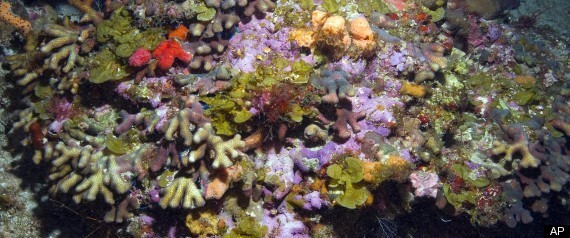
Huffington Post: Coral Reefs May Be Gone By 2050: Study

Coral Reef

The Huffington Post  Joanna Zelman  Posted: 02/25/11 08:37 AM


A recent study has found that all of the world’s coral reefs could be gone by 2050. If lost, 500 million people’s livelihoods worldwide would be threatened.

The World Resources Institute report, “Reefs at Risk Revisited,” suggests that by 2030, over 90 percent of coral reefs will be threatened. If action isn’t taken soon, nearly all reefs will be threatened by 2050. Jane Lubchenco, administrator of the National Oceanic and Atmospheric Administration states, “Threats on land, along the coast and in the water are converging in a perfect storm of threats to reefs.”

The AFP suggests that these threats include overfishing, coastal development, pollution, and climate change. Warming sea temperatures lead to coral bleaching, a stress response where corals expose their white skeletons. In 2005, the Caribbean saw the most extensive coral bleaching event ever recorded, often attributed to rising ocean temperatures. CO2 emissions are also making the oceans more acidic. Because of the rising acidity levels, some scientists claim we will see conditions not witnessed since the period of dinosaurs.

Lauretta Burke, one of the report’s lead authors, feels that quick action could help save the reefs. She encourages policymakers to reduce overfishing and cut greenhouse gas emissions. If action is not taken though, millions of people will suffer. Shorelines will lose protection from storms — a Time Magazine post suggests that up to 90 percent of the energy from wind generated waves is absorbed by reef ecosystems. If reefs are lost, coastal communities will lose a source of food security and tourism.

Special thanks to Erika Biddle.

Coral-list: P.L. Harrison: New Coral Global Reproduction Review Available

Colleagues,

the following global coral reproduction review chapter has recently
been published in Dubinsky and Stambler’s book:

Harrison, P.L. (2011). Sexual reproduction of scleractinian corals.
In: Z. Dubinsky and N. Stambler (Editors), Coral Reefs: An Ecosystem
in Transition Part 3, 59-85,
DOI: 10.1007/978-94-007-0114-4_6 Springer Publishers.

This new review presents a synthesis of current global knowledge of
coral reproduction and updates aspects of the earlier major review by
Harrison, P.L. and Wallace, C.C. (1990), with particular emphasis on
new data and molecular perspectives that have emerged during the past
two decades.

Some key points that may be of interest:
Information on sexual reproduction is now available for 444
scleractinian coral species (almost double the number of species
compared with the 230 species whose reproductive characteristics had
been studied by the late 1980s).

The global data confirm many of the trends noted previously: the
great majority of species that have been studied are hermaphroditic
broadcast spawers (64.5%) with fewer gonochoric spawners (19.5%) and
relatively few hermaphroditic brooders or gonochoric brooders
recorded. However, there are a number of species for which mixed
sexual patterns/sex change and/or both brooding and spawning modes of
development have been recorded hence these sexual patterns and modes
of development are not simple binary characteristics for all
scleractinian corals.

Biogeographical patterns are even more complex:  multispecific
spawning has been recorded in many reef regions, but the scale of
spawning and degree of reproductive synchrony within and among
populations of different species forms a continuum from largely
asynchronous patterns through to highly synchronised mass spawning
events.

If you want to know more please contact me.  Read the actual paper here. Harrison 2011 Coral Reproduction Review[1]

cheers, Peter

Professor Peter Harrison, PhD
Director of Marine Studies SCU
Director, Marine Ecology Research Centre
Research Leader, Coral Reef and Whale Research Teams
Marine Science and Management Course Coordinator
School of Environmental Science and Management
Southern Cross University, PO Box 157
Lismore NSW 2480   AUSTRALIA
Patron, Banyan Tree Marine Labs, Maldives
SCU Phone: 0266 203774    Fax: 0266 212669
Mobile: 0407456249
E-mail: peter.harrison@scu.edu.au
International Phone: 61 266 203774   International Fax: 61 266 212669
_______________________________________________
Special thanks to:

Coral-List mailing list
Coral-List@coral.aoml.noaa.gov
http://coral.aoml.noaa.gov/mailman/listinfo/coral-list