Commondreams.org: The Guardian/UK: Climate Skeptic Willie Soon Received $1m from Oil Companies, Papers Show

http://www.commondreams.org/headline/2011/06/28-12

Published on Tuesday, June 28, 2011
Documents obtained by Greenpeace show prominent opponent of climate change was funded by ExxonMobil, among others
by John Vidal

One of the world’s most prominent scientific figures to be skeptical about climate change has admitted to being paid more than $1m in the past decade by major US oil and coal companies.

Willie Soon received over $1m from oil companies including ExxonMobil, documents reveal. (Photograph: Donna Williams/AP) Dr Willie Soon, an astrophysicist at the Solar, Stellar and Planetary Sciences Division of the Harvard-Smithsonian Centre for Astrophysics, is known for his view that global warming and the melting of the arctic sea ice is caused by solar variation rather than human-caused CO2 emissions, and that polar bears are not primarily threatened by climate change.

But according to a Greenpeace US investigation, he has been heavily funded by coal and oil industry interests since 2001, receiving money from ExxonMobil, the American Petroleum Institute and Koch Industries along with Southern, one of the world’s largest coal-burning utility companies. Since 2002, it is alleged, every new grant he has received has been from either oil or coal interests.

In addition, freedom of information documents suggest that Soon corresponded in 2003 with other prominent climate skeptics to try to weaken a major assessment of global warming being conducted by the UN’s leading climate science body, the Nobel prize-winning Intergovernmental Panel on Climate Change.

Soon, who had previously disclosed corporate funding he received in the 1990s, was today reportly unapologetic, telling Reuters that he agreed that he had received money from all of the groups and companies named in the report but denied that any group would have influenced his studies.

“I have never been motivated by financial reward in any of my scientific research,” he said. “I would have accepted money from Greenpeace if they had offered it to do my research.” He did not respond to a request from the Guardian to comment.

Documents provided to Greenpeace by the Smithsonian under the US Freedom of Information Act (FoIA) show that the Charles G Koch Foundation, a leading provider of funds for climate sceptic groups, gave Soon two grants totalling $175,000 (then roughly £102,000) in 2005/6 and again in 2010. In addition the American Petroleum Institute (API), which represents the US petroleum and natural gas industries, gave him multiple grants between 2001 and 2007 totalling $274,000, oil company Exxon Mobil provided $335,000 between 2005 and 2010, and Soon received other grants from coal and oil industry sources including the Mobil Foundation, the Texaco Foundation and the Electric Power Research Institute.

As one of very few scientists to publish in peer-reviewed literature denying climate change, Soon is widely regarded as one of the leading skeptical voices. His scientific position and the vehemence of his views has made him a central figure in a heated political debate that has informed the US right wing and helped to undermine public trust in the science of global warming and UN negotiations.

“A campaign of climate change denial has been waged for over 20 years by big oil and big coal,” said Kert Davies, a research director at Greenpeace US. “Scientists like Dr Soon, who take fossil fuel money and pretend to be independent scientists, are pawns.”

Soon has strongly argued that the 20th century was not a uniquely extreme climatic period. His most famous work challenged the “hockey stick” graph of temperature records published by Michael Mann, which showed a relatively sharp rise in temperatures during the second half of the 20th century. A paper published with Sallie Baliunas in 2003 in the journal Climate Research which attacked the hockey stick on flimsy evidence led to a group of leading climate scientists including Mann deciding to boycott the journal. In a letter to the Guardian in February 2004, Soon wrote that the authors had been open about their sources of funding. “All sources of funding for our research were fully disclosed in our manuscript. Most of our funding came from federal agencies, including the Air Force Office of Scientific Research and Nasa,” he wrote.

He has also questioned the health risks of mercury emissions from coal and in 2007 co-wrote a paper that down-played the idea that polar bears are threatened by human-caused climate change

The investigation is likely to embarrass Exxon, the world’s largest oil company, which for many years funded climate sceptics but in 2008 declared it would cut funds to lobby groups that “divert attention” from the need to find new sources of clean energy. According to the documents, Exxon provided $55,000 for Soon to study Arctic climate change in 2007 and 2008, and another $76,106 for research into solar variability between 2008 and 2010.

Exxon spokesman Alan Jeffers said this week the company did not fund Soon last year, and that it funds hundreds of organisations to do research on climate and the environment.

Southern gave Soon $120,000 starting in 2008 to study the Sun’s relation to climate change, according to the FIA documents. Spokeswoman Stephanie Kirijan said the company has spent about $500m on funding environmental research and development ,and that it did not fund Soon last year.

In one 2003 email released to Greenpeace, that Soon sent, it is believed, to four other leading skeptics, he writes: “Clearly [the fourth assessment report] chapters may be too much for any one of us to tackle them all … But as a team, we may give it our best shot to try to anticipate and counter some of the chapters …” He adds: “I hope we can … see what we can do to weaken the fourth assessment report.”

In 2003 Soon said at a US senate hearing that he had “not knowingly been hired by, nor employed by, nor received grants from any organisation that had taken advocacy positions with respect to the Kyoto protocol or the UN Framework Convention on Climate Change.”
Lenfestocean.org: DILUTION CANNOT BE ASSUMED THE SOLUTION FOR AQUACULTURE POLLUTION by S. K. Venayagamoorthy, H.Ku, O.B. Fringer, A. Chiu, R.L. Naylor, & J.R. Koseff

http://lenfestocean.org/sites/default/files/pollution_plume_summary_final.pdf

Venayagamoorthy, S.K., H. Ku, O.B. Fringer, A. Chiu, R.L. Naylor and J.R. Koseff. 2011. Numerical modeling of
aquaculture dissolved waste transport in a coastal embayment. Environmental Fluid Mechanics.

A recent scientific study published in the journal Environmental Fluid Mechanics shows that the location of
coastal and offshore aquaculture pens can dramatically influence the extent to which dissolved fish farm
waste disperses from its source and reaches coastlines. This study is the first detailed look at how real
world factors influence the flow of wastewater from fish farms and provides a further basis for understanding
the impact of aquaculture fish-pens on coastal water quality.

Marine aquaculture, or fish farming, is viewed as a means to supplement declining wild fisheries and to
help meet the rising global demand for seafood; however it can cause environmental degradation. For
example, water quality can be significantly impacted because farmed fish excrete much of the nutrients
contained in their feed, including nitrogen and phosphorous. In excess, these nutrients, can trigger
eutrophication and depleted oxygen levels. Nutrients discharges are a particular concern when fish are
grown in open net pens because nutrient-laden feces, undigested feed, and other fish wastes flow freely
into the surrounding environment, some settling to the bottom and other waste products dissolving into
the water column. The concentrations of dissolved waste from net pens are often assumed to decline
continuously in all directions as the discharge moves further from the pens, diluting the environmental
impacts as the distance from the pens increases.

Dr. Venayagamoorthy and colleagues, supported by the Lenfest Ocean Program, explored the influence
of local currents and flow conditions on the concentration and dispersal of dissolved wastes from
marine aquaculture net pens. In order to test the assumption that waste products are consistently
diluted as distance from the net pens increases, the scientists developed an idealized computational
model and performed simulations of dissolved pollutant plumes in variable coastal and offshore marine
environments. The simulations included representations of the local physical environment (i.e., the
shape and depth of the embayment containing the pens), flow conditions (i.e., tides and wind-induced
currents), and the physical locale of the pens relative to the coasts and freshwater discharges.
The scientists showed that specific flow conditions around the aquaculture pens, such as tidal flow, the
earth’s rotation, local river discharges and the drag introduced by the pens, can lead to pockets of
concentrated pollution traveling considerable distances from the source, potentially affecting coastal
waters and the coastlines far from the aquaculture pens themselves.

The results of this study show that producers, regulators and other stakeholders cannot simply assume
that fish waste discharge will be diluted consistently as it moves away from the net pens, or that dilution
is necessarily the solution for aquaculture wastes. Instead, they need to consider how factors such as
tides, river outflows, shape of embayments and other factors will influence the concentration and spread
of dissolved wastewater plumes. Thus, the effluent model created in this exercise can be a useful tool
for predicting a site’s ability to meet water quality standards before aquaculture facilities are built.

Lenfest Ocean Program: Protecting Ocean Life Through Marine Science
The Lenfest Ocean Program supports scientific research aimed at forging
solutions to the challenges facing the global marine environment.
email: info@lenfestocean.org

Huffington Post: State Of The Ocean: ‘Shocking’ Report Warns Of Mass Extinction From Current Rate Of Marine Distress

http://www.huffingtonpost.com/2011/06/20/ipso-2011-ocean-report-mass-extinction_n_880656.html

by Travis Donovan

If the current actions contributing to a multifaceted degradation of the world’s oceans aren’t curbed, a mass extinction unlike anything human history has ever seen is coming, an expert panel of scientists warns in an alarming new report.

The preliminary report from the International Programme on the State of the Ocean (IPSO) is the result of the first-ever interdisciplinary international workshop examining the combined impact of all of the stressors currently affecting the oceans, including pollution, warming, acidification, overfishing and hypoxia.

“The findings are shocking,” Dr. Alex Rogers, IPSO’s scientific director, said in a statement released by the group. “This is a very serious situation demanding unequivocal action at every level. We are looking at consequences for humankind that will impact in our lifetime, and worse, our children’s and generations beyond that.”

The scientific panel concluded that degeneration in the oceans is happening much faster than has been predicted, and that the combination of factors currently distressing the marine environment is contributing to the precise conditions that have been associated with all major extinctions in the Earth’s history.

According to the report, three major factors have been present in the handful of mass extinctions that have occurred in the past: an increase of both hypoxia (low oxygen) and anoxia (lack of oxygen that creates “dead zones”) in the oceans, warming and acidification. The panel warns that the combination of these factors will inevitably cause a mass marine extinction if swift action isn’t taken to improve conditions.

The report is the latest of several published in recent months examining the dire conditions of the oceans. A recent World Resources Institute report suggests that all coral reefs could be gone by 2050 if no action is taken to protect them, while a study published earlier this year in BioScience declares oysters as “functionally extinct”, their populations decimated by over-harvesting and disease. Just last week scientists forecasted that this year’s Gulf “dead zone” will be the largest in history due to increased runoff from the Mississippi River dragging in high levels of nitrates and phosphates from fertilizers.

A recent study in the journal Nature, meanwhile, suggests that not only will the next mass extinction be man-made, but that it could already be underway. Unless humans make significant changes to their behavior, that is.
Travis Donovan
Travis Donovan travis.donovan@huffingtonpost.com Become a fan of this reporter
GET UPDATES FROM Travis
Like
718
State Of The Ocean: ‘Shocking’ Report Warns Of Mass Extinction From Current Rate Of Marine Distress
State Of The Ocean Report 2011 Ipso Mass Extinctio

First Posted: 06/20/11 05:19 PM ET Updated: 06/21/11 09:09 AM ET
React
Inspiring
Enlightening
Infuriating
Scary
Helpful
Amazing
Innovative
Adorable
Follow
Climate Change , Our Oceans , Science , IPSO 2011 Report , IPSO Report , Marine Extinction , Mass Extinction , Ocean Extinction , State Of Oceans , State Of The Oceans , State Of The Oceans 2011 , State Of The Oceans 2011 Report , Green News
share this story
9,925
1,721
2,016
Get Green Alerts
Sign Up
Submit this story

If the current actions contributing to a multifaceted degradation of the world’s oceans aren’t curbed, a mass extinction unlike anything human history has ever seen is coming, an expert panel of scientists warns in an alarming new report.

The preliminary report from the International Programme on the State of the Ocean (IPSO) is the result of the first-ever interdisciplinary international workshop examining the combined impact of all of the stressors currently affecting the oceans, including pollution, warming, acidification, overfishing and hypoxia.

“The findings are shocking,” Dr. Alex Rogers, IPSO’s scientific director, said in a statement released by the group. “This is a very serious situation demanding unequivocal action at every level. We are looking at consequences for humankind that will impact in our lifetime, and worse, our children’s and generations beyond that.”

The scientific panel concluded that degeneration in the oceans is happening much faster than has been predicted, and that the combination of factors currently distressing the marine environment is contributing to the precise conditions that have been associated with all major extinctions in the Earth’s history.

According to the report, three major factors have been present in the handful of mass extinctions that have occurred in the past: an increase of both hypoxia (low oxygen) and anoxia (lack of oxygen that creates “dead zones”) in the oceans, warming and acidification. The panel warns that the combination of these factors will inevitably cause a mass marine extinction if swift action isn’t taken to improve conditions.

The report is the latest of several published in recent months examining the dire conditions of the oceans. A recent World Resources Institute report suggests that all coral reefs could be gone by 2050 if no action is taken to protect them, while a study published earlier this year in BioScience declares oysters as “functionally extinct”, their populations decimated by over-harvesting and disease. Just last week scientists forecasted that this year’s Gulf “dead zone” will be the largest in history due to increased runoff from the Mississippi River dragging in high levels of nitrates and phosphates from fertilizers.

A recent study in the journal Nature, meanwhile, suggests that not only will the next mass extinction be man-made, but that it could already be underway. Unless humans make significant changes to their behavior, that is.

The IPSO report calls for such changes, recommending actions in key areas: immediate reduction of CO2 emissions, coordinated efforts to restore marine ecosystems, and universal implementation of the precautionary principle so “activities proceed only if they are shown not to harm the ocean singly or in combination with other activities.” The panel also calls for the UN to swiftly introduce an “effective governance of the High Seas.”

“The challenges for the future of the ocean are vast, but unlike previous generations we know what now needs to happen,” Dan Laffoley of the International Union for Conservation of Nature and Natural Resources (IUCN) and co-author of the report said in a press release for the new report. “The time to protect the blue heart of our planet is now, today and urgent.”

Special thanks to Lynn Davidson.

Commondreams.org: USA Today reports Record ‘Dead Zone’ Predicted in Gulf of Mexico

http://www.commondreams.org/headline/2011/06/15-8

Published on Wednesday, June 15, 2011

by Doyle Rice

The “Dead Zone” in the Gulf of Mexico – a region of oxygen-depleted water off the Louisiana and Texas coasts that is harmful to sea life and the commercial fishing industry – is predicted to be the largest ever recorded this year, federal scientists announced Tuesday.

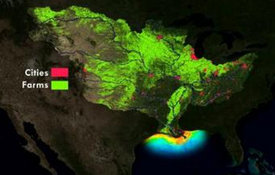
The majority of land in the Mississippi’s watershed is farm land (in green). Each spring, as farmers fertilize their land in preparation for crop season, rain washes fertilizer off the land and into streams, rivers, and then the Gulf of Mexico. This leads to a Dead Zone in the Gulf. (NOAA)

The majority of land in the Mississippi’s watershed is farm land (in green). Each spring, as farmers fertilize their land in preparation for crop season, rain washes fertilizer off the land and into streams, rivers, and then the Gulf of Mexico. This leads to a Dead Zone in the Gulf. (NOAA) The unusually large size of the zone is due to the extreme flooding of the Mississippi River this spring.

The Dead Zone occurs when there is not enough oxygen in the water to support marine life. Also known as “hypoxia,” it is created by nutrient runoff, mostly from over-application of fertilizer on agricultural fields. It flows into streams, then rivers and eventually the Gulf.

Forty-one percent of the contiguous USA drains into the Mississippi River and then out to the Gulf of Mexico. The majority of the land in Mississippi’s watershed is farm land.

Excess nutrients such as nitrogen can spur the growth of algae, and when the algae die, their decay consumes oxygen faster than it can be brought down from the surface, according to NOAA. As a result, fish, shrimp and crabs can suffocate, threatening the region’s commercial fishing industry.

Scientists say the area could measure between 8,500 and 9,421 square miles, or an area about the size of New Hampshire. If it does reach those levels, it would be the largest since mapping of the Gulf Dead Zone began in 1985.

The largest Dead Zone on record occurred in 2002 and encompassed more than 8,400 square miles. On average, the Dead Zone size is estimated to be 6,000 square miles.

Commondreams.org: The Guardian/UK: Explosion in Jellyfish Numbers May Lead to Ecological Disaster, Warn Scientists

http://www.commondreams.org/headline/2011/06/13-5

Published on Monday, June 13, 2011 by The Guardian/UK

by Tracy McVeigh

Global warming has long been blamed for the huge rise in the world’s jellyfish population. But new research suggests that they, in turn, may be worsening the problem by producing more carbon than the oceans can cope with.

Dr Carol Turley, a scientist at Plymouth University’s Marine Laboratory, said the research highlighted the growing problem of ocean acidification, the so-called “evil twin” of global warming. (Image: wiki commons) Research led by Rob Condon of the Virginia Institute of Marine Science in the US focuses on the effect that the increasing numbers of jellyfish are having on marine bateria, which play an important role by recycling nutrients created by decaying organisms back into the food web. The study, published in the journal Proceedings of the National Academy of Sciences, finds that while bacteria are capable of absorbing the constituent carbon, nitrogen, phosphorus and other chemicals given off by most fish when they die, they cannot do the same with jellyfish. The invertebrates, populating the seas in ever-increasing numbers, break down into biomass with especially high levels of carbon, which the bacteria cannot absorb well. Instead of using it to grow, the bacteria breathe it out as carbon dioxide. This means more of the gas is released into the atmosphere.

Dr Carol Turley, a scientist at Plymouth University’s Marine Laboratory, said the research highlighted the growing problem of ocean acidification, the so-called “evil twin” of global warming. “Oceans have been taking up 25% of the carbon dioxide that man has produced over the last 200 years, so it’s been acting as a buffer for climate change. When you add more carbon dioxide to sea water it becomes more acidic. And already that is happening at a rate that hasn’t occurred in 600 million years.”

The acidification of the oceans is already predicted to have such a corrosive effect that unprotected shellfish will dissolve by the middle of the century.”

Condon’s research also found that the spike in jellyfish numbers is also turning the marine food cycle on its head. The creatures devour huge quantities of plankton, thus depriving small fish of the food they need. “This restricts the transfer of energy up the food chain because jellyfish are not readily consumed by other predators,” said Condon.

The increase in the jellyfish population has been attributed to factors including climate change, over-fishing and the runoff of agricultural fertilisers. The rise in sea temperature and the elimination of predators such as sharks and tuna has made conditions ideal, and “blooms” – when populations explode in great swarms, sparking regular panics on beaches around the world– are being reported in ever-increasing size and frequency. Last year scientists at the University of British Columbia found that global warming was causing 2,000 different jellyfish species to appear earlier each year and expanding their number.

The proliferation of jellyfish has caused problems for seaside power and desalination plants in Japan, the Middle East and Africa. The blooms are also perilous to swimmers; the effects of a jellyfish sting range across the species from painless to tingling to agony and death.