Coral-list: Dave Vaughan of Mote Marine reports Elkhorn corals spawning in July at Looe Key

Just a note that /A. palmata/ (i.e. Elkhorn coral) colonies were observed to spawn Tuesday night July 19th.(Looe Key- Florida Keys National Marine Sanctuary, Special Protected Area), at about 2 hours after sunset. This is one month earlier than usual (3-4 days after full moon in August). Could this be a new trend with warmer seawater temperatures? It seams that corals may have spawned earlier these past two years as well. It seams apparent that some corals think its August or September.

Are there any other early spawning observations taking place?

Dave Vaughan,
Coral Reef Research Center Director
Mote Tropical Research Lab
Summerland Key, Florida,
DVaughan@Mote.org

TG Daily.com: Mississippi runoff expands Gulf ‘dead zone’

http://www.tgdaily.com/sustainability-features/57323-mississippi-runoff-expands-gulf-dead-zone
Posted on Jul 19th 2011 by Kate Taylor

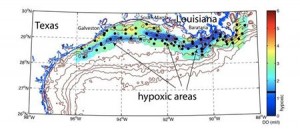
The so-called Gulf Dead Zone is looking set to be the biggest ever this year.

It’s currently about 3,300 square miles, or roughly the size of Delaware and Rhode Island combined, but researchers at Texas A & M University say it’s likely to become much larger.

The dead zone is caused by hypoxia, whereby oxygen levels in seawater drop to dangerously low levels. Severe hypoxia can potentially result in widespread fish kills.

During the past five years, the Gulf dead zone has averaged about 5,800 square miles and has been predicted to exceed 9,400 square miles this year.

More changes are expected because large amounts of water are still flowing into the Gulf of Mexico from the Mississippi River.

“This was the first-ever research cruise conducted to specifically target the size of hypoxia in the month of June,” says oceanography professor Steve DiMarco.

“We found three distinct hypoxic areas. One was near the Barataria and Terrebonne region off the Louisiana coast, the second was south of Marsh Island (also Louisiana) and the third was off the Galveston coast. We found no hypoxia in the 10 stations we visited east of the Mississippi delta.”

The largest areas of hypoxia are still around the Louisiana coast, he says, thanks to the huge amounts of fresh water still coming down from the Mississippi River. The hypoxic area extends about 50 miles off the coast.

The Mississippi is the US’ largest river, draining 40 percent of the land area of the country. It also accounts for almost 90 percent of the freshwater runoff into the Gulf of Mexico.

Special thanks to Craig Quirolo

Conservation Letters: Underestimating the damage: interpreting cetacean carcass recoveries in the context of the Deepwater Horizon/BP incident Rob Williams1, Shane Gero2, Lars Bejder3, John Calambokidis4, Scott D. Kraus5, David Lusseau6, Andrew J. Read7, & Jooke Robbins8

Conservation Letters 4 (2011) 228–233

cetacean carcasses and oil spills 1

Author affiliations:
1Marine Mammal Research Unit, University of British Columbia, Vancouver, Canada
2Department of Biology, Dalhousie University, Halifax, Canada
3Centre for Fish and Fisheries Research, Cetacean Research Unit, Murdoch University, Western Australia
4Cascadia Research Collective, Olympia, WA, USA
5New England Aquarium, Boston, MA, USA
6School of Biology, Aberdeen University, Aberdeen, Scotland, UK
7Nicholas School of the Environment, Duke University, Beaufort, NC, USA
8Humpback Whale Studies Program, Provincetown Center for Coastal Studies, Provincetown, MA, USA

Keywords
Anthropogenic impacts; dolphin; Deepwater
Horizon; Gulf of Mexico; mortality; oil;
strandings.

Correspondence
Rob Williams, Current address: Sea Mammal
Research Unit, Scottish Oceans Institute,
St Andrews Fife KY16 8LB. Tel: +44 (0)1334
462630; Fax: +44 (0)1334 463443.
E-mail: rmcw@st-andrews.ac.uk

Received 23 September 2010
Accepted 15 February 2011
Editor Leah Gerber
doi: 10.1111/j.1755-263X.2011.00168.x

Abstract
Evaluating impacts of human activities on marine ecosystems is difficult when effects occur out of plain sight. Oil spill severity is often measured by the number of marine birds and mammals killed, but only a small fraction of carcasses
are recovered. The Deepwater Horizon/BP oil spill in the Gulf of Mexico was the largest in the U.S. history, but some reports implied modest environmental impacts, in part because of a relatively low number (101) of observed marine mammal mortalities. We estimate historical carcass-detection rates for 14 cetacean species in the northern Gulf of Mexico that have estimates of abundance,
survival rates, and stranding records. This preliminary analysis suggests that carcasses are recovered, on an average, from only 2% (range: 0–6.2%) of cetacean deaths. Thus, the true death toll could be 50 times the number of carcasses recovered, given no additional information. We discuss caveats to this estimate, but present it as a counterpoint to illustrate the magnitude of
misrepresentation implicit in presenting observed carcass counts without similar qualification. We urge methodological development to develop appropriate multipliers. Analytical methods are required to account explicitly for low probability of carcass recovery from cryptic mortality events (e.g., oil spills, ship strikes, bycatch in unmonitored fisheries and acoustic trauma).

Special thanks to Richard Charter