Monthly Archives: December 2010
Natural Resources Defense Council: The Florida Keys Response To the Gulf Oil Disaster: Stories Shared and Lessons Learned by Sarah Chasis- NRDC, Ali Chase- NRDC, Julie Hauserman & Paul Johnson
http://www.nrdc.org/oceans/files/FloridaKeysIP.pdf
Oil spills can travel vast distances and even drilling that occurs hundreds of miles away in the Gulf of Mexico can have real impacts on the health of the protected places like the Florida Keys National Marine Sanctuary. The Keys were at risk because the Loop Current that flows up into the Gulf of Mexico loops down along the western shore of Florida and then heads right along the Florida Keys before picking up the Gulf Stream and shooting along the Atlantic Ocean’s shoreline. When oil started gushing, state, federal, and local officials in the Keys snapped into action. Citizens prepared for the worst. Thankfully, an unusual current — dubbed the “Franklin Eddy” — pinched off the Loop Current and kept the oil from reaching the Keys. One of the most environmentally sensitive island chains in America was spared oiling of its shores.
last revised 12/15/2010
Wall Street Journal: Costly Sand Piles Caught Little Gulf Oil
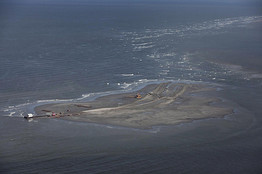
Louisiana’s first sand berm. European Pressphoto Agency.
http://online.wsj.com/article/SB10001424052748703395204576023673494788638.html
Report Questions Value of Effort to Protect Fragile Coastline.
By STEPHEN POWER
Sand piles designed to block oil in the Gulf of Mexico from hitting the Louisiana coast captured a minuscule amount of petroleum at an overwhelmingly expensive cost, according to a report issued Thursday by the staff of a presidential panel investigating the BP PLC oil spill.
The report said federal officials who coordinated the government’s cleanup efforts in the Gulf approved the use of berms not because they believed they would succeed in trapping oil but in response to the pleas of Louisiana politicians, whose demands “overwhelmed” the government’s scientific analysis.
The report by the National Commission on the BP Deepwater Horizon Oil Spill and Offshore Drilling is the latest in a series of white papers its staff has issued in recent months critiquing various aspects of the government’s response to the worst offshore oil spill in U.S. history. A final report, due out in January, could influence how the government plans for and responds to future accidents.
The report issued Thursday examines one of the most contentious aspects of the disaster. The Obama administration approved the construction of miles of berms, and forced BP to pay for them, despite concerns expressed at the time by the Environmental Protection Agency and other federal agencies that building the barriers would take months, and that dredging up sand to build the berms could intensify coastal erosion and alter the water’s salinity, potentially hurting fish.
The report notes that the state’s politicians have for years proposed beefing up their eroded barrier islands as a way to protect their coastline from storms. The BP spill, the report said, “presented an opportunity for state and parish officials to facilitate construction of a large-scale, temporary oil spill response measure whose purpose might, they believed, ‘pivot’ to permanent restoration of Louisiana’s barrier islands—with BP footing the bill.”
Although the National Incident Command—led by Thad Allen, the Coast Guard admiral overseeing the spill response—”sought to balance science with the demands of elected officials,” the report says, “ultimately, pressure to build the berms overwhelmed the analysis.”
In the end, the report concludes, the berms captured “not much more than” 1,000 barrels of oil, compared with the nearly five million barrels that were released from BP’s Macondo well. When considered against the $220 million BP has spent as of last month on constructing the berm project, it “does not survive a rigorous cost-benefit analysis,” the report said.
The office of Louisiana Republican Gov. Bobby Jindal defended the berms Thursday.
“Doing nothing was not an option for us as we fought to protect our coast,” Garret Graves, chairman of the state’s Coastal Protection and Restoration Authority, said in a letter to the commission that the governor’s office released Thursday. “To undercut the function of the berms in hindsight means the Commission staff would have rather employed the fallback plan to just set our marshes on fire weeks after oil saturated them. That was not a viable option for our state.”
A spokeswoman for BP declined to comment on the report.
The report cautions against using offshore barrier berms in response to future oil spills, saying that even with advance planning, it is unlikely they could ever be constructed “to any effective scale” during an emergency as a result of the time and cost needed to build them.
Write to Stephen Power at stephen.power@wsj.com
Special thanks to Richard Charter
AP: Salon–Obama Justice Department sues BP for Gulf oil spill
http://www.salon.com/news/louisiana_oil_spill/?story=/news/feature/2010/12/15/us_gulf_oil_spill_justice_1
Editor: Kerry Lauerman
Wednesday, Dec 15, 2010 14:25 ET
Administration’s lawsuit names nine companies, seeking damages and civil penalties under Clean Water Act
By Associated Press
The Justice Department on Wednesday sued BP Exploration and Production Inc. and eight other companies in the Gulf oil spill disaster in an effort to recover billions of dollars from the largest offshore spill in U.S. history.
The Obama administration’s lawsuit asks that the companies be held liable without limitation under the Oil Pollution Act for all removal costs and damages caused by the oil spill, including damages to natural resources. The lawsuit also seeks civil penalties under the Clean Water Act.
An explosion that killed 11 workers at BP’s Macondo well last April led to oil spewing from the company’s undersea well — more than 200 million gallons in all by the government’s estimate. BP disputes the figure.
The department filed the suit in federal court in New Orleans.
The other defendants in the case are Anadarko Exploration & Production LP and Anadarko Petroleum Corp.; MOEX Offshore 2007 LLC; Triton Asset Leasing GMBH; Transocean Holdings LLC and Transocean Offshore Deepwater Drilling Inc. and Transocean Deepwater Inc.; and BP’s insurer, QBE Underwriting Ltd./Lloyd’s Syndicate 1036.
Anadarko and MOEX are minority owners of the well that blew out. Transocean owned the rig that BP was leasing.
QBE/Lloyd’s can be held liable only up to the amount of insurance policy coverage under the Oil Pollution Act and is not being sued under the Clean Water Act.
The lawsuit alleges that safety and operating regulations were violated in the period leading up to April 20.
It says that the defendants failed to keep the Macondo well under control during that period and failed to use the best available and safest drilling technology to monitor the well’s conditions. They also failed to maintain continuous surveillance and failed to maintain equipment and material that were available and necessary to ensure the safety and protection of personnel, equipment, natural resources and the environment, the suit charges.
Before Wednesday, potential class-action lawsuits had been filed in the Gulf oil spill by fishing and seafood interests, the tourism industry, restaurants and clubs, property owners losing vacation renters — even vacationers who claim the spill forced them to cancel and lose a deposit. So far, more than 300 suits have been spawned by the spill and consolidated in federal court in New Orleans.
Wednesday’s move by the Justice Department follows the Obama administration’s decision not to open new areas of the eastern Gulf and Atlantic seaboard to drilling. That marked a reversal from an earlier decision to hunt for oil and gas, an announcement the president himself made last spring three weeks before the spill.
The staff of a presidentially appointed commission looking into the spill has said that the disaster resulted from questionable decisions and management failures by three companies: BP, the well owner and operator; Transocean, the owner of the Deepwater Horizon rig; and Halliburton.
The panel found 11 decisions made by these companies increased risk. Most saved time, and all but one had a safer alternative.
Separately, an administrator is doling out money to Gulf oil spill victims from a $20 billion fund of BP money.
The Justice Department isn’t the first government entity to sue BP. Alabama Attorney General Troy King filed federal lawsuits in August on behalf of the state against BP, rig owner Transocean, cement contractor Halliburton Energy Services Inc. and other companies that worked on the ill-fated drilling project.
U.S. District Judge Carl Barbier is presiding over most of the consolidated federal suits. In September, Louisiana Attorney General James “Buddy” Caldwell’s office asked Barbier to create a “government case track” to handle government-related suits separately from other claims. The judge hasn’t ruled on that request yet.
Other companies that were not targeted by the Justice Department lawsuit could be added later if the department decides that the evidence warrants it.
Among the other companies whose names have emerged in the aftermath of the spill are Halliburton, which handled the cementing of the well; and Cameron International, which made the blowout preventer that apparently failed to stop the gusher after the rig exploded last April 20.
Special thanks to Richard Charter
Common Dreams.org/Foreign Policy in Focus: Oil or Terrorism: Which Motivates U.S. Policy More?
http://www.commondreams.org/view/2010/12/15-7
Published on Wednesday, December 15, 2010 by Foreign Policy in Focus
by Nafeez Mosaddeq Ahmed
Among the batch of classified diplomatic cables recently released by the controversial whistle-blowing website WikiLeaks, several have highlighted the vast extent of the financial infrastructure of Islamist terrorism sponsored by key U.S. allies in the ongoing “War on Terror.”
One cable by U.S. Secretary of State Hillary Clinton in December 2009 notes that “donors in Saudi Arabia constitute the most significant source of funding to Sunni terrorist groups worldwide.” Despite this, “Riyadh has taken only limited action to disrupt fundraising for the UN 1267-listed Taliban and LeT [Lashkar e-Tayyiba] groups that are also aligned with al-Qaeda.”
Clinton raises similar concerns about other states in the Gulf and Central Asia. Kuwait remains reluctant “to take action against Kuwait-based financiers and facilitators plotting attacks outside of Kuwait.” The United Arab Emirates is “vulnerable to abuse by terrorist financiers and facilitation networks” due to lack of regulatory oversight. Qatar’s cooperation with U.S. counter-terrorism is the “worst in the region,” and authorities are “hesitant to act against known terrorists.” Pakistani military intelligence officials “continue to maintain ties with a wide array of extremist organizations, in particular the Taliban [and the] LeT.”
Despite such extensive knowledge of these terrorism financing activities, successive U.S. administrations have not only failed to exert military or economic pressure on these countries, but in fact have actively protected them, funnelling billions of dollars of military and economic assistance. The reason is oil.
It’s the Hydrocarbons, Stupid
Oil has always been an overwhelming Western interest in the region, beginning with Britain’s discovery of it in Persia in 1908. Britain controlled most Middle East oil until the end of World War II, after which the United States secured its sphere of influence in Saudi Arabia. After some pushback, Britain eventually accepted the United States as the lead player in the region. “US-UK agreement upon the broad, forward-looking pattern for the development and utilisation of petroleum resources under the control of nationals of the two countries is of the highest strategic and commercial importance”, reads a 1945 memo from the chief of the State Department’s Petroleum Division.
Anglo-U.S. geo-strategy exerted this control through alliances with the region’s most authoritarian regimes to ensure a cheap and stable supply of petroleum to Western markets. Recently declassified secret British Foreign Office files from the 1940s and 1950s confirm that the Gulf sheikhdoms were largely created to retain British influence in the Middle East. Britain pledged to protect them from external attack and to “counter hostile influence and propaganda within the countries themselves.” Police and military training would help in “maintaining internal security.” Similarly, in 1958 a U.S. State Department official noted that the Gulf sheikhdoms should be modernized without undermining “the fundamental authority of the ruling groups.”
The protection of some of the world’s most virulent authoritarian regimes thus became integral to maintaining Anglo-U.S. geopolitical control of the world’s strategic hydrocarbon energy reserves. Our governments have willingly paid a high price for this access – the price of national security.
Still Funding Radicalism
One of al-Qaeda’s chief grievances against the West is what Osama bin Laden dubs the “Crusader-Jewish” presence in the lands of Islam, including support for repressive Arab regimes. Under U.S. direction and sponsorship, many of these allies played a central role in financing and supporting bin Laden’s mujahideen networks in Afghanistan to counter Soviet influence. It is perhaps less well understood that elements of the same regimes continued to support bin Laden’s networks long after the Cold War – and that they have frequently done so in collusion with U.S. intelligence services for short-sighted geopolitical interests.
In fact, Afghanistan provides a rather revealing example. From 1994 to 2001, assisted by Saudi Arabia and Pakistan, the Clinton and Bush II administrations covertly sponsored, flirted and negotiated with the Taliban as a vehicle of regional influence. Congressman Dana Rohrabacher, former White House Special Assistant to Ronald Reagan, also testified before the Senate Foreign Relations Subcommittee on South Asia about the “covert policy that has empowered the Taliban,” in the hopes of bringing sufficient stability to “permit the building of oil pipelines from Central Asia through Afghanistan to Pakistan.”
The Great Game is still in full swing. “Since the U.S.-led offensive that ousted the Taliban from power, the project has been revived and drawn strong U.S. support” reported the Associated Press in 2005. “The pipeline would allow formerly Soviet Central Asian nations to export rich energy resources without relying on Russian routes. The project’s main sponsor is the Asian Development Bank” – in which the United States is the largest shareholder alongside Japan. It so happens that the southern section of the proposed pipeline runs through territory still under de facto Taliban control, where NATO war efforts are focused.
Other evidence demonstrates that control of the world’s strategic energy reserves has always been a key factor in the direction of the “War on Terror”. For instance, the April 2001 study commissioned by then-Vice President Dick Cheney confirmed official fears of an impending global oil supply crunch, energy shortages, and “the need for military intervention” in the Middle East to maintain stability.
Energy and Iran
Other diplomatic cables released by Wikileaks show clearly that oil now remains central to U.S. policy toward Iran, depicting an administration desperate to “wean the world” off Iran’s oil supply, according to the London Telegraph. With world conventional oil production most likely having peaked around 2006, Iran is one of few major suppliers that can potentially boost oil output by another 3 million barrels, and natural gas output by even more. The nuclear question is not the real issue, but provides ample pretext for isolating Iran.
But the U.S. anti-Iran stance has been highly counterproductive. In a series of dispatches for the New Yorker, Seymour Hersh cited U.S. government and intelligence officials confirming that the CIA and the Pentagon have funnelled millions of dollars via Saudi Arabia to al-Qaeda-affiliated Sunni extremist groups across the Middle East and Central Asia. The policy – officially confirmed by a U.S. Presidential Finding in early 2008 – began in 2003 and has spilled over into regions like Iraq and Lebanon, fuelling Sunni-Shi’ite sectarian conflict.
Not only did no Democratic members of the House ever contest the policy but President Obama reappointed the architect of the policy – Robert Gates – as his defence secretary. As former National Security Council staffers Flynt and Hillary Mann Leverett observe, Obama’s decision earlier this year to step up covert military operations in North Africa and the Middle East marked an “intensification of America’s covert war against Iran.”
This anti-Iran directive, which extends covert U.S. support for anti-Shi’ite Islamist militant networks linked to al-Qaeda, hardly fits neatly into the stated objectives of the “War on Terror.” Unless we recognize that controlling access to energy, not fighting terror, is the primary motive.
Beyond Dependency
While classified covert operations continue to bolster terrorist activity, the Obama administration struggles vainly to deal with the geopolitical fall-out. Getting out of this impasse requires, first, recognition of our over-dependence on hydrocarbon energy sources to the detriment of real national security. Beholden to the industry lobbyists and the geopolitical dominance that control of oil provides, Western governments have supported dictatorial regimes that fuel widespread resentment in the Muslim world. Worse, the West has tolerated and until recently colluded in the sponsorship of al-Qaeda terrorist activity by these regimes precisely to maintain the existing global energy system.
Given the convergence of peak oil and climate change, it is imperative to transition to a new, renewable energy system. Such a transition will mitigate the impact of hydrocarbon energy depletion, help prevent the worst effects of anthropogenic global warming, and contribute to economic stability through infrastructure development and job creation.
By weaning us off our reliance on dubious foreign regimes, a shift to renewables and away from supporting oil dictatorships will also make us safer.
This work is licensed under Creative Commons.
Nafeez Mosaddeq Ahmed is executive director of the Institute for Policy Research & Development in London and a contributor to Foreign Policy In Focus. His latest book is A User’s Guide to the Crisis of Civilization: And How to Save It (2010). He blogs at The Cutting Edge.