Category Archives: Uncategorized

PNJ.com: Oil spill, politics biggest state stories in 2010

http://www.pnj.com/article/20101225/NEWS01/12250321/Oil-spill-politics-biggest-state-stories-in-2010-

Paul Flemming * News Journal capital bureau * December 25, 2010

At the beginning of 2010, Floridians knew they’d have a new governor in a year, but no one predicted it would be Rick Scott.

Gov. Charlie Crist was a Republican then, but he would end the year a pariah in the GOP and on his way out of public life.

The town hall meetings surrounding President Barack Obama’s health care initiatives showed the force of tea party activists, whose disenchantment U.S. Sen.-elect Marco Rubio rode into office.

Back in January, it was possible that proponents of offshore drilling for oil and gas in state waters could pass a proposal to allow it. That debate would forever be changed April 20 by the Deepwater Horizon disaster.

Here are some selected highlights of the year from Tallahassee:

January

* Republican Party of Florida Chairman Jim Greer was under direct fire from major donors, party leaders and statewide Republicans with increasing demands for his resignation. At a Jan. 9 meeting of the party’s executive board, Greer was voted out.

* At the end of the month, Crist delivered his final budget as governor. It proposed spending $69.2 billion and relied on money from a Seminole-gambling compact that didn’t then exist and more than a billion extra federal Medicaid dollars that hadn’t been approved.

February

* Republican Rep. Ray Sansom of Destin, under criminal indictment related to a $6 million Okaloosa County airport hangar that cost him his speakership the year before, resigned from the House rather than face an ethics hearing by fellow representatives. Sansom said the structure of the ethics hearing compromised his criminal defense.
March

* U.S. Rep. Allen Boyd, a Monticello Democrat, voted for a revised version of Obama’s health care legislation. The bill passed narrowly.

Minutes after Obama signed the proposal into law, Attorney General Bill McCollum filed a legal challenge in federal court in Pensacola on behalf of Florida. He was joined by a dozen other states.

April

* During 10 days at the end of the month: BP’s Deepwater Horizon drilling rig exploded in the Gulf of Mexico killing 11 crew members; Crist left the Republican Party to run for the U.S. Senate as an independent; and the Legislature passed a $70 billion budget remarkably close to what Crist proposed.

May

* Crist declared a state of emergency for five Northwest Florida counties in response to the Deepwater Horizon disaster.

* Anyone watching TV recognized Rick Scott, who spent $5 million on advertising, already more than Republican gubernatorial frontrunner McCollum had raised in his bid for the nomination.

“My goal is to connect with Floridians,” Scott said.
June

* Ousted GOP chairman Greer was jailed at the beginning of the month, charged with six felonies of skimming more than $100,000 from the state GOP under a secret contract he rigged with an aide.

* More than a month after the Deepwater Horizon explosion, oil hit Florida beaches, starting in Escambia County. Throughout the month, winds and currents pushed pollution onto the Panhandle’s shores.

Crist showed up in Pensacola early in the month with singer Jimmy Buffett to see the damage.

“We’re going to be open for business come hell or high water,” Buffett said. “People in the Panhandle are tough people.”
July

* On July 15, BP’s Deepwater Horizon well was capped. Later estimates concluded 4.9 million barrels spilled into the Gulf.

* Leon County Circuit Judge John Cooper ordered Florida State University and the National Collegiate Athletic Association to pay more than $300,000 in legal fees paid by media outlets in a public-records case.

The year before, Cooper’s and appeal court rulings forced the release of more than 700 pages of documents in an academic-cheating inquiry.
August

* After a St. Petersburg Times story detailed the features of the still-under-construction 1st District Court of Appeal building in southeast Tallahassee, Loranne Ausley, Democratic candidate for chief financial officer, began the criticism that continued through the election and beyond.

* Scott beat McCollum in the GOP primary, spending more than $40 million of his money in the win. CFO Alex Sink easily won the Democratic primary for governor.
September

* Pensacola federal judge Roger Vinson allowed McCollum’s lawsuit challenging Obama’s health care legislation, now joined by 19 other states, to go forward.

October

* Sink criticized judges of the 1st District Court of Appeal and project managers at the Department of Management Services with an audit that derided the new $49 million courthouse. The audit reported 17 instances of inconsistencies with state laws and rules.

* The state’s Ethics Commission found that incoming Senate President Mike Haridopolos of Merritt Island failed to disclose tens of thousands of dollars in pay through his consulting firm, along with misreported assets.
November

* Scott defeated Sink, all three Cabinet positions went to Republicans, four incumbent Florida Democratic members of Congress were sent packing and the statehouse swung even further to the GOP with veto-proof majorities in both chambers.

* Rubio defeated Crist and U.S. Rep. Kendrick Meek in the race for U.S. Senate.
December

* Crist, in one of his last actions as governor, posthumously pardoned rock legend Jim Morrison for a 1969 indecent-exposure conviction from a Miami concert.

* The U.S. Department of Justice filed suit against BP and eight other companies it says were responsible for the Deepwater Horizon spill, seeking billions in fines and cleanup costs.

Jim Ash and Bill Cotterell contributed to this report.

Special thanks to Richard Charter.
The Online Clearinghouse for Education & Networking: Oil Interdisciplinary Learning (OCEAN-OIL)

http://www.eoearth.org/topics/view/50359/< Boston University, Louisiana State University, and the National Council for Science and the Environment (NCSE) have created a resource that will allow you to explore these questions and others, as well as to contribute your own expertise. The Online Clearinghouse for Education & Networking: Oil Interdisciplinary Learning (OCEAN-OIL) is an open-access, peer-reviewed electronic education resource about the Deepwater Horizon disaster. OCEAN-OIL is funded by the National Science Foundation. Special thanks to Coral-list.

Natural Resources Defense Council: The Florida Keys Response To the Gulf Oil Disaster: Stories Shared and Lessons Learned by Sarah Chasis- NRDC, Ali Chase- NRDC, Julie Hauserman & Paul Johnson

http://www.nrdc.org/oceans/files/FloridaKeysIP.pdf
Oil spills can travel vast distances and even drilling that occurs hundreds of miles away in the Gulf of Mexico can have real impacts on the health of the protected places like the Florida Keys National Marine Sanctuary. The Keys were at risk because the Loop Current that flows up into the Gulf of Mexico loops down along the western shore of Florida and then heads right along the Florida Keys before picking up the Gulf Stream and shooting along the Atlantic Ocean’s shoreline. When oil started gushing, state, federal, and local officials in the Keys snapped into action. Citizens prepared for the worst. Thankfully, an unusual current — dubbed the “Franklin Eddy” — pinched off the Loop Current and kept the oil from reaching the Keys. One of the most environmentally sensitive island chains in America was spared oiling of its shores.

last revised 12/15/2010

Wall Street Journal: Costly Sand Piles Caught Little Gulf Oil

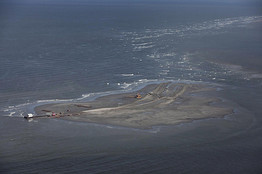
Louisiana’s first sand berm. European Pressphoto Agency.

http://online.wsj.com/article/SB10001424052748703395204576023673494788638.html

Report Questions Value of Effort to Protect Fragile Coastline.

By STEPHEN POWER

Sand piles designed to block oil in the Gulf of Mexico from hitting the Louisiana coast captured a minuscule amount of petroleum at an overwhelmingly expensive cost, according to a report issued Thursday by the staff of a presidential panel investigating the BP PLC oil spill.

The report said federal officials who coordinated the government’s cleanup efforts in the Gulf approved the use of berms not because they believed they would succeed in trapping oil but in response to the pleas of Louisiana politicians, whose demands “overwhelmed” the government’s scientific analysis.

The report by the National Commission on the BP Deepwater Horizon Oil Spill and Offshore Drilling is the latest in a series of white papers its staff has issued in recent months critiquing various aspects of the government’s response to the worst offshore oil spill in U.S. history. A final report, due out in January, could influence how the government plans for and responds to future accidents.

The report issued Thursday examines one of the most contentious aspects of the disaster. The Obama administration approved the construction of miles of berms, and forced BP to pay for them, despite concerns expressed at the time by the Environmental Protection Agency and other federal agencies that building the barriers would take months, and that dredging up sand to build the berms could intensify coastal erosion and alter the water’s salinity, potentially hurting fish.

The report notes that the state’s politicians have for years proposed beefing up their eroded barrier islands as a way to protect their coastline from storms. The BP spill, the report said, “presented an opportunity for state and parish officials to facilitate construction of a large-scale, temporary oil spill response measure whose purpose might, they believed, ‘pivot’ to permanent restoration of Louisiana’s barrier islands—with BP footing the bill.”

Although the National Incident Command—led by Thad Allen, the Coast Guard admiral overseeing the spill response—”sought to balance science with the demands of elected officials,” the report says, “ultimately, pressure to build the berms overwhelmed the analysis.”

In the end, the report concludes, the berms captured “not much more than” 1,000 barrels of oil, compared with the nearly five million barrels that were released from BP’s Macondo well. When considered against the $220 million BP has spent as of last month on constructing the berm project, it “does not survive a rigorous cost-benefit analysis,” the report said.

The office of Louisiana Republican Gov. Bobby Jindal defended the berms Thursday.

“Doing nothing was not an option for us as we fought to protect our coast,” Garret Graves, chairman of the state’s Coastal Protection and Restoration Authority, said in a letter to the commission that the governor’s office released Thursday. “To undercut the function of the berms in hindsight means the Commission staff would have rather employed the fallback plan to just set our marshes on fire weeks after oil saturated them. That was not a viable option for our state.”

A spokeswoman for BP declined to comment on the report.

The report cautions against using offshore barrier berms in response to future oil spills, saying that even with advance planning, it is unlikely they could ever be constructed “to any effective scale” during an emergency as a result of the time and cost needed to build them.

Write to Stephen Power at stephen.power@wsj.com

Special thanks to Richard Charter

AP: Salon–Obama Justice Department sues BP for Gulf oil spill

http://www.salon.com/news/louisiana_oil_spill/?story=/news/feature/2010/12/15/us_gulf_oil_spill_justice_1

Editor: Kerry Lauerman
Wednesday, Dec 15, 2010 14:25 ET
Administration’s lawsuit names nine companies, seeking damages and civil penalties under Clean Water Act
By Associated Press

The Justice Department on Wednesday sued BP Exploration and Production Inc. and eight other companies in the Gulf oil spill disaster in an effort to recover billions of dollars from the largest offshore spill in U.S. history.

The Obama administration’s lawsuit asks that the companies be held liable without limitation under the Oil Pollution Act for all removal costs and damages caused by the oil spill, including damages to natural resources. The lawsuit also seeks civil penalties under the Clean Water Act.

An explosion that killed 11 workers at BP’s Macondo well last April led to oil spewing from the company’s undersea well — more than 200 million gallons in all by the government’s estimate. BP disputes the figure.

The department filed the suit in federal court in New Orleans.

The other defendants in the case are Anadarko Exploration & Production LP and Anadarko Petroleum Corp.; MOEX Offshore 2007 LLC; Triton Asset Leasing GMBH; Transocean Holdings LLC and Transocean Offshore Deepwater Drilling Inc. and Transocean Deepwater Inc.; and BP’s insurer, QBE Underwriting Ltd./Lloyd’s Syndicate 1036.

Anadarko and MOEX are minority owners of the well that blew out. Transocean owned the rig that BP was leasing.

QBE/Lloyd’s can be held liable only up to the amount of insurance policy coverage under the Oil Pollution Act and is not being sued under the Clean Water Act.

The lawsuit alleges that safety and operating regulations were violated in the period leading up to April 20.

It says that the defendants failed to keep the Macondo well under control during that period and failed to use the best available and safest drilling technology to monitor the well’s conditions. They also failed to maintain continuous surveillance and failed to maintain equipment and material that were available and necessary to ensure the safety and protection of personnel, equipment, natural resources and the environment, the suit charges.

Before Wednesday, potential class-action lawsuits had been filed in the Gulf oil spill by fishing and seafood interests, the tourism industry, restaurants and clubs, property owners losing vacation renters — even vacationers who claim the spill forced them to cancel and lose a deposit. So far, more than 300 suits have been spawned by the spill and consolidated in federal court in New Orleans.

Wednesday’s move by the Justice Department follows the Obama administration’s decision not to open new areas of the eastern Gulf and Atlantic seaboard to drilling. That marked a reversal from an earlier decision to hunt for oil and gas, an announcement the president himself made last spring three weeks before the spill.

The staff of a presidentially appointed commission looking into the spill has said that the disaster resulted from questionable decisions and management failures by three companies: BP, the well owner and operator; Transocean, the owner of the Deepwater Horizon rig; and Halliburton.

The panel found 11 decisions made by these companies increased risk. Most saved time, and all but one had a safer alternative.

Separately, an administrator is doling out money to Gulf oil spill victims from a $20 billion fund of BP money.

The Justice Department isn’t the first government entity to sue BP. Alabama Attorney General Troy King filed federal lawsuits in August on behalf of the state against BP, rig owner Transocean, cement contractor Halliburton Energy Services Inc. and other companies that worked on the ill-fated drilling project.

U.S. District Judge Carl Barbier is presiding over most of the consolidated federal suits. In September, Louisiana Attorney General James “Buddy” Caldwell’s office asked Barbier to create a “government case track” to handle government-related suits separately from other claims. The judge hasn’t ruled on that request yet.

Other companies that were not targeted by the Justice Department lawsuit could be added later if the department decides that the evidence warrants it.

Among the other companies whose names have emerged in the aftermath of the spill are Halliburton, which handled the cementing of the well; and Cameron International, which made the blowout preventer that apparently failed to stop the gusher after the rig exploded last April 20.

Special thanks to Richard Charter