Category Archives: Uncategorized

Seacoastonline.com: UNH oil specialist talks Gulf future

http://www.seacoastonline.com/apps/pbcs.dll/article?AID=/20100924/NEWS/9240391/-1/NEWSMAP

Long-term effects unknown
By Charles McMahon
cmcmahon@seacoastonline.com
September 24, 2010 2:00 AM
PORTSMOUTH — It could take years — possibly even decades — for environmental and biological effects of the Gulf of Mexico oil spill to come to light, University of New Hampshire oil specialist Dr. Nancy Kinner told local Rotarians on Thursday.
As the co-director of the Coastal Response Research Centre at UNH, Kinner was the featured speaker during a Portsmouth Rotary luncheon held at the Redhook Ale Brewery on Thursday afternoon.
Having been part of the national discussion that took place during efforts to stop the oil spill, and an expert contacted by the media, Kinner said the response and outlook for recovery in the Gulf of Mexico has been the focus of her group’s work for quite a while.
The tragedy began on April 20, when an explosion on the BP-owned Deepwater Horizon oil rig killed 11 workers, sank a drilling rig and led to what Kinner called the worst offshore oil spill in U.S. history.
The spill is estimated to have spewed close to 200 million gallons of oil into the Gulf of Mexico, Kinner said.
Kinner first educated Rotarians on the amount of oil drilling activity that takes place in the Gulf.
If someone were to take all of the pipelines that connect the thousands of oil platforms in the Gulf and connect them the end result would be close to 63,000 miles of pipeline, said Kinner.
“That’s enough to wrap around the equator of Earth two-times-plus,” she said.
Kinner also spoke about the type of oil involved in the spill.
Called “Louisiana sweet crude,” the oil that spread across the Gulf was lighter and less dense but able to rise to the surface quickly and should be considered highly volatile, said Kinner.
“If I opened up a container of it, within a matter of minutes you’d be smelling it in the back of the room,” she said.

When the oil traveled to the surface it mimicked that of a smokestack and spread out, Kinner said. What resulted was the process of emulsion, which Kinner said created thick oil plumes and tar balls that washed ashore.
What makes the recent oil spill so unique and separates it from the Exxon Valdez oil tanker spill in 1989 is the fact that it involved a much larger release of highly concentrated oil over a prolonged period of time.
Despite the fact the spill ended up killing fewer organisms, such as birds, than the Exxon Valdez, Kinner said what researchers are most concerned about are the long-term effects the spill could have on Gulf wildlife.
“We don’t know the long-term impacts on some of the species, and we will have to wait and see,” she said.
Kinner said scientists are beginning to look at the genetic material of organisms affected by the spill to determine whether they have any markers that indicate changes or increased potential for impaired growth or reproduction.
In addition to the effects, Kinner also gave an analysis on response efforts.
Kinner said the concern for people’s lives and the need to determine what resources to protect should be first and foremost in spill response
In the case of the Gulf spill, Kinner said a decision was made at the national level to protect near-shore resources such as the shrimp, crab and lobster industries.
The trade-off, according to Kinner, was deepwater resources and species.
“It’s what do you want to protect more, that’s the only choice you have to make,” Kinner said. “Until you get it stopped, you have to make a trade-off.”

Special thanks to Richard Charter

Everything Alabama.com: Oil lingering in waters off Alabama, Mississippi and Florida beaches


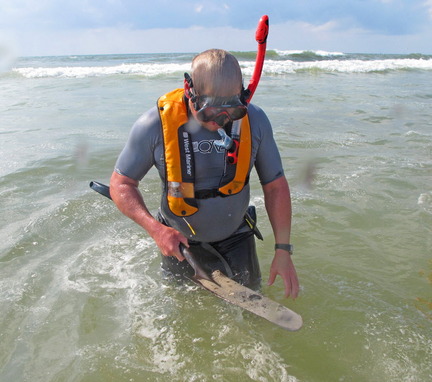
(Press-Register/Ben Raines)Todd Farrar, a BP contractor with the Shoreline Cleanup Assessment Team working its way along the Gulf Coast, examines a layer of oil buried a few inches below the seafloor at the Bon Secour National Wildlife Refuge. He estimated the sample contained about 15 percent oil, with the rest composed of sand and seashells.

http://blog.al.com/live/2010/09/oil_lingering_in_waters_off_al.html

Published: Thursday, September 23, 2010, 5:00 AM Updated: Thursday, September 23, 2010, 4:01 PM
Ben Raines, Press-Register

A good deal of oil remains in the shallow waters closest to the beaches in Mississippi, Alabama and Florida, according to a federal team using shovels and snorkeling gear to survey the coastline for submerged oil.

The team found tarballs washing ashore with every wave Wednesday morning in the Bon Secour National Wildlife Refuge. And just off the beach, in about 3 feet of water, the team found bands of oil buried under 4 or 5 inches of clean sand.

That’s proving to be a common problem, said Todd Farrar, who works for Polaris Applied Sciences, a company hired by BP to do the shoreline assessments with federal officials.

The Shoreline Cleanup Assessment Team, working its way along the Alabama coast this week, also included Aaron Boutin from the U.S. Coast Guard and Stephanie Hill from the National Oceanic and Atmospheric Administration.

The buried oil was broken into small pieces, some as small as BBs, others the size of marbles. Farrar said they were finding similar patches of oil scattered along the Gulf coast, primarily in the areas that saw the most oil come ashore.

The team works from the shoreline out to about 180 feet offshore, unless the water gets deeper than 10 feet.

“We’re basically digging potholes approximately 18 inches deep,” Farrar said. “We do transects in the areas that were hit harder with oil. We’re finding plenty of it.”

For oil close to the beach, the fix is simple: dig it out with heavy equipment sitting on shore.

Farther out, oil removal is more complicated. Farrar said most of it would be vacuumed up with heavy-duty pumps or dug out by track hoes on barges.

“For the greater depths, we haven’t worked out a method yet for doing the assessment,” Farrar said. “If they find oil at those greater depths, we might have to get more inventive about how to clean it up.”

Lauren Jorgensen, with the Coast Guard, said the so-called SCAT survey was the first step in the cleanup process.

“The SCAT teams go out and find evidence of oil underwater. They record the precise location where they find it and then recommend a cleanup method,” Jorgensen said. “Then we resurvey to make sure the cleanup was effective. We’re definitely trying to ensure that the oil is cleaned up.”

Farrar said the oil close to the shore tended to become buried in the layer of loose sand that gets moved around by waves.

Beneath that 5- or 6-inch layer, he said, the sand becomes more compact and resistant to wave action, meaning the oil doesn’t get any deeper.

In the potholes he dug Wednesday morning, Farrar reported that from 10 to 25 percent of the material in his shovel was oil, with the rest composed of sand and seashells. In some areas, the team has documented large mats of tar.

“The tar mats vary greatly. The biggest mat we found was about (150 feet by 210 feet). That was in Pensacola Bay. Some of them are much smaller,” Farrar said. “Usually, they are an inch to an inch-and-a-half thick, though we’ve seen 2 or 3 inches in different spots.”

In Pensacola, more than 3,000 pounds of an oil-sand mix was dredged up in a single day in some areas where Farrar’s team documented oil, according to BP officials.

Back in late June and early July, a large amount of oil was scooped from the Bon Secour beach Farrar snorkeled Wednesday.

Tarballs were still spread liberally around the wildlife refuge’s beaches Wednesday, from the water’s edge up to the first line of sand dunes.

While there was less oil on the sand than was present in July, tarballs remained as easy to find as seashells.

Special thanks to Richard Charter

Maritime Executive: The US Drilling Moratorium –The Economic Impact

http://www.maritime-executive.com/article/2010-9-23-us-drilling-moratorium-economic-impact/

Thursday, September 23rd, 2010
(Crude Awaking -3)

OPED by Tony Munoz, Editor-in-Chief of the Maritime Executive Magazine and MarEx Newsletter

The September 16, 2010 US Inter-Agency report on the economic effects of the deepwater drilling moratorium on the Gulf Coast economy begins by stating there has been little impact. This is based on conversations with rig companies and review of unemployment insurance claims (UI) that show only about 2,000 rigworkers have lost their jobs.

The Department of the Interior (DOI) estimates there were a total of 80,000 offshore oil production, construction and drilling workers in the GOM, and fewer than 10,000 of these workers were employed on rigs affected by the moratorium. Additionally, the report goes on to say the six-month moratorium may temporarily result in about 8,000 to 12,000 fewer jobs in the Gulf Coast and that rig operators have reduced spending by $1.8 billion.

Needless to say Louisiana Governor Bobby Jindal flew off the handle saying his state alone could lose about 20,000 existing and potential new jobs because of the moratorium He went on to point out that the workers still employed in the GOM have had their hours severely cut, which has had an impact on state revenues and has reduced economic activity, which has had a rippling effect throughout the state.

Meanwhile, Senator Mary Landrieu (D-LA) said the administration was aware that their actions might eliminate nearly 23,000 jobs, but proceeded anyway. She attacked the report saying the “the heavy hand of the federal government” has placed thousands of jobs in the GOM at risk. Additionally, Senator David Vitter (R-LA) challenged the accuracy of the report saying “its upbeat analysis was at odds with reality in the gulf.”

Furthermore, a number of regional economists have calculated the GOM region has already loss at least 8,169 jobs, $2.2 billion in economic activity and $98 million in revenue from the lost of state and local taxes. While the report claims to have focused on the direct impact of the moratorium, officials from the Gulf States have called the administration’s drilling moratorium an unnecessary job-killer, which has failed to recognize the wider economic impacts on fishing and tourism and local economies of Gulf Coast cities.

However, DOI’s rebuttal is to point out that federal regulation 43 U.S.C. 1334(a)(1) allows it to “suspend or temporary prohibition any operation or activity, including production, pursuant to any lease or permit….if there is a threat of serious, irreparable, or immediate harm or damage to life including fish or other aquatic life, to property …or to the marine, coastal, or human environment.”

Even though the initial moratorium was struck down by a federal judge and DOI’s appeal to the Fifth Circuit was denied, what the court did say is that the administration could seek emergency relief against offshore drilling. Consequently, on July 12th, Secretary Salazar imposed a second suspension based on “equipment configuration used in conduction deepwater operations.” Meaning all operations using subsea blowout preventers (BOPs) or surface BOPs on a floating facility must have certified inspections before continuing its activities.

Essentially, while the administration cannot get the courts to support its moratorium, it is doing an end run by imposing a “moratorium via technicalities.” Prior to the Deepwater Horizon explosion on April 20th, which killed 11 workers and injured 17 more, the MMS agency granted 14 permits a month for the previous 11 months. Since the explosion, the Bureau of Ocean Energy Management (BOEM) has granted only four permits in the 500-foot “shallow GOM.”

Government versus BP

BP has suspended all dividends to its stockholders and is in the process of selling $30 billion of assets around the world. Additionally, it has set up a $20 billion escrow fund over the next four years to pay damage claims and government penalties and has agreed to contribute $100 million to a foundation to support rig workers who have lost their jobs due to the moratorium. Furthermore, the company has donated $32 million to Florida’s tourism marketing fund as well as providing $15 million each to Louisiana, Mississippi and Alabama to assist in their tourism efforts.

However, on July 30th, the House passed a bill to bar any company from receiving drill permits on the OCS if it has had more than 10 deaths occur at an offshore or onshore facility and bans permits to any company with fines of $10 million or more under the Clean Air and Clean Water Acts in a seven-year period. While BP was not mentioned specifically, it doesn’t take a fourth-grader to figure out whom Representative George Miller (D-CA) was targeting when he wrote the provision. And, while the senate version does not specifically have the same language, it does allow regulators to deny leases to companies with safety or environmental problems.

BP operates 89 production wells and shares in a stake in 60 other wells in the GOM. It produces 400,000 barrels per day, which accounts for about 20 percent of total production in the deepwater GOM. The GOM to BP is worth around $5 -$7 billion annually in profits, which is about 25 percent of the company’s total. So, if BP is not allowed to operate in the GOM, it will not be able to meet its financial obligations and the US tax payer will be on the hook. Considering the massive US deficits already impeding the American recovery, the administration should do everything within its power to ensure BP gets back on its feet.

Higher Costs in the GOM

As US lawmakers impose stringent regulations on the industry to ensure another catastrophe won’t happen again, they would be wise to recognize the long term economic ramifications. Drilling and production costs are projected to skyrocket in the near-term with legislative proposals such as raising the financial responsibility for an oil spill to $10 billion or possibly removing the cap altogether.

Future insurance cost will surely be off-the-charts for operators meaning only companies with the financial wherewithal will be able to do business in the GOM. From here on out corporate boards will be reassessing the financial opportunities against the onerous liabilities.

The Department of Energy (DOE) statistics show more than 36,000 wells have been drilled sine the 1950s. Other than the Macondo blowout, the only other accident took place in Mexico when the Ixtoc well blew in 1979. Small companies and independents will have to form consortiums and merge in order to do business in the offshore GOM because it is estimated that BP has spent $6 billion on the spill cost as well as its overall liability being $32.2 billion, and who knows what costs compliance will bring.

DOI Convenes Town Hall Meeting and Webcast

On September 21st, the DOI held a meeting of scientists, government and industry stakeholders at its headquarters in DC. And, while there weren’t any surprises about lifting the ‘technical moratorium’ or getting oil production back to work in the GOM. Secretaries Salazar and Chu made it clear that the DOI and DOE would continue its investigation of the causes for the explosion, and that more science and oversight was required before haphazardly allowing drilling in the deepwater to continue.

The science they are speaking of will come from DOI’s Bureau of Ocean Energy Management, NOAA, and the EPA, because the old approach of depending on information from the oil industry is passé and unreliable. Remember, the US government is to blame for the lack scientific data provided by the old MMS, because during the 80s and 90s and throughout the 96’ to 06’ moratorium scientific budgets were cut to the bone. The DOI is considering appointing an independent science director to work with federal agencies to analyze deepwater drilling data. Also, the meeting made it clear that more government oversight is required, along with more inspectors and bureaucrats, but the obvious question is where will the money come from? Well, we all know where it’s coming from, the oil companies and, ultimately, you and I.

Zero Failures, No Accidents, No Fatalities, and No Spills

During testimony before Congressional hearings about the Macondo spill, oil company executives made it clear the BP operation was an aberration of normal well management operations. In response to DOI’s moratorium, which is impacting industry revenues, coastal communities and employment, Chevron, ExxonMobil, ConocoPhillips and Shell have announced a rapid response company.

The oil majors have formed the Marine Well Containment Company in the event of future underwater well blowouts in the GOM. The new company will be capable of mobilizing within 24 hours and can capture and contain oil rapidly. The company will engineer equipment that can be used in 10,000 feet of water and have the initial capability of handing 100,000 barrels per day. More importantly, the companies have committed $1 billion in funding for the organization.

With less than five weeks before the moratorium (that doesn’t’ exist) comes to an end, the administration should deal with the reality that the Gulf Coast economy is truly in distress. It is being propped up by the cleanup and artificially being infused by BP’s dwindling assets. When BP is broke and the boats and men come home, Gulf Coast economies and its way of life will be in absolute shambles and an American asset and paradise will resemble the unemployed and decaying industrial north.

Tony Munoz can be contacted at tonymunoz@maritime-executive.com with comments, input and quetions on this editorial.

Special thanks to Richard Charter
Miami Herald: Efforts to clean up Gulf oil continue in Louisiana

Read more: http://www.miamiherald.com/2010/09/21/v-print/1835106/oil-spill-response-head-tours.html#ixzz10FkRSWeU

Posted on Tue, Sep. 21, 2010

By KEVIN McGILL
Associated Press Writer

Crews on fishing boats with giant vacuums sucked up pools of oil near a small Louisiana barrier island Tuesday as officials sought to reassure residents that the cleanup continues even though no crude has leaked in two months.

Coast Guard Rear Adm. Paul Zukunft, who is overseeing the cleanup, said about 23,000 workers are still employed in the effort, about 80 percent of them in Louisiana.

No oil has leaked from the BP PLC well in the Gulf of Mexico since July 15. The well was declared dead Sunday after engineers pumped in cement from to stop up the bottom.

While oil has not been gushing into the Gulf, it continues to come ashore on coastal islands and wetlands in Louisiana. Local officials are worried cleanup efforts won’t be maintained to catch as much of it as possible.

Last week, BP said it was ending a program that employed boat captains as scouts for oil in Alabama, Florida and Mississippi.

The company called the vessels of opportunity program a success, although it was criticized for hiring recreational boats and out-of-state craft while some local commercial boats sat idle.

The boats looked for oil on the coast and helped in the cleanup by skimming for oil and deploying oil barriers.

Later Tuesday, Zukunft told reporters during a conference call that crews continue to respond to pockets of oil washing up along 600 miles of coastline. Besides oil in marshes and on beaches, officials also are focused on monitoring what is below the surface of the water, he said.

While acknowledging oil continues to come ashore in some areas, Zukunft and other Coast Guard officials said that marsh grasses appeared to be recovering. Oil making its way to shore is lighter and sparser.

The BP-leased rig Deepwater Horizon exploded off the Louisiana coast on the night of April 20, killing 11 workers and setting off a massive spill that ultimately led to more than 200 million gallons of oil spewing from BP’s undersea well.

Crude first washed ashore near the mouth of the Mississippi River on April 29. It fouled marshes, caused the closing of fishing grounds and sparked an intense environmental debate over long-term impact of oil in the water and at the bottom of the Gulf.

So far, BP said the effort to shut down the well and clean up the spill has cost $9.5 billion, not including a $20 billion fund the London-based company established to handle claims from individuals and businesses claiming damage from the spill.

On Tuesday, Zukunft reflected on the massive cleanup effort.

“If you were here in June or July you’d have been in thick black oil,” Zukunft said as the fishing boat he was aboard floated on oil free water.

Zukunft estimated that about 900 Vessels of Opportunity are still operating in Louisiana waters, deploying boom where needed or hauling in boom that is damaged or contaminated with oil. He said it was too early to estimate when or how quickly that number would be reduced, saying it will depend on weather and the condition and amount of oil that comes in. Vessels of Opportunity is a BP program that pays boat operators knocked out of work by the spill to assist with response activities.

A few feet away the oil spill effect was still evident. Strands of absorbent boom washed inland by rough weather littered the edge of the island, laying amid dead brown grass lining the perimeter of the lining the island.

Zukunft’s tour came a day after the Unified Area Command that was formed in response to the Deepwater Horizon oil spill announced that it was consolidating command Posts in Houma, La., and Mobile, Ala., into a single Gulf Coast Incident Management Team in New Orleans. Zukunft said that would result in a staff reduction of about 1,800 people.

© 2010 Miami Herald Media Company. http://www.miamiherald.com

Special thanks to Richard Charter

UK Financial Times: BP leak just a bump in road for oil industry

http://www.ft.com/cms/s/0/a10d9c1e-c428-11df-b827-00144feab49a.html

By Ed Crooks in New York
Published: September 19 2010 22:13 | Last updated: September 19 2010 22:13

Workers vacuum up oil from the Gulf of Mexico spill. Heavy oiling remains in Louisiana

For the people of the Gulf of Mexico region, the Deepwater Horizon disaster has been a nightmare of polluted coastlines and threatened livelihoods.

For BP, the crisis has been shattering, putting the future of the company in jeopardy.
For the global oil industry, it looks like being no more than a bump in the road towards further exploitation of deepwater oil reserves, even in the Gulf of Mexico.

Oil companies worldwide have reviewed their practices following the spill, but have generally insisted that their systems remain safe and robust, and that no fundamental changes are needed.

After the big flaws in the US offshore regulatory system exposed by the Deepwater Horizon disaster, the regulation of the Gulf of Mexico will inevitably become tighter, but industry executives believe the US will not be willing to shut off such an important source of future domestic oil production.

Christophe de Margerie, the chief executive of Total of France, one of the ?western world’s five biggest oil groups, said last week that oil exploration in the Gulf of Mexico was likely to take 20 per cent longer and cost 20 per cent more as a result of new US regulations, but that the development of the deepwater reserves of the region would continue.

Globally, countries such as Libya, Greenland, Ghana and the UK have all said that they plan to press ahead with the exploitation of their own deepwater resources.

A typical view was set out last week by Khalid al-Falih, the chief executive of Saudi Aramco, in an interview with the Financial Times.

The company, the world’s biggest oil producer, has looked at the lessons it can learn from BP, but concluded that there is no reason to delay or modify its plans to drill for gas and oil in the deep waters of the Red Sea in 2012.

At last week’s World Energy Congress in Montreal, some executives called for new global safety standards for the industry in order to restore public confidence.

Miguel Martínez, chief operating officer of Repsol YPF, the Spanish oil group that is an important player in the development of Brazil’s deepwater reserves, suggested the leading companies might be able to agree such new standards between themselves.

One area in which companies have already begun to make progress is in developing systems for responding to a spill, which were shown to be manifestly inadequate for BP and the industry as a whole in the Gulf of Mexico.

Tony Hayward, BP’s chief executive, admitted in June that the company did not have all the tools available to stop a blow-out on the seabed in 5,000 feet of water.

Four of the world’s biggest oil companies, pointedly excluding BP, in July announced a plan to set up a new $1bn joint venture to develop a new oil spill response and containment system for the Gulf of Mexico, and the industry is likely to be asked to put similar arrangements in place in other countries as well. Again, however, these new precautions are unlikely to hold back deepwater old production for long.

The greatest test of the longer-term impact of the spill may be in the US Congress, where it will become clear whether or not the disaster has assisted the passage of new legislation aimed at supporting renewable energy.

Special thanks to Richard Charter