Category Archives: Uncategorized

Livescience: Environment: Degraded Oil From BP Spill Coats Gulf Seafloor

http://www.livescience.com/environment/gulf-oil-spill-underwater-plumes-100921.html

By Brett Israel
posted: 21 September 2010 05:45 pm ET
NEW YORK – Now that BP’s Deepwater Horizon oil well has been sealed, the long, hard work of assessing the damage begins even as the oil is dispersing throughout the Gulf.
A research team from Columbia University in New York returned this past weekend (Sept. 17 to 19) from a tour of duty in the Gulf of Mexico with new data to attempt to measure the location and magnitude of subsurface oil plumes, and their effects on the marine ecosystem, which have recently been the focus of much debate.
They found oil on the seafloor, evidence that it may be in the food chain, and signs that it may be hidden in large marine mammals. In spots, the “oily snow” — degraded oil and other organic material that clings to it — was up to 6 inches (15 centimeters) deep on the seafloor, said Columbia oceanographer Ajit Subramaniam.
“The idea that the oil is degraded and therefore doesn’t matter is something we have to think about differently,” Subramaniam said at a talk here today. “This is one of the first findings that showed degraded oil material collected on the seafloor.”
When this gunk starts to pile up on the sea floor, the entire food web is at risk, the researchers said. The oceanographers also discovered discolored zooplankton, which eat the food chain’s primary producers °©– phytoplankton – near oily clouds, Subramaniam said. The full analysis of the effects to the food chain, however, will take several months.
While the deep-ocean effects are largely out of sight, the Gulf’s large mammals — including whales and dolphins — were also hit hard by the oil spill. Yet the true impact may take years to uncover.
“We really don’t know much about the effect of the oil spill in cetaceans, because the effects are likely to be long term,” said marine mammal expert Martin Mendez of the American Museum of Natural History in New York.
Scientists have found 89 dead dolphins and one dead whale in the Gulf since the oil began pouring into the Gulf, Mendez said.
Of the dolphins, one-quarter will undergo necropsies so scientists can say for sure whether or not they died because of the oil. The whale was found floating far from the wellhead and was degraded to the point that a necropsy could not be performed. Something has clearly gone wrong however, because 89 dead dolphins is about 10 times the amount typically found in the Gulf over a similar time period.
The Columbia oceanographers’ data will help researchers track the physical and ecological impact of the Deepwater Horizon oil spill. When BP’s oil rig exploded off the coast of Louisiana on April 22, the ruptured oil well began emptying an estimated 136.4 tons of oil a day into the Gulf of Mexico, resulting in the largest oil spill in U.S. history.
After a relief well was drilled to intercept the well, the gusher was finally sealed on Sept. 18 with a blast of cement to cap the busted pipe.
An estimated 4.4 million barrels of oil (205 million gallons) have leaked into the Gulf since the spill began, but little oil has squirted out since July 15, when a cap was installed and sealed on the wellhead.

Brett Israel is a staff writer for OurAmazingPlanet, a sister site of LiveScience.

Special thanks to Richard Charter

American Institute of Biological Sciences: Joint Society Statement on Public Access to Independent Scientific Research Assessments of the Gulf of Mexico

http://www.aibs.org/position-statements/20100915_september_2010.html
September 15, 2010

*AMERICAN INSTITUTE OF BIOLOGICAL SCIENCES * AMERICAN SOCIETY OF AGRONOMY * AMERICAN SOCIETY OF LIMNOLOGY AND OCEANOGRAPHY * COASTAL & ESTUARINE RESEARCH FEDERATION * COUNCIL OF ENVIRONMENTAL DEANS AND DIRECTORS * CROP SCIENCE SOCIETY OF AMERICA * ECOLOGICAL SOCIETY OF AMERICA * NATIONAL COUNCIL FOR SCIENCE AND THE ENVIRONMENT * NATURAL SCIENCE COLLECTIONS ALLIANCE * NORTH AMERICAN BENTHOLOGICAL SOCIETY * ORNITHOLOGICAL COUNCIL * SOCIETY FOR CONSERVATION BIOLOGY * SOCIETY OF WETLAND SCIENTISTS * SOIL SCIENCE SOCIETY OF AMERICA

——————————————————————————–

Re: Public access to independent scientific research assessments of the Gulf

Dear Senator:

As scientific organizations, we are concerned with the issue of intellectual property rights and ownership of research results that arise in the aftermath of incidents caused by industry, most recently, the BP oil disaster in the Gulf of Mexico. The public needs access to results and conclusions not affected by legal wrangling or private ownership. We are writing specifically to request that a source of independent funding for research on actual or potential industry impacts be available and dispersed from an independent source.

After the Alaska oil spill in 1989, researchers studying its effects on natural systems were prevented from publishing or reporting on their findings, because the responsible company (Exxon) owned the research. Some steps towards a solution were taken since the Valdez spill. One is the Natural Resource Damage Assessment (NRDA) fund, administered by trustees in state and federal government agencies, usually resource agencies. Another is the Oil Pollution Trust Fund, established by the 1990 Oil Pollution Act and administered by the Coast Guard.

While these two funds do not directly place an embargo on scientists’ data, there are cases where government attorneys may want to sequester data, for example, while court cases are being litigated. In addition, provisions in both funds can be overridden if court settlements between the responsible parties (the companies) and the government agencies allow restrictions on release of the data. All the legal maneuvering leads to a stringent cap on what information is released to the public until such time as the case is resolved. This should be avoided. While confidentiality agreements play an important role in a fair legal process, researchers are equally deserving of the right to an open exchange of scientific data and analysis.

Letting the research community have access to external funding through a competitive research program will help the nation develop new understanding and approaches. The National Science Foundation’s (NSF) Rapid Response Research grants program (RAPID) is one such program that provides researchers with funds to study the impacts of the Gulf oil disaster on coastal and marine life in the Gulf of Mexico with quick turnaround. NSF, which has a peer-review system in place and encourages dissemination of results, has made more than 153 awards totaling $17.8 million to track the effects of the oil and oil dispersants.

S. 3663, the Clean Energy Jobs Oil Accountability Act, would help fund research to better understand and manage the nation’s waters and marine and aquatic resources, including the Gulf of Mexico. The bill proposes an independent panel composed of a mix of federal agency representatives, academics and others to review grant proposals to gain greater understanding of ocean and coastal ecosystems and marine resources.

We encourage you to support the preservation of the Senate bill provisions as well as additional statutes as needed to ensure that scientists retain their right to independent peer-reviewed study. Maintaining public access to candid, comprehensive and qualitative impact assessments will ultimately encourage better management, restoration and stewardship of all our nation’s ecosystems and natural resources.

Thank you for considering these points.

Sincerely,

American Institute of Biological Sciences
American Society of Agronomy
American Society of Limnology and Oceanography
Coastal & Estuarine Research Federation
Council of Environmental Deans and Directors
Crop Science Society of America
Ecological Society of America
National Council for Science and the Environment
Natural Science Collections Alliance
North American Benthological Society
Ornithological Council
Society for Conservation Biology Society of Wetland Scientists Soil Science Society of America

Special thanks to Erika Biddle and Tina Johnson

Greenpeace: Going Beyond Oil Blogpost 9/21/10


© Will Rose / Greenpeace

http://www.greenpeace.org/usa/en/news-and-blogs/campaign-blog/going-beyond-oil/blog/26454
Blogpost by Philip_Radford – September 21, 2010 at 19:32 PM 2 comments

Despite the overwhelming evidence that Big Oil’s reckless pursuit of the last remaining oil reserves (and ever-more exorbitant profits) is disastrous for the planet, governments of the world are still greenlighting dangerous deepwater drilling projects.

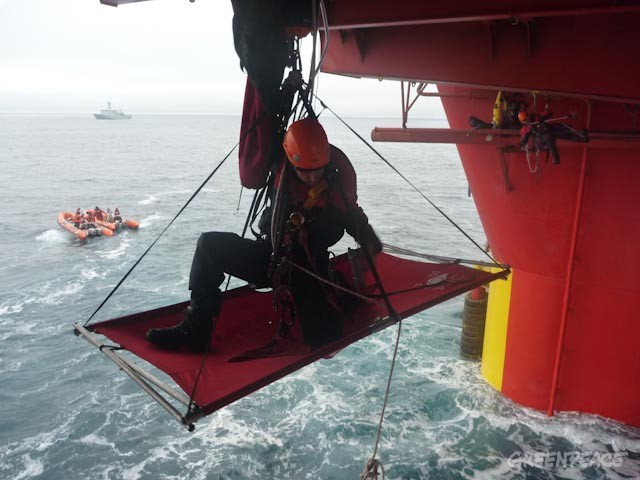
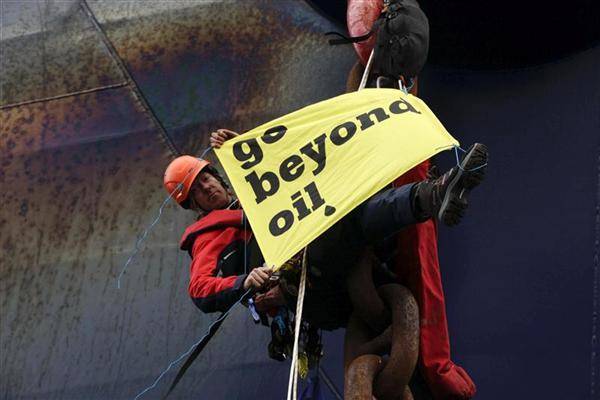
That’s why this morning two Greenpeace activists locked down the anchor chain of Chevron’s drill ship the Stena Carron, which was scheduled to depart for a deepwater drilling site north of Scotland’s Shetland Islands. While our activists physically prevent one more irresponsible drilling project from getting underway, we’re calling on all governments to ban deepwater drilling once and for all.

The action was launched from the Greenpeace ship Esperanza, which was also the base of operations for the activists who staged a 40-hour occupation of Cairn Energy’s Stena Don oil rig off the coast of Greenland earlier this month. There is real danger that the Stena Don could spark an Arctic oil rush, which would pose a huge threat to the climate and put the fragile Arctic environment at risk. So, for nearly two days, Greenpeace activists prevented this dangerous drilling operation from proceeding to threaten any more marine life and coastal ecosystems with catastrophic oil spills.

© Greenpeace

This is as much a moral issue as an environmental issue. We don’t fully understand the long-term effects of oil spills like the BP Deepwater Disaster in the Gulf of Mexico. We need independent science to find out what those will be. All we do know for certain is that the oil and its impacts will persist for decades. Surely we can all agree that we owe our children a healthy planet to live on? And unfortunately, as is now all-too clear, expanding offshore drilling operations is incompatible with keeping our planet healthy enough to support future generations.

That’s why we’re not only working to stop more dangerous drilling, we’re also seeking to get to the truth about the impacts of oil spills. Our ship, the Arctic Sunrise, is now halfway through its three-month expedition in the Gulf and has hosted several teams of independent scientists who are working to understand where all of BP’s oil has gone and what it’s doing to marine wildlife and ecosystems in the Gulf. You can stay up do date with the crew’s findings via our Google Earth map, which is tracking blog posts, pictures, and videos coming from the crew onboard the ship.

If you want to know even more about the long-term effects of oil spills and how we can prevent future oil spills from happening, tune in this Friday to the blogger briefing Greenpeace is hosting as part of UN Week. Greenpeace USA’s Kert Davies is onboard the Arctic Sunrise in the Gulf right now and will be participating in the briefing as well as answering your questions live via video Skype.

We’re not just against oil, we’re for clean, sustainable energy. Sven Teske, the author of our Energy [R]evolution report, will be taking part in the briefing to discuss how expanding our offshore drilling operations is not only dangerous, but unnecessary. We can get to 80 percent renewable energy globally by 2050, and we’d be creating 12 million jobs by 2030 in the process.

A clean energy revolution would not only help stop global warming and get our ailing economy back on track, but it is also the only 100 percent fail-safe method for preventing oil spills. That’s because the only way to stop oil spills is to leave the oil in the ground (or hundreds of feet under the sea, as the case may be). We can’t do that until we move beyond oil and other fossil fuels as our primary energy sources.

Greenpeace will continue to confront reckless new oil drilling operations and bring attention to the issue, but we need to build a widespread movement that demands we go beyond oil as soon as possible. Join us on the blogger briefing this Friday to find out how you can help get us there.

CBS: NEW ORLEANS TV STATION FINDS OIL SPILL COVERUP; CONGRESSMAN CALLS FOR INVESTIGATION

http://www.thecypresstimes.com/article/News/National_News/NEW_ORLEANS_TV_STATION_FINDS_OIL_SPILL_COVERUP_CONGRESSMAN_CALLS_FOR_INVESTIGATION/33602

The video report is more descriptive so go to the link:

Published 09/17/2010 – 9:22 a.m. CST

Local CBS affiliate WWL TV of New Orleans uncovered an attempt by the Presidential Commission on the oil spill to “chill” independent research which is finding extremely dangerous levels of toxic material in gulf waters and seafood, including shrimp and oysters. These researchers are presenting their findings today in New Orleans at the Loyola University Symposium on the status of the oil catastrophe, and their findings contradict the government’s official announcement that there is no contamination. Congressman Anh Cao who sits on the House Committee on Oversight and Government Reform has called for an investigation into the matter.

Loyola University New Orleans College of Law presents “The Deepwater Horizon Oil Spill-A Billion Pound Dossier,” a legal and environmental examination of the BP disaster in the Gulf of Mexico. The symposium will be held on Friday, Sept. 17, from 1:15 – 5:30 p.m., in Loyola’s College of Law, 526 Pine Street, Room 405. It is free and open to the public. A reception will follow.

Panelists include Stuart H. Smith, J.D. ’86, a longtime Loyola supporter and environmental advocate (Smith Stag, L.L.C.), Joel Waltzer (Waltzer & Wiygul) and Mitch Crusto, an expert on disaster and environmental management (College of Law, Loyola University New Orleans).

Public health, as well as coastal ecosystems, marine life, plant and wildlife will be the focus of the second panel (approximately 3 pm). Particular emphasis will be placed on documenting environmental contamination and natural resources damages. Panelists include William R. Sawyer, Ph.D. (Toxicology Consultants & Assessment Specialists, L.L.C.), Marco Kaltofen (Boston Chemical Data Corp.), Anthony Ladd, Ph.D. (Department of Sociology, Loyola University New Orleans), LuAnn E. White, Ph.D. (Tulane Center for Applied Environmental Public Health) and Paul Barnes, Ph.D. (Department of Biological Sciences, Loyola University New Orleans).

Special thanks to Richard Charter

Vanity Fair: Letter from the Gulf — The Oil and the Turtles


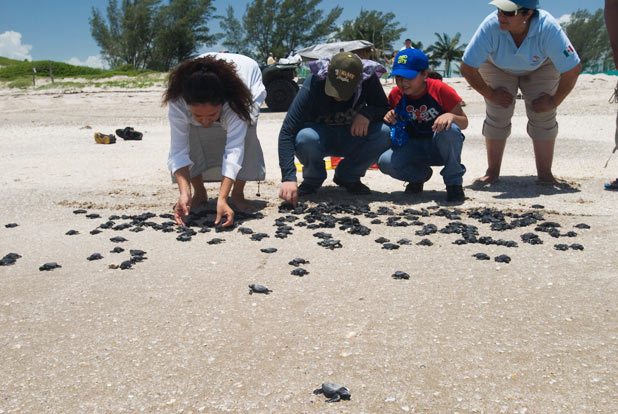
Ridley-turtle hatchlings head into the Gulf in Tamaulipas, Mexico.

http://www.vanityfair.com/culture/features/2010/09/ridley-turtles-201009

Letter from the Gulf
The Oil and the Turtles

Every year, Rancho Nuevo, 900 miles southwest of the Deepwater Horizon blowout, sees a spectacular phenomenon: the arribada-mass nesting-of the Kemp’s ridley sea turtle, which has already neared extinction. This year, thousands of baby ridleys swam off toward a deadly new enemy.

By Alex Shoumatoff*
Photograph by Gary Braasch

WEB EXCLUSIVE September 21, 2010

Of all the devastation in the Gulf of Mexico caused by the Deepwater Horizon blowout, no one single species is being directly affected as much as the critically endangered Kemp’s ridley sea turtle. Only 8,000 adult females nested in 2009, and the adult males are thought to be even fewer. Those that remain have been hit hard. Most of the surviving juveniles inhabit the waters 20 to 30 miles from shore, feeding and growing in the same currents and gyres that collected the bulk of the four million barrels spewed by the now capped well. There were confirmed reports of ridleys being burned alive in the pools of corralled, concentrated oil that BP had been burning off during the spill.

Almost every gravid female ridley lays her eggs on a single beach in Tamaulipas, Mexico, coming ashore in a unique mass-nesting event known as the arribada-the arrival. Kemp’s cousins in the Pacific, the Olive ridleys, also do this, but the other five sea-turtle species (and a small percentage of ridleys) are solitary nesters and don’t always return to the same place. The arribadas happen at Rancho Nuevo-a beach 900 miles southwest from the blowout. It’s only 200 miles south of Brownsville, Texas. Not a bad drive, only I’m told it’s too dangerous because three warring factions of narcotrafficantes-the Gulf cartel, the Zetas (former hit men of the cartel), and a local mafia called La Maña-have been having shoot-outs along it. Instead, I fly to Tampico, the sleepy port where the opening scene of The Treasure of the Sierra Madre was filmed, which is 60 miles south of Rancho Nuevo. (Not that Tampico is immune to the violence; the week before I arrive, the naked bodies of five policemen were found hanging from one of its bridges, I am told by a fellow gringo who narrowly escaped being shaken down at one of the narcos’ impromptu roadblocks right in the city.) I’m met at the airport by two people from the federal agency that manages Mexico’s protected areas, and they whisk me to the nearby Hampton Inn for the night.

In the morning we are driven to the Rancho Nuevo beach reserve by its director Dr. Gloria Tavera. Its 20 miles of wild white sand are patrolled three times a day by guards on A.T.V.’s, and 20 times a day or more during nesting season. Dr. Tavera tells me that the arribadas are over, but that the white ping-pong-ball-size eggs, having incubated for 45 days, are starting to hatch.

Sure enough, at five a.m. on the second morning, we jump onto four-wheelers and bomb down to the South Corral, four miles from the camp, where dozens of the 800 nests from the June 3 arribada are erupting with hatchlings, about 90 per nest. The babies are three inches long and look like black rubber-toy turtles. They crawl down to the surf and, as soon as they hit the water, their angled forelimbs begin to flap wildly. Then they’re pulled into the breaking waves by the undertow and are off, on their own, into the great unknown. Guided by pure instinct, fueled by the remaining yoke in their waterproof belly sacs, they will swim straight out for five days or so until they hit the mats of sargassum, a golden-brown, free-floating marine algae (these lines of sargassum are often only 20 or 30 feet wide, but can extend for miles, and offer cover and food for the hatchlings). We don’t know how many hatchlings will survive to adulthood, but the most common ballpark estimate is only one in a thousand. Many will be picked off by sharks, many other species of fish, dolphins, and sea birds. Everything wants to eat them. But many more than usual will die when the clockwise currents of the Gulf carry the turtles directly up into the area contaminated by the Deepwater Horizon spill. “The internal damage from the hydrocarbons to the organs of the ridleys could make them unable to reproduce,” Dr. Tavera tells me. “That would mean extinction. But nobody knows.”
Her fears could be well founded. A new study of shorebirds finds that the ingestion of only a small amount of oil can cause lasting changes in brain function and behavior. The males’ pheromones are inhibited so they stop doing their mating behavior.

Conservationists rallied round the ridley in 1978, when human predation left them hanging by a thread. Poaching of the eggs-rich and delicious, they had long been part of the local diet-was stopped, and in l986, when only 600 females came back to nest at Rancho Nuevo, an American law was passed requiring shrimp fishermen meeting certain criteria to equip their nets with escape holes for turtles known as TEDs (turtle excluder devices). For a time, it was working. In 2009 there were 21,000 nests. Six thousand females came ashore over a two-day period that May, the biggest arribada in the 40-year history of the conservation program at Rancho Nuevo. But this year there were only 13,115 nests, the result of a record cold winter followed by three months of red tide, a toxic algae bloom that prevented the females from being able to access the beach. Then, on June 30, the beach was slammed by Hurricane Alex, and a thousand more nests were lost.
Barbara Schroeder, of the National Oceanic and Atmospheric Association in Silver Spring, Maryland, thinks the spill is unlikely to spell the end of the ridley but it “is definitely a setback to the turtle’s recovery. We are going to have to enhance our efforts to get the species back on the trajectory it was on, and we will need to re-look at the most significant human threats-bycatch from shrimp and other trawlers and gill nets, hook and line-fishing, and boat strikes.”

That the four million barrels of oil seem to be dissipating more quickly than expected does not mean the turtles will no longer be affected. The oil below the surface concerns many experts. Kemp’s ridleys in nearshore areas feed on the bottom, which means they have to dive through the oil. What’s more, this relatively quick disappearance of the large oil pools was achieved because BP dumped nearly two million gallons of the highly toxic chemical dispersant Corexit into the Gulf-in some cases, without the necessary approval of the Environmental Protection Agency. Corexit, used to break up large pools of oil in water, is an alarmingly unknown entity. Scientists in Louisiana are just beginning to study its effects on marine life in the Gulf. They’ve discovered high levels of it in blue-crab larvae, which suggests the poison may have already entered the food chain, just in time for the start of Louisiana’s shrimp season. Blue crabs are the ridley’s favorite food.

Ed Clark, the president of the Wildlife Center of Virginia, who has been treating oiled wildlife for 28 years, tells me that the dispersant is like “putting a coat of new paint on a junk car.” The official marine-life casualty numbers, Clark maintains, are grossly underestimated. “If they’re saying 400 turtles were killed, I’d bet my house it’s more like 4,000,” he says.

“BP is responsible for the damages”-up to $50,000 per turtle, as per the Endangered Species Act-“but it is incumbent on the government to prove what [the damages] are,” says Clark. He has heard rumors that the cleanup crews on Grand Isle, Louisiana, which are mainly made up of prisoners, were bagging dead turtles and birds in plastic bags marked for incineration because no one from Fish and Wildlife responded to their calls. The F.W.S. agents were mainly focused on federally owned coastline. It may go beyond unresponsive government agencies. Clark also heard rumors that BP was deliberately burning oiled sargassum, even though living sea turtles were known to be still in the floating mats.

So the crisis isn’t over, as BP and the government would have you believe. It’s only beginning. The biological consequences of this disaster will be felt for years, over generations, like Chernobyl. And we may never know how bad it was.

Alex Shoumatoff is a Vanity Fair contributing editor.

Special thanks to Richard Charter