Category Archives: Uncategorized

Washington Post: BP Macondo Well Successfully Capped

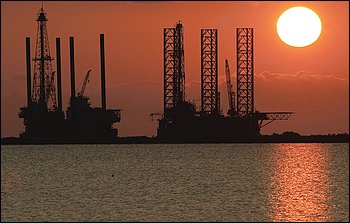
Two offshore oil platforms near Port Fourchon, La. under construction in June, 2010. photo by Saul Loeb

http://www.washingtonpost.com/wp-dyn/content/article/2010/09/17/AR2010091706725.html

By David A. Fahrenthold and Steven Mufson
Saturday, September 18, 2010; 1:48 AM

At last, the well is dead.

BP’s Macondo oil well is physically incapable of leaking another drop, according to the head of the U.S. government’s response effort. Retired Coast Guard Adm. Thad W. Allen said Friday that this discovery was made after a “relief well” finally broke through into the Macondo well more than 17,000 feet below the Gulf of Mexico floor.

This Story
BP Macondo oil well successfully capped
Steps that killed the well
Officials had worried that they would find oil between the pipe and the shaft’s rock wall. But they found none – a discovery that shows that the well is capped and also could provide new clues to what made it blow up in the first place.

“The well presents no further threat of discharge,” Allen said.

But just to be sure, BP plugged it a little bit more. About 4 p.m. Friday, authorities began the long-awaited – and now, rather anti-climactic – “bottom kill,” filling in that empty space with cement. The cement should be set by Saturday afternoon, Allen said, and a final pressure test will allow the declaration of death.

After the American people spent the summer watching the fearsome oil well spill, Allen said this last step was as much for our benefit as it was for the gulf’s.

He said the intent was “psychologically, for people in the gulf to understand that there is a stake in the heart of this beast.”

BP’s well spent about three months repelling all attempts to kill it – eventually spilling 4.9 million barrels, or 205.8 million gallons, into the gulf. Then, it spent the next two months dying: The well was sealed off July 15, and cement was forced down its central pipe in a so-called “static kill” in early August.

Through it all, a rig in the gulf was slowly drilling down to provide the final nail in its coffin. The relief well’s progress was slowed by passing storms – which made the gulf too choppy – but also by the depth of its target. Drilling began on the gulf floor a mile down and continued for another 2.4 miles into the earth.

Finally, on Thursday afternoon, the drill hit its target, a seven-inch shaft. It opened a hole into the space between the shaft’s wall and the outer layer of pipe.

There was no camera recording it, but engineers could learn about the outer space around the Macondo well pipe by studying fluid that rose from the other well’s drill pipe. When no oil came up, they knew that the Macondo well was plugged at its source.

That was a good thing for the gulf. But it could also be a good thing for BP’s legal case, because it could be a signal that the blowout was not caused by a problem with BP’s design for the well’s pipes.

Instead, BP’s lawyers could argue that part of the blame lies in the cementing job done by contractor Halliburton, which was supposed to plug those pipes at the bottom.

This Story
BP Macondo oil well successfully capped
Steps that killed the well
“All the information we have gathered to date . . .leads us to believe conclusively that the well design did not contribute to this accident and the well has complete integrity,” Daren Beaudo, a BP spokesman, said in a statement Friday.

This denouement about four miles down will not do much to alter the way the spill is still affecting life in the gulf, in the oil-smeared states on its shore and in oil-company boardrooms from Houston to London.

In the Louisiana marshes, fishermen have reported patches of peanut-butter-thick oil rising to the surface as the water warms. In Pass a Loutre, La., near the Mississippi River mouth, state officials were grappling with a patch of submerged oil several acres wide.

And even in areas where the oil has disappeared, the spill is still hurting Louisiana’s shrimp business by scaring off its customers.

“Can’t find nobody to take it. Can’t find nobody that wants to eat it,” said David Chauvin, a seafood dealer in Chauvin, La. He said that three-quarters of his boats haven’t returned from helping with BP’s cleanup. “My fear is that, if we have 100 percent of these boats come back, we’d flat out have to tell the boats ‘Look, you have to quit fishing.’ Because we could not sell it at any price.”

For BP, the spill has forced the resignation of its chief executive, Tony Hayward, who steps down Oct. 1. The company is waiting to see if the Justice Department – which is examining equipment such as the “blowout preventer” – will file criminal charges. If not, the financial burden will be immense but more easily within the company’s means.

Already, the spill has washed away more than $70 billion of BP’s market share. The stock is up about 50 percent from its post-spill low point but is down 37 percent from its April 20 close, hours before the Macondo blowout. BP’s stock closed down slightly Friday at $38.03 a share.

And, for those on the Gulf Coast who lost money during the spill, the next step is to wait for Kenneth Feinberg, the administrator of BP’s $20 billion compensation fund. The difficulty of his job, sorting out claims from fishermen, beach resorts and the far-flung businesses that support them, was made clear this week in a series of meetings along the coast.

Feinberg said that 3,000 claims had no documentation and an additional 12,000 had “documentation so inadequate that no one would pay those claims.” After facing angry claimants in Louisiana on Monday and Florida on Tuesday, Feinberg said he felt like “a moving pinata.”

“I must say I underestimated the problems in processing these claims,” Feinberg said. He added: “I never thought it would be easy. But there’s a serious proof problem with some of these claims.”

fahrenthold@washpost.com mufsons@washpost.com

Oil and Gas Journal: Relief well intercepts BP Macondo well in gulf

http://www.ogj.com/index/article-display/8639520373/articles/oil-gas-journal/general-interest-2/hse/2010/09/relief-well_intercepts/QP129867/cmpid=EnlDailySeptember172010.html

Sep 17, 2010
Paula Dittrick
OGJ Senior Staff Writer
HOUSTON, Sept. 17 — A relief well drilled by crews on Transocean Ltd.’s Development Driller III semisubmersible intercepted the annulus of the deepwater Macondo well on Sept. 16, and BP PLC expects crews will completely seal the Macondo well on Sept. 18.

Engineers and scientists from across the oil industry have worked with government scientists for months to reach this point. An Apr. 20 blowout of the Macondo well in 5,000 ft of water and subsequent oil spill prompted the development of new technology and equipment to handle a seabed spill.

An estimated 4.9 million bbl leaked from the well, of which BP estimates it captured 800,000 bbl. No oil has leaked into the gulf since a capping stack was installed on July 15. BP operates the well on Mississippi Canyon Block 252 off Louisiana.

The Macondo well blowout triggered an explosion and fire on Transocean’s Deepwater Horizon semi, which killed 11 people. The Deepwater Horizon sank on Apr. 22. Cause of the accident remains under investigation by a number of government agencies and others.

After replacing the Deepwater Horizon’s failed blowout preventer earlier this month, relief well drilling resumed at 7:15 a.m. CDT on Sept. 15, and crews completed drilling the final 45 ft of hole. Interception of the annulus was confirmed at 4:30 p.m. on Sept. 16. Total measured depth on the DDIII for the annulus intercept point was 17,977 ft.

“Operations conducted bottoms up circulation, which returned the contents of the well’s annulus to the rig for evaluation,” BP said. “Testing of the drilling mud recovered from the well indicated that no hydrocarbons or cement were present at the intersect point. Therefore, no annulus kill is necessary, and the annulus cementing will proceed as planned.”

Once cementing operations are complete, the DDIII will begin standard plugging and abandonment procedures for the relief well.

The Development Driller II semi continues gathering additional data from the Macondo well in efforts to determine the location of the drill pipe in the well during the Apr. 20 accident. DDII’s BOP is latched onto the wellhead.

Subsequently plug and abandonment activities will commence in accordance with the approved procedure, BP said.

National Incident Commander and retired US Coast Guard Adm. Thad Allen issued a news release late Sept. 16 saying he received extensive briefings over the last 24 hr as BP engineers and federal scientists confirmed the relief well intersected the Macondo well.

“The aggregate data available supports the conclusion that the two wells are joined,” Allen said. “It is also important to note that none of the measurements supported a scenario where the annulus of the well is in communication with the reservoir. Accordingly, we intend to proceed with preparation to cement the annulus and complete the bottom kill of the well.”

Contact Paula Dittrick at paulad@ogjonline.com.

Special thanks to Richard Charter

Sept 27-28 Next Oil Spill Commission Hearings in D.C.

SAVE THE DATE
NATIONAL OIL SPILL COMMISSION HOLDS
THIRD PUBLIC HEARING IN WASHINGTON, DC
SEPTEMBER 27 – 28, 2010
FOCUS ON OIL SPILL RESPONSE & RESTORATION ISSUES

The National Commission on the BP Deepwater Horizon Oil Spill and Offshore Drilling (“Oil Spill Commission”) is holding a public hearing regarding response to the BP Deepwater Horizon oil spill, environmental impacts, and approaches to restoration.

Among the panelists:

· The Honorable Ken Salazar, US Secretary of the Interior
· The Honorable Lisa Jackson, US-EPA Administrator
· The Honorable Mary Landrieu, US Senator, Louisiana
· The Honorable Haley Barbour, Governor of Mississippi
· Retired Admiral Thad Allen, National Incident Commander for the Unified Command
· Doug Suttles, Chief Operating Officer for Exploration & Production, BP
· Pete Slaiby, Vice President for Exploration & Production, Shell Alaska
· Mayor Edward Itta, North Slope Borough, Alaska

WHERE: Marriott Wardman Park
2660 Woodley Park Road, NW
Washington, DC 20008

WHEN: Monday & Tuesday, September 27th & 28th, 2010
9:00 am – 5:30 pm Public hearing

Registration begins 8:00 am on both days
Public comment period: 5:00 pm – 5:30 pm for both days

The meeting is open to the public, with a 30 minute public comment period held during both days. Public comment participants are chosen on a first-come, first-serve basis. Time allotted per public comment will be 3 minutes. Registration for those wishing to participate in the public comment period opens on-site at 8:00 am.

For further information: www.oilspillcommission.gov

Andrea Yank
Special Assistant
National Commission on the BP Deepwater Horizon Oil Spill and Offshore Drilling
One Thomas Circle, 4th floor
Washington, DC 20005
202-254-2662

Special thanks to Richard Charter

USF: Gulf of Mexico Oil Spill Conference Feb. 9-11 in St Pete Fl.

Subject: FW: Gulf of Mexico Oil Spill Conference

Planned for February 9-11, 2011, in St. Petersburg, the meeting will address a broad spectrum of questions relating to the aftermath of the Deepwater Horizon event of earlier this year. Topics will include: Geotechnical Engineering, Regional Oceanography, Chemical Weathering – Biological Consumption, Dispersants, Ecological Consequences and Toxicity, Economic and Social Impacts, Human Health Issues, and Stakeholders, Science and Policy.

October 1, 2010 is the deadline for receipt of abstracts for presentation consideration at the upcoming Gulf of Mexico Oil Spill Conference. I ask that you please share this Call for Abstracts with interested colleagues and students.

More information can be found at: http://www.oilspill.usf.edu/

Special thanks to Richard Charter

AP/Washington Times: Allen: Blown-out Gulf well to be sealed by Sunday & New York Times: BP Well May Be Sealed Soon & more…

http://www.washingtontimes.com/

By Harry R. Weber

Associated Press

Updated: 2:56 p.m. on Wednesday, September 15, 2010

KENNER, La. (AP) – The U.S. government’s point man on the Gulf of Mexico oil spill said Wednesday that BP’s blown-out well is expected to be sealed permanently and declared dead by Sunday, nearly five months after a rig explosion set off the disaster.
Retired U.S. Coast Guard Adm. Thad Allen, the national incident commander, told reporters gathered at a seafood distributor in Kenner that a relief well is expected to intersect the blown-out well within 24 hours. He said workers then will pump in mud and cement, which is expected to seal the well within four days.

“We are within a 96-hour window of killing the well,” Adm. Allen said.

The April 20 explosion killed 11 workers and led to 206 million gallons of oil spewing from the deepwater well.

No fresh oil has spewed into the Gulf since a temporary cap was successfully fitted to the top of the well in mid-July. Mud and cement later were pushed down through the top of the well, allowing the cap to be removed. The relief well is being drilled so the well that blew out also can be sealed from the bottom, ensuring that it never causes a problem again.

Appearing with Adm. Allen, National Oceanic and Atmospheric Administration chief Jane Lubchenco said that monitoring continues of oil that remains in the Gulf. Ms. Lubchenco stood by earlier government estimates that 50 percent of the oil that spilled is gone from the water system.

Scientists said earlier this week that they had found thick patches of oil coating the sea floor, raising questions about government conclusions that much of the oil from the spill was gone. Testing is under way this week for chemical fingerprints that would conclusively link that oil to the BP spill.

Still, Adm. Allen and Ms. Lubchenco sought to reassure hesitant diners from outside the region that Gulf seafood is safe to eat during their appearance outside the Louisiana Fish House. Adm. Allen noted that he has eaten Gulf seafood every day for the past several days.

“In short, folks want to know if it is safe to eat, swim and fish, and that is the kind of information we are committed to identifying answers to those questions,” Ms. Lubchenco said.

Gulf shrimpers currently are producing only 20 percent of their normal production for this time of year – because demand is down sharply and because supply is not where it should be in part because of the fact that some shrimpers are wary of taking on the expense of fishing if they can’t sell their catch, according to Ewell Smith, executive director of the Louisiana Seafood Promotion & Marketing Board.

Adm. Allen also said he plans to step down as incident commander on Oct. 1 – the same day BP PLC installs American Bob Dudley as its new chief executive to replace Tony Hayward. Adm. Allen will be replaced by Coast Guard Rear Adm. Paul Zukunft. The move is not a surprise: Adm. Allen said previously that he would transition out of his current rule by late September or early October.

Adm. Allen said in an interview after the news conference that the timing of the transition is not connected to BP’s leadership change.

“I worked well with Tony Hayward, and I work well with Bob Dudley,” Adm. Allen said. “I like to think I work well with anybody.”

BP is the majority owner of the well that blew out, and it was leasing the rig that exploded from owner Transocean Ltd.

Copyright 2010 The Associated Press.

September 15, 2010

By THE NEW YORK TIMES
With BP close to intercepting its stricken Gulf of Mexico well with a relief well, the government said Wednesday that the final sealing of the once-gushing well might occur this weekend.

Thad W. Allen, the retired Coast Guard admiral who is leading the federal response effort, said in a briefing in Kenner, La., that the relief well was within 25 feet of the interception point, nearly 13,000 feet below the seabed. Drilling resumed on Monday after being suspended for several weeks while the company replaced pressure-control equipment atop the well.

Once the interception occurs, engineers will assess the condition of the stricken well’s annulus, the space between the casing pipe and the surrounding rock. Admiral Allen said it was expected that a decision would then be made to pump cement into the annulus to create a final seal.

“Four days from now, it could be all done,” he said.

The well leaked an estimated 4.9 million barrels, or about 205 million gallons, of oil into the gulf after the Deepwater Horizon drill rig exploded and sank in late April. No appreciable amount of oil or gas has leaked since July 15, when valves on a newly installed cap at the wellhead were closed.

Joint Investigation – RMI letter re DWH documentation

The Joint Investigation of the Deepwater Horizon (DWH) marine casualty posted a copy of the letter received from the Maritime Administrator of the Republic of the Marshall Islands (RMI) relating to documentation of the DWH. The letter states that, while the erroneous document issued to the DWH might have allowed it to not have a master on board when the unit was “on location”, the evidence shows that the DWH had both a master and an offshore installation manager (OIM) on board at all times relevant to the investigation. (9/14/10).

National Commission – meeting

The National Commission on the BP Deepwater Horizon Oil Spill and Offshore Drilling, sponsored by the Department of Energy, will conduct an opening meeting in Washington, DC on September 27 and 28. Topics on the agenda include the response following the oil spill, impacts on the Gulf, and approaches to long-term restoration. 75 Fed. Reg. 56526 (September 16, 2010).

House – bill introduced to restore Gulf coastal areas

Representative Scalise (R-LA) introduced the Gulf Coast Restoration Act (H.R. 6112) to provide for restoration of the coastal areas of the Gulf of Mexico affected by the Deepwater Horizon oil spill, and for other purposes. (9/14/10).

House – bill introduced re use of dispersants in oil spills

Representative Pallone (D-NJ) introduced a bill (H.R. 6119) to amend the Federal Water Pollution Control Act to ensure the safe and proper use of dispersants in the event of an oil spill or release of hazardous substances, and for other purposes. Official text of this bill is not yet available. (9/14/10).

House – bill introduced re export and import of natural gas

Representative Wu (D-OR) introduced a bill (H.R. 6124) to amend certain provisions of the Natural Gas Act relating to exportation or importation of natural gas, and for other purposes. Official text of this bill is not yet available. (9/14/10).

Courtesy: Bryant’s Maritime Blog – 16 September 2010

Homepage


BP ending oil-spotting program in 3 Gulf states
Posted on Thursday, September 16th, 2010 at 12:00 am.

By Associated Press

MOBILE (AP) – BP is ending the program that hired coastal boats to scout for oil in Alabama, Florida and Mississippi during the Gulf of Mexico spill.

Administrators in Mobile said Wednesday they were shutting down the vessel of opportunity program in the three states. It continues operating in coastal Louisiana, where officials say oil is still hitting the shore.

BP calls the program highly successful, although it was widely criticized during the summer for hiring recreational boats and out-of-state craft while some local commercial boats sat idle.

The company says almost 3,500 boats worked in the program, which cost some $500 million across the Gulf region. Boat operators both looked for oil on the coast and helped in the cleanup by skimming for oil and deploying oil barriers.

Houston Business Journal – September 16, 2010
/houston/stories/2010/09/13/daily35.html

Thursday, September 16, 2010, 7:45am CDT | Modified: Thursday, September 16, 2010, 7:45am

Transocean sued by Louisiana over Gulf oil spill
Houston Business Journal
Transocean Ltd. and subsidiary Triton Asset Leasing GmbH are being sued by the state of Louisiana, according to news reports.

The state is asking a federal judge out of New Orleans to rule that Transocean (NYSE: RIG) be liable for damages resulting from the Gulf oil spill.

In the filing, the state said: “The state has incurred and will continue to incur costs and certain damages including cleanup and removal costs, costs of increased public services, loss of state revenue, property damages and natural resource damages.”

For now, the state is only seeking for Transocean to be deemed liable. It is not yet seeking to recover any costs or damages.

Transocean has maintained responsibility only for oil that may have leaked from its Deepwater Horizon rig, which was leased by BP Plc when it exploded on April 20, killing 11 people and resulting in the largest oil spill in U.S. history.

But the state of Louisiana argues that the company violated state and federal environmental laws, according to the Wall Street Journal.

“Transocean’s denial of liabilityŠis also at odds with the State of Louisiana as it affects Louisiana’s ability to seek recovery of costs and damages related to this oil spill from the responsible parties,” it said in the filing.

Switzerland-based Transocean has a significant presence in Houston.

On Wednesday, the company pulled a second rig out of the Gulf of Mexico due to the federal moratorium on deepwater drilling.

The Houston Business Journal is providing continuous coverage of the Gulf oil spill.

Special thanks to Richard Charter