
Category Archives: Uncategorized

Huffington Post: Senator Barbara Boxer — Her Reelection — Our New Climate Movement

http://www.huffingtonpost.com/subhankar-banerjee/senator-barbara-boxer-her_b_703079.html

Subhankar Banerjee
Photographer, writer, activist, founder ClimateStoryTellers.org
Posted: September 3, 2010 02:31 PM

Wednesday evening was the first (and perhaps the only) debate between Senator Barbara Boxer (D-California) and her Republican challenger Carly Fiorina.

I’m not a guru of politics. I’m not a pundit of policy debates. I’m not a Beltway lobbyist. My knowledge of politics does not go beyond 101, those classes we take during our freshman college year. I live in New Mexico — not California.

Yet, I care passionately about Senator Barbara Boxer’s reelection. Why? Because I care deeply about life on Earth and I’m very concerned about climate crimes that are killing animals, birds, trees, and also humans in the U.S. as well as all over the world.

Soon I’ll tell you about why we must help Senator Boxer’s reelection campaign, no matter where in the U.S. we live, but first I’ll share a story of how I came to know Senator Boxer.

March 19, 2003: I was living in Seattle. It must have been midday, when I got a call from Cindy Shogan, executive director of Alaska Wilderness League, a Washington-DC based non-profit organization. “Turn on your TV”, said Cindy, “Senator Boxer is showing your polar bear photo on the Senate floor”. She hung up, and I was nowhere near a TV. Later someone emailed me a screenshot from CSPAN — Senator Boxer showing a poster-size image of one of my polar bear photos from the Arctic National Wildlife Refuge in Alaska.

That day Senator Boxer passionately argued to prevent oil drilling in the Arctic Refuge. President George W. Bush was pushing very hard to sell the Arctic Refuge to the oil companies. Cindy had brought some of my photos and a copy of my just published book, Arctic National Wildlife Refuge: Seasons of Life and Land to Senator Boxer’s attention. Cindy’s hope was that it could help counter the arguments made by then Republican Senators Ted Stevens and Frank Murkowski, who had portrayed the Arctic Refuge as a “white nothingness” or “barren, frozen wasteland”. Vice President Dick Cheney sat at his Senate office most of the day, expecting that the Senate would split the votes 50-50, he will break the tie, win the vote, and let the oilers move forward. To their dismay, Senator Boxer’s passionate plea resulted in a 51-49 votes that day. Her use of my book and photos during the Senate debate, however, resulted in my soon to open exhibition at the Smithsonian Institution to turn into a political football. But that’s another story. I slowly began to learn about American politics.

Later that year, the California Academy of Sciences in San Francisco opened my Arctic Refuge exhibition. Senator Boxer attended the opening reception. She told us a story. On March 19, when she returned home later that evening, her granddaughter said, “I’m very proud of you grandma for protecting the polar bear.” That day she indeed did. And she continues to be a champion of the Arctic Refuge, which is a crown jewel of America, and it is also the most biologically diverse conservation area in the entire Arctic. Later this year, on December 6, we will be celebrating the 50th anniversary of the Arctic National Wildlife Refuge. We must never sell the Arctic Refuge to the oil companies.

In 2007, Senator Barbara Boxer became the first woman ever to chair the Senate Environment and Public Works Committee.

Fast forward to 2010. We had BP’s unforgiveable oil-and-methane spill in the gulf, a disaster Jerry Cope and Charles Hambleton have called the crime of the century. Then on June 10, Republican Senator Lisa Murkowski launched an attack to block Environmental Protection Agency’s effort to limit greenhouse gas emissions through the Clean Air Act. Senator Barbara Boxer made a passionate counter-attack. She showed poster-sized images of blackened birds killed by BP’s spill. While showing the dead-bird photos, Senator Boxer said, “They’re almost too painful. But for someone (Senator Lisa Murkowski) to come to this floor to say too much carbon is not dangerous, then I’m sorry, we’ll have to look.” Her passion prevailed and the Republican attempt was defeated by 53-47 votes.

Wednesday evening during the debate at Saint Mary’s College, Senator Boxer talked about protecting the California coast from offshore oil-and-gas development (Carly Fiorina favors offshore development in California). On May 13, Senator Boxer and five senators from California, Oregon, and Washington introduced legislation to ban all future drilling along the Pacific shoreline.

Offshore oil development is a dirty and dangerous business. When something goes wrong it kills a helluva lot of marine life and also destroys people’s way of life. Some Californians may remember very well the 1969 oil spill off of Santa Barbara coast that spewed 200,000 gallons of crude, and killed seals, dolphins, fish, birds, and other marine life.

I’ve been extremely concerned about offshore drilling in the Beaufort and Chukchi Seas of arctic Alaska. To prevent a BP like catastrophe in the Arctic Ocean that Shell was just about to embark on this summer, I wrote a piece BPing the Arctic? on May 25. Two days later President Obama reversed his earlier decision and suspended Shell’s drilling for 2010. We must put a permanent ban on offshore drilling in America’s Arctic Ocean, the way Senator Boxer and her colleagues have proposed for the Pacific coast.

Resource expert Michael Klare has pointed out that most of the easy oil in North America has already been extracted. We’re now going after what he calls extreme-energy with potentially devastating consequences — offshore drilling in deepwater, offshore drilling in extremely harsh environment like the Arctic Ocean, or the Tar Sands of Alberta in Canada.

Senator Boxer is doing the right thing by protecting the coast of her home state from offshore drilling. It’s time that we move away from the death grip of oil-and-coal and start a clean energy revolution in the U.S. During Wednesday evening’s debate Senator Boxer also pointed out that her aim is to make California “a hub of clean energy industry”. This is what all Americans need to hear. Clean energy is no longer an idea that has the promise to create new jobs. Elizabeth Lynch wrote recently in The Huffington Post that China has already beat the U.S. to become the new green tech giant. We need the same direction for U.S. — it’ll create new jobs, actually lot of new jobs, and help control global warming at the same time. For that we need Senator Barbara Barbara Boxer and not Carly Fiorina (whose sympathy is with the oil-and-coal companies).

After the U.S. Senate killed the climate bill in late July, many of us were disappointed (but not surprised). We pointed our fingers to what went wrong and why our climate movement failed, but then we got to work to figure out how to move forward. Just a few days ago I founded ClimateStoryTellers.org that you can check out. And for action you can check out great activist movements — 350.org and the Climate Justice Network. Last year with a puny budget and a lot of passion, Bill McKibben and his compatriots at 350.org organized 5200 climate rallies in 181 countries. And this coming October they’re planning Global Work Party — 1400 events already planned in more than 135 countries. Our climate movement is moving forward with many new ideas, renewed energy, and enthusiasm.

And we need Senator Boxer with us on our new climate movement train. She is a champion of our environment and clean energy economy, and we must do everything to help her win reelection.

I’m with her.

Are you?

Subhankar Banerjee is a photographer, writer, activist, and founder of ClimateStoryTellers.org
[
Special thanks to Richard Charter
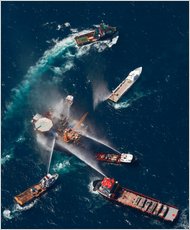
New York Times: Blowout Preventer is Removed & Spotlight Shifts to Shallow Water Wells

Boats spray water to extinguise the fire aboard the Mariner/NYT

New York Times
September 4, 2010

Blowout Preventer Is Removed
By HENRY FOUNTAIN
BP on Friday removed the damaged blowout preventer from atop the company’s stricken oil well in the Gulf of Mexico in preparation for the final plugging of the well, the government said. Thad W. Allen, the retired Coast Guard admiral who leads the federal response to the spill, said in a statement that the preventer — the roughly 500-ton safety device that failed in the Deepwater Horizon blowout in April — would be brought to the surface on Saturday. It will be replaced by a blowout preventer better able to handle any pressure increases that might result when a relief will is used to pump mud and cement into the well after Labor Day. The damaged blowout preventer will eventually be taken to shore and will be in the custody of investigators looking into the cause of the accident.

_________________________________________

New York Times
September 3, 2010

Spotlight Shifts to Shallow-Water Wells
By CLIFFORD KRAUSS and JOHN M. BRODER
For decades, thousands of oil and gas platforms have operated quietly in the shallower waters of the Gulf of Mexico, largely forgotten by the public and government regulators.

But just as the BP disaster in April brought new scrutiny to the dangers of drilling in the deepest waters of the gulf, Thursday’s fire aboard a platform owned by Mariner Energy could well drag the shallow-water drillers into the spotlight’s glare.

The Bureau of Ocean Energy Management, Regulation and Enforcement, the new agency responsible for overseeing offshore oil and gas development, said Friday that it was investigating the cause of the Mariner fire, which forced the 13 crew members to jump overboard and rattled nerves in a region that was still coping with the effects of the Deepwater Horizon disaster.

Members of Congress expressed alarm about the accident, with some saying it was proof that drilling laws needed to be tightened. And even industry executives said it was likely the fire would toughen the already difficult regulatory climate for gulf drilling after the Deepwater Horizon explosion killed 11 people and caused the largest maritime oil spill in American history.

“We will use all available resources to find out what happened, how it happened and what enforcement action should be taken if any laws or regulations were violated,” said Michael R. Bromwich, head of the bureau, which replaced the discredited Minerals Management Service after the BP disaster.

Mr. Bromwich has been carefully reviewing shallow-water drilling as he draws up new regulations governing the industry. The agency, which imposed a six-month moratorium on all deepwater projects after the BP accident, has approved only four of 21 new shallow-water drilling applications since it issued new safety and environmental guidelines in late May.

Representative Nick Rahall, Democrat of West Virginia and chairman of the House Natural Resources Committee, said he was “alarmed” by the latest mishap in the gulf and demanded documentation on the Mariner platform from the Interior Department for a committee investigation.

He said the Mariner platform, working in only 340 feet of water, “highlights all too clearly that the risks of offshore drilling are not limited to deep water.”

Although more than 70 percent of all offshore oil production now comes from jumbo oil platforms plumbing the gulf’s deeper waters, thousands of small-scale outfits pump oil from the shallower waters. Currently, 3,333 platforms are drilling in depths of less than 500 feet, compared with just 74 in deeper waters, according to B.O.E.M. data.

The kind of accident that set the Mariner platform ablaze is not unusual. Although the cause is still under investigation, it appears to have started in the crew’s quarters and did not lead to any significant oil leakage.

Under normal circumstances, such an event would have received little attention. There are more than 100 fires a year on oil and gas facilities in the gulf, mostly minor incidents involving welding sparks, grease fires and other mishaps that occur during routine maintenance.

“People need to remember that the environment that people work in offshore is really no different from other industrial plants located onshore,” said Thomas E. Marsh, vice president of operations for ODS-Petrodata, which tracks the offshore industry. “And industrial accidents happen regularly, but not commonly.”

But industry experts say that most accidents happen aboard older platforms that tend to be concentrated in shallow waters.

Mariner operations alone have reported several dozen incidents, including 18 fires, from 2006 to 2009, according to federal records. Although no one died, there were at least three dozen injuries, including one that paralyzed a worker. Several others suffered severe injuries, and some received burns and broken bones. In May 2008, a Mariner rig briefly lost well control and partly evacuated the crew while workers frantically worked to shore up operations.

In addition, since 2006, Mariner Energy has been involved in at least four spills, in which at least 1,357 barrels of chemicals and petroleum flowed into the gulf, according to federal records.

Patrick Cassidy, Mariner’s director of investor relations, said that the company only seriously got into the offshore drilling business in 2006 with its acquisition of properties of the Forest Oil Corporation. “Since Mariner has been operating there, we have steadily improved our performance,” he said. “The performance yesterday is indicative of the improvement. There were no injuries, no spill, and the fire was extinguished.”

Early reports of Thursday’s accident suggested another spill had occurred. But Coast Guard officials said on Friday that only a patch of light rainbow sheen, measuring about 100 yards by 10 yards, had been spotted in morning flights over the area around the platform. The sheen appeared to be residual from the firefighting efforts, the Coast Guard said.

Nevertheless, the Mariner accident has already stoked the intense policy debate over stiffening regulations on shallow-water drillers.

“It will likely provide sufficient political cover for the Obama administration to pursue its current strategy toward stricter offshore regulation,” Robert Johnston of the Eurasia Group, a research and consulting firm, said in a note to clients on Friday. “Even after the formal moratorium is lifted, the pending oil-spill legislation and proposed changes by the Interior Department will translate to higher costs and extended uncertainty for offshore drilling.”

Oil production in the deep slopes and canyons of the Gulf of Mexico surpassed production from shallow waters roughly a decade ago. But for half a century before that, scores of oil and gas companies, big and small, made their fortunes from platforms propped up in waters less than 1,000 feet deep on the inner continental shelf, which can extend for 100 miles or more off the coasts of Texas and Louisiana.

According to data published in July by the Energy Policy Research Foundation in Washington, more than 50,000 wells have been drilled in the gulf’s federally regulated waters since oil production in the area first began in 1947. Only 4,000 of those have been drilled in depths beyond 1,000 feet, and just 700 wells have gone beyond 5,000 feet.

Independent oil and gas companies — far smaller than the majors like Exxon Mobil and BP — represent the dominant shareholders in two-thirds of the 7,521 leases in the gulf, including the vast majority of the production leases in shallow waters.

According to a recent study by IHS Global Insight, the independents produced nearly 500,000 barrels a day of oil last year in shallow gulf waters, while the majors produced just over 20,000 barrels a day there.

But the new accident came at an inopportune time for the oil industry. After BP capped its runaway well and the spill faded from news media coverage, political pressure had grown in the gulf and around Washington to lift the drilling moratorium.

Now, the momentum is likely to shift again.

“This explosion is further proof that offshore drilling is an inherently dangerous practice,” said Senator Frank R. Lautenberg, Democrat of New Jersey, an opponent of offshore oil and gas development.

James W. Noe, senior vice president of Hercules Offshore, the largest shallow-water drilling company in the gulf, said he thought the administration and regulators would use the incident to further slow drilling.

“People that have an agenda that is hostile to offshore drilling will use this incident, there’s no doubt about that,” he said, “But once the facts are understood fully, this will be treated as an industrial accident that could have occurred at a gas station around the corner. It’s just bad timing.”

Andrew W. Lehren and Tom Zeller Jr. contributed reporting.

Special thanks to Richard Charter

Grist: BACK IN BLACK–Latest Gulf oil well explosion was no disaster, but what does it say about offshore drilling?

http://www.grist.org/article/2010-09-03-Gulf-oil-well-explosion-off-shore-drilling/

BY Randy Rieland
3 SEP 2010 10:25 AM

If we hadn’t spent the summer watching crude gush into the Gulf, no one outside the industry would have noticed or cared much about Thursday’s explosion on a Mariner Energy oil platform. No serious injuries, no spreading slick.

But everyone did notice, and it reminded us that no matter how much BP and the rest of Big Oil say they’ve learned from the Deepwater Horizon disaster, offshore drilling remains a high-risk business, even in shallow water.

Plus, Tony Hayward had nothing to say: The fossil-fuel folks were quick to point out that yesterday’s accident had little in common with the BP debacle. But as David A. Fahrenthold and David S. Hilzenrath point out in The Washington Post, that made it even more noteworthy to offshore drilling critics. This wasn’t some cutting-edge venture where machinery was drilling a mile under the ocean; it was in relatively shallow water, and while the well was still in production, the drilling was finished. Sierra Club Executive Director Michael Brune cut to the chase:
The oil industry continues to rail against regulation, but it’s become all too clear that the current approach to offshore drilling is simply too dangerous. We don’t need to put American workers and waters in harm’s way just so multinational oil companies can break more profit records.

Timing is everything: Wouldn’t you know it that just a day before the explosion, at a “Rally for Jobs” event in Houston sponsored by the American Petroleum Institute, Barbara Hagood, a Mariner Energy exec, moaned about the moratorium on deepwater drilling in the Gulf:
I have been in the oil and gas industry for 40 years, and this administration is trying to break us. The moratorium they imposed is going to be a financial disaster for the Gulf Coast, Gulf Coast employees, and Gulf Coast residents.

While not in the same league as BP as a safety ne’er-do-well, Mariner has been more Homer Simpson than Ned Flanders. According to The Houston Chronicle, the company has been involved in at least 13 offshore accidents since 2006 in the Gulf — including a blowout and four fires.

Language barrier: BP, meanwhile, is sharing its concern that it may not be able to spend as much money on restoring the Gulf and its economy as it previously said it would. The reason? Language in a drilling overhaul bill passed by the House this summer that it contends would hamper its business. Clifford Krauss and John M. Broder of The New York Times explain:
The bill includes an amendment that would bar any company from receiving permits to drill on the Outer Continental Shelf if more than 10 fatalities had occurred at its offshore or onshore facilities. It would also bar permits if the company had been penalized with fines of $10 million or more under the Clean Air or Clean Water Acts within a seven-year period. While BP is not mentioned by name in the legislation, it is the only company that currently meets that description.
BP also announced that it has now spent $8 billion in dealing with the Deepwater Horizon explosion and its consequences. About $93 million of that went toward ads on TV, radio, and in newspapers from April through July. All those images of BP employees vowing to “make things right” appear to be working. An Associated Press poll found that 33 percent of the people surveyed in August approved of the job BP was doing — more than double the number who felt that way in June.

You’re not the boss of me: If the comments of one of China’s top climate spokespeople is any indication, don’t expect that country to take the lead in slashing energy consumption. Yu Qingtai, who represented China in climate talks from 2007 to 2009 and is now his country’s ambassador to the Czech Republic, had this to say in a recent speech:
As a Chinese person, I cannot accept someone from a developed nation having more right than me to consume energy. We are all created equal — this is no empty slogan. The Americans have no right to tell the Chinese that they can only consume 20 percent as much energy. We do not want to pollute as they did, but we have the right to pursue a better life. The public relations efforts of developed nations on climate change are always more effective than ours, but it is more important to look at their actual actions. Overall, when you look at the facts, there is a huge difference between what is said and what is done.

Andrew Revkin has more in his Dot Earth blog.
The road to madness: Remember that hideous traffic jam in China that lasted nine days? Well, it’s back. The replay’s only a few days old, but it’s already stretching 75 miles again. And also again, the cause is road construction and the huge number trucks hauling coal to Beijing from mines in Inner Mongolia.

California reamin’: The race for California senator between incumbent Democrat Barbara Boxer and her Republican challengers Carly Fiorina is heating up. But when it comes to green issues, Fiorina is bobbing and weaving like a flyweight boxer. During a recent debate, she refused to say if she believed global warming is real. Instead, she offered up the lame comment, “We should always have the courage to examine the science.” When she also declined to take a stand on Prop. 23, which would suspend California’s landmark climate law, Boxer pounced:
If you can’t take a stand on Prop. 23, I don’t know what you will take a stand on. If we overturn California’s clean energy policies, that’s going to mean that China takes the lead away from us with solar, that Germany takes the lead away from us with wind, but I guess my opponent is kind of used to creating jobs in China and other places. I want those jobs created here in America.

Well, that didn’t take long: The more rabid of climate-change deniers have seized upon the revelation that James Lee, the madman shot by police after he grabbed three hostages in Discovery’s headquarters, was moved to environmental fanaticism in part by watching Al Gore’s An Inconvenient Truth. Matt Drudge has piled on, as have others in the right-wing blogosphere, laying blame on Gore himself. Under the headline “Stop the Hysteria,” here’s Thomas Fuller on the climate-change-denial site wattsupwiththat:
At what point will we call to account those who have preached ‘the end of the earth as we know it’ to countless people? How many people will be driven to desperation by those who distort the science?

Blizzard of lies: OK, one last run at all the woofin’ last winter by Foxcateers Limbaugh, Beck, and Hannity when they mocked global warming during the double dose of blizzards in Washington. New research suggests that the intense snowfalls were caused by a rare, once-in-a-century collision of two weather systems. You could explain what happened — that a climatic phenomenon called a North Atlantic Oscillation entered a “strongly negative phase” and that brought cold air down from the Arctic to the East Coast where it rammed into air full of moisture from El Niño.
Or you could just say Al Gore is crazy.

Special thanks to Richard Charter

Huffington Post: No Safe Harbor on Gulf Coast; Human Blood Tests Show Dangerous Levels of Toxic Exposure–Shocking story of human impacts and BP’s active efforts to prevent doctors & hospitals from providing needed treatment

http://www.huffingtonpost.com/jerry-cope/no-safe-harbor-on-gulf-co_b_698338.html

I find this shocking and can’t believe it’s happening in the United States; this sounds like some kind of horror movie. Sick people can’t find doctors to treat them? DV

Jerry Cope
Designer, Filmmaker, Environmental Writer, Eco Activist
Posted: September 2, 2010 03:04 PM

Even as BP and US government officials continue to declare the oil spill over at Mississippi Canyon 252 and the cleanup operation an unqualified success, for the first time blood tests on sickened humans have shown signs of exposure to high levels of toxic chemicals related to crude oil and dispersants. Some of the individuals tested have not been on the beaches, were not involved in any cleanup operations or in the Gulf water — they simply live along the Gulf Coast. Several of them are now leaving the area due to a combination of illness and economic hardship. As the media’s attention has moved on and the public interest wanes, the suffering and hardship for people along the entire Gulf Coast of the United States from Louisiana to Florida continues to worsen. While BP and the government are scaling back cleanup operations and distancing themselves from legal liability for the environmental destruction, economic hardship, sickness and death resulting from the largest environmental disaster in our nation’s history, the situation continues to deteriorate.

The use of the Corexit dispersant 9500 and the highly toxic 9527 by BP, with the approval and assistance of the US Coast Guard and EPA, has been the subject of intense scrutiny and criticism. Never before has such a huge quantity of the toxic compound been used anywhere on the planet. Most countries including NATO allies ban it’s use and will only grant approval as a last resort after other methods have failed. Britain has banned its use altogether. The NOAA provided extensive information summarizing other nation’s policies in regards to Corexit after Senator Barbara Mikulski demanded the information from EPA administrator Lisa Jackson during congressional hearings in July. While the dispersant serves to break down crude oil on the surface and thus makes the oil invisible from the air, it is highly toxic and bioaccumulates in the marine food chain. In humans it is a known carcinogen and its use was widely condemned after Exxon/Valdez and the horrifying health effects on the populations exposed to it there. As it evaporates and becomes airborne, the toxic compounds have moved on shore, creating health impacts that, although apparently large from the numbers of people affected, the full extent is unknown. BP and the US government have effectively been performing the largest chemical experiment in history on a civilian population without their knowledge or consent.
Dispersant and crude in Gulf

Within two days after arriving in the region in mid-July, everyone on our team began getting sick. After our first day out on the water with Captain Lori of Dolphin Queen Cruises touring the lagoons around Orange Beach, Alabama, we all had extreme headaches. During our boat tour, dispersant was visible covering the water everywhere. That evening I developed a gagging, coughing reflex that was so intense and persistent it was impossible to speak to my daughter on the phone. The symptoms typical for high levels of chemical exposure such as burning, itching eyes, constantly runny nose, chronic coughing, burning sore throat, chest congestion, and lethargy progressively intensified.

Over the next several weeks these symptoms continued to worsen until I developed chemically-induced pneumonitis. Before leaving the area I had blood tests initiated to determine if the levels of exposure were high enough to be be detected. The musical activists Sassafrass and the tireless efforts of Michelle Nix allowed myself and several local residents to have blood drawn and tested by Metametrix for chemical exposure. Project Gulf Impact and the Coastal Heritage Society have also contributed greatly to air and water testing in the Gulf region affected by the spill. Project Gulf Impact has set up a dedicated medical help phone line at 504-814-0283. It has proven extremely difficult to find medical care providers who are willing to see patients who have been impacted by the oil spill due to the tremendous pressure exerted against hospitals, clinics, and physicians by BP. In numerous cases BP has provided financial payments to institutions and individuals in exchange for them agreeing not to allow their physicians or staff to see, advise, or treat anyone sickened as a result of the well blowout.

I spoke at length with Michael R. Harbut, MD, MPH, who is clinical professor of Internal Medicine and director of the Environmental Cancer Program at Wayne State University’s Karmanos Cancer Institute. Board Certified in Occupational and Environmental Medicine, Harbut was Chair of the Occupational and Environmental Health Section of the American College of Chest Physicians, was Medical Coordinator of the Kibumbe Refugee Camp during the 1994 Civil War in Rwanda, where the death rate for patients under his care was 1/3 that of the remainder of the camp and was Chief US Medical Advisor to Poland’s Solidarity during the Cold War. His research has been published or presented in venues ranging from the New England Journal of Medicine to the White House.

JC: I wanted to speak with you and see what you thought of the test results we got back. As you know, some of the locals actually came back even higher than mine.

MH: First you have to remember the setting — this is New Orleans and the Gulf Coast; there is a history and a context in which things need to be placed. In my specialty, which is occupational and environmental medicine, there are not many of us who are board certified who actually take care of patients. The bulk of the physicians in our specialty are medical advisors or medical directors to large corporations, and many have never met a chemical they didn’t like. Sort of like Will Rogers. Part of the context is there is a physician whose name is Victor Alexander who was a specialist in my field. He worked in New Orleans at the Oxnar clinic and was seeing a lot of patients who worked for the petroleum companies and was reportedly fired for all of the work he did for his patients as opposed to the petroleum companies — what a doctor is supposed to do. So Victor Alexander then goes into private practice and the New Orleans police came and arrested him for robbing a bank.

JC: Seriously?

MH: Yea, it gets way crazier. This is a guy who was doing very well personally, economically — it came out in trial that he had a half a million dollars in the bank and was making plenty of money. It is unlikely in terms of motive that he would rob a bank for 2,500 dollars. The video from the bank was analyzed by the retired chief of criminal identification for the FBI; he said there was no way it could have been Dr. Alexander robbing this bank. He went to trial twice, the judge threw out a lot of evidence that would have exonerated him and he was sent to prison for robbing a bank. The Louisiana State Medical Society refused to take away his license. Many physicians who do work or potentially could do work or have knowledge of the area in New Orleans know the story about Victor Alexander. The message is quite clear: Don’t mess around with the petroleum industry.

JC: I have been working mainly in the Orange Beach/Gulf Shores area of Alabama, and that’s where I got sick.

MH: Have you had a CAT scan?

JC: Not yet, although they want to do one at the National Jewish Respiratory Center in Denver.

MH: You have to do that. I was chairman of the Occupational and Environmental medicine section of the American College of Chest Physicians so I have a lot of experience in this. You really need to be seen by a physician who understands this is serious.
JC: It’s on the schedule when I get back to Colorado. What do you see when you look at the test results from myself and the other people down here? What do they tell you?
MH: Let me tell you one more thing before I forget. I think that the only way to come close to getting the ultimate answer down there is to — there has to be a federal task force if you will. A federal effort where there would be half a dozen or a dozen specialists in this field who would have the protection of the government either temporary commissions from the U. S. public health service or something like that. Who would be responsible for organizing all the science and all the medicine and trying to get people to deliver care down there. I just don’t think you are going to get many volunteers unless they know they have the protection of the government. The annals of environmental diseases are strewn with stories about physicians who have had their lives ruined.

JC: The impacts of what is happening down here is are so big it’s very hard to wrap your head around it.

MH: I will give you one other example while we are talking about it. In the early 1990s I had called a bunch of cases, I saw patients who were sick from their environment who worked for Dow and DOW Chemical and a couple of the steel mills. In an eighteen month period I had one Blue Cross Blue Shield audit, two Medicare audits, a Michigan Employment Security Commission audit, a USAID Inspector General’s audit, and I was the target of a federal grand jury investigation. After two years and tens of thousands of dollars Medicare thanked me for teaching them how to catch a crook, apologized for bothering me — I told them how they could catch crooks and they thanked me. The US government, the local FBI office actually called my attorney and said they really weren’t able to find anything and my attorney who is a former US Attorney said that the government never calls when they have investigated somebody they just leave them dangling for the rest of their lives. The degree of harassment towards physicians is enormous, which I think is part of the reason — because of the conflicting forces at work in the Gulf, because of the probably less than half truths that are floating around that there needs to be a federal task force of independent physicians and scientists who have the protection and full faith of the United States. The way the system works, I think it would mean temporary commissions in the public health service. I don’t think even the oil companies that work down there would try and bump off a guy who works with the public health service.

JC: A number of people I have spoken to in Washington share that same opinion. Does it help to have test results in hand that show high levels of exposure from this event?

MH: I remember you had no Benzene but a lot of Hexane and a couple of Hexane metabolites. I am not sure what that means because where you see Hexane, Hexane causes what is called a dying back neuropathy, meaning the nerve cells in the arms and legs die back from the distal tips to the proximal end. You can end up with numbness, pain, all sorts of things. Hexane is a direct petroleum product so where you see Hexane you would expect to see Benzene. Now, that having been said I personally don’t even do actual solvent levels anymore because they are fraught with error. Rubbing alcohol is the prototypical solvent, and if you put a cap of rubbing alcohol on a flat surface like marble or something it’s usually gone before you would have a chance to get a paper towel it evaporates so quickly. So what happens with the organic solvents in general is that unless there is absolutely perfect control when they are drawn, there is a fair amount that will evaporate, if in fact not all of it. One of the dangers of people going to this lab (Metametrix), which I think is a good lab, is if they get the test drawn at a facility that lets it sit out for a little bit you are going to get a false negative result. In a case like yours, if you believe the sample is valid and it shows that you have Hexane and Hexane metabolites and also Octane in your blood, then it’s a pretty good clinical indication of how to go about treating you, which is usually just drinking a lot of water and then treating the end organ damage. End organ damage meaning we know if you inhale this stuff, if you have it in your system, it will damage your nerves. so we take a look at the nerves. The nerves will not show up abnormal on a test until there has been 30% damage. So what I do here and what I teach my residents is that for most people who come in to see the doctor in this field with a problem you will get more yield in terms of finding pathology and being able to help them if you look for end organ damage rather than the presence of a solvent because the solvent could have evaporated after it has already whacked the brain or whacked the liver.

JC: I spoke to the founder of Metametrix and he said that the tests were designed to pick up these compounds in the body after part of it, particularly Benzene, has been flushed. He indicated that the Benzene would not show up for very long once you were exposed but that the other compounds, the Ethylbenzene, m. p.-Xylene, the Hexane, which was way high, the Methylpentanes and the Isooctane, all of those things indicated to him that we were exposed to significant amounts of Benzene.

MH: That’s what I would think, too.

JC: When you look at these results is there reason to believe we might have sustained serious damage to our organs?

MH: In order to be scientific about this you have to have baseline data on a large population. What the oil company doctors, the professional experts that will ultimately be hired in these cases will argue is that you don’t know what background is in the area. I have seen them do this. They will go out and check 90 people and they will find people with results less than yours or more than yours and they will say this is background so with this particular patient you can not rely on the validity of the testing. On a scientific basis that’s true, I would prefer background. What happened to you right now is you have an indication that you breathed in harmful agents — you have a marker. They are called bio-markers. A bio-marker is the Hexane, N-Hexane and the Octane. You have evidence that you inhaled it because it’s in your blood. Nobody has correlated how much N-Hexane in your blood by PPM or PPB correlates with actual nerve damage. You need to have pulmonary tests, high resolution cat scans of your chest, liver function and cardiac function tests. What should happen with people with these exposures is at an absolute minimum, and I do not believe this is adequate, but at an absolute minimum the NIOSH recommended health monitoring tests should be done. Be certain to ask the doctor examining you if they have ever been paid or retained by a petroleum company or a chemical manufacturing company.

JC: I can do that.

Test Results for Jerry Cope
Additional Information on the the Health Impacts of the Gulf Oil Spill can be found at Sciencecorps and Dr. Riki Ott.

Special thanks to Richard Charter

Environmental News Service: Greenland Police Arrest Greenpeace Oil Rig Demonstrators

http://www.ens-newswire.com/ens/sep2010/2010-09-02-01.html

BAFFIN BAY, Greenland, September 2, 2010 (ENS) – Four Greenpeace activists who climbed a Cairn Energy oil rig in Greenland waters were arrested this morning and are now being held in police custody in Greenland.

The activists first scaled the oil rig Stena Don on Tuesday. They attached hanging platforms to the underside of the rig where they camped out in tents with self-heating meals until last night.

Freezing gale-force winds forced the climbers and Greenpeace campaigners on the ship Esperanza anchored one kilometer from the rig to decide to end the occupation.

It took the Greenpeacers four hours of climbing in bitter winds to scale the rig from their hanging platforms up onto the platform gantry, where police were waiting for them. They were taken into custody and flown off the oil rig by helicopter at 2 am.

Before ending the occupation, climber Sim McKenna of the United States, said on his satellite phone, “We stopped this rig drilling for oil for two days, but in the end the Arctic weather beat us. Last night was freezing and now the sea below us is churning and the wind is roaring. It’s time to come down, but we’re proud we slowed the mad rush for Arctic oil, if only for a couple of days.”

The protesters occupied the oil rig Stena Don, operated by Cairn Energy, to draw attention to their “Beyond Oil” campaign. They say deepwater oil drilling in the Arctic is too risky for the environment and the world needs to switch to cleaner sources of energy to avoid the worst consequences of climate change.

McKenna said, “This beautiful fragile environment would be decimated by an oil spill, while the melting Arctic ice is a grim reminder that we need to stop burning oil and invest instead in clean energy solutions.”

“I’m not sure what will happen to us now,” he said, “but as soon as we can we’ll be back to call for the world to finally go beyond oil.”

Ben Stewart, communications officer onboard the Greenpeace ship Esperanza said, Looking out of my porthole at the massive waves, and feeling the movements of the Esperanza, there is no doubt in my mind that they took the right decision.”

“I hope and believe that this action will be remembered as the first step against our blind and reckless hunt for the last drops of oil on the planet,” Stewart said.

In London this morning, Greenpeace lawyers threatened legal action against the UK government over its decision to continue issuing licenses for deep sea oil drilling even before the causes of BP’s Deepwater Horizon explosion and oil spill in the Gulf of Mexico are ascertained.

Lawyers for the environmental group wrote to Energy and Climate Change Secretary Chris Huhne asking the government to do as U.S. President Barack Obama has done and introduce a moratorium on deepwater drilling for oil and gas.

“We’re asking the government to stop giving out these licenses for new offshore drilling and to carry out a comprehensive new environmental assessment into offshore oil,” said Stewart. “It’s not just irrational to give out licenses without this new environmental assessment; we believe it’s also a breach of European and UK law.”

“This is just the first step in the legal process,” Stewart said. “If the government does not give us an undertaking within 14 days that it will stop the licensing and do a new environmental assessment, we plan to go to court.”

While the UK has not imposed a moratorium on new licensing of deepwater drilling projects, in June, Huhne announced that environmental inspections of rigs in UK waters would be stepped up.

Special thanks to Richard Charter