Category Archives: Uncategorized

Keynoter: Shark bites oil-seeking robot Waldo–during Shark Week–no oil found in Keys

This is Waldo in better days, before a shark munched it.

http://www.keysnet.com/2010/08/28/252562/shark-bites-oil-seeking-robot.html
By KEVIN WADLOW
kwadlow@keynoter.com
Posted – Sunday, August 29, 2010 07:17 AM EDT
By SEAN KINNEY

Now a shark-scarred sub-sea seeker, Waldo the scientific robot survived its latest mission to bring positive news to the Florida Keys.

The 6-foot “autonomous underwater vehicle” found no significant traces of underwater oil from the Deepwater Horizon spill in its 28 days at sea, after being launched July 19 from Mote Marine Laboratory’s Summerland Key facility, according to the Natural Resources Defense Council, an expedition backer.

The run, on a triangular search pattern from north of the Keys to south of Naples, was curtailed about two days early “when a shark bit into and damaged Waldo’s rudder and his left wing was lost,” council analyst Ali Chase reported in an online account.

“There’s a good chance the attack occurred during [the Discovery Channel’s] Shark Week,” said Paul Johnson, a marine consultant working with the council.

The yellow, torpedo-shaped Waldo, worth an estimated $100,000, was recovered successfully.

In its first Keys-based mission during the Deepwater Horizon spill, Waldo was recovered June 2 after being knocked off course by strong currents near the Dry Tortugas.

Normally used to seek red-tide organisms, Waldo was modified to seek traces of oil from the Deepwater Horizon spill.

“Waldo didn’t turn up any strong indications of oil on the continental shelf to the north and northwest of the Florida Keys during this run,” Chase said.

“That was excellent news,” said Johnson, a former Reef Relief president. “This was a time when the path of the oil was unknown. NRDC and [conservation group] Oceana stepped up to help safeguard the Florida Keys in a time of dire need.”

Gulf of Mexico currents and weather conditions combined to push the spill oil away from the Loop Current that could have carried it through the Florida Straits to South Florida. However, much of the spill oil apparently has settled into deepwater plumes, and the effect on the marine environment remains unknown. Information sent by Waldo during its most recent run could prove useful in another scientific field: Hurricane tracking. While at sea during Tropical Storm Bonnie, the AUV sent back water temperatures from hundreds of feet below the surface.

“How much heat is in the water determines hurricane force,” Chase said. “Measurements Waldo captured during this time will help advise future forecasting of hurricane strength.”

Truthout: Despite “All Clear,” Mississippi Sound Tests Positive for Oil


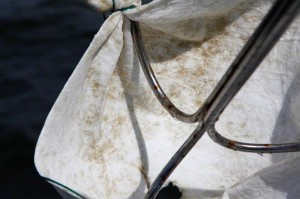
(Photo © Erika Blumenfeld 2010)


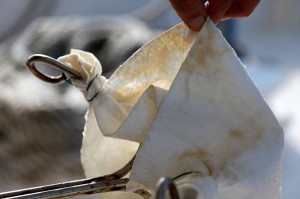
Miller and Dahr Jamail holding oil-soaked sorbent pad. (Photo © Erika Blumenfeld 2010)


(Photo © Erika Blumenfeld 2010)


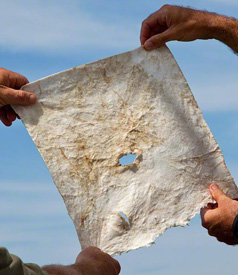
Laboratory confirmed oil-soaked sorbent pad. (Photo © Erika Blumenfeld 2010)


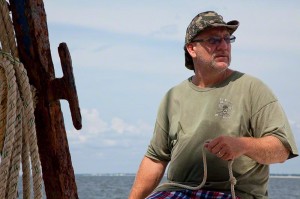
James “Catfish” Miller, third-generation fisherman. (Photo © Erika Blumenfeld 2010)


Miller and Mark Stewart attaching the sorbent pad to the weighted hook. (Photo © Erika Blumenfeld 2010)

Sunday 29 August 2010

by: Dahr Jamail and Erika Blumenfeld, t r u t h o u t | Report

The State of Mississippi’s Department of Marine Resources (DMR) opened all of its territorial waters to fishing on August 6. This was done in coordination with the National Oceanic and Atmospheric Administration and the US Food and Drug Administration, despite concerns from commercial fishermen in Louisiana, Mississippi, Alabama and Florida about the presence of oil and toxic dispersants from the BP oil disaster.

On August 19, Truthout accompanied two commercial fishermen from Mississippi on a trip into the Mississippi Sound in order to test for the presence of submerged oil. Laboratory test results from samples taken on that trip show extremely high concentrations of oil in the Mississippi Sound.

James “Catfish” Miller and Mark Stewart, both lifelong fishermen, have refused to trawl for shrimp because they believe the Mississippi Sound contains submerged oil.

“I can’t tell you how hard it is for me not to be shrimping right now, because I’m a trawler,” Miller told Truthout as he piloted his shrimp boat out of Pass Christian Harbor, “That’s what I do. I trawl.”

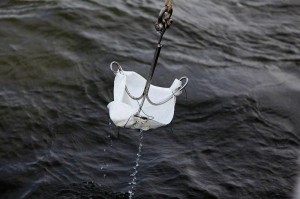
But Miller and Stewart have been alarmed by their state’s decision to reopen the waters, and have been conducting their own tests for oil in areas where they have fished for years. Their method was simple – they tied an absorbent pad to a weighted hook, dropped it overboard for a short duration of time, then pulled it up to find the results.

On each of the eight tests Truthout witnessed, the white pads were brought up covered in a brown oily substance that the fishermen identified as a mix of BP’s crude oil and toxic dispersants. The first test conducted was approximately one-quarter mile out from the harbor, and the pad pulled up was stained brown.

“They’re letting people swim in this,” Miller exclaimed, while holding the stained pad up to the sun.

Miller and Stewart were both in BP’s Vessels Of Opportunity (VOO) program and were trained in identifying oil and dispersants. This writer took two samples from two absorbent pads that were brought up from the water that were covered in brown residue and had them tested in a private laboratory via gas chromatography.

The environmental analyst who worked with this writer did so on condition of anonymity, and performed a micro extraction that tests for Total Petroleum Hydrocarbons (TPH). The lower reporting limit the analyst is able to detect from a solid sample like the absorbent pad is 50 parts per million (ppm).

The first sample this writer took was from a sorbent pad dropped overboard to a depth of approximately eight feet and held there for roughly one minute. The location of this was 30 18.461 North, 089 14.171 West, taken at 9:40 AM. This sample tested positive for oil, with a hydrocarbon concentration of 479 ppm. Seawater that is free of oil would test at zero ppm of hydrocarbons.

The second sample this writer took was from a sorbent pad dropped overboard to a depth of approximately eight feet and held there for roughly one minute. The location of this was 30 18.256 North, 089 11.241 West, taken at 10:35 AM. This sample tested positive for oil, with a hydrocarbon concentration of 587 ppm.

“For the sorbent pads, I had to include the weight of the actual pad itself, so that the extraction was done as a solid,” the environmental analyst explained. “Had I had enough liquid in these samples to do a liquid extraction, the numbers would have been substantially higher.”

Jonathan Henderson, with the nonprofit environmental group, Gulf Restoration Network, was on board to witness the sampling.

Jonathan Henderson, coastal resiliency organizer of the Gulf Restoration Network. (Photo © Erika Blumenfeld 2010)

“I can verify that the shrimp boat captain retrieved what appeared to be an oily residue,” Henderson told Truthout. “My suspicion is that it was oil. It felt like oil to the touch, and it smelled like oil when you sniffed it.”

On August 11, the two fishermen brought out scientist Dr. Ed Cake of Gulf Environmental Associates. (Video from the “Bridge the Gulf Project” of that trip with Miller and Stewart finding an oil and dispersant mixture on open Mississippi fishing waters.)

Dr. Cake wrote of the experience: “When the vessel was stopped for sampling, small, 0.5- to 1.0-inch-diameter bubbles would periodically rise to the surface and shortly thereafter they would pop leaving a small oil sheen. According to the fishermen, several of BP’s Vessels-of-Opportunity (Carolina Skiffs with tanks of dispersants [Corexit?]) were hand spraying in Mississippi Sound off the Pass Christian Harbor in prior days/nights. It appears to this observer that the dispersants are still in the area and are continuing to react with oil in the waters off Pass Christian Harbor.”

Shortly thereafter, Miller took the samples to a community meeting in nearby D’Iberville to show fishermen and families the contaminated sorbent pads. At the meeting, fishermen unanimously supported a petition calling for the firing of Dr. Bill Walker, the head of Mississippi’s DMR, who is responsible for opening the fishing grounds.

On August 9, Walker, despite ongoing reports of tar balls, oil and dispersants being found in Mississippi waters, declared “there should be no new threats” and issued an order for all local coast governments to halt ongoing oil disaster work being funded by BP money that was granted to the state. Recent weeks in Mississippi waters have found fishermen and scientists finding oil in Garden Pond on Horn Island, massive fish kills near Cat Island and Biloxi, “black water” in Mississippi Sound, oil inside Pass Christian Harbor and submerged oil in Pass Christian, in addition to what Miller and Stewart showed Truthout and others with their testing.

“We’ve sent samples to all the news media we know, here in Mississippi and in [Washington] D.C.,” Stewart, a third-generation fisherman from Ocean Springs told Truthout, “We had Ray Mabus’ people on this boat, and we sent them away with contaminated samples they watched us take, and we haven’t heard back from any of them.” Raymond Mabus is the United States Secretary of the Navy and a former governor of Mississippi. President Obama tasked him with developing “a long-term Gulf Coast Restoration Plan as soon as possible.”

Mabus has been accused by many Gulf Coast fishermen of not living up to his task. Thus, since neither the federal nor state governments will conduct the testing they feel is necessary, Miller and Stewart decided to take matters into their own hands.
Stewart had on board another homemade method of capturing oil in the water column. He took two tomato cages and filled them with sorbent pad, layered it in plastic to hold it together, and left a hole at the bottom for the water to flow through, creating a large sorbent cone that could flow through the water.
The method proved fruitful. After several tests in the water column, being careful to never let it touch bottom, the cone was turned a dark brown with what turned out to be a very high concentration of oil.

“Normally we have a lot of white shrimp in the Sound right now,” Stewart told Truthout of the current situation in the Mississippi Sound. “You can catch 500-800 pounds a night, but right now, there are very few people shrimping, and those that are, are catching nothing or maybe 200 pounds per night. You can’t even pay your expenses on 200 pounds per night.”

“We think they opened shrimp season prematurely,” Miller told Truthout. “How can we put our product back on the market when everybody in America knows what happened down here? I have seen so many dead animals in the last few months I can’t even keep count.”

Jonathan Henderson holding the oil-soaked sorbent cone. (Photo © Erika Blumenfeld 2010)

On August 19, several commercial shrimpers, including Miller and Stewart, held a press conference at the Biloxi Marina. Other fishermen there were not fishing because they feared making people sick from toxic seafood they might catch.

“I don’t want people to get sick,” Danny Ross, a commercial fisherman from Biloxi told Truthout. “We want the government and BP to have transparency with the Corexit dispersants.”

Ross said he has watched horseshoe crabs trying to crawl out of the water and other marine life like stingrays and flounder also trying to escape the water. He believes this is because the water is hypoxic due to the toxicity of the dispersants, of which BP admits to using approximately 1.9 million gallons.

“I will not wet a net and catch shrimp until I know it’s safe to do so,” Ross added, “I have no way of life now. I can’t shrimp and others are calling the shots. For the next 20 years, what am I supposed to do? Because that’s how long it’s going to take for our waters to be safe again.”

David Wallis, another fisherman from Biloxi, attended the press conference. “We don’t feel our seafood is safe, and we demand more testing be done,” Wallis told Truthout. “I’ve seen crabs crawling out of the water in the middle of the day. This is going to be affecting us far into the future.”

“A lot of fishermen feel as we do. Most of them I talk to don’t want the season opened, for our safety as well as others,” Wallis added. “Right now there’s barely any shrimp out there to catch. We should be overloaded with shrimp right now. That’s not normal. I won’t eat any seafood that comes out of these waters, because it’s not safe.”

Miller told Truthout that when he worked in BP’s VOO program, “I came out here and looked at the oil and they didn’t let us clean it up most days. Instead, I watched them spray dispersants on it at night, and now we’re seeing acid rain burn holes in our plants. I’ve seen them spray Corexit from Carolina Skiffs with my own eyes. For the last several weeks now they keep shoving these lies in our face. You can only turn your head so far, for so long.”

The hydrocarbon tests conducted on the samples taken by this writer only represent a tiny part of the Gulf compared to the massive area of the ocean that has been affected by BP’s oil catastrophe. A comprehensive sampling regime across the Gulf, taken regularly over the years ahead, is clearly required in order to implement appropriate cleanup responses and take public safety precautions.
On their own, Miller and Stewart have made at least seven sampling runs, covering many tens of miles of the Mississippi Sound, and have, in their words, “rarely pulled up a sorbent pad that did not contain oil residue.”

This work by Truthout is licensed under a Creative Commons Attribution-Noncommercial 3.0 United States License.

Support Truthout’s work with a $10/month tax-deductible donation today! digg
»

——————————————————————————–

Dahr Jamail, an independent journalist, is the author of “The Will to Resist: Soldiers Who Refuse to Fight in Iraq and Afghanistan,” (Haymarket Books, 2009), and “Beyond the Green Zone: Dispatches From an Unembedded Journalist in Occupied Iraq,” (Haymarket Books, 2007). Jamail reported from occupied Iraq for nine months as well as from Lebanon, Syria, Jordan and Turkey over the last five years.
Erika Blumenfeld is an internationally exhibiting artist and Guggenheim Fellow with a BFA in Photography from Parsons School of Design. She is known for her Light Recordings series, and her ambitious work The Polar Project, a series of environment-focused artworks that document the environment of Antarctica and the Arctic. Blumenfeld’s installations have been exhibited widely in galleries and museums in the US and abroad, and have been featured in /Art In America/, /ARTnews/ and more than half a dozen books. She is posting her photographs of the Gulf Coast on her blog.

Special thanks to Ashley Hotz.

Spill into Washington DC: Labor Day Rally Sept. 4th & 5th, 2010

http://spillintowashington.org/

Stand up – Speak out – Be heard!
Spill into Washington DC
–a national rally–
“Man must cease attributing his problems to his environment and learn again to exercise his will — his personal responsibility.” — Albert Schweitzer

Why Rally?

Join for us two days of rallying against BP and the regulatory failures that contributed to the largest oil disaster in American history. In addition, we will honor the loss of life, as well as the land and sea most directly impacted by the explosion and its aftermath. The quest for oil has influenced international relations to the extent of war. We will tell our government and the corporate world that we will not stand idly by while the powerful spin our world out of control. It is time to address the disasters that companies like BP, and the banking industry, mete upon the entire world, with regularity, and without regard for the destruction they create. For two days families and individuals, of all political backgrounds, will peacefully come together, with ONE VOICE, to unite in our common struggle against abusive power. See the transportation page for lodging, ridesharing options, and maps of the nation’s capitol.

For Full Details and Event Schedule: Click on the About Tab, then Event Info

When & Where:
Day 1: Lafayette Park, 2-5p Day 2: Washington Mall, 11a-4p

Who: ALL PUBLIC INVITED
T-Shirts: Please see link on the right of the page. Your $20.00 donation will support the Rally by covering expenses. If you would like to pre-order a t-shirt and pick it up at the Rally, please submit your pre-order and then email Sherry Lear to let her know. learlaw@earthlink.net

Travel: Please visit Logistics page
This event is open to the public. It is a non-partisan event, so please leave a

ll political differences at home and join us with an open mind, as well as a willingness and commitment to unite our voices and fight for ourselves, for each other, for our environment, for restoring freedom, for personal responsibility, for our future.

Carpooling and Ridesharing is a proven way to reduce greenhouse gas emissions that lead to global warming. By simply consolidating passengers into fewer vehicles, we can save on fuel costs and drastically reduce carbon dioxide emissions without serious changes or investments to our transportation infrastructure. Consider a carpooling option through Ride Buzz!

“A world run by the people only works if the people show up to remind the powerful that it is indeed a world of the people.”

Lydia Johnson

Special thanks to Diana Dodson

Riki Ott: An Open Letter to US EPA, Region 6

http://www.huffingtonpost.com/riki-ott/an-open-letter-to-us-epa_b_697376.html

Riki Ott is a Marine toxicologist and Exxon Valdez survivor –see RikiOtt.com
She’s also dead on in this assessment of illegal dispersant use and my hero for saying this. I wonder if the EPA ever replied to her. This is one of the most damning elements of the entire Gulf blowout incident.
DV

Posted: August 27, 2010 03:27 PM

U.S. EPA, Region 6
1445 Ross Ave.
Dallas, TX 75202-2733 Via email: coleman.sam@epa.gov

August 27, 2010

Re: Documentation of continued dispersant spraying in near shore and inland waters from Florida to Louisiana (despite contrary claims by USCG and BP) and documentation that dispersants made oil sink

Dear Mr. Coleman,

During the August 25 Dockside Chat in Jean Lafitte, LA, it came to our attention that the federal agencies were unaware — or lacking proof — of the continued spraying of dispersants from Louisiana to Florida. Further, the federal agencies were woefully ignorant of the presence of subsurface oil-dispersant plumes and sunken oil on ocean and estuary water bottoms. We offer evidence to support our statements, including a recently declassified subsurface assessment plan from the Incident Command Post.

But first, you mentioned that such activities (continued spraying of dispersants and sinking oil) — if proven — would be “illegal.” As you stated, sinking agents are not allowed in oil spill response under the National Contingency Plan Subpart J §300.910 (e): “Sinking agents shall not be authorized for application to oil discharges.”

We would like to know under what laws (not regulations) such activities are illegal and what federal agency or entity has the authority to hold BP accountable, if indeed, such activity is illegal. It is not clear that the EPA has this authority.

For example, on May 19, the EPA told BP that it had 24 hours to choose a less toxic form of chemical dispersants and must apply the new form of dispersants within 72 hours of submitting the list of alternatives. Spraying of the Corexit dispersants continued unabated. On May 26, the EPA and Coast Guard told BP to eliminate the use of surface dispersants except in rare cases where there may have to be an exemption and to reduce use of dispersants by 75 percent. Yet in a letter dated July 30, the congressional Subcommittee on Energy and the Environment reported the USCG on-scene commander (OSC) had approved 74 exemption requests to spray dispersants between May 28 and July 14.

Under the National Contingency Plan Subpart J, the authorization of use §300.910 (d) gives the OSC the final authority on dispersant use: “The OSC may authorize the use of any dispersant… without obtaining the concurrence of he EPA representative… when, in the judgment of the OSC, the use of the product is necessary to prevent or substantially reduce a hazard to human life.”

Given this history of events and the NCP regulation, we would like to know what federal entity actually has the final authority to: order BP to stop spraying of dispersant; declare that spraying of dispersant after issuance of a cease and desist order is illegal; and prosecute BP for using product to sink oil.

The documentation of dispersant spraying in nearshore and inland waters includes:
√ claims by USCG and BP
√ eyewitness accounts
√ fish kills in areas of eyewitness accounts
√ photos of white foam bubbles and dispersant on boat docks in areas of eyewitness accounts
√ sick people in areas of eyewitness accounts

Claims by USCG and BP – and Counter Evidence

July 30-31: Lt. Cmdr. of USCG confirms, “Dispersants are only being used over the wellhead in Louisiana.”

•When reached for comment, Lt. Cmdr. Dale Vogelsang, liaison officer with the United State Coast Guard, told The (Destin) Log he had contacted Unified Command and they had “confirmed” that dispersants were not being used in Florida waters.

•”Dispersants are only being used over the wellhead in Louisiana,” Vogelsang said. “We are working with Eglin and Hurlburt to confirm what the flight pattern may be. But right now, it appears to be a normal flight.”

•Vogelsang also said Unified Command confirmed to him that C-130s have never been used to distribute dispersants, as they “typically use smaller aircraft.”

Contradicted by evidence in same Destin The Log article and posted on websites:

•But according to an article by the 910th Airlift Wing Public Affairs Office, based in Youngstown, OH., C-130H Hercules aircraft started aerial spray operations Saturday, May 1, under the direction of the president of the United States and Secretary of Defense. “The objective of the aerial spray operation is to neutralize the oil spill with oil dispersing agents,” the article states.

•A Lockheed Martin July newsletter states that “Lockheed Martin aircraft, including C-130s and P-3s, have been deployed to the Gulf region by the Air Force, Coast Guard and other government customers to perform a variety of tasks, such as monitoring, mapping and dispersant spraying.”

•Further: “Throughout the effort, Lockheed Martin employees have been recognized for their contributions in a wide range of roles. IS&GS senior network engineer Lawrence Walker, for example, developed a solution to a critical networking issue involving two C-130’s that arrived from the Air Force Reserve Command’s 910th Airlift Wing at Youngstown, Ohio, as part of the cleanup mission.”

May 11: USCG and BP claims of no dispersant spraying activities are further contradicted by intentional mislabeling of flight plans:

•Aerial dispersant operations – Houma Status Report, Dispersant Application Guidance, p. 4, point 8: “Use discreet IFF codes as provided on separate correspondence. This removes need to file DVFR flight plans.”

Destin – Fort Walton, FL
July 30-31: Destin Mayor Sam Seevers investigating claims of dispersant spraying:

•Resident and former VOO worker Joe Yerkes testified that he witnessed a military C-130 “flying from the north to the south, dropping to low levels of elevation then obviously spraying or releasing an unknown substance from the rear of the plane.”

•The unknown substance, Yerkes wrote, “was not smoke, for the residue fell to the water, where smoke would have lingered.”

Austin Norwood, whose boat is contracted by Florida Fish and Wildlife, also provided a written account of a “strange incident.”

•While Norwood was observing wildlife offshore, he had received a call from his site supervisor at Joe’s Bayou. After telling the supervisor that he and his crewmember were not feeling well, the supervisor had the two men come in “to get checked out because a plane had been reported in our area spraying a substance on the water about 10- 20 minutes before.”

•Norwoord complained of a bad headache, nasal congestion while his crewmember said he had a metallic taste in his mouth.

•After filling out an incident report, both Norwood and his crewmember were directed to go to the hospital. The following day, the two men were once again “asked to go to the hospital for blood tests.”

Aug. 2: Joe Yerkes reported sludgy brown oil and foamy white dispersant bubbles in Destin and 40 miles east in St. Joe Bay, just days before a fish kill of croaker, flounder, trout, and baitfish on August 5.

Perdido Pass, AL
Aug. 24: Received report of oil debris from anchor chain while weighing anchor at position 30*15.6 N 87*32.7 W, 0.6 nm east of Perdido Pass sea buoy. Samples taken.

Dauphin Island, AL
Aug. 21: Fisherman Chris Bryant documents Corexit 9500 use

Aug. 24: Washington’s Blog interview with chemist Bob Naman

•Bob Naman is the analytical chemist who performed the tests featured in WKRG’s broadcast. He was interviewed by or an August 24 report. Highlights include:

•Naman found 2-butoxyethanol in the Cotton Bayou sample. [Ingredient in ‘discontinued’ Corexit 9527.]

•Naman said found no propylene glycol, the main ingredient of Corexit 9500.

•Naman said he went to Dauphin Island, Alabama last night and while there observed many 250-500 gallon barrels which were labeled Corexit 9527. Naman took pictures that he will soon be sharing.

•Naman said he saw men applying the Corexit 9527 while he was in Dauphin Island and also in Bayou La Batre, Alabama.

•Naman said the Corexit 9527 is being haphazardly sprayed at night and is impacting beach sands in a highly concentrated form.

Bayou La Batre, AL
Aug. 4: Fisherman Chris Byrant documents oil-dispersant in Mississippi Sound, northwest of Katrina Cut, in an area open to fishing in state waters between Dauphin Island and Bayou La Batre

Aug. 19, Aug. 21: Rocky Kistner with NRDC documents use of Corexit 9527a and Corexit 9500 and oil-dispersant visible sheen in area open to fishing in state waters

Aug. 23: Natural Resources Defense Council Switchboard posting
We spotted huge plastic containers marked with Corexit warning labels on the dock public docks near Bayou La Batre. …

The next day at a town hall meeting in Buras, LA, BP Mobile Incident Commander Keith Seilhan was asked about the use of chemical dispersants. “We are not using dispersants and haven’t been for some time,” he said. But when asked whether contractors who operate in state waters could be, he said he could not be certain. “We have lots of contractors, but no one should be using them. If they are, we need to know about it and stop it.”

Long Beach, MS
Aug. 8: Fisherman James “Catfish” Miller sampled the subsurface oil plume (VIDEO)

Miller tied an oil absorbent pad onto a pole and lowered it 8-12 feet down into deceptively clear ocean water. When he pulled it up, the pad was soaked in oil, much to the startled amazement of his guests, including Dr. Timothy Davis with the Department of Health and Human Services National Disaster Medical System. Repeated samples produced the same result. Three weeks earlier, there had been a massive fish kill along the same shoreline from Gulfport to Pass Christian.

Aug. 23: The methods for sampling subsurface oil used by Mr. Miller are also being used by Incident Command for the Deepwater Horizon as evidenced in a declassified document (p. 3).

Hancock County, MS
Aug. 23: Dispersant container found in Bayou Caddy Hancock County marsh. White foam indicative of dispersant use in marsh. Samples taken and being analyzed.

Barataria, LA
July 31: Documentation of oil in Barataria Bay.

Venice, LA
Aug. 11 (reported): Contractor sick from dispersant spraying

Summary: Based on these documents, and more, we believe that dispersant spraying in inland and near shore waters across the Gulf of Mexico from Louisiana to the western Florida panhandle is occurring now and has continued unabated (before) and since July 19, the date that the seafood safety panel proclaimed was the last day dispersants were sprayed. Based on these documents, and more, we believe that the dispersant spraying in inland and near shore waters is being conducted for the sole purpose of sinking the visible oil, an activity that is supposedly illegal. According to the University of South Florida, dispersed oil micro-droplets have been documented throughout the Gulf water column and are likely to affect the entire ecosystem.

The inability of the federal and state agents who attended the Dockside Chat in Jean Lafitte, LA, on Aug. 25 to find recent subsurface oil and ocean bottom oil or dispersant spraying activity in inland or near shore waters gives us zero confidence in these same agencies’ declaration that they can find no oil or dispersant in Gulf seafood product.

Sincerely,

Riki Ott, PhD
Ultimate Civics Project
Earth Island Institute
POB 1460
Cordova, AK 99574
970-903-6818
www.RikiOtt.com

Mother Nature Network: Congress: Did anyone think about the environment?

http://www.mnn.com/earth-matters/politics/stories/congress-did-anyone-think-about-the-environment

Oil spill commission probes the Obama administration’s fickle stance on offshore oil drilling.
By Andrew Schenkel, Guest Columnist
Thu, Aug 26 2010 at 11:42 AM EST
Comments

NOT BUYING IT: Bob Graham had a tough time getting his head around the testimony during day one of the oil spill commission hearings. (Photo: Pablo Martinez Monsivais/AP)

Remember March? The Gulf oil spill hadn’t happened. President Obama was calling for increased offshore oil production. Well, the White House’s National Commission on the BP Deepwater Horizon Spill and Offshore Drilling remembers March, and its wants to know more.

During round one of the commission’s hearings, its chairmen probed the Obama administration on its focus on the environment while it pushed for increased offshore drilling prior to the Gulf oil spill.

The head of the White House’s Council on Environmental Quality, Nancy Sutley, testified that the Obama administration did not consult her agency about the potential environmental impacts of the president’s plans.

“We weren’t asked and wouldn’t expect to be asked ahead of time whether they should [drill],” said Sutley. She added that she didn’t expect her organization to be consulted on “what level of environmental analysis is appropriate for the kinds of planning and decisions that result from that March announcement.”

So the chairwoman of the White House’s Council on Environmental Quality not only wasn’t asked, but wasn’t planning on being asked. At least everyone is on the same page here.

Oil spill commission co-chair, former senator and former Florida Gov. Bob Graham, couldn’t believe his ears. “If you are developing a policy to expand offshore oil and gas exploration to the extent that the president announced,” Graham began, “consultation with the agency with responsibility for oceans management and regulation and your overall umbrella agency, the Council for Environmental Quality, should be two of the people on the consultation list.”

The commission’s other co-chairman, William Reilly, seemed equally surprised and perplexed that the Obama administration rushed to judgment. “I’m disappointed that CEQ particularly, which is in the heart of the executive office of the president, was not involved, which seems to go directly to the heart of its responsibility,” said Reilly.

Special thanks to Richard Charter