Category Archives: Uncategorized

PBS Newshour: Scientist Studies Oil Dispersant’s Effects, Methane in the Gulf

http://www.pbs.org/newshour/rundown/2010/07/scientist-studies-dispersant-use-methane-in-the-gulf.html

OIL SPILL — July 23, 2010 at 1:26 PM EDT

BY: LEA WINERMAN

On Thursday’s NewsHour, Spencer Michels reported on the ongoing controversy over the use of chemical dispersants in the Gulf of Mexico. BP has sprayed nearly 2 million gallons of dispersant — mostly a brand called Corexit — into the Gulf in order to break up the oil into smaller droplets that can be more readily consumed by microorganisms.
The EPA has said that using dispersant is better than the alternative — leaving oil to come ashore on beaches and marshes. And many scientists agree. But others are concerned about the unprecedented scale at which it’s been used, and worry that it could make its way into the Gulf food chain.

Among the researchers NewsHour producer Joanne Elgart Jennings spoke with was David Valentine, a geochemist at the University of California-Santa Barbara, who is studying how the Corexit might interact with the natural bacteria that usually break down oil in the Gulf. Below, Valentine demonstrates how Corexit and bacteria work to break down oil.
In addition to his work on dispersants, Valentine is also interested in the methane gas that has leaked into the Gulf along with oil from the well. In May, he proposed using measurements of the methane to help answer one of the most vexing questions of the Gulf disaster — how much oil has been leaked? Now that the well has been capped, he says, the time is right to begin those measurements. Listen to him explain how.

Special thanks to Richard Charter

Riki Ott: Seafood Safety and Politics Don’t Mix

Aug 24

http://www.chelseagreen.com/content/riki-ott-seafood-safety-and-politics-dont-mixopening-of-gulf-fisheries-at-odds-with-evidence-of-harm/?utm_source=feedburner&utm_medium=feed&utm_campaign=Feed%3A+ChelseaGreen+%28Chelsea+Green%29&utm_content=Google+Reader

Chelsea Green

Riki Ott: Seafood Safety and Politics Don’t Mix-Opening of Gulf Fisheries at Odds With Evidence of Harm

Posted on Monday, August 16th, 2010 at 9:48 am by webeditor

Eight days after returning home from his Gulf oil-spill response job, Jason Brashears has flashbacks of a scene that he witnessed one day in Lake Ponchartrain, Louisiana: Thousands of fish gasping at the surface in a sea of foamy oil and dispersant.

Brashears spent 65 days spotting oil in Lake Ponchartrain; Mobile Bay; and along the coast off Destin, Florida; Ocean Springs, Alabama; and Cat Island, Mississippi. His team reported oil sightings during the day. At night, planes sprayed dispersant to break up the oil.
The fish are not the only thing that haunts him from his Gulf work. His lungs feel “leaden,” he has trouble concentrating on his graphic designs that used to give him so much pleasure, his moods swing unpredictably, he is dizzy, and the fragrance in ordinary household products makes his eyes water and sinuses stuffy.

“You would think,” Brashears said over the phone, “that they [his subcontractor] would not send us out the next day if they knew the dispersants would make us sick. You would think they would warn us or give us a day off.”

But Brashears received no such warning. Nor did other people across the Gulf as BP applied at least 1.8 million gallons of dispersants to the oil it spilled there. Even though the number of gallons reported by BP is widely questioned as conservative, this is still by far the longest and heaviest application of dispersant in world history. Yet neither workers nor the public were, or are, being adequately informed of the risk of exposure to oil and dispersants.

I have been in the Gulf since May 3 and have witnessed the outbreak of a public-health epidemic as the oil and dispersant came ashore. Every day now, former workers, Gulf coast residents, and visitors share similar stories with me of respiratory problems, central nervous system problems, chemical sensitivities, or bad skin rashes after exposure to air or water in the Gulf – predictable illnesses from chemical exposure, all of which were avoidable given adequate warning and protection.

Stories of illnesses persist despite assurances from four federal agencies – the Environmental Protection Agency, the Occupational Safety and Health Administration, the National Institute for Occupational Safety and Health, and the U.S. Coast Guard – that no levels of oil or dispersant measured in Gulf water or air were found to be unsafe.

But government officials have no credibility in communities across the Gulf because the official story does not match the reality of what people are seeing and smelling. The community stories that string together across the Gulf coast paint a picture quite different from what BP, its contractors, and our government report.

A week ago, a team dispatched by local officials with Plaquemines Parish, Louisiana, discovered a beach on a barrier island oozed oil from tiny holes drilled by Hermit crabs. Oil trapped in fragile marshes degrades slowly. It’s been more than 40 years since the Florida barge ran aground in Buzzards Bay, Massachusetts, and spilled 200,000 gallons of fuel oil. Yet the oil is still there – and still has measurable effects on marsh life.

Off Long Beach, Mississippi, on August 8, fisherman James “Catfish” Miller tied an oil absorbent pad onto a pole and lowered it 8-12 feet down into deceptively clear ocean water. When he pulled it up, the pad was soaked in oil, much to the startled amazement of his guests, including Dr. Timothy Davis with the Department of Health and Human Services National Disaster Medical System. Repeated samples produced the same result. Three weeks earlier, there had been a massive fish kill along the same shoreline from Gulfport to Pass Christian.

Also this past weekend on a beach near Dauphin Island, Alabama, a family was alarmed to find themselves covered in thick gooey oil after swimming in what looked to be clear water.

In Florida, Joe Yerkes reported sludgy brown oil and foamy white dispersant bubbles in Destin and 40 miles east in St. Joe Bay, just days before a fish kill of croaker, flounder, trout, and baitfish on August 5.

Let’s think about this. There’s been an unprecedented release of oil and dispersants – industrial grade solvents – into the Gulf. Unprecedented means we have no past history to fall back on and really no science to guide us because it’s an ongoing experiment, right now.

The old science, the old standards, and the old protocols may be dangerously unreliable – as was the case in the Exxon Valdez oil spill. Scientists relied on old science in 1989 and predicted that spill impacts would be short-term and the ecosystem would recover rapidly. Ten years later, the new science proved there were long-term impacts; 21 years later, the oiled ecosystem still has not fully recovered.

To borrow Brashears’ phrase, you would think the federal government would warn us if it thought there was – or even might be – a problem. But the framework of risk management is very narrow and limits itself to educated best guesses among the experts – until proven otherwise.

And therein lies the current danger of this evolving Gulf experiment. The federal government is re-opening vast areas of the Gulf that were closed to fishing because it has “not observed any oil” in these areas and because the “rigorous safety standards” will supposedly “ensure the seafood is safe.”

The problem is the ‘rigorous safety standards’ are outdated. The protocol relies on visual oil. What of the underwater plumes? The chart produced by NOAA last week shows, in effect, that over 50 percent of the oil (not to mention dispersant) is still in the water column as dispersed or dissolved oil. Scientists have found that the oil-dispersant mixture is getting into the foodweb.

The Food and Drug Administration only tests for oil in “edible” tissue of seafood. So if oil has contaminated a fish’s organs or other body parts, it would still be deemed safe for consumption if the flesh tested fine. If a steer had cancer in its kidney and blood, would you eat its “edible” tissue? To make matters worse, though, there is no test for dispersants – yet.

The new Coalition of Commercial Fishing Families across the Gulf is urging the federal government to use precaution rather than 30-year old standards. The coalition has asked NOAA to close all Gulf fisheries until updated protocol and standards are available to test seafood product. Fishermen are also concerned about losing consumer confidence. Kathy Birren, a commercial fisherman from Hernando Beach, Florida, stated at a Gulf of Mexico Alliance conference last week in Gulfport, “We believe that Gulf and Inland waters have been prematurely re-opened to fishing. Fishermen do not want to lose our credibility or deliver contaminated seafood to market. We have lost enough already.”

BP has already stated that it is “not responsible” for any long-term effects from its dispersant experiment. Unless American seafood consumers want to be part of the Gulf experiment, I suggest we all support our fishermen – and not trust the federal government to warn us about seafood safety.

Riki Ott’s book about the Exxon Valxez spill, Not One Drop, is available in our bookstore. Her earlier book, Sound Truth and Corporate Myth$, is also available.
Special thanks to Riki Ott and Richard Charter
LA Times blog: Gulf oil spill: Has it caused a new fish kill? (UPDATED)

http://latimesblogs.latimes.com/greenspace/2010/08/gulf-oil-spill-dead-fish-kill-mississippi.html

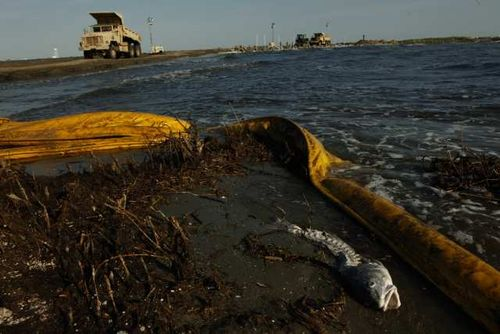
Photo: A dead fish lays along and oil boom deployed along the Louisiana shore in May. Credit: Carolyn Cole / Los Angeles Times

Greenspace August 23, 2010

Louisiana state biologists Monday were investigating whether a large fish kill at the mouth of the Mississippi River was caused by oil or dispersants from the BP spill in the Gulf of Mexico. The gulf also contains a vast dead zone created by agricultural runoff along the river.

“By our estimates, there were thousands, and I’m talking about 5,000 to 15,000 dead fish,” St. Bernard Parish President Crag Taffaro said in a news release Monday. “Different species were found dead, including crabs, sting rays, eel, drum, speckled trout, red fish, you name it, included in that kill.”

The fish were found floating at the top of the water, collected along plastic booms that were placed to contain millions of gallons of oil from the spill that was touched off by the April 20 explosion of BP’s Deepwater Horizon drilling rig. The oil flowed into the gulf until July 15 when the gusher was capped.

A half-mile long swirl of thick substance with several tar balls and a strong smell of diesel was discovered Monday around Louisiana’s Grassy Island, St. Bernard Parish officials announced. Skimmers were collecting the scum.

“There is what we believe to be some recoverable oil in the area,” Taffaro said. “We will be sampling that and recovering what we can. We don’t want to jump to any conclusions because we’ve had some oxygen issues by the Bayou La Loutre Dam from time to time.

“The Marine Division of Wildlife and Fisheries is on it … It does point to the need for us to continue to monitor our waters.”

According to St. Bernard Parish spokeswoman Karen Bazile, the fish were found in the Mississippi River Gulf Outlet, a 76-mile shipping shortcut from the Gulf of Mexico to New Orleans that was dug by the U.S. Army Corps of Engineers in the 1960s. “It is blamed for massive wetlands loss and is widely believed to have worsened the flooding from Hurricane Katrina,” she said in an e-mail. “Since that storm, the federal government has paid for a rock structure across the channel at Bayou La Loutre to stop the flow of salt water, also putting an end to shipping in the channel.”

UPDATE: On Monday evening, St. Bernard Parish oil disaster information officer, Jennifer Belson, said that preliminary testing by the state’s Wildife & Fisheries indicated that the cause of the fish kill was “hypoxia” or lack of oxygen. “But we don’t have the final testing back,” she said. Hypoxia is most often caused by an excess of nitrogen and phosphorus from agricultural fertilizer or human waste, but it can also be caused by chemical dispersants, which were used extensively after the oil spill.

Ralph Portier, an environmental scientist at Louisiana State University, cautioned in an interview that, “A lot of things can explain a fish kill, which is not uncommon during the hot summer weather in Louisiana. It could be the nutrient-rich environment with a lot of heat. It could be rainfall. It could be changes in salinity or upwelling from disturbed sediment.”

The Mississippi River Gulf Outlet, he noted, is “like a dead end canal with water that does not mix as much as you would like it to.” If oil were the cause, he said, he would expect a more gradual, rather than a sudden fish kill.

But he said he could not rule out that the fish kill could be related to the oil spill. Fresh water, which has been diverted into the marshes since the spill, can change salinity levels and affect fish, he noted. The fish kill announcement, he said, “goes to show how sensitive the (oil spill) issue is. You can imagine the angst of a lot of people in the sea food industry when they hear about a fish kill now.”

— Margot Roosevelt

Oceana to host oil meeting in Key West on Thursday, August 26th

The oil disaster in the Gulf may be capped, but the drilling continues. We need to protect our oceans from this happening again. Join us in our effort to put an end to offshore drilling.

On Thursday, Thursday, August 26th, from 6pm to 7pm, we’ll be hosting a meet-up. Come meet other people interested in protecting the world’s oceans and learn about Oceana’s campaign to End Offshore Oil Drilling and Protect Ocean Health for future generations to come.

Share your perspective in thoughtful conversation about Ocean welfare and the legacy we’re leaving our kids. We are going to brainstorm actions that we can take in days ahead and talk about how we can take a strong stand against offshore drilling and support offshore wind.

Join Us For A Meet-Up »
When: 6:00 – 7:00pm on
Thursday, August 26th

Where: Sippin Café
424 Eaton Street, Key West

RSVP to agambill@oceana.org

We will be meeting in the Sippin Café, 424 Eaton Street, Key West, from 6:00 to 7:00. The event is free, but please RSVP to attend this meet-up.

Looking forward to seeing you there!

For the oceans,
Amanda Gambill
Climate and Energy Campaign
Oceana www.oceana.org

Dr. Mercola: BP, toxic impacts on humans, dispersants, and more…..

http://articles.mercola.com/sites/articles/archive/2010/08/16/next-major-toxic-hazard-that-can-ruin-you-and-your-childrens-health.aspx

The above link takes you to a video of Susan Shaw, internationally recognized marine toxicologist, author and explorer, who shows evidence that the toxic Gulf of Mexico oil slick is being kept off of beaches at devastating cost to the health of the deep sea.

Please sign the petition to stop the use of dispersants! Go to: http://www.thepetitionsite.com/25/stop-the-use-of-dispersants-in-the-gulf/
Thank you, DeeVon

**************************************
Dr. Mercola’s Comments:

The BP oil leak has reportedly been plugged, but the devastation caused by the hundreds of millions of gallons of oil that poured into the Gulf, coupled with a reckless use of toxic dispersants to “clean it up,” is just beginning.

And the sad truth is, even highly trained toxicologists can only guess what the full extent of the damage will be. This is, by far, the worst oil spill in human history. The Exxon Valdez disaster spilled “only” 12 million gallons of oil — and even that ended up taking a much more complex environmental toll than toxicologists initially predicted.

There’s no doubt in my mind this disaster will take DECADES to clean up, if it’s at all possible, and the worst-case scenario is pointing to major devastation on all levels of marine life, from coral reefs and plankton to fish and air-breathing mammals.

Where Did the Massive Oil Slicks Go?
Since the April 20 explosion on the Deepwater Horizon, thousands of square miles in the Gulf were covered with immense patches of oil. Media images showing the extent of the destruction have been scarce — draconian measures have been implemented to limit media access and reporting on the disaster, and CNN recently reported on a new rule that prevents anyone, including reporters and photographers, from coming within 65 feet of any response vessel or booms anywhere on the water or on beaches — but the oil was there, coating expansive stretches of ocean, nonetheless.

Now, fast-forward to early August and the New York Times reported that the oil patches are “largely gone,” and “Radar images suggest that the few remaining patches are quickly breaking down in the warm surface waters of the gulf.” They went on to report, “The slick appeared to be dissolving far more rapidly than anyone expected.”

Two days earlier, a government report released by the National Oceanic and Atmospheric Administration and the U.S. Geological Survey similarly implied that the oil in the Gulf was quickly disappearing and that environmental effects were well under control.

Government Report Implies Oil is Mostly Gone!
For starters, the report estimated that only 4.9 million barrels of oil were released from the BP Deepwater Horizon well, when at the height of the spill estimates revealed that 4.2 million gallons of oil were likely still spilling into the Gulf of Mexico daily.

Next the report goes on to explain that:
“It is estimated that burning, skimming and direct recovery from the wellhead removed one quarter (25%) of the oil released from the wellhead. One quarter (25%) of the total oil naturally evaporated or dissolved, and just less than one quarter (24%) was dispersed (either naturally or as a result of operations) as microscopic droplets into Gulf waters.
The residual amount — just over one quarter (26%) — is either on or just below the surface as light sheen and weathered tar balls, has washed ashore or been collected from the shore, or is buried in sand and sediments.”

The remaining “residual” oil, along with the oil that has been chemically and naturally dispersed are “currently being degraded naturally,” according to the government report.
With a glowing report like this one, it makes you wonder if the U.S. government is in collusion with BP. Already the report is dr