Category Archives: Uncategorized

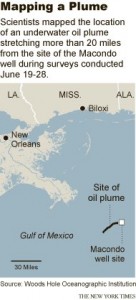
NYTimes: Gulf Oil Plume Is Not Breaking Down Fast, Research Says, see map of location

http://www.nytimes.com/2010/08/20/science/earth/20plume.html?_r=1&hp

By JUSTIN GILLIS and JOHN COLLINS RUDOLF

New research confirms the existence of a huge plume of dispersed oil deep in the Gulf of Mexico and suggests that it has not broken down rapidly, raising the possibility that it might pose a threat to wildlife for months or even years.

The study, the most ambitious scientific paper to emerge so far from the Deepwater Horizon spill, casts some doubt on recent statements by the federal government that oil in the gulf appears to be dissipating at a brisk clip. However, the lead scientist in the research, Richard Camilli, cautioned that the samples were taken in June and circumstances could have changed in the last two months.

The paper, which is to appear in Friday’s issue of the journal Science, http://www.sciencemag.org/ , adds to a welter of recent, and to some extent conflicting, scientific claims about the status of the gulf. While scientists generally agree that the risk of additional harm at the surface and near the shore has diminished since the well was capped a month ago, a sharp debate has arisen about the continuing risk from oil in the deep waters.

So far, scientific information about the gulf has emerged largely from government reports and statements issued by scientists. Many additional research papers are in the works, and it could be months before a clear scientific picture emerges.

The slow breakdown of deep oil that Dr. Camilli’s group found had a silver lining: it meant that the bacteria trying to eat the oil did not appear to have consumed an excessive amount of oxygen in the vicinity of the spill, alleviating concerns that the oxygen might have declined so much that it threatened sea life. On this point, Dr. Camilli’s research backs statements that the government has been making for weeks.

Dr. Camilli, of the Woods Hole Oceanographic Institution in Woods Hole, Mass., said the plume, at the time he studied it, was dissipating so slowly that it could still be in the gulf many months from now. Assuming that the physics of the plume are still similar to what his team saw in June, “it’s going to persist for quite a while before it finally dissipates or dilutes away,” he said.

Concentrations of hydrocarbons in the plume were generally low and declined gradually as the plume traveled through the gulf, although Dr. Camilli’s team has not yet completed tests on how toxic the chemicals might be to sea life.

In a report on Aug. 4, a team of government and independent scientists organized by the National Oceanic and Atmospheric Administration estimated that 74 percent of the oil from the leak had been captured directly from the wellhead; skimmed, burned, dispersed chemically or by natural processes; evaporated from the ocean surface; or dissolved into the water in microscopic droplets.

The report found that the remaining 26 percent of the oil had mostly washed ashore or collected there, was buried in sand and sediment, or was still on or below the surface as sheen or tar balls.

While the government report expressed concern about the continuing impact of the spill, it was widely viewed as evidence that the risk of additional harm in the gulf was declining.

This week, scientists at the University of Georgia, who in May were among the first to report the existence of the large plume studied by Dr. Camilli’s team, sharply challenged

the government’s assessment. They contended that the government had overestimated rates of evaporation and breakdown of the oil.

“The idea that 75 percent of the oil is gone and is of no further concern to the environment is just incorrect,” said Samantha Joye, a professor of marine sciences at the University of Georgia. She has studied the spill extensively but has not yet published her results.

Responding to the University of Georgia criticism, Jane Lubchenco, the NOAA administrator, said the government stood by its calculations. “Some of those numbers we can measure directly,” she said. “The others are the best estimates that are out there.”

Dr. Lubchenco has noted repeatedly that some of the remaining oil existed in the form of undersea plumes and cautioned that this subsurface oil could pose a threat to marine life.

In another report http://usfweb3.usf.edu/absoluteNM/templates/?a=2604&z=120

( also see )

this week, researchers from the University of South Florida said they had found oil droplets scattered in sediment along the gulf floor and in the water column, where they could pose a threat to some of the gulf’s most important fisheries.

The dispersed oil appeared to be having a toxic effect on bacteria and on phytoplankton, a group of micro-organisms that serves as a vital food for fish and other marine life, the scientists said, although they cautioned that further testing was needed.

Dr. Camilli’s paper tends to support the view that considerable oil may be lingering below the surface of the gulf. He said he was not especially surprised by the slow rate of breakdown, considering that the deep waters of the gulf are cold, about 40 degrees Fahrenheit in the vicinity of the plume.

“In colder environments, microbes operate more slowly,” Dr. Camilli said. “That’s why we have refrigerators.”

For weeks, BP, the company that owned the out-of-control well, disputed claims from scientists that a huge plume of dispersed oil droplets had formed in the gulf, with its chief executive at the time, Tony Hayward, declaring at one point, “There aren’t any plumes.” http://topics.nytimes.com/top/reference/timestopics/people/h/tony_hayward/index.html?inline=nyt-per

NOAA, while initially skeptical, ultimately confirmed the existence of such plumes in two reports. The new paper appears to dispel any lingering doubt, providing detailed evidence that one major plume and at least one minor plume existed and that they contained large quantities of hydrocarbons, albeit dispersed into tiny droplets.

Dr. Camilli’s team measured the main plume at roughly 3,600 feet below the surface; it extended for more than 20 miles southwest of the well. It was more than a mile wide in places and 600 feet thick, traveling at about four miles a day.

At the time his team studied it in June, the plume appeared to have narrowed from measurements reported early in the spill by a team that included Dr. Joye and Vernon Asper, a marine scientist from the University of Southern Mississippi, but Dr. Camilli’s results otherwise matched their report.

The slow breakdown of the plume, if verified by additional research, suggests that scientists may find themselves tracking the toxic compounds from BP’s well and trying to discern their impact on sea life for a long time.

“I expect the hydrocarbon imprint of the BP discharge will be detectable in the marine environment for the rest of my life,” Ian MacDonald, an oceanographer at Florida State University, told Congress in prepared testimony on Thursday. “The oil is not gone and is not going away anytime soon.”

Special thanks to Richard Charter

LA Times: Gulf oil spill: Most of the oil remains

http://latimesblogs.latimes.com/greenspace/2010/08/noaa-official-concedes-majority-of-gulf-oil-still-there.html

— Kim Murphy in New Orleans
August 19, 2010 | 4:52 pm

The National Oceanic and Atmospheric Administration released
http://articles.latimes.com/2010/aug/05/nation/la-na-oil-spill-20100805
a controversial “oil spill budget”
http://www.deepwaterhorizonresponse.com/posted/2931/Oil_Budget_description_8_3_FINAL.844091.pdf
Aug. 2 estimating that a large part of the oil released into the Gulf of Mexico by the Deepwater Horizon spill was gone. But in a hearing
http://energycommerce.house.gov/index.php?option=com_content&view=article&id=2106:heairng-on-the-bp-oil-spill-accounting-for-the-spilled-oil-and-ensuring-the-safety-of-seafood-from-the-gulfq&catid=130:subcommittee-on-energy-and-the-environment&Itemid=71
on Capitol Hill, a NOAA official conceded that three-fourths of the pollutants from the 4.1 million barrels spewed into the gulf are still lingering in the environment.

Bill Lehr, senior scientist with NOAA’s Office of Restoration and Response, said booming and burning probably cleaned up only about 10% of the spilled oil. Much of the oil has evaporated or dispersed, but remains a source of hydrocarbons in the ecosystem, he said.

“This is a continuing operation,” Lehr emphasized. “The spill is far from over. We’re beginning a new phase, and NOAA and all the other agencies will be involved in this.”

“We have seen some premature celebration,” said Rep. Edward Markey, (D-Mass.), who convened the House Energy and Environment subcommittee hearing. “What we have learned today is that the oil is not gone. The oil remaining in the Gulf waters or washed up on the shore is equivalent to 10 Exxon Valdez spills, and could be much more.”

The report released recently by NOAA and the Department of Interior — in which the agencies said the “vast majority” of the oil had been either recovered, dispersed or evaporated — rendered more optimistic figures because it counted as recovered the 800,000 barrels of oil captured directly by ships, Lehr conceded under questioning by Markey.

He said agency scientists also have not tallied the significant quantities of methane gas and heavy metals released into the gulf as a result of the spill.

If only 10% of the spilled oil was actually recovered, that is equivalent to the 10% to 15% recoveries scientists estimated were possible from a major spill at the time of the 1989 Exxon Valdez disaster, Markey noted. “So it seems to me that BP comes in only at the low end of what was possible 20 years ago…. I think it’s important that even using a 21-year-old grading system, that BP has done a very poor job in cleaning up the gulf.”

Lisa Suatoni, senior scientist at the Natural Resources Defense Council, added in her testimony: “We understand that the government wants to turn the corner and wants to signal that the gulf is on its way to recovery. However, the facts simply do not bear that out. There is still a huge amount of oil in the environment.”

Scientists from the Environmental Protection Agency and the Food and Drug Administration said they are confident that seafood coming from the newly opened areas of the gulf is safe to eat. Testing for hydrocarbons and residuals from the 1.8 million gallons of chemical dispersants used to break up the oil showed no dangerous contaminants, they said.

In tests of 500 shrimp and crabs for exposure to the polycyclic aromatic hydrocarbons (PAHs) that are one of the most dangerous elements in crude oil, all showed levels “below levels of concern” by a factor of 500 to 1,000 “essentially similar to prior to the oil spill,” said Donald Kraemer, acting deputy director of the FDA’s Center for Food Safety and Applied Nutrition.

In testing of 3,000 water samples, only two showed signs of dispersant. Moreover, all dispersants used when tested directly showed up as non-toxic or slightly toxic, and in combination with crude oil, no more toxic than the oil itself, which is considered moderately toxic, said Paul Anastas, an assistant EPA administrator.

— Kim Murphy in New Orleans

Special thanks to Richard Charter

Washingtonpost.com/Huffpost Reporting: NOAA Claims Scientists Reviewed Controversial Report; The Scientists Say Otherwise

http://www.huffingtonpost.com/2010/08/20/noaa-claims-scientists-re_n_689428.html

The last sentence says it all: “The consistent theme,” MacDonald said, “seems to be to minimize the impact of the oil — and to act as a bottleneck for information.” This has been another in a series of government cover-ups and complicity with Big Oil. We expected better of Lubchenko and Obama. DV
First Posted: 08-20-10 04:23 PM | Updated: 08-20-10 10:14 PM

In responding to the growing furor over the public release of a scientifically dubious and overly rosy federal report about the fate of the oil that BP spilled in the Gulf of Mexico, NOAA director Jane Lubchenco has repeatedly fallen back on one particular line of defense — that independent scientists had given it their stamp of approval.

Back at the report’s unveiling on August 4, Lubchenco spoke of a “peer review of the calculations that went into this by both other federal and non-federal scientists.” On Thursday afternoon, she told reporters on a conference call: “The report and the calculations that went into it were reviewed by independent scientists.” The scientists, she said, were listed at the end of the report.

But all the scientists on that list contacted by the Huffington Post for comment this week said the exact same thing: That although they provided some input to NOAA (the National Oceanic and Atmospheric Administration), they in no way reviewed the report, and could not vouch for it.

The skimpy, four-page report dominated an entire news cycle earlier this month, with contented administration officials claiming it meant that three fourths of the oil released from BP’s well was essentially gone — evaporated, dispersed, burned, etc. But independent scientists are increasingly challenging the report’s findings and its interpretation — and they are expressing outrage that the administration released no actual data or algorithms to support its claims.

HuffPost reached seven of the 11 scientists listed on the report. One declined to comment at all, six others had things to say.

In addition to disputing Lubchenco’s characterization of their role, several of them actually took issue with the report itself.

In particular, they refuted the notion, as put forth by Lubchenco and other Obama administration officials, that the report was either scientifically precise or an authoritative account of where the oil went.

“What we were trying to do was give the Incident Command something that they could at least start with,” said Ed Overton, an emeritus professor of environmental science at Louisiana State University. “But these are estimates. There’s a difference between data and estimates.”

Overton said NOAA asked him: “How much did I think would evaporate?” He responded with some ideas, but noted: “There’s a jillion parameters which are not very amenable to modeling.”

He said he didn’t know what NOAA did with his input. “I pretty much did my estimates and let that go,” he said.

And Overton bridled at the way the report was presented — with very precise percentages attributed to different categories. For instance, the report declared that 24 percent of the oil had been dispersed.

“I didn’t like the way they say 24 percent. We don’t know that,” Overton said. “They could have said a little bit more than a quarter, a little bit less than a quarter. But not 24 percent; that’s impossible.”

Michel Boufadel is on the list, but told HuffPost he did not review the report or its calculations. And the Temple University environmental engineer also said its specificity was inappropriate.

“When you look at that dispersed amount, and it says 8 percent chemically dispersed and 16 percent naturally dispersed, there’s a high degree of uncertainty here,” he said. “Naturally dispersed could be 6 or it could be 26.”

Ron Goodman, a 30-year veteran of Exxon’s Canadian affiliate who now runs his own consulting company, was incorrectly listed on the report with an academic affiliation: “U. of Calgary.” He is only an adjunct there. He said he responded to a series of questions from NOAA — “and that was it.”

And once the report came out, he said, “I was concerned that the amount dispersed was very low. I think it was higher by maybe a factor of two or three.”

In another example of how people are reading too much into the report, there has been some discussion suggesting that its estimate that 8 percent of the oil was chemically dispersed provides a new data point regarding how well those controversial chemicals worked. Goodman, however, said he believes the government scientists didn’t base their conclusion on evidence, but on faith.

“They took the amount of dispersant that was applied, and multiplied it by 20 which is the manufacturer’s suggested amount,” he said.

Merv Fingas, a former chief researcher for Canada’s environmental protection agency, said he thought the report was purely operational in nature. “The purpose of this was for the responders, and to tell them what to do — as opposed to saying ‘golly, the oil’s all gone.’ That was never the impression. That was very badly misinterpreted.”

Fingas said the scientists stressed how broad the ranges should be for the estimates. “On the pie chart, if you say 15 percent, it could maybe be 30, it could maybe be 5.”

Told how much certainty administration officials expressed in the estimates — “we have high degree of confidence in them,” is how Lubchenco put it — Fingas was blunt.

“That’s what happens when stuff goes from scientists to politicians,” he said. “It was exactly the opposite with the scientists. We had a lot of uncertainty.”

Juan Lasheras, an engineering professor at University of California, San Diego, on the list explained: “My involvement with the estimation of the oil spill budget has been minimal. I simply assisted Bill Lehr (NOAA) in a minor way with the estimation of the size of the oil droplets generated by the rising plume. I have not been involved in any of the other calculations or in the discussion and the writing of the report.”

Jim Payne, a private environmental consultant on the list, declined to comment beyond saying: “I really don’t know that much about how that was calculated.”

Also worth noting: Four of the “independent scientists” listed on the report work for the oil industry, have until recently, and/or work for consulting companies that do business with the oil industry.

What happened here? Why did ballpark estimates clearly created to guide emergency responders suddenly get cast as a conclusive scientific facts? (See my story from a few hours ago, Questions Mount About White House’s Overly Rosy Report On Oil Spill.)

Why did administration officials mislead the public about those findings — and then claim that independent scientists had reviewed them, when the evidence suggests that they did not?

NOAA public affairs officials did not respond to requests for comment before my deadline.

Ian R. MacDonald, an oceanographer at Florida State University who was not one of the scientists on NOAA’s list, sees this latest incident as part of an ongoing problem.

Lubchenco had previously been a key figure in the patently low-ball estimates for the oil flow, and fervently resisted acknowledging the existence of underwater oil plumes, he said.

“I’ve worked with NOAA essentially all my career and I have many good friends there, and people I respect in the agency, scientists who are really solid,” MacDonald said.

“Throughout this process, it’s been troubling to me to see the efforts of people like that passed through a filter where the objective seems to be much more political and public relations than making comments to inform the public.

“The consistent theme,” MacDonald said, “seems to be to minimize the impact of the oil — and to act as a bottleneck for information.”

Special thanks to Richard Charter

LA Times: Well’s blowout preventer to be replaced before ‘bottom kill’

August 21, 2010

http://www.latimes.com/news/nationworld/nation/la-na-oil-spill-20100820,0,1300452.story

Well’s blowout preventer to be replaced before ‘bottom kill’
BP and U.S. officials decide to move ahead with caution to prepare for complications.
By Richard Fausset and Kim Murphy, Los Angeles Times
August 20, 2010
Reporting from Atlanta and New Orleans

BP and government officials said Thursday that they planned to remove the damaged existing blowout preventer on top of the company’s troubled oil well and replace it with a new, stronger one a move they said would allow them to safely carry out the final “kill” of the well, but would delay the ultimate fix until after Labor Day.

Earlier in the crisis, BP had estimated that it would be able to complete the final step to plug the well, called the “bottom kill,” in mid-August. But because the well has not been spewing oil since July 15 when crews affixed a giant cap on the blowout preventer federal and company experts have decided to move slowly and carefully, preparing thoroughly for possible complications.

“We’re taking a little more time than we would have otherwise to make sure we’ve got everyone on board with what we’re doing in a very systematic approach,” said BP Senior Vice President Kent Wells.

In a hearing Thursday on Capitol Hill, the National Oceanic and Atmospheric Administration took fire on a controversial oil spill “budget” released Aug. 2 that estimated that a large part of the oil released into the Gulf of Mexico by the Deepwater Horizon spill was gone.

In fact, perhaps three-fourths of the pollutants from the 4.1 million barrels spewed into the gulf are still lingering in the environment, Bill Lehr, senior scientist with NOAA’s Office of Restoration and Response, conceded under questioning.

“This is a continuing operation,” Lehr emphasized. “The spill is far from over. We’re beginning a new phase, and NOAA and all the other agencies will be involved in this.”

Lehr said booming and burning probably only managed to clean up about 10% of the spilled oil. Much of the oil has evaporated or dispersed, but remains a source of hydrocarbons in the ecosystem, he said. An unknown amount washed up on beaches and is no longer polluting the gulf, he added.

The Aug. 2 report rendered more optimistic figures because it included the 800,000 barrels of oil captured directly by ships, Lehr said under questioning by Rep. Edward J. Markey (D-Mass).

Agency scientists also have not tallied the significant quantities of methane gas and heavy metals released into the gulf as a result of the spill, Lehr said.

“We have seen some premature celebration,” said Markey, who convened the House Energy and Environment Subcommittee hearing. “What we have learned today is that the oil is not gone. The oil remaining in the gulf waters or washed up on the shore is equivalent to 10 Exxon Valdez spills, and could be much more.”

Also Thursday, a group of ocean researchers announced they had found conclusive evidence of a 22-mile-long oil plume, directly attributable to the BP blowout, deep below the surface of the Gulf of Mexico.

The 1.2-mile wide, 650-foot high plume appears to be breaking down slowly and could linger in the Gulf “for some time,” the researchers reported.

The findings by scientists at the Woods Hole Oceanographic Institution, to be published Friday in the journal Science, represent the most rigorous study to date of the deepwater remnants of the BP spill.

The scientific studies and oil spill assessments come as engineers and the federal response team focus on the bottom kill, which involves drilling a relief well into the original well deep under the seafloor and injecting it with mud and concrete. A similar injection through the top of the well earlier this month appears to have successfully sealed off the inside of the well pipes.

But the plans for the bottom kill have been complicated by some good news arising from the first injection of concrete: Officials believe that the injection may have not just plugged up the well’s pipes, but also created a seal outside of them, at the base of the annulus, which is the space between the pipes and well bore.

Officials fear that with the bottom sealed off, the injection of mud from the bottom kill could cause a pressure spike inside the annulus that could burst seals at the top of the well, or even rupture the new base seal.

Experts decided to remove the old blowout preventer and replace it with a better one that can handle any pressure jolts. BP and government officials said they were confident that the well would be secure during the swap.

Thad Allen, the national spill response chief, was reluctant to give a precise timeline for the events leading up to the bottom kill, but he said that if all went well, the well could be intercepted the week after Labor Day, which is Sept. 6.

“We’re very close to putting this well away,” he said. “I think none of us wants to make a mistake at this point. And I have no problem, as national incident commander, with an overabundance of caution.”

A blowout preventer is supposed to shut down a well in the event of the kind of high-pressure geyser of oil and gas that shot through BP’s well on April 20, setting off explosions and fires that killed 11 workers.

BP’s damaged device will be placed in government custody and will likely be central to the U.S Coast Guard’s investigation into the cause of the disaster. The Department of Justice has also launched a criminal investigation.

The federal probes and a tangled web of litigation are apparently causing friction among the major companies involved. On Thursday, drilling company Transocean, which owned the stricken rig, released a seven-page letter accusing BP of withholding evidence necessary to fully investigate the blowout.

The letter, which was also sent to the U.S. Coast Guard and members of Congress, said BP had been asked seven times to turn over technical documents that might shed light on what caused the explosion. According to Transocean, BP has not provided any information since June 21.

BP said the letter was full of “misguided and misleading assertions, including the assertion that BP is ‘withholding evidence’ … Our commitment to cooperate with these investigations has been and remains unequivocal and steadfast.”

richard.fausset@latimes.com

kim.murphy@latimes.com

Fausset reported from Atlanta and Murphy reported from New Orleans.

Times staff writer Julie Cart in Los Angeles and Jim Tankersley in the Washington bureau contributed to this report.

Special thanks to Richard Charter

National Environmental Policy Act: Council on Environmental Quality Report on Oil & Gas Exploration & Development now available

The Council on Environmental Quality (CEQ) conducted a review of National Environmental Policy Act (NEPA) policies, practices, and procedures for the Department of the Interior’s Minerals Management Service (MMS) decisions for Outer Continental Shelf (OCS) oil and gas exploration and development.

This review of MMS NEPA policies, practices and procedures was conducted as a result of the oil spill from the Deepwater Horizon well and drilling rig in the Gulf of Mexico. The review ascertained how MMS applied NEPA in its management of OCS oil and gas exploration and development and makes recommendations for future Department of the Interior and Bureau of Ocean Energy Management, Regulation and Enforcement (the successor agency to MMS) NEPA for decisions involving OCS oil and gas exploration and development. The scope of the review encompasses NEPA for all decisions from leasing decisions to drilling and production.

The review was issued in a report by the Chair of CEQ on August 16, 2010 and can be viewed here. The CEQ report has been released and is available on-line at http://ceq.hss.doe.gov/current_developments/mmsnepa.html and a copy is attached to this e-mail.

Special thanks to: Horst Greczmiel, Associate Director for NEPA Oversight, Council on Environmental Quality, 202-395-0827, HGreczmiel@ceq.eop.gov