The Huffington Post,
July 29, 2010
http://www.huffingtonpost.com/2010/07/29/scientists-find-evidence_n_664298.htm l
The Huffington Post, July 29, 2010-07-29
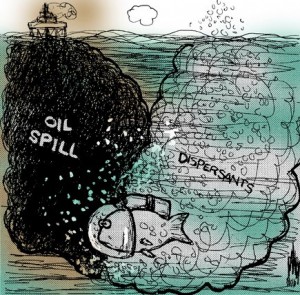
Scientists have found signs of an oil-and-dispersant mix under the shells of tiny blue crab larvae in the Gulf of Mexico, the first clear indication that the unprecedented use of dispersants in the BP oil spill has broken up the oil into toxic droplets so tiny that they can easily enter the foodchain.
Marine biologists started finding orange blobs under the translucent shells of crab larvae in May, and have continued to find them “in almost all” of the larvae they collect, all the way from Grand Isle, Louisiana, to Pensacola, Fla. — more than 300 miles of coastline — said Harriet Perry, a biologist with the University of Southern Mississippi’s Gulf Coast Research Laboratory.
And now, a team of researchers from Tulane University using infrared spectrometry to determine the chemical makeup of the blobs has detected the signature for Corexit, the dispersant BP used so widely in the Deepwater Horizon
“It does appear that there is a Corexit sort of fingerprint in the blob samples that we ran,” Erin Gray, a Tulane biologist, told the Huffington Post Thursday. Two independent tests are being run to confirm those findings, “so don’t say that we’re 100 percent sure yet,” Gray said.
“The chemistry test is still not completely conclusive,” said Tulane biology professor Caz Taylor, the team’s leader. “But that seems the most likely thing.”
With BP’s well possibly capped for good, and the surface slick shrinking, some observers of the Gulf disaster are starting to let down their guard, with some journalists even asking: Where is the oil?
But the answer is clear: In part due to the1.8 million gallons of dispersant that BP used, a lot of the estimated 200 million or more gallons of oil that spewed out of the blown well remains under the surface of the Gulf in plumes of tiny toxic droplets. And it’s short- and long-term effects could be profound.
BP sprayed dispersant onto the surface of the slick and into the jet of oil and gas as it erupted out of the wellhead a mile beneath the surface. As a result, less oil reached the surface and the Gulf’s fragile coastline. But more remained under the surface.
Fish, shrimp and crab larvae, which float around in the open seas, are considered the most likely to die on account of exposure to the subsea oil plumes. There are fears, for instance, that an entire year’s worth of bluefin tuna larvae may have perished.
But this latest discovery suggests that it’s not just larvae at risk from the subsurface droplets. It’s also the animals that feed on them.
“There are so many animals that eat those little larvae,” said Robert J. Diaz, a marine scientist at the College of William and Mary.
Oil itself is of course toxic, especially over long exposure. But some scientists worry that the mixture of oil with dispersants will actually prove more toxic, in part because of the still not entirely understood ingredients of Corexit, and in part because of the reduction in droplet size.
“Corexit is in the water column, just as we thought, and it is entering the bodies of animals. And it’s probably having a lethal impact there,” said Susan Shaw, director of the Marine Environmental Research Institute. The dispersant, she said, is like ” a delivery system” for the oil.
Although a large group of marine scientists meeting in late May reached a consensus that the application of dispersants was a legitimate element of the spill response, another group, organized by Shaw, more recently concluded “that Corexit dispersants, in combination with crude oil, pose grave health risks to marine life and human health and threaten to deplete critical niches in the Gulf food web that may never recover.”
One particular concern: “The properties that facilitate the movement of dispersants through oil also make it easier for them to move through cell walls, skin barriers, and membranes that protect vital organs, underlying layers of skin, the surfaces of eyes, mouths, and other structures.”
Perry told the Huffington Post that the small size of the droplets was clearly a factor in how the oil made its way under the crab larvae shells. Perry said the oil droplets in the water “are just the right size that probably in the process of swimming or respiring, they’re brought into that cavity.”
That would not happen if the droplets were larger, she said.
The oil droplet washes off when the larvae molt, she said — but that’s assuming they live that long. Larvae are a major food source for fish and other blue crabs — “their siblings are their favorite meal,” Perry explained. Fish are generally able to excrete ingested oil, but inverterbrates such as crabs don’t have that ability.
Perry said the discovery of the oil and dispersant blobs is very troubling — but not, she made clear, because it has any impact on the safety of seafood in the short run. “Unlike heavy metals that biomagnify as they go up the foodchain, oil doesn’t seem to do that,” she said. Rather, she said, “we’re looking at long-term ecological effects of having this oil in contact with marine organisms.”
Diaz, the marine scientist from William and Mary, spoke at a lunchtime briefing about dispersants on Capitol Hill on Thursday.
Dispersant, he explained, “doesn’t make the oil go away, it just puts it from one part of the ecosystem into another.”
In this case, he said, “the decision was to keep as much of the oil subsurface as possible.” As a result, the immediate impact on coastal wildlife was mitigated. But the effects on ocean life, he said, are less clear — in part because there’s less known about ocean ecosystems than coastal ones.
“As we go further offshore, as the oil industry has gone offshore, we find that we know less,” he said. “We haven’t really been using oceanic species to assess the risks, and this is a key issue.”
(Similar concerns have been expressed about the lack of important data that would allow scientists to accurately assess the effects of the spill on the Gulf’s sea turtles, whose plight is emerging as particularly poignant.)
Diaz warned of the danger posed to bluefin tuna — and also to “the signature resident species in the Gulf, the shrimp.” He noted that all three species of Gulf shrimp spawn offshore before moving back into shallow estuaries.
Diaz also expressed concern that dispersed oil droplets could end up doing great damage to the Gulf’s many undersea coral reefs. “If the droplets agglomerate with sediment,” he said, “they could even settle to the bottom.”
Nancy Kinner, co-director of the Coastal Response Center at the University of New Hampshire, said the use of dispersants in this spill raises many issues that scientists need to explore, starting with the effects of long-term exposure. She also noted that scientists have never studied the effects of dispersants when they’re injected directly into the turbulence of the plume, as they were here, or at such depth, or at such low temperatures, or under such pressure.
She also said it will be essential for the federal government to accurately determine how much oil made it out of the blown well. A key data point for scientists is the ratio of dispersant to oil, she said, and “if you don’t know the flow rate of the oil, you don’t know what you dispersant to oil ratio is.”
After a series of ludicrous estimates, the federal government settled last month on an official estimate of about 20,000 to 40,000 barrels a day, but BP is widely expected to contest that figure and some scientists think it is still a low-ball estimate.
There seems to be no doubt that history will record that the use of dispersants was good for BP, making it harder to tell how much oil was spilled, and reducing the short-term visible impact. But what’s less clear is whether it will turn out to have been good for the Gulf.
*************************
Dan Froomkin is senior Washington correspondent for the Huffington Post. You can send him an e-mail, bookmark his page; subscribe to his RSS feed, follow him on Twitter, friend him on Facebook, and/or become a fan and get e-mail alerts when he writes.
__________________________________________________________
MSNBC.Com
July 30, 2010
http://www.msnbc.msn.com/id/38415786/ns/nightly_news-nbc_news_investigates/
Scientists: BP dispersants have made spill more toxic
Group working for law firms suing BP cites ‘compelling evidence”
by Amna Nawaz, Rich Gardella and Lisa Myers, NBC News
NBC News Investigative Unit
-Editor’s note: Lisa Myers’ report on oil dispersants will air Friday on NBC Nightly News..
Amid growing concern about the use of dispersants in the Gulf of Mexico, a group of scientists working for law firms suing BP says their testing indicates that the dispersants being used to break up the oil are making this spill even more toxic to marine life.
Dr. William Sawyer, a toxicologist, is part of a team of scientists hired by law firms led by Smith Stag of New Orleans that are representing Louisiana fishermen and environmentalists.
The scientists collected and analyzed globs of oil, sand, and water from more than a dozen sites in four states along the Gulf.
Sawyer told NBC News that the findings are troubling. “We now have compelling evidence that the dispersant has enhanced and increased the toxicity from the spill,” he said.
Last week, a group of independent scientists called for an “immediate halt” to the use of dispersants. In what was called a “consensus statement,”
http://msnbcmedia.msn.com/i/TODAY/Sections/aNEWS/2010/07-July%2010/ScientistsConsensusStatement.pdf
they warned that dispersants pose “grave risks to marine life and human health.”
Spreading the damage?
So far, the federal government has approved use of more than 1.8 million gallons of dispersant in the Gulf. Most of it is Corexit 9500.
One reason relatively little oil is now on the surface of the Gulf’s waters is the use of such a vast quantity of dispersants. The dispersant spreads the oil over a much larger area, which some scientists worry makes it hard for marine life to avoid it.
Studies also have shown that when the dispersant breaks up the oil, it can free the most toxic components certain hydrocarbons and spread them throughout the water, exposing marine animals to more toxic components than if the oil hadn’t been dispersed.
Sawyer said their tests show that is now happening in parts of the Gulf. “What we found is a pattern of highly toxic hydrocarbon components that are not normally soluble in seawater, and at levels that are toxic to the marine environment,” he said.
Sawyer said these toxic hydrocarbons can be especially harmful to early stages of marine life.
NBC News shared Sawyer’s findings with Dr. Moby Solangi, a biologist at the Institute for Marine Mammal Studies, who has studied how oil spills impact marine life.
Solangi called the findings “very concerning.” “The way he [Sawyer] has theorized that the toxicity of the combination of both [oil and dispersant] is of some concern that needs to be looked at very carefully,” Solangi said.
Other scientists told NBC that Sawyer’s theory appears valid, but can’t be proven conclusively without testing the mixture of oil and dispersant on marine life.
Story: Oil dispersants an environmental ‘crapshoot’
http://www.msnbc.msn.com/id/37282611/ns/disaster_in_the_gulf
A toxic brew
Most recent scientific research has found that combining dispersants with oil makes the oil even more toxic. A review of more than 400 studies since 1997 showed that 75 percent of them found that the combination of oil and dispersant actually increased the toxic effects of the oil.
“I think we all agree that the dispersed oil is more likely to be toxic than the crude oil by itself,” says Dr. Joe Griffitt, a toxicologist at the University of Southern Mississippi.
However, so far, the scientific community has not reached any conclusion on whether oil mixed with dispersant is increasing the danger to marine creatures in the case of this particular spill. Part of the problem is that so little is known about use of dispersants in such great amounts or at this depth 5,000 feet.
BP points out that the federal government has approved its use of dispersants, and that they’ve been “very effective in keeping oil from reaching shore.” BP says it’s working closely with the government to monitor the environmental impact, and has committed to spend $500 million over 10 years to study the impact on the Gulf environment.
Nalco, which makes Corexit, says the EPA has concluded that use of Nalco’s dispersants “has not significantly affected the marine environment” and that federal officials have said they resulted in “no harm to aquatic life.”
.The EPA says “no federal agency has said these products cause no harm to aquatic life”,” but that its testing so far shows no “significant impact.”
Because of potential litigation, the EPA hasn’t seen all of Sawyer’s data. But the agency says it’s now conducting its own tests to determine just how toxic dispersants mixed with oil are to life in the Gulf.
To read statements to NBC News about the use of dispersants from BP, EPA and Nalco, as well as link to a statement from independent scientists opposed to the use of dispersants, click here .
http://www.msnbc.msn.com/id/38417141/ns/today
http://today.msnbc.msn.com/id/38417141
Statements from BP, EPA, Nalco
and scientists on dispersants
.TODAY
updated 7/30/2010 12:58:12 PM ET
Below are statements to NBC News from BP, EPA and Nalco regarding BP’s use of dispersants on oil spilled in the Gulf of Mexico, as well as a link to a recent statement on the subject from a group of independent scientists:
BP statement to NBC News:
With regard to the use of dispersants,
– We are working closely with EPA and the Coast Guard to monitor the effect of dispersants on the environment. Dispersants have never been used underwater in this way and we have been working with the agencies to gather as much data as possible to understand the current situation and for the future.
– They have been very effective in keeping oil from reaching the shore.
– Scientists say that given the light quality of the oil, the uses of dispersant, and the natural bioremediation effect of 5,000 feet of water, the oil is extremely weathered when it gets to shore, and the toxic components have greatly if not completely been reduced.
– BP has committed to spend $500 million over 10 years to study the impact of the oil spill on the Gulf environment and will be here for the long run.
EPA statement to NBC News:
There have been no “conclusions” reached about any of this EPA’s monitoring and research into dispersant is ongoing specifically because we want more information about this chemical’s impact on the environment. No federal agency has said these products cause no harm to aquatic life what our ongoing sampling tells us, is that to date they have not had a significant impact on aquatic life. And the issue is not the dispersant’s ingredients or constituents which Nalco only released after considerable prodding from EPA but the way those ingredients are mixed together to form dispersants.
Throughout this crisis, EPA scientists have consulted with all groups, including representatives from academia, non-governmental organizations, industry and other federal and state agencies to ensure we have access to the best available science. These independent scientists have been open and very willing to share their research and data, and it is very unfortunate that this scientist is unwilling to share his full report with EPA.
Still, we hope to have an opportunity to review his full study and discuss the results. EPA continues to conduct its own independent testing into dispersants, and the Agency released data from the first round of testing on June 30 to ensure outside scientists and the public have access to the same data EPA has. The next phase of EPA’s testing is focused on the acute toxicity of multiple concentrations of Louisiana Sweet Crude Oil alone and combinations of Louisiana Sweet Crude Oil with each of the eight dispersants for two test species.
Nalco statment to NBC News:
1. As the EPA said last week, it’s important to remember that oil is enemy number one in this crisis.
2. The EPA has concluded that the use of Nalco’s dispersants to break apart the oil has been effective and has not significantly affected the marine environment.
3. Federal officials have repeatedly stated, based on continual air and water sampling and other tests:
a. No harm to aquatic life
b. No indication of any impact in the atmosphere
c. No evidence of worker illness due to dispersant use
4. All of the ingredients contained in the Nalco dispersants are found in common household products, such as food, packaging, cosmetics, and household cleaners. It has been compared to dishwashing detergent by Federal officials.
5. Soon after oil began leaking on April 20, the government requested dispersants from the approved NCP list to help minimize the effects of the accident. Not a drop of Corexit dispersant has been used without the express approval of the federal government.
Special thanks to Richard Charter