Category Archives: Uncategorized

PPIC: In Big Shift, Californians Oppose Offshore Oil Drilling

http://www.ppic.org/main/pressrelease.asp?p=1037

I hope this translates into support for renewable energy legislation. DV

Support For Policies To Counter Global Warming Holds Steady

SAN FRANCISCO, July 28, 2010- Three months after a massive oil spill in the Gulf of Mexico, Californians’ support for more drilling off their coast has plunged, according to a survey released today by the Public Policy Institute of California (PPIC). A solid majority of the state’s residents now oppose more offshore drilling (59% oppose, 36% favor)-a 16-point increase in opposition from last year (43% oppose, 51% favor). The PPIC survey was conducted with support from The William and Flora Hewlett Foundation and is the 10th in a series about Californians and the environment.

In contrast to the shift in opinion on drilling, Californians’ views on another contentious environmental policy issue have held steady since last year. Two-thirds (67% today, 66% in 2009) favor the state law (AB 32) that requires California to reduce its greenhouse gas emissions to 1990 levels by 2020.

AB 32 is the focus of renewed debate because Proposition 23 on the November ballot asks whether the law should be suspended until unemployment drops to 5.5% or below for a minimum of one year. Because the ballot language has not been finalized, we posed a more general question about timing: Should the government take action to reduce emissions right away or wait until the state economy and job situation improve? A slim majority (53%) say California should act right away, while 42 percent say the state should wait.

“Two crises-a major oil spill and a major recession-have affected Californians’ views on environmental policy in very different ways,” says Mark Baldassare, PPIC president and CEO. “After consistently opposing more offshore oil drilling, residents began to waver as gas prices increased. But events in the gulf appear to have renewed opposition to more drilling here. In contrast, the lingering effect of the recession and a continuing state budget crisis haven’t changed Californians’ overall view of AB 32. While support has declined somewhat since 2007, a solid majority still favors the law.”

Little Confidence in Federal Spill Response
Partisan divisions are stark in many of the environmental survey findings. On the question of allowing more drilling, Democrats (72%) and independents (64%) oppose it, while Republicans (64%) favor it.

Californians are more united in their low levels of confidence in the federal government’s handling of the oil spill. Just 21 percent have either a great deal (8%) or good amount (13%) of confidence in the government to make the right decisions in dealing with the spill. Fewer than one in five residents across political, regional, and demographic groups express a great deal of confidence. Residents also lack confidence in the federal government’s ability to prevent future spills. About three in 10 are very (7%) or fairly (21%) confident; 32 percent are not very confident and 37 percent are not confident at all.

Build More Nuclear Plants? Californians Divided
The question about oil drilling is one of four that PPIC asked about U.S. energy policies. On another issue-nuclear power-Californians are divided (49% oppose, 44% favor) about building more nuclear power plants at this time to address the country’s energy needs and reduce dependence on foreign oil sources. On this question, too, partisan differences emerge: 57 percent of Democrats are opposed, while 67 percent of Republicans and half of independents (51%) favor building more plants now.
There is considerably more consensus on the two other policies. To address the country’s energy needs and reduce dependence on foreign oil sources, overwhelming majorities favor increasing federal funding to develop wind, solar, and hydrogen technology (83%), and favor requiring automakers to significantly improve the fuel efficiency of cars sold in this country (83%). Strong majorities across parties, regions, and demographic groups hold these views.

(This year we asked these energy policy questions in two ways. Half of our sample was asked the questions as we have in the past, with the introductory phrase, “Thinking about the country as a whole, to address the country’s energy needs and reduce dependence on foreign oil sources, do you favor or oppose the following proposals?” Half of the sample was asked the policy questions without this introductory phrase, to test whether or not the framing of the question influenced responses. Results for the four questions asked with the introductory phrase and without it are similar. Details on page 31.)

Will Action To Curb Warming Lead To Lost Jobs? Most Say No
Most Californians (54%) say global warming is already having an impact but are somewhat less likely to hold this view than they were last July (61%). Today 28 percent say global warming’s effects will be felt sometime in the future-up 6 points since last year-while just 16 percent say they will never happen. Nearly three-fourths say global warming is a very serious (44%) or somewhat serious (29%) threat to California’s future economy and quality of life. These findings are similar to last year but have declined since July 2007 (54% very serious, 28% somewhat serious).
Against a backdrop of state and national debates over climate change policies, Californians (76%) support government regulation of emissions from sources like power plants, cars, and factories, with 85 percent of Democrats, 81 percent of independents, and 51 percent of Republicans holding this view. Although a majority (67%) support the idea of AB 32, party divisions are strong: 80 percent of Democrats and 73 percent of independents are in favor, but only 39 percent of Republicans share this view.

Proposition 23 would suspend AB 32 until unemployment in the state is 5.5 percent or lower for four consecutive quarters. We asked Californians how the state’s actions to reduce global warming would affect employment. Forty-five percent say the result would be more jobs, 23 percent say fewer jobs, and 24 percent say the number of jobs wouldn’t be affected. Most Democrats (57%) and half of independents (50%) foresee more jobs in California as a result of action on global warming. Forty-three percent of Republicans foresee fewer jobs; half of Republicans say there would be more jobs (24%) or no effect on jobs (25%).

About half of Californians say the state (48%) and federal (52%) governments are not doing enough to address global warming. When it comes to ideas about state and federal actions to address global warming, strong majorities of Californians think the government should require: increased use of renewable energy sources by utilities (85%); industrial plants, oil refineries, and commercial facilities to reduce emissions (81%); all automakers to further reduce the emissions of greenhouse gases from new cars (79%); and an increase in energy efficiency for residential and commercial buildings and appliances (75%). They also favor encouraging local governments to change land use and transportation planning so that people can drive less (77%). Support for all of these policies is similar to last year.

Most Californians (54%) have not heard of one policy being discussed, the cap and trade system of setting limits on carbon dioxide emissions. After being read a brief description of the idea, 50 percent would support a cap and trade system and 40 percent would oppose it. They are much more likely to support a carbon tax (60% favor, 33% oppose).

Close Races For California Govern.or And U.S. Senate Seat
With the November election approaching, an overwhelming majority (79%) of likely voters say the gubernatorial candidates’ positions on the environment are at least somewhat important. Likely voters are closely divided between Democrat Jerry Brown (37%) and Republican Meg Whitman (34%), with 23 percent undecided. Of those saying that a candidate’s environmental positions are very important in determining their vote, 50 percent would vote for Brown and 16 percent would vote for Whitman. Among those who say a candidate’s environmental positions are somewhat important, Whitman is favored (42% to 33%). Preferences follow party lines, with independents split (30% Brown, 28% Whitman, 30% undecided). (The survey questionnaire lists results for all six candidates listed on the November ballot.)

Most likely voters (79%) also view the U.S. Senate candidates’ positions on the environment as at least somewhat important. Thirty-nine percent of likely voters support Democratic Senator Barbara Boxer, 34 percent support Republican Carly Fiorina, and 22 percent are undecided. Those who view candidates’ positions on the environment as very important are three times as likely to support Boxer (54%) as Fiorina (18%). Among those who say candidates’ views on the environment are somewhat important, support is evenly divided (37% to 37%). Each candidate has the support of her party’s likely voters. Among independents, 35 percent support Boxer, 29 percent support Fiorina, and 25 percent are undecided.

President Barack Obama’s approval rating has dropped 9 points since last July and 16 points since his record high (72%) in May 2009. Approval of Governor Arnold Schwarzenegger’s handling of environmental issues (34%) is higher than his overall rating (25%). The state legislature’s approval rating is 15 percent.

Most Support Tougher Pollution Standards For New Vehicles
When asked the open-ended question of what is the most important environmental issue facing Californians, air pollution is most often mentioned, as it has been since 2000. But it has declined in importance to residents from 33 percent in 2000 to 23 percent today. Other frequently named issues this year are water supply (12%), energy and oil drilling (11%), and water pollution (6%).

Similar to last year (23%), one in four Californians consider air pollution in their region a big problem (25%). Majorities of residents in Los Angeles (63%), the Inland Empire (57%), and the Central Valley (54%) consider air pollution a very serious or somewhat serious health threat, and 43 percent of Californians say they or an immediate family member has asthma or other respiratory problems.

When it comes to air quality policies, a strong majority (70%) would be willing to see tougher air pollution standards on new passenger vehicles. But there is much less agreement across party lines: 86 percent of Democrats and 73 percent of independents are willing to see stricter standards, compared to 45 percent of Republicans.

The California Air Resources Board is poised to consider easing or delaying implementation of diesel pollution rules because of their economic impact on truck owners and businesses. Asked about tougher air pollution standards on diesel engine vehicles, an overwhelming majority (75%) of Californians are willing to see stricter standards, a view held by solid majorities across political, regional, and demographic groups. Similarly, 75 percent would be willing to see tougher air pollution standards on commercial and industrial activities. A smaller majority (58%) would be willing to see tougher standards on agriculture and farm activities.

ABOUT THE SURVEY
The PPIC Statewide Survey has provided policymakers, the media, and the general public with objective, advocacy-free information on the perceptions, opinions, and public policy preferences of California residents since 1998. This is the 10th survey on the environment since 2000 and is part of an annual series conducted with funding from The William and Flora Hewlett Foundation. It is intended to inform policymakers and encourage discussion about environmental issues. Findings are based on a telephone survey of 2,502 California adult residents reached by landline and cell phones throughout the state. Interviews took place from July 6-20, 2010, and were conducted in English, Spanish, Chinese (Mandarin or Cantonese), Vietnamese, and Korean. The sampling error is ±2 percent for all adults, ±2.2 percent for the 1,971 registered voters, and ±2.7 percent for the 1,321 likely voters. For more information on methodology, see pages 25-26.

Mark Baldassare is president and CEO of PPIC, where he holds the Arjay and Frances Fearing Miller Chair in Public Policy. He is founder of the PPIC Statewide Survey, which he has directed since 1998.

PPIC is dedicated to informing and improving public policy in California through independent, objective, nonpartisan research on major economic, social, and political issues. The institute was established in 1994 with an endowment from William R. Hewlett. As a private operating foundation, PPIC does not take or support positions on any ballot measure or on any local, state, or federal legislation, nor does it endorse, support, or oppose any political parties or candidates for public office.

Special thanks to Richard Charter
Environment & Energy: Obama admin cancels 2 lease sales

Mike Soraghan, E&E reporter

The Obama administration today formally cancelled two lease sales that were once part of President Obama’s plan for “the largest expansion of our nation’s available offshore oil and gas supplies in three decades.”

But in the wake of the Deepwater Horizon spill in the Gulf of Mexico, the administration filed notices for the Federal Register that state the Interior Department needs time to do environmental reviews, scientific analysis and gather public input.

“Cancellation,” the notices say, “will allow time to develop and implement measures to improve the safety of oil and gas development in Federal waters, provide greater environmental protection, and substantially reduce the risk of catastrophic events.”

One of the lease sales was off Virginia and the other was in the western Gulf in waters as deep as 10,975 feet.

Obama had announced the decision on May 27 when he suspended the 33 deepwater exploratory wells then being drilled in the Gulf of Mexico. Publication in the Federal Register will make it official. The notices will be published tomorrow, over the signature of Michael Bromwich, the head of the Bureau of Ocean Energy Management, Regulation and Enforcement, the agency formerly known as the Minerals Management Service.

The filing drew praise from one of the environmental groups most critical of the Obama administration’s handling of the Deepwater Horizon spill.

“Obama’s decision to cancel these lease sales recognizes that risky offshore drilling needs reform,” said Miyoko Sakashita, oceans director at the Center for Biological Diversity. “Halting controversial lease sales is among the most proactive steps that Obama has taken toward the Gulf disaster.”

Special thanks to Richard Charter

Politico: Spill bills highlight Republican opposition

http://www.politico.com/news/stories/0710/40316.html
read more at http://www.politico.com/news/stories/0710/40316.html#ixzz0uyfIm5wL

I hope the Democrats hold a majority in Congress so we can continue to make at least minimal progress…
DV

House and Senate Democratic leaders Tuesday rolled out their big “spill bills” – the main legislative responses to the Gulf oil spill. The proposals are packed with aggressive offshore drilling reforms that Republicans have long fought and were immediately met with fierce pushback from the GOP and the oil industry.

That could make it tough to get the bills passed, especially in the Senate, where a handful of oil-state Democrats may cross the aisle to vote against the package. But strategists say the Republican “no” votes will also benefit Democrats politically – and some Republicans say that’s why the so-called poison pill provisions were included.

“If, after the worst oil spill in the history of the country, Republicans were to vote no against new offshore drilling protections – can you imagine the ads?” asked one senior Democratic aide.

Campaign strategists certainly can. “Republicans have found themselves on the defensive on that issue, and they are sitting on piles of big oil contributions,” said a Democratic strategist. “Absolutely, this is something we will be playing up before Election Day.”

Democratic campaign committees are already preparing lists of Republicans to target with ads over the August recess in the event that they vote against the oil reform package, the strategist added.

Democrats say the spill bills simply represent a robust and long-overdue effort to reform the offshore drilling industry – which hasn’t been subject to a major overhaul since 1978. And they point out that many of the core provisions have already won bipartisan support. For example, at the heart of the Senate bill are provisions to reorganize the Interior Department’s oversight of offshore drilling, co-sponsored by Senate Energy and Natural Resources Chairman Jeff Bingaman (D-N.M.) and the panel’s ranking member, Lisa Murkowski (R-Alaska); a title to retrofit heavy vehicles to run on natural gas, co-sponsored by New Jersey Democrat Robert Menendez and Utah Republican Orrin Hatch and the Homestar energy efficiency rebate program, Cash for Caulkers, co-sponsored by Bingaman and South Carolina Republican Lindsey Graham. The House bill includes elements of the Blowout Prevention Act, which passed through the House Energy and Commerce Committee on a unanimous vote, even drawing an “aye” from Texas Republican and BP
apologist Joe Barton.

But Republicans and the oil industry say that, in addition to those core bipartisan measures, Democrats have intentionally shoehorned provisions that are so onerous to the oil industry that Republican allies will be forced to vote no.

Special thanks to Richard Charter

Truthout: Experts: Health Hazards in Gulf Warrant Evacuations

It is so utterly senseless that our government is not only allowing, but is actually facilitating the poisoning of its people. There is no other way to interprete this. DV

http://www.truth-out.org/toxic-dispersants-causing-widespread-illness61604

Thursday 22 July 2010
by: Rose Aguilar, t r u t h o u t | Report

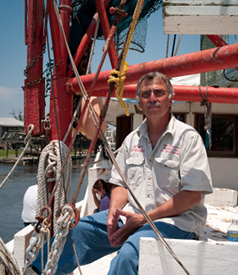
George Barisich has been a fisherman in New Orleans for over 40 years. Some experts are concerned that toxic chemicals being used to help clean up the oil spill in the Gulf are seriously endangering the health of those living near the water. (Photo: bbcworldservice / Flickr)
When Louisiana residents ask marine toxicologist and community activist Riki Ott what she would do if she lived in the Gulf with children, she tells them she would leave immediately. “It’s that bad. We need to start talking about who’s going to pay for evacuations.”
In 1989, Ott, who lives in Cordova, Alaska, experienced firsthand the devastating effects of the Exxon Valdex oil disaster. For the past two months, she’s been traveling back and forth between Louisiana and Florida to gather information about what’s really happening and share the lessons she learned about long-term illnesses and deaths of cleanup workers and residents. In late May, she began meeting people in the Gulf with symptoms like headaches, dizziness, sore throats, burning eyes, rashes and blisters that are so deep, they’re leaving scars. People are asking, “What’s happening to me?”
She says the culprit is almost two million gallons of Corexit, the dispersant BP is using to break up and hide the oil below the ocean’s surface. “It’s an industrial solvent. It’s a degreaser. It’s chewing up boat engines off-shore. It’s chewing up dive gear on-shore. Of course it’s chewing up people’s skin. The doctors are saying the solvents are making the oil worse.”
In a widely watched YouTube video, from Project Gulf Impact, a project that aims to give Gulf residents a voice, Chris Pincetich, a marine biologist and campaigner with the Sea Turtle Restoration Project, said Coast Guard planes are flying overhead at night spraying Corexit on the water and on land.
Ott says people who are experiencing discomfort of any kind, especially children, pregnant women, cancer survivors, asthma sufferers and African-Americans because they’re prone to sickle cell anemia, should wear a respirator and see a doctor that specializes in chemical poisoning immediately. She also recommends contacting the detox specialists at The Environmental Health Center in Dallas, Texas. “People don’t have the information to know that the burning sore throat is actually chemical poisoning,” she said. “And this isn’t getting any attention, but it’s very important. There are no vaccinations for chemical poisoning. None.”
Because she’s gotten to know the locals and has done a number of national media interviews, she’s now receiving a barrage of daily phone calls and emails from people who are concerned and don’t know where else to turn. She recommends they read this Sciencecorps resource about potential health hazards.
In the video above, author and journalist Summer Burke talks about her experience being sprayed with the toxic dispersant Corexit.
Ott shared these stories on a recent trip to the Bay Area with Diane Wilson, former Texas shrimper turned rabble-rousing activist. Ott was coughing and constantly clearing her throat during our two-hour conversation. “I can still smell the oil,” she said.
Media outlets have been reporting on public health concerns and taking water quality samples, but Ott says they’ve only scratched the surface. “If I were in charge of the media, I would be talking be about public safety and public health every day. They should also be exposing the truth about how our federal standards are outdated and no longer protective of public health or worker safety. We knew in 1989 that OSHA had a loophole in it that’s big enough to drive every single sick worker through. It exempts the reporting of colds and flus. That loophole has not been closed since Exxon Valdez.”
Ott expressed her concerns during a May meeting with Environmental Protection Agency (EPA) administrator Lisa Jackson. “I was sitting across from her. She said, quote, ‘I am walking a fine line between truth and hysteria. We don’t want to create a panic.’ This shows you how much our government is beholden to oil and cannot imagine a future without oil. We the people have got to imagine this. We have to. This is way worse than people think.”
On Tuesday, Mother Jones’ Kate Sheppard reported that Hugh Kaufman, a whistleblower who works as a senior policy analyst in the EPA’s Office of Solid Waste and Emergency Response, is accusing the agency of deliberately downplaying public health threats and its own role in regulating the chemicals being dumped into the Gulf “to protect itself from liability and keep the public from getting too alarmed.”
The cause for alarm can’t be more apparent. In addition to the health problems people are already experiencing, WKRG News 5 reporter Jessica Taloney recently collected samples of water and sand from five Alabama beaches and took them to a local lab to be tested.
Bob Naman, a chemist with nearly 30 years of experience, told Taloney that he wouldn’t expect to see more than five parts per million of oil and petroleum in the water. The sample of the water taken in Gulf Shores beach, where adults and kids were swimming and playing, showed 66 parts per million. The sand had 211 parts per million. When Naman began to test the sample collected from Dauphin Island Marina, it exploded. “We think that it mostly likely happened due to the presence of methanol or methane gas or the presence of the dispersant, Corexit.”
“What’s going on in the Gulf is the same cover-up that was going with the 9/11 environmental issue,” the EPA’s Kaufman told Sheppard. “The Bush White House ordered EPA to lie about the environmental and public health situation at the World Trade Center because of economic ramifications. So they did.”
On Democracy Now!, Kaufman accused the EPA of being “sock puppets for BP in this cover-up.”
I called Kaufman to find out if he agrees with Ott’s decision to sound the alarm about evacuations. The short answer? Yes. “If you’re getting sick, it’s because you’re being poisoned,” he said. “Those chemicals can cause cancer 20 years down the line and that’s why Riki Ott is saying some areas have to be evacuated. That’s true. We don’t know how bad it is because the EPA is not doing adequate air testing. They’re taking some measurements so they can tell the public that everything is safe [when in fact the public has] an increased risk of getting cancer and dying early. They’re pawns in a money game.”
Kaufman and Ott both say the media need to follow the money. The reason why the EPA is covering this up, they say, is because the cost to BP would be astronomical. “The dispersants hide the oil,” said Ott. “If you put dispersants in the water, you don’t know how much oil was really spilled. Oil fines are based on how much oil was spilled, so it’s all about money.”
If a group listed as a terrorist organization had caused the oil disaster, Kaufman says their assets would be seized immediately and their members would be arrested. So, why hasn’t the US government seized BP’s assets? Kaufman points to an April Vanity Fair article about Larry Fink, one of the most powerful men on Wall Street. Fink’s BlackRock money-management firm controls or monitors more than $12 trillion worldwide, including a billion shares of BP. According to the article, BlackRock “has effectively become the leading manager of Washington’s bailout of Wall Street,” thanks to Fink’s close relationship with former Treasury Secretary Henry Paulson and Treasury Secretary Timothy Geithner.
“It’s all about money,” says Kaufman. “Follow the money.”
So, where does this leave the people whose lives have been destroyed by this disaster? Where does this leave the people who will face long-term health problems? Where does this leave our oceans, wildlife and environment? What’s next?
“The more the public knows, the more the media cover it, the more the people tell officials to help, the better it is,” says Kaufman. “It’s a game of momentum.”
Ott says she plans to stay in the area to assist where she can (getting respirators for workers is near the top of her list), get the truth out and continue the conversations and community meetings she’s having with self-described Tea Partiers, evangelicals and fifth and sixth generation fisherman. “Here’s something positive for you,” she said. “I’m starting to hear, ‘We all live on one planet and there really is a climate crisis here. This can’t continue.’ I’m having conversations with the Christian Right. I’m staying in an oilman’s camper. Oilmen are starting to see that we need alternatives. I’m having tea party people come up to me and say, ‘How can I help?’ Corporations want to divide the nation into red and blue, Democrat and Republican. I’m seeing that crashing down. The frames are dissolving. The South is rising. I’m talking about the Deep South. This is the most hopeful sign I’m seeing.”
Former shrimper Diane Wilson hopes to see more direct action. “This is a crisis. If this oil gusher does not move people to force a change in Washington, then it will never happen. We are seeing the end of the United States as we know it. If people hold their planet dear, they better be out there. Folks are too well behaved. We need to be unreasonable.”

FAIR USE NOTICE: This may contain copyrighted material the use of which has not always been specifically authorized by the copyright owner. Such material is made available to advance understanding of ecological, political, human rights, economic democracy, scientific, moral, ethical, and social justice issues, etc. It is believed that this constitutes a “fair use” of any such copyrighted material as provided for in section 107 of the US Copyright Law. In accordance with Title 17 U.S.C. Section 107, this material is distributed without profit to those who have expressed a prior general interest in receiving similar information for research and educational purposes. For more information on this topic go to: http://www.law.Cornell.edu/uscode/17/107.html

Special thanks to Ashley Hotz

New Orleans Times-Picayune: Storm’s passage reveals problems with oil spill response

http://www.nola.com/news/gulf-oil-spill/index.ssf/2010/07/storms_passage_reveals_problem.html

Published: Monday, July 26, 2010, 8:45 AM Updated: Monday, July 26, 2010, 8:46 AM
Jeff Adelson, The Times-Picayune

Photo by Eliot Kamenitz / The Times-Picayune
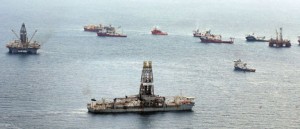
Drilling rigs and support ships return to the Deepwater Horizon accident site on Sunday after their evacuation from Tropical Storm Bonnie.

As officials surveyed a coastline left nearly unchanged by the passage of Tropical Storm Bonnie on Sunday, crews worked to restart key operations aimed at permanently stopping the flow of oil from the damaged BP well into the Gulf of Mexico.

Though Bonnie had little effect on the oil in the Gulf, the storm’s passage revealed some new problems with the booms used to protect the coastline, and it strained the relationships in the web of local and federal officials charged with defending the area from the oil.

Now that the latest threat of stormy weather has passed, officials are working on new plans to scale back the amount of boom they deploy, to prevent the barriers themselves from damaging sensitive marshes.

Officials are also working to refine plans to prevent the “misunderstandings” that led to a series of complaints and threats from parish leaders over the redeployment of resources as Bonnie approached.

Of the spill-fighting vessels returning to the area around the damaged well, “the critical ones are out there right now,” said Thad Allen, the National Incident Commander overseeing the response to the Deepwater Horizon response, in an 11 a.m. news briefing. All assets should be back at the site sometime today, said Allen, a retired U.S. Coast Guard admiral.

The waters above the spill off the Louisiana coastline were emptier of ships than they have been since the immediate aftermath of the explosion on the Deepwater Horizon rig. Oil began flowing into the Gulf after that explosion, which killed 11 workers on the platform, and the subsequent sinking of the rig.

During an overflight Sunday afternoon, the two rigs working on relief wells could be seen back at the site, and several other large support vessels had already moved back into the area. There was no sign of heavy oil near the wellhead.

Work resumes

Crews are working to re-extend the pipeline running from the rig working on the primary relief well and expected to have latched back onto the well by midnight Sunday, Allen said. The “static kill, ” which will be attempted after the relief wells connect to the well that was attached to the Deepwater Horizon, will pump material into the well in an effort to staunch the flow of oil. Officials believe they can go ahead with that effort sometime during the first week of August.

The relative quiet in the Gulf was a blessing of sorts for responders who had a chance to conduct seismic tests without interference from other vessels, Allen said.

The cap on the Macondo well is still holding, and its pressure has risen above 6,900 pounds per square inch, he said. That should be taken as a sign of “a well that has integrity, ” Allen said. More resources are being moved into the area to allow about 80,000 barrels a day to be pumped out of the capped well, he said.

In St. Tammany, crews began to redeploy the barges that guard the Rigolets from oil, though crosswinds delayed those efforts. Parish President Kevin Davis said they will be put into place as soon as possible and noted that a skimmer used to gather oil in the area had been brought back into service Sunday.

Throughout the day, flights searched for oil near the coast. Much of the oil now seems to have moved toward the Mississippi Sound, the Chandeleur Islands and Breton Sound, and responders will be sent to protect those areas and determine what, if any, damage has already been caused, Allen said.
There was no sign that oil had been pushed closer to Lake Pontchartrain, Davis said.

‘Family fight’

As the threat from Bonnie passed, officials found themselves dealing with the aftermath of another storm, one of words and proclamations. With a tropical storm bearing down on the area, Allen ordered that oil-cleanup vessels and equipment not needed on the scene to deal specifically with the storm be moved to be kept out of danger.

This drew protests by Plaquemines Parish President Billy Nunngesser and threats from Davis, who issued an executive order calling for the arrest of anyone who attempted to move equipment needed to protect the Rigolets and the Lake Pontchartrain.

Both officials worried that the order would leave their parishes vulnerable just as they needed the most protection from oil borne by storm surge.

Federal and local officials downplayed their disagreements Sunday, with New Orleans Mayor Mitch Landrieu referring to the spat as “typical family fight.”
“I’m very happy with what I saw today,” Landrieu said. “We were concerned about the ability to redeploy assets quickly, and the Coast Guard has done that, I think, with great expertise. Everyone is back in the fight.”

Allen did not back down from his earlier stance Sunday, recalling scenes from his work with the Coast Guard after Hurricane Katrina to drive the point home. He said he is “still haunted” from a flyover of the city on Sept. 6, 2005, when he saw lines of school buses that could have been used to aid in an evacuation sitting flooded in a lot.

Whenever there is a threat of gale-force winds, those over 39 mph, “for the safety of the personnel, we need to pull them back,” Allen said.
But, he added: “We didn’t pull them way far away.”

Practice run

To plan for future storms — and prevent similar “misunderstandings” between local and federal officials — Coast Guard Rear Adm. Paul Zukunft said he plans to meet with local leaders this week to discuss how the government will respond to storms from here on out.

The effort has given officials the practice of a dry run and a chance to work out these issues before a serious storm hits, said Zukunft, the federal on-scene coordinator for the response.

And, responding to concerns that once equipment left the area it would not be brought back, Zukunft said: “At no point are we talking about any diminishment of the level of effort.”

But the relief over Bonnie’s dissipation was mixed with a seemingly counter-intuitive regret that the storm had not kept its strength and continued on its path, an outcome that could have helped clean contaminated marshes.
Steve Lehmann, a scientific support coordinator at the National Oceanographic and Atmospheric Administration, said the northern winds that would have hit New Orleans had Bonnie remained a cyclone and come from the east would have flushed oily water out of the marshes.

Officials have also discovered a new problem with the strategy aimed at protecting those marshes. Boom that surrounded marshes in some areas were pushed into the wetlands by the rising water, becoming bludgeons that smashed the delicate plant life they once protected.

“Just the mechanical action of the boom being dragged over the marshes is not desirable,” he said. “That may cause more damage to the marsh than the oil would if it was there.”

Lehmann later referred to the issue by noting that the boom are “terrific technology that has become a liability.”

With evidence that the boom that was laid around hundreds of miles of coast may now be a threat, officials are considering a much more scaled-back deployment in the future. Rather than string boom around the coast, the floating barriers will be kept ready for deployment and laid out in areas only when it appears oil will shortly become a threat.

“We’ll be more surgical about where we put boom,” Zukunft said.

Jeff Adelson can be reached at jadelson@timespicayune.com or 985.645.2852.

1

Comments Feed

marlinfish July 26, 2010 at 9:00AM
Follow

NOAA maps show new oil landing all along the LA Coast. Where are the reports on this? And when is someone going to start testing for the toxic dispersant COREXIT. Scientist Terry Hazen from Berkeley, CA reported that after the 1970’s oil spill in NORMANDY France, areas untreated with dispersants recovered in 5 years but that areas treated with dispersants have still not recovered.

Special thanks to Richard Charter.