Category Archives: Uncategorized

Miami Herald: Judge halts oil, gas development on Chukchi Sea

http://www.miamiherald.com/2010/07/21/1741164/judge-halts-oil-gas-development.html

Posted on Wednesday, 07.21.10
BY DAN JOLING
ASSOCIATED PRESS WRITER
ANCHORAGE, Alaska — A federal judge on Wednesday stopped companies from developing oil and gas wells on billions of dollars in leases off Alaska’s northwest coast, saying the federal government failed to follow environmental law before it sold the drilling rights.

The lease sale in February 2008 brought in nearly $2.7 billion for the federal government from the sale of 2.76 million acres in the Arctic waters of the Chukchi Sea, including $2.1 billion in high bids submitted by Shell Gulf of Mexico Inc.

U.S. District Judge Ralph Beistline said that the Minerals Management Service failed to analyze the environmental effect of natural gas development despite industry interest and specific lease incentives for such development.

The agency analyzed only the development of the first field of 1 billion barrels of oil – despite acknowledging that the amount was the minimum level of development that could occur on the leases.

Beistline enjoined all activity under the lease sale pending additional environmental reviews.

The decision comes after the massive oil spill from a BP PLC well in the Gulf of Mexico and is a blow to the unit of Royal Dutch Shell PLC, which had hoped to drill three exploratory wells this summer in the Chukchi Sea. Those plans were halted with President Barack Obama’s decision in May to delay offshore oil drilling in the Arctic Ocean until at least 2011.

Offshore drilling is strongly supported by Alaska Gov. Sean Parnell and other elected officials in the state, where upward of 90 percent of general fund revenue is provided by the petroleum industry.

However, environmental and Alaska Native groups have long contended it would be impossible to clean up a spill in icy Arctic waters, far from deep water ports and airports.
The nearest Coast Guard base is on Kodiak Island more than 1,000 miles away.

Read more: http://www.miamiherald.com/2010/07/21/1741164/judge-halts-oil-gas-development.html#ixzz0uMvKy8OK

++++++++++++++++++++

http://www.kgw.com/news/business/98974654.html

KGW-TV

Business News

Judge halts oil, gas development on Chukchi Sea
Posted on July 21, 2010 at 6:00 PM
Updated today at 6:00 PM

ANCHORAGE, Alaska (AP) – A federal judge on Wednesday stopped companies from developing oil and gas wells on billions of dollars in leases off Alaska’s northwest coast, saying the federal government failed to follow environmental law before it sold the drilling rights.

The lease sale in February 2008 brought in nearly $2.7 billion for the federal government from the sale of 2.76 million acres (1.12 million hectares) in the Arctic waters of the Chukchi Sea, including $2.1 billion in high bids submitted by Shell Gulf of Mexico Inc.

U.S. District Judge Ralph Beistline said that the Minerals Management Service failed to analyze the environmental effect of natural gas development despite industry interest and specific lease incentives for such development.

The agency analyzed only the development of the first field of 1 billion barrels of oil – despite acknowledging that the amount was the minimum level of development that could occur on the leases.

Beistline enjoined all activity under the lease sale pending additional environmental reviews.

The decision comes after the massive oil spill from a BP PLC well in the Gulf of Mexico and is a blow to the unit of Royal Dutch Shell PLC, which had hoped to drill three exploratory wells this summer in the Chukchi Sea. Those plans were halted with President Barack Obama’s decision in May to delay offshore oil drilling in the Arctic Ocean until at least 2011.

Offshore drilling is strongly supported by Alaska Gov. Sean Parnell and other elected officials in the state, where upward of 90 percent of general fund revenue is provided by the petroleum industry.

However, environmental and Alaska Native groups have long contended it would be impossible to clean up a spill in icy Arctic waters, far from deep water ports and airports.
The nearest Coast Guard base is on Kodiak Island more than 1,000 miles (1,600 kilometers) away.

Special thanks to Richard Charter
AP: Pipeline repaired as China works to contain spill

Pipeline repaired as China works to contain spill

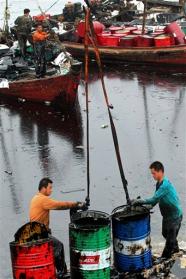
In this photo taken Wednesday, July 21, 2010, workers clean and collect crude oil near a polluted beach after a pipeline explosion in Dalian, in northeast China’s Liaoning province. China National Petroleum Corp. said Thursday the vital pipeline has resumed operations after an explosion caused the country’s largest reported oil spill. (AP Photo)

By CARA ANNA (AP) – 1 hour ago

BEIJING — China and environmental observers said cleanup efforts on the country’s largest reported oil spill were progressing Thursday, but the environmental and economic damage was clear.

The cleanup — marred by the drowning of a worker this week, his body coated in crude — continued over a 165 square mile (430 square kilometer) stretch of the Yellow Sea off the northeastern city of Dalian, one of China’s major ports and strategic oil reserve sites.

China National Petroleum Corp. said Thursday that the pipeline that exploded and caused the oil spill last Friday had resumed operations. The blast had reduced oil shipments from part of China’s strategic oil reserves to the rest of the country. The cause of the explosion that started the spill was still not clear.

The company, Asia’s biggest oil-and-gas producer by volume, also said more than 400 tons of oil had been cleaned up by 9 a.m. Wednesday, according to a posting on its website.

The environmental group Greenpeace China released photos Thursday of local fishermen cleaning up oily sludge at Weitang Bay with shovels, and of an employee scooping up dead snails at Guotai Water Products Farm, about 1 kilometer (0.6 miles) from the site of the explosion and spill.

“Dalian’s seafood farming and tourism industries have taken critical hits,” Greenpeace China said in a statement. It estimated 10,000 shellfish farms have been contaminated.

Fishing in the waters around Dalian has been banned through the end of August, the state-run Xinhua News Agency reported.

Greenpeace China also saw progress in the cleanup at Jinshitan, one of Dalian’s most popular beaches.

“On Jinshitan beach, several hundred fishermen, citizens and paramilitary police were using straw mats to absorb the oil,” said Zhong Yu, a Greenpeace China worker. “The cleanup there was almost done, but the air still remained smelly.”

The Dalian Daily newspaper cited an official in charge of cleanup efforts as saying the polluted area was shrinking, but no update on the spill size was issued Thursday.

It remained unclear exactly how much oil has spilled, but state media has said no more is leaking into the sea.

China Central Television earlier reported an estimate of 1,500 tons of oil has spilled. That would amount roughly to 400,000 gallons (1,500,000 liters) — as compared with 94 million to 184 million gallons in the BP oil spill off the U.S. coast.

The ecological harm from the spill could last a decade, Zhao Zhangyuan, a researcher with the China Environmental Science Research Institute, told the Shanghai Morning News earlier this week.

“The most critical is the effect on people, the effect on health,” Zhao said, because the decomposing oil will produce some carcinogenic substances that could move along the food chain to humans.

Associated Press writer Gillian Wong and researcher Yu Bing in Beijing contributed to this report.

USA Today: Ships ready to leave leaky Gulf well as storm brews

http://www.usatoday.com/news/nation/2010-07-22-storm-approaches-gulf-oil_N.htm

Image By Chris Graythen, Getty Images

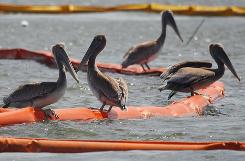
Pelicans sit on boom that is protecting Queen Bess Island on Wednesday in Grand Isle, Louisiana. A possible storm that may head into the Gulf of Mexico where BP is drilling a relief well would suspend oil spill containment projects.

ON THE GULF OF MEXICO (AP) — Dozens of ships were preparing Thursday to pull out of the Gulf of Mexico as a tropical storm brewed in the Caribbean, halting deep-sea efforts to plug BP’s ruptured oil well.

Though the rough weather was hundreds of miles (kilometers) from the spill site, officials ordered technicians to suspend work Wednesday as they would need several days to clear the area. The government’s oil spill chief was waiting to see how the storm developed before deciding whether to order the ships to evacuate.

Anxiety was building among the 75-member crew aboard the cutter Decisive, the Coast Guard’s primary search and rescue vessel, which would be the last of about 65 ships to leave in the event of an evacuation.

“It’s a controlled chaos out there,” Lt. Patrick Montgomery told an Associated Press reporter aboard the cutter heading to the spill site from Pascagoula, Mississippi.

The technicians were forced to halt their work just days from completing a relief well to permanently throttle the free-flowing crude.

Worse yet, foul weather could require reopening the cap that has contained the oil for nearly a week, allowing oil to gush into the sea again while engineers wait out the storm.

“This is necessarily going to be a judgment call,” said retired Coast Guard Adm. Thad Allen, the government’s point man on the crisis, on Wednesday.

The cluster of thunderstorms passed over Haiti and the Dominican Republic on Wednesday, and was forecast to move into the Gulf over the weekend with a 40% chance it would becoming a tropical depression or tropical storm by Friday.

Crews stationed some 50 miles (80 kilometers) out in the Gulf had planned to spend Wednesday and Thursday reinforcing with cement the last few feet (meters) of the relief tunnel that will be used to pump mud into the gusher and block it once and for all. But BP instead placed a temporary plug called a storm packer inside the tunnel in case it has to be abandoned while the storm passes.

“What we didn’t want to do is be in the middle of an operation and potentially put the relief well at some risk,” BP vice president Kent Wells said.

If the work crews are evacuated, it could be two weeks before they can resume the effort to plug the well. That would upset BP’s timetable for finishing the relief tunnel this month and plugging the blown-out well by early August.

Scientists have been scrutinizing underwater video and pressure data for days, trying to determine if the capped well is holding tight or in danger of rupturing and causing an even bigger disaster. If the storm prevents BP from monitoring the well, the cap may simply be reopened, allowing oil to spill into the water, Allen said.

BP and government scientists were discussing whether the cap could be monitored from shore.

As the storm drew closer, boat captains hired by BP for skimming duty were sent home for five or six days, said Tom Ard, president of the Orange Beach Fishing Association in Alabama.

In Florida, crews removed booms protecting the Panhandle’s waterways, as high winds and storm surges could carry the booms into sensitive wetlands.

Also, Shell Oil began evacuating employees out in the Gulf.

The storm could affect oil containment and cleanup efforts even if it does not hit the area directly. Last month, Hurricane Alex stayed 500 miles (805 kilometers) away but skimming in Alabama, Mississippi and Florida was curtailed for nearly a week.

The relief tunnel extends about 2 miles (3 kilometers) under the seabed and is about 50 to 60 feet (15 to 18 meters) vertically and 4 feet (1.2 meters) horizontally from the ruptured well. BP plans to cement a final string of casing, or drilling pipe, into place and give it up to a week to set before attempting to punch through to the blown-out well and kill it.

BP’s broken well spewed between 94 million and 184 million gallons (356 million to 697 million liters) before the cap was attached. The crisis — the biggest offshore oil spill in U.S. history — unfolded after the BP-leased Deepwater Horizon rig exploded April 20, killing 11 workers.

The cause of the blast is still under investigation, but rig workers have repeatedly questioned the rig’s equipment and safety conditions.

The New York Times reported early Thursday that rig workers expressed concern in a confidential survey before the blast about safety and the condition of equipment.

The Times said another report for Transocean by Lloyd’s Register Group found that several pieces of equipment — including the rams in the failed blowout preventer on the well head — had not been inspected since 2000, despite guidelines calling for inspection every three to five years. Transocean said most of the equipment was minor and the blowout preventer was inspected by manufacturer guidelines.

A spokesman for Transocean, the owner of the rig leased by BP, confirmed the existence of the reports to The Associated Press.

“As part of Transocean’s unwavering commitment to safety and rigorous maintenance discipline on all our rigs, we proactively commissioned the safety survey and the rig assessment review,” Transocean spokesman Lou Colasuonno said in an e-mail Thursday. “A fair reading of those detailed third-party reviews indicates clearly that while certain areas could be enhanced, overall rig maintenance met or exceeded regulatory and industry standards and the Deepwater Horizon’s safety management was strong and a culture of safety was robust on board the rig.”

Miami Herald: Florida legislature rejects oil drilling ban vote, adjourns. The question now becomes: Who gains politically from the state’s inaction?

http://www.miamiherald.com/2010/07/20/v-fullstory/1739673/florida-legislature-rejects-oil.html#ixzz0uKhdudTj
Posted on Wednesday, 07.21.10

How they voted:
The House voted 67-44 Tuesday to end the special session on oil drilling. Here’s how members of the South Florida delegation voted. A “yes” vote is a vote to end the session.

Yes

Bogdanoff, R-Fort Lauderdale
Bovo, R-Hialeah
Fresen, R-Miami
Gonzalez, R-Hialeah
Hasner, R-Delray Beach
Hudson, R-Naples
Lopez-Cantera, R-Miami
Rivera, R-Miami

No

Braynon, D-Miami Gardens
Bris, D-North Miami
Bullard, D-Miami
Clarke-Reed, D-Deerfield Beach
Garcia, D-Miami Beach
Gibbons, D-Hallandale Beach
Jenne, D-Dania Beach
Kiar, D-Davie
Llorente, R-Miami
Porth, D-Coral Springs
Robaina, R-Miami
Rogers, D-Lauderdale Lakes
Sands, D-Weston
Saunders, D-Key West
Skidmore, D-Boca Raton
Steinberg, D-Miami Beach
Thurston, D-Plantation
Waldman, D-Coconut Creek
Zapata, R-Miami

Absent/Not voting

Bush, D-Miami
Flores, R-Miami
Planas, R-Miami
Yolly Roberson, D-Miami
Schwartz, D-Hollywood

THE Senate voted 18-16 on Tuesday to end the session. Here’s how the South Florida delegation voted.

Yes

Atwater, R-North Palm Beach
Diaz de la Portilla, R-Miami
Ring, D-Margate

No

Gelber, D-Miami Beach
Smith, D-Lauderdale Lakes
Sobel, D-Hollywood
Villalobos, R-Miami

Absent/not voting

Bullard, D-Miami Garcia, R-Miami Rich, D-Weston Wilson, D-Miami

By STEVE BOUSQUET MARY ELLEN KLAS, LEE LOGAN AND JOHN FRANK
Herald/Times Tallahassee Bureau
TALLAHASSEE — Moving with extraordinary speed, the Florida Legislature took just two hours Tuesday to reject Gov. Charlie Crist’s proposal to give voters the chance to amend the state Constitution and ban offshore oil drilling.

In a brief special session, Republicans carried out a plan to block Crist from scoring political points by leading the charge for what they see as a symbolic ban on near-shore drilling, something already barred by state law.

The referendum is strongly supported by Democrats and independents whose votes Crist covets as an independent U.S. Senate candidate.

Lawmakers said they would work on another special session in September, one focused on long-term measures to provide economic relief to people affected by the Deepwater Horizon spill in the Gulf.

A fired-up Crist heaped scorn on lawmakers, criticizing them for an “arrogance of power” and urging voters to throw them out of office in November.

“They are the do-nothing Legislature,” said Crist, who called the special session in hopes of beating the Aug. 4 deadline to add a referendum to the Nov. 2 general election ballot.

“I can’t believe that this Legislature has shirked their duty so badly,” Crist said. “How arrogant can a Legislature be? I can’t believe that they would have that much of a lack of respect for the people of Florida.”

Neither the House nor the Senate debated the issue itself. Instead, both chambers debated whether the drilling ban proposal should be debated.

As scores of drilling opponents looked on wearing “Let the People Vote” stickers, the House voted 67-44 to curtail debate after 10 minutes, and senators followed with a vote of 18 to 16.

Two Democratic senators who sided with Republicans played key roles in blocking a vote on the measure: Sen. Jeremy Ring, D-Margate, and Gary Siplin, D-Orlando. Their influence was magnified by the absences of three Democrats and two moderate Republicans who are both Crist allies.

Eight Republican senators, four from the Tampa Bay region, voted against ending the session prematurely. They were Lee Constantine of Altamonte Springs, Victor Crist of Tampa, Paula Dockery of Lakeland, Mike Fasano of New Port Richey, Dennis Jones of Treasure Island, Evelyn Lynn of Ormond Beach, Steve Oelrich of Gainesville and Alex Villalobos of Miami, who sponsored the drilling ban, and who threw in the towel when the House adjourned after 49 minutes.

“I can’t prevail because they left,” Villalobos said.

In the House, four Republicans sided with Democrats in support of debating the ban. They were Reps. Kevin Ambler, R-Tampa and three Miami lawmakers: Reps. Marcelo Llorente, Julio Robaina, and Juan Zapata. One House Democrat, Rep, Leonard Bembry of Greenville, voted with Republicans to block debate.

House Speaker Larry Cretul, R-Ocala, pounded his gavel at 12:02 p.m., quickly rejecting Crist’s call for a constitutional drilling ban and criticizing the governor for calling lawmakers to work on short notice.

“The fact remains that he has called us here at the last possible moment to consider a constitutional amendment for which he never proposed any language and permitted far too little time for reflection and review,” Cretul said. “This is a terrible way to propose constitutional changes.”

Senate President Jeff Atwater, R-North Palm Beach, said he tried to persuade Crist and Cretul to expand the scope of the session to discuss tax relief and creation of a claims advocate, but got no takers: “Unfortunately, I did not receive a receptive audience.”

But Crist said neither legislative leader asked him to expand the session’s agenda.

Later Tuesday, the Senate convened a select committee on Florida’s economy for a two-hour hearing on relief measures.

The House immediately went home, but Cretul created six work groups of lawmakers to seek solutions ranging from economic aid to the need for tougher criminal penalties for environmental disasters.

The leaders of all six work groups are Republicans who are not part of the House leadership and who oppose Crist’s Senate candidacy. Even though the Panhandle is currently the area most directly affected by the disaster, the chairman of the work group on meeting the needs of affected areas is Rep. Marlene O’Toole, R-Lady Lake, from The Villages in Central Florida.

Two busloads of drilling opponents arrived at the Capitol only to see their hopes quickly dashed. Wearing green “Let the People Vote” stickers, 150 cheered, and some squeezed through the crowd to shake the hand of Crist, who, in the presence of eight TV cameras, stuck one of the stickers on his suit lapel.

Ed Berry, who owns a natural food store and massage therapy business in Walton County, made the two-and-a-half hour bus ride to the Capitol, and pleaded for the chance to permanently ban drilling off Florida’s coast.

“Big Oil is destroying our communities. It’s destroying our lives,” he said. “Fifteen years of hard work is going down the drain.”

Now that the Legislature has rejected Crist’s call for an anti-drilling amendment, the question is which side will reap any political benefit. Even if Crist’s anti-drilling ban were in the Constitution, it wouldn’t have prevented the Deepwater Horizon spill, which was beyond the reach of state jurisdiction.

Three leading candidates for governor all had strongly-worded reactions to the Legislature’s action. Republican Rick Scott blasted lawmakers for not taking his advice and enacting an Arizona-style immigration law. “The career politicians in Tallahassee have yet again wasted taxpayer dollars for a political stunt,” Scott said.

Scott’s GOP primary opponent, Bill McCollum, said a constitutional amendment to ban drilling was unnecessary, but if it went forward, he would favor it. “I’d want to see us address the economic and environmental concerns, particularly in the Panhandle,” added McCollum, the state attorney general.

Democrat Alex Sink, the state’s chief financial officer, called the lawmakers’ truncated session a “complete failure,” adding, “Instead of action, the tone deaf Florida Legislature has been twiddling their thumbs.”

Crist’s Republican U.S. Senate rival, Marco Rubio, described the session as “Charlie Crist’s meltdown” that “embodies everything that’s wrong with government today. Instead of presenting solutions, he points fingers and blames others.”

Tuesday’s short-lived session was not the shortest in Florida history. On Nov. 17, 1970, lawmakers convened for just 36 minutes to provide money for then-Gov.-elect Reubin Askews transition program.

Cristina Silva contributed to this report.

Houston Chronicle: Deadly Gulf blowouts persist

http://www.chron.com/disp/story.mpl/business/deepwaterhorizon/7115411.html

By ERIC NALDER

July 20, 2010, 9:27PM

Mario Tama Getty Images

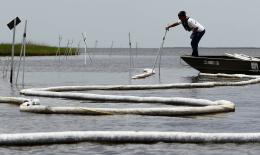
A worker adjusts an oil boom in Louisiana in the area where the Pointe Aux Chenes tribe lives. The tribe is concerned about leakage spotted near BP’s newly installed oil well cap.

Dangerous and short-tempered subterranean gases have erupted to kill 29 oil drillers since 1979, and despite repeated recommendations aimed at quelling blowouts, years and even decades have passed as accidents continued unabated.

The Houston Chronicle reviewed 66 blowouts in the Gulf of Mexico – one of the most dangerous places on Earth to drill for oil – and found that time and again, federal investigators’ calls for improvement were either largely ignored or delayed amid industry consternation.

In the last 10 years, blowouts triggered explosions on five rigs in the Gulf, a minefield of Mississippi mud deposits, and caused the evacuation of 17, according to the Chronicle’s examination of scores of documents.

Blowouts, known technically as “loss of well control incidents,” range in seriousness from slow old leakers to explosive killers that can open the earth and swallow a rig while spewing gas, drilling mud, water vapor, sand and oil.

There are so many man-made holes in the Gulf, 50,000, that the government has lost track of at least 4,500 old wells, records show.

And preventing blowouts may be more difficult than curbing airline disasters. Unlike airplanes, no two wells are alike. Building an oil well is like building a ship in an opaque bottle, threading massive pipes and intricate tools through a dark, narrow hole.

Documents show the top two causes of blowouts are failed cement jobs and surprise encounters with shallow gas pockets. Also common are well-design mistakes and poor maintenance.

Yet, solutions have been elusive, according to records.

“The administrative process has gotten extremely burdensome,” said Alan Spackman, vice president of the International Association of Drilling Contractors, adding that it takes too long for the government to change regulations. Spackman once worked as a Coast Guard marine safety officer.

Jo Ann Freeman needs no convincing. Her husband, Ben Freeman, 61, was killed in 2001 even as oil executives and government bureaucrats pondered for years an equipment requirement that might have saved his life.

Freeman told his wife as he headed for the waters off the Texas coast that he was “going to a bad job.” During his second week on location aboard the jack-up rig Marine IV, the crew encountered natural gas 90 feet sooner than expected 26 miles off Surfside Beach.

Shortly before dawn, hell blasted up the drill pipe.

Thirty-nine crew members drifted in escape capsules before noticing Freeman was missing. He was last seen helping others down slippery stairs, and his body was never found. Over 35 years, Freeman had risen from roughneck to high-paid consultant.

Mineral Management Services records show the blowout preventer failed because a section of drill pipe jammed inside it, preventing it from closing over the gas geyser. The blowout preventer lacked a “blind shear ram” specifically designed for such jams.

When it works properly, the shear ram cuts through most pipe jammed in a BOP so it can control a wild well.

During the 25 years leading up to Freeman’s death, shear rams might have prevented a dozen other blowouts that caused nine deaths, records show. As a result, federal agencies including the U.S. Coast Guard and MMS on six occasions had recommended requiring them on rigs like the Marine IV.

Fight over shear ram rule

The oil industry successfully opposed it, citing costs and worries that shear rams might hamper other well-control efforts or cut pipe needlessly. Even after Freeman died, the peril continued.

Nineteen months later, 600 feet of steel tubing jammed a BOP during an Anadarko operation. An Anadarko spokesman said the BOP complied with federal regulations, even without a shear ram. Again, MMS accident investigators recommended requiring them.

Not until 2006 did the shear ram become the rule.

“Certainly in hindsight it makes sense,” admitted Spackman, whose group opposed it at the time.

In the aftermath of the Deepwater Horizon blowout, Spackman and others say more rule changes are needed. Upgrading blowout preventers isn’t enough, he said, because “when you get to the point of using it, a lot of other things have gone wrong.”

A cementing failure likely contributed to the Deepwater Horizon disaster. MMS attempted in 2000 to create new regulations to prevent cementing failures, but records show it faced opposition from the Offshore Operators Committee, representing 70 companies in offshore exploration and oil and gas production.

OOC executive director Allen Verret wrote at the time: “We have serious reservation with MMS prescribing any type of ‘Best Cementing Practices.’ ”

Verret told the Chronicle the industry prefers guidelines to prescriptions: “It hasn’t been uncommon for there to be some sort of knee-jerk reaction by government. They throw a lot of stuff at the wall. Some sticks and some doesn’t.”

The other leading cause of Gulf blowouts, the shallow gas problem, has plagued drillers for 50 years. Gases roam the Gulf’s subsea geology, moving from crevice to crevice, launching surprise attacks on drillers who don’t detect them before starting operations. The vapors change locations because of natural forces and even drilling activities.

Crater swallows ship

The hazard hit the headlines back in 1964, when a blowout near Louisiana set fire to the C.P. Baker drill ship and opened a crater that literally swallowed it. After C.P. Baker, devices were required on rigs that divert gases safely out to sea, away from the machinery.

However, certain pre-drill tests weren’t required on wells planned near existing holes on the theory the hazards would be clear, though MMS repeatedly recommended conducting them.

A Chevron crew was surprised by shallow gas in April 2003, just 100 feet from the tracks of four previous wells. Records show shallow gas caused or contributed to 10 blowouts in the last decade.

In 2001 and 2002, two rigs were set ablaze in 18 months, one a BP operation and the other Forest Oil. Both companies declined comment.

The government sent out a notice to oil field lessees calling for more testing in 2008, 44 years after C.P. Baker.

A 2008 Chevron blowout appears in hindsight to have been a rehearsal for Deepwater Horizon and its design problems. Like BP, Chevron was in the final stages of drilling a well aboard Transocean rig Discoverer Deep Seas. Because of the blowout, drillers lost 500,000 gallons of drilling mud into the earth below the wellhead, and spilled 293 gallons onto the ocean floor.

Afterward, Chevron adopted its own well-design guidelines for deepwater operations – guidelines that might have prevented the Macondo well disaster had BP adopted them. Key was a casing pipe, or “tieback string,” not employed on Macondo, that provides superior barriers against blowouts, records show.

But federal regulators did not issue a safety alert to other companies.

Maintenance woes afflict wells of all types. On a modern deepwater BP well in May 2003, the entire riser pipe, which connects the floating rig to the wellhead, broke apart because of a failed joint, reports say.

Because of that close call with a blowout, MMS investigators recommended twice-a-year thorough inspections of deepwater risers, rather than one.

No such change has been made to the industry standard, according to the American Petroleum Institute.

ericnalder@hearst.com
Special thanks to Richard Charter