Category Archives: Uncategorized

Bureau of Offshore Energy Management to Hold Public Meetings on Offshore Drilling Safety

http://www.offshoreenergylawblog.com/07-20-2010boemtoholdpublicmeetingsonoffshoredrillingsafety/

July 20, 2010 by David L. Wochner, Benjamin Norris, Caileen N. Gamache

Michael Bromwich, Director of the Bureau of Ocean Energy Management, Regulation and Enforcement (“BOEM”) announced yesterday that he will lead a series of public meetings to collect information and views on offshore deepwater drilling safety, well blowout containment, and oil spill response. The meetings are designed to collect input from industry representatives, environmental organizations, the public, state and local leaders, and experts in an effort to enhance the safety of deepwater drilling. The meetings are scheduled to occur in August and September in the following cities: New Orleans, LA; Lafayette, LA; Mobile, AL; Pensacola, FL; Santa Barbara, CA; Anchorage, AK; Biloxi, MS; and Houston, TX. Director Bromwich plans to release dates and specific locations soon. Written comments will also be accepted at the meetings, online, and by mail.

Special thanks to Richard Charter

MSNBC: China spill doubles in size, is deemed ‘severe threat’ Crude pours out after pipeline blast; at least 1 firefighter dead

http://www.msnbc.msn.com/id/38337393/ns/world_news-world_environment

Jiang He / AP
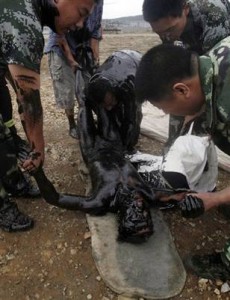
In this photo released by Greenpeace, a firefighter submerged in thick oil during an attempt to fix an underwater pump is brought ashore by his colleagues in Dalian, China on Tuesday.by CARA ANNA

updated 7/21/2010 7:51:14 AM ET
Share Print Font: +-BEIJING — China’s largest reported oil spill more than doubled in size to 165 square miles by Wednesday, forcing nearby beaches to close and prompting one official to warn of a “severe threat” to sea life and water quality.

The oil slick started spreading five days ago when a pipeline at a busy northeastern port exploded, sparking a massive fire that took more than 15 hours to contain. Hundreds of boats have been deployed to help with the cleanup.

At least one person has been killed in those efforts, a 25-year-old firefighter, Zhang Liang, who drowned Tuesday after a wave threw him from a vessel and pushed him out to sea, the state-run Xinhua News Agency reported. Another man who also fell in was rescued.

Beaches near Dalian, once named China’s most livable city, were closing as oil started reaching their shores, Xinhua reported.

“The oil spill will pose a severe threat to marine animals, and water quality, and the sea birds,” Huang Yong, deputy bureau chief for Dalian, China Maritime Safety Administration, told Dragon TV.

Crude oil started pouring into the Yellow Sea off a busy northeastern port after a pipeline exploded late last week, sparking a massive 15-hour fire.

The cause of the blast was still not clear Wednesday. The pipeline is owned by China National Petroleum Corp., Asia’s biggest oil and gas producer by volume.

Images of 100-foot-high flames shooting up near part of China’s strategic oil reserves drew the immediate attention of President Hu Jintao and other top leaders. Now the challenge is cleaning up the greasy brown plume floating off the shores of Dalian.

The environmental group, Greenpeace China, shot several photographs at the scene Tuesday before their team was forced to leave. They showed oil-slicked rocky beaches, a man covered in thick black sludge up to his cheekbones, and workers carrying a colleague covered in oil away from the scene.

Activists said it was too early to tell what impact the pollution might have on marine life.

Largest spill in recent memory
Officials told Xinhua they did not yet know how much oil had leaked, but China Central Television reported no more pollution, including oil and firefighting chemicals, had entered the sea Tuesday. It was not clear how far the spill was from China’s closest neighbor in the region, North Korea.

Dalian’s vice mayor, Dai Yulin, told Xinhua 40 specialized oil-control boats would be on the scene along with hundreds of fishing boats. Oil-eating bacteria were also being used in the cleanup.

“Our priority is to collect the spilled oil within five days to reduce the possibility of contaminating international waters,” he said.

But an official with the State Oceanic Administration has warned the spill will be difficult to clean up even in twice that amount of time.

The Dalian port is China’s second largest for crude oil imports, and last week’s spill appears to be the country’s largest in recent memory.

“In terms of what is known to the public, this is definitely the biggest,” said Yang Ailun, spokeswoman for Greenpeace China.

“Government and business leaders have been telling the media that there’s no environmental impact. From Greenpeace’s perspective, that’s very irresponsible,” she added. “It’s too early to tell. Oil is still floating around.”

While the Chinese public has not seized on the accident as its own version of the massive BP spill in the United States, warnings over the country’s increasing dependence on oil were clear.

The International Energy Agency said Tuesday that China has overtaken the United States as the world’s largest energy consumer, using the equivalent of 2.252 billion tons of oil last year. China immediately questioned the calculation.

Special thanks to Richard Charter

Linda Young Florida Clean Water Network: Weekly update on oil disaster 7-19-10:

Dear Friends of Florida’s waters:
I’m sure that each of you are doing the same thing I am, which is watching the television with bated-breath in hopes that the gushing hole in the Gulf of Mexico will soon cease to flow permanently. As we have been told, that will not be the end of this nightmare, but the end of the beginning. There is a tremendous amount of information available now, but the main problem that I have on a regular basis is figuring out what is credible and what is not. The news and information spans the spectrum between pure PR spin on the one hand to wild speculation on the other. This leaves many of us confused, discouraged and/or scared. What are we supposed to think?

Here’s what I have learned since our last update:

STATE AND FEDERAL RESPONSE EFFORTS – Local governments are reporting that coordination with the state has improved in recent weeks. Escambia County finally got reimbursed for the millions of dollars that they have spent up through the end of June and the state is in the process of taking over the private contract that Escambia County had negotiated to protect its coast and resources. The problem that was created for local governments when the state was changing its policies and procedures on a daily basis sometimes, has improved.

Another recent change is that BP now has a representative at several Panhandle local response sites. Early in the process, Escambia County offered its Emergency Operations Center as a central coordination site, but BP declined the offer. An operation center is now established at Bayou Chico and serves Escambia and Santa Rosa Counties. Other similar centers are established in counties to the east.

HEALTH AND SAFETY ISSUES:

Air quality – The DEP and EPA websites have air quality data from their monitoring stations but they are averaging the data over 24 hours or longer (maybe up to a week as far as I can tell), so that data is not helpful in my opinion. Lately the air quality in the western panhandle has been much better in terms of not smelling the oil like we have in previous weeks and months. However, our members in Panama City and Port St. Joe reported strong oil odors last week. They contacted the local health department who told them that the air was fine and that they were imagining the odors. Whatever.

Water quality – If you visit the FL DEP website, you will find air and water quality data. The problem is that they only have two basic findings: non-detect or detected but not believed to be related to the BP oil disaster. Hmmmmm . . . Just across the Florida/Alabama line, the water and sand were tested by the local TV station WKRG and they found high levels of oil in the beach and sand where children were swimming and playing.

There has been less oil coming ashore in the Panhandle over the past week or two and that seems to be mostly by the graces of Mother Nature, more than a great improvement in the mechanical efforts to keep the oil at bay. The NOAA website and others shows the concentration of surface oil to be about 80 to 90 miles off the coast of Pensacola today. There is essentially no way to keep the oil out of Pensacola Pass due to the depth and swift currents. The only thing that is being done is to try to clean it up after it enters the pass. It has moved at times as far as the Bob Sikes Bridge.

To track oil, the Coast Guard is using a hot-air blimp that cruises back and forth along the coast, which is actually quite impressive. They report that the oil is visible from above but is impossible to see from down in the water until late in the afternoon. They often see swimmers in the water with oil and they are completely unaware of its presence. All of the Florida beaches are open and ready for business.

At Perdido Pass, booms are being used with marginal success apparently. Destin Pass has a different technology in place, which is apparently being somewhat successful as well. The lengths of coastline that have no passes cut or maintained (for natural passes) seem to be getting a lot less oil on the beaches, such as Navarre Beach. I have no scientific information to support this observation, but it makes sense when you think about it.

Methane – http://204.90.20.174/oilspill/documents/methane_fact_sheet.pdf

This is DEP’s fact sheet on the concern that has been raised regarding the possibility of a tsunami that would be induced by a methane explosion under the floor of the Gulf at the well site. I’ll let you draw your own conclusions. I truly don’t know what to think about this.

HURRICANES – Everyone on the Florida Gulf Coast should think about how a hurricane in the Gulf might affect their property and/or their ability to return home after a major hurricane. I have inquired of state Emergency officials if there will be a statewide policy regarding whether homeowners would be able to return home after a hurricane, if there was land contamination from oil/chemicals. I have been told that state emergency officials are discussing this issue but all decisions will be made on a county level.

In discussing this with NW Florida emergency operations officials, I was told that in the event that a storm washes oil/chemicals onto the land and/or into residences and businesses, there would be several factors to consider. If it is fresh oil that has not weathered and contains high levels of VOCs (volatile organic compounds), then that would be the worse case scenario as that would likely pose a health concern. If there is a health risk, then people will not be allowed to return to their homes as long as that risk is present.

If the debris is contaminated, or the roads are contaminated with oil/chemicals then that will dramatically slow down the removal and recovery process and time. In advance of a storm scenario, officials have no way of knowing if the oil would come ashore, how much oil could come ashore, where it would appear or whose property would be impacted. The prudent thing to do would be to remove anything that is important to you from your home or business that you aren’t willing to part with permanently.

There are many unknown answers to questions concerning liability in the event of a hurricane. You should definitely check with your insurance agent about what your coverage will offer you in terms of protection. One thing for sure is that federal flood insurance does not offer loss of use coverage. So, if there is a storm surge that deposits oil/chemicals on your property, making it unusable for a period of time and that is the only damage you have (meaning there is no wind damage that would trigger a wind policy claim) then even if you are prohibited from returning to your home by local authorities, you will have no loss of use coverage from your flood policy.

If there is wind and oil damage then the answers will vary depending on whom you have wind insurance with. Most wind policies exclude pollutants in the definition of damaged. Like I said, there are many unanswered questions at this point. As I find out more, I will pass the information on to you. There is a meeting of state Emergency Operations directors next week and this is one of the many discussions that will happen there.

Any liability that BP should assume will likely be addressed in a court setting and will probably not be settled quickly. I’m trying to think positively that the hurricanes are going to miss all of us for the next couple of years (at least).

Financial impact – one final bit of unwelcome news that I learned today from my insurance agent is that in the past week, he personally knows of two different mortgage companies that are refusing to write mortgages for homes on Pensacola Beach because of the oil. This is very troubling news and I’ll let you know when and if I learn more about it.

That’s probably enough information for one update. Much of this is not water quality related per se, but as we are seeing, the quality of our water can affect many aspects of our lives. We have seen in previous hurricanes that contaminants do get washed on shore and into peoples homes when storm surges occur. For instance, during hurricane Ivan, dioxin and arsenic contaminated sludge was dislodged from the bottom of Perdido Bay and washed into the yards and homes of hundreds of families living around the Bay. In that case the state and local governments couldn’t have cared less that a discharge from the International Paper Company mill in Pensacola had caused thousands of people to be at risk from exposure to these toxic chemicals. Local residents had to get the sludge tested to determine their risk level.

It is impossible to know how a similar situation involving BP’s oil will be handled. As individuals, we have little or no control over BP’s oil right now. But, facilities that are willfully discharging toxic chemicals into our coastal waters (many without current permits) while the FL DEP looks the other way, are putting us at risk and this lax implementation and enforcement of the Clean Water Act should end. These polluting industries include papermills, phosphate mines, coal-fired power plants, chemical plants, sewage plants, and others. If you live within 50 miles of any of these types of facilities, then you may want to check into your exposure risk in the event of a storm surge.

In closing, if you live anywhere along the Gulf Coast, I want to still urge you to make sure that your local government is ready to protect your local beaches and waters in the event that the oil makes its way to your area. It is better to be prepared and never have to use the plan than to suddenly find yourself facing oil contamination and have no precautions in place.

For all of Florida’s waters,
Linda Young
Director

Sierra Club: Less than an hour into the Special Session, the Florida House of Representatives voted to adjourn and go home

What a pathetic political move. DV

The Senate took the next hour and a half to decide whether to stay and do something. Then voted 18-16 to go home, too.

Earlier in the day 300 representatives of people circled the Capitol joining hands, then filled the galleries of the House and Senate.

Sierra Club and the Tampa Bay Beaches Chamber of Commerce will hold a press conference at the Alden Beach Resort on St. Pete Beach at 4 p.m. to express our outrage at the Legislature for its refusal to let Florida voters decide whether to ban drilling in Florida’s near shore, territorial waters. We’ll send you all a copy of our statement.

Frank

“It ain’t over ’till it’s over, and even then it ain’t over” – Yogi Berra


Frank Jackalone
Senior Field Organizing Manager/ FL & PR
Sierra Club
111 Second Avenue, Suite 1001
St. Petersburg, FL 33701
(727)824-8813
frank.jackalone@sierraclub.org

Washington Post: MMS investigations of oil-rig accidents have history of inconsistency–shocking statistics on dangerous activities

I’m alarmed by the extent of dangerous activities allowed in offshore oil drilling. Where’s the enforcement of safety laws? DV

http://www.washingtonpost.com/wp-dyn/content/article/2010/07/17/AR2010071702807.html?sub=AR

By Marc Kaufman, Carol D. Leonnig and David Hilzenrath
Washington Post Staff Writers
Sunday, July 18, 2010

A year and a day before BP’s Deepwater Horizon oil rig exploded in the Gulf of Mexico, crew members on a neighboring oil rig found themselves bracing for their own potential disaster.

A dangerous gas bubble surged up a well pipe, and the blowout preventers hadn’t worked. The crew reported hearing a “deafening roar” as fluids shot up, knocking over huge metal equipment on the deck. Alarms sounded. Some workers ran to lifeboats, while others stayed behind to control the well.

The accident on the rig, leased by Louisiana Land Oil and Gas (LLOG), was one of the 12,087 oil-related incidents in the gulf reported over the past five years to the federal Minerals Management Service — the now-revamped agency investigating the BP oil spill. The number of accidents, spills and deaths regularly occurring in the region has far surpassed the agency’s ability to investigate them.

Until now, 60 inspectors were tasked with investigating all types of incidents. Between 2006 and 2009, those included 30 worker deaths, 1,298 injuries, 514 fires and 23 blowouts that left wells out of control. They conducted 378 investigations in the gulf in roughly the same time period, with 21 considered worthy of more rigorous and extended scrutiny by a panel.

As federal inspectors work to dissect the underlying causes of the BP accident — an issue to be probed this week in a new round of joint panel hearings in Kenner, La. — The Washington Post reviewed several dozen serious MMS investigations in recent years to assess how they were conducted and found large variations in aggressiveness and outcome.

In some cases, investigators ran their own tests, tracked down witnesses and did complicated technical calculations. In others, they relied heavily on information and witness interviews provided by companies. Once their findings were forwarded to agency officials for review, many probes resulted in small fines or none at all.

MMS levied financial penalties 154 times in the past five years, agency officials testified last month. Although the agency now may assess fines of up to $35,000 per day, in five years it collected only $8.5 million. Its largest fine between 2000 and 2009 was $697,500, according to an MMS Web site.

It took 11 months for MMS to finalize its report in the LLOG case, and along the way it sometimes accepted the accounts of company officials without probing more deeply, the report shows.

Investigators asked to see a safety valve provided by a subcontractor, Halliburton Corp. When Halliburton told investigators the device was under repair and couldn’t be examined, an inspector accepted the company’s assertions and data. Kendra Barkoff, an Interior Department spokeswoman, said Saturday that the valve played no role in the accident.

The inquiry concluded that no rules had been broken, no fines were warranted, and the agency’s response should be to alert the industry to potential risks. Barkoff noted that “some accidents are just that: accidents that involve no wrongdoing or criminal or negligent behavior.”

The team looking into that case was led by Frank Patton, a veteran investigator also responsible for monitoring the Deepwater Horizon rig. In recent weeks, Patton has testified that he approved a BP drilling plan that other oil companies and drilling experts have said was deeply flawed.

The supervisor who approved the LLOG report was J. David Dykes, co-chairman of the joint panel with the Coast Guard that on Monday begins its second round of hearings into the BP blowout. Dykes referred questions to Barkoff, who also answered for Patton. “Frank Patton and David Dykes . . . are committed to ensuring the safety of offshore energy operation,” Barkoff said.

In an interview, Michael Bromwich, director of the MMS successor agency, the Bureau of Ocean Energy, declined to look back on specific MMS investigations but said he believes performance will improve with the addition of up to 200 new inspectors in coming years. He said there are many dedicated and hardworking inspectors examining the industry.

“I’ve certainly heard and read the agency wasn’t aggressive in the past,” he said. “And given the revenues coming into the companies, the fines seem like a paltry amount. But going forward, when we find violations we will really impose sanctions that fit those violations.”

Some observers, like Christopher Jones of Baton Rouge, want assurances that the joint panel looking into the BP accident will hold industry accountable. Jones, whose 28-year-old brother, Gordon, was among the 11 who died in the Deepwater Horizon explosion, said the oil companies should not be left to “brush aside their inspections and continue doing whatever they want to do.”

Some panel investigations reflect rigorous scrutiny. They show accident inspectors analyzing complicated calculations, including gas pressure, fluid chemical compositions and equipment strength.

Even when inspectors documented long-standing problems, sometimes the companies were not fined, the Post review found. Even the toughest fines appeared to have little impact. Dan Donovan, a spokesman for Dominion Exploration & Production, said he could find no evidence of a $675,500 fine cited against the company on an MMS Web site and questioned its accuracy.
“That’s the largest fine? That’s unbelievable,” Donovan said.

MMS focused on delinquent paperwork in 2007 after chronicling a leaking pipeline near a Stone Energy platform that had needed attention for six months. The company at first denied responsibility when five small oil slicks showed up near its production platform. A few days later, a larger oil slick, 30 miles long and six miles wide, was reported near the Stone platform.

When the larger spill surfaced and an MMS inspector visited the platform, “the Operator initially questioned the possibility” that it was responsible, the report said. Two tests that day requested by MMS verified that the Stone pipe was leaking. In reviewing Stone’s paperwork, MMS discovered that required corrosion tests had not been performed for some time. Divers who went down to inspect the pipes found four holes. At the end of its investigation, the MMS team wrote that the corroded pipes had been vulnerable for “at least six months.” It did not recommend a fine, penalty or industry warning. Instead, it suggested the agency “reanalyze its procedures” to track delinquent reports. Stone spokesman Tim O’Leary said the company believed the pipeline damage “was not caused by corrosion but by mechanical damage, such as an anchor dragging over the pipeline during Hurricane Katrina.”

In March 2000, Dykes was called upon to help investigate one of his former employers, Burlington Resources. A crane operator was seriously injured when his crane collapsed while carrying too much load at an unsafe angle.
Working at night and in heavy winds, the Burlington rig workers tried to move a heavy tank from a boat onto the rig deck. The crane operator radioed the boat master to reposition, and the master explained the weather conditions were making the task difficult. A supervisor ordered work to proceed anyway. After lifting the tank six feet, the crane snapped in four places. Parts tumbled — with the operator — onto the boat. Co-workers pulled him from the wreckage before the rest of the crane toppled.

Dykes’s team found that Burlington “failed to ensure that daily crane inspections were performed . . . failed to ensure that all onside supervisors adhere to [safety] guidelines” and learned little from a similar 1996 crane failure on one of its platforms.

The team cited no violations, and no fines were imposed. The investigators recommended a safety alert instead and urged MMS to audit outdated cranes.
While the safety of oil-rig work has improved over the years, death and injury remain ever-present threats. In July 2006, for instance, a crew member of the vessel Lorelay stood in the “pinch point” between two giant pipe segments. As he worked, one of the pipes moved along a conveyor and pinned him from behind, crushing him.

MMS investigators tried to assess what set the second pipe in motion. They visited the scene the next day, interviewed some of the crew, gathered documents and reviewed the findings of an investigation by the ship owner.

Two workers were nearby at the time of the incident but said they saw nothing. Closed-circuit cameras also monitored the area, but the investigators reported that the cameras did not work on the day of the accident.

The panel’s findings were inconclusive. “The fatality was caused by the inside conveyor system becoming inadvertently energized,” it noted, “causing uncontrolled pipe movement.”

Staff writer Steven Mufson contributed to this story.

Special thanks to Richard Charter