Category Archives: Uncategorized

AP: Gulf awash in 27,000 abandoned wells–a leaking time bomb

By JEFF DONN and MITCH WEISS (AP) – July 7, 2010

More than 27,000 abandoned oil and gas wells lurk in the hard rock beneath the Gulf of Mexico, an environmental minefield that has been ignored for decades. No one — not industry, not government — is checking to see if they are leaking, an Associated Press investigation shows.

The oldest of these wells were abandoned in the late 1940s, raising the prospect that many deteriorating sealing jobs are already failing.

The AP investigation uncovered particular concern with 3,500 of the neglected wells — those characterized in federal government records as “temporarily abandoned.”

Regulations for temporarily abandoned wells require oil companies to present plans to reuse or permanently plug such wells within a year, but the AP found that the rule is routinely circumvented, and that more than 1,000 wells have lingered in that unfinished condition for more than a decade. About three-quarters of temporarily abandoned wells have been left in that status for more than a year, and many since the 1950s and 1960s — eveb though sealing procedures for temporary abandonment are not as stringent as those for permanent closures.

As a forceful reminder of the potential harm, the well beneath BP’s Deepwater Horizon rig was being sealed with cement for temporary abandonment when it blew April 20, leading to one of the worst environmental disasters in the nation’s history. BP alone has abandoned about 600 wells in the Gulf, according to government data.

There’s ample reason for worry about all permanently and temporarily abandoned wells — history shows that at least on land, they often leak. Wells are sealed underwater much as they are on land. And wells on land and in water face similar risk of failure. Plus, records reviewed by the AP show that some offshore wells have failed.

Experts say such wells can repressurize, much like a dormant volcano can awaken. And years of exposure to sea water and underground pressure can cause cementing and piping to corrode and weaken.

“You can have changing geological conditions where a well could be repressurized,” said Andy Radford, a petroleum engineer for the American Petroleum Institute trade group.

Whether a well is permanently or temporarily abandoned, improperly applied or aging cement can crack or shrink, independent petroleum engineers say. “It ages, just like it does on buildings and highways,” said Roger Anderson, a Columbia University petroleum geophysicist who has conducted research on commercial wells.

Despite the likelihood of leaks large and small, though, abandoned wells are typically not inspected by industry or government.

Oil company representatives insist that the seal on a correctly plugged offshore well will last virtually forever.

“It’s in everybody’s interest to do it right,” said Bill Mintz, a spokesman for Apache Corp., which has at least 2,100 abandoned wells in the Gulf, according to government data.

Added spokeswoman Margaret Cooper of Chevron U.S.A., which has at least 2,700 abandoned wells in the Gulf: “It is our experience that the well abandonment process, when performed in accordance with regulation, has been accomplished safely and successfully.”

Greg Rosenstein, a vice president at Superior Energy Services, a New Orleans company that specializes in this work for offshore wells, maintained that properly plugged wells “do not normally degrade.” When pressed, he acknowledged: “There have been a few occasions where wells that have been plugged have to be entered and re-plugged.”

Officials at the U.S. Interior Department, which oversees the agency that regulates federal leases in the Gulf and elsewhere, did not answer repeated questions regarding why there are no inspections of abandoned wells.

State officials estimate that tens of thousands are badly sealed, either because they predate strict regulation or because the operating companies violated rules. Texas alone has plugged more than 21,000 abandoned wells to control pollution, according to the state comptroller’s office.

Offshore, but in state waters, California has resealed scores of its abandoned wells since the 1980s.

In deeper federal waters, though — despite the similarities in how such wells are constructed and how sealing procedures can fail — the official policy is out-of-sight, out-of-mind.

The U.S. Minerals Management Service — the regulatory agency recently renamed the Bureau of Ocean Energy Management, Regulation and Enforcement — relies on rules that have few real teeth. Once an oil company says it will permanently abandon a well, it has one year to complete the job. MMS mandates that work plans be submitted and a report filed afterward.

Unlike California regulators, MMS doesn’t typically inspect the job, instead relying on the paperwork.

The fact there are so many wells that have been classified for decades as temporarily abandoned suggests that paperwork can be shuffled at MMS without any real change beneath the water.

With its weak system of enforcement, MMS imposed fines in a relative handful of cases: just $440,000 on seven companies from 2003-2007 for improper plug-and-abandonment work.

Companies permanently abandon wells when they are no longer useful. Afterward, no one looks methodically for leaks, which can’t easily be detected from the surface anyway. And no one in government or industry goes underwater to inspect, either.

Government regulators and industry officials say abandoned offshore wells are presumed to be properly plugged and are expected to last indefinitely without leaking. Only when pressed do these officials acknowledge the possibility of leaks.

“Once a well is plugged with cement, it’s deemed no longer a risk,” said Eric Kazanis, an MMS petroleum engineer for the Gulf of Mexico. “It’s not supposed to leak.” He said no special financial guarantees are required to assure that repairs can be made if they are needed.

Despite warnings of leaks, government and industry officials have never bothered to assess the extent of the problem, according to an extensive AP review of records and regulations.

That means no one really knows how many abandoned wells are leaking — and how badly.

The AP documented an extensive history of warnings about environmental dangers related to abandoned wells:

_ The General Accountability Office, which investigates for Congress, warned as early as 1994 that leaks from offshore abandoned wells could cause an “environmental disaster,” killing fish, shellfish, mammals and plants. In a lengthy report, GAO pressed for inspections of abandonment jobs, but nothing came of the recommendation.

_ A 2006 Environmental Protection Agency report took notice of the overall issue regarding wells on land: “Historically, well abandonment and plugging have generally not been properly planned, designed and executed.” State officials say many leaks come from wells abandoned in recent decades, when rules supposedly dictated plugging procedures. And repairs are so routine that terms have been coined to describe the work: “replugging” or the “re-abandonment.”

_ A GAO report in 1989 provided a foreboding prognosis about the health of the country’s inland oil and gas wells. The watchdog agency quoted EPA data estimating that up to 17 percent of the nation’s wells on land had been improperly plugged. If that percentage applies to offshore wells, there could be 4,600 badly plugged wells in the Gulf of Mexico alone.

_ According to a 2001 study commissioned by MMS, agency officials were “concerned that some abandoned oil wells in the Gulf may be leaking crude oil.” But nothing came of that warning either. Told of his employer’s supposed worry nearly a decade ago, Kazanis conceded the possibility that sealing jobs “could be bad.”

The study targeted a well 20 miles off Louisiana that had been reported leaking five years after it was plugged and abandoned. The researchers tried unsuccessfully to use satellite radar images to locate the leak.

But John Amos, the geologist who wrote the study, told AP that MMS withheld critical information that could have helped verify if he had pinpointed the problem. “I kind of suspected that this was a project almost designed to fail,” Amos said. He said the agency refused to tell him “how big and widespread a problem” they were dealing with in the Gulf.

Amos is now director of SkyTruth, a nonprofit group that uses satellite imagery to detect environmental problems. He still believes that technology could work on abandoned wells.

MMS, though, hasn’t followed up on the work. And Interior Department spokeswoman Kendra Barkoff said agency inspectors would be present for permanent plugging jobs “only when something unusual is expected.” She also said inspectors would check later “only if there’s a noted leak.” But she did not respond to requests for examples.

Companies may be tempted to skimp on sealing jobs, which are expensive and slow offshore. It would cost the industry at least $3 billion to permanently plug the 10,500 now-active wells and the 3,500 temporarily abandoned ones in the Gulf, according to an AP analysis of MMS data. Many such jobs take more than $200,000 and 10 days. Difficult jobs in deep water can cost several million dollars, and some companies own hundreds of wells.

The AP analysis indicates that more than half of the 50,000 wells ever drilled on federal leases beneath the Gulf have now been abandoned. Some 23,500 are permanently sealed. Another 12,500 wells are plugged on one branch while being allowed to remain active in a different branch.

Government records do not indicate how many temporarily abandoned wells have been returned to service over the years. Federal rules require only an annual review of plans to reuse or permanently seal the 3,500 temporarily abandoned wells, but companies are using this provision to keep the wells in limbo indefinitely.

Petroleum engineers say abandoned offshore wells can fail from faulty work, age and drilling-induced or natural changes below the seabed. Maurice Dusseault, a geologist at the University of Waterloo in Ontario, Canada, says U.S. regulators “assume that once a well is sealed, they’re safe — but that’s not always the case.”

“Many of the wells are leaking because they had been inadequately plugged,” added Dusseault, who co-authored a study in 2000 about why oil wells leak.

Even fully depleted wells can flow again because of fluid or gas injections to stimulate nearby wells or from pressure exerted by underlying aquifers. In a 2007 report, the EPA said of depleted inland wells: “Although no longer producing, these wells still represent significant sources of oil pollution and must be properly plugged.”

“Even though the fields are depleted, you don’t get all the hydrocarbons out,” acknowledged Radford of the petroleum trade group.

Permanently abandoned wells are corked with cement plugs typically 100-200 feet long. They are placed in targeted zones to block the flow of oil or gas. Heavy drilling fluid is added. Offshore, the piping is cut off 15 feet below the sea floor.

Wells are abandoned temporarily for a variety of reasons. The company may be re-evaluating a well’s potential or developing a plan to overcome a drilling problem or damage from a storm. Some owners temporarily abandon wells to await a rise in oil prices.

Since companies may put a temporarily abandoned well back into service, such holes typically will be sealed with fewer plugs, less testing and a metal cap to stop corrosion from sea water. “Remember, the sea water penetrates,” said Iraj Ershaghi, a University of Southern California petroleum engineer who has also worked commercially and for the state of California on regulating offshore wells.

In the Deepwater Horizon blowout, investigators believe the cement may have failed, perhaps never correctly setting deep within the well. Sometimes gas bubbles form as cement hardens, providing an unwanted path for oil or gas to burst through the well and reach the surface.

The other key part of an abandoned wells — the steel pipe liner known as casing — can also rust through over time.

“I’ve seen casing they’ve pulled out of these old wells. It looks like a worm has eaten it,” said petroleum geologist Norman J. Hyne, who owned inland oil and gas wells in the 1980s as a small independent producer.

Any holes, cracks or spaces can open a path for repressurized oil or gas to surge to the surface slowly or, in extreme cases, as a bigger blowout.

Petroleum engineer John Getty, who studies cement properties at Montana Tech, said it is reasonable to expect that some abandoned offshore wells would leak after decades of aging.

At sea, huge blowouts, like the one at BP’s well, would presumably be noticed by nearby rigs or passing ships. But otherwise these environmental violations generally go unnoticed.

MMS personnel do sometimes spot smaller oily patches on the Gulf during flyovers. Operators are also supposed to report any oil sheens they encounter. Typically, though, MMS learns of a leak only when someone spots it by chance.

In the end, the Coast Guard’s Marine Safety Laboratory handles little more than 200 cases of oil pollution each year.

And manager Wayne Gronlund says it’s often impossible to tell leaking wells from natural seeps, where untold thousands of barrels of oil and untold millions of cubic feet of gas escape annually through cracks that permeate the sea floor.

Oily patches are often attributed to natural leaks. A 2002 report by the National Academy of Sciences estimated that 60 percent of the oil in North American waters comes from natural seeps, with most of the remainder from urban runoff, polluted rivers, discharges from boats — and very little from oil drilling operations.

But no industry or government records are kept on oil leaks from abandoned wells. And the academy’s report cautioned: “Even a small amount released at the wrong time or place can have a severe impact.”

Barkoff, the Interior Department spokeswoman, said discussions are under way on possible ways of finding leaks from offshore abandoned wells, including the use of undersea robots.

Without strong federal encouragement, though, few researchers are working on the problem.

The AP National Investigative Team can be reached at investigate(at)ap.org
Special thanks to Richard Charter


Houma Today Opinion: Why Louisiana’s ecosystems should sue BP

http://www.dailycomet.com/article/20100715/ARTICLES/100719641/-1/opinion?p=1&tc=pg

Published in the Houma Today newspaper, Lafourche Parish, Louisiana
July 15, 2010

by Thomas Linzey, Community Environmental Legal Defense Fund

For months, BP’s oil spill has dominated the news.

The blame game between the government and the corporation began mere minutes after the Deepwater Horizon explosion – the corporation blaming the regulators, the regulators blaming the corporation.

Been there, done that.

The only exceptional thing about the finger-pointing is that it isn’t exceptional at all.

Although it’s rarely said out loud, the regulators allow the energy corporations to write their own regulations – and when it becomes too expensive to comply with the regulations, the regulator simply exempts the corporations from them or the corporations simply rewrite the regulations to eliminate the added cost.

In the eyes of the regulators, after all, it’s the energy corporations that are the experts on methods for extracting oil, gas, and coal, not the government.

What gets missed in all of the blather is the recognition that “we the people” can’t protect ourselves through the regulatory system.

In fact, most of us aren’t even awake enough to understand that the regulatory system is used by corporations to legalize practices that would otherwise be harmful and illegal.

It’s not called “permitting” for nothing.

But that’s not the only problem with the way that the system works.

Consider this – for the past 3,000 years, nature and ecosystems have been defined under the law as mere property.

Whether private property – the land that you own; or property owned by government or the public – such as bayous, rivers, or zones of the ocean, nature is still defined as property by the law.

Rights, of course, can’t belong to property – rights belong only to people. That means that when nature and ecosystems are destroyed, courts don’t inquire about how much it would cost to restore those ecosystems back to their undamaged state.

Instead, courts solely examine how much damage has been caused to the people or corporations whose use of that property has now been denied.

Which means that the natural environment (even though it may be the most damaged of all) is invisible to courts and judges.

With the BP spill, the only damage deemed compensable by the legal system is the financial damage caused to those who can’t use the Gulf ecosystem anymore.

But that’s not enough to make the coast of Louisiana whole.

The law has always recognized that damages awarded after an injury should be equal to the cost of remedying the injury.

Compensating fishermen and other businesses is a good and necessary thing, but it doesn’t come close to fixing the mess that has been made of sportsmen’s paradise.

Creating a system that makes ecosystems whole may not be as crazy as it sounds.

In 2009, the people of Ecuador adopted a new constitution recognizing that ecosystems themselves have a right to exist, flourish, and evolve.

Closer to home, over a dozen municipal governments in New Hampshire, Pennsylvania, Maine and Virginia have done the same. Those laws authorize residents to sue to restore damaged ecosystems, which, of course, allows them to depend on those ecosystems once again.

Municipal governments in the coastal regions of Louisiana, Alabama and Florida should consider adopting similar local laws, which would enable those governments and residents to hold BP to a standard well-recognized by the law – that of fixing what you have broken.

Without those laws, these nightmares will repeat themselves over and over again – and once again, we’ll be resigned to watching the oil coat our beaches and destroy the ecosystems upon which our livelihoods depend.

Thomas Linzey is executive director of the Community Environmental Legal Defense Fund, which is based in Chambersburg, Pa.
Special thanks to Richard Charter

News from Committee on Natural Resources: House Panel Approves Comprehensive Energy Bill

Sent: Thursday, July 15, 2010 10:07 AM

FOR IMMEDIATE RELEASE
July 15, 2010

CONTACT:
Blake Androff, 202-226-9019

Washington, D.C. – Capping a decade of investigations and dozens of oversight hearings held on the beleaguered Minerals Management Service, the House Natural Resources Committee today approved landmark comprehensive legislation authored by Chairman Nick J. Rahall (D-WV) to address the Deepwater Horizon oil rig explosion and to implement reforms of America’s federal offshore and onshore oil and gas leasing program.

“While the incident in the Gulf does not signal the end of drilling off America’s coasts, it certainly is a game changer and is proof positive that broad reforms are needed to ensure that oil and gas development on federal lands and waters is done efficiently while protecting human safety and the environment,” said Rahall. “The problems we have identified and addressed in this legislation are not merely the result of one incident, but rather are the product of more than a decade of investigations, hearings, and prior legislative efforts into the pressing need to improve the management of America’s public energy resources.”

The “Consolidated Land, Energy, and Aquatic Resources (CLEAR) Act” (H.R. 3534), approved today by a vote of 27 to 21, was introduced by Rahall on September 8, 2009. As introduced, the bill would make several important changes to current law in an effort to create greater efficiencies, transparency, and accountability in the development of energy resources on federal lands and in the Outer Continental Shelf. In light of the enormous sea change caused by the Deepwater Horizon incident, the updated version of the bill approved by the Committee today includes significant and wide-ranging reforms to ensure that oil and gas development on federal lands and waters is done efficiently while protecting human safety and the environment.

“It’s unfortunate, but as I have said on multiple occasions, every mine safety law we have on the books was penned in the blood of coal miners. It often takes a tragic incident such as the one at the Massey mine or the one in the Gulf of Mexico, both in April, before these lapses in safety laws come to light and are properly addressed,” said Rahall. “Whether it is a coal miner in West Virginia or an oil rig worker in the Gulf of Mexico, I firmly believe that no one should have to risk their life to secure their livelihood.”

The legislation would abolish for good the scandal-ridden Minerals Management Service and divide it into three separate entities: The Bureau of Energy and Resource Management (BERM), to manage leasing & permitting and conduct necessary environmental studies; The Bureau of Safety and Environmental Enforcement (BSEE), to conduct all inspections and investigations related to health, safety and environmental regulations; and The Office of Natural Resource Revenue (ONRR), to collect all offshore and onshore oil and gas and renewable energy-related revenues.

Responding to a recently released Department of the Interior Inspector General investigation that raised serious concerns about the “ease with which [safety inspectors] move between industry and government,” the CLEAR Act contains a strong “revolving door” provision that would broaden the scope of prohibited activities and add a 2-year ban on accepting employment with certain companies. The provision would also add new recusal requirements and provide stricter penalties for violations.

“We need professional, highly-trained inspectors who aren’t just pushing paper and rubberstamping what the industry tells them but rather are out there asking the tough questions and are truly holding these oil companies accountable,” said Rahall. “Too often we find MMS is playing around with – instead of keeping an eye on – the oil operators they are supposed to be regulating. I know a few bad apples tend to taint the bunch, but the Deepwater Horizon is a perfect example of how there is very little room for error when it comes to the safety of these oil rigs.”

The CLEAR Act would also provide mandatory full funding, beginning in 2011, for the Land and Water Conservation Fund (LWCF), the Historic Preservation Fund (HPF), and the Oceans Resources Conservation and Assistance Fund (ORCA).

As the Committee with primary jurisdiction over offshore drilling, the House Natural Resources Committee has led congressional efforts to vigorously investigate the Deepwater Horizon oil rig explosion in the broader context of what it means for future energy development both offshore and onshore. In addition to dozens of oversight hearings held on MMS since becoming Chairman in 2007, Rahall has led the Committee in holding six oversight hearings on the oil rig explosion in the Gulf of Mexico.

A section-by-section summary of the legislation is available on the Committee’s Web site.

-30-

BLAKE J. ANDROFF | Communications Director
Committee on Natural Resources
U.S. House of Representatives
1324 Longworth House Office Building
Washington, D.C. 20515
Phone: 202.226.9019
Fax: 202.226.4631
http://resourcescommittee.house.gov/

Special thanks to Richard Charter
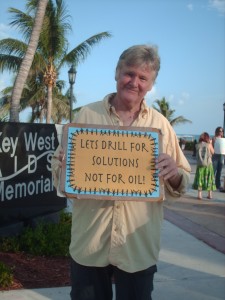
Images of BP Protest Key West July 10th

On Saturday, July 10th at sunset, Key Westers gathered at the White Street Pier to protest the BP and its lack of corporate responsibility since the Deep Horizon blowout. Kelly Young and Erika Biddle led the event. Many citizens spoke out and signed a pledge to reduce their oil comsumption by 10%. Everyone hoped to send a message for a clean energy future.

Christian Science Monitor: Drilling moratorium: US cites weak spot in blowout preventers

http://www.csmonitor.com/USA/2010/0713/Drilling-moratorium-US-cites-weak-spot-in-blowout-preventers

The Obama administration on Monday cited control systems on subsea blowout preventers as one reason for its offshore drilling moratorium. But more than a year before the BP oil spill, authorities learned that balky control systems were the most common cause of blowout preventer failure.
*
Oil and gas escape from the top of the new containment cap (black discharge at top-center) at the site of the Deepwater Horizon oil spill in the Gulf of Mexico, in this image captured from a BP live video feed July 13.
BP/Reuters

By Mark Clayton, Staff writer / July 13, 2010
Before he leaped into a lifeboat in the middle of the night on April 20, Christopher Pleasant tried to trigger a deep-sea safety device to squelch the oil-well blowout and fire raging aboard the Deepwater Horizon drill rig.

In those last frantic minutes in the rig’s central control room, Mr. Pleasant – a subsea superviser for Transocean, the rig’s owner – pressed two buttons simultaneously to activate a 450-ton blowout preventer sitting 5,300 feet below the sea surface. If its massive “shear ram” valve closed, it would slice through the drill pipe and stop the torrent of burning gas.

For one fleeting moment, the control panel lights offered a ray of hope – showing the shear ram and other BOP valves apparently closing. Valve indicator lights flicked from green (open) to red (closed), he told federal investigators in May in New Orleans.

Yet something wasn’t right. Another set of gauges just above the BOP control panel showed no hydraulic pressure at all – “no flow,” he testified. Also, the fire was still burning. So, despite BOP control system lights showing the shear-ram closed, it was not.
“I knew it was time to leave,” Pleasant testified.

No one knows yet just why the rig’s BOP did not work – or why the device’s hydraulic-electric control system gave Pleasant the wrong readings. That mystery won’t be solved unless the BOP is pulled off the sea floor months from now. But when the Obama administration on Monday issued a revised moratorium on drilling in the Gulf, it cited fresh concerns about the reliability of BOP control systems as one reason for its action.
Indeed, more than a year before Pleasant’s frantic efforts to stop an inferno, a large study of BOP reliability in the Gulf of Mexico had warned industry experts and federal safety officials that balky control systems were by far the most common cause of BOP failure – and apparently getting worse.

Altogether, 63 percent of blowout preventer test failures cited in that 2009 study, a joint effort by the industry and the regulatory US Minerals Management Service (MMS), involved control systems. By contrast, a similar study a decade earlier had found control systems were responsible for 51 percent of BOP failures.

Control systems are vulnerable to leaks

Blowout preventer control systems are hydraulic and electrical units housed in two waterproof pods – the electronic brains of the school-bus-size BOP stacks. The pods – one blue, one yellow – are identical systems, each a backup for the other. Hydraulic and electrical conduits run from the rig deck above the ocean’s surface to the pods on the sea floor.

But these control systems, many of them newer-generation units activated by microprocessors, are vulnerable to leaks and failures that can render a BOP useless, according to the closely held study, first reported by the Monitor.

Those microprocessor-based, or “multiplex,” control systems enable BOPs to respond in an instant to an electrical signal from the rig – a rate much faster in deep water than that of older, hydraulic-only systems. But there is a downside, too.

“These systems are newer within the industry and thus efforts to improve reliability have not been as extensive,” the 2009 study found. They “are much more complex, with more subsea components.”

Because the newer systems “have electrical and electronic components in the water; leaks are more likely to have significant consequences in these systems,” the report warned. After noting that hydraulic fluid may leak to the sea in some circumstances, the report states: “Leaks in electrical systems can be expected to render them inoperative.”

It was not the first such warning. A smaller 1999 study of BOP reliability in the Gulf had warned that “a single leakage can jeopardize complete BOP control.”

But the big new 2009 study, funded by the industry and the MMS, was focused on finding ways to cut the cost of BOP safety testing – with potential savings of about $193 million annually, the study’s prospectus estimated.

In fact, the study authors – West Engineering Services, a Texas consulting firm specializing in BOP technology – did recommend that the MMS relax its standards concerning how often to test several subsea BOP components. The study, for instance, recommended a reduced schedule for pressure testing of some BOP valves, from at least once every 14 days to once every 35 days. It recommended testing the shear ram valve just once in 77 days instead of once in 30 days. (See related story.)

Emphasis on testing control systems

But because control systems were found to be the part of the BOP most susceptible to failure, the report recommended no change to rules for testing control systems: at least once a week.

“It is important to understand and focus on the fact that control system failures are the most likely category of failures on subsea BOP equipment,” the authors wrote. “Even though control systems seem to have the larger margin of failures, due to redundancy there were not any cases where a control system failure would have compromised the well control abilities.”

While the control system failure rates may be accurate, the study’s conclusions are questionable, some industry veterans say.

Leaks of hydraulic fluid in deep water are the bane of BOP control systems and need more, not less, oversight, says Robert Bea, an engineer at the University of California at Berkeley who was a chief engineer for Shell Oil for 18 years and an expert reviewer for President Obama’s recent 30-day safety study on offshore drilling.

The BOP hydraulic lines of the Deepwater Horizon were leaking, according to the drill logs, he says.

“It’s like the brakes on your car. Those brakes get mushy when there’s a leak,” Dr. Bea says. “At some point they just won’t work. With a BOP, you don’t need much of a leak for that control system’s hydraulics to fail.”

The complexity of newer BOP control systems makes them vulnerable, says another BOP engineer who asked not to be named because he is still active in the industry. “The biggest problem with a BOP is the control system,” he says. “If a BOP has maybe 50 parts, then its control system has 500 parts. Many of them are vulnerable to water leaks.”

As part of the Deepwater Horizon’s last line of defense, a “dead man’s switch” in the BOP unit was supposed to trigger the shear ram, if both electrical and hydraulic communications with the rig were lost. But this system failed, too.

“We already know one of the battery pods [providing power to the BOP control system] was dead,” Bea says. “The other one was functional. But you have this system designed for redundancy, and because of neglected maintenance it is no longer redundant. It’s like going parachuting, but without a backup chute. We were relying on this BOP like a parachute – and when it came time, the backup didn’t work.”

‘The problem child’

The study shows that industry representatives reviewing the findings wrestled with their meaning and sought clarification about the vulnerability of control systems on BOPs. In an appendix to the 2009 study, unidentified industry officials commented on control system failures and asked the consultant about it.

“What’s being said [in the report] is that the control system is the problem child in the system, but redundancy is the savior?” the industry officials commented.

“Yes, control systems are the problem and redundancy is the savior,” the authors responded.

Officials at West Engineering did not return Monitor e-mails or phone calls. MMS officials, along with the Department of Interior, responded to e-mailed questions but refused requests for an interview.

Asked if the MMS had changed, or considered changing, its testing frequency for control systems, MMS said: “No, MMS has always required operators to function test annular and ram BOPs every 7 days between pressure tests.”

The MMS added that the 2009 study “is not an MMS study” and therefore the high frequency of control system failures was “proprietary” information that never became part of the agency’s safety research program data.

But key people at MMS did know of the control system problem. The agency provided funding for the study, several industry experts told the Monitor. Moreover, a prospectus for the study and the study itself both refer to a close partnership between BP, at least eight other oil companies, and the MMS.

Three senior MMS officials are listed in the study as involved and raising questions about it: Lars Herbst, regional director of the Gulf of Mexico OCS Region; William Hauser, chief of the Regulations and Standards Branch, and Kirk Malstrom, an agency petroleum engineer.

The Interior Department, which is coordinating media requests for the MMS during its reorganization, did not grant requests to interview those MMS officials. In review comments on the report, MMS officials asked questions about rig performance, failure detection, and a few other issues. None questioned the report’s central finding: the high rate of control system failures.

“This sort of touch-and-feel evolutionary approach to loosening testing standards is not good engineering,” says Bea, who has read the study. “I would never want to fly on an aircraft whose safety margins are regulated this way.”

Paul Helfer, a former senior engineer with BOP-maker Cameron International, who now does consulting work in the industry, says control system standards need reexamination and a new set of testing requirements.

“It’s a pretty good chore to ensure a control system works and stays working,” he says. “That has to include some serious testing.”

Special thanks to Richard Charter