Category Archives: Uncategorized

New York Times: Waves From Storm Hinder Spill Effort


By HENRY FOUNTAIN
Published: June 30, 2010

The first major storm of the season in the Gulf of Mexico continued to disrupt oil spill cleanup and containment work on Wednesday, officials said.

Hurricane Alex was bearing down on Mexico and the southern Texas coastline, far from the spill but generating waves big enough to hamper the cleanup effort 500 miles away. Dozens of vessels used for things like skimming and supplies were idled. Rough seas make it impossible to contain oil so that skimmers can pick it up or it can be ignited.

But the storm was not expected to delay efforts to plug BP’s runaway well 40 miles off the Louisiana coast, and it could help disperse some of the tens of millions of gallons of oil that have spewed into the gulf since late April.

The disruptive weather was expected to last through Thursday.

High waves at the well site delayed surface work to prepare for the next phase of BP’s system to collect oil at the wellhead, said Toby Odone, a company spokesman. That phase, in which up to 25,000 barrels of oil a day would be collected through a free-standing riser pipe that could be quickly disconnected if a hurricane threatened, is now expected to be completed in early July.

But BP said existing systems that are collecting about 25,000 barrels a day were not affected by the rough seas, nor were efforts to drill two relief wells that are considered the ultimate solution to plugging the well.

Chris Vaccaro, a spokesman for the National Oceanic and Atmospheric Administration, said winds from the storm might tend to push oil toward the Louisiana, Mississippi and Alabama coasts. But there was little possibility of oil being pushed inland.

“We’re not dealing with a situation where we’re running the risk of having a storm surge with oil in it,” he said.

Mr. Vaccaro said the winds and higher seas may help “weather” the oil, breaking it up into smaller droplets that are more easily consumed by microbes. While some weathering occurs in all conditions, he said, a major storm “helps by stirring up the water and literally pounding away at it.”

In addition to higher winds and waves, the gulf was due for heavy rains as moisture brought into the region by the tropical storm encountered a cold front from the north, said Eric Wilhelm, a meteorologist with AccuWeather in State College, Pa.

The rainfall may flush marshes and other sensitive coastal areas, Mr. Vaccaro said.
New York Times: A Line in the Sand over Offshore Drilling

By THE NEW YORK TIMES
Published: June 26, 2010

MIAMI BEACH, Fla. — The first time Dave Rauschkolb staged a rally against offshore drilling with people holding hands across the beach outside his restaurant in Seaside, Fla., barely anyone noticed.

Four months and a colossal oil spill later, the second Hands Across the Sand event held at noon on Saturday was nothing short of a worldwide movement.

In all, mainly through connections made through Facebook, 820 events were scheduled in all 50 states and in 34 countries. Thousands of people worldwide stood hand in hand — with some, here in South Beach at least, breaking the chain only for surfers or topless women — to protest drilling and to demand cleaner energy sources.

“I believe every American and every person has a beach that they hold dear to their heart,” said Mr. Rauschkolb, 48, a lifelong surfer. “This resonates. It’s a very simple yet powerful statement for people to go to the beach and draw a line in the sand.”

He added: “This is not rocket science. Our basic message is no to offshore oil drilling and yes to clean energy. Why is it that it takes a disaster in the gulf of this magnitude to get our leaders to pay attention? They need to stop taking that oil money and listen to their constituents.”

Special thanks to Larry Lawhorn.

Hurricanes & Oil Will Mix: Managing the Risk Now. Briefing Open to the Public in Wash DC Wed. June 30th

Wednesday, June 30, 2010 | 3:30 p.m. – 4:45 p.m. | Capitol Visitors Center – SVC 202

Refreshments will be served

Seasonal forecasters predict that 2010 will produce between 14 and 23 named hurricanes–the most active season since 2005, when Hurricane Katrina and 27 other named storms swept the Atlantic and Gulf of Mexico. As economic challenges continue and oil spews from the damaged Deepwater Horizon well in the Gulf, the growing impacts to the region’s economic recovery and unique ecosystems are staggering. What risks does an active hurricane season pose for other energy-related infrastructure, for inland areas as storm surges push oil beyond beaches and marshland, and for stakeholders dealing with flooding in coastal communities in the Gulf and along the East Coast? Can recent advancements in hurricane prediction help manage these risks? Might related climate change impacts exacerbate them in the future? What does an increasing scale of catastrophic loss associated with hurricane activity mean for critical services provided by the insurance sector? Please join our panelists as they address these questions and discuss research results, institutions, and processes in place to help manage potential catastrophic risk of this hurricane season.

Opening Remarks:

Senator Mary Landrieu
Honorary host

Moderator:

Heidi Cullen
CEO and Director of Communications, Climate Central

Panelists:

Greg Holland
Director, NCAR Earth System Laboratory, National Center for Atmospheric Research

Rick Luettich
Professor & Director, Institute of Marine Sciences, University of North Carolina at Chapel Hill

Rowan Douglas
CEO, Global Analytics, Willis Re and Chairman, Willis Re Research Network

RSVP by Monday, June 28 to Gloria Kelly at gloriak@ucar.edu or (303) 497-2102.

RSVP needed for admission to the CVC.

This briefing is sponsored by the American Geophysical Union (AGU), the Congressional Hazards Caucus Alliance, the National Science Foundation (NSF), the Pew Center on Global Climate Change, the University Corporation for Atmospheric Research (UCAR) and the Weather Coalition.
Special thanks to Richard Charter.

Key West Hands Across the Sand June 26th draws over 400; many take THE PLEDGE

Photos by Carol Tedesco
Key West Hands Across the Sand Draws Over 400 People; Many take the pledge

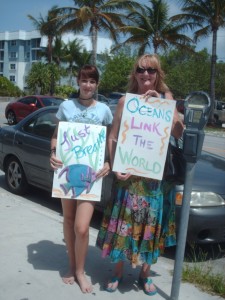
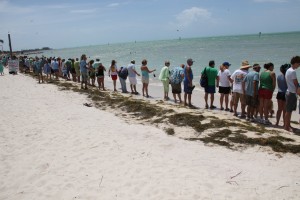
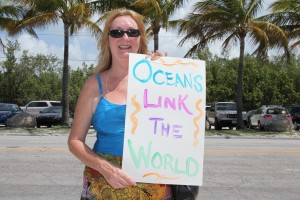
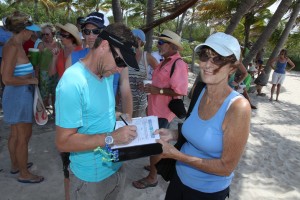
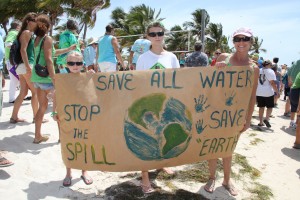
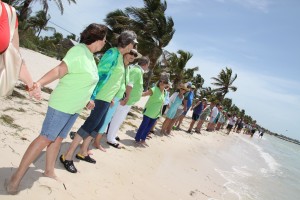
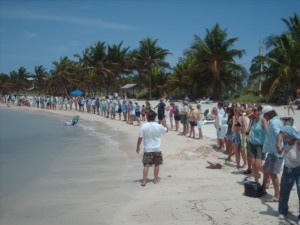
Today, Saturday, June 26, 2010, over 400 Key Westers joined ocean lovers around the world for the Hands Across the Sand demonstration of love for our ocean waters and opposition to offshore oil development and the ecological disasters it spawns. The pictures tell the story. A count of each participant was made as everyone held hands along the entire length of Smathers Beach on the oceanside of Key West. Each person called out their consecutive number for an actual count of 428, and they stretched to the end of the long beach, over the breakwater and back again onto the beach behind the main line of people. Some held up signs such as those that read, “Oil & Water Don’t Mix, “Oceans Link the World” and “Just Breathe.” It was a glorious Florida Keys day and spirits were positive.

“You can blame BP and you should; you can blame the White House and you should; but we are each of us responsible for the problem that consuming fossil fuels has on our planet and especially on fragile marine environments. We must personalize the challenge for a clean energy future and use less plastic, change our transportation habits, reduce our consumption, and conserve resources to reduce our use of oil every day,” noted organizer Erika Biddle. “Take the pledge today. Until then, nothing will have changed.”

The pledge Biddle referred to was signed by many at the event and is reproduced below for you to sign. Others signed a letter to the President asking for a clean energy future.

I PLEDGE
TO REDUCE MY DEPENDENCE UPON FOSSIL FUELS
Oil spills are terrible. We all abhor what BP has done to the water, the wildlife, and the way of life of citizens of the Gulf of Mexico and the world. However, I also understand the connection between OUR consumption of oil and the aggressive manner in which oil companies are feeding our addiction.
Therefore, I pledge to reduce my use of oil and all fossil fuels by 10%, starting today.
I pledge to carpool, walk, bike, or take public transportation instead of driving.
I pledge to stop using plastic bags (made from petroleum).
I pledge to stop buying things I don’t need, especially those made from plastic.
I pledge to use less electricity (fueled by oil).
I pledge to reduce my water consumption (pumped by oil).
I pledge to take one fewer trip on an airline per year.
I pledge to buy as much local food as possible.
I take this pledge now, as oil continues to leak into the water, to reduce
my dependence on fossil fuels by 10% NOW.

_______________________________________
Name

_______________________________________
Signature

_______________________________________
Email