Category Archives: Uncategorized

Naples News: Oil spill threat to Southwest Florida low but Coast Guard stresses vigilance

http://www.naplesnews.com/news/2010/jun/17/oil-spill-threat-southwest-florida-low-coast-guard/

By Naples Daily News staff report

Originally published 01:29 p.m., June 17, 2010
Updated 01:40 p.m., June 17, 2010

The man leading the U.S. Coast Guard oil spill response on Florida’s west coast said Thursday that the threat to Southwest Florida is low but he’s prepared.

“We are being vigilant, we’re being very vigilant,” said Capt. Timothy Close, commander of the Coast Guard’s St. Petersburg sector, a branch of the Florida Peninsula Command Post set up for the oil spill.

Close spoke and answered questions for more than an hour at a meeting in Fort Myers of the Southwest Florida Regional Planning Council.

A research vessel west of Tampa Bay, two BP ships west of Key West and a C-130 aircraft flying from the St. Petersburg Naval Air Station are keeping daily track of the spill’s track toward Florida, Close said.

So far, only patches of light oil have been spotted in a clockwise eddy that has detached from the Loop Current west of the coast between Tampa and Naples, he said.

When 72-hour projections of the spill bring it within 94 miles of the coast – into a so-called trigger zone – Close sits down with spill responders to discuss what response is needed, if any.

That has happened two or three times, Close said, but the spill has always retreated back over the trigger line without any action being required.

He said the Coast Guard has confirmed one tar ball a man said he had collected from St. Petersburg Beach, but tests determined it was not associated with the Deepwater Horizon gusher.

Should the oil get close enough to threaten Southwest Florida, Close said, he is “confident” resources will be available to respond.

“We’ll have a pretty substantial period of time to start jumping on it,” Close said. “We’re watching every single day.”

Close said he has met with local emergency managers to fine-tune Coast Guard response plans, including locations for booms.

The response plans call for booms to be laid across passes and inlets to keep oil out of mangrove shorelines and marshes, where oil would be hardest to clean up.

“It’s not about protecting the beaches,” Close said.

Thanks to Richard Charter

Businessweek: BP Gulf Spill Fuels Australian Opponents to Drilling

http://www.businessweek.com/news/2010-06-17/bp-gulf-spill-fuels-australian-opponents-to-drilling-update1-.html
 (Update1)
June 17, 2010, 3:15 AM EDT
By James Paton
June 17 (Bloomberg) — BP Plc’s Gulf of Mexico disaster is generating opposition to deepwater drilling off Australia, where the government is opening new exploration areas less than a year after the country’s third-worst oil spill.

Resources Minister Martin Ferguson will receive the results tomorrow of an investigation into last August’s Timor Sea oil spill, he said in a phone interview. A month ago, he invited companies to bid for permits to explore new “frontiers” as Australia faces an import cost for oil and liquid fuels that may double in five years to A$30 billion ($26 billion). The country was self sufficient in oil as recently as 2000.

Ferguson, who today ruled out suspending exploration, is offering 31 drilling areas in waters as deep as 3,750 meters, more than twice the depth of BP’s leaking well. Australia’s expanded search for oil and gas comes as BP’s spill, the worst in U.S. history, focuses attention on petroleum industry safety.

“We should hold off on exploring in some of the deeper basins,” said Tina Hunter, an assistant law professor at Bond University in Queensland state who studies offshore oil regulation. “The last thing we need is to go into deeper waters and risk something like what happened in the U.S.”

Chevron Corp., Royal Dutch Shell Plc and ConocoPhillips are among companies planning more than $185 billion of oil and gas projects in the country, according to the Australian Petroleum Production and Exploration Association.

‘Accidents Will Happen’

Increased drilling adds to the risk a disaster the size of the BP Gulf spill could occur off Australia, said Justin Marshall, a professor at the University of Queensland.

“The public needs much greater assurance accidents can be dealt with effectively, because they will happen,” Marshall, a former president of the Australian Coral Reef Society, said by phone yesterday. “Safety measures need to be enforced at a much higher level, the risks to the environment are huge.”

The U.S. probe into the BP spill and what caused the Deepwater Horizon drilling rig to explode on April 20, killing 11 workers, will focus on safety lapses and equipment failures.
Oil producers around the world are bracing for stricter regulation. Norway will ban any deepwater drilling in new areas until the cause of the BP spill is known, Oil Minister Terje Riis-Johansen said June 8. Russia may tighten its rules, Energy Minister Sergei Shmatko said May 24.

Obama Response

BP’s spill was initially overseen by the U.S. Minerals Management Service. The agency, faulted for lax regulation, was broken into three by President Barack Obama on May 19, creating bodies to oversee leases, drilling safety and fee collection.

When Ferguson opened the new areas on May 17, he said the country must streamline rules to make a single agency responsible for safety, well operations and the environment.
“There is no intention by the government to scale back the development of the oil and gas industry in Australia,” Ferguson said today. “It is very important in terms of the nation’s energy security, jobs and the overall economy, but I am totally focused on the need to ensure we have the absolute best practices in place.”

The National Offshore Petroleum Safety Authority, the Australian Maritime Safety Authority and the Northern Territory Department of Resources are among bodies that had oversight of the Montara spill.

Moratorium Needed

Australia needs a yearlong moratorium on deepwater drilling to study the Montara report and the BP spill, Bond University’s Hunter told Bloomberg Television today.

Companies drilled 1,500 wells off Australia in the 25 years before the Montara accident without any blowouts, the petroleum group said. Explorers face stringent environmental conditions before drilling, Chief Executive Officer Belinda Robinson said in an e-mailed response to questions.

Last year’s spill, about 250 kilometers (155 miles) off the Kimberley coast, shows Australia needs a single agency to monitor well safety, protect the marine environment and oversee spill response, according to Hunter.

Calls to strengthen Australian regulations began before the Montara incident when a 2008 explosion at Apache Corp.’s Varanus Island gas plant caused fuel shortages in Western Australia, source of a third of the nation’s exports.

‘Consistent Approach’

“Some of the issues that have arisen as a result of the Varanus and Montara incidents mean we need to revisit our regulatory system and make sure we have the strongest possible national, consistent approach, rather than allowing potential differences to develop,” Ferguson said.

Montara may have spilled about 30,000 barrels of oil between Aug. 21 and Nov. 3, based on estimates by Bangkok-based PTT. That would make it the third-biggest spill in Australian history, according to figures from the Maritime Safety Authority.

The Timor Sea accident and a Chinese coal carrier that ran aground in April on the Great Barrier Reef have already damaged the marine environment, University of Queensland’s Marshall said.

“The ocean is full of life, and when that oil sinks to the bottom it’s going to be killing things,” he said.

Australian Greens party Senator Rachel Siewert urged the government to scrap the latest set of new drilling permits, concerned about the threat to whales, seals, turtles and other marine life in one area marked for exploration off the Western Australian coast. Parts of this block are “extremely deep,” as much as 3,750 meters, the Resources Department said.
“If a Montara-size spill occurred there, you’d see oil on the coast,” Siewert said in a telephone interview. “There are dangers inherent in deepwater production, and the government should put a hold on exploration that we have control over.”
______________________________________________

–With assistance from Rishaad Salamat in Hong Kong. Editors: John Viljoen, Peter Langan.
To contact the reporter on this story: James Paton in Sydney jpaton4@bloomberg.net.
To contact the editor responsible for this story: Amit Prakash at aprakash1@bloomberg.net.

Special thanks to Richard Charter

Los Angeles Times: Death by fire in the gulf

http://www.latimes.com/news/nationworld/nation/la-na-oil-spill-burnbox-20100617,0,4814068.story?page=1

So-called burn boxes are torching oil from the water’s surface at the sacrifice of turtles, crabs, sea slugs and other sea life.

By Kim Murphy, Los Angeles TimesJune 17, 2010

Reporting from the Gulf of Mexico —

Here on the open ocean, 12 miles from ground zero of the Deepwater Horizon oil spill, the gulf is hovering between life and death.

The large strands of sargassum seaweed atop the ocean are normally noisy with birds and thick with crustaceans, small fish and sea turtles. But now this is a silent panorama, heavy with the smell of oil.

There are no birds. The seaweed is soaked in rust-colored crude and chemical dispersant. It is devoid of life except for the occasional juvenile sea turtle, speckled with oil and clinging to the only habitat it knows. Thick ribbons of oil spread out through the sea like the strips in egg flower soup, gorgeous and deadly.

» Don’t miss a thing. Get breaking news alerts delivered to your inbox.

A few dead fish float in the water, though dolphin-fish, tuna, flying fish and the occasional shark can still be seen swimming near the surface, threading their way through the wavy, sometimes iridescent gobs of crude.

“This is devastating. I mean literally, it’s terrible. All this should be pretty much blue water, and — look at it. It just looks bad,” said Kevin Aderhold, a longtime charter fishing captain who has been taking a team of researchers deep into the gulf every day to rescue oil-soaked sea turtles.

“When this first happened, a lot of us were like, they’ll cap that thing and we’ll be out fishing again. Now reality’s set in. Look around you. This is long-term. This’ll be here for-ev-er.”

And then it gets worse. When the weather is calm and the sea is placid, ships trailing fireproof booms corral the black oil, the coated seaweed and whatever may be caught in it, and torch it into hundred-foot flames, sending plumes of smoke skyward in ebony mushrooms. This patch of unmarked ocean gets designated over the radio as “the burn box.”

Wildlife researchers operating here, in the regions closest to the spill, are witnesses to a disquieting choice: Protecting shorebirds, delicate marshes and prime tourist beaches along the coast by stopping the oil before it moves ashore has meant the largely unseen sacrifice of some wildlife out at sea, poisoned with chemical dispersants and sometimes boiled by the burning of spilled oil on the water’s surface.

“It reflects the conventional wisdom of oil spills: If they just keep the oil out at sea, the harm will be minimal. And I disagree with that completely,” said Blair Witherington, a research scientist with the Florida Fish and Wildlife Conservation Commission who has been part of the sea turtle rescue mission.

By unhappy coincidence, the same convergences of ocean currents that create long mats of sargassum — nurturing countless crabs, slugs and surface fish that are crucial food for turtles, birds and larger fish — also coalesce the oil, creating islands of death sometimes 30 miles long.

“Most of the Gulf of Mexico is a desert. Nothing out there to live on. It’s all concentrated in these oases,” Witherington said.

“Ordinarily, the sargassum is a nice, golden color. You shake it, and all kinds of life comes out: shrimp, crabs, worms, sea slugs. The place is really just bursting with life. It’s the base of the food chain. And these areas we’re seeing here by comparison are quite dead,” he said.

“It’s amazing. We’ll see flying fish, and they’ll land in this stuff and just get stuck.”

Hardest hit of all, it appears, are the sea jellies and snails that drift along the gulf’s surface, some of the most important food sources for sea turtles.

“These animals drift into the oil lines and it’s like flies on fly paper,” Witherington said. “As far as I can tell, that whole fauna is just completely wiped out.”

* * *

The turtle rescue team sets out at 6 a.m. in the muggy warm stillness of the harbor at Venice, La. The researchers move into the open gulf about an hour later, past a line of shrimp boats deputized to lay boom along the coastal marshes.

Closer to the Deepwater Horizon site, the water takes on a foreboding gray pallor tinged with a rainbow-like sheen. Soon, the oil begins swirling around the boat and the seascape smells like an auto mechanic’s garage.

Strewn among the oil and seaweed are human flotsam: an orange hardhat, a pie pan, a wire coat hanger, yellow margarine-tub lids, a black-and-green ashtray. The crew has found papers — long at sea on global currents — bearing inscriptions in Spanish, Arabic, Greek and Chinese.

The only sound that breaks the stillness is the deep thrum of the motors of the large charter boat and a small skiff carrying the turtle researchers. From dawn until nearly dusk, across sargassum islands that normally are alive with birds looking for crabs and snails — bridal terns, shearwaters, storm-petrels — only one bird is seen.

“What’s amazing is there’s so little bird life out here right now. Either they’ve moved on, or the oiling has had a tremendous impact,” said Kate Sampson, a researcher with the National Oceanic and Atmospheric Administration who is part of the turtle rescue team.

“We saw a few yesterday. We saw a few laughing gulls fly by. They were oiled, but they could still fly. And we saw a northern gannet, a diving bird. It was oiled too,” she said. “I can only imagine that the birds left because the dining hall is closed.”

» Don’t miss a thing. Get breaking news alerts delivered to your inbox.

Soon, the rising towers of the Discoverer Enterprise drill ship, which is collecting oil and gas from the damaged well, and the tall rigs boring two relief wells miles into the seabed appear through the haze. A flare of burning natural gas is silhouetted against the gray hull of the ship.

The Premier Explorer, which is helping coordinate cleanup operations at the broken well, announces the day’s burn box: A 500-square-mile field within which 16 controlled burns will be conducted.

In the days since the April 20 explosion on the Deepwater Horizon, more than 5 million gallons of oil have been consumed in more than 165 burns.

“The real issue is to stop this thing at the source, do maximum skimming, in-situ burning — deal with it as far off shore as possible, and do everything you can to keep it from getting to shore, because once it’s into the marshes, quite frankly, I think we would all agree there’s no good solution at that point,” Coast Guard Adm. Thad Allen told reporters last week.

But the burn operations have proved particularly excruciating for the turtle researchers, who have been trolling the same lines of oil and seaweed as the boom boats, hoping to pull turtles out of the sargassum before they are burned alive.

Much of the wildlife here seems doomed in any case. “We’ve seen the oil covering the turtles so thick they could barely move, could hardly lift their heads,” Witherington said. “I won’t pretend to know which is the nastiest.”

Yet in one case, the crew had to fall back and watch as skimmers gathered up a long line of sargassum that hadn’t yet been searched — and which they believe was full of turtles that might have been saved.

“In a perfect world, they’d gather up the material and let us search it before they burned it,” Witherington said. “But that connection hasn’t been made. The lines of communication aren’t there.”

The smoke starts rising on the horizon at midday. The two boats carrying the researchers head in different directions, hoping to find and rescue a few more turtles before their mission wraps up. They find 11, all of them heavily speckled with oil.

Each day, the chances of rescues grow smaller. That there are still so many left stranded in the oil without food is a small miracle. Their long-term chances “are zero,” Witherington said.

“Turtles just take a long time to die.”

kim.murphy@latimes.com

Thanks to Mark Spaulding
St Pete Times: Sea Creatures flee oil spill, gather near shore

http://hosted.ap.org/dynamic/stories/U/US_GULF_OIL_SPILL_MARINE_LIFE_FLOL-?SITE=FLPET&SECTION=HOME

June 17, 2010

By JAY REEVES, JOHN FLESHER and TAMARA LUSH
Associated Press Writers

GULF SHORES, Ala. (AP) — Dolphins and sharks are showing up in surprisingly shallow water off Florida beaches, like forest animals fleeing a fire. Mullets, crabs, rays and small fish congregate by the thousands off an Alabama pier. Birds covered in oil are crawling deep into marshes, never to be seen again.

Marine scientists studying the effects of the BP disaster are seeing some strange phenomena.

Fish and other wildlife seem to be fleeing the oil out in the Gulf and clustering in cleaner waters along the coast in a trend that some researchers see as a potentially troubling sign.

The animals’ presence close to shore means their usual habitat is badly polluted, and the crowding could result in mass die-offs as fish run out of oxygen. Also, the animals could easily be devoured by predators.

“A parallel would be: Why are the wildlife running to the edge of a forest on fire? There will be a lot of fish, sharks, turtles trying to get out of this water they detect is not suitable,” said Larry Crowder, a Duke University marine biologist.

The nearly two-month-old spill has created an environmental catastrophe unparalleled in U.S. history as tens of millions of gallons of oil have spewed into the Gulf of Mexico ecosystem. Scientists are seeing some unusual things as they try to understand the effects on thousands of species of marine life.

Day by day, scientists in boats tally up dead birds, sea turtles and other animals, but the toll is surprisingly small given the size of the disaster. The latest figures show that 783 birds, 353 turtles and 41 mammals have died – numbers that pale in comparison to what happened after the Exxon Valdez disaster in Alaska in 1989, when 250,000 birds and 2,800 otters are believed to have died.

Researchers say there are several reasons for the relatively small death toll: The vast nature of the spill means scientists are able to locate only a small fraction of the dead animals. Many will never be found after sinking to the bottom of the sea or being scavenged by other marine life. And large numbers of birds are meeting their deaths deep in the Louisiana marshes where they seek refuge from the onslaught of oil.

“That is their understanding of how to protect themselves,” said Doug Zimmer, spokesman for the U.S. Fish and Wildlife Service.

For nearly four hours Monday, a three-person crew with Greenpeace cruised past delicate islands and mangrove-dotted inlets in Barataria Bay off southern Louisiana. They saw dolphins by the dozen frolicking in the oily sheen and oil-tinged pelicans feeding their young. But they spotted no dead animals.

“I think part of the reason why we’re not seeing more yet is that the impacts of this crisis are really just beginning,” Greenpeace marine biologist John Hocevar said.

The counting of dead wildlife in the Gulf is more than an academic exercise: The deaths will help determine how much BP pays in damages.

As for the fish, researchers are still trying to determine where exactly they are migrating to understand the full scope of the disaster, and no scientific consensus has emerged about the trend.

Mark Robson, director of the Division of Marine Fisheries Management with Florida Fish and Wildlife Conservation Commission, said his agency has yet to find any scientific evidence that fish are being adversely affected off his state’s waters. He noted that it is common for fish to flee major changes in their environment, however.

In some areas along the coast, researchers believe fish are swimming closer to shore because the water is cleaner and more abundant in oxygen. Farther out in the Gulf, researchers say, the spill is not only tainting the water with oil but also depleting oxygen levels.

A similar scenario occurs during “dead zone” periods – the time during summer months when oxygen becomes so depleted that fish race toward shore in large numbers. Sometimes, so many fish gather close to the shoreline off Mobile that locals rush to the beach with tubs and nets to reap the harvest.

But this latest shore migration could prove deadly.

First, more oil could eventually wash ashore and overwhelm the fish. They could also become trapped between the slick and the beach, leading to increased competition for oxygen in the water and causing them to die as they run out of air.

“Their ability to avoid it may be limited in the long term, especially if in near-shore refuges they’re crowding in close to shore, and oil continues to come in. At some point they’ll get trapped,” said Crowder, expert in marine ecology and fisheries. “It could lead to die-offs.”

The fish could also fall victim to predators such as sharks and seabirds. Already there have been increased shark sightings in shallow waters along the Gulf Coast.

The migration of fish away from the oil spill can be good news for some coastal residents.

Tom Sabo has been fishing off Panama City, Fla., for years, and he’s never seen the fishing better or the water any clearer than it was last weekend 16 to 20 miles off the coast. His fishing spot was far enough east that it wasn’t affected by the pollution or federal restrictions, and it’s possible that his huge catch of red snapper, grouper, king mackerel and amberjack was a result of fish fleeing the spill.

In Alabama, locals are seeing large schools hanging around piers where fishing has been banned, leading them to believe the fish feel safer now that they are not being disturbed by fishermen.

“We pretty much just got tired of catching fish,” Sabo said. “It was just inordinately easy, and these were strong fish, nothing that was affected by oil. It’s not just me. I had to wait at the cleaning table to clean fish.”

Lush contributed from Barataria Bay, La., Flesher from Traverse City, Mich.

 special thanks to Larry Lawhorn

Newsweek: The Environmental Legacy of the Oil Spill

http://www.newsweek.com/2010/06/17/the-environmental-legacy-of-the-oil-spill.html

What’s in store for the gulf? Lessons from previous disasters.

Saul Loeb / AFP-Getty Images
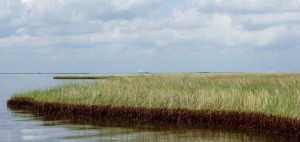
Oil mixes with sea grass off the coast of Louisiana. Experts predict damage to the grass will be worse than previous spills, thanks to the use of dispersant.

In 1974, the oil tanker Metula ran aground near the southern tip of South America. Almost 400,000 barrels of oil spilled along the coast of Chile. The Chilean government gave up on cleaning the land, deciding instead to spend its limited cash on removing the grounded ship to stem the source of the leak. The result was a layer of oil left floating in the area’s marshes and baking on its beaches for decades-a natural laboratory for testing oil’s long-term environmental impact.
Years later, the Metula site is showing signs of life. But some parts of the coast recovered far more quickly than others, an indication of the tangle of variables, from the chemical reactions in the oil to the millions of moving parts that make up every discrete ecosystem it touches, that determine a spill’s environmental impact. As these complex interactions play out in the gulf, where a hole beneath mile-deep water off the Louisiana coast continues to spew huge amounts of crude, the Metula site’s progress, as well as information gathered at the sites of other disastrous spills, offer valuable lessons about the long-term fate of the Gulf of Mexico.

Lesson 1: The longer oil floats, the less toxic it becomes.

Some of history’s most environmentally damaging oil spills have involved oil that hit the water near the shoreline. In 1986, a leaky storage tank of refined jet fuel in Puerto Rico annihilated six hectares (more than 12 football fields) worth of mangrove forest around a single bay. Crude oil that leaked from a refinery storage tank in Panama in 1976 killed an estimated 75 hectares of mangroves.

But at least one researcher says Louisiana’s mangroves-the trees that make up the backbone of life in saltwater forests like the ones in Barataria Bay-probably won’t face oil that toxic. That’s because the most poisonous components of crude oil (benzene, kerosene, or other relatively lightweight chemicals) evaporate as they are exposed to the sun. The longer the longer the oil floats on the surface of the ocean, the more those components dissipate, leaving the heaviest part of the oil behind in the form of tar balls. That “weathered” oil can still do damage, and it can stick around-after the Panama spill researchers could still detect significant levels four years later. But forests hit by oil that has floated over longer distances and spent more time in the sun will have a better chance to recover.

“There are people who are saying that if oil touches a mangrove, the mangrove is dead. That’s the doomsday scenario, that’s absolutely not true,” said Robin Lewis, who runs an environmental consulting firm in Florida and studied the Puerto Rican spill in 1986. Even if some trees die, “mangroves recolonize areas relatively rapidly, even if there’s oil present.”

Lesson 2: It’s the soil.

Much has been written about the dire situation in the Mississippi River Delta, where oil has entered fragile wetlands in places like Barataria Bay. The slick has already had lethal consequences for turtles, seabirds, and other animals that have come in direct contact with it. But for the mangroves and grasses that bind the marshes together, the results are more complicated.

Scientists know that oil tends to leave plants unharmed when it doesn’t directly contact them. In the months following the massive 1991 oil spill in the Persian Gulf, researchers observed that submerged sea grasses had fared well, in all likelihood because the oil floated over top of them. The toxic components of the oil hadn’t seeped into the water.

One reason some observers are concerned about BP’s use of chemicals to disperse the oil in the Gulf of Mexico is that oil treated with dispersant is more likely to sink, rather than float over sea grass as it did in the Persian Gulf. As Louisiana State University scientist Irving Mendelssohn pointed out earlier this month in a long but informative Youtube video, the larger danger to plants is the risk of oil penetrating the sensitive, sandy soil where they place their roots. When roots die, the soil further erodes. And as was the case after the Amoco Cadiz oil spill off the French coast in 1978, soil erosion can delay the recovery of vegetation. In addition, humans trying to clean the marsh-and perhaps using heavy machinery to do so-might cause damage. “People tromping around pushing the oil into the sediments Š makes it much worse,” Lewis said.

Like mangroves, marsh grasses can grow back as long as their roots stay untouched. But just how long that will take is difficult to predict. Five years after oil spilled from the Metula when untouched by clean-up crews in Chile, much of the marshes hadn’t grown back. Some areas, though, recovered within five months. The difference? Deader areas experienced heavier coats of oil.

Lesson 3: Get the oil off the beach, but don’t expect to remove it all.

Marshes and mangrove forests are just one ecosystem that BP’s spill will touch. Sand beaches, the other major environment where the oil will make landfall, require a much different approach.

There’s no question that it’s worth removing oil from a beach. In spills where the oil has not been removed, what remains is a layer of black, viscous tar with a cracked top layer of asphalt. Researchers returning to the site of the Metula spill in Chile two years later found what was essentially a paved roadway about two miles long and more than 500 yards wide. By 1997, 21 years after the spill, much of the asphalt had eroded, but portions remained, particularly in areas where seawater lapped up in low-energy waves.

Yet even when clean-up crews scrape oil off a beach, the impact of a spill can linger. For a study released this year, a team of Spanish researchers excavated the sand on a beach where, in 2002, the tanker Prestige had spilled oil off the coast of Spain. They found thick layers of oil-coated sand underneath the surface, sometimes three meters (about 12 feet) below ground. Oil from the 1989 Exxon Valdez spill has been found trapped underneath boulder-covered beaches in Alaska 10 years later. Scientists there have seen toxins from the oil seep into streams where salmon breed, while the populations of otters who dig on oiled beaches have recovered more slowly than populations elsewhere.
But Alaskan beaches are made mostly of gravel and boulders, not the fine grains of sand found on the gulf’s beaches. It’s known that oil can persist in finer sediments, too: researchers at a Massachusetts nonprofit found diesel fuel in the soil of marshes at West Falmouth in 2003, 30 years after a barge had spilled nearby. What happens in the gulf will be fodder for more study. Scientists there are already taking as many measurements as they can of the “before” picture of the spill. The nation nervously awaits the “after.”

Thanks to Richard Charter