The wildlife mortality / oiled wildlife ticker is live on the Defenders Blog and www.Defenders.org
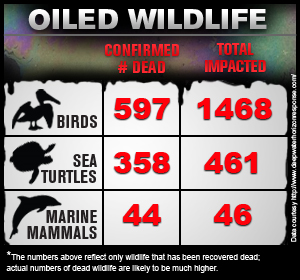
The wildlife mortality / oiled wildlife ticker is live on the Defenders Blog and www.Defenders.org
I really really like this idea of local citizen oversight boards….DV
Patti Epler | Jun 16, 2010
The notion that citizens should help oversee oil industry operations is getting some traction as state and federal lawmakers scratch their heads over what to do next about the Gulf oil spill and the escalating economic and environmental problems.
Alaska Sen. Mark Begich has drafted legislation that would authorize citizen oversight commissions anywhere the industry operates, and other elected officials are considering similar measures.
The Prince William Sound Regional Citizens’ Advisory Council, established shortly after the Exxon Valdez spill in 1989, has been inundated with requests for information and guidance on how people who live and work in oil-producing regions can help ensure safer, more environmentally sound operations, according to Stan Jones, director of administration and external affairs for the group.
The council has become something of an international success story in the past 20 years, working to put in place safety measures like double-hulled tankers and tug escorts for tankers. It has acquired a hefty institutional knowledge — not to mention a library’s worth of studies and white papers — on the oil industry, its business practices and operations, and, perhaps more importantly, how to get the companies to work effectively with citizens and local communities.
Funded largely by the oil industry — a requirement of the federal law that created the council and a similar group in Cook Inlet — PWSRCAC sponsors its own scientific research projects, including some that have resulted in improved radar technology and pollution-control systems for tankers and terminal facilities in Valdez. The group also is closely involved in monitoring oil-shipping operations in Valdez and providing recommendations and advice to Alyeska Pipeline Service Co. and tanker operators.
It has no enforcement authority but has managed to steer much of the tougher policy and procedures relating to tanker and terminal operations through public pressure on the industry.
Now, the Deepwater Horizon blowout that continues to spread millions of gallons of crude along Gulf Coast communities is prompting a national effort modeled after the Alaska oversight program.
Jones said he has been spending much of his time responding to requests from lawmakers, community groups and the media. “We got calls from Al-Jazeera and the Rachel Maddow Show on the same day,” he said.
Staff and board members from PWSRCAC traveled to the Gulf soon after the April 20 spill to help folks there figure out how to handle the community impact. The board is made up of representatives from the people who were most affected by the Exxon Valdez spill, including fishermen, local officials and environmental advocates.
Besides Begich, Jones said his group has been working with Sen. Bill Nelson of Florida and a congressional subcommittee headed by Rep. Maria Cantwell of Washington state, as well as some state lawmakers.
One point of contention PWSRCAC has been trying to help out on is the public release of daily action plans — Coast Guard reports that essentially detail what the agency and other spill-response entities plan to tackle on the coming day, where they will be deploying boom, for instance, or sending clean-up crews.
“It’s an invaluable amount of information … very useful to communities,” Jones said.
Yet reporters and community members are being told they have to submit federal Freedom of Information Act requests for the documents, a process that often takes several days, sometimes even months or worse.
The plans are routinely released, without a formal public records request, during a spill in Alaska, including in 2006 when officials handled the major North Slope spill.
“When we have a spill here, a ton of those documents are made available immediately,” Jones said. “So we’ve been doing a little advocacy on that, and we’re starting to make some headway just by elevating it in the public consciousness.”
Begich, who has in the past pushed for an RCAC-type organization for the North Slope, thinks the notion of citizen involvement is critical to keeping oil companies, as well as government regulators, from becoming complacent. Engaged citizens ensure that operators and producers are more transparent and that means better safety standards and greater confidence in the entire system, Begich said Wednesday.
His legislation, which is included as part of a more comprehensive prevention and response package, would authorize the creation of regional commissions similar to the Cook Inlet and Prince William Sound groups. But it stops short of mandating them.
“I don’t want to prescribe how to set them up, but just give them a framework,” he said. Then states or regions could decide if they wanted the councils and how they might work best; several states might join together, for example.
The measure does include a requirement that the industry provide the cash the groups need to monitor and advise the companies.
“We’re giving them the lessons learned from the Exxon Valdez,” he said. “Give them some tools, and how they use them would be their determination.”
Begich said the response from fellow lawmakers and others has been positive. He thinks the fact that he is from an oil-producing state and advocates continued development has blunted some criticism that the citizen commissions might be seen as anti-industry.
“I think people kind of go, OK, this guy isn’t one side or the other and understands the need for balance,” he said.
Thanks to Richard Charter
http://www.washingtonpost.com/wp-dyn/content/article/2010/06/17/AR2010061703756.html?hpid=topnews
Washington Post
GOP leaders forced Rep. Barton to retract apology to BP
By Aaron Blake and Paul Kane
Thursday, June 17, 2010; 5:11 PM
Under pressure from Republican leaders who threatened to remove him from a ranking committee position, Rep. Joe Barton (R-Tex.) late Thursday retracted his apology to BP CEO Tony Hayward for the way his company has been treated by the U.S. government — a comment that had drawn heavy criticism from both parties.
Barton made that apology to Hayward in his opening statement Thursday morning before Hayward’s testimony to the House subcommittee, in which Barton decried the Obama administration for pressuring BP to open a $20 billion escrow account and to suspend dividend payments for the rest of the year.
The ranking Republican on the House Energy and Commerce Committee said such arrangements have no legal basis, and that the political pressure exerted on the corporation in the midst of an investigation is a “tragedy of the first proportion.”
“I’m ashamed of what happened in the White House yesterday,” Barton said in the morning. “I apologize.”
Barton called the escrow account, which will be distributed independently, a “slush fund” and said the situation amounted to a “shakedown” by the White House. He said if he, as a congressman, asked for something similar from a corporation he was investigating, he could go to jail.
Later Thursday, when House Republican leaders called his statement “wrong,” Barton first said he was sorry for the “misconstruction” of his comments, then later put out a statement retracting his apology to BP.
According to a GOP leadership aide, Barton met with House Minority Leader John Boehner (Ohio) and Minority Whip Eric Cantor (Va.) Thursday afternoon, and was told, “Apologize, immediately. Or you will lose your [subcommittee] position, immediately. Now that he has apologized, we’ll see what happens going forward.”
Another aide said Barton would now not be removed unless he goes on “the TV circuit” and causes further controversy. The aides requested anonymity to discuss the private discussions of the Republican leaders.
In his statement, Barton said, “I apologize for using the term ‘shakedown’ with regard to yesterday’s actions at the White House in my opening statement this morning, and I retract my apology to BP…I regret the impact that my statement this morning implied that BP should not pay for the consequences of their decisions and actions in this incident.”
BP’s Hayward said in testimony at the hearing that he doesn’t think the $20 billion escrow account amounts to a “slush fund.” Pressed by Rep. Bruce Braley (D-Iowa), Hayward repeatedly declined to give a yes-or-no answer about whether he thought the situation represented a “shakedown.”
Almost immediately following Barton’s morning comments, the liberal blogs and Democratic campaign operatives sprang into action and the White House denounced Barton. Even before Barton’s comments, Democrats had been attempting to connect Republicans to BP, noting the many contributions GOP congressmen have received from it and other oil companies.
White House press secretary Robert Gibbs said in a statement that Barton was taking the side of corporations over the American people.
“Congressman Barton may think that a fund to compensate these Americans is a tragedy, but most Americans know that the real tragedy is what the men and women of the Gulf Coast are going through right now,” Gibbs said. “Members from both parties should repudiate his comments.”
Jim Manley, a spokesman for Senate Majority Leader Harry Reid (D-Nev.), said: “Republicans should get their priorities straight: Are they going to keep protecting and apologizing for Big Oil or will they finally stand up for families and businesses whose lives have been upended by the BP oil spill?”
Republicans hoping to pin the problems of the Gulf Coast on Obama were immediately put on the defensive.
Later Thursday, Boehner, Cantor (Va.) and Conference Chairman Mike Pence (Ind.) issued a statement denouncing Barton’s comments.
“Congressman Barton’s statements this morning were wrong,” the Republicans said. “BP itself has acknowledged that responsibility for the economic damages lies with them and has offered an initial pledge of $20 billion dollars for that purpose. The families and businesspeople in the Gulf region want leadership, accountability and action from BP and the administration. It is unacceptable that, 59 days after this crisis began, no solution is forthcoming.”
Rep. Ed Markey (D-Mass.) spent much of his speaking time at the hearing attacking Barton.
“This is not a shakedown of the company,” Markey said. “This is, in my opinion, the American government working at its best.”
Democrats point out that Barton, represents a district just south of Dallas, has a history of defending the energy industry and making controversial and colorful comments.
Rep. Jeff Miller (R-Fla.) who represents the Gulf Coast area, called on Barton to step down as ranking member of the committee.
Barton has some company in his position. Rep. Tom Price (R-Ga.) also said in a statement Wednesday that the fund amounted to a shakedown.
“These actions are emblematic of a politicization of our economy that has been borne out of this administration. ####
Special thanks to Richard Charter
http://www.thesolutionsjournal.com/node/629
June 16, 2010
By Robert Costanza, David Batker, John Day, Rusty Feagin, M. Luisa Martinez, Joe Roman
National Oceanic and Atmospheric Administration (NOAA)
“If we refuse to take into account the full cost of our fossil fuel addiction—if we don’t factor in the environmental costs and national security costs and true economic costs—we will have missed our best chance to seize a clean energy future.”
–President Barack Obama, Carnegie Mellon University, June 2, 2010
The continuing oil spill from the Deepwater Horizon is causing enormous economic and ecological damage. Estimates of the size and duration continue to escalate, but it is now the largest in U.S. history and clearly among the largest oil spills on record.1
As efforts to plug the leak and clean up the damages continue, it is not too soon to begin to draw lessons from this disaster. We need to learn from this experience so we can prevent future oil spills, reevaluate society’s current trajectory, and set a better course.
One major lesson is that our natural capital assets and other public goods are far too valuable to continue to put them at such high risk from private interests. We need better (not necessarily more) regulation and strong incentives to protect these assets against actions that put them at risk. While the Obama administration’s demand for a trust fund to compensate injured parties is appropriate, it arrived only after the fact. Common asset trusts and new financial instruments like assurance bonds would be better able to shift risk incentives and prevent disasters like the Deepwater Horizon.
The Costs: Damages to Natural Capital Assets
The spill has directly and indirectly affected at least 20 categories of valuable ecosystem services in and around the Gulf of Mexico. The $2.5 billion per year Louisiana commercial fishery has been almost completely shut down. As the oil extends to popular Gulf Coast beaches, the loss of tourism revenue will also be enormous. In addition, the spill has damaged several important natural capital assets whose value in supporting human well-being is both huge and largely outside the market system. These non-marketed ecosystem services include climate regulation via the sequestration of carbon by coastal marshes and open water systems, hurricane protection by coastal wetlands,2 and cultural, recreational, and aesthetic values. Since the time of the Exxon Valdez spill, we have developed better techniques to estimate the value of the damage to these public assets.
A recently released study estimated the total value of these ecosystem services for the Mississippi River Delta to be in the range of $12-47 billion per year.3 Based on the flow of these services into the future, the value of the Delta as a natural asset was estimated to be in the range of $330 billion to $1.3 trillion, far more than the total market value of BP ($189 billion) before the spill. Unlike BP, ecosystem service values are outside the market. They continue to produce benefits unless an action like the spill damages them.
The value of the loss of these ecosystem services for the entire Gulf will always be difficult to estimate with any precision. In addition to the Mississippi Delta, the spill will also probably affect a large fraction of the Gulf’s open water systems and the coasts of all of the states and nations bordering the Gulf: Florida, Alabama, Mississippi, Louisiana, Texas, and perhaps even Mexico and Cuba. Once the spill has been stopped and the extent of the damages assessed, we will have a better idea of these costs. In the meantime, the best we can do is to try to put the expected magnitude of the damages in rough perspective.
If we assume that the Mississippi River Delta will be the most affected region and that there will be a 10 to 50 percent reduction in the ecosystem services provided by the Delta, this amounts to a loss of $1.2 – $23.5 billion per year into the indefinite future until ecological recovery, or $34 – $670 billion in present value (at a 3.5 percent discount rate).
Dealing with Risk
Our current approach to dealing with the risk of private interests damaging public environmental assets is to assign liability to the private interests, but with the burden of proof on the public. The public must demonstrate damages after the fact, claim compensation, endure a lengthy judicial process, and finally hope to recover just reparations. In addition, the total liability is often limited. For example, in the U.S., the Oil Pollution Act of 1990 limits the liability for oil spills to $75 million,4 and the Price-Anderson Act limits the liability for nuclear power plant accidents to $10 billion. The Exxon Valdez oil spill resulted in an estimated $3.4 billion in fines, compensation, and cleanup costs, and a court settlement of $2.5 billion in punitive damages that took decades of lawsuits after the incident and was ultimately reduced by the Supreme Court to $500 million in 2008.5
In many other parts of society, we require private interests to buy insurance to deal with the risks they impose on the public. For example, purchasing automobile insurance is now mandatory, and assurance bonds are often required from building contractors. Requiring assurance bonds or insurance forces private interests to internalize the risk of their activities before any damages occur. It gives them strong financial incentives to reduce risk, since it is their own money that they stand to lose.
The Deepwater Horizon incident, like the banking crisis, resulted from inadequate attention to the risks that the public was left to bear. Precautionary measures were known but not taken. Investments in safety devices (like the acoustic blowout preventer) were not made. Corners were cut. Short-term private profits motivated taking high risks with public assets.
The fundamental problem is that while private interests are ultimately liable for damages to public assets, they are only held accountable long after the fact and only partially. This gives private interests strong incentives to take large risks with public assets—far larger than they should from society’s point of view.
National Oceanic and Atmospheric Administration (NOAA)
If society does not change investment incentives, private interests will continue to devote vast sums of capital to pursue increasingly risky oil reserves (or financial products) that provide less net energy and maintain our oil addiction—an addiction which simply cannot be physically sustained.
The Solutions
The long-term solutions to these problems require fundamental changes to business-as-usual practices, including:
Assessment and incorporation of the full value of public natural capital assets into both corporate and public accounting and decision-making, as President Obama recommended.
Assessment of the risks and worst-case damages that could result from accidents, based on damages to this more broadly assessed value.
Application of the best science available about the complex linkages between human systems and the rest of nature.
Reversal of the burden of proof and requirement of corporations and other private interests to internalize and monetize their risks to public goods. One way to monetize these risks would be to require private interests to post an “assurance bond” large enough to cover the worst-case damages.6-8 Portions of the bond (plus interest) would be returned if and when the private interests could demonstrate that the suspected worst-case damages had not occurred or would be less than was originally assessed. If damages did occur, portions of the bond would be used to rehabilitate or repair the environment and to compensate injured parties. The critical feature is that the risk to the public asset is apparent to the private interests in financial terms before the fact, not as a liability that may or may not be enforced after the damage occurs.
Finally, it is high time government policy realigned investment incentives for both public and private investment away from greater oil dependency and toward renewable domestic energy sources. Environmental bonding is a good start.
Imagine how this system might have worked had it been in place prior to the Deepwater Horizon incident. What actually occurred is pretty close to the “worst-case” scenario that might have been envisioned before the fact. Our best guess of the potential damages would thus be in the range of $34-$270 billion, as discussed above. Let’s say that a scientific review panel, after assessing the risk in more detail, settled on an estimate of $50 billion. This immediately makes it very apparent to BP and others drilling in deep water in the Gulf of Mexico that they are engaged in a very risky business—several orders of magnitude riskier than the $50 million liability limit previously in force. The size of this bond, for one deepwater well, would be close to one quarter of the total value of the company! What could they do? Either not drill at all or find ways to reduce the size of the risk and the bond. They might be able to do this very cost-effectively if they spent some money on risk-reduction procedures or technology, such as the acoustic blowout preventer costing a mere $500,000. These measures might convince the scientific review panel to change their assessment of the worst-case scenario and reduce the bond. There would be very strong economic incentives for BP to find creative ways to reduce the risks (just what we want them to do!) rather than ignoring the risks and cutting corners.
How could such a system be implemented? A public agency would need to be appointed as “trustee” for the natural capital assets at risk. This could be a branch of an existing government agency or it could be a new quasi-governmental organization (QGO) or non-governmental organization (NGO) set up as an independent “common asset trust.” In any case, the mission of the agency would be explicitly to “protect the asset” rather than facilitating its exploitation, and it would have the authority to charge fees for damages to the asset and require posting bonds to cover potential damages.9-11
This change in approach to risk should be extended to several other private activities that put the public interest at risk. Nuclear power should be required to be fully insured. Repealing the Price-Anderson Act that currently limits liability and requiring bonds to adequately cover accidents and future waste disposal costs would accomplish this. It would reveal that nuclear power is extremely expensive. The banking crisis would never have occurred if the banks had been required to internalize their risks rather than literally “banking on them.” We need to reassert the public-goods nature of money and put control of the money supply back in the hands of the government rather than the private banks, which currently create most of the money supply by issuing loans on fractional reserves.12 Recapturing “seigniorage,” the government’s right to control the money supply, could enable a dramatic reduction in taxes.
The Deepwater Horizon incident offers a strong lesson in risk management. Our entire society is taking far too many risks with public assets whose real value we are only now beginning to recognize. By shifting the financial burden of those risks onto the private interests who benefit from them, we can establish the right incentives, shift investment to less risky, more productive pursuits, and create a more sustainable and desirable future.
References
Cleveland, C. Deepwater Horizon oil spill [online]. The Encyclopedia of Earth (2010) www.eoearth.org/article/Deepwater_Horizon_oil_spill
Costanza, R, Pérez-Maqueo, OM, Martínez, ML, Sutton, P, Anderson, SJ & Mulder, K. The value of coastal wetlands for hurricane protection. Ambio 37, 241-248 (2008).
Batker, DP, de la Torre, I, Costanza, R, Swedeen, P, Day, JW, Jr., Boumans, R & Bagstad, K. Gaining Ground—Wetlands, Hurricanes and the Economy: The Value of Restoring the Mississippi River Delta (Earth Economics Tacoma, WA, 2010).
This liability limit is not in effect if the spill is deemed a criminal offense, as may be the case for the Deepwater Horizon incident. In addition, the U.S. Congress is currently considering increasing the liability limit, but only to $200 Million.
Maag, C. Supreme Court decision on Exxon Valdez damages a blow to Alaskans. The New York Times (2008). www.nytimes.com/2008/06/26/world/americas/26iht-alaska.4.14027236.html
Costanza, R & Perrings, C. A flexible assurance bonding system for improved environmental management. Ecological Economics 2, 57-76 (1990).
Costanza, R & Cornwell, L. The 4P approach to dealing with scientific uncertainty. Environment 34, 12-20, 42 (1992).
A precedent for environmental assurance bonds is the producer-paid performance bonds often required for federal, state, or local government construction work. For example, the Miller Act (40 U.S.C. 270), a 1935 federal statute, requires contractors performing construction work for the federal government to secure performance bonds. Bonds are frequently required for construction work done in the private sector as well.
Barnes, P. Capitalism 3.0: A Guide to Reclaiming the Commons (Berrett-Koehler, 2006)
Barnes, P & McKibben, B. A Simple Market Mechanism to Clean Up Our Economy. Solutions 1, 30-38 (2010). www.thesolutionsjournal.com/feature_article/2009-01-14-simple-market-mec…
The Obama administration has demanded that an independently administered trust fund be set up with money paid by BP to compensate injured parties. This is a good idea since it takes the details of the compensation for damages out of the hands of the parties causing the damage and removes an important conflict of interest. But it is after the fact and does little to change the risk incentives to prevent future problems.
Daly, HE. From a failed-growth economy to a steady-state economy. Solutions 1, 37-43 (2010). www.thesolutionsjournal.com/node/556
Special thanks to Ashley Hotz
http://pdf.keysnews.com/frontpage.pdf
BY MARC PHELPS
AND TIMOTHY O’HARA
Citizen Staff
Marathon will lead its own oil spill response for the Middle Keys — one focused on prevention — despite BP’s warning that it won’t foot the bill if the city’s efforts are subpar or duplicate.
The Marathon City Council criticized BP’s response plan for only addressing cleaning up after oil polluted the Florida Keys. The council’s decision represents the latest rise in temperature as pressure from residents — and possibly election candidates — heats up the rhetoric among BP, local officials and the Coast Guard.
Councilman Dick Ramsay chastised BP and the Coast Guard for being “evasive,” and demanded answers to a list of questions he provided at a forum the council hosted Monday night in the Marathon High School auditorium.
In attendance were U.S. Rep. Ileana Ros-Lehtinen, R-Miami, state Rep. Ron Saunders, D-Key West, Monroe County Commissioner Mario Di Gennaro and a group of sometimes rowdy citizens. They peppered BP Vice President of Policy and U.S. Regulatory Affairs Mark Stultz, who is temporarily stationed in the Keys, and Coast Guard Sector Key West commander Capt. Pat DeQuattro with questions about available resources should oil from the Gulf of Mexico geyser reach the Middle Keys.
Stultz assured the audience his focus was “on mitigating the impacts,” with the most significant part of that being the claims process.