Category Archives: Uncategorized

Wall Street Journal: Chevron Distances Its Ways From BP’s

“A recent incident involved a Chevron pipeline in Utah that leaked what officials estimated was hundreds of barrels of crude oil into a Salt Lake City creek and threatened to contaminate the Great Salt Lake.”
June 14, 2010

 http://online.wsj.com/article/SB10001424052748704067504575304883167477548.html?mod=WSJ_hpp_MIDDLTopStories

BUSINESS JUNE 14, 2010
By BEN CASSELMAN

Chevron Corp. has come out swinging in its fight to continue drilling in the deep waters of the Gulf of Mexico, arguing that not all oil firms should be tarred with the brush of BP PLC’s Deepwater Horizon disaster.

In an interview with The Wall Street Journal, Chevron chairman and CEO John Watson said he accepts the need for tighter drilling regulations in the wake of the spill, which since April has fouled the waters and coastline of the Gulf. But Mr. Watson, 52, called unnecessary the six-month moratorium on deep-water drilling imposed by the Obama administration.

The second-biggest U.S. oil firm by market capitalization after Exxon Mobil Corp., San Ramon, Calif.-based Chevron owns more Gulf of Mexico drilling leases than any other company and is the third-biggest oil producer there, after BP and Royal Dutch Shell PLC. It was considered a growth area for Chevron.

Now, access to deep water may be in jeopardy. In addition to the six-month moratorium on drilling in more than 500 feet of water in the Gulf, President Obama has put on hold plans to expand drilling off the coast of Alaska. Norway, too, has put a temporary halt to new deep-water exploration.

While Mr. Watson wouldn’t directly criticize BP, he said that even before the current disaster, Chevron had in place policies and procedures that might have avoided the oil-well blowout that caused the spill.

“This incident was preventable,” Mr. Watson said.

In the early days of the Gulf disaster, the oil industry mostly presented a united front. But as the crisis has dragged on, companies have begun to distance themselves from BP.

Mr. Watson and the CEOs of several other big oil companies are almost certain to try to draw distinctions when they face questions from a congressional panel on Tuesday.

Chevron shares have fallen nearly 10% since the Deepwater Horizon drilling rig caught fire April 20; though that drop is small compared with the drop in BP’s market valuation has declined 46%.

Mr. Watson said he understood the decision to halt drilling in the immediate aftermath of the disaster, which he called a “humbling experience for the industry.” But he said the industry’s overall safety record is strong, and that both industry and government panels have drawn up new safety recommendations in light of the spill.

“We favor rapid adoption of those recommendations,” Mr. Watson said.

Environmental groups, however, oppose a quick return to drilling.

David Goldston, director of government affairs for the Natural Resources Defense Council, said drilling shouldn’t resume until a presidential commission appointed to investigate the disaster completes its work.

“We don’t really understand a lot about what happened here,” Mr. Goldston said. “We don’t really understand how endemic the problems are, and that all needs to be sorted out before drilling is resumed.”

BP has been criticized by some industry experts for using a risky well design that could have made it easier for natural gas to get into the well and eventually cause the explosion.

Chevron uses a safer well design, said Gary Luquette, who heads North American exploration and production for Chevron.

“I think that if we’d have had best practices employed on this well, we wouldn’t have this situation that we have today,” Mr. Luquette said.

BP has said its well design wasn’t unusual and that its engineers evaluate many different factors in deciding how to drill.

BP spokesman David Nicholas said, “there are detailed investigations ongoing and these will determine the causes of the tragic Deepwater Horizon disaster.”

Many Gulf coast residents and politicians have also accused BP of being unprepared for the spill. Chevron has a “robust” system in place to deal with major spills, Mr. Watson and Mr. Luquette said, but they acknowledged that it, too, would have had difficulty dealing with a disaster of this magnitude.

Congress and President Obama have criticized BP for seeking to shift blame for the Deepwater Horizon disaster onto contractors. Mr. Watson pledged that Chevron wouldn’t do the same in a similar situation.

“These are our wells,” he said.

The Deepwater Horizon disaster has brought attention to industry’s safety record onshore, too. In recent weeks, there have been several accidents at oil and gas sites on shore, including natural-gas wells that blew out in Pennsylvania and West Virginia and two deadly pipeline explosions in Texas.

A recent incident involved a Chevron pipeline in Utah that leaked what officials estimated was hundreds of barrels of crude oil into a Salt Lake City creek and threatened to contaminate the Great Salt Lake.

Chevron said Sunday that the leak from a pipeline that ruptured two nights earlier has stopped, but clean-up operations continue. “The leak has been stopped,” Chevron spokesman Sean Comey said in an email.”We’re planning to excavate the area of the pipeline were we believe the leak began.”The company said it “takes full responsibility for the incident.”
Write to Ben Casselman at ben.casselman@wsj.com

Thanks to Richard Charter
Anchorage Daily News: BP free to drill with Liberty project

June 14, 2010

 http://www.adn.com/2010/06/12/1320536/bp-free-to-drill-with-liberty.html

NORTH SLOPE: Island lease not affected  by deepwater restriction.
By ERIC LIDJI
Petroleum News
Published: June 12th, 2010 07:04 PM
Last Modified: June 12th, 2010 07:05 PM

The new federal moratorium on deepwater drilling won’t delay the Liberty project BP hopes to begin drilling this year from an existing island off the North Slope.

“The deepwater moratorium does not apply to this particular project,” said Frank Quimby, spokesman for the U.S. Department of the Interior. “If drilling permit applications are submitted for the project, the Department of the Interior will review them at the appropriate time and determine, based on safety and other considerations, whether the project should move forward with drilling under federal waters.”

On May 27, the Obama administration announced a six-month “pause” in deepwater drilling off the U.S. coast, a response to the April 20 drilling rig explosion that killed 11 workers and triggered the massive Gulf of Mexico oil spill. “Deep water” is defined as being deeper than 500 feet.

The Liberty project would develop an offshore reservoir on federal leases using ultra-extended-reach drilling from one of the man-made Endicott oil field islands in state waters of the Beaufort Sea.

BP plans to apply for drilling permits at Liberty “closer to the first development well spud date, probably by fall,” according to local spokesman Steve Rinehart.

He said BP hopes to have the first oil production by 2011.

Besides the moratorium on deepwater drilling, the Obama administration also cancelled a pending lease sale in the Gulf of Mexico and a planned lease sale off the coast of Virginia, suspended 33 exploratory wells being drilled and, in Alaska, suspended Shell Oil’s plans to drill three wells in the Chukchi Sea and two in the Beaufort this summer. Because of seasonal drilling limitations, this Alaska suspension effectively pushes back Shell’s drilling for one year. Shell was planning to drill in about 150 feet of water.

Special thanks to Richard Charter

USA Today: Oil spills escalated in this decade

http://www.usatoday.com/news/nation/2010-06-07-oil-spill-mess_N.htm

By Alan Levin, USA TODAY
The number of spills from offshore oil rigs and pipelines in U.S. waters more than quadrupled this decade, a trend that could have served as a warning for the massive leak in the Gulf of Mexico, according to government data and safety experts.
The spills – and the amount of oil that leaked – grew markedly worse even when taking increases in production into account, a USA TODAY analysis of federal data shows. The leaks came as the oil industry repeatedly claimed that offshore drilling was never safer.

From the early 1970s through the ’90s, offshore rigs and pipelines averaged about four spills per year of at least 50 barrels, according to the Minerals Management Service (MMS). One barrel is equal to 42 gallons. The average annual total surged to more than 17 from 2000 through 2009. From 2005 through 2009, spills averaged 22 a year.

The company with the most spills from 2000 through 2009 is BP, which leased the well spewing millions of gallons of oil into the Gulf since April 20, according to the data. The oil giant and its affiliated companies reported 23 spills of 50 barrels or more, not including the latest blowout. Oil firm Shell was next with 21, according to MMS spill reports.

Environmental activists and safety experts said the increasing numbers of spills should have been a red flag that the industry needed to tighten safety practices and that federal regulators needed to improve oversight.
A similar trend of increasing leaks and fires occurred at a BP refinery in Texas City, Texas, before a fire and explosion killed 15 people in 2005, said Andrew Hopkins, a professor at Australian National University who wrote a book about the accident. Paying closer attention to the smaller incidents might have prevented the disaster, but BP’s pay system gave employees no incentive to do so, he said.

“I suspect that the same may be going on with offshore oil spills,” Hopkins said.

Richard Charter, a marine expert with the environmental group Defenders of Wildlife, said the smaller spills should have foreshadowed bigger mistakes were on the way.
“Carelessness is usually a sign of impending disaster,” he said.

In the 1980s, an average of about 2,900 barrels of oil and other toxic chemicals spilled a year. That figure rose to more than 4,400 in the 1990s and to more than 6,100 in the 2000s. Offshore oil production increased during that time, but the rate of barrels spilled per barrels produced continued to increase.

The amount of spillage represents a small fraction of that piped out of the ground, according to the American Petroleum Institute, a trade group that represents the oil and gas industry.

MMS did not respond to requests for comment. BP also did not respond to a request for comment.
Richard Ranger, a senior policy adviser with the petroleum institute, acknowledged there have been “too many incidents” in the offshore industry. “The Deepwater Horizon incident compels a much deeper look at this information.”

Special thanks to Richard Charter

Reuters: Offshore drilling backlash may boost shale, oil sands

from our “oh, swell *&^%” department….R. Charter


http://www.reuters.com/article/idUSTRE65D56I20100614
Offshore drilling backlash may boost shale, oil sands

Alberta (Reuters) – The massive Gulf oil spill may hasten the development of shale gas and oil sands, North America’s two most important emerging energy sources.
The risk of pursuing deepwater oil reserves dwarfs the environmental concerns facing both onshore sectors.

Neither Canadian oil sands petroleum nor natural gas from U.S. shale beds will immediately substitute for delayed Gulf of Mexico crude output in the wake of a six-month drilling moratorium. Still, their development should speed up thanks to the search for less-risky energy sources.

“If offshore development is slower because of this accident, the implication is going to be that the world is going to need supply growth in other areas,” said Jackie Forrest, analyst with energy consultancy IHS CERA in Calgary. “So you might see more growth in oil sands and other sources of global supply.”

Both offer even more promise than the deep waters off the U.S. Gulf Coast.

Alberta’s oil sands are the largest source of crude outside the Middle East, with enough reserves to meet all U.S. demand for 25 years; shale beds beneath many U.S. states could meet the country’s natural gas needs for a century.

Both resources face environmental worries, yet they may be deemed lesser evils compared to the worst U.S. oil spill in history. The spill has officials reconsidering the drive to drill ever deeper in more difficult conditions and should result in tighter and costlier regulations.

“Both shale gas and oil sands have their own challenges but the problems we have seen in the Gulf could lead to a capital shift away from deepwater drilling and toward other sources,” said Robert Johnston, director of energy and natural resources for Eurasia Group in Washington DC.

Whatever the reservations about developing the new fuels, they are attractive as major new domestic energy sources that don’t risk fouling the ocean and would allow the United States to cut its dependence on imported oil, analysts said.

“I would expect to see more development onshore and less offshore,” said Benjamin Schlesinger, president of Benjamin Schlesinger Associates, an energy consultant.

IN SHALE WE TRUST

It’s neither a straight nor clear line from Gulf oil to other forms of energy to the north, yet it is important for energy markets wondering whether fallout from the BP spill will constrain future deepwater oil supply.

Even before the Gulf disaster, U.S. state and federal politicians were urging tighter regulation of shale gas drilling. Environmental groups and some neighbors of shale gas drilling operations fear that ground water is being contaminated with chemicals used in the hydraulic fracturing (“fracking”) process, which extracts the gas from shale a mile or more underground.

A bill in Congress would require drillers to publicly identify the chemicals they use in fracking. Drillers oppose this, saying they are reluctant to disclose proprietary information.

The so-called Frac Act would also give the Environmental Protection Agency (EPA) the option of oversight of the drilling industry, currently regulated by the states.

The EPA is getting ready to conduct a national study of the safety of hydraulic fracturing. State regulators are cracking down on environmental violations in a bid to calm public fears while nurturing a growing industry that already has created thousands of jobs.

Fears over the safety of shale drilling mounted with the blowout of a Pennsylvania well on June 3, prompting state regulators to suspend drilling or fracking by the operator, EOG Resources Inc, amid a drilling boom in the state.

EOG said the cause appeared to be the failure of a seal on the blow-out preventer (BOP), not directly related to the fracking process. Still, the incident should prompt more questions about whether fracking is a safe process that prevents chemical contamination of ground water.
SANDS TAKE TIME

In the oil sands industry, opposition has intensified. Environmental groups such as Natural Resources Defense Council and Greenpeace have mounted campaigns to put the international spotlight on the spread of toxic tailings ponds, high carbon-dioxide emissions and cutting of boreal forests.

Developers say they are working to develop technology to deal with these problems.

High costs and the long lead time for production have limited oil sands development, but it has accelerated with oil prices above $70 a barrel ensuring profitability for key projects. (Graphic: link.reuters.com/fyz89k )

Alberta’s energy regulator said last week that raw bitumen production from Alberta’s oil sands averaged 1.49 million barrels a day in 2009, a 14 percent increase from 2008 — despite a slowdown in planning after prices crashed in 2008.

The Canadian Association of Petroleum Producers said this week that oil sands output could double to nearly 3 million barrels a day by 2020.

Increases in pipeline capacity to the United States and plans to ship large volumes as far as the Gulf Coast were already in place long before the Gulf oil disaster.

Not all analysts were convinced that the Gulf spill would be so positive for oil sands and shale gas development.

“The environmental issues around shale gas pale in comparison with what’s happening in the Gulf,” said Bill Durbin, head of global markets research for the consulting firm Wood MacKenzie.

“But where you already have environmental concerns, those sources may be subject to greater scrutiny and higher costs.”

(Additional reporting by Deborah Zabarenko; Editing by David Gregorio)

Thanks to Richard Charter

Time.com: In Florida Keys, Residents Plan Their Own Spill Cleanup

http://www.time.com/time/nation/article/0,8599,1996441-2,00.html#ixzz0qtUgq9ni

By Nathan Thornburgh / Key West Monday, Jun. 14, 2010

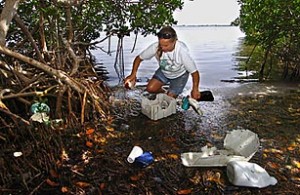
Maya Totman of Florida Keys Wildlife Rescue hopes to keep the oil spill from mixing with garbage because of the deadly impact that could have on the local wildlife

Miami Herald / MCT / Landov

Read more: http://www.time.com/time/nation/article/0,8599,1996441-1,00.html#ixzz0qtWIAzWT

A small island in the middle of a big ocean, Key West has always made a virtue of its isolation. In 1982, for example, an onerous Border Patrol checkpoint on U.S. Route 1, which links the Keys to mainland Florida, resulted in the island’s declaring itself the autonomous Conch Republic. This was, of course, mostly a joke (“We Seceded Where Others Failed” was its e pluribus unum), but the mayor’s declaration of independence did include a twinge of real anger and a vow that “we have no intention of suffering in the future at the hands of fools and bureaucrats.”

Now, facing the possibility that oil from the Deepwater Horizon spill could arrive on its reefs and beaches in the coming weeks, many in the Florida Keys are once again angry about perceived fools and bureaucrats. In particular, they’ve watched how BP has monopolized and, in the eyes of many, mismanaged the oil cleanup in the northern Gulf of Mexico and are frantically trying to organize an independent local response.

“We cannot wait. We have to be prepared,” says Dan Robey, whose website KeysSpill.com has gathered 4,000 volunteers, including 300 boat captains, who have offered to help before and after any potential arrival of oil. As Patrick Rice, dean of marine science and technology at Florida Keys Community College, puts it, “We will not allow the inept responses that have been happening up north to happen here.”

But there’s a problem with their plans for grass-roots activism: BP (and the Deepwater Horizon’s Unified Command, which BP runs with the Coast Guard and other agencies) has so far insisted on complete control of the cleanup operations. A BP spokesman told TIME that the only appropriate way for interested boat captains to become involved would be to register with the Unified Command’s Vessels of Opportunity program. Never mind that according to BP’s numbers, only a third of the 7,200 boats “under contract” through the program are in active service. Robey says captains in the Keys haven’t even been able to register. “It’s a joke, a total joke,” he says. “Our people have called them for over a month. They don’t return phone calls.”

Uncertainty is another complicating factor. Locals want to start preparing now, even though it’s unclear how much oil will arrive and in what form — sheen, plume, tar ball or all three. And BP and the Coast Guard won’t start really organizing, or funding, a response yet. “The general feeling is that BP has been reluctant to support advanced preparation,” says Laura Fox, owner of Danger Charters in Key West. “The Coast Guard’s big party line is that until oil is imminent — within 72 hours — nothing is going to be done. That’s not enough time to protect the 180 miles or more of shoreline that we have in the Keys.”

So without waiting for protocol, the Keys are making preemptive strikes. A group called Adopt a Mangrove is assigning kayakers their own mangroves to clean if oil comes. Volunteers are monitoring shores throughout the islands for signs of oil. The Florida Keys Environmental Coalition formed to connect boat captains, scientists, environmental activists and various agencies. Fox coordinated a cleanup of Man Key, a mangrove island west of Key West (oil is easier to clean off a beach that is in good condition). “It was all women, actually,” she says. “Thirteen women in kayaks, clenching knives in their teeth, cutting monofilament fishing line off the mangroves and clearing trash. We brought 35 bags of trash off the island.”

Local boat captain George Bellenger and others set up a series of town-hall meetings at Sippin’ Internet Café on Eaton Street, the last of which was attended by both Coast Guard and BP reps. It was at 8 p.m. on a Friday, traditionally not the soberest hour of the week in Key West, and Bellenger had called the Key West police department to see if it would help keep the peace. In the end, the police didn’t come. Bellenger had to throw one person out for “not showing respect to our [BP] guest,” but it was an otherwise calm event.

In May, Bellenger had heard through word of mouth (“the coconut telegraph,” as it’s known here) about a closed meeting between city officials and BP representatives and others. He and a few others showed up to complain about the lack of preparation and left with a promise that BP would pay $10,000 to fund hazardous-materials training for 100 people. It was, says Bellenger, one of the “two good things” that has happened with BP. The other: a towboat operator out of Big Pine Key was recently hired to be a sentry boat, keeping an eye out for approaching oil to the west of the Keys.

But everyone else is on their own for now. The Hazwoper haz-mat training that is a pre-requisite for handling oil spills can cost hundreds of dollars per person (although KeysSpill.com has arranged a discounted online course for $69). Florida Keys Community College offered a sold-out bird-cleaning course this past weekend, giving Keys residents practice on dead seabirds. But that course cost $150 per person and was not paid for by BP.

Advance planning would benefit BP as well: the Keys’ coral-reef ecosystem is unique and would require a different approach than the coastal marshes and beaches to the north. For example, chemical dispersants, already controversial in the northern Gulf, would be far too toxic for the coral, says Dave Hallac, supervisory biologist at the Dry Tortugas and Everglades national parks. Additional worries about the potential impact that unwitting contractors could have on the Dry Tortugas National Park caused the park service to “pre-negotiate” with the Coast Guard to insure that there would be park service advisers working with the contractors.

The generic cleanup plans that existed before the spill will have to be reimagined as well. “The contingency plan we have with the Coast Guard is for the event of a tanker spill,” says Rice. “I asked [the Coast Guard] directly, ‘Do you have a contingency plan for oil at depth?’ They don’t.”

Rice is pushing his own solution that might help protect the most sensitive reefs and mangrove plants from oil beneath the surface: curtains of air bubbles from perforated air hoses laid on the seabed. “It would at least deflect the smaller tar balls and push the oil up the surface,” he says.

How receptive would the Unified Command be to trying out a clever hack like this from a local scientist? How much help would they accept from the captains who know the backcountry currents and channels best? If oil comes to the Keys, residents warn, BP had better be ready to work with them. “I just talked with BP yesterday,” says Rice. “I told them flat out, ‘If you come down here and start doing what you’ve done in Louisiana, you’re going to have a revolt. They’ll shut down U.S. 1. You won’t be able to bring any of your contractors in or out.’ ” Key West’s isolation may not protect it from the coming oil, but perhaps its independent streak will.

Special thanks to Erika Biddle.