Category Archives: Uncategorized

Coast Guard Panel to Screen, Evaluate Oil Spill Technologies

Coast Guard Panel to Screen, Evaluate Oil Spill Technologies

Jun 09, 2010
The Interagency Alternative Technology Assessment Program workgroup, newly established by the National Incident Commander for the BP Deepwater Horizon oil spill, has called for white papers that cover oil spill response solutions on http://www.FedBiz Opps.gov.
The Coast Guard’s Research and Development Center, in collaboration with interagency partners, is seeking white papers on:

oil sensing improvements to response and detection;
oil wellhead control and submerged oil response;
traditional oil spill response technologies;
alternative oil spill response technologies; and
oil spill damage assessment and restoration.
The workgroup and center will screen and triage submissions based on technical feasibility efficacy and deployability. This will be a federal process to ensure a fair, systematic, responsive and accountable review of alternative response technologies by interagency experts.

The initial screening will determine potential for immediate benefit to the oil spill response effort; whether more detailed investigation or evaluation by the appropriate government agency is needed; or if the white paper submission does not support this incident.

The workgroup, established by Adm. Thad Allen, the national incident commander, includes the U.S. Coast Guard, National Oceanic and Atmospheric Administration, Department of Interior, Minerals Management Service, U.S. Environmental Protection Agency, and the Department of Agriculture.

The Research and Development Center, located in New London, Conn., is part of the U.S. Coast Guard Acquisition Directorate’s Research, Development, Test and Evaluation Program. The Acquisition Directorate has been supporting the response to the BP Deepwater Horizon oil spill with an on-site subject matter expert who provides guidance on in-situ burns, dispersant and sorbent boom use. The RDT&E Program’s Fire and Safety Test Detachment in Mobile, Ala., is coordinating local logistical support for volunteers in the Gulf Coast region. The RDC also participates in the interagency Flow Rate Technical Group, helping provide the latest scientifically validated information about the amount of oil flowing from the Mississippi Canyon 252 well.

Special thanks to Richard Charter

EPA issues Request for Nominations of Experts to Provide Scientific & Technical Advice related to the Gulf of Mexico Oil Spill

Notices]             
[Page 32769-32770]
From the Federal Register Online via GPO Access [wais.access.gpo.gov]
[DOCID:fr09jn10-52]                       

———————————————————————–

ENVIRONMENTAL PROTECTION AGENCY

[FRL-9160-6]

 
Science Advisory Board Staff Office; Request for Nominations of
Experts to Provide Scientific and Technical Advice Related to the Gulf
of Mexico Oil Spill

AGENCY: Environmental Protection Agency (EPA).

ACTION: Notice of request for nominations.

———————————————————————–

SUMMARY: The Science Advisory Board (SAB) Staff Office is requesting
public nominations of experts to serve on potential workgroups or
panels to advise the Agency on scientific and technical issues related
to the Gulf of Mexico Oil Spill.

DATES: Nominations should be submitted by June 24, 2010 per
instructions below.

FOR FURTHER INFORMATION CONTACT: Any member of the public wishing
further information regarding this Request for Nominations may contact
Ms. Stephanie Sanzone, Designated Federal Officer (DFO), EPA Science
Advisory Board (1400F), 1200 Pennsylvania Avenue, NW., Washington, DC
20460; via telephone/voice mail (202) 343-9697; by fax at (202) 233-
0643; or via e-mail at sanzone.stephanie@epa.gov. General information
concerning the EPA Science Advisory Board can be found on the EPA SAB
Web site at http://www.epa.gov/sab.

SUPPLEMENTARY INFORMATION:
    The SAB was established by 42 U.S.C. 4365 to provide independent
scientific and technical advice, consultation, and recommendations to
the EPA Administrator on the technical basis for Agency positions and
regulations. As announced previously Federal Register, May 19, 2010,
Volume 75, Number 96, Page 28009), the SAB may be asked to provide
advice on a range of scientific and technical issues related to the
Gulf of Mexico oil spill. To expand the pool of experts available to
serve as SAB consultants, the SAB Staff Office is seeking public
nominations of nationally recognized experts for potential service on
SAB workgroups, panels or committees to provide advice on this critical
matter. The advice will assist the Agency in developing and
implementing timely and scientifically appropriate responses to oil
spill contamination in the Gulf of Mexico and along the Gulf Coast. All
SAB advisory activities generally comply with the provisions of the
Federal Advisory Committee Act (FACA). As announced previously (Federal
Register, May 19, 2010, Volume 75, Number 96, Page 28009), critical
mission and schedule requirements may preclude the full 15 days notice
in the Federal Register prior to advisory meetings, pursuant to the
final rule on Federal Advisory Committee Management codified at 41 CFR
102-3.150. However, information on Gulf of Mexico oil spill meetings,
as well as experts selected for service will be posted on the SAB Web
site at http://www.epa.gov/sab as they are available. Nominees will be
invited to serve based on: Scientific and technical expertise,
knowledge, and experience; availability and willingness to serve;
absence of financial conflicts of interest; and scientific credibility
and impartiality.
    Request for Nominations: The SAB Staff Office is requesting
nominations of nationally and internationally recognized experts with
demonstrated research or operational experience assessing the
environmental impacts and associated mitigation of impacts due to oil
spills, oil products, oil constituents, and dispersants in air and
water (including wetlands) media. Appropriate expertise may include one
or more of the following disciplines: Chemistry; fate, transport and
exposure assessment; toxicology; public health; ecology; ecotoxicology;
risk assessment; engineering; and economics.
    Process and Deadline for Submitting Nominations: Any interested
person or organization may nominate qualified individuals for possible
service in the areas of expertise described above. Self-nominations are
encouraged. Nominations should be submitted in electronic format (which
is preferred over hard copy) following the instructions for
“Nominating Experts to Advisory Panels and Ad Hoc Committees Being
Formed” provided on the SAB Web site. The instructions can be accessed
through the “Nomination of Experts” link on the blue navigational bar
on the SAB Web site at http://www.epa.gov/sab. To receive full
consideration, nominations should include all of the information
requested.
    EPA’s SAB Staff Office requests: contact information about the
person making the nomination; contact information about the nominee;
the disciplinary and specific areas of expertise of the nominee; the
nominee’s curriculum vitae; sources of recent grants and/or contracts;
and a biographical sketch of the nominee indicating current position,
educational background, research activities, and recent service on
other national advisory committees or national professional
organizations.
    Persons having questions about the nomination procedures, or who
are unable to submit nominations through the SAB Web site, should
contact Ms. Sanzone, DFO as indicated above in this notice. Nominations
should be submitted in time to arrive no later than June 24, 2010. EPA
values and welcomes diversity. In an effort to obtain nominations of
diverse candidates, EPA encourages

[[Page 32770]]

nominations of women and men of all racial and ethnic groups.
    The EPA SAB Staff Office will acknowledge receipt of nominations.
The names and biosketches of qualified nominees identified by
respondents to the Federal Register notice and additional experts
identified by the SAB Staff will be posted on the SAB Web site at
http://www.epa.gov/sab. Public comments on this List of Candidates will
be accepted for 15 calendar days. The public will be requested to
provide relevant information or other documentation on nominees that
the SAB Staff Office should consider in evaluating candidates.
    For the EPA SAB Staff Office, a balanced subcommittee or review
panel includes candidates who possess the necessary domains of
knowledge, the relevant scientific perspectives (which, among other
factors, may be influenced by work history and affiliation), and the
collective breadth of experience to adequately address the charge. In
establishing workgroups, the SAB Staff Office will consider information
provided by the candidates themselves, and background information
independently gathered by the SAB Staff Office. Selection criteria to
be used for panel membership include: (a) Scientific and/or technical
expertise, knowledge and experience (primary factors); (b) availability
and willingness to serve; (c) absence of financial conflicts of
interest; (d) absence of an appearance of a lack of impartiality; (e)
skills working in advisory committees and panels for the Panel as a
whole, and (f) diversity of and balance among scientific expertise and
viewpoints.
    The SAB Staff Office’s evaluation of an absence of financial
conflicts of interest will include a review of the “Confidential
Financial Disclosure Form for Special Government Employees Serving on
Federal Advisory Committees at the U.S. Environmental Protection
Agency” (EPA Form 3110-48). This confidential form allows Government
officials to determine whether there is a statutory conflict between
that person’s public responsibilities (which includes membership on an
EPA Federal advisory committee) and private interests and activities,
or the appearance of a lack of impartiality, as defined by Federal
regulation. The form may be viewed and downloaded from the following
URL address http://www.epa.gov/sab/pdf/epaform3110-48.pdf.
    The approved policy under which the EPA SAB Office selects
subcommittees and review panels is described in the following document:
Overview of the Panel Formation Process at the Environmental Protection
Agency Science Advisory Board (EPA-SAB-EC-02-010), which is posted on
the SAB Web site at http://www.epa.gov/sab/pdf/ec02010.pdf.

    Dated: June 1, 2010.
Anthony F. Maciorowski,
Deputy Director, EPA Science Advisory Board Staff Office.
[FR Doc. 2010-13858 Filed 6-8-10; 8:45 am]
BILLING CODE 6560-50-P

Special thanks to Richard Charter

E&E: Lobbying heats up as Murkowski resolution hits home stretch

Robin Bravender, E&E reporter

Industry and left-leaning advocacy groups are waging last-minute lobbying efforts as the Senate prepares to vote tomorrow on a measure aimed at blocking federal climate regulations.

A coalition of 24 industry groups sent a letter yesterday to members of the Senate urging them to support a resolution from Sen. Lisa Murkowski (R-Alaska) that would prevent U.S. EPA from regulating greenhouse gases under the Clean Air Act.

The groups include the U.S. Chamber of Commerce, American Petroleum Institute, National Mining Association, National Petrochemical & Refiners Association, National Association of Manufacturers and National Cattlemen’s Beef Association, among others.

“While our organizations may differ on some subjects with respect to approaches toward climate change, we are united in opposition to unilateral EPA action to regulate [greenhouse gases] under the [Clean Air Act],” the letter says.

The letter also urges senators to oppose any measures to codify EPA regulation of greenhouse gases under the Clean Air Act by legislatively affirming EPA’s “tailoring” rule or similar measures.

Sens. Tom Carper (D-Del.) and Bob Casey (D-Pa.) have discussed introducing a measure that would seek to exempt small stationary sources from greenhouse gas regulations while allowing the agency to regulate larger emitters. The proposal would be “very similar” to EPA’s tailoring rule, which would phase in greenhouse gas permitting requirements starting with the biggest polluters, according to a Senate aide (E&E Daily, May 18).

Meanwhile, a liberal advocacy group is expanding a television campaign targeting Murkowski’s supporters to include Massachusetts Sen. Scott Brown, one of the few Republicans who has not yet declared support for the resolution.

Americans United for Change — a group formed in 2005 by Democratic officials and labor interests — will launch a $40,000 television ad in Boston tomorrow targeting the Massachusetts senator after hearing that he is “leaning toward supporting it,” said Jeremy Funk, the group’s spokesman.

The 30-second ad, which features images of oil spewing from BP PLC’s Deepwater Horizon rig, accuses Republicans of “working to gut the bipartisan Clean Air Act” and “giving Big Oil a bailout.” Worst of all, the ad says, “Senator Brown is considering voting ‘yes.'”

Brown and Maine’s Olympia Snowe and Susan Collins are the three Republican senators who have not yet publicly staked out a position on the resolution. The remaining 38 GOP senators are co-sponsoring Murkowski’s legislation.

Brown’s office did not immediately respond to a request for comment.

Americans United for Change is running similar ads in Maine targeting Collins and a national ad running on Washington, D.C., cable channels during the run-up to tomorrow’s vote (E&ENews PM, June 7).

Special thanks to Richard Charter

Newsweek: Should We Clean Oiled Animals?

I don’t agree, but here is one theory….(Richard Charter)

http://www.newsweek.com/2010/06/08/should-we-clean-oiled-animals.html

Why it may be more humane to euthanize them instead.
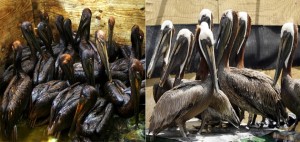
Photos: A.J. Sisco / UPI-Landov
Brown pelicans soaked in oil await cleaning at a rescue center (left), while birds that have been cleaned wait for their release.
So far, the numbers have been small. As of June 6, rescue workers had collected 820 birds and 289 turtles from the Gulf of Mexico oil spill, the majority of them already dead. But the current spill promises to be the largest in U.S. history, and as cleanup efforts stretch across the summer, it’s clear that more oiled birds will be found, stuck and suffering in black goo. And as they do with every oil spill, rescue workers will go to great lengths to capture and clean the survivors hoping to restore them to their natural habitat.

Is it worth the effort? Some scientists aren’t so sure. Because the stress of being captured and bathed is as significant as the trauma of being doused in oil, and because research suggests that many rescued birds die shortly after being released, some experts say euthanasia is a more humane option. “It might make us feel better to clean them up and send them back out,” says Daniel Anderson, an ornithologist at the University of California, Davis. “But there’s a real question of how much it actually does for the birds, aside from prolong their suffering.”
Clean bird feathers repel water and regulate body temperature-dirty ones don’t. Oil in particular makes feathers heavier and diminishes their ability to trap air, which in turn makes birds less buoyant and more vulnerable to drowning. They are also more vulnerable to overheating (oiled feathers are less insulative), and organ damage (licking their feathers clean forces birds to ingest lethal quantities of black gooey hydrocarbons).

(Oiled mammals suffer many of the same stresses as birds, including habitat loss, disregulated body temperature, and organ damage. They are also more vulnerable to viruses and bacteria that humans carry; sea turtles have their own vulnerabilities, but because all sea turtles are endangered, most scientists agree that it’s worth the effort to try and save as many as possible.)
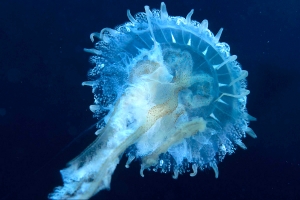
Jesse Cancelmo
The Gulf spill’s disastrous effects on marine life
Animals at Risk From the Gulf Oil Spill
Of course, being captured and cleaned is no picnic either. Some birds wind up returning to their destroyed habitats only to fall victim to the oil again. And those who manage to avoid a second oil bath suffer dramatically shortened life spans and lower reproductive success. Of the thousands of birds that were rescued from the Prestige oil spill off the coast of Spain in 2002, only 600 were released into the wild; most of the rest died after just a few days in captivity.
To be sure, survival rates vary widely by species, and not all species fare poorly. For example, South African penguins often go on to live long lives and breed well after being rescued from an oil spill. But species endemic to the gulf region, including the brown pelican, which was just removed from the Endangered Species List last year, remain among the most difficult to save. More than half the pelicans rescued from the American Trader spill in 1990 died within a year; fewer than 15 percent lasted two years.

Bird rescuers say they have learned a lot since then about how to best help oil-soaked birds, and that therefore, survival rates stand to increase this time around. “The rescue operations have gotten more sophisticated year by year,” says Michael Fry, an ornithologist with the American Bird Conservancy. In the past, birds were cleaned right away, and volunteers often worked through the night bathing rescued birds. But, as research has since shown, the stress of capture and cleaning can be profoundly deleterious to a bird’s health-knocking hormones out of balance and exacerbating organ damage. So now, captured birds are left to rest for a day or two before being cleaned, and only washed during the day, so as not to disrupt their circadian rhythms.

According to the International Bird Rescue Research Center (IBRRC), a nonprofit rescue operation that has responded to some 200 oil spills around the world, these protocol tweaks have dramatically increased the proportion of birds who make it from rescue to release-from 5 percent to 80 percent for some species.

But part of that increase may be due to greater selectivity on the part of rescuers. “They do blood tests right in the field now,” says Fry. “And birds that are loaded with hydrocarbons or don’t look like they’re going to make it are put down right away, rather than subjected to the stress of captivity and cleaning.”
And so far, while release rates may be improving, there is little evidence of better medium or long-term survival, especially for the more-difficult-to-save species. “They say they are getting better results, but I haven’t seen any data,” says Anderson. “And while the husbandry methods are better, there still aren’t good biomedical protocols, for repairing the internal organ damage.” Rescue workers have taken to giving Pepto-Bismol to afflicted birds, to help them absorb ingested hyrdrocarbons, but its unclear how much this actually helps.

The world’s worst man-made environmental disasters
On one point, experts do agree: the best way to save birds is to prevent them from being doused in oil to begin with. After the Exxon Valdez spill, a wildlife-care network, established by Congress and funded by oil-company taxes, began mapping all of the country’s “sensitive areas” (those vulnerable to significant wildlife casualties from prospective oil spills). The network has since established a system where protective booms and trained responders are rapidly deployed in the wake of a spill. For the current gulf oil spill, Fry says, responders were mobilized and facilities were ready on the day of the explosion. “Of course, when you have a spill the size of Connecticut, and the oil company’s containment efforts fail miserably,” he adds, “that preparedness is going to be of limited value.”

At any rate, rescue efforts will continue, in large part because the public demands that they do. “Without an organized response, members of the public will try to care for oiled wildlife on their own,” says Florina Tseng, a veterinarian and bird rescue expert at Tufts University. “We’ve seen this over and over. And as well-intentioned as they are, they have no knowledge of proper wildlife care.” Tseng says that while concrete figures are hard to come by, the cost of rescue and rehabilitation efforts are a tiny sliver of the total clean-up costs, and thanks to the Oil Spill Act of 1990, are the legal responsibility of the offending oil company.

“I think for some species it makes more sense to euthanize,” says Anderson. “But that’s a difficult thing to do, especially for people who have built their lives around saving animals.”

Special thanks to Richard Charter

BBC News: Salazar reassures over oil drilling pause

http://news.bbc.co.uk/2/hi/world/us_and_canada/10273904.stm
Page last updated at 19:40 GMT, Wednesday, 9 June 2010 20:40 UK

 US Interior Secretary Ken Salazar said drilling would continue in a “safe way”

US Interior Secretary Ken Salazar has told a senate panel that a six-month moratorium on deepwater drilling will stay in place until safety is assured.

But he sought to reassure senators that the moratorium – imposed after the huge Gulf of Mexico spill – was a “pause” rather a permanent halt to exploration.

Coast Guard Adm Thad Allen said the amount of oil captured from the leaking well could almost double by next week.

President Barack Obama has criticised BP’s efforts to deal with the spill.
He is due to make his fourth trip to the Gulf of Mexico next week.
Mr Salazar’s announcement came a day after he announced plans to bolster safety requirements for shallow-water oil drilling.

He said that drilling would continue, but it “has to be done in a safe way”.
Mr Salazar said the pause, which was put in place following the 20 April explosion of the Deepwater Horizon rig, would remain “until we can have a sense of safety, until we have a sense that this can never happen again”.
Mr Salazar also told the panel he would ask BP to repay the salaries of any workers laid off due to the six-month moratorium.

Three committees and two subcommittees on Capitol Hill were to discuss matters related to the oil spill and oil industry on Wednesday.

Underwater plumes

Among the new safety regulations announced by Mr Salazar on Tuesday, oil companies drilling in US waters will now have to inspect their blow-out preventers and provide safely certificates.

BP engulfed in controversy again

The failure of the blow-out preventer on the Deepwater Horizon rig led to the oil spill, the worst in US history.

A containment cap placed on the blown-out well last week is now helping to contain some of the leaking oil.

Adm Allen said in a press conference on Wednesday that the containment operation was now catching up to 630,000 gallons (2,864,037 litres) daily.
He said he hoped the existing containment structure would soon be able to hold 1.17 million gallons per day.

“We’re only at 15 [15,000 barrels] now and we’ll be at 28 [28,000 barrels] next week. We’re building capacity,” said Adm Allen.
At some point there might “have to be a transition between a containment cap and a regular cap”, he said.

Adm Allen added that Obama administration officials were talking to BP about a longer-term containment strategy with “built-in redundancies”.
The government has estimated that 600,000 to 1.2 million gallons a day are leaking from the bottom of the sea.

BP’s efforts to tackle the spill have come under close scrutiny
BP has said it will donate net revenues from the oil recovered to a fund to restore wildlife habitats on the coastlines of four affected Gulf Coast states.
However, a BP spokesman told the AP news agency that it could not say how much of the recovered oil had been processed.

Adm Thad Allen wrote to BP on Tuesday demanding “more detail and openness” about how the company is managing claims for compensation payments to individuals and businesses in the region.

“The BP Deepwater Horizon oil spill is having a devastating impact on the environment and the economy of the Gulf Coast states and their communities,” he wrote.

Meanwhile, tests have shown that underwater oil plumes have travelled at least 64km (40 miles) from the leaking well, the US government says.
Scientists noted that concentrations of oil in the plumes were “very low”, but said the plumes were very difficult to clean up, and they could damage the Gulf’s abundant sea life by depleting oxygen in the water.

Speaking on US network NBC’s Today show on Wednesday, BP spokesman Doug Suttles maintained BP’s position that no massive underwater oil plumes in “large concentrations” had been detected.

“It may be down to how you define what a plume is here,” he said.

‘Cut corners’

Oil has been leaking into the Gulf of Mexico since the Deepwater Horizon rig exploded and sank off the coast of the US state of Louisiana, killing 11 workers.

The morning the rig exploded, a BP executive and an official from Transocean, which operated the rig, argued over how to proceed with the drilling, survivors of the blast told CNN.

The workers said BP had routinely cut corners and pushed ahead despite concerns about safety.

A BP spokesman said it would not comment on specific allegations until an investigation into the accident was completed, but said that “BP’s priority is always safety”.

BP chief Tony Hayward is scheduled to appear before Congress next week.
BP shares fell 3.4% on Wednesday over worries that the company will have to suspend its dividend payments to pay for legal claims and cleaning up the spill.
ATTEMPT TO CAP OIL LEAK

The latest stage in BP’s efforts to contain leaking oil has involved lowering a cap onto the failed blowout preventer (BOP) valve system on the seabed. The cap sits on the BOP’s lower marine riser package (LMRP) section.

Special thanks to Richard Charter