Category Archives: Uncategorized

CNN: Oil confirmed on Pensacola beaches

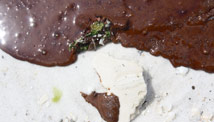
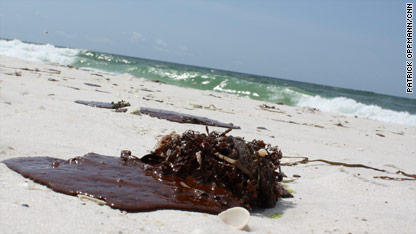
Tar sits on the beach in Gulf Breeze, Florida, on Friday. 

For days, CNN’s small army of reporters, photographers and producers has been repositioning toward Florida as oil was expected to come ashore in the Sunshine State. 

And on Friday morning, tar balls – hundreds of small bits of hardened oil – littered Pensacola’s white beaches. Our iReporters had been saying they had spotted tar balls nearby and in different areas a few days earlier. So we set out to check the beaches.

Tourists were the first to begin cleaning it up. iReporter Marc Sigler said he had been camping in Fort Pickens on Tuesday when he saw tar balls; they spent the next day swimming, picking it up and cleaning the beach. iReport: See Sigler’s photos 

Further south on the beach on Friday, we saw blobs the size of a Frisbee of reddish-brown oil.

Nobody knew for sure whether the tar was from the Deepwater Horizon disaster. Local officials said that so much tar had been piling up that they didn’t have the resources to test all the balls and blobs of oil locally, so they would be assuming that if they came in such large amounts now, they were probably from the disaster in the Gulf. Similar tar balls and oil slicks have shown up on beaches along the Gulf since the rig exploded and sank. 

Friday afternoon, reporters and residents got the answer they were waiting for: Florida’s Division of Emergency Management issued a statement saying, “tar patties and tar balls have been confirmed in widely scattered areas east of Pensacola.”

Reconnaissance flights are taking place to determine all of the locations nearby that may be affected. While that goes on, some tourists will keep on cleaning – and worrying. 

Tourist Catherine Maloney looked at the blobs of oil with surprise and disgust before taking pictures of them.

“This is going to affect this area for years,” she said. “It’s already so quiet, it feels like a hurricane came.”

Key West Citizen: Fishing ban lifted west of Dry Tortugas

Saturday, June 5, 2010
Fishing ban lifted
Fishermen are breathing a bit easier this weekend as the National Marine Fisheries Service on Friday reopened for fishing nearly 13,000 square miles of the Gulf of Mexico west of the Dry Tortugas.

The feds had banned fishing there, including portions of the Florida Keys National Marine Sanctuary, on Wednesday after projecting an oil sheen from the Deepwater Horizon oil spill would move into that area within the next several days.

The agency on Friday essentially moved the fishing ban boundary 100 miles west throughout the Gulf. The ban had been 20 miles from the Dry Tortugas park boundary. The move reopened an additional 3,000 square miles elsewhere in the Gulf.

“This is extremely good news,” said Capt. Bill Kelly, executive director of the Florida Keys Commercial Fishermen’s Association. “We hope that Mother Nature continues to watch out for us. … My telephone was ringing off the hook yesterday. These guys [fishermen] were scared, and understandably so. There were all kinds of rumors running around about the feds shutting down fishing in the Florida Straits. I think people realized how quickly the economy of the Florida Keys could be shut down.”

Kelly said he has urged federal fishery managers for more stringent water-sampling and fish-testing before they close off areas to fishing.

Several members of the Florida Keys National Marine Sanctuary Advisory Committee have contacted sanctuary Superintendent Sean Morton asking what criteria is used to ban fishing, he wrote to members on Friday. The National Oceanic and Atmospheric Administration (NOAA) is the parent organization over both the National Marine Fisheries Service and the Florida Keys National Marine Sanctuary.

The criteria is based on computer models that produce trajectory maps of where the oil is likely to be in 24, 48 and 72 hours, based on weather, satellite imagery, ocean buoy data and ocean currents, Morton said. The trajectory is “truth-tested” by daily flights over the Gulf.

The feds review the data daily and by noon determine whether a fishing ban is needed and where, Morton said. 

They will continue to monitor the trajectory of the oil spill, sheens and tar balls, and close and open areas as needed, said Roy Crabtree, southeast regional director of the National Marine Fisheries Service.  Crabtree, who oversees fishing rules throughout the Gulf, said he understands the need to ensure areas free of oil remain open to fishing, as fishermen are being hit by more regulations than ever before.

“It’s been a tough year for fishermen,” Crabtree said. “We are taking this day by day.”

Also on Friday, the U.S. Department of Commerce issued a Fishery Failure Determination for Florida, which opens the door for the state’s fishermen to receive federal funding because of lost wages. Gov. Charlie Crist requested the determination on Thursday. 

“The quick response of the federal government to this request is a positive step toward protecting Florida’s hardworking citizens,” Crist said in a prepared statement Friday. “We are continuing to keep a close watch on the oil spill and are prepared to respond to any impacts we may experience. Florida is still open and we encourage everyone to go fishing and enjoy Florida seafood products.”

Commerce Secretary Garcy Locke granted Crist’s request to establish a regional economic transition program, which allows fishermen and other businesses to qualify for economic injury loans through the U.S. Small Business Administration.

tohara@keysnews.com

Petroleumworld.com: BP Scenarios After the Spill

http://www.petroleumworld.com/

HOUSTON
Petroleumworld.com, June 4, 2010

Here are some potential scenarios facing BP:
BP RUNS OUT OF CASH – UNLIKELY
BP and the White House have said the oil giant has the financial muscle to cover the cost of cleaning up the oil spill and compensating those affected.
All analysts consulted by Reuters agree on this, and that the key determinant of how much it does finally cost depends on how long the oil continues to flow.
Analysts and investors have started to factor in that the spill lasts until August, when a relief well is expected to be completed. The relief well would end the spill even if earlier efforts to cap the ruptured well have failed.
BP’s market capitalization has fallen by around $65 billion since the Deepwater Horizon rig sank on April 22 after exploding two days earlier, unleashing a torrent of oil into the Gulf of Mexico .
Most analysts believe this more than factors in the total cost to BP.
“It’s not going to be anything in that ball park,” Alex Morris, oil analyst at Raymond James in Houston said.
Estimates for the total cost start at around $5.3 billion, an estimate from Dutch bank ING, assuming the current effort to fit a cap on the well to capture the oil works.
However, estimates run to up to $37 billion — the forecast from investment bank Credit Suisse.
As costs, especially those for damages, will be absorbed over a period of years, BP is seen as able to handle them.
The company generated cash of $7.7 billion from operating activities in the first quarter. Even after capital investment of $3.8 billion, it had $3.9 billion of free cash.
Most analysts believe the company can foot the bill without cutting its dividend or raising debt levels.
However, Credit Suisse said if its $37 billion estimate is accurate, the company can only maintain its dividend by raising its gearing ratio by 10 percentage points, something it may not wish to do.
And even if BP can afford to maintain its dividend, it may cut it as a political gesture to bolster its flagging reputation. Democratic Senators Charles Schumer and Ron Wyden said on Wednesday BP should cut its dividend until the full costs for cleaning up the spill can be calculated.
BP, which owns 65 percent of the leaking well, its partners Anadarko Petroleum, which owns 25 percent and Japan ‘s Mitsui & Co, which owns 10 percent, are legally liable for the clean-up on the basis of their shareholdings. BP has undertaken to cover all damages itself.
CEO Hayward said in an interview with Britain’s The Daily Mail newspaper on Wednesday that clean-up costs could hit $3 billion if the leak continues until August.
This is based on BP’s estimate of around $950 million spent in the first 41 days after the explosion.
However, Credit Suisse estimated in a research note on Wednesday that clean-up costs could total $15-23 billion. Other analysts put the number as low as the $2 billion estimated by Panmure Gordon’s Peter Hitchens.
BP has agreed to compensate all those affected by the spill for all legitimate costs, even though under the law BP and its partners are only liable to pay up to $75 million. BP has undertaken to pay this money itself, rather than in conjunction with its partners, so the full liability may fall to it.
BP has offered no estimate but Hitchens at Panmure said on Wednesday he estimates compensation claims will be $10 billion. Credit Suisse estimates this at $23 billion.
BP BECOMES A TAKEOVER TARGET – UNLIKELY
The collapse in its share price means BP could become a takeover target, Dougie Youngson, oil analyst at brokerage Arbuthnot said on Tuesday.
However, most analysts do not expect this to happen.
Exxon Mobil, Royal Dutch Shell and Chevron are the only fully publicly traded oil companies larger than BP and deemed financially strong enough to buy it.
The U.S. government blocked the takeover of Asia-focused U.S. oil company Unocal by China’s CNOOC for strategic reasons, so most analysts doubt it would allow BP — the largest oil producer in the Gulf of Mexico — to be taken over by a state-backed oil company.
Antitrust issues could arise over BP’s refineries if it were acquired by Exxon, Shell or Chevron, Alex Morris said. This could force the sale of the refineries but in the current depressed refining environment that would be difficult.
BP’s significant U.S. gas production assets could also cause regulatory problems for any of the above, Jason Kenney at ING said.
However, the biggest barriers to an acquirer making a move are the unknown liabilities that arise from the spill.
“It would be hard to see one of the other supermajors taking on such an unknown liability,” Raymond James’s Morris said.
Similarly, selling of BP piecemeal may not attract buyers because the individual parts would still be liable for the spill.
Washington may also block any deal seen to strengthen anyone in the oil industry.
“The last thing that President (Barack) Obama needs today is “bigger oil,” ING’s Kenney said in a research note.
CEO HAYWARD LOSES HIS JOB – UNLIKELY, FOR THE MOMENT
Inevitably, there have been questions over whether Hayward should stay. He told the Daily Mail “…it would be ridiculous to resign at this point” and most analysts have defended the CEO’s position.
John Hofmeister, former president of Shell Oil Company, Shell’s U.S. unit, and author of “Why We Hate the Oil Companies,” told Reuters it was unreasonable to blame the CEO.
“Ultimately the CEO is accountable and responsible … but the individual on the rig may have a made a bad judgment.”
Investors had been happy with Hayward’s efforts as CEO. In the almost three years before the Deepwater Horizon rig sunk, he had improved refinery operations, boosted oil production and cut a lot of management overheads.
“People were happy with him — he had done a good job turning around BP,” Alex Morris said.
So far, investors and analysts seem to be backing Hayward.
However, documents and testimony submitted to government investigations into the incident have prompted some in Washington and Louisiana to question BP’s decisions about the drilling of the oil well.
Hayward took up his role promising to standardize and streamline the way BP built facilities and drilled oil wells. If the structures he put in place are deemed to have led to any decisions that contributed to the accident, then the CEO’s position could come under pressure.
BP IS BARRED FROM DOING SOME BUSINESS IN THE U.S. AT LEAST TEMPORARILY – SOMEWHAT LIKELY
Some commentators have called for BP to be banned from drilling in the United States, which would seriously damage the company’s business given that 40 percent of its assets are in the United States and it depends on the country for its growth plans.
Analysts are divided on whether some debarment is likely.
“There are going to be heavy fines. The regulator is going to be tough on them getting permits but all companies have to be treated by the rules. This isn’t Venezuela ! ” said Morris.
However, under federal law BP would have to be banned from government contracts for a period of time if convicted of a criminal offense under the Clean Water Act. The company could also be barred from contracts if civil judgments are entered against it for violations of environmental laws.
BP has already faced partial bans on receiving federal contracts because of past violations of U.S. laws. After the pipeline leaks at its Prudhoe Bay Unit in Alaska and a fatal explosion at a Texas refinery, the company was ineligible to receive federally funded contracts for services from those two facilities.
The company had been negotiating with the U.S. Environmental Protection Agency over those bans but those talks were halted after the oil spill in the Gulf of Mexico .
While BP could face such a penalty in the latest oil spill, one law professor and private practitioner, Anthony Sabino, noted that there were not a lot of other oil producers so it might only be a short-term debarment.
That could be viewed as a punitive and politically motivated action, but regardless such a ban would likely “be a short-term hit and not substantial,” he said.
BP TO FACE FINES AND PENALTIES – LIKELY
In addition to facing billions of dollars in costs from the economic liability and damages, BP could also potentially face billions of dollars in civil and criminal penalties if the Justice Department’s investigation finds wrongdoing.
Some legal experts have said that proving some criminal charges may be more difficult because it requires showing intent, negligence or other malfeasance. However, some environmental laws have simple criminal violations, including the one banning harm to migratory birds.
For each barrel of oil that prosecutors can prove has spilled into the Gulf, BP could be fined $1,100 or as much as $4,300 if they are able to prove negligence was the cause.
Prosecutors could use estimates from a team of scientists and experts who found between 12,000 barrels per day and 19,000 bpd are flowing from the broken well. That could equal as much as $81.7 million in fines per day at the high end. With 44 days of oil spewing from the well, that would equal $3.6 billion as of Wednesday.
Additionally, U.S. laws protect endangered species and migratory birds, with fines of up to $25,000 per violation. Already more than 100 birds have been found oiled or dead, according to the Unified Area Command for the spill response efforts. There are also criminal fines associated with such violations, which could be as much as $50,000.
If other companies are also found to be responsible for the spill as well, the penalties could potentially be imposed on each violator. In some cases, most significantly the Exxon Valdez spill in 1989, companies try to negotiate a settlement with the federal government, as is expected with BP.
Two years after the Valdez spill, Exxon settled U.S. civil and criminal charges in a plea agreement that included just over $1 billion in penalties, damages and restitution.
At the time, the $125 million in criminal penalties was the largest of its kind while $900 million went to reimburse federal and state governments for responding to the spill and later restoration projects. The federal government and state of Alaska in 2006 sought another $92 million from Exxon, however that request has not been resolved.
BP TO FACE GROWTH HEADWINDS IN THE FUTURE – LIKELY
BP’s targets for expanded production will become tougher to achieve following the oil spill, and its financial performance will suffer from higher costs — even after spill costs and fines are paid.
BP said earlier this year it was targeting oil and gas output growth of 1-2 percent over the medium term. This plan relies heavily on BP’s U.S. projects and especially the Gulf of Mexico , where it was leading the push into ever-deeper waters.
The dislocation caused by dealing with the spill, including the diversion of vessels from other fields means BP will face a particular challenge in keeping its drilling plans on track.
A moratorium imposed by Obama on new deepwater drilling after the spill will also slow development plans at BP and across the industry.
Even when the oil spill has been dealt with and the drilling moratorium is lifted, BP’s damaged reputation is likely to mean more scrutiny from regulators than other companies, analysts said.
This means it will likely take longer than it would have expected in the past to bring fields to production.
“The Gulf of Mexico position was much heralded by management as a differentiated position for BP relative to its peers only 12 months ago … the full monetization of these assets is likely to take longer,” Morgan Stanley oil analyst Theepan Jothilingam said in a research note.
Lower-than-expected production would hit BP’s financial performance but in addition to this, higher costs could weigh on BP’s profits. Analysts at Bernstein estimated the company could face 10 percent higher operating costs in the United States after the spill, in part due to the need to impose tougher safety standards.
 
Story by Tom Bergin , additional reporting by Jeremy Pelofsky and Ayesha Rascoe in Washington from Reuters

Reuters Thu Jun 3, 2010 8:34am

Special thanks to Richard Charter
NY Daily News: BP Top officials on Gulf oil spill –We can’t stop leak until August at the earlest

Read more: http://www.nydailynews.com/news/national/2010/05/30/2010-05-30_bp_officials_on_gulf_oil_spill_we_cant_stop_leak_until_august_at_the_earliest.html#ixzz0q196Lo32

BY Helen Kennedy
DAILY NEWS STAFF WRITER

Originally Published:Sunday, May 30th 2010, 2:14 PM
Updated: Sunday, May 30th 2010, 10:27 PM

Oil is spewing into the Gulf of Mexico at a rate of one Exxon Valdez disaster every 10 days – and BP officials admitted Sunday they won’t be able to stop it until August.

“The oil is going to flow for a while,” Robert Dudley, BP’s newly installed head of disaster management, told CNN.

Dudley appeared on all the major TV news shows to say that BP, which has failed repeatedly to stop the environmental cataclysm it started, is now focusing on containing the oil.

“We’re going to redouble our efforts to keep it off the beaches,” Dudley said. “If we can contain the flow of the well between now and August and keep it out of the ocean, that’s also a good outcome.”

Saturday’s wrenching failure of the “top kill” effort to choke the well laid bare the extent to which the company was unprepared for catastrophe.

BP’s new plan involves making a clean cut in the bent, broken riser pipe and attempting to cap it, drawing the oil up to a drillship at the surface.

Some experts warn that the new plan could cause the leak to grow worse – by as much as 20% – because the crimped riser pipe could be restricting the flow of oil.

Dudley said “there may be a small increase” but insisted it would be worth it to get the oil out of the sea.

BP says the oil gusher can be stopped for good only by drilling a relief well, which won’t be finished for three months.

In those months, millions of barrels of oil would shoot from the seabed into the gulf, killing fish, mammals and birds and turning giant areas of the ocean and marshland into dead zones.

BP had said about 5,000 barrels of oil were leaking a day since the April 20 rig explosion, but new figures from government experts last week found the real number to be well over twice that, and possibly as high as 20,000 barrels a day.

When the Exxon Valdez tanker ran aground in 1989, it spilled 257,000 barrels into Alaska‘s Prince William Sound.

The new estimates mean the equivalent of roughly four Exxon Valdez spills has already polluted the gulf – and seven more may join it by August.

“This is probably the biggest environmental disaster we’ve ever faced in this country,” White House energy adviser Carol Browner told ABC.

She said efforts to keep the oil off the beaches – including burning it on the surface of the sea, skimming it up and corralling it with long floating booms – were continuing with great urgency and some effect.

Rep. Ed Markey (D-Mass.) said he found documents showing BP knew at least 14,000 barrels a day were flowing right from the start, but said the company covered that up because environmental fines are set by barrels of oil leaked per day.

“They had a stake in lowballing the number right from the very beginning,” Markey told CBS. “They were either lying or they were incompetent. … I have no confidence whatsoever in BP.”

If left alone, the underwater geyser would not run dry for seven years, experts say.

hkennedy@nydailynews.com

Alt.Politics: BP Disaster: White House Covers Up Menacing Oil “Blob”–10 X 3 mile oil plume now transiting the Gulf Loop Current, with tar balls washing ashore the Florida Keys and Dry Tortugas

from: razvlekatsa zabavlatsa
http://oilprice.com/Environment/Oil-Spills/White-House-Covers-Up-Mena… White House Covers Up Menacing Oil “Blob” \
Friday, May 21, 2010
Written by Wayne Madsen

In an exclusive for Oilprice.com, the Wayne Madsen Report (WMR) has learned from Federal Emergency Management Agency (FEMA) and U.S. Army Corps of Engineers sources that U.S. Navy submarines deployed to the Gulf of Mexico and Atlantic Ocean off the Florida coast have detected what amounts to a frozen oil blob from the oil geyser at the destroyed Deep Horizon off-shore oil rig south of Louisiana. The Navy submarines have trained video cameras on the moving blob, which remains frozen at depths of between 3,000 to 4,000 feet. Because the oil blob is heavier than water, it remains frozen at current depths.

FEMA and Corps of Engineers employees are upset that the White House and the Pentagon remain tight-lipped and in cover-up mode about the images of the massive and fast-moving frozen coagulated oil blob that is being imaged by Navy submarines that are tracking its movement. The sources point out that BP and the White House conspired to withhold videos from BP-contracted submersibles that showed the oil geyser that was spewing oil from the chasm underneath the datum of the Deep Horizon at rates far exceeding originally reported amounts. We have learned that it was largely WMR’s scoop on the existence of the BP videos that forced the company and its White House patrons to finally agree to the release of the video footage. The White House is officially stating that it does not know where the officially reported 10 miles long by 3 miles wide “plume” is actually located or in what direction it is heading. However, WMR’s sources claim the White House is getting real-time reports from Navy submarines as to the blob’s location.

We have learned that the blob is transiting the Florida Straits between Florida and Cuba, propelled by the Gulf’s Loop Current, and that parts of it that is encountering warmer waters are breaking off into smaller tar balls that are now washing ashore in the environmentally-sensitive Florida Keys and Dry Tortugas. Corps of Engineers and FEMA officials are also livid about the cover-up of the extent of the oil damage being promulgated by the National Oceanic and Atmospheric Administration (NOAA) and its marine research vessel in the Gulf, RV Pelican. NOAA stands accused by the aforementioned agencies of acting as a virtual public relations arm for BP. NOAA is a component of the business-oriented Department of Commerce. Similarly, the Coast Guard, which takes its orders from the cover-up operatives at the Homeland Security Department, is denying the tar balls washing up on the Florida Keys are from the oil mass.

WMR has been told the Coast Guard is lying in order to protect the Obama administration, which has thoroughly failed in its response to the disaster. The White House’s only concern is trying to limit political damage to its image in the electorally-important state of Florida while the Pentagon has spent between $25 and $30 billion on oil spill operations in the Gulf and the Atlantic to date. WMR sources also report that the oil mass has resulted in dead zones in the Gulf of Mexico that have cut off oxygen and killed massive numbers of marine creatures and plant life. Seafood wholesalers from the Gulf Coast to New Jersey and New York have been told that the supply of shrimp, oysters, and other seafood from the Gulf is severely in short supply and that they can expect a possible total cut-off as the situation worsens. The shortage will also affect the supply of seafood, especially shrimp, to national seafood restaurant chains like Red Lobster and Long John Silver’s.

There is also evidence that BP, Halliburton, and Transocean sank a drill to a depth of 35,000 feet at the Deep Horizon site some six months ago without the required permits from the federal government. WMR has learned from U.S. government sources that the drilling at 35,000 feet caused a major catastrophic event that required the firms’ oil rig personnel to quickly pull up the drill and close the drill hole. However, the Deep Horizon re-sank the drill some six months after the unspecified “catastrophe,” resulting in another, more destructive chain of events following the explosion that destroyed the rig, killing eleven workers. When the Deep Horizon blew up, WMR has been told it also “blew down,” cracking the the sub-seabed pipe that may have been re-drilled to a depth of between 25,000 to 30,000 feet, again, without a government permit. Government sources also report that BP is intent on recovering as much oil as possible from the undersea geyser rather than simply plugging and capping the well, which would then place it off-limits to further drilling.

The Corps of Engineers reports that BP is playing a game with Obama, convincing him of the feasibility of “shooting junk” into the subterranean pipe, which would stop up the pipe with a manufactured chemical compound called “MUD.” However, WMR has been informed that BP actually intends to shoot cement into the pipe in an attempt to cap the well with the later intention of digging a trench for side drilling from the pipe to recover as much oil as possible. The technology that would be employed by BP is the same technology that was used by Kuwait to conduct slant drilling of Iraq’s Rumallah oil field — an event that helped trigger Iraq’s invasion of Kuwait.

Corps of Engineers and FEMA sources also give a failing grade to both Homeland Security Secretary Janet Napolitano, who stands accused of being woefully incompetent in handling the disaster, and Interior Secretary Ken Salazar. Government sources say both secretaries should immediately step down or be fired.

Read Wayne’s first breakthrough article on the Oil Spill and other interesting pieces: The Cover-up: BP’s Crude Politics and the Looming Environmental Mega-Disaster http://oilprice.com/Environment/Oil-Spills/The-Cover-up-BP-s-Crude-Po… 8 Long Term Economic and Environmental Effects of the Gulf Oil Spill http://oilprice.com/Environment/Oil-Spills/8-Long-Term-Economic-and-E… Could There Be A Bright Side To the Gulf of Mexico Disaster http://oilprice.com/Environment/Oil-Spills/Could-There-Be-A-Bright-Si… 10 Geopolitical Predictions for 2010 & Short Term Strategic Outlook http://oilprice.com/Geo-Politics/International/10-Geopolitical-Predic… By. The Wayne Madsen Report for Oilprice.com http://oilprice.com/Environment/Oil-Spills/White-House-Covers-Up-Mena…

Special thanks to Dave Curtis