Category Archives: Uncategorized

Wall Street Journal: Scientists to Back Dispersant Use, Despite Concerns

http://online.wsj.com/article/SB10001424052748703406604575278662019860160.html?mod=WSJ_hpp_MIDDLETopStories

This is such bad news; they believe dispersants should be used to sink the toxic oil and the strategy is that it is easier to allow oil ashore onto Florida’s beaches and then clean it up than prevent it from reaching the shore.  What about using microbes along with tankers and skimmers to remove the oil altogether?????DV

JUNE 1, 2010
Scientists to Back Dispersant Use, Despite Concerns

By JEFFREY BALL
A federally convened group of scientists is set to recommend that BP PLC and the government continue spraying chemicals into the Gulf of Mexico to help prevent leaking oil from washing ashore, even though the scientists have serious concerns about the potential long-term damage to sea life.

The group’s report, due this week, comes after BP’s latest efforts to plug the leaking Deepwater Horizon oil well failed. If further interim measures to cap the well don’t work, large additional amounts of the chemicals, known as “dispersants,” could be sprayed into the Gulf until relief wells can be completed and the gusher capped, which could take until late late summer.

Research ships sponsored by the Obama administration and universities have recently found what scientists believe is evidence that clouds of tiny oil droplets are collecting deep underwater.

Tests are under way to determine whether the droplets are oil-and, if so, whether they were caused by the dispersants. Scientists suspect those droplets could harm fish, birds and sea mammals in coming months and years.

But scientists say they can’t make firm predictions about the effects of chronic exposure, in part because dispersants have rarely been used for long periods of time. In addition, funding for research on dispersants has lagged in recent years as concern about oil spills slipped off the political agenda.
“The bottom line is that there hasn’t been political will to fund this, because we haven’t had a spill,” said Nancy Kinner, co-director of an oil-spill-response institute at the University of New Hampshire.

When the Gulf spill began in April, her institute-the Coastal Response Research Center, created in 2003 with funding from the National Oceanic and Atmospheric Administration-hadn’t received any new federal funding for oil-spill research since 2007.

Last week, with only a few days’ notice, the government paid Ms. Kinner’s institute to hold a large meeting on dispersant use in Louisiana. The report from the closed-door meeting will recommend that dispersants continue to be sprayed on the gulf as a “tradeoff” to prevent massive amounts of oil from washing into coastal marshes, she said. The report also will call on the federal government to continue to do environmental testing to monitor whether that tradeoff remains worthwhile.

“We are assuming that keeping it out in the water column is better than letting it into the coastal areas,” Ms. Kinner said of the leaking oil. Louisiana’s marshes are crucial to many species-including to shrimp, a major industry in the state.

Ms. Kinner, other scientists and top administration officials say the tradeoff makes them increasingly uneasy.

Last month, the Environmental Protection Agency ordered BP to find a less-toxic alternative to the dispersant it has been using most, Corexit 9500, or explain why it couldn’t find one.

But Nalco Co., Corexit’s maker, says the dispersant is safe. And when BP told the EPA that it could find no less-toxic dispersant in the quantities necessary to fight this spill, the EPA relented. The agency asked BP to reduce the amount of Corexit 9500 the company is using.

EPA Administrator Lisa Jackson said in testimony to a House subcommittee Thursday that the administration has requested an additional $2 million for research into the environmental and health effects of the spill, including the use of dispersants. The government’s “modest investment” in dispersant research thus far, she said, “must increase to address the uncertainties that have arisen” from the spill.

The ongoing leak from the well on the ocean floor raises two main concerns in the Gulf: the effect of dispersed oil particles and the effect of the chemical dispersants themselves. Particularly unclear is how sea life will fare when exposed to dispersed oil over long periods of time. Past studies have looked at how short-term exposure could kill fish and sea mammals.

The long-term question didn’t get much consideration before April 20, when the Deepwater Horizon drilling rig exploded and unleashed the torrent of oil that has been spewing into the Gulf ever since. Based on government estimates released last week, the well is pouring out 12,000 to 19,000 barrels of oil every day. That would make the Gulf spill bigger than the 1989 Exxon Valdez disaster.

The EPA doesn’t regulate dispersants’ toxicity. It requires dispersant manufacturers to test the amount of dispersant necessary to kill a given quantity of one type of fish and one type of shrimp in lab tests. But it doesn’t impose any maximum toxicity level that dispersants must stay below.

The EPA does require dispersant manufacturers to show that their chemicals break apart and sink a given amount of oil in a given time in a lab test. The dispersants that have that documentation are placed on a list maintained by the EPA, along with the dispersants’ toxicity levels.

Because only small amounts of dispersant were used in the past, “the toxicity of a dispersant has not historically been a driving consideration,” said Chris Piehler, director of the clean-waters project for the Louisiana Department of Environmental Quality and one of the Louisiana officials involved in the current oil-spill response.

BP and the federal government said they have applied more than 900,000 gallons of dispersant onto the oil so far, an unprecedented amount.
The EPA’s Ms. Jackson said she hoped the quantities of dispersant could be reduced as much as 75% from initial levels, and federal officials say the amount of dispersant being applied to the spill is down. But even at those reduced quantities, there will still be a lot of dispersant in the Gulf.

 Write to Jeffrey Ball at jeffrey.ball@wsj.com

Special thanks to Richard Charter
Center for Biologic Diversity: Interior Formalizes Oil Drilling Moratorium, Center Applauds Deepwater Action, Decries Lifting of Shallow Moratorium and Continuation of Environmental Waivers

Center for Biological Diversity

http://www.biologicaldiversity.org/

The Center for Biologic Diversity doesn’t fool around; read the list of demands….they rock!!! And they sue.  They’re the ones that got elkhorn and staghorn on the Endangered Species List.  DV

For Immediate Release, May 31, 2010
Contact: Kierán Suckling (520) 275-5960

Interior Formalizes Oil-drilling Moratorium
Center Applauds Deepwater Action, Decries Lifting of Shallow Moratorium and
Continuation of Environmental Waivers
TUCSON, Ariz.- Interior Secretary Ken Salazar yesterday released the Department of the Interior’s written description of the six-month drilling moratorium announced by President Barack Obama last week. Salazar has been heavily criticized for breaches of his previous moratorium – which allowed at least 17 drilling permits to be issued – and for defining the moratorium differently with each new revelation of an approved drilling permit. It was later determined that Salazar’s previous moratorium had only been issued verbally.
The current moratorium lifts limits placed on drilling in waters less than 500 feet deep, which were put in place on May 6, 2010. Such drilling can now continue unabated, while under the May 6 moratorium new wells were not allowed to be initiated in waters less than 500 feet deep. The oil industry and Republican congresspersons have been heavily pressuring Salazar to exempt drilling in shallower waters from his moratorium.

The current moratorium expands limitations on drilling in waters greater than 500 feet deep for the next six months. Oil companies are allowed to continue retrieving oil from already completed wells, but they are not allowed to do any kind of drilling to initiate or complete new wells. This broader scope responds to criticism that Interior’s previous moratorium continued to allow the very same kind of drilling that was occurring on BP’s Deepwater Horizon when it exploded. The new moratorium does not allow such drilling types.

The current moratorium also allows the continued granting of highly controversial environmental waivers to drilling plans. The Deepwater Horizon drilling plan was approved with such a waiver, and at least 19 additional plans have been granted waivers since the Deepwater’s explosion on April 20, 2010. The waivers are being granted under the clearly false declaration that oil drilling poses no threat to the environment.
“We’re glad to see the moratorium has been expanded to cover all deepwater drilling,” said Kierán Suckling, executive director of the Center for Biological Diversity, “but we’re very upset that restrictions on shallower-water drilling have been lifted. All offshore oil drilling, whether deep or shallow, is dangerous and should be suspended.

“It is unbelievable that the Interior Department is continuing to exempt all drilling plans, deep or shallow, from environmental review. There is absolutely no question that offshore oil drilling is a danger to the environment and the fishing economy. Just look at the oil gushing into the Gulf of Mexico. It is not only illegal, it is deeply unethical for Salazar to allow these waivers to continue in the midst of the greatest environmental catastrophe in American history.”

The Center for Biological Diversity called upon Secretary Salazar to take the following actions immediately:

1. Remove former BP executive Sylvia Baca from her job as deputy assistant secretary for land and minerals management. Secretary Salazar expressed outrage at the Inspector General’s finding earlier this week that the revolving door between the oil industry and the Minerals Management Service has undermined the agency’s effectiveness and credibility. He did not mention, however, that in June 2009 he himself appointed a BP executive to oversee the Minerals Management Service.
“Sylvia Baca is a classic example of the revolving door between oil companies and the MMS,” said Suckling. “It was a terrible judgment call to appoint her; it is politically catastrophic to keep her. If Salazar is serious about reform, he needs to start with his own interest-conflicted appointments.”

2. Ban the use of environmental waivers for offshore exploration and production plans. Such waivers are designed for very small-impact projects such as constructing hiking trails and outhouses. There is no possible scenario in which an offshore drilling project – whether deepwater, ultradeepwater, or shallow water – can be considered a non-threat to the environment, economy, and endangered species.

3. Rescind all drilling approvals issued with environmental waivers. Hundreds of dangerous offshore oil platforms are operating today in the Gulf of Mexico without having undergone any environmental review. These dangerous drilling projects are operating illegally and threaten the Gulf with additional oil spills.

4. Rescind the Interior Department’s plan to open up new areas on the Atlantic Coast, eastern Gulf of Mexico, and Alaska to offshore oil drilling. The president’s announcement, made on March 31, 2010, three weeks before the BP explosion, was made on the false premise that offshore oil drilling is safe.
5. Permanently ban all new offshore oil drilling, beginning in Alaska. As a nation, we need to transition to clean energy sources such as sun and wind as fast as possible. Pushing forward with new, dangerous, and dirty offshore oil drilling sends the wrong signal to energy companies and technology developers. Continued subsidizing of Big Oil is a major hindrance to our nation’s development of clean energy.

The Center for Biological Diversity is a national, nonprofit conservation organization with more than 260,000 members and online activists dedicated to the protection of endangered species and wild places.

AP: Effort to contain Gulf oil stalls with stuck saw; Slick nearing Florida Panhandle beaches

http://www.dailyfinance.com/article/oil-nears-florida-as-bp-tries-risky-cap/1039683/
Associated Press
Effort to contain Gulf oil stalls with stuck saw
By KEVIN MCGILL
AP
posted: 10:00 AM 06/02/10

SCHRIEVER, La. -Coast Guard Adm. Thad Allen is saying that a saw has become stuck as it was cutting through a pipe on a busted well, stalling the latest attempt to contain the Gulf oil gusher.

Allen said Wednesday the goal is to free the saw and finish the cut later in the day. This is the second major cut in the effort to contain – not plug – the nation’s worst spill.
Allen says the first cut with giant shears was successful overnight.

The best chance at plugging the leak involves a relief well that is at least two months from completion.

THIS IS A BREAKING NEWS UPDATE. Check back soon for further information. AP’s earlier story is below.

PORT FOURCHON, La. (AP) – The BP oil slick drifted close to the Florida Panhandle’s white sand beaches for the first time as submersible robots a mile below the Gulf of Mexico made the latest risky attempt to control the seafloor gusher.

Even if it works, the current mission to cut a major pipe and cap it would only reduce the flow, not stop it. If it fails, it could make the largest oil spill in U.S. history even worse. The best hope for sealing the leak, until a permanent fix is possible in August, failed Saturday, when engineers were unable to plug it with heavy mud in a maneuver called a top kill.

Investors ran from BP’s stock for a second day Wednesday, reacting to the top kill failure and the Justice Department’s announcement that it was looking at criminal and civil probes into the spill, although the department did not name specific targets for prosecution.

Shares in British-based BP PLC were down 3 percent Wednesday morning in London trading after a 13 percent fall the day before. BP has lost $75 billion in market value since the spill started with an April 20 oil rig explosion and analysts expect damage claims to total billions more.

In Florida, officials confirmed an oil sheen Tuesday about nine miles from Pensacola beach, where the summer tourism season was just getting started.

Winds were forecast to blow from the south and west, pushing the slick closer to western Panhandle beaches.

Emergency crews began scouring the beaches for oil and shoring up miles of boom. County officials will use it to block oil from reaching inland waterways but plan to leave beaches unprotected because they are too difficult to protect and easier to clean up.
“It’s inevitable that we will see it on the beaches,” said Keith Wilkins, deputy chief of neighborhood and community services for Escambia County.

The oil has been spreading in the Gulf since the Deepwater Horizon rig exploded six weeks ago, killing 11 workers and eventually sinking. The rig was being operated for BP, the largest oil and gas producer in the Gulf.

Crude has already been reported along barrier islands in Alabama and Mississippi, and it has polluted some 125 miles of Louisiana coastline.

More federal fishing waters were closed, too, another setback for one of the region’s most important industries. More than one-third of federal waters were off-limits for fishing, along with hundreds of square miles of state waters.

Fisherman Hong Le, who came to the U.S. from Vietnam, had rebuilt his home and business after Hurricane Katrina wiped him out. Now he’s facing a similar situation.

“I’m going to be bankrupt very soon,” Le, 53, said as he attended a meeting for fishermen hoping for help. “Everything is financed, how can I pay? No fishing, no welding. I weld on commercial fishing boats and they aren’t going out now, so nothing breaks.”

Le, like other of the fishermen, received $5,000 from BP PLC, but it was quickly gone.
“I call that ‘Shut your mouth money,'” said Murray Volk, 46, of Empire, who’s been fishing for nearly 30 years. “That won’t pay the insurance on my boat and house. They say there’ll be more later, but do you think the electric company will wait for that?”

BP may have bigger problems, though.

Attorney General Eric Holder, who visited the Gulf on Tuesday, would not say who might be targeted in the probes into the largest oil spill in U.S. history.

“We will closely examine the actions of those involved in the spill. If we find evidence of illegal behavior, we will be extremely forceful in our response,” Holder said in New Orleans.

The federal government also ramped up its response to the spill with President Barack Obama ordering the co-chairmen of an independent commission investigating the spill to thoroughly examine the disaster, “to follow the facts wherever they lead, without fear or favor.”

The president said that if laws are insufficient, they’ll be changed. He said that if government oversight wasn’t tough enough, that will change, too.

BP has tried and failed repeatedly to halt the flow of the oil, and the latest attempt like others has never been tried before a mile beneath the ocean. Experts warned it could be even riskier than the others because slicing open the 20-inch riser could unleash more oil if there was a kink in the pipe that restricted some of the flow.

“It is an engineer’s nightmare,” said Ed Overton, a Louisiana State University professor of environmental sciences. “They’re trying to fit a 21-inch cap over a 20-inch pipe a mile away. That’s just horrendously hard to do. It’s not like you and I standing on the ground pushing – they’re using little robots to do this.”

Engineers have put underwater robots and equipment in place this week after a bold attempt to plug the well by force-feeding it heavy mud and cement – called a “top kill” – was aborted over the weekend. Crews pumped thousands of gallons of the mud into the well but were unable to overcome the pressure of the oil.

The company said if the small dome is successful it could capture and siphon a majority of the gushing oil to the surface. But the cut and cap will not halt the oil flow, just capture some of it and funnel it to vessels waiting at the surface.

BP’s best chance to permanently plug the leak rests with a pair of relief wells but those won’t likely be completed until August.

Bluestein reported from Covington, La. Associated Press writers Darlene Superville and Pete Yost from Washington, Curt Anderson from Miami, Brian Skoloff from Port Fourchon, Mary Foster in Boothville, and Michael Kunzelman also contributed to this report.
Copyright 2010 The Associated Press. All rights reserved. This material may not be published, broadcast, rewritten or redistributed.
2010-06-02 10:00:37

Special thanks to Richard Charter

St Pete Times: Truth o meter statement: Obama blames 30 day legal limit for role in oil spill

http://www.politifact.com/truth-o-meter/statements/2010/jun/01/barack-obama/obama-blames-30-day-limit-law-role-oil-spill/

Yeah, I’ve been on the other side of this when getting state permits in Florida; the agency “asks” you to seek an extension of time in which to reply while they get it together.   DV

Politifact: The Truth-O-Meter Says:

“The Interior Department has only 30 days to review an exploration plan submitted by an oil company. That leaves no time for the appropriate environmental review. The result is, they are continually waived.”    Barack Obama on Thursday, May 27th, 2010 in a press conference at the White House.

As anger grows over the massive, uncontained oil spill in the Gulf of Mexico, the procedure for issuing federal drilling permits for the Gulf Coast has begun to attract intense scrutiny. During a May 27, 2010, press conference, President Barack Obama — under pressure for the failure to stem the underwater leak — laid a large portion of the blame on the existing law that governs the permitting process, as well as the regulations to implement that law, which were drawn up by the Minerals Management Service, the Interior Department office that oversees oil and gas leases.

“What’s also been made clear from this disaster is that, for years, the oil and gas industry has leveraged such power that they have effectively been allowed to regulate themselves,” Obama said. “One example, under current law, the Interior Department has only 30 days to review an exploration plan submitted by an oil company. That leaves no time for the appropriate environmental review. The result is, they are continually waived. And this is just one example of a law that was tailored by the industry to serve their needs instead of the public’s. So Congress needs to address these issues as soon as possible, and my administration will work with them to do so.”

We wondered whether the president is correct that the law mandates such a short period for an environmental review.

The law in question is the Outer Continental Shelf Lands Act. The law was originally passed in 1953, though the amendments relevant to the Obama’s statement were added in 1978.

Under the law, a proposal to drill must pass through several stages before it can be approved. First, the Interior Department must choose the locations it will open to leasing. Then, the department puts those areas up for lease.

Once a lease is purchased by an energy company, the leaseholder must submit an “exploration plan” to the Interior Secretary before exercising its right to drill. Interior Department regulations specify that the regional supervisor of MMS has 15 working days after receiving a proposed plan to rule a submission packet complete. At that point, a 30-day clock starts ticking. If the secretary finds problems during this period, modifications can be ordered or, if modifications are insufficient to solve the problem, the lease can be canceled. But if the secretary finds the plan acceptable, it must be approved within that same 30-day window.

So Obama is correct about the law’s 30-day limit. He’s also correct that waivers are common. The Interior Department says that in recent years, MMS has granted 250 to 400 waivers annually for Gulf of Mexico projects alone. (The department was unable to provide PolitiFact with the number of cases in which a waiver was not granted.) The Deepwater Horizon project had been given a “categorical exclusion” from detailed environmental review more than a year before the disaster occurred — a decision that is supposed to be granted to projects that are expected to have minimal environmental impact.

Meanwhile, on Obama’s assertion that 30 days is too short a window to conduct a credible environmental review — much less a plan to respond to a major malfunction — many experts we spoke to agreed with the president.

In general, then, Obama’s statement is on target. But we think it’s worth noting that the 30-day limit is not the only factor that explains the failure of MMS to study the environmental impact of Gulf of Mexico projects.

The exploration plan Obama referenced is not the only environmental study that is supposed to be conducted during this process. Studies are also required when the lease locations are chosen and when the leases are sold, and they don’t have statutory time limits.

Critics say that, in their current form, these earlier-stage studies do not include enough detail on the specific drilling locations to qualify as a full-scale environmental assessment. But if MMS — or Congress, or the industry — had wanted to beef up these earlier studies as a way of getting around the 30-day limit, they could have done so. But they never did. In their absence, the courts have sometimes stepped in: In 2009, a federal appeals court threw out the initial five-year leasing plan for drilling in Alaska’s Chukchi Sea, citing shortcomings in the plan’s environmental assessment.

Holly Doremus, a law professor at the University of California-Berkeley who has studied the MMS permitting process, called it “a bit disingenuous” for Obama to focus solely on the 30-day limit.

“The categorical exclusion has never been formally justified by the short time line, and so far as I know MMS has never — until after this blow-out — asked Congress for more time to review exploration plans,” she said in an interview. “I think rather that MMS has thought, and acted, as if it didn’t need to do detailed environmental review at the exploration plan stage” because it does them at the two earlier stages. “If that review were more thorough, and considered true worst-case scenarios, it might well be the case that 30 days would be enough to look at the environmental impacts of exploration in a particular location,” she said.

Meanwhile, some say that Congress ought to shoulder a portion of the blame for letting an inadequate permitting process fester for more than 30 years.

“If that is too short for a review, then Congress should change it,” Gary Wolfram, an economics and public policy professor at Hillsdale College. “My suspicion is that, as with all central planners, Congress doesn’t know the proper amount of time it takes to review a project.”
Belatedly, Congress — prodded, also belatedly, by the Obama administration — is looking to change the rules. On May 11, 2010, Interior Secretary Ken Salazar released a legislative package that includes a proposal to eliminate the 30-day deadline. “Changing this 30-day mandatory deadline to a 90-day timeline that can be further extended to complete environmental and safety reviews, as needed, would provide MMS more time to conduct additional environmental analysis on an exploration plan,” the department said in its announcement.

Sen. Jeff Bingaman, D-N.M., the chairman of the Senate Energy and Natural Resources Committee, sought to attach the change to a supplemental spending bill before the congressional Memorial Day recess, but the effort was unsuccessful. Supporters vow to push on. “I am not aware of any pending free-standing legislation on this, but I do know that Congress will revisit the topic when it gets back,” said Bill Wicker, a spokesman for Bingaman.

Ultimately, Obama was correct on everything he said about the law — the 30-day limit, the difficulties of conducting a full study in that time frame, and the frequent waivers. But we’re marking him down slightly for implying that the 30-day limit tied the administration’s hands. If the administration had wanted to change MMS procedures short of rewriting the law, it could have done so by proposing more stringent requirements for the other environmental assessments undertaken during the permitting process, which are not time-limited under the law. And it could have pushed earlier to rewrite the law. On balance, we rate his statement Mostly True.

Special thanks to Richard Charter

CNN:Oil Spill spreads to Mississippi, Alabama

By the CNN Wire Staff
June 1, 2010 6:59 p.m. EDT

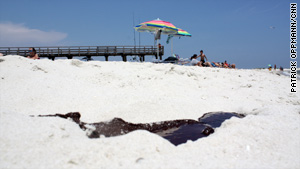
Tar balls and puddles of oil are reported on Alabama's Dauphin Island.

Tar balls and puddles of oil are reported on Alabama’s Dauphin Island.

STORY HIGHLIGHTS

  • U.S. begins criminal investigation into oil spill
  • Robots make latest attempt to stop the oil leak
  • Spill makes a third of Gulf off-limits to fishing
  • BP puts cost of spill response at $990 million

(CNN) — Oil from BP’s massive Gulf of Mexico crude spill reached the shores of Mississippi on Tuesday, Gov. Haley Barbour’s office reported. Residents and researchers reported oil in Alabama.

In Mississippi, a long, narrow strand of oil came ashore on Petit Bois Island, Barbour’s office said. The strand of oil was about 2 miles long but only 3 feet wide, said Laura Hipp, a spokeswoman for Barbour’s office. Cleanup crews were on the scene Tuesday evening, she said.

Petit Bois Island is off Pascagoula, Mississippi. It’s about five miles west of Dauphin Island, Alabama, where oil was also washing ashore Tuesday afternoon. But Hipp said most of the oil remained more than 35 miles off Horn Island, the largest of Mississippi’s barrier islands.

The National Oceanographic and Atmospheric Administration had warned earlier this week that the spreading slick from an undersea BP oil well was heading toward the Alabama and Mississippi coasts. Tar balls associated with the Gulf spill had hit Dauphin Island, about 35 miles south of Mobile, in early May, but residents said that Tuesday was the first time they had seen oil hitting the beach. Nevertheless, people were still on the beaches and swimming in the blue-green waters.

BP began its latest attempt to curtail the flow of oil from an underwater well in the Gulf of Mexico on Tuesday, using robot submarines to cut into a damaged pipe a mile down.

The operation carries the risk that the flow of crude from the ruptured well, already the largest oil spill in U.S. history, will increase — but if successful, the company says it will be able to catch most of that oil with a cap it plans to place over the severed lower marine riser pipe.

“Even with an increased flow rate, this cap will be able to handle this,” BP Managing Director Bob Dudley told CNN’s “American Morning.”

Meanwhile, the Obama administration distanced itself from BP by announcing it would no longer hold joint news conferences with the company; and Attorney General Eric Holder, after meeting with Gulf-Coast-state attorneys general, told reporters the Justice Department has launched a criminal investigation into the oil spill.

The engineering involved in the latest work on the damaged well has never been attempted at a depth of 5,000 feet. But Dudley said Tuesday the latest attempt is “more straightforward” than previous, unsuccessful efforts.

A mechanical claw began squeezing the heavy riser pipe late Tuesday morning, the first step in a series of planned cuts. After that, a diamond-cut saw was being brought in to make a “clean cut,” preparing the way for the custom-made cap to be fitted over the lower marine riser package.

Oil has been gushing from the undersea well since April 20 when the Deepwater Horizon oil rig exploded and later sank. Government estimates are that up to 19,000 barrels (798,000 gallons) of oil a day are flowing into the Gulf of Mexico. Dudley said that could increase by up to 20 percent — nearly 160,000 gallons — when the pipe is cut, but he said the company has learned lessons from its earlier attempts that it is applying to the new process.

Warm water and methanol will be pumped into the cap to limit the growth of gas hydrate crystals that thwarted an earlier attempt to cap the spill, he said. And a second line is planned to draw more oil off the well’s blowout preventer, a critical piece of safety equipment that has so far failed to shut down the well, using equipment involved in last week’s failed “top kill” operation.

BP’s handling of the spill and its statements regarding the status of operations have been sharply criticized by some in recent weeks. The Obama administration announced Tuesday that it would no longer hold joint news briefings with the company and that Coast Guard Adm. Thad Allen, its point man on the spill, will now become the face of the government’s response effort.

Allen told reporters in New Orleans, Louisiana, that his job is to speak “very frankly with the American public.”

“I think we need to be communicating with the American people through my voice as the national incident commander,” he said.

Rear Adm. Mary Landry, who has been the Coast Guard’s on-scene coordinator for five weeks, will be returning to her duties as chief of the service’s New Orleans district office. Coast Guard Commandant Robert Papp said the plan always has been for Landry to resume that role in preparation for the Atlantic hurricane season, which began Tuesday.

Allen praised Landry’s work leading “an anomalous and unprecedented response” to the spill, but said Landry now needs to focus “on the larger array of threats” to her district, which includes the U.S. Southeast and Midwest.

The oil spill has spread across much of the northern Gulf of Mexico, washing ashore in the environmentally sensitive marshes along the Louisiana coast that serve as the cradle of the region’s fishing industry. Plaquemines Parish President Billy Nungesser said crude has fouled 24 miles and about 2,965 acres of the state’s coastline, and the start of hurricane season raised new worries that a storm could drive more oil ashore.

“We don’t want to scare anybody, but we need to be realistic about it,” Nungesser said. “If a storm does top out levees, it will probably bring oil with it.” He said residents who evacuate ahead of a hurricane might return “not to a flooded home, but to a home that is completely contaminated with this oil.”

“I don’t know how to soft-pedal that,” he said.

Tuesday also marked the start of the recreational fishing season for red snapper, a big draw for sport anglers in the region. But the season opened with a new blow to the region’s fisheries industry as the National Oceanographic and Atmospheric Administration extended its restrictions on fishing to nearly a third of the Gulf.

The latest closures extend southward to a point about 240 miles west of the tip of Florida and eastward to federal waters off the Alabama-Florida state line.

Holder met with state attorneys general and federal prosecutors from Louisiana, Alabama and Mississippi on Tuesday, emerging to tell reporters that the Justice Department was looking at possible criminal violations in connection with the spill as well as working to make sure BP paid the full cost of the cleanup.

Justice Department launches investigation

“If we find evidence of illegal behavior, we will be forceful in our response,” he said. “We have already instructed all relevant parties to preserve any documents that may shed light on the facts surrounding this disaster.”

A group of senators asked Holder to look into whether BP had leveled with federal officials in the exploration plan it filed with the government for the site, expressing concerns about BP’s “truthfulness and accuracy.” But in a reply to that letter last week, a Justice Department official did not say whether a criminal investigation had begun.

In a statement issued in response to Holder’s announcement, BP said it would cooperate with any inquiry, “just as we are doing in response to the other inquires that are already ongoing.”

BP, as the well’s owner, is responsible for the costs of the cleanup under federal law. The company said Tuesday that the tab for its response to date was $990 million. BP, rig owner Transocean Ltd. and oilfield services company Halliburton have blamed each other for the disaster, which left 11 workers dead.

BP stock has taken a beating on Wall Street since the spill and plunged 15 percent on Tuesday after the failure of the “top kill” plan, which pumped heavy drilling fluid into the damaged well in hopes of holding back the flow. The company’s stock value is down more than a third since the April 20 explosion on the rig.

The spill may not be completely under control until August, when BP expects to complete relief wells that will take the pressure off the one now spewing into the Gulf. If attempts to capture more of the leaking oil fail, White House energy adviser Carol Browner said, “we would be in a situation where it is conceivable that there would be oil leaking at a rate of something on the order of 12 to 20,000 barrels a day until the relief wells are dug.”

The Obama administration has always hoped for the best, “but we are preparing for the worst,” she said.