Category Archives: Uncategorized

Oceana.org: Sign the petition to stop offshore oil drilling

http://na.oceana.org/en/stopthedrill?key=31485793

Demand a clean energy future: Help us reach 500,000 names on our petition to stop offshore drilling.

On April 20, 2010, the Deepwater Horizon oil rig exploded in the Gulf of Mexico.

Now, an oil spill on pace to be worse than Exxon Valdez is pumping at least 12,000 barrels of oil a day – that’s over 500,000 gallons – into the biologically diverse and commercially productive Gulf of Mexico. Thousands of sea birds, dolphins, whales, sea turtles, and other animals are threatened by the ever growing plume of toxic sludge.

Fresno Bee: As oil spill damages Gulf, will U.S. change energy use?

http://www.fresnobee.com/2010/05/30/1951665/as-oil-spill-damages-gulf-will.html

As oil spill damages Gulf, will U.S. change energy use?

Posted at 01:00 AM on Sunday, May. 30, 2010

By MARGARET TALEV AND SHASHANK BENGALI – McClatchy Newspapers 

WASHINGTON — The Gulf oil spill has triggered a crisis of confidence, shaking Americans’ views about BP, the oil industry, technology and President Barack Obama and slowing a planned expansion of domestic offshore oil drilling.

Are the worst spill in U.S. history and images of dead birds and toxic syrup lapping at Gulf shores shocking enough to be a tipping point for energy policy and consumer behavior, however?

Will Americans rush to smaller cars or spend more to buy hybrids? Will politicians embrace gas taxes and charges on large carbon polluters or adopt other measures to punish fossil-fuel burning and encourage alternative energy use?

It’s probably too soon to say. Public willingness to change – and the political courage to provoke change – may hinge on how long the spill continues, how the wind blows, how the cleanup goes and the extent of damage to wildlife, seafood, jobs, tourism and real estate.

The debate also comes as the nation is emerging from the worst economic crisis in decades, saddled with debt, trying to wrap up two wars and embarking on an experiment in health care that has left many Americans unsettled and businesses bracing for higher taxes. It also comes as key developing nations, including China and India, rely heavily on oil and coal to drive their expansions.
 
For now, many experts say Americans aren’t ready to change.

“I don’t think it’s a game-changer,” said Antoine Halff, the head of commodities research at Newedge, a New York-based brokerage firm.

“It drives home the risky nature of meeting the demand for oil,” but he predicted perspective largely would be offset by a more powerful reflex: “People like to have their cake and eat it too.”

Even the most cautious analysts expect the crisis to lead Americans to embrace greater government regulation of offshore drilling and perhaps to expedite higher fuel-efficiency standards for cars and trucks.

Advocates of a faster transition from an oil economy to alternative energy are seizing the opportunity to push for as much as they can get.

“Perhaps in the face of this terrible crisis we can find the political will and the political leadership to get it done,” said Kevin Knobloch, the president of the Union of Concerned Scientists. The National Resources Defense Council Action Fund has launched ads in eight states pressuring senators to pursue a “strong clean-energy climate bill.”

The searing images of the spill already are having some impact. In a USA Today/Gallup poll released this week, 55 percent of those polled said environmental protection should be prioritized, even if it meant limiting U.S. energy production.

In the same poll, however, 50 percent said they still supported increased offshore drilling, perhaps realizing the nation depends so heavily on oil that change will be difficult. The lion’s share of the oil used domestically goes to power cars, trucks and airplanes, and alternatives such as hybrid-powered engines remain too expensive and inefficient for most Americans.

“We’ve been through this sort of drill before with the oil embargo back in the 1970s, the various oil price shocks,” said Frank Felder, the director of the Center for Energy, Economic and Environmental Policy at Rutgers University in New Jersey.

“Everyone gets riled up … and then we go back to our ways. The reason we do it is that oil is just very, very useful.”

With the economy recovering gingerly and elections looming in November, politicians aren’t radically changing their rhetoric, either. 

President Barack Obama has said while the Gulf spill should be “a wake-up call” for the need to invest in renewable energy, he continues to support expanded domestic drilling as part of a national security effort to make the country less dependent on foreign oil.

Sen. John Kerry, D-Mass., the leading author of the major energy bill the Senate is considering this year, said this week that, “The sooner we can move off fossil fuels and to a new energy paradigm, the better for our nation.” At the same time, he said, “We’re not going to stop drilling in the Gulf. Let’s be realistic.”

“About 30 percent of our transportation fuel comes from the Gulf,” Kerry said. “You think Americans are suddenly going to stop driving to work tomorrow? You think people are going to stop driving trucks to deliver the goods to the department store? It’s not going to happen.”

Some say the challenges are overstated and that Americans can end their oil dependence with a few small lifestyle changes: promoting electric vehicles, investing in light rail, creating pedestrian- and bike-friendly communities and exploiting alternatives such as natural gas.

“Meeting this challenge will not be easy, but nor will it require tremendous sacrifices,” the American Security Project, a nonpartisan research center, and the Sierra Club, a leading environmental group, wrote in a report this week. “There is a powerful economic rationale for taking action now.”   

Sean Kay, a professor and the chairman of the international studies program at Ohio Wesleyan University, said even if the spill made Americans rethink how they used oil, it would take “a sustained campaign” by politicians, lasting years and with far more intensity than on display now, to shift behavior and spending.

Kay said expanding alternative energy was essential, not just for national security but also for preserving U.S. dominance, but Americans still considered the short-term costs more important than the long-term benefits.

“A press conference on a Thursday afternoon probably isn’t going to do the trick,” Kay said. “The actual movement and action on these things would cause near-term economic dislocation.”

“It begs the question: At what cost to American competitiveness?” said John Hofmeister, a former president of Shell Oil who’s founded an advocacy group, Citizens for Affordable Energy, and written a book called “Why We Hate the Oil Companies.”

“I understand the environmentalists’ issue with hydrocarbons. I don’t like hydrocarbons any more than they do, but the reality is we’re living off hydrocarbons,” Hofmeister said. “It would take us at least 50 years to get to where the environmentalists want to get, but they want to get there a lot faster.”

He said America was well on its way to developing alternative energy sources and didn’t need the BP spill to get people interested. The question, he thinks, is how quickly it’s practical to shift without hurting the economy and outpacing science.

In the interim, Hofmeister supports more domestic oil and gas exploration in shallow offshore areas or on federal land.

One pet cause he hopes will get more attention is moving away from the internal combustion engine.

“Let’s use batteries, let’s use hydrogen fuel technology for mobility,” he said. He notes moves by Germany and Japan in this direction. Even so, he said, “It would take 25 years to cycle away from the internal combustion engine if we start now.”

The pace of change that environmentalists and scientists want seems, for now, to be distant and extremely expensive.

According to PFC Energy, a consulting firm to energy companies, shifting 10 percent of U.S. electricity sources to wind power would require wind farms covering an area the size of South Dakota; shifting 10 percent to solar would require an investment of $16 trillion.

“I’m not trying to trivialize things,” said J. Robinson West, the firm’s founder. “It’s just the scale and cost are staggering.”

The “low-hanging fruit,” as West put it, is legislation requiring automobiles to become more fuel-efficient, which the Obama administration has slowly been trying to advance.

“I haven’t seen a vast movement in the last 20 years for everybody saying, ‘I want to buy this small car because I’m worried about national security,'” said James Sweeney, a management science and engineering professor who heads Stanford University’s Precourt Energy Efficiency Center. “They may be willing to say, ‘I’d like more fuel efficiency standards.'”

The 1989 Exxon Valdez spill didn’t stop Americans from driving, Sweeney pointed out, but it did force oil companies to adopt double-hulled tankers. In the same way, many experts said, the Gulf spill probably will lead to tougher government regulations on offshore drilling. That could cause production delays and raise costs to consumers, but even some limited-government advocates seem to agree now that that’s a worthy tradeoff.

“If the result of this is to determine a set of practices to make drilling much safer,” said Halff, the commodities researcher, “that would be a positive outcome.”
(Renee Schoof contributed to this article.) Special thanks to Richard Charter

CNN: Latest oil spill developments, BP vows to start again–soon

http://www.cnn.com/2010/US/05/31/gulf.oil.spill.developments

Latest oil spill developments

By the CNN Wire Staff
May 31, 2010 2:28 a.m. EDT
STORY HIGHLIGHTS

(CNN) — Here are the latest developments involving the BP oil spill in the Gulf of Mexico:

NEW:

Fisherman John Wutsell, Jr., has filed a temporary restraining order in federal court against oil company BP asking it to refrain from “altering, testing or destroying clothing or any other evidence or potential evidence” when workers, involved in the cleanup efforts, become ill. Graham MacEwen, a spokesman for BP, said he could not comment on the restraining order, or on allegations that BP confiscated clothing.

BP reported problems controlling the undersea well at the heart of the spill and won a delay in testing a critical piece of equipment in March, according to documents released Sunday. The company won a postponement from the New Orleans, Louisiana, district manager for the U.S. Interior Department’s Minerals Management Service, the documents show.
The New York Times reported Sunday that BP documents indicated the company had “serious problems and safety concerns” with the rig’s well casing and blowout preventer for months. Rep. Ed Markey, a Massachusetts Democrat who

leads an Energy and Commerce subcommittee, said he has seen documents that confirm the Times report.

PREVIOUSLY REPORTED:

The cleanup

BP’s CEO said he’s sorry for the oil spill and the “massive disruption” it has caused the Gulf Coast. He also said the company is trying to contain the spill offshore.

A team of oil spill experts were on standby in the United Arab Emirates, ready to help in the Gulf of Mexico cleanup efforts if called to do so, said Craig Buckingham of the Abu Dhabi National Oil Company.
Sen. Mary Landrieu, a Democrat from Louisiana, said Saturday night that BP should immediately invest $1 billion to protect marshes, wetlands and estuaries.
An independent contractor supplying workers to clean up an oil spill on the Gulf Coast denied that his company sent more workers to Grand Isle, Louisiana, on Friday just because Obama was going to visit that site. Donald Nalty of Environmental Safety and Health, hired by BP to supply clean-up workers, said, “I had no idea about the president” and that his company decided several days before it knew of Obama’s visit that it would send 400 workers to Grand Isle on Friday.

Interior Secretary Ken Salazar said that Bob Abbey would become acting director of the troubled Minerals Management Service even as he retains his role as director of the federal Bureau of Land Management. Salazar said previous director Elizabeth Birnbaum resigned, but two sources said she was fired. Abbey will begin to manage the reorganization of the Minerals and Management Service into three separate agencies. Salazar has unveiled plans to divide the agency’s energy development, enforcement and revenue collection divisions, saying they have “conflicting missions.”

Obama said the spill had sparked the “largest cleanup effort in U.S. history.”

The oil spill

The Obama administration questioned BP’s estimate of the oil spill rate, noting the company has a financial interest in the numbers. “They will pay a penalty based on the number of barrels per day,” Carol Browner, Obama’s assistant on energy and climate change, said.

BP Managing Director Robert Dudley said Sunday that after failing to plug the Gulf of Mexico oil leak, the next step is try to reduce the amount of oil spilling into the ocean while drilling a relief well intended to halt the leak by August.

Dudley said that oil would continue to flow “for a while” from the leaking well, and the company would strengthen efforts to

keep it from reaching Gulf beaches.

Browner said the oil spill is “probably the biggest environmental disaster we’ve ever faced in this country.”

BP’s “top kill” attempt to stop the flow of oil from a ruptured well in the Gulf of Mexico failed, the company’s chief operating officer said Saturday.

The next option will be to place a custom-built cap known as the “lower marine riser package cap” over the leak, Doug Suttles said. BP crews were working Saturday to ready the materials for that option, he said.

Subsea dispersants will be used in the next attempt to stop flow from breached well, the Coast Guard said. “The real solution, the end state, is a relief well,” Coast Guard Rear Adm. Mary Landry said.

Obama ordered Interior Secretary Ken Salazar, Environmental Protection Agency Administrator Lisa Jackson and NOAA Administrator Jane Lubchenco to return to the Gulf of Mexico as part of the federal response to the oil spill.

The spill is the largest in U.S. history. Government scientists said Thursday that as many as 19,000 barrels (798,000 gallons) of oil were spewing into the ocean every day, making this disaster perhaps twice the size of the 1989 Exxon Valdez spill.

Health problems

At least two more oil spill cleanup workers have been hospitalized after feeling ill on the job, according to local shrimpers who are assisting in the recovery effort along the Gulf Coast. The workers complained of nausea, headaches and dizziness after low-flying planes applied chemical dispersants within one mile of operating cleanup vessels.
Some people involved in cleaning up the oil spill “clearly” have become sick, but the reasons are not yet clear, Suttles said earlier Saturday.

Seven oil spill recovery workers who were hospitalized in New Orleans, Louisiana, after complaining of feeling ill were properly trained and had protective gear on, according to the federal on-scene coordinator for the oil spill response effort.

Landry said workers were treated for several symptoms, including headaches, nausea, vomiting and shortness of breath. Safety officials from the Coast Guard, BP and the federal Occupational Safety and Health Administration have responded.
BP said it has provided spill recovery workers with protective equipment, such as suits, steel-toed boots, gloves, hard hats and safety glasses. In addition, BP said, workers are conducting about 250 air-quality tests a day. They also are testing workers for exposure to irritants and other substances that could be harmful, BP said.
Economy

The commercial and recreational fishing closure is now 60,683 square miles, which is about 25 percent of the Gulf of Mexico exclusive economic zone, according to the National Oceanic and Atmospheric Administration. The closure went into effect at 6 p.m. ET Friday.

Images from the massive BP oil spill have prompted tourists to go to other destinations this Memorial Day weekend.

Hotels in Florida, Alabama and Mississippi are using everything from “beach cams” and money-back guarantees to constant updates on their websites to get the word out that their beaches are clean and open for business.

In Louisiana, hotels catering to sport fishermen are seeing a falloff in bookings, but that’s been offset by the masses of recovery workers, BP employees and journalists who have poured into the area.

Oil prices rose Friday for the third day in a row, as traders anticipate that a six-month moratorium on new offshore drilling permits and other responses to the spill could mean supply decreases in the long term.

Prior to the scrapping of the “top kill” effort, BP said Friday its costs have totaled $930 million to date. That includes expenditures on the spill response, containment, relief well drilling, grants to the Gulf States, claims paid and federal costs. 

http://www.cnn.com/2010/US/05/31/gulf.oil.spill/index.html?hpt=T1On heels of failure, BP vows to start again — soon

By the CNN Wire Staff
May 31, 2010 6:54 a.m. EDT
STORY HIGHLIGHTS

New attempt to stop gushing oil could start early this week
Method involves cutting lower marine riser package and lowering cap
BP’s CEO apologizes for “disruption,” says BP is boosting effort to contain oil
Spill is in its 42nd day
(CNN) — BP could try to cap a massive oil gusher again early this week in an attempt to solve what the Obama administration has called “probably the biggest environmental disaster we’ve ever faced in this country.”

As the oil spill entered its 42nd day Monday, efforts to clean up coastal areas and develop a new plan of attack continued.

All previous attempts at containing the crude gushing from BP’s undersea well have failed, including a “top kill” approach that many had pinned their hopes on.

BP said Sunday that it would strengthen its efforts to stop the flow and protect the coastline.

“As far as I’m concerned, a cup of oil on the beach is a failure,” BP CEO Tony Hayward told reporters in Venice, Louisiana.

Hayward said he was sorry for the spill and the “massive disruption” it has caused the Gulf Coast.

“There’s no one who wants this over more than I do. I would like my life back,” Hayward told reporters. But he said the company has about 30 aircraft searching for signs of oil and has moved more than 300 people to offshore “floatels” to speed up its response time.

Up to 19,000 barrels (798,000 gallons) of oil a day have been spewing out of a BP-owned undersea well since the late April sinking of the drill rig Deepwater Horizon. BP, rig owner Transocean Ltd. and oilfield services company Halliburton have blamed each other for the disaster, which left 11 workers dead, but BP is responsible for cleanup under federal law.
“We’re disappointed the oil is going to flow for a while, and we’re going to redouble our efforts to keep it off the beaches,” BP Managing Director Robert Dudley said on CNN’s “State of the Union.”

The most recent setback was the failure of the so-called “top kill” method of pumping mud to plug the leak.

Dudley said the next effort will involve placing a custom-built cap to fit over a piece of equipment called the “lower marine riser package.” The process will involve cutting the riser package to create a clean surface to cap, Dudley said, and warm water will be circulated around the cap to prevent the freezing that hindered a previous dome-cap effort.
If successful, the procedure will allow BP to collect most — but not all — of the oil spewing from the well. The long-term solution is the drilling of a relief well that will be in place by August.

“If we can contain the flow of the well between now and August and keep it out of the ocean, that’s also a good outcome as well,” Dudley said. “And then, if we can shut it off completely with a relief well, that’s not a bad outcome compared to where we are today.”
On Sunday, the Obama Administration questioned BP’s oil spill numbers.

On NBC’s “Meet the Press,” Carol Browner, Obama’s assistant on energy and climate change, said BP may have had an ulterior motive for underestimating the amount of oil leaking.

“BP has a financial interest in these numbers. They will pay a penalty based on the number of barrels per day,” she said.

BP had originally said about 5,000 barrels of oil per day were leaking.

The latest estimate, Browner said, is between 12,000 and 19,000 barrels per day.

“This is probably the biggest environmental disaster we’ve ever faced in this country,” she said.

More oil is leaking into the Gulf of Mexico than any other spill in U.S. history, including the 1989 Exxon Valdez oil spill in Alaska, according to the government.

Many systems are in place to manage and decrease the amount of oil coming on shore, Browner said.

Controlled burns of oil have been effective so far, she said, though they have been limited due to weather conditions.

As a consequence of the Gulf of Mexico oil spill, all deepwater operations in the gulf have been shut down for now, including operating wells, Browner said.

“At the end of the day we will make the right decisions ensuring that our environment is protected,” she said.

Special thanks to Richard Charter

NY Times: White House Tries to Regroup as Criticism Mounts over Leak, Reforms Slow to Arrive at Drilling Agency, Hurricane Season Raises New Fears, Op-Ed: Questions about the Gulf

http://www.nytimes.com/2010/05/31/us/31spill.html
May 30, 2010

By CLIFFORD KRAUSS, JOHN M. BRODER and JACKIE CALMES

This article is by Clifford Krauss, John M. Broder and Jackie Calmes.

HOUSTON — The Obama administration scrambled to respond on Sunday after the failure of the latest effort to kill the gushing oil well in the Gulf of Mexico. But administration officials acknowledged the possibility that tens of thousands of gallons of oil might continue pouring out until August, when two relief wells are scheduled to be completed.

“We are prepared for the worst,” said Carol M. Browner, President Obama’s climate change and energy policy adviser. “We have been prepared from the beginning.”
Even as the White House sought to demonstrate that it was taking a more direct hand in trying to solve the problem, senior officials acknowledged that the new technique BP will use to try to cap the leak — severing the riser pipe and placing a containment dome over the cut riser — could temporarily result in as much as 20 percent more oil flowing into the water during the three days to a week before the new device could be in place.

“This is obviously a difficult situation,” Ms. Browner said on NBC’s “Meet the Press” on Sunday, “but it’s important for people to understand that from the beginning, the government has been in charge.”   “We have been directing BP to take important steps,” including the drilling of a second relief well, she added.

The White House said that Interior Secretary Ken Salazar would make his eighth trip to the region and that the number of government and contract employees sent to work in areas affected by the spill would be tripled.   But despite the White House efforts, the criticism also intensified. Colin L. Powell, who served as secretary of state and chairman of the Joint Chiefs of Staff, told ABC’s “This Week” that the administration must move in quickly with “decisive force and demonstrate that it’s doing everything that it can do.”
Gov. Bobby Jindal of Louisiana, appearing on “Meet the Press,” again criticized the administration’s efforts, saying: “We need our federal government exactly for this kind of crisis. I think there could have been a greater sense of urgency.”
The administration has left to BP most decisions about how to move forward with efforts to contain the leak. But Ms. Browner made a point of saying that the administration, led by Secretary of Energy Steven Chu, had told BP that the company should stop the top kill. Government officials thought it was too dangerous to keep pumping drilling mud into the well because they worried it was putting too much pressure on it. BP announced Saturday evening that it was ending that effort.

BP engineers are now working on several containment plans, with the first being implemented over the next few days.   “According to BP, the riser cutting will likely start Monday or Tuesday,” the White House press secretary, Robert Gibbs, said in a statement on Sunday.    Using submarine robots, technicians intend to sever the riser pipe on top of the blowout preventer, the five-story-high stack of pipes above the well that failed to shut off the leak when the Deepwater Horizon rig exploded on April 20, killing 11 workers. A funnel-like containment device will be fitted above the cut riser to draw the escaping oil through tubing attached to a drilling ship.

But BP officials acknowledged that there was no certainty that this attempt would work. Robert Dudley, BP’s managing director, appearing on “This Week,” also said that if it did work, some oil would still seep out until relief wells provided “an end point” in August. The failure of the most recent effort — known as a top kill, which BP officials expressed great optimism about before trying it — has underlined the gaps in knowledge and science about the spill and its potential remedies. Ever since the explosion and the resulting leak, estimates of how much oil is escaping have differed by thousands of barrels a day. Both government and BP officials said on Sunday that they had no accurate idea of how much oil was spilling into the gulf.
“We honestly do not know,” Mr. Dudley said on “Meet the Press.” “We’ve always found this a difficult oil to measure because of the huge amounts of gas in the oil.”   “The one thing about this method that we’re about to go into — it will and should measure the majority of the flow,” he said.

Mr. Dudley said that the original estimates by the government and BP officials of 5,000 barrels a day were based on satellite pictures and that the current estimate of 12,000 to 19,000 barrels was “issued without an actual flow measurement.” If the leak is not contained or slowed and continues at the higher estimated flow rate of 19,000 barrels a day until Aug. 20 — four months after the accident — it could amount to close to 2.3 million barrels spilled into the gulf.

After more than a month of diagnostic tests and the pumping of tens of thousands of barrels of drilling fluids — and everything from golf balls to shards of rubber — into the broken blowout preventer, engineers are still debating about what they think may be the inner contours of the five-story stack of pipes and how to best contain its leaking gashes.

In the end, all the mysteries of what went wrong and caused one of the greatest environmental calamities of history may not be known until the well is finally killed and the ill-fated blowout preventer is brought up from the bottom of the sea.

The final plugging of the well will have to wait until August, when the two relief wells are scheduled be completed. Those wells are being drilled diagonally to intersect with the runaway well and inject it with heavy liquids and cement. Work could be slowed by storms in what is expected to be an active summer hurricane season.

Officials from BP and the administration announced on Saturday that the top kill was a failure and had been abandoned, and that engineers were once again trying to solve the problem with a containment cap. A similar operation was tried nearly four weeks ago, but it failed because a slush of icy water and gas, known as hydrates, filled the large containment device, blocking the escaping oil from entering it. This time, engineers will pump hot sea water around the new, smaller device to keep hydrates from forming, and there will be far less space between the cap and the well for any hydrates that do form to flow in.

BP officials expressed optimism on Sunday about the new operation, though one technician working on the project warned that there were concerns that hydrates could again stymie the containment effort. The technician and outside experts also warned that by cutting the riser, the engineers may increase the flow of escaping oil.

Donald Van Nieuwenhuise, director of petroleum geoscience programs at the University of Houston, said that he thought BP’s next plan had a good chance of succeeding, but that there was also a risk of increasing the flow of escaping oil by 10 percent.   “Then it just makes the situation worse for longer,” he said, unless the containment cap succeeds in collecting a substantial amount of oil.

Clifford Krauss reported from Houston, John M. Broder from Washington and Jackie Calmes from Chicago.

Protesters demonstrated in Jackson Square in New Orleans on Sunday against BP and the handling of the Gulf of Mexico oil spill and cleanup.

http://www.nytimes.com/2010/05/31/us/politics/31drill.html

May 30, 2010

Reforms Slow to Arrive at Drilling Agency

By JOHN M. BRODER and MICHAEL LUO

WASHINGTON — As President Obama and his top aides were convening a series of meetings that led to the announcement in March of a major expansion of offshore oil drilling, the troubled history of the agency that regulates such drilling operations was well known.

Mr. Obama, shortly after taking office, had assigned Interior Secretary Ken Salazar to clean up the agency, the Minerals Management Service. The office’s history of corruption and coziness with the industry it was supposed to regulate had been the subject of years of scathing reports by government auditors, lurid headlines and a score of Congressional hearings.

But the promised reforms of the agency were slow to arrive, and the subject of the minerals service never came up at the meetings leading to the new drilling policy, according to a senior administration official involved in the discussions.   “I don’t recall a conversation on how the offshore drilling and M.M.S. issues overlapped,” said the official, who spoke on the condition of anonymity to discuss confidential deliberations involving the president.
Defending the new policy on April 2, less than three weeks before the Deepwater Horizon oil rig blew up in the Gulf of Mexico, Mr. Obama emphasized the safety record of offshore operations.

“It turns out, by the way,” he said, “that oil rigs today generally don’t cause spills. They are technologically very advanced.”  In the weeks since the Deepwater Horizon explosion, the Minerals Management Service has come under intense scrutiny, and Mr. Salazar moved this month to essentially disband the agency, splitting it into three parts.

On Thursday, he asked for the resignation of the head of the service, S. Elizabeth Birnbaum, and named an interim successor on Friday.

But the question remains why Mr. Obama — and members of Congress charged with oversight of the agency — did not come to grips with its obvious problems before the accident occurred.

The answer may have as much to do with the workings of business as usual in Washington and the long-entrenched influence of the oil industry in Washington politics as it does with anything more sinister.

Political expediency may have played a role. In pushing offshore drilling, Mr. Obama was hoping to placate the oil industry and its supporters in Congress, who were demanding increased access to the outer continental shelf in exchange for their possible support for broader climate change and energy legislation that Mr. Obama wants.

That focus apparently eclipsed any concerns about the minerals agency, especially since at the time no oil rig had exploded and sent hundreds of thousands of barrels of oil into the gulf.

The breadth of the expansion stunned oil industry representatives, who were expecting a much more restrictive policy accompanied by tough new safety and environmental rules. They were prepared to attack the new policy; instead, the American Petroleum Institute, the industry’s main lobby, praised it.

“We saw the president’s announcement as a positive development,” said Jack Gerard, president of the institute, “a recognition that oil and natural gas play a critical role in our energy future.”  But there had been warnings for years from government auditors about the Minerals Management Service, including revelations just before Mr. Obama took office that agency personnel had accepted gifts, drugs and sexual favors from oil company representatives.

Shortly after he was appointed in 2009, Mr. Salazar visited the agency’s Denver office and declared at a news conference that he was the “new sheriff in town” who would bring significant changes. He issued new ethics guidelines and eliminated a controversial royalty program.   But it is now clear that he did little else, focusing his energies elsewhere, for example on offshore wind projects.

On Thursday, Mr. Obama acknowledged that he should have paid more attention to the problems at the service and moved more quickly to correct them.   At M.M.S., Ken Salazar was in the process of making these reforms,” Mr. Obama said at a news conference. “But the point that I’m making is that, obviously, they weren’t happening fast enough.”

For lawmakers on the Congressional committees that oversee the agency, there was also little to gain politically in taking it on. Many of those committee members come from states where the energy industry is important. And members also draw an outsize share of oil industry contributions.

Members of the Senate Energy and Natural Resources Committee, for instance, have taken in an average of about $52,000 from individuals and groups associated with the oil and gas industry this election cycle, compared with $24,000 for others in the Senate, according to data from the Center for Responsive Politics.

Senator Bill Nelson, Democrat of Florida, an ardent foe of offshore drilling who in 2008 introduced unsuccessful legislation to impose new ethics and disclosure guidelines on employees of the minerals service, said that the industry played a powerful role in shaping the agenda on energy legislation, and that overhauling the minerals service obviously was not on that agenda.   “They’ve got every interest in the world to have a cozy relationship with the regulators,” he said of the oil companies.   Still, Mr. Nelson added, the failure of his bill was more a function of poor timing. He proposed it toward the end of the legislative session, and in the rush to complete other business after the presidential election, it had no chance.  And, he said, the fact a Democratic administration was coming in reassured him that changes were coming.

The unusual structure of the agency has also helped thwart efforts to overhaul it, despite its problems. Established in 1982 by Interior Secretary James G. Watt, it was created by secretarial order, not legislation, a set-up that some lawmakers said made Congress pay less attention to it.

And because it is financed by the $13 billion a year it collects in oil royalties, it largely escapes the kind of scrutiny that other regulatory bodies get in the appropriations process.

Serious concerns about the agency were raised as early as 2006, when Representative Darrell E. Issa, Republican of California, led the House Committee on Oversight and Government Reform in a series of hearings on problems in deepwater oil leases during the Clinton administration that freed companies from paying billions of dollars in royalties.

Earl E. Devaney, the Interior Department’s inspector general, testified at those hearings about a culture of “managerial irresponsibility and a lack of accountability” at the agency.
But Mr. Issa recalled in an interview last week that he had trouble getting his fellow committee members, both Democrats and Republicans, to attend the hearings, because the agency operated in relative obscurity and its problems were not of intense interest on Capitol Hill.

“It was kind of lonely,” he said.  Two years later, the department’s inspector general released new reports of misconduct, this time accompanied by more attention from the news media and outrage in Congress. Both the House and Senate held hearings. Several lawmakers, including Mr. Issa, Mr. Nelson and Representative Nick Rahall, a West Virginia Democrat and chairman of the Natural Resources Committee, introduced bills to fix the minerals service.

But none of the measures went anywhere. Mr. Rahall drew parallels with the regulation of the coal mining industry, where changes often occur only after tragic accidents. “It’s unfortunate that it takes such before we enact safety legislation,” he said.

Griff Palmer contributed reporting from New York.

http://www.nytimes.com/2010/05/31/us/31cleanup.html

May 30, 2010

Cleanup Draws Critics Over Speed and Care

By LESLIE KAUFMAN and JAMES C. McKINLEY Jr.

PORT FOURCHON, La. — By dawn, the beach here looks like the staging area for a B-movie invasion.  As semi rigs unload equipment and dozens of all-terrain vehicles buzz up and down the sand, young men in blinding white protective suits listlessly shovel globs of rust-colored oil in the heat.

Operations here are just the forward tip of a growing army of cleanup workers, already thousands strong, that is advancing along hundreds of miles of Louisiana shoreline to combat the oily sludge that began washing up heavily here about two weeks ago.

Yet the cleanup effort is drawing some criticism as it unfolds on the beaches, in the bayous and in the marshes.

Environmentalists accuse workers of running roughshod over wildlife and delicate grasses. Conversely, state and local officials are worried that the crews are not doing enough, fast enough. And most agree that the effort has been wildly uneven.

Here in Port Fourchon, vehicles have not only flattened sand dunes, one of the few lines of defense against erosion by the gulf waves, but have also plowed through nesting sites of the least tern.

“There is a lot of collateral damage out there,” said C. Cathy Norman, who manages the nine-mile beachfront here and 35,000 acres of marshland behind it for a local trust.   At other points along the Louisiana coast, some officials complained that the companies hired by BP, which bears heavy responsibility for the cleanup, were not adequately supervising their workers.

On the western end of Grand Isle, where crews filled thousands of bags with oily debris before President Obama’s visit on Friday, local residents cited a dead dolphin that had been buried rather than removed and about a dozen large redfish, dead and still covered with oil, that had been thrown into the grasslands.    All dead wildlife are supposed to be bagged and counted. But local officials said incidents like the tossed redfish are perhaps unavoidable in such a large undertaking done mostly by a newly hired and quickly trained labor force.

Cleanup workers on the beach the day the president arrived declined requests for interviews, saying they had been instructed not to speak to reporters. “I need this job,” explained one man who asked not to be named.   Some local officials complained about delays in the crews’ arrival. In Plaquemines Parish, home to the Mississippi River Delta, the companies hired by BP to clean up the marshes have been slow to respond, sometimes waiting a week to 10 days after oil has been spotted in the marshes to attack the problem, officials there said.

And where they have acted, the workers have at times trampled on flora and fauna as they deployed large absorbent pads to sop up the oil, the parish president, Billy Nungesser, said in an interview.   “I classify it as a sloppy cleanup,” he said.   Some other parish leaders echoed his criticisms. In Terrebonne Parish, oil has fouled the delicate marshes on Timbalier Bay, Lake Felicity and Lake Barre, which are important spawning grounds for brown shrimp.

“Not only was the response not adequate, but the cleanup wasn’t adequate,” the parish president, Michel Claudet, said. “The oil goes into the marsh, and they would send 15 guys in who would trample on the marsh to get it out.”   But Mr. Claudet said contractors working for BP stepped up the number of cleanup crews working in his region late last week, recruiting unemployed people in Houma and New Orleans for $12 an hour. The response time is improving, he said.

He also welcomed the assignment of a Coast Guard officer to each parish last week to be a go-between with BP, saying it had helped improve coordination.   BP and the Coast Guard say that their biggest challenge is explaining to eager and desperate residents why some oil is being left instead of being mopped up.

“We are walking a real fine line between getting the oil removed and irreversibly harming the environment,” said Rear Adm. James Watson, a deputy federal on-scene commander.
The National Audubon Society, which owns beachfront property west of Port Fourchon, recently posted signs warning contractors not to act without its approval, said Paul Kemp, a vice president of the group. “We hope that will forestall the zealous cleanup folks from working without supervision.”    Dr. Kemp said he hoped the size and inaccessibility of many of the marshes would protect them. “The only saving grace is that they can’t get to most of the beaches,” he said of the workers.    But that is changing swiftly, too. On Saturday, in response to criticisms from eager parishes, Doug Suttles, BP’s chief operating officer for exploration and production, announced that they hoped to move 2,200 workers into the more inaccessible areas of the marsh using tent camp bases and floating hotels.

“It’s scary,” said Angelina Freeman, a coastal scientist with the Environmental Defense Fund who has been making boat inspections off the marsh area off Pass a Loutre. “You are seeing lots of wildlife disturbance.”    Some environmentalists assert that BP’s contractors seem more worried about giving the appearance of cleaning up than about cataloging the damage and taking care not to disturb the ecosystem more than necessary.

“The larger reason for these efforts seems to be to make it seem that they are doing everything they can,” said Joseph Smyth, a spokesman for Greenpeace, “when, tragically, there isn’t much that can be done to clean up a spill of this size and nature.”  The avoidable damage is what bothers Ms. Norman, the beachfront manager.   She has brought in her brother, Don Norman, a wildlife toxicologist, to evaluate the harm that the oil and the cleanup are doing to birds here.

He said he had seen the all-terrain vehicles that roam up and down the beach spin through nesting colonies and had even witnessed the occupants honking at baby Wilson’s plovers for fun.    “Nesting season will be over soon,” he said, sighing. “And that is a good thing.”
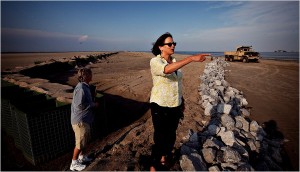
Chris Bickford for The New York Times

C. Cathy Norman, who manages the beach at Port Fourchon, La., for a local trust, and Don Norman, a wildlife toxicologist.

May 30, 2010

http://www.nytimes.com/2010/05/31/science/earth/31hurricane.html

Hurricane Season Raises New Fears    By KENNETH CHANG

As oil continues to gush from a broken well into the Gulf of Mexico, officials and scientists are worrying that the environmental disaster could be compounded later this year by a natural one.

The hurricane season starts Tuesday and runs through November, and forecasters expect one of the most turbulent seasons ever. If a hurricane rolled over the spill, the winds and storm surges could disperse the oil over a wider area and push it far inland, damaging the fragile marshlands.

“It would very definitely turn an environmental disaster into an unprecedented environmental catastrophe,” said Brian D. McNoldy, a tropical storms researcher at Colorado State University.  Specific predictions are impossible to make because the effects would depend on the path, strength and speed of a hurricane, as well as the size and location of the oil spill when the storm arrived. Because of the counterclockwise rotation of hurricane winds, a storm passing to the west of the slick would tend to push the oil to the coast, while a storm passing to the east would drive the oil away from land.

The winds churn water down only a few hundred feet, so a hurricane would probably not have a major effect on the large plumes of oil believed to be accumulating deep underwater.

The National Oceanic and Atmospheric Administration is predicting 14 to 23 named storms this season, of which 8 to 14 will turn into hurricanes and 3 to 7 of those will grow into major hurricanes with sustained winds of at least 111 miles per hour.

Last month, hurricane forecasters at Colorado State issued similar predictions: 15 named storms, 8 hurricanes and 4 major hurricanes.

The Colorado State team, Philip J. Klotzbach and William M. Gray, said there was a 43 percent chance that at least one hurricane would make landfall in Louisiana this year, based on the higher number of storms and the historical pattern of hurricane paths. (The atmospheric administration does not predict where the hurricanes will head.)

A hopeful speculation is that the oil might not be all bad news and that it might sap the storm’s energy. In 1966, a husband-and-wife team of federal hurricane researchers, Joanne and Robert H. Simpson, speculated that spraying an insoluble liquid like oil onto the ocean might even be a way to combat hurricanes by cutting off the evaporation that feeds energy into the storm.   But in a fact sheet issued last week, the atmospheric administration noted that hurricanes span 200 to 300 miles wide, much larger than the current size of the spill, and doubted that the oil could have much effect on the strength or path of a storm.

Hurricane winds would also minimize the evaporation effect.

A few years ago, when researchers at the Massachusetts Institute of Technology built a laboratory experiment to look at the flow of heat from water to air under different conditions, they, almost as a lark, followed up on the Simpsons’ suggestion. They applied fatty alcohols onto the water, and at very low wind speeds the alcohols did suppress evaporation.

“But when the winds get up to gale force or so, the surface gets torn apart,” said Kerry A. Emanuel, a professor of atmospheric science at M.I.T. “We just didn’t see any effect at high wind speeds.”   Conversely, other effects could intensify a storm, Dr. Emanuel said. By reducing evaporation, the oil could be heating the gulf waters, similar to a person wearing a rubber suit on a hot day.

Warmer water could then mean more energy to power a stronger hurricane, Dr. Emanuel said. But he said it was unclear what was actually happening, because the oil sheen fools satellite measurements of water temperature.
http://www.nytimes.com/2010/05/31/opinion/31mon1.html

May 30, 2010

Questions About the Gulf

BP’s latest failure to plug the leaking oil well in the Gulf of Mexico is one more crushing disappointment to Louisiana’s beleaguered people, one more strike against the company and one more signal to President Obama to redouble efforts to contain and clean the spill.

BP now pins its hopes — and those of the country — on yet another containment strategy, its fifth since the April 20 explosion. It does so amid mounting public anger and a report in The Times on Sunday that the company may have violated its own safety standards by ignoring warnings about design flaws in the well.   These disclosures add to the growing list of questions that must be addressed by the special commission President Obama has appointed to examine the root causes of the spill and recommend ways to prevent future catastrophes.

Here are others:

WHAT HAPPENED, AND WHY Five weeks after the blowout, there is no clear picture of the fatal sequence of events. Gas somehow escaped up the well, then exploded, collapsing the rig. The blowout preventer — a giant set of valves on the ocean floor — failed to work, and oil began spurting into the gulf at a rate recently estimated at 12,000 to 19,000 barrels a day. The total spill now exceeds the estimated 250,000 barrels that leaked from the stricken tanker Exxon Valdez in 1989. The public needs to get an honest accounting of the spill’s size, and BP’s word is not enough since it has to pay for the cleanup.

A joint Interior Department-Coast Guard investigative committee in Louisiana, and numerous Congressional panels, have been seeking clarity. Their search has not been helped by industry grandstanding and finger-pointing, with BP blaming the rig operator, Transocean, for the faulty blowout preventer.

It is also unclear which company was calling the shots on the rig, and there have been ominous suggestions that BP short-circuited standard drilling procedures to cut costs.

THE RESPONSE The questions about whether BP and the government responded quickly enough, and with the right weapons, could fill a book — and probably will. Both parties seem to have underestimated the size of the spill, and neither had a coherent underwater response plan in place. Though the oil industry had experienced blowouts at shallower depths, BP’s disjointed response suggested it had given little thought to the possibility of a blowout at 5,000 feet.

Partly as a result of laws passed after the Exxon Valdez, industry and the Coast Guard were better prepared to deal with the oil when it hit the surface. But the techniques — the controlled burns, the skimmers, the booms, the dispersants — were little more sophisticated than they were in 1989. Why no progress? And why was there only one dispersant available (and a toxic one at that) made by one company, Nalco?

REGULATORY FAILURE Much has been said — including by President Obama — about the incestuous relationship between the oil industry and its chief regulator, the Interior Department’s Minerals Management Service, which routinely ignored basic environmental laws and its own rules to fast track drilling permits.

But while these were terrible failures, and Interior Secretary Ken Salazar’s promise to reform the agency is overdue, it is hard to believe that other agencies in Washington, and even the Congressional oversight committees, were not also culpable.

NEW WEAPONS One outside-the-box question that looms large is whether the federal government should now develop its own capacity to deal with a huge blowout. As things stand now, industry has all the equipment and experience. In an interim report to the president on Thursday, Mr. Salazar suggested the creation of a kind of parallel technological universe in which government would have the robots, the coffer dams and the other tools necessary to help control a big blowout.

That could be expensive, but Mr. Obama indicated on Friday that he had been thinking along the same lines. As well he should be. The images from the last month — Washington essentially powerless, BP flailing away — has been deeply disheartening.


Special thanks to Richard Charter and Vivian Newman

Dept of Interior: Interior Issues Directive to Guide Safe, Six-month Moratorium on Deepwater Drilling

From: Rivera, Ray <Ray_Rivera@ios.doi.gov>
To: Rivera, Ray <Ray_Rivera@ios.doi.gov>
Sent: Mon May 31 11:43:46 2010

Subject: Interior Issues Directive to Guide Safe, Six-Month Moratorium on Deepwater Drilling

Interior Issues Directive to Guide Safe, Six-Month Moratorium on Deepwater Drilling

Washington, DC:  The U.S. Department of the Interior today issued a directive to oil and gas lessees and operators on the Outer Continental Shelf notifying them of requirements under the six month deepwater drilling moratorium that Secretary Salazar has ordered.

“The six month moratorium on deepwater drilling will provide time to implement new safety requirements and to allow the Presidential Commission to complete its work,” said Salazar.  “Deepwater production from the Gulf of Mexico will continue subject to close oversight and safety requirements, but deepwater drilling operations must safely come to a halt.  With the BP oil spill still growing in the Gulf, and investigations and reviews still underway, a six month pause in drilling is needed, appropriate, and prudent.”

The Moratorium Notice to Lessees and Operators (Moratorium NTL) issued today directs oil and gas lessees and operators to cease drilling new deepwater wells, including wellbore sidetrack and bypass activities; prohibits the spudding of any new deepwater wells; and puts oil and gas lessees and operators on notice that, with certain exceptions, MMS will not consider for six months drilling permits for deepwater wells and for related activities.  For the purposes of the Moratorium NTL, “deepwater”
means depths greater than 500 feet.

Operators that are currently drilling any well covered by the NTL must proceed at the next safe opportunity to secure the well and take all necessary steps to cease operations and temporarily abandon or close the well until they receive further guidance from the Regional Supervisor for Field Operations.

Activities necessary to support existing deepwater production may continue, but operators must obtain approval of those activities from the Department of the Interior.

The NTL issued today is based on a May 28, 2010 Memorandum from Secretary of the Interior Ken Salazar to the Director of the MMS finding that, under current conditions, deepwater drilling poses an unacceptable threat of serious and irreparable harm or damage to wildlife and the marine, coastal and human environment, as set forth in 30 C.F.R. 250.172(b).  The Secretary also determined that the installation of additional safety or environmental protection equipment is necessary to prevent injury or loss of life and damage to property and the environment, as set forth in 30 C.F.R. 250.172 (c).

Salazar’s determination that deepwater drilling activities on new wells must cease, and that MMS will not process APDs accordingly, is based on the recommendations in the May 27, 2010 report from Secretary Salazar to President Obama, Increased Safety Measures for Energy Development on the Outer Continental Shelf.

In addition to today’s NTL, Secretary Salazar again called on Congress to provide more time under the law for MMS to review exploration plans that oil and gas companies submit.  Under current law, MMS is currently required to review exploration plans within 30 days and determine whether the environmental analysis conducted at several previous stages in the leasing and planning process is sufficient.  In the oil spill response legislation submitted to Congress on May 12, the Obama Administration is proposing to change the 30-day congressionally-mandated deadline to a 90-day timeline that can be further extended to complete additional environmental and safety reviews, as needed.  (An exploration plan does not grant a company permission to drill a new well; companies must obtain additional and separate permits to gain permission to spud a well.)  The Department of the Interior, together with the Council on Environmental Quality, is also conducting a review of MMS’s use of categorical exclusions.

MEMORANDUM

To: Director, MMS

From: Secretary

Re: Suspension of Outer Continental Shelf (OCS) Drilling of New Deepwater Wells

Date: May 28, 2010

The recent blow-out and oil spill in the Gulf of Mexico is new evidence of the serious risks associated with deepwater drilling, and presents new challenges for the Department to assure the American public that OCS deepwater drilling can be accomplished in a safe and environmentally sound manner.

Yesterday, I presented recommendations to the President based on a 30-day review of the BP Explosion and Oil Spill that began on April 20, 2010. Based on that review, the recommendations contained in the report to the President, and further evaluation of the issue, I find at this time and under current conditions that offshore drilling of new deepwater wells poses an unacceptable threat of serious and irreparable harm to wildlife and the marine, coastal, and human environment as that is specified in 30 C.F.R. 250.172(b). I also have determined that the installation of additional safety or environmental protection equipment is necessary to prevent injury or loss of life and damage to property and the environment. 30 C.F.R. 250.172(c).

Therefore, I am directing a six month suspension of all pending, current, or approved offshore drilling operations of new deepwater wells in the Gulf of Mexico and the Pacific regions. This suspension does not apply to drilling operations that are necessary to conduct emergency activities, such as the drilling operations related to the ongoing BP oil spill. For those operators who are currently drilling new deepwater wells, they shall halt drilling activity at the first safe and controlled stopping point and take all necessary steps to close the well. In addition, MMS shall not process any new applications for permits to drill consistent with this directive. All applicable regulations shall apply to the implementation of this directive.

Please ensure that appropriate Letters of Suspension and any other appropriate documentation, including any additional instructions and details regarding this directive, are sent to all affected lessees, owners, and operators immediately.

Drilling Moratorium Guidance
Operations with Subsea BOP Stack –

Water Depth Greater Than 500 Feet

Activity type

6 Month No Drilling Moratorium Applies

Drilling of new well

Yes

Wellbore Sidetrack on current drilling operations

Yes

Wellbore Bypass on current drilling operations

Yes

Workover Operations

No

Completion Operations

No

Abandonment Operations

No

Intervention (Non emergency)

No

Intervention ( Emergency)

No

Waterflood, Gas Injection, Disposal Wells

No

Operations with Surface BOP Stack –

Water Depth Greater Than 500 Feet

Drilling of new well

Yes

Wellbore Sidetrack on current drilling operations

Yes

Wellbore Bypass on current drilling operations

Yes

Workover Operations with stack

No

Completion Operations with stack

No

Abandonment Operations

No

Intervention (Non emergency)

No

Intervention (Emergency)

No

Waterflood, Gas Injection, Disposal Wells

No


1

MINERALS MANAGEMENT SERVICE

UNITED STATES DEPARTMENT OF THE INTERIOR NTL No. 2010-N04 Effective Date: May 30, 2010

NOTICE TO LESSEES AND OPERATORS OF FEDERAL OIL AND GAS LEASES IN THE

OUTER CONTINENTAL SHELF REGIONS OF THE GULF OF MEXICO AND THE PACIFIC TO IMPLEMENT THE DIRECTIVE TO IMPOSE A MORATORIUM ON ALL DRILLING OF DEEPWATER WELLS

Background

The events resulting from the April 20, 2010, Deepwater Horizon included the deaths of 11 people, and an oil spill of national significance that continues to harm the marine ecosystem, wildlife, and property along the Gulf Coast. Although the causes are still under investigation, these events highlight the importance of ensuring safe operations on the Outer Continental Shelf (“OCS”).

Directives

The Six-Month Deepwater Moratorium as set forth in this Notice to Lessees and Operators (“Moratorium NTL”) directs you to cease drilling all new deepwater wells, including any wellbore sidetracks and bypasses; prohibits you from spudding any new deepwater wells; and puts you on notice that, except as provided herein, MMS will not consider for six months from the date of this Moratorium NTL drilling permits for deepwater wells and for related activities as set forth herein. For the purposes of this Moratorium NTL, “deepwater” means depths greater than 500 feet.

If you are currently drilling any well covered by this Moratorium NTL, you must proceed at the next safe opportunity to secure the well and take all necessary steps to cease operations and temporarily abandon or close the well until you receive further guidance from the Regional Supervisor for Field Operations. You must submit to the appropriate District Manager your plans to stop operations and secure the well before 5:00pm EDT, June 1, 2010.

If you have an approved Application for a Permit to Drill (“APD”) or other required permit for wells covered by this Moratorium NTL, but have not spud the well, you may not start drilling for the duration of this Moratorium NTL.

Under 30 C.F.R. 250.172, the Regional Supervisor for Production and Development will issue Suspensions of Operations (“SOO”) to all OCS Lessees and Operators currently drilling or proposing to drill new deepwater wells consistent with this Moratorium NTL. 2

Findings

This Moratorium NTL is based on a May 28, 2010, Memorandum from the Secretary of the Interior to the Director of the MMS finding that, under current conditions, deepwater drilling poses an unacceptable threat of serious and irreparable harm or damage to wildlife and the marine, coastal and human environment , as set forth in 30 C.F.R. 250.172(b). The Secretary also determined that the installation of additional safety or environmental protection equipment is necessary to prevent injury or loss of life and damage to property and the environment, as set forth in 30 C.F.R. 250.172(c).

The Secretary’s determination that deepwater drilling activities on new wells must cease for six months, and that MMS will not process permits for such activities accordingly, is based on the recommendations in the May 27, 2010, Report from the Secretary of the Interior to the President,

Based on the Secretary’s May 28, 2010, Memorandum, the recommendations in the Report, and the authority of 30 C.F.R. 250.172, the Director of MMS has determined that this Moratorium NTL is warranted because of the significant risks of OCS drilling in deepwater without implementation of the safety equipment, practices and procedures recommended in the Report.

Therefore, under 30 C.F.R. 250.172, the Regional Supervisor for Production and Development will issue SOOs to all OCS Lessees and Operators currently drilling or proposing to drill new deepwater wells covered by this Moratorium NTL.

Increased Safety Measures for Energy Development on the Outer Continental Shelf (“Report”). Activities Not Affected by This Moratorium NTL

This Moratorium NTL does not apply to intervention or relief wells for emergency purposes, including the 2 relief wells related to the ongoing BP spill.

This Moratorium NTL does not apply to operations that are necessary to sustain reservoir pressure from production wells.

This Moratorium NTL does not apply to workover operations.

This Moratorium NTL does not apply to waterflood, gas injections, or disposal wells.

This Moratorium NTL does not apply to drilling operations or other activities that are necessary to safely close or abandon a well, or to accomplish well completion operations under 30 C.F.R 250.500.

All activities not affected by this Moratorium NTL must be performed in compliance with all applicable regulations. For the duration of this Moratorium NTL, MMS will process only those APDs and other permits that are necessary to perform the activities not affected by this Moratorium NTL, as set forth above. 3

Requirements for Existing Deepwater Production

To obtain approval to conduct an activity in support of existing deepwater production, you must submit your request to the Regional Supervisor for Field Operations. Your request must include the following:

A new APD or Application for Permit to Modify, as appropriate;

Purpose of the well (disposal, injection, water flood);

Type of rig/BOP;

Water depth;

Safety systems in place; and

Location/placement of safety system devices (hydraulic accumulators located in a protected area).

In addition, you must submit a structured risk analysis that identifies and discusses the risks of the requested drilling or activity. The discussion must address risks of losing well control, risks of not conducting the requested activity, and your planned use of best practices. This analysis must be specific for each situation and include a detailed description of the activity.

Guidance Document Statement

The MMS issues NTLs as guidance documents in accordance with 30 C.F.R. 250.103 to clarify, supplement, or provide more detail about certain MMS requirements. NTLs may also outline what must be provided as required information in submissions to the MMS.

The MMS will provide additional guidance on this Moratorium NTL and the recommendations contained in the Report through the issuance of additional NTLs, rulemaking, or by other appropriate means.

Authority

This Moratorium NTL provides guidance and requirements pursuant to 30 C.F.R. 250.106, which requires safe lease operations, and pursuant to 30 C.F.R. § 250.172(b), which states that the Regional Supervisor may grant or direct a suspension when activities pose a threat of serious, irreparable, immediate harm or damage, this would include a threat to life, property, mineral deposit, or marine coastal or human environment and 30 C.F.R. § 172(c), which states that the Regional Supervisor may grant or direct a suspension when necessary for the installation of safety or environmental protection equipment.

Paperwork Reduction Act of 1995 Statement

This Moratorium NTL does not impose additional information collection requirements subject to the Paperwork Reduction Act of 1995. 4

Contact

If you have any questions regarding this Moratorium NTL, please contact Mike Saucier by e-mail at michael.saucier@mms.gov or by telephone at (504) 736-2503 in the Gulf of Mexico Region, or Rishi Tyagi by e-mail at rishi.tyagi@mms.gov or by telephone at (805) 389-7775 in the Pacific Region.

_______ __________________________

Dated Deputy Director

Minerals Management Service