Category Archives: Uncategorized

Wall Street Journal: Spill May Be Still Bigger

 http://online.wsj.com/article/SB10001424052748703957604575272880066140578.html?mod=WSJ_hpp_MIDDLETopStories

May 29, 2010

By CARL BIALIK

The Gulf oil spill may be a good deal bigger even than the numbers issued Thursday suggest, some of the scientists who worked on the estimate said.

BP PLC’s oil well is leaking between 12,000 and 19,000 barrels of oil a day, according to initial estimates announced by the U.S. Geological Survey on Thursday. Even using the more conservative figure, of 12,000 barrels a day, the spill already has become the largest in U.S. history, surpassing that of the Exxon Valdez accident in Alaska in 1989. The USGS statement Thursday called the numbers “the overall best initial estimate for the lower and upper boundaries.”

But some of the researchers who came up with the range of 12,000 to 19,000 say that is merely the minimum amount gushing out, not the lower and upper limits.

“It would be irresponsible and unscientific to claim an upper bound,” Ira Leifer, a researcher at the Marine Science Institute at the University of California, Santa Barbara, said in an interview. Dr. Leifer is a part of the National Incident Command’s Flow Rate Technical Group, which produced the estimate.

UC-Santa Barbara issued a statement Thursday in which Dr. Leifer said that “it’s safe to say that the total amount is significantly larger” than 12,000 to 19,000 barrels a day. He urged that the statement be issued because “I wanted to stand up for academic integrity,” he said in the interview.

The university is providing, upon request, a document that explains how scientists who reported to the USGS arrived at their estimate by observing the plume of oil from the leak site on videos provided by BP. In the document, the research team, led by William J. Lehr, senior scientist with the National Oceanic and Atmospheric Administration’s Office of Response and Restoration, states that it is providing “a range of values that represent an estimated minimum.”

“There are and will continue to be differing estimates and conclusions within the group,” USGS spokeswoman Julie Rodriguez said in a written statement. These disagreements “represent a healthy and important part of the process that will continue to help us get closer to more and more accurate estimates,” Ms. Rodriguez said.

Dr. Leifer, in an interview, and the report also said BP provided low-quality video of the leak site that hindered efforts to make an estimate. The footage had a resolution of 720 x 480 pixels, not much higher than that of a YouTube clip, and “appeared to be video of videos, rather than original high definition images,” the scientists wrote. BP later provided more videos, but too late for this round of estimates.

“After some initial hiccups around video resolution and file sizes, we have been supplying [researchers] with large quantities of data,” BP spokesman John Curry said.

The confusion over the initial estimate of flow rate highlights for Dr. Leifer the need, in the aftermath of such incidents, “for some kind of scientific SWAT team to go and collect data, independent of the cause of an incident,” he said. “That would be in everyone’s interest, because that would give everyone confidence in the numbers.”

Write to Carl Bialik at numbersguy@wsj.com

Society of Wetland Scientists: Statement on BP Gulf Blowout Disaster

 http://www.sws.org/ 

 Society of Wetland Scientists Mission 

The mission of the Society of Wetland Scientists is to promote understanding, scientifically based management, and sustainable use of wetlands. The current oil spill in the Gulf of Mexico has the potential to impact coastal wetlands and cause enormous short- and long-term damage to ecosystem services they provide. The potential short- and long-term economic costs are therefore massive and unprecedented.

Statement from the Environmental Concerns Committee

Society of Wetland Scientists

Dennis F. Whigham, Chair

Stephen W. Broome

Curtis J. Richardson

Robert L. Simpson

Loren M. Smith

May 18, 2010

Coastal wetlands are essential components of healthy and productive coastal fisheries, and nowhere within the lower 48 states has the critical linkage between wetlands and fisheries resources been more clearly demonstrated than in the Gulf Mexico (e.g., Chesney et al. 2000, Crain et al. 1979). Louisiana alone, for example, generates 30% of the nation’s seafood production (Day et. al., 2005) and accounts for 40% of the total wetlands in the conterminous United States (Richardson and Pahl 2006). The ongoing loss of wetland resources in the Gulf of Mexico and the potential economic and environmental costs, especially in Louisiana and Florida, is an issue of international concern. The impacts of the current oil spill are unknown but the potential for direct and indirect environmental damage to coastal ecosystem services are extraordinary. Both the oil and the activities used in the cleanup have the potential to adversely affect wetland flora and fauna.

Thus far, most of the oil has remained offshore but reports of oil reaching the coast have been geographically extensive ranging from Florida to Louisiana. The potential geographic extent of the spill could result in the exposure of many types of coastal wetlands to oil, ranging from mangroves in Florida, Texas, Mexico and islands in the Caribbean basin to tidal freshwater wetlands along the Gulf Coast. Most wetlands that will potentially be exposed to oil are saline and brackish tidal wetlands, which are nursery grounds for economically important coastal fish and shellfish. Seagrass beds are also at risk.

Experimental and monitoring studies around the world have found that oil commonly has a negative impact on emergent wetlands and the biota that reside in them (e.g., Lin et al. 2002). However, the degrees of impacts are variable and complex (Pezeshki et al. 2000), depending on the species composition of the wetland vegetation (e.g., Lin and Mendelssohn 1996), the amount and characteristics of the oil, the extent of weathering, and the geographic location of the wetland. Tropical and subtropical mangroves seem especially vulnerable to oil spills (e.g., Garrity and Levings 1993, Proffittt et al. 1995), as was demonstrated along the Persian Gulf following the Gulf War and in Panama following a major spill in 1986. Coastal wetlands in the Gulf of Mexico are also sensitive to oil as are species-rich tidal freshwater wetlands, although long term impacts span the gamut from rapid recovery within a growing season to delayed recovery for several years (Hester and Mendelssohn 2000). In

addition to direct impacts on emergent plants, oil that reaches wetlands also impacts animals that utilize the wetlands, especially benthic organisms that reside in the substrate.

Studies of impacted wetlands have demonstrated that wetlands can recover from the impacts of oil spills but the recovery process varies from extremely slow in mangroves swamps (e.g., Burns et al. 1993, 1994) to relatively rapid in grass-dominated marshes (Pahl et al. 2003). The recovery of coastal wetlands from the current oil spill will be further complicated due to current stress on wetland plant productivity from the ongoing 1 cm yr

The current oil spill in the Gulf of Mexico has also focused discussion on where offshore drilling should be allowed. The disaster at the Deepwater Horizon platform demonstrates that the placement of oil wells in deep offshore waters has the potential to have far-reaching geographic impact. The disaster has also demonstrated that current technologies are not adequate to assure that an accident of this magnitude in deep ocean areas can be effectively managed without enormous economic and environmental costs. While the short- and long-term impacts of the current oil spill on ecosystem services unfold, the Society of Wetlands Scientists supports (1) the immediate inspection of all offshore oil facilities and remediation, if required, to ensure that an accident of this type does not happen again and (2) a moratorium on all new deep-water oil exploration and extraction until further technological advances are available and tested to assure that the impacts of accidents of this sort can be managed efficiently to assure minimal negative impacts to coastal resources.

References

Burns, K.A., S.D. Garrity, and S.C. Levings. 1993. How many years until mangrove ecosystems recover from catastrophic oil spills? Marine Pollution Bulletin 26: 239-248.

Burns, K.A., S.D. Garrity, D. Jorissen, J. MacPherson, M. Stoelting, J. Tierney, and L. Yelle-Simmons. 1994. The Galeta Oil Spill. II. Unexpected persistence of oil trapped in mangrove sediments. Estuarine, Coastal and Shelf Science 38: 349-364.

Chesney, E.J., D.M. Baltz, and R. G. Thomas. 2000. Louisiana estuarine and coastal fisheries and habitats: perspectives from a fishse eye view. Ecological Applications 10: 350-366.

Craig, N.J. R.E. Turner, and J.W. Day Jr. 1979. Land loss in coastal Louisiana (U.S.A.) Environmental Management 3: 133-144.

Day, J.W., Jr., J. Barras, E. Clairain, J. Johnston, D. Justic, G.P. Kemp, J. Ko, R. Lane, W.J. Mitsch, G. Steyer, P. Templet, and A. Yañez-Arancibia. 2005. Implications of global climatic change and energy cost and availability for the restoration of the Mississippi delta.

Garrity, S.D. and S.C. Levings. 1993. Effecs of an oil spill on some organisms living on mangrove (

Hester, M. W. and I. A. Mendelssohn. 2000. Long-term recovery of a Louisiana brackish marsh plant community from oil-spill impact: vegetation response and mitigating effects of marsh surface elevation. Marine Environmental Research 49:233-254.

Lin, Q. and I.A. Mendelssohn, 1996. A comparative investigation of the effects of South Louisiana crude oil on the vegetation of fresh, brackish, and salt marshes. Marine Pollution Bulletin 32: 202-209.

Lin, Q., I.A. Mendelssohn, M.T. Suidan, K. Lee, and A.D. Venosa. 2002. The dose-response relationship between No. 2 fuel oil and the growth of the salt marsh grass,

Pahl, J. W., I. A. Mendelssohn, C. B. Henry, and T. J. Hess. 2003. Recovery trajectories after in-situ burning of an oiled wetland in coastal Louisiana, USA. Environmental Management 31:236-251.

Pezeshki, S.R., M.W. Hester, Q. Lin, and J.A. Nyman. 2000. The effects of oil spill and clean-up on dominant US Gulf coast marsh macrophytes: a review. Environmental Pollution 108: 129-139.

Proffitt, C.E., D.J. Devlin, and M. Lindsey. 1995. Effects of oil on mangrove seedlings grown under different environmental conditions. Marine Pollution Bulletin 30: 788-793.

Richardson, C. J. and J. W. Pahl. 2006. Katrina consequences assessment and projection Report. Chapter 23, in FEMA Report on Impacts of Hurricane Katrina. February 2006. Washington, D. C.

Stumpf, R. P. and J. W. Haines. 1998. Variations in tidal level in the Gulf of Mexico and implications for tidal wetlands. Estuarine, Coastal, and Shelf Science 46:165–173.

The Deepwater Horizon disaster and wetlands -1 relative sea level rise (Stumpf and Haines 1998) and land subsidence due to natural and human-related factors within the Louisiana coastal zone (Richardson and Pahl 2006). Ecological Engineering 24: 253-265. Rhizophora mangle L.) roots in Caribbean Panama. Marine Environmental Research 35: 251-271. Spartina alterniflora. Marine Pollution Bulletin 44. 897-902.

Special thanks to Richard Charter

Truthout: Obama’s Missing Moral Narrative

http://www.truthout.org/obamas-missing-moral-narrative59968
SUNDAY 30 MAY 2010
Saturday 29 May 2010
by: George Lakoff, t r u t h o u t | Op-Ed
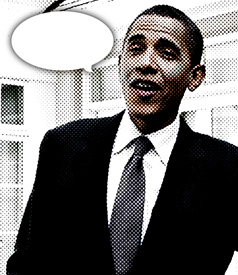
photo

(Photo: jurvetson; Edited: Jared Rodriguez / t r u t h o u t)

Barack Obama may be one of the best communicators of this generation, but he is not living up to his own talents. In a year of disasters, communication failure doubles the disasters.

If, as he says, the monster spill was his highest priority from Day 1, he needed to communicate that from Day 1 – or at least Day 3 or 4. It took five weeks for him to tell the nation what he and his administration were doing. The result was visible in the press conference yesterday. He was on the defensive. He needed to be on the offensive – from early on. The choice is not doing or communicating. It is doing **and** communicating.

His narrative: This is a tough, unprecedented situation, but I’m in charge, and I’ve been very busy, in the Situation Room where I belong, not on TV. I’m fully competent. I’m a good policy wonk – ask me any question about details. I’m honest. I admit my few policy mistakes. I think about the details day and night. Don’t think I’m oblivious.

It’s defensive, trying to overcome criticism that should never have been allowed to accumulate. But worse, it’s weak when it needs to be strong.

The president did do the required minimum. He placed a moratorium on offshore drilling and cancelled oil leases in the Gulf and off Virginia. He appointed a commission to make safety recommendations. And he is reorganizing the Mining Management Service. All to the good, but…

Crises are opportunities. He has consistently missed them. Today was a grand opportunity to pull together the threads – BP and the spill, Massey and the mine disaster, Wall Street and the economic disaster, Anthem BlueCross and health care, the Arizona Immigration Law, Don’t Ask, Don’t Tell, even Afghanistan. The press threw him fastballs straight down the middle, and he hit dribblers every time.

It’s not that he said nothing to tie them together.  But there was no home run, no unifying narrative, no patriotic call to the nation on the full gamut of issues. Instead, there were only hints, suggestions, possible implications, notes of concern – as if he had been intimidated by the right-wing message machine.

And yet Obama, of all political leaders, could have done it, because he did before in his campaign.

The central idea is Empathy. Democracy is based on empathy, on people caring about one another and acting to the very best of their ability on that care, for their families, their communities, their nation, and the world. Government must also care and act on that care. Government’s job is to protect and empower its citizens.

That idea is what draws together all the threads. The bottom line for corporations (whether BP, Massey, Anthem or Goldman Sachs) is money, not empathy. The bottom line for those who hate (whether homophobes, the Arizona Legislature, or al Qaeda) is domination and oppression, not empathy.

Empathy, and acting on it effectively, is the main business of government. And Obama knows it in his heart.

Yet the right wing has intimidated Obama into dropping not just the word “empathy,” but the idea. Empathy is a positive deep connection with other people in general and with all living things, the ability to see and feel as they do.  The right wing, which shows little empathy, has confused empathy with a bleeding-heart sympathy for individuals, which they see as a weakness. And though Obama has repeatedly made the distinction clear, he has allowed the right wing to intimidate him into abandoning “the most important thing my mother taught me.”

At the very end of the press’ questions, there was a hint of the campaign Obama.
 
…I think everybody understands that when we are fouling the Earth like this, it has concrete implications not just for this generation, but for future generations.
I grew up in Hawaii where the ocean is sacred. And when you see birds flying around with oil all over their feathers and turtles dying, that doesn’t just speak to the immediate economic consequences of this; this speaks to how are we caring for this incredible bounty that we have.

And so sometimes when I hear folks down in Louisiana expressing frustrations, I may not always think that they’re comments are fair; on the other hand, I probably think to myself, these are folks who grew up fishing in these wetlands and seeing this as an integral part of who they are – and to see that messed up in this fashion would be infuriating.

So the thing that the American people need to understand is that not a day goes by where the federal government is not constantly thinking about how do we make sure that we minimize the damage on this, we close this thing down, we review what happened to make sure that it does not happen again. And in that sense, there are analogies to what’s been happening in terms of in the financial markets and some of these other areas where big crises happen – it forces us to do some soul searching. And I think that’s important for all of us to do.
 
Here, at the very end, he allows the empathy and the moral vision to come out. Future generations, the sacredness of nature over the immediate economic consequences, caring for this incredible bounty that we have, identifying with folks who see fishing as part of who they are, analogies to what’s been happening in the financial markets, soul searching.

That should have – and could have – been the central narrative drawing all the threads together. The narrative about the daily competence and effort should have been in service of the central narrative of his administration. It should be, and can be, the central narrative of American democracy.

But to make it central and powerful would be confrontational. It would bring him head-to-head with right-wing ideology – empathy-free, self-interest maximizing, with disdain or even hatred for those seen as lesser beings. It is self-reinforcing:  a value-system that above all promotes that value-system itself. That is why right-wing Republicans always vote no to his proposals. Because to vote yes would strengthen an empathy-based moral system and weaken their own.

Because right-wing ideology takes precedence over empathy, there will be little or any real bipartisanship with those on the hard-core right.  The right is provoking confrontation. It cannot be avoided. The president should be confronting the right wing on all issues – not issue-by-issue as a policy wonk, but with the master moral narrative that makes sense of our country’s values.

Here’s what that would mean. The following “shoulds” are not mine. They follow naturally from President Obama’s own values as he articulated them is his 2008 campaign, and as they leaked out, largely unnoticed, during his press conference.

The president recognizes that financial reform requires dealing with systemic risk, which means not mere regulation, but restructuring the financial system to minimize, and if possible eliminate, systemic risk. Applying the analogy to oil spills, it would mean no more deep-water drilling because major systemic risks (“worst case scenarios”) cannot be eliminated when you drill starting a mile down where no human being can go and drill three miles deeper.

Like other large corporations, BP uses cost-benefit analysis to maximize profits. It is no surprise that, to save money, BP chose inferior materials in Deepwater Horizon, materials whose defects may well have caused the explosion. The use of cost-benefit analysis for a corporation’s benefit (and not the public’s) is a dangerous practice in many industries.  Cost-benefit analysis itself, used this way, should be considered as an important component of systemic risk by the President’s commission on safety.

The president should support the Cantwell-Collins CLEAR ACT, which will actually cut gasoline consumption radically by 2050 and carbon emissions by 80% by 2050, while stimulating the economy by providing significant financial dividends to all adult citizens, eliminating government imposition on business, and making those who profit from selling polluting fuel pay to clean it up and develop alternative energy. CLEAR is far superior to cap-and-trade alternatives.

The president should generalize from oil spills to coal mining, banning the blowing up of mountaintops and the fouling of streams, and imposing serious safety restrictions on all mining.
The president should review the covert operations imposed by the military and cancel those that are inconsistent with American values.

The president should order military leaders under his command to support the elimination of Don’t Ask, Don’t Tell.

The president should ask the First Lady to sponsor a major government program to do research on and support empathetic parenting, along the lines of his 2008 Father’s Day speech.
And much more.  A great deal follows from a unified moral stance.

Empathy and the discipline to act effectively on it, when seen as the basis of democracy and American values, can be powerful. It can unify the major policies of the administration, and unify people of good will – and that is a majority of our citizens.  But only if the president communicates empathy effectively, and acts on it consistently.

Empathy Now!

Special thanks to Richard Charter

AP: Highlights of Obama’s orders on offshore drilling

http://www.google.com/hostednews/ap/article/ALeqM5h-3O699qQ-Lz_D4XuXiI_JWy3VZQD9FVGSK80

 1 hour ago May 28, 2010

 Highlights of President Barack Obama’s new orders on offshore oil drilling safety. Obama and Interior Secretary Ken Salazar discussed the measures Thursday and Salazar’s office released a 44-page report that night.
___
SAFER DRILLING?

Obama ordered a number of changes designed to ensure offshore drilling is safer going forward, based on a 30-day review by Salazar, including:

_Extending a moratorium on new deep water drilling leases for six months, until the presidential commission on the spill completes its work.

_Suspending Shell Oil’s plans to begin exploratory drilling this summer on Arctic leases as far as 140 miles off the Alaska coast. Now those wells will not be considered until 2011.

_Canceling pending lease sales off the coast of Virginia and in the western Gulf of Mexico.

_Suspending action on 33 deep water exploratory wells currently being drilled in the Gulf.

_Salazar announced additional safety measures, including requiring more thorough inspections of the “blowout preventers” designed to prevent oil spills. The blowout preventer on BP’s Deepwater Horizon rig failed.
___
Online:
Interior Department report:
http://www.doi.gov/deepwaterhorizon/loader.cfm?csModulesecurity/getfile&PageID33598

special thanks to Richard Charter

The Hill.com: BP Oil leak spills into Florida Senate Race

http://thehill.com/blogs/ballot-box/senate-races/100361-bp-oil-leak-spills-into-florida-senate-race

By Sean J. Miller – 05/27/10 06:55 PM ET

The deep-water oil leak in the Gulf of Mexico may emerge as a controversial pocketbook issue in the Florida Senate race.
Floridians are watching nervously as the oil slick in the Gulf drifts toward the state’s pristine beaches and rich fishing waters. The spill has made “Floridians more aware than ever how dependent we are on coastal industries,” said Susan MacManus, a professor at the University of South Florida.

Florida Gov. Charlie Crist wants to call state lawmakers into a special session in order to pass a constitutional amendment permanently banning drilling off Florida’s coast – a position supported by two of his Senate rivals but not Republican candidate Marco Rubio.

“He’s holding discussions with our legislative leadership to propose a constitutional ban on offshore drilling,” said Sterling Ivey, a spokesman for the governor’s office. “He would like to have the voters of Florida decide whether they want drilling off the coasts of Florida.”

Rubio said government’s focus should be on stopping the leak in the Gulf, not on passing a ban.

“Calling for an emergency special session to constitutionally ban something that is already prohibited by state law is nothing more than an election-year stunt,” he said in a statement.

Meanwhile, Rep. Kendrick Meek (D-Fla.) signed on to a letter from Florida’s congressional Democrats pushing Crist to call a special session.

“For Florida, it may yet mean full or partial destruction of the world’s third largest coral reef in the Florida Keys and a devastating hit to Florida’s beaches and tourism-driven economy,” the lawmakers wrote. “Governor, you have the authority to call the Legislature back to Tallahassee. We urge you to do so.”

A spokesman for real estate mogul Jeff Greene, who’s challenging Meek for the Democratic Senate nod, said he “100 percent supports calling a special session to ban” offshore drilling.

Florida already has a ban on offshore drilling in place, but observers say anything less than a state constitutional amendment could one day be overturned by state lawmakers.
The proposed amendment can move through the Legislature with a majority. It would then be placed on the state’s November ballot, where it would require a 60 percent vote to pass.

Ivey said the Republican leadership in the state Senate has expressed willingness to return to Tallahassee for a special session but those on the House side are reluctant. The GOP controls both chambers.

Ivey said Crist is working to convince the state House leadership to support the constitutional ban and return for a special session to pass it.

“The leadership in the Florida House is not interested in coming back to Tallahassee to support the issue,” Ivey said. The governor could summon them back, but Ivey said he’s reluctant to do that without the guarantee they’d work to pass the ban. “If they’re not going to pass the amendment, it may not be best to bring them back not to do any work,” Ivey said.

It could also be a political liability for Crist, who already has alienated Republicans by dropping out of the GOP Senate primary and launching an Independent bid.

Sources told The Hill that state House lawmakers’ patience with Crist is running short. They were already frustrated by Crist’s veto of an education bill last month and would be enraged by a summons to the capitol. Part of their frustration is that under Florida statute, lawmakers seeking state-level office can’t raise campaign money while the Legislature is in session. But that provision doesn’t apply to candidates for federal office, so Crist could still raise money while the lawmakers worked through what’s expected to be a special session that could last between four days and two weeks.

If the ban amendment does end up on the ballot, it could become a central issue of the campaign, forcing the candidates to stake out firm positions on the question. Moreover, if the oil reaches Florida’s beaches, “it would be one more huge pocketbook issue,” said MacManus.

Already, she added, “people are canceling hotel reservations, fishermen are freaking out.”
State tourism officials told The Associated Press that Panhandle-area businesses – those closest to the spill – have suffered a roughly 30 percent drop and that hotels in the Florida Keys have started to see a decrease in new bookings.

But there are also some risks with pushing for a permanent ban – the public’s mood could be different by November.
“Suppose gas prices by then are really, really high,” MacManus said. That would make a drilling ban unpopular. “There’s that uncertainty,” she noted.

Special thanks to Richard Charter