Category Archives: Uncategorized

Washington Post editorial: In the wake of Deepwater, let’s put the environment first

http://www.washingtonpost.com/wp-dyn/content/article/2010/05/27/AR2010052704153.html?nav=hcmoduletmv
By Eugene Robinson
Friday, May 28, 2010

In June 1969, the stretch of the Cuyahoga River that runs through Cleveland was so polluted that it caught fire. Time magazine described the Cuyahoga this way: “Chocolate-brown, oily, bubbling with subsurface gases, it oozes rather than flows.”
The spectacle of a river in flames helped galvanize the environmental movement, and the following year, with Richard Nixon as president, the Environmental Protection Agency was established. In 1972, Congress passed the landmark Clean Water Act. Today, the Cuyahoga is clean enough to support more than 40 species of fish.

We still don’t know the full extent of the environmental disaster unfolding in the Gulf of Mexico — the impact on avian and aquatic life, on fisheries, on tourism, on the delicate ecology of coastal marshes and barrier islands. We do know, though, that it is the worst oil spill in our nation’s history, far surpassing the Exxon Valdez incident. And maybe the shocking images from the gulf of dead fish, oiled pelicans and shores lapped by viscous “brown mousse” will refocus attention on the need to preserve the environment, not just exploit it.
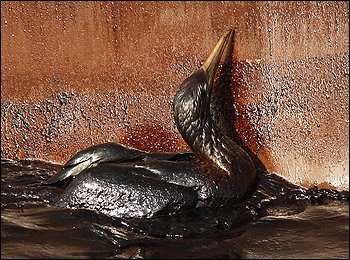
An oil-soaked bird struggles against the side of a ship near the oil-spill site. (Gerald Herbert/associated Press)

“Drill, baby, drill” isn’t just the bizarrely inappropriate chant that we remember from the Republican National Convention two years ago. It’s a pretty good indication of where the national ethos has drifted. Environmental regulation is seen as a bureaucratic imposition — not as an insurance policy against potential catastrophe, and certainly not as a moral imperative.
Yes, many Americans feel good about going through the motions of environmentalism. We’ve made a religion of recycling, which is an important change. We turn off the lights when we leave the room — and we’re even beginning to use fluorescent bulbs. Some of us, though not enough, understand the long-term threat posed by climate change; a subset of those who see the danger are even willing to make lifestyle changes to try to avert a worst-case outcome.

But where the rubber hits the road — in public policy — we’ve reverted to our pre-enlightenment ways. When there’s a perceived conflict between environmental stewardship and economic growth, the bottom line wins.

Barack Obama is, in many admirable ways, our most progressive president in decades. But as an environmentalist, let’s face it, he’s no Richard Nixon. Before the Deepwater Horizon rig exploded — allowing, by some estimates, as many as a million gallons of crude oil to gush into the Gulf of Mexico each day for more than a month — Obama had announced plans to permit new offshore drilling. “I don’t agree with the notion that we shouldn’t do anything,” Obama said at the time. “It turns out, by the way, that oil rigs today generally don’t cause spills. They are technologically very advanced.”

Obama has wisely backed away from that decision. The technology involved in deep-sea oil drilling turned out to be far more advanced than the technology needed to halt a spill if something goes wrong — essentially, like engineering a car to double its top speed without thinking to upgrade the brakes. This oversight apparently wasn’t noticed by anyone who had the power to correct it.
Calls for Obama to somehow “take over” the emergency response ring hollow.
Take it over with what? Hands-on intervention has never been government’s role in this kind of situation. BP and the other oil companies had the undersea robots and the deep-water experience. Other private companies owned and operated the skimmers that remove the oil from the surface. There is no huge government reserve of the booms that are needed to protect Louisiana’s beaches and marshlands; those are made by private firms and are being deployed by unemployed fishermen.
Obama has rethought his enthusiasm for offshore drilling. Now he, and the rest of us, should rethink the larger issue — the trade-off between economic development and environmental protection. In the long run, our natural resources are all we’ve got. Defending them must be a higher priority than our recent presidents, including Obama, have made it.

Energy policy is one of Obama’s priorities. He talks about “clean coal,” which I believe to be an oxymoron, and favors technologies — such as carbon capture and sequestration — that are new and untested. The environmental risks must be a central and paramount concern, not a mere afterthought. Let’s preclude the next Deepwater Horizon right now.

 eugenerobinson@washpost.com

special thanks to Richard Charter

Huffington Post: Gulf Oil Spill Scientists Discover Massive New Sea Oil Plume

<http://www.huffingtonpost.com/2010/05/27/gulf-oil-spill-new-plumes_n_591994.html>
MATTHEW BROWN AND JASON DEAREN 05/27/10 04:42 PM |

NEW ORLEANS – Marine scientists have discovered a massive new plume of what they believe to be oil deep beneath the Gulf of Mexico, stretching 22 miles (35 kilometers) from the leaking wellhead northeast toward Mobile Bay, Alabama.

The discovery by researchers on the University of South Florida College of Marine Science’s Weatherbird II vessel is the second significant undersea plume recorded since the Deepwater Horizon exploded on April 20.

The thick plume was detected just beneath the surface down to about 3,300 feet (1,000 meters), and is more than 6 miles (9.6 kilometers) wide, said David Hollander, associate professor of chemical oceanography at the school.

Hollander said the team detected the thickest amount of hydrocarbons, likely from the oil spewing from the blown out well, at about 1,300 feet (nearly 400 meters) in the same spot on two separate days this week.

The discovery was important, he said, because it confirmed that the substance found in the water was not naturally occurring and that the plume was at its highest concentration in deeper waters. The researchers will use further testing to determine whether the hydrocarbons they found are the result of dispersants or the emulsification of oil as it traveled away from the well.

The first such plume detected by scientists stretched from the well southwest toward the open sea, but this new undersea oil cloud is headed miles inland into shallower waters where many fish and other species reproduce.

The researchers say they are worried these undersea plumes may be the result of the unprecedented use of chemical dispersants to break up the oil a mile undersea at the site of the leak.

Hollander said the oil they detected has dissolved into the water, and is no longer visible, leading to fears from researchers that the toxicity from the oil and dispersants could pose a big danger to fish larvae and creatures that filter the waters for food.

“There are two elements to it,” Hollander said. “The plume reaching waters on the continental shelf could have a toxic effect on fish larvae, and we also may see a long term response as it cascades up the food web.”

Dispersants contain surfactants, which are similar to dishwashing soap.

A Louisiana State University researcher who has studied their effects on marine life said that by breaking oil into small particles, surfactants make it easier for fish and other animals to soak up the oil’s toxic chemicals. That can impair the animals’ immune systems and cause reproductive problems.

“The oil’s not at the surface, so it doesn’t look so bad, but you have a situation where it’s more available to fish,” said Kevin Kleinow, a professor in LSU’s school of veterinary medicine.

Special thanks to Richard Charter

St Pete Times: Biologists worry about oil spill’s effects on nesting sea turtles

http://www.tampabay.com/news/environment/wildlife/biologists-worry-about-oil-spills-effects-on-nesting-sea-turtles/1097536

May 25, 2010
By Sara Gregory, Times Staff Writer
With the oil spill casting a shadow of danger, turtles begin making nests.
Wildlife officials are cautiously waiting to see what impact the Deepwater Horizon oil spill will have on sea turtles as their nesting season gets under way.
Biologists worry about oil spill’s effects on nesting sea turtles
By Sara Gregory, Times Staff Writer
In Print: Wednesday, May 26, 2010

Mike Anderson of the Clearwater Marine Aquarium measures the first loggerhead turtle nest of the year, at Sunset Beach in Treasure Island, on Sunday. A beachgoer saw a turtle digging and alerted authorities. The nest will be monitored until the hatchlings emerge.
 
[JIM DAMASKE | Times]

The number of loggerhead turtle nests along Pinellas beaches has grown moderately the past two years, recovering from an all-time low in 2007. Officials were hoping the growth would have continued or stayed the same, though what will happen now is anyone’s guess.
“Probably strange things,” said David Godfrey, executive director of the Caribbean Conservation Corporation, an organization dedicated to advocating on behalf of sea turtles. “It’s really impossible to guess what this spill may do to the nesting season.”
The oil spill could affect turtles in a number of ways.
Oil in the gulf could leave adult turtles too ill to mate or make it to the beach to lay their eggs. If the oil reaches the shore, it could contaminate nests, cutting off oxygen to the eggs buried in the sand.
Hatchlings that make it back to the water could face even more challenges. They spend the first years of their life swimming in the loop current, which could become contaminated with oil. If that happens, oil could burn their skin and they could mistake tar balls for food.
“You can imagine this little mouth with this marble-sized tar ball in its mouth,” Godfrey said. “It’s not coming out.”
Pinellas County’s first loggerhead turtle nest of the season was discovered Sunday morning on Sunset Beach Treasure Island. That’s on track with when the first nests are usually found, said Mike Anderson, Clearwater Marine Aquarium’s supervisor of sea turtle nesting.
Nesting season began May 1 and continues until Oct. 31, though most of the golf ball-sized eggs will have been laid by the end of September, Anderson said.
Throughout that time, Anderson and his staff will patrol the beaches, looking for the telltale signs of turtle nesting: drag marks in the sand from flippers, a mound of sand near where the eggs are buried and more drag marks as the female turtles make their way back to the water.
Both Godfrey and Anderson stress that the spill’s full effects might not be known for decades, when the hatchlings born this season reach maturity.
“This spill keeps me up at night,” Godfrey said.
There were signs before the spill that the loggerhead population was struggling.
“We’ve really had an unusual last 10 years,” said Anne Meylan, a research administrator with the Fish and Wildlife Research Institute. About 55,000 nests were laid statewide each year in the late 1990s, a number that dropped about 43 percent by 2006.
Unprecedented cold weather in January left thousands of turtles in “cold stuns,” unable to move.
And in March, the U.S. Fish and Wildlife Service and the National Marine Fishery Service declared its intent to change the status of loggerhead turtles from “threatened” to “endangered.”
Florida’s other two turtle species, the leatherback and green turtles, already are listed as endangered. If the loggerhead turtle joins their ranks, it could mean extra efforts to identify and preserve crucial loggerhead turtle habitats.
For now, there’s only wait-and-see, Meylan said.
“Everybody’s just heartsick about it,” she said. “Turtles are dead center in this particular mess.”
Sara Gregory can be reached at (727) 893-8785 or sgregory@sptimes.com.
By the numbers
Loggerhead nests found in Pinellas by Clearwater Marine Aquarium
2005 105
2006 115
2007 38
2008 108
2009 138

National Journal: A Moratorium on new Drilling?

http://energy.nationaljournal.com/2010/05/a-moratorium-on-new-drilling.php
MONDAY, MAY 24, 2010

By Amy Harder
NationalJournal.com
Should the government clamp a moratorium on new offshore oil and natural gas drilling until more is known about how the Gulf of Mexico spill could have been prevented or minimized?
Key congressional Democrats are urging the Obama administration to halt current oil drilling in the gulf, postpone planned drilling off Alaska, and abandon plans to drill off the Virginia coast. Meanwhile, a group of Gulf Coast lawmakers from both chambers is asking the administration to lift the ban on shallow-water drilling. The month-long suspension imposed by the administration is set to expire May 28 when the Interior Department issues its safety report on offshore energy production. There are seven pending drilling permit applications, two in deep waters and five in shallow.
Should the administration extend the current suspension? Should it be broadened to current and/or future drilling operations in the Arctic Ocean, off the East Coast and other parts of the gulf? Can the U.S. afford to curb its offshore drilling, given its dependence on oil?
 

Leave a response
5 Responses
Expand all comments
MAY 24, 2010 7:37 AM
 
Do you agree?
Submit
Arctic Drilling Should Be Suspended
By Bill Eichbaum
Vice President of Marine and Arctic Policy, World Wildlife Fund

The Beaufort and Chukchi Seas off the coast of Alaska’s North Slope are two of nature’s most untamed places. Pristine, yet forbidding, the gale-force winds, dark skies and icy waves make these vast bodies of water appear desolate. Yet the region is teeming with wildlife, including polar bears, seals, walrus, birds, whales and more than 150 species of fish.

This remote corner of the Arctic feels a world away from the Gulf of Mexico, where more than 3,000 drilling rigs are in active service, and tens of thousands of gallons of oil continue to gush from the BP Deepwater Horizon blowout.

Yet if all goes as planned, in less than a week from now, a ship operated by the Shell Oil Co. will begin its journey to the Arctic, in preparation for drilling that is scheduled to start on July 1.

It may be months before we fully understand the underlying causes of the BP catastrophe. And as we’ve witnessed, oil spills are difficult to contain even under the best of circumstances. After more than a month, …
Read More
Link to this response:  http://energy.nationaljournal.com/2010/05/a-moratorium-on-new-drilling.php#1587325 Print | Share | E-mail

MAY 24, 2010 7:35 AM
 
Do you agree?
Submit
Suspend All New Drilling
By Frances Beinecke
President, Natural Resources Defense Council
Yes, the administration should impose a moratorium on all new offshore drilling activities. Existing plans to move ahead with projects were based on the assumption that the likelihood of a serious spill was virtually too remote to contemplate. The catastrophe in the Gulf of Mexico has shattered that assumption.
In light of the Gulf tragedy–now one-month old and counting–America should halt new offshore leasing, exploratory drilling, and seismic exploration.
The moratorium should remain in effect until the causes of the current spill and their ramifications are fully understood.
I am pleased that President Obama is establishing an independent commission to investigate the disaster and that two experienced and fair-minded figures, former Senator Bob Graham and Former EPA Administrator William Reilly, will lead it. The work of a fully independent commission is our best hope of finding out what caused this catastrophe and what we can do to make sure nothing like this ever happens again. No new offshore activities should be allowed until we receive the…
Read More
Link to this response:  http://energy.nationaljournal.com/2010/05/a-moratorium-on-new-drilling.php#1587323 Print | Share | E-mail

MAY 24, 2010 7:34 AM
 
Do you agree?
Submit
Room For Compromise?
By Mark Muro
Fellow and Director of Policy, Metropolitan Policy Program at Brookings

It goes without saying that the nation should legislate no new commitments to offshore oil drilling without first getting to the bottom of the colossal BP disaster in the Gulf of Mexico.
That means investigators, lawmakers, and the public at large need to really grapple with the Deepwater Horizon mess.
In this respect, lawmakers need to understand what technical things went wrong and get a grip on what regulatory failures played a role. But beyond that–and hardest–all of us need to take from this debacle a little more serious appreciation of the unavoidable costs of our oil addiction. Along these lines, it remains quite mystifying that President Obama only last weekend began to tie what Brad Plumer over at The Vine calls “the nasty side effects of our fossil fuel addiction”–from massive spills to the risks of catastrophic climate change–to a broader ca…
Read More
Link to this response:  http://energy.nationaljournal.com/2010/05/a-moratorium-on-new-drilling.php#1587322 Print | Share | E-mail

MAY 24, 2010 7:33 AM
 
Do you agree?
Submit
Oil Consumption Numbers
By Bill Snape
Senior Counsel, Center For Biological Diversity

In assessing whether to continue dangerous offshore oil drilling in the United States, let’s look at some numbers. First, Americans consume approximately 20 million barrels of oil daily, or 7.3 billion barrels annually. Second, the estimated amount of recoverable oil in the Gulf of Mexico is approximately 44 billion barrels, a number that is larger than the Pacific, Atlantic and Alaska waters put together. Further, the Gulf of Mexico now produces roughly 1.7 million barrels of oil daily, which is less than one-tenth of current American consumption (this does not count the 100,000 barrels daily that the BP blow out is currently spewing and wasting).
Put it all together and what does it mean? Even if we completely destroyed the Gulf of Mexico, it has only enough oil to satisfy our thirst for seven years. This, of course, ignores the billions, if not trillions, of dollars of damage we would do to fisheries, tourism, clean water, homes and wildlife were we to follow the Bush/Salazar logic of more drilling. Most of our oil does not come from oceans and outer …
Read More
Link to this response:  http://energy.nationaljournal.com/2010/05/a-moratorium-on-new-drilling.php#1587321 Print | Share | E-mail

MAY 24, 2010 7:32 AM
 
Do you agree?
Submit
Oil And Water Don’t Mix
By Carl Pope
Chairman, Sierra Club

If there is one lesson from the Deepwater Horizon it is that we should not be continuing to allow new oil drilling in the ocean. Such drilling will unavoidably continue to pollute the marine environment, poison fisheries, and devastate coastal economies dependent on recreation and tourism. The promise of “safe, clean” off-shore drilling is a chimaera, a myth — and a fraud.

This is not because off-shore drilling technology is ALWAYS inadequate. It is because oil companies are ALWAYS irresponsible.

It is because MOST OF THE TIME is not good enough.

It is because both the ocean and oil and gas strata geology are highly unpredictable, so technology which works most of the time won’t work all of the time. We don’t yet know what happened at Deepwater Horizon. But it’s clear that Blow Out Preventers, which are the final line of defense, don’t work all the time — and they didn’t work here. It’s clear that as the industry goes deeper and deeper the difficulties of testing the equipment…

Greenpeace: Felony charges for Gulf protest by Greenpeace

Any support from the community would be much appreciated! Here’s our release on this, with some news articles below that you could forward.

http://www.greenpeace.org/usa/press-center/releases2/charge-bp-not-greenpeace

Charge BP not Greenpeace

Today, seven Greenpeace activists were arrested for standing up to the oil industry, and sending a message to Secretary Salazar that we must stop offshore drilling. The activists were Lindsey Allen, Lauren Valle, Emma Cassidy, David Pomerantz, Georgia Hirsty, Scott Cardiff, and Paul Kelley. They have been charged with the felony charges of Unauthorized Entry of a Critical Infrastructure and Unauthorized Entry of an Inhabited Dwelling.

In response to the charges, Greenpeace Executive Director Phil Radford issued the following statement:

“Charging these activists with felonies is a disproportionate response to the peaceful protest that took place today at Port Fourchon. It is outrageous that prosecutors would confront peaceful protestors with such a heavy hand while not a single BP executive has been charged for the devastation they have wrought on the Gulf of Mexico and the people and animals that depend on it. Charge BP, not Greenpeace activists.

Greenpeace staff, scientists, and volunteers have been in Louisiana for weeks taking water samples, bearing witness, and documenting the devastation that has been unleashed on the Gulf of Mexico. We have seen firsthand the damage that this has done to the ecosystem, the community and the local economy, and have sympathized with the people who make Louisiana their home, or depend upon the Gulf for their livelihoods.

Today, activists used that same oil to ask Interior Secretary Ken Salazar to make sure this never happens again. We must not drill off the shores of Alaska when there is no way to prevent another blowout in the pristine Arctic waters.

I am proud of the action that these activists took today, and if we are to move past the mistakes of the past toward a clean energy future, we’ll have to heed today not only to the words they painted, but the urgency with which they painted them. We must act now to protect our oceans and the future of our planet.”