Category Archives: Uncategorized

Nola.com: Moving forward on repairs to spill’s damage: An editorial

http://www.nola.com/opinions/index.ssf/2011/12/moving_forward_on_repairs_to_s.html

Times-Picayune

Published: Saturday, December 17, 2011, 7:09 AM
By Editorial page staff, The Times-Picayune

The first projects covered by BP’s pledge to provide $1 billion for early restoration from the 2010 oil spill will include creating 104 acres of marsh, placing oyster cultch on six public seed beds and upgrading a Grand Isle oyster hatchery. That’s fitting, since wetlands and oyster beds are both important natural resources in Louisiana that took serious blows in the disaster.

It’s also encouraging that Louisiana is getting $28 million of the first $57 million in projects that was approved this week. A committee of trustees representing the five Gulf Coast states, the federal departments of Interior and Commerce and BP gave the OK for the projects, which represent only a fraction of what BP will pay. The oil giant may ultimately have to fork over as much as $20 billion to compensate for damage done to natural resources in the blowout of the Macondo oil well.

The Louisiana wetlands project will create 104 acres of unbroken marsh. The $13.2 million effort is an expansion of an existing project in Lake Hermitage in Plaquemines Parish and replaces plans to create 70 acres of marsh terraces.

The fact that $14.9 million in oyster projects for Louisiana are included is especially significant since BP had been opposed to paying for damage to beds. The company’s argument was that freshwater from Mississippi River diversions that the state opened up after the spill were responsible for wiping them out, not oil.

But some beds were damaged by oil, and Louisiana opened up freshwater diversions to prevent oil from moving into the wetlands and doing even more damage. Clearly, the freshwater impact on oyster beds was a direct consequence of the spill.

Louisiana officials and the oyster industry were pushing to include oyster bed projects, and rightly so. Louisiana oysters are a natural resource that suffered great harm. Production this year is down 65 percent, according to Mike Voisin, who is a member of the Louisiana Oyster Task Force.

The projects approved by the committee include placing oyster cultch on 850 acres of public seed beds at 3-Mile Bay and Drum Bay in St. Bernard Parish, Lake Fortuna and South Black Bay on the east bank of Plaquemines Parish, Hackberry Bay in Lafourche Parish and Sister or Caillou Lake in Terrebonne Parish. The work also includes an upgrade to the oyster hatchery.

“This is the trustees recognizing that damage to the oyster industry (from the spill) is an important issue, and BP also concurring that it’s an important issue,” Mr. Voisin said.

That’s progress, especially considering BP’s previous unwillingness to take responsibility for freshwater damage to oyster beds.

Special thanks to Richard Charter.

Bloomberg.net: Chevron’s Crude-Oil Spill in Brazil Prompts $10.6 Billion Lawsuit

http://www.bloomberg.com/news/2011-12-15/chevron-s-oil-spill-in-brazil-prompts-10-6-billion-lawsuit.html

By Peter Millard and Adriana Brasileiro – Dec 15, 2011 12:00 AM ET
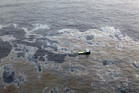
This photo taken Nov. 18, 2011 and released by Rio de Janeiro’s government, shows an aerial view of a boat crossing an area of the oil spill in an offshore field operated by Chevron at the Bacia de Campos, in Rio de Janeiro state, Brazil. Photographer: Rio de Janeiro’s government,Rogerio Santana/AP Photo

A Brazilian lawsuit that seeks to halt Transocean Ltd. (RIG) and Chevron Corp. (CVX) operations after an oil spill would reduce the country’s offshore drilling at a time when it wants to double output in ten years.

Federal prosecutors in Campos, in the oil region of Rio de Janeiro state, are suing both companies for 20 billion reais ($10.6 billion) in environmental and social damages and asked a court to suspend their operations, according to a statement yesterday. Chevron, based in San Ramon, California, and Transocean, based in Vernier, Switzerland, said they haven’t been notified and are cooperating with authorities.

The case imperils Brazil’s plan to boost crude output because Transocean operates 10 out of the 61 rigs working in the country and it would be hard to replace them in a tight market for oil equipment, said Judson Bailey, an analyst at Jefferies & Co Inc. Brazilian oil production growth has slowed after the country increased safety requirements following the spill at BP Plc’s Macondo well in the Gulf of Mexico last year.

“The rig market is pretty tight, so if Transocean were banned, the oil companies wouldn’t be happy at all,” Bailey said in a phone interview from Houston. “Chevron and Petrobras can’t get a rig elsewhere, so it messes with the state-owned oil company.”

Chevron, Brazil’s third-largest producer behind state- controlled Petroleo Brasileiro SA (PETR4) and Royal Dutch Shell Plc, will see production wane in Brazil until the government lets it drill again, said Cleveland Jones, an oil specialist and professor at Rio de Janeiro State University.
‘Opening Shot’

Chevron fell 3 percent to $100.53 at the close in New York yesterday. Transocean declined 3.9 percent to $40.19.

Chevron has come under increased scrutiny in Brazil after 3,000 barrels of oil leaked last month from an oil field in deep waters of the Campos Basin. The company underestimated the amount of pressure at an oil deposit it was exploring, and crude leaked from the reservoir for about eight days, George Buck, the head of Chevron for Brazil, said on Nov. 20.

BP has booked more than $40 billion in losses related to the April 2010 blowout of the Macondo well in the Gulf of Mexico. The accident killed 11 workers aboard Transocean’s Deepwater Horizon well and spilled 4.9 million barrels of crude. That’s about $8,163 per barrel spilled, compared to $3.57 million per barrel if the Brazilian fine were to hold.
Still Operating

“Ultimately this is an opening shot, Chevron’s attorneys are probably not at all fazed by this,” said Jones. “The prosecutor’s office will be a positive development for Chevron, because they will ensure that the letter of the law is followed and the letter of the law is reasonable.”

Chevron said in an e-mailed statement that it “responded responsibly to the incident at its Frade Field and has dealt transparently with all Brazilian authorities.” Guy Cantwell, a Transocean spokesman, said the company’s rigs are operating in Brazilian waters and the company continues to cooperate with the government.

Chevron holds a 51.74 percent stake in Frade. Petrobras holds a 30 percent stake, and Frade Japao Petroleo Ltda., a joint venture including Inpex Corp. and Sojitz Corp, holds 18.26 percent. Frade is about 230 miles (370 kilometers) northeast of Rio de Janeiro in the Campos Basin and produced 76,000 barrels a day of oil and natural gas in October.
Criminal Lawsuit

In the next few weeks, prosecutors will probably file a criminal lawsuit against Chevron for alleged environmental crime, said Romulo Sampaio, a law professor at Brazil’s Getulio Vargas Foundation.

“In this case, everything conspires against the company: it’s a foreign company, drilling for oil in Brazilian waters. That may bring about emotional responses,” Sampaio, who coordinates the university’s Environmental Law program, said in a telephone interview.

Prosecutors’ track record in lawsuits against companies involving environmental issues has been at best mixed. Federal prosecutors twice this year sought to halt construction of the Belo Monte hydroelectric dam in the Amazon, and on both occasions federal judges ruled that the project should proceed.

Federal prosecutors in 2009 convinced Brazilian cattle ranchers in Para, the state that has lost the most forestland to illegal logging, to halt Amazon forest destruction and replant trees to avoid an international ban on meat after prosecutors took action.

Brazil’s five largest meatpackers — JBS SA, the world’s largest beef producer, Marfrig Alimentos SA, Bertin SA, Minerva SA and Frigol Comercial Ltda. — agreed to stop buying cattle from suppliers that contributed to stripping the Amazon forest.

A lawsuit against Alcoa Inc. is still pending after six years of legal haggling. Federal and state prosecutors sued Alcoa’s Brazilian mining subsidiary in 2005 in an effort to block construction of the Juruti bauxite mine in the state of Para, saying the company had circumvented the law by not applying for a federal permit and instead seeking a license from the state of Para.

To contact the reporters on this story: Peter Millard in Rio de Janeiro at pmillard1@bloomberg.net; Rodrigo Orihuela in Rio de Janeiro at rorihuela@bloomberg.net Adriana Brasileiro in Rio de Janeiro at abrasileiro@bloomberg.net

To contact the editor responsible for this story: Carlos Caminada at ccaminada1@bloomberg.net

Special thanks to Craig Quirolo

News Observer: Cuba shows U.S. its response plans in case of oil spill

http://www.newsobserver.com/2011/12/12/1707129/cuba-shows-us-its-response-plans.html

ERIKA BOLSTAD – MCCLATCHY NEWSPAPERS

Dec 12, 2011

WASHINGTON – As Cuba prepares to embark on a new round of exploratory offshore drilling, U.S. officials are slightly more enlightened about the island nation’s plans in the event of a catastrophic oil spill on the scale of last year’s Deepwater Horizon explosion. Several Caribbean countries – including the United States and Cuba – met last week in the Bahamas to talk about response plans. U.S. officials got an opportunity to see the Cuban disaster-response plans; Cuba already has participated in a mock response drill in Trinidad with the Spanish oil company that’s doing the first round of drilling. That company, Repsol, also agreed to allow U.S. inspectors from the Interior Department to look at the rig that will be doing the drilling.

Sarah Stephens, the executive director of the Center for Democracy in the Americas, said she was encouraged that Cuban and American officials had met, along with other nations that have an interest in regional oil production. “There should be a lot more direct conversation and collaboration between the U.S. and Cuba and others about the rig, because it’s inevitable,” she said.

U.S. officials say their priority is mitigating any potential threat to the United States and its territorial waters from oil drilling in Cuban waters. They say they’ve done nothing to facilitate oil drilling in Cuban waters, and that their main goal is to be prepared for the possibility of a spill and how they’d respond to it. “The United States will continue to engage multilaterally to advance regional collaboration and to ensure responsible stewardship of the Gulf of Mexico and the Caribbean Sea,” the State Department said in a statement issued before the meeting in the Bahamas. Although U.S. officials say they’re not actively working to keep Cubans from drilling in their own waters, the Cuba embargo that’s been in place since the 1960s may have slowed things down.

Repsol had to find an oil rig made from fewer than 10 percent U.S. components – not an easy task. Although few rigs are made in the United States, many components of them are, including software and blowout preventers. The rig, which is owned by a subsidiary of the Italian oil company Eni, will be used next by a rotation of state-owned oil companies: Petronas, a Malaysian company, and the Oil and Natural Gas Corp., an Indian company that will be partnering with Russia’s Gazprom. “That rig was custom-built to be sure that it met the embargo limitations,” said Jorge Pinon, a former Amoco executive and a visiting research fellow with Florida International University’s Latin American and Caribbean Center’s Cuban Research Institute. “That’s why it’s taken so long, over the last three years, for international oil companies to be able to drill in Cuba.”

Pinon and other experts in Cuba’s drilling and regulatory abilities remain concerned that the U.S. government hasn’t spoken with the state-owned oil giants that will be leasing the rig after Repsol to drill in Cuban waters. “Politics have exceeded common sense in protecting the environment and economy of Florida,” Pinon said.

The United States doesn’t have the same leverage with the companies next in line, however, Interior Department officials told Congress in October. But because it’s a public company and because of its other extensive U.S. interests, Repsol is likely to exercise caution in a prospect less than 100 miles from the Florida coastline.

Special thanks to Richard Charter

Huffington Post: Gulf Offshore Drilling Leases Challenged By Environmentalists

http://www.huffingtonpost.com/2011/12/13/gulf-offshore-drilling-leases-challenge_n_1146254.html

This is good news; to begin leasing again when the same drill is in place is insanity. Thank you Oceana, Defenders of Wildlife, the Natural Resources Defense Council and the Center for Biological Diversity. DV

By ALAN SAYRE 12/13/11 04:04 PM ET

NEW ORLEANS — The federal government will move ahead with the first auction of offshore petroleum leases in the Gulf of Mexico since the Deepwater Horizon disaster – despite a lawsuit challenging the sale.

The suit filed Tuesday in U.S. District Court in Washington claims that the federal government failed to take steps to avoid a repeat of BP’s disastrous oil spill in 2010, which leaked more than 200 million gallons of crude oil into the Gulf of Mexico.

The suit was filed by Oceana, Defenders of Wildlife, the Natural Resources Defense Council and the Center for Biological Diversity.

Attorney Catherine Wannamaker said the action is not intended to stop the sale, but the groups want the court to vacate an environmental analysis of the sale based on claims within the lawsuit. That could make the sale moot, although a judge eventually could toss the analysis but allow the sale to stand, she said.

The Interior Department’s Bureau of Ocean Energy Management, Regulation and Enforcement plans to auction 3,900 blocks off the Texas coast on Wednesday in New Orleans. The sale covers about 20.6 million acres.

The tracts are far from the site of the BP spill, which began in April 2010 about 50 miles southeast of the mouth of the Mississippi River.

Interior Department spokeswoman Melissa Schwartz said the bids will be opened as scheduled. She said the agency could not comment on the suit.

According to agency figures, the sale has already attracted 241 bids from 20 companies on 191 tracts. The last western Gulf sale in August 2009 drew 189 bids from 27 companies on 162 tracts.

Wannamaker said the offshore regulatory agency “is continuing the same irresponsible approach that led to the BP Deepwater Horizon disaster and harm still being felt in the Gulf.”

“It’s easier for the government and oil companies to return to business as usual without the oil spill’s impacts on the Gulf, but it’s illegal and irresponsible,” said Wannamaker, an attorney for the Southern Environmental Law Center, which is representing the environmental groups.

The suit alleges that the government has failed to advance preparedness for offshore oil spills and analyses to prevent oil spills since BP’s Macondo well blowout. The environmental groups said the government did not consider the merits of a delay in order to gather more information.

Before the blowout, the government generally held two offshore Gulf leases annually – one for the central Gulf off the coasts of Louisiana, Mississippi and Alabama and a second for the western Gulf, mostly off the Texas coast.

The western Gulf sale in recent years has been focused on potential natural gas finds, while deepwater oil has been more the target in the central Gulf, where the Macondo spill occurred.

Randall Luthi, head of the National Ocean Industries Association, an offshore trade group, said increased risk of lawsuits could chill industry plans to drill offshore, along with a drawn-out permitting process that is “below what is needed to have robust activity in the Gulf.” He also said higher minimum bid requirements for deepwater leases could discourage some bidding.

The government has said those minimums were raised to reflect fair market value.
“It probably won’t be a record sale,” Luthi said of Wednesday’s auction. “But it is a sale.”

Special thanks to Richard Charter