Category Archives: Uncategorized

New York Times: U.S. Acts to Fine BP and Top Contractors for Gulf Oil Spill

by JOHN M. BRODER
Published: October 12, 2011

WASHINGTON — The Interior Department formally cited BP and its two chief contractors on Wednesday for numerous safety and environmental violations in the operation of the doomed Deepwater Horizon well.

The citations, which could lead to millions of dollars in fines, arose from an investigation of the April 2010 explosion that killed 11 workers and led to the worst offshore oil spill in American history. The department and the Coast Guard found in a report issued last month that BP, Transocean and Halliburton had failed to operate the Gulf of Mexico drilling rig in a safe and responsible manner, had heedlessly endangered their workers, had not followed proper well control procedures and had not properly maintained safety equipment, including the blowout preventer.

“The joint investigation clearly revealed the violation of numerous federal regulations designed to protect the integrity of offshore operations,” said Michael R. Bromwich, head of the department’s offshore safety office. “To ensure the safe and environmentally responsible conduct of offshore operations, companies that violate federal regulations must be held accountable.”

The actions against Transocean, which operated the drilling rig, and Halliburton, which performed the well cementing job, are the first time that the government has cited contractors rather than just a well’s principal owner, in this case BP, for safety violations. The government considers all three parties responsible for the disaster, although the degree of liability will be decided in pending legal actions.

The companies have 60 days to appeal the citations.

Special thanks to Richard Charter

Indpendent, UK: BP faces fierce backlash from green groups over new oil well

http://www.independent.co.uk/environment/green-living/bp-faces-fierce-backlash-from-green-groups-over-new-oil-well-2369714.html

Campaigners warn that wildlife at Shetland site would be at ‘significant risk’ from any spill

By Michael McCarthy, Environment Editor
Thursday, 13 October 2011

BP’s plan for a controversial deep-water oil well off Shetland should be halted by the Government, four of Britain’s biggest green groups said last night.

The Royal Society for the Protection of Birds (RSPB), Greenpeace, the World Wide Fund for Nature (WWF) and Friends of the Earth urged the Energy Secretary, Chris Huhne, to refuse consent for the oil giant’s proposed North Uist well as any spill from it would pose a “significant risk to wildlife” in one of the UK’s most environmentally sensitive areas.

In a joint letter to Mr Huhne, the groups’ leaders expressed anger that none of them had been made aware of BP’s “public consultation exercise” about the well – which ended last week without a single response from the public – and raised concerns about the difficulty of coping with a deep-water oil leak in the hostile conditions of the North Atlantic.

The Independent disclosed yesterday that BP’s own worst-case scenario for a spill from North Uist, to be drilled at 1,290 metres, or 4,230ft, below the surface, would involve oil leaking at 75,000 barrels a day for 140 days. This would constitute the worst oil spill in history and one more than twice the size of the Deepwater Horizon catastrophe in the Gulf of Mexico last year that brought the oil giant to the brink of collapse.

BP admits that in the event of a spill, the Shetland Islands – home to the UK’s richest seabird breeding grounds, with more than a million birds present in summer – “may be affected.”

Last night’s letter to Mr Huhne was from Mike Clarke, chief executive of the RSPB; Richard Dixon, director of WWF Scotland; Stan Blackley, chief executive of Friends of the Earth Scotland; and John Sauven, executive director of Greenpeace UK.

The case for drilling the well is now being examined by Mr Huhne’s Department of Energy and Climate Change, which can give or refuse approval.

The four leaders wrote to the minister: “We strongly urge you to refuse consent for this proposed well. It is less than two years since BP’s Deepwater Horizon disaster in the Gulf of Mexico and the lessons from this terrible incident are yet to be learned and applied.

“Allowing deep water drilling off Shetland is dangerous and could be very polluting. We believe there is a significant risk to wildlife and protected areas, both around the UK and beyond, from an oil spill that could result from BP drilling this well.”

The green leaders also said they were “very disappointed” with BP’s consultation process, “which we believe was wholly inadequate, particularly in its failure to proactively engage with key stakeholders such as ourselves”.

The comment reflects anger at the perception that BP deliberately tried to bypass potential objectors to the well by giving the consultation exercise very little publicity. None of the groups, who all could be considered prime stakeholders, knew it existed until they saw yesterday’s Independent.

Special thanks to Richard Charter

Reuters: Arrival of Cuba offshore oil rig delayed again

http://www.reuters.com/article/2011/10/12/cuba-oil-idUSN1E7930U020111012

* Delay the latest of many in long-awaited project

Wed Oct 12, 2011 5:22pm EDT

* Opponents fear oil will prop up Cuba communism
* Project has raised environmental fears in Florida

By Jeff Franks
HAVANA, Oct 12 (Reuters) – The arrival of a Chinese-built drilling rig set to explore for oil in Cuban waters has been delayed again and is not expected to reach the island until the second half of December, sources close to the project said.

The delay is the latest of many as communist-run Cuba awaits the start of a project it hopes will give a shot in the arm to its struggling economic system.

The massive Scarabeo 9, which set sail from Singapore in late August, had been expected in Cuba by early November, but was slowed by problems not unusual for a newly built rig going to its first drilling operations, people close to the project said this week.

The late December arrival means the first well, to be sunk in 5,600 feet (1,700 metres) of water off Cuba’s northern coast, may not be started until January, the sources said.

They warned that further delays were possible as the rig makes its journey halfway around the world after it was built in Yantai, China, and completed in Singapore. It was said to be currently off the coast of West Africa, although reports about its location varied.

Cuba had hoped to begin exploring for oil in its part of the Gulf of Mexico several years ago, but the project has been put off by construction delays and other issues.

The high-tech rig belongs to Saipem, the offshore unit for Italy’s Eni SpA, and has been contracted by Spain’s Repsol YPFfor the Cuba project, which is the island’s first major exploration offshore.

It will be used to drill at least three wells, two by Repsol in a consortium with Norway’s Statoila unit of India’s ONGC, and another by Malaysia’s Petronas in partnership with Russia’s Gazprom Neft.

After that, plans for the project, which has been cloaked in secrecy, are not clear, but may depend on the success of the first three wells, a diplomatic source said.

If oil is found, it will take at least three years to begin production, said the local manager for one of the companies involved.

BALM FOR CUBAN ECONOMY

Cuban officials have not said much publicly about the offshore exploration, but make it clear in private conversations that oil would help their troubled economy.

Opponents of the Cuban government fear oil will be the salvation of the communist system, which President Raul Castro is trying to preserve with economic reforms. But that will depend in part on how much oil, if any, is found.

Cuba has said it may have 20 billion barrels of oil in its 43,000 square miles (111,370 square km) of the Gulf of Mexico, while the U.S. Geological Survey has estimated 5 billion barrels, the figure more broadly accepted in the oil world.

Cuba oil expert Jorge Pinon, a former president of Amoco Oil in Latin America who is now at Florida International University, said the most likely prospect if oil were found was that it would be a field closer to the USGS estimate.

Owing to the fields and the probability they contain heavier oil, he thinks only 30 percent to 40 percent of the reserves can be produced.

“If they find 5 billion barrels, you take 40 percent of that and it’s 2 billion barrels,” Pinon said.

The contracts with international partners call for Cuba to get 60 percent of the oil, which based on a 25-year reservoir life, would equate to about 131,000 barrels a day.

That amount may or may not assure the survival of the Cuban system, experts said, but would bring solid economic and political benefits, including a better balance sheet for the cash-strapped island and oil independence.

Cuba now gets 92,000 barrels a day from socialist ally Venezuela to help meet internal demand, but Venezuelan President Hugo Chavez is battling cancer, raising questions about how much longer the program will last.

The Cuban wells have raised environmental concerns because they will be about 60 miles (96 km) from Florida, twice as close to the state as drillers are allowed in U.S. waters.
A blowout like BP experienced last year off the coast of Louisiana could douse both Cuba and Florida with oil.

To alleviate concerns, Repsol will follow through on an offer it made to invite U.S. Coast Guard officials to inspect the rig when it reaches Trinidad and Tobago, sources said.

Special thanks to Richard Charter

Common Dreams: Independent/UK:

Published on Wednesday, October 12, 2011 by The Independent/UK

Internal report warns of ecological disaster if new well bursts
by Michael McCarthy

BP is making contingency plans to fight the largest oil spill in history, as it prepares to drill more than 4,000 feet down in the Atlantic in wildlife-rich British waters off the Shetland Islands.
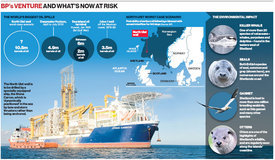
Internal company documents seen by The Independent show that the worst-case scenario for a spill from its North Uist exploratory well, to be sunk next year, would involve a leak of 75,000 barrels a day for 140 days – a total of 10.5 million barrels of oil, comfortably the world’s biggest pollution disaster.

This would be more than double the amount of oil spilled from its Deepwater Horizon well in the Gulf of Mexico last year, which had a maximum leak rate of 62,000 barrels a day in an incident lasting 88 days – and triggered a social, economic and environmental catastrophe in the US which brought the giant multinational to the brink of collapse.

The North Uist well, in a seabed block named after the Hebridean island but located 80 miles north-west of Shetland, is part of BP’s ongoing attempts to open up the West of Shetland sea area, sometimes referred to as the “Atlantic Frontier”, as a rich new oil province to replace the dwindling productivity of the North Sea.

The project appeared to have been shelved by the former BP chief executive Tony Hayward last year in the aftermath of Deepwater Horizon and the barrage of criticism directed at the company for its safety record. But it is now going ahead, and the well will be drilled by a drilling ship, the Stena Caron, some time from January onwards, as long as it is given a licence by the Energy Secretary, Chris Huhne.

The company already has three West of Shetland wells producing oil, at depths from 140 to 500 metres (460 to 1,640ft). But North Uist, described by BP as “stepping out, in terms of depth”, will be nearly three times as deep, at 1,290m below the surface, in immensely testing conditions similar to those of its ill-fated Gulf well, which was located 1,500 metres down, and began its unprecedented “gusher” leak in April last year.

The difficulty of capping a gushing well at such depths, vividly illustrated by the three months it took for Deepwater Horizon to be staunched, is greatly concerning British environmentalists who point out that the waters which might be affected by a North Uist spill are among the most wildlife-rich in all the UK.

Seabirds including many rare species are found in enormous concentrations on Shetland, the nearest landmass to any spill, and in the surrounding waters, which also contain large numbers of whales, dolphins and seals, as well as substantial fish stocks.

A major destination for wildlife tourism, Shetland has already been badly affected by a previous oil spill, that of the tanker MV Braer, which ran aground on Shetland in January 1993. BP documents referring to the North Uist project themselves list more than 20 vulnerable Shetland nature sites, including eight Special Protection Areas, two Special Conservation Areas and 12 Sites of Special Scientific Interest, which involve the breeding grounds of otters and rare birds such as the great skua, the red-throated diver and Leach’s petrel.

“This project is so risky that even BP is quietly planning for the possibility of the world’s worst ever oil spill happening off Scotland’s precious coastline,” said John Sauven, executive director of Greenpeace UK.

“It would be utterly reckless for Chris Huhne to approve this plan as if the Deepwater Horizon disaster never happened.

“Instead of chasing the last drops of oil from one of our country’s most sensitive and important natural environments, ministers should be developing a comprehensive plan to get us off the oil hook.”

A spokesman for BP said that the company was legally obliged to model the worst-case scenario, “but the reality is, the chances of a spill are very unlikely”. Since Deepwater Horizon, he added, BP had invested “a huge amount of time and resources strengthening procedures, investing in additional safety equipment and further improving our oil spill response capability”.

In particular, a major new well-capping device, designed for use at depths of up to 10,000ft, has been constructed, tested and made available, and could quickly be deployed, and any leak from North Uist is likely to be at a much lower pressure than that in the Gulf.

“We are confident that the improvements that have been made provide the level of assurance necessary against the risks,” the BP spokesman said.

North Uist: The story so far

In the storm of criticism of its safety record that followed the Deepwater Horizon blow-out, BP blew hot and cold about drilling the North Uist well. After confirming that it would go ahead, in August 2010, the company faced more criticism that such a similar deep well was inappropriate in the aftermath of the disaster in the Gulf of Mexico. Tony Hayward, BP’s chief executive at the time, hinted to the House of Commons Energy Select Committee in September 2010 that BP would hold its plans for deep water drilling off the Shetlands. He left the company shortly afterwards, and a final decision was taken to go ahead with North Uist, although more than a year later than originally intended.

BP has held a public consultation about the project, which ended last week. However, it was not widely advertised, had virtually no publicity, and a BP spokesman said there had been “no responses” from the public.

New York Times: Gulf Shrimp Are Scarce This Season; Answers, Too

October 10, 2011

By CAMPBELL ROBERTSON
LAFITTE, La. – The dock at Bundy’s Seafood is quiet, the trucks are empty and a crew a fraction of the normal size sits around a table waiting for something to do. But the most telling indicator that something is wrong is the smell. It smells perfectly fine.

“There’s no shrimp,” explained Grant Bundy, 38. The dock should smell like a place where 10,000 pounds of shrimp a day are bought off the boats. Not this year. In all of September, Bundy’s Seafood bought around 41,000 pounds.

White shrimp season began in late August, and two months in, the shrimpers here say it is a bad one, if not the worst in memory. It is bad not just in spots but all over southeastern Louisiana, said Jules Nunez, 78, calling it the worst season he had seen since he began shrimping in 1950. Some fishermen said their catches were off by 80 percent or more.

“A lot of people say it’s this, it’s that, it’s too hot, it’s too cold, it’s BP,” Mr. Nunez said. “We just don’t know.”
There is plenty that is not known. Louisiana’s Department of Wildlife and Fisheries has not compiled landings data for the season, so at this point it is hard to measure with any certainty the degree to which it is abnormal.

Even if the reports of a dismal season prove true, any forensic work is complicated by the oddities of this year’s weather, with a severe drought in the states along the Gulf of Mexico interrupted by spring flooding on the Mississippi River that brought millions of gallons of fresh water into the marshes. In addition, white shrimp crops have fluctuated over the decades for various reasons. (A BP spokesman said in a statement that some preliminary sampling indicated that the 2011 white shrimp population was within the historical range of variability.)

“We’re going to have to look at all of those different things and come up with reasons why it’s down, if it is down,” said Jim Nance, a shrimp biologist at the National Marine Fisheries Service. But while all scientists acknowledge the difficulty of determining a cause for a reported decline in the shrimp crops, some say there is evidence that is at the very least suggestive of a culprit.

Joris L. van der Ham, a researcher at Louisiana State University who has been studying white shrimp, said he had found more white shrimp than usual last winter in estuaries that were affected by the BP oil spill. That abundance might have been due in part, he said, to a decrease in the number of people out shrimping last year, but a significant decline in this year’s season would undercut that assumption. While cautioning that his study is incomplete, Dr. van der Ham speculated that certain compounds in the oil may have stunted the shrimp’s growth rate, and that the large numbers he found last year might have never made it out into the gulf to spawn, thus explaining a missing generation.

“There are numerous lines of evidence now that are sort of lining up that chronic exposure to this material could be problematic,” said James Cowan, a professor in L.S.U.’s department of oceanography and coastal sciences. Those who work in the gulf seafood industry, as well as their lawyers, have watched closely for signs of a species collapse similar to the one that decimated the herring fishery four years after the 1989 Exxon Valdez spill in Alaska. The causes of even that collapse remain a matter of dispute, but it is often cited as an example of the delayed disaster that shrimpers and others fear.

This concern was stoked further by a recent study by L.S.U. researchers that reported that a species of fish abundant in Gulf marshes was showing signs of cellular damage, problems typically due to exposure to oil. The functions of the fish, a minnow called the killifish, have been affected in ways that could harm reproduction, the study found.

Seafood industry representatives say there is enough uncertainty to raise doubts that the shrimp harvest will recover by 2012, a supposition in a report that Kenneth R. Feinberg, the administrator of the $20 billion compensation fund for victims of the spill, used in his formula for determining final settlements. Mr. Feinberg, in an interview, pointed out that he had, all along, described his report as preliminary and open to revision depending on new findings.

“We are monitoring this, and we are sensitive to these concerns,” he said. “We reserve the right to change the formula if anecdotal and empirical evidence justifies it.” Concerns about the lack of shrimp are different from concerns about the state of shrimp that are found. Repeated studies have shown gulf seafood is safe to eat, a fact trumpeted by industry representatives and government officials, who launched a gulf seafood safety Web site last week to reassure consumers.

All of this demonstrates just how hard it has become to make a living on shrimp boats, said David Veal, the executive director of the American Shrimp Processors Association. Mr. Veal has heard the anxieties about the white shrimp season, but while “clearly something is going on,” it is too early to say whether it is the worst in memory, he said. Whether it is the worst or just very bad is almost immaterial, Mr. Veal said; it is still another blight on the shrimping life, compounded by the decline in the domestic market, the steep rise in fuel prices and the battery of hurricanes over the last decade. “The fact that anybody is still in this business is a testament to their tenacity,” he said.

Special thanks to Richard Charter