Category Archives: Uncategorized

San Francisco Chronicle: China offshore oil spill spreads 320 square miles

http://www.sfgate.com/cgi-bin/article.cgi?f=/c/a/2011/07/05/MN891K6L0O.DTL

Andrew Jacobs, New York Times
Wednesday, July 6, 2011
Beijing —
Oil that spewed from an offshore drilling rig in northeastern China for two weeks last month has spread over 320 square miles, government officials acknowledged Tuesday, amid uproar over why it took so long for fishermen, local residents and environmental groups to be informed of the spill.

News of the accident emerged in late June on the microblogging site Sina Weibo and was not confirmed by the state-owned operator until Friday. The government sought to play down the leak’s significance, saying the environmental repercussions were likely insignificant and blaming the rig’s Western operator.

“There is no visible floating oil on the sea and the leak is now under control,” said a spokesman for the State Oceanic Administration, according to a transcript of a news conference posted on its website, although another official acknowledged that a small slick could be seen from the two platforms involved in the accident.

Officials at the agency said ConocoPhillips China, a subsidiary of the Houston-based energy giant that operates the rigs with a Chinese state-owned company, “should take the blame” for the accident, which occurred in the mouth of the Bohai Sea, a largely enclosed body of water that touches on three provinces and the city of Tianjin.

Speaking at a news conference Tuesday, an official at the oceanic agency’s Beihai branch said the minimum fine would be about $30,000, a figure that could rise depending on the extent of the economic and ecological damage.

ConocoPhillips officials did not immediately respond to requests for comment Tuesday, but in an earlier e-mailed statement, the company said it was still investigating the scope of the leak and that there had been no reported impact on wildlife, fishing or shipping activities.

The company owns a 49 percent stake in the venture, Penglai 19-3, which is the country’s largest offshore oil discovery, reportedly producing 150,000 barrels a day. It operates the rig with China’s National Offshore Oil Corp.

In recent days, several Chinese media outlets have reported die-offs among fish farmed in ocean enclosures, but such accounts could not be verified Tuesday.

According to the oceanic agency’s website, a leak was first detected June 4 and then again June 17. It said the spills occurred during the drilling process, when water is forced into the earth’s crust. By June 19, the problem was under control, the agency said, and by Monday, 40 cubic meters of oily water had been removed from the sea.

Yang Fuqiang, a senior adviser on climate and energy at the Beijing offices of the U.S.-based Natural Resources Defense Council, an environmental group, said that even if the environmental damage turned out to be minimal, the long delay in publicizing the accident erodes public trust in the government and its state-run energy companies.

“According to the regulations, any oil spill has to be reported to the public,” he said. “People who live in coastal areas have a right to know so they can make preparations.”

This article appeared on page A – 4 of the San Francisco Chronicle
Read more at : http://www.sfgate.com/cgi-bin/article.cgi?f=/c/a/2011/07/05/MN891K6L0O.DTL#ixzz1RNhzf2B

Special Thanks to Richard Charter

Miami Herald: Cuba’s oil hunt, our potential mess

http://www.miamiherald.com/2011/06/12/2285003/cubas-oil-our-potential-mess.html#storylink=misearch

Originally published July 3, 2011 at 5:58 PM | Page modified July 3, 2011 at 10:27 PM

Cuba’s oil hunt, our potential mess
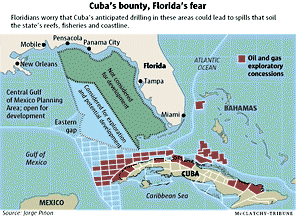
In about five months, Spanish oil giant Repsol is to begin a risky offshore exploration in Cuba’s North Basin, about 60 to 70 miles from Key West and even closer to ecologically fragile waters of the Florida Keys National Marine Sanctuary.

By Cammy Clark
The Miami Herald

KEY WEST, Fla. –
In about five months, Spanish oil giant Repsol is to begin a risky offshore exploration in Cuba’s North Basin, about 60 to 70 miles from Key West and even closer to ecologically fragile waters of the Florida Keys National Marine Sanctuary.

From a $750 million semi-submersible rig, Repsol will drill through 5,600 feet of seawater with strong currents and an additional 14,000 or so feet of layered rock at high pressure.
It’s the start of Cuba’s big push to find and produce what geologists believe is an energy treasure trove of oil and natural-gas reservoirs. The prospects are so promising that seven international consortiums involving 10 countries have partnered with the communist nation.

In the Florida Keys and up the East Coast, the prospect of potential oil spills so close to precious coral reefs, fisheries and coastal communities is frightening. Federal, state and local agencies have been scrambling to update contingency response plans using the lessons learned from last year’s devastating BP Deepwater Horizon blowout, which took 85 days to contain.

“Deepwater Horizon was 450 miles away, and we saw the impact for the Keys,” said Coast Guard Capt. Pat DeQuattro, commander of Sector Key West. “This is much, much closer, and Cuba is a sovereign nation.”

Cuba also has been embargoed for nearly 50 years, with bitter relations dating to the Kennedy administration.

As it stands, a lot of U.S. containment equipment, technology, chemical dispersants and personnel expertise would not be allowed to respond to a spill where it likely would be needed most – “at the faucet,” said oil-industry expert Jorge Piñon, a visiting research fellow at the Cuban Research Institute at Florida International University.

Politics also would prevent relief wells in Cuban waters from being built by U.S. companies or with U.S. resources.

“The clock is ticking for the U.S. to rethink its policy,” said Dan Whittle, Cuban program director for the nonprofit Environmental Defense Fund. “Hoping [Cuban oil exploration] goes away is not good policy.”

Even the final report issued in January from the National Commission on the BP Deepwater Horizon Oil Spill and Offshore Drilling recommended U.S. cooperation with Cuba’s oil industry to protect “fisheries, coastal tourism and other valuable U.S. natural resources.”

The report said it is in the national interest to negotiate with Cuba on common, rigorous safety standards and regulatory oversight. The countries also should develop a protocol to cooperate on containment and response strategies and preparedness in case of a spill.
But direct discussions have not happened, due primarily to a powerful voting bloc of pro-embargo Cuban Americans. Among them is Rep. Ileana Ros-Lehtinen, a Republican who represents the Florida Keys and Miami-Dade County and is chairwoman of the House Foreign Affairs Committee.

“You can’t trust that evil, awful Castro regime,” she said. “It would be dangerously naive.”
Ros-Lehtinen has spearheaded efforts to stop oil drilling in Cuban waters.

In May, she introduced the Caribbean Coral Reef Protection Act, the third version of legislation she tried to push through previous Congresses. The bill would impose penalties against companies that spend $1 million or more developing Cuba’s offshore petroleum resources and would deny U.S. visas to their foreign principals.

“I know it will be hard to pass; I have no delusions of success,” Ros-Lehtinen said. “But it’s important to take a stand. … We cannot allow the Castro regime to become the oil tycoons of the Caribbean.”

Rep. Vern Buchanan, R-Fla., also is pushing legislation that would deny U.S. oil and gas permits to companies that do business with Cuba. But of 10 companies that have agreements with Cuba to drill offshore, only private company Repsol also has leases in the United States.

Sen. Bill Nelson, D-Fla., has been fighting to stop Cuban oil exploration for years.
Yet, the best the United States has been able to do is push for safety. In May, Interior Secretary Ken Salazar met with Repsol officials in Madrid and reportedly used leases in U.S. waters as leverage to obtain assurances the company would follow the same American safety standards in Cuba. Repsol also has been in contact with the Coast Guard regarding how it would deal with a potential spill.

There is ample reason to believe drilling in Cuban waters will be highly profitable. The U.S. Geological Survey in 2004 estimated Cuba’s North Basin has 5.5 billion barrels of oil and 9.8 trillion cubic feet of natural gas – roughly the same amount as reserves in Ecuador and Colombia.

Cuban geologists also estimate an additional 10 billion to 15 billion barrels of undiscovered oil lies in deeper territorial waters in the middle of the Gulf. The amount of recoverable oil and gas, however, always is much less than what’s available.

On June 5, Cuban President Raul Castro watched as Cuba’s national oil company, Cupet, signed an expanded oil agreement in Havana with China’s state-owned oil company. Cupet also has agreements with state-owned companies from Norway, Russia, India, Vietnam, Malaysia, Canada, Angola and Venezuela.

Coast Guard Rear Adm. William Baumgartner, commander for the Southeast United States, said much effort has gone into planning for a possible spill. But, he added, “The diplomatic situation will make our job more difficult in planning and execution.”

Some companies already have special licenses issued by the Treasury Department and Commerce Department to send staffing and other resources to Cuba in the event of an oil spill.

If those companies did respond to a spill, Baumgartner said the Coast Guard would be “well aware of what they are doing inside Cuban waters and complement what they are doing.”

The National Oceanic and Atmospheric Administration is updating 2004 computer tracking models of a spill coming from Cuban waters.

“Even with what the models tell you, you still want to be prepared for any possibility,” said Sean Morton, superintendent of the FSpec
“We’ve had markers and mooring buoys break lose in Keys waters, and they have ended up as far north as Scotland and also in Alabama,” Morton said.

Special thanks to Richard Charter
Skytruth.org: ‘OIL CONTINUES TO IMPACT -WALTON CO. FL’

Latest report of lingering BP spill impact on Florida panhandle – see pics at http://oilspill.skytruth.org/reports/view/203 – j

Large tar patties have been found along this stretch of beach for several weeks.This is near Topsail Park at Stallworth Lake outflow into the Gulf. Hoping to have dive teams assess this area soon.

Clean up crews have been reduced again and will only be on a certain beach once every week or two and respond to call-ins from NRC/Unified Command. Sad state of affairs for our beaches along 30-A. This is what happened last year, and why we have buried oil on nearly 30 miles of our shoreline.

This current oil has been initially tested with UV light and found to be heavily contaminated.
Extensive lab work has been ordered.


John Amos – President, SkyTruth
John@skytruth.org
P.O. Box 3283
Shepherdstown, WV 25443-3283
(o) 304.885.4581 (m) 304.260.8886
skype: skytruth.amos
******************************************************************
Satellite images and digital mapping for environmental protection,
education and advocacy – a 501(c)(3) nonprofit organization
Visit us on the Web at http://www.skytruth.org
Learn more at the SkyTruth Blog – http://blog.skytruth.org
Browse our image galleries on Flickr – http://tinyurl.com/yd576ep
Follow us on Twitter for the latest – http://twitter.com/skytruth
And yes,we’re on Facebook – http://www.facebook.com/SkyTruth

Special thanks to Richard Charter

St Pete Times Editorial: Governor’s energy policy veers toward drilling

http://www.tampabay.com/opinion/editorials/article1178335.ece

A Times Editorial
In Print: Sunday, July 3, 2011

Gov. Rick Scott and state Senate President Mike Haridopolos have short memories. They have forgotten about last year’s BP oil spill. They have forgotten about the millions of gallons of oil that spewed into the gulf, the dead wildlife and the soiled Panhandle beaches. They have forgotten about the financial strain it placed on residents and businesses hundreds of miles from any oil. Floridians need to remind the governor and the Senate president of the devastating impact of the nation’s greatest environmental disaster as the two foolishly open the door again to offshore drilling.

Haridopolos, a Republican candidate for the U.S. Senate, recently spoke about his quest for a comprehensive energy policy on a conference call hosted by the Florida chapter of the Consumer Energy Alliance. The alliance is a prodrilling group that features oil companies, major business groups – and deep pockets for political contributions. In the call, Haridopolos said he wants to explore all options, and he has asked for a report from the alliance by the end of the year. Don’t expect an objective assessment from that outfit. Yet in an interview last week, Haridopolos said he is keeping his pledge not to pursue authorizing oil drilling in state waters during next year’s legislative session. That should be a relief, except it sounds like someone trying not to upset either side on a clear-cut issue.

More disconcerting than Haridopolos’ maneuvering is Scott’s initial foray into energy policy. Scott reportedly said in a private meeting with energy interests last month that he wants to pursue renewable energy and get the Public Service Commission to cut energy efficiency standards for electric utilities. Cutting those efficiency standards would be the wrong direction, and even more misinformed is Scott’s goal to lower electric bills for business.

To save money by conserving and to pursue more environmentally sound renewable energy requires upfront investment. Executives with Progress Energy and other utilities have long said the amount of renewable energy options they can pursue is directly tied to how much more ratepayers are willing to spend to develop them. Even more alarming were signals by the governor’s policy director that Scott would be open to expanding oil drilling and embracing clean coal.

“What did the previous governor do?” asked Mary Anne Carter dismissively. “Kill six coal plants? We want them in the room.”

Fortunately, Carter left the governor’s staff last week and returned home to Tennessee. Any smart energy strategy that seeks to reduce carbon emissions and emphasize renewable energy will not include coal plants, which even the state’s electric utilities are not seeking to build any more. It will not include offshore oil drilling; the BP oil disaster has demonstrated the damage that can do to Florida’s environment and economy. And it most certainly will not result in immediately reducing electric rates for businesses.

Special thanks to Richard Charter

BOEMRE.gov: BOEMRE Completes Draft Supplemental EIS for Central Gulf of Mexico Lease Sale–Comment Period to Include Four Public Hearings

http://www.boemre.gov/ooc/press/2011/press0629a.htm

NEW ORLEANS – The Bureau of Ocean Energy Management, Regulation and Enforcement (BOEMRE) today released a Draft Supplemental Environmental Impact Statement (SEIS) for proposed oil and gas Lease Sale 216/222 in the Central Planning Area in the Gulf of Mexico. The draft SEIS updates the findings in several previously published environmental reviews covering the Gulf of Mexico and incorporates the latest available information following the Deepwater Horizon explosion and oil spill.
“The analyses contained in this draft SEIS will allow us to make objective, science-based decisions regarding offshore energy exploration, development and production,” said BOEMRE Director Michael R. Bromwich. “The public hearings on the draft SEIS we are announcing today are vehicles for gaining broad public input on the environmental effects of oil and gas operations in the Gulf of Mexico.”
The Draft SEIS is available online at: http://www.gomr.boemre.gov/PDFs/2011/2011-027.pdf
The bureau is accepting public comment before the document is finalized. The Federal Register notice announcing the Draft SEIS will be published July 1, 2011, at which time BOEMRE will begin accepting public comments at: http://boemre.gov/PublicComment.htm. Comments will be used to prepare the Final SEIS for the lease sale.
Lease Sales 216 and 222 are the last remaining sales scheduled for the Central Gulf Planning Area in the 2007 – 2012 Outer Continental Shelf Oil and Natural Gas Leasing Program. The sales were delayed due to the Deepwater Horizon tragedy and are being combined to maximize efficiency.
BOEMRE will hold public hearings in three cities to give interested parties an opportunity to comment on the draft SEIS. The meetings are scheduled as follows:
· New Orleans, La: Tuesday, August 2, 2011, BOEMRE, 1201 Elmwood Park Boulevard, New Orleans, LA 70123, beginning at 1:00 p.m. CDT.
· Houston, Texas: Tuesday, August 9, 2011, Houston Airport Marriott at George Bush Intercontinental, 18700 John F. Kennedy Boulevard, Houston, TX 77032, beginning at 1:00 p.m. CDT.
· Mobile, Ala: Thursday, August 11, 2011, Renaissance Mobile Riverview Plaza Hotel, 64 South Water Street, Mobile, AL 36602, beginning at 1:00 p.m. and 6:00 p.m. CDT.
Federal, state and local government agencies and other interested parties are requested to send their comments on the draft SEIS no later than August 16, 2011, by email to CPA Supplemental EIS@boemre.gov or by mail to: Comments on the CPA Lease Sale 216/222 Draft SEIS, Regional Supervisor, Leasing and Environment (MS 5410), Bureau of Ocean Energy Management, Regulation and Enforcement, Gulf of Mexico OCS Region, 1201 Elmwood Park Boulevard, New Orleans, LA 70123-2394.
Contact: BOEMRE Public Affairs

Special thanks to Richard Charter.