Category Archives: Uncategorized
New York Times: High hopes and fear stir Belize as oil riches swirl (note 2006 date)
By Simon Romero
Published: Tuesday, February 21, 2006
SPANISH LOOKOUT, Belize — Near this small Mennonite town carved out of the thick jungle, a farmer dug a shallow water well a few years ago and found a viscous black liquid seeping into the water.
Given Belize’s disappointing record of oil exploration, stretching back to its years under British rule, nearly everyone shrugged at the story except a stubborn Denver geologist.
Now Belize is the newest exporter of oil to the United States, a development that is starting to upend this small country of 280,000 people. A roughneck crew, backed by investors from Ireland and Colorado, struck oil in its first drilling attempt last year.
Their wells, dotting the dairy farms of German-speaking Mennonites who moved here a half-century ago from Canada and Mexico, are producing 2,000 barrels a day of oil similar in quality to the prized low-sulfur crude from the oil fields of West Texas.
Much of Belize is on tenterhooks regarding the oil and its ramifications. But the small companies behind the discovery, Belize Natural Energy andCHX Energy, which is based in Denver, are reveling in their good fortune.
Together with other independent companies that have recently struck oil and natural gas in locations once written off, including Paraguay, Syria and Uganda, these entrepreneurs are proving that wildcatting is alive and well.
As in Belize, the quantities of oil discovered in these places are relatively small. But with oil fetching more than $60 a barrel on world markets, smaller companies are willing to risk just about everything these days in hopes of finding even tiny oil fields.
“There were 50 dry wells drilled in Belize over 50 years until we came along,” said Susan Morrice, a geologist from Denver.
She is the wildcatter behind Belize Natural Energy, a venture she formed with the backing of her husband, Alex Cranberg, who is a Colorado oil executive, and more than 70 small investors from Ireland, her native country.
“We simply felt we could not fail in our search for oil in such a promising, if neglected, country.”
Morrice’s company has been remarkably swift in turning the discovery into cash. In January, Belize Natural Energy loaded 40,000 barrels onto a barge destined for a refinery in Houston, netting the company about $2 million.
With other wells planned in Spanish Lookout, it soon expects to be producing 5,000 barrels a day, and some geologists say Belize as a whole may one day produce 50,000 barrels a day. That level is tiny compared with Mexico, where daily output is 3.4 million barrels a day. But it is significant for a small country that has long scrounged for enough hard currency to import all its oil.
Belize imports about 5,000 barrels of oil a day. So the crude in Spanish Lookout has allowed this country to dream of energy independence.
Still, Belize, known as British Honduras until it was granted autonomy from Britain in 1981, faces some serious obstacles before it becomes anything resembling the Kuwait of Central America. It has no refineries or pipelines and, unlike many developing countries, it has no national oil company or oil ministry.
Andre Cho, a civil servant who is Belize’s inspector of petroleum, said the government had recently approved his request to hire more staff geologists, as well as a former United Nations consultant from India who specializes in organizing the petroleum industries of poor nations.
Despite such moves and the formation of a government petroleum advisory board in December, there is considerable skepticism throughout Belize that the country can develop its oil resources without the corruption and environmental damage that afflict other poor oil-producing countries.
Much of the tension around the oil discovery is focused on the 7.5 percent royalty that Belize Natural Energy is required to pay the government, which is much less than in other oil-producing countries. Royalties to Norway for exploration in the North Sea, for instance, are more than 70 percent.
Belize’s prime minister, Said Musa, has said the royalty was kept low to provide a strong incentive for companies to explore in a country where oil had never been found before.
Sheila McCaffrey, a director of Belize Natural Energy, said the government would end up collecting overall taxes of about 30 percent on the oil. That includes royalties and agreements that give the government a minority stake in the company, along with control of 10 percent of production from the oil wells.
The company is also trying to avoid ill will among Belizeans by channeling 1 percent of its revenue to a fund for protecting the country’s fragile environment, which is about 40 percent jungle.
The most acute political risk for Belize’s nascent oil industry may be a territorial dispute with Guatemala.
Representatives of the two countries agreed this month to begin negotiations to resolve territorial claims. But areas of Belize where oil exploration is taking place or planned remain squarely in land still claimed by Guatemala. Spanish Lookout is just a 20-minute drive from the Guatemalan border, where migrants seeking available land, many of them Maya Indians, have settled.
Special thanks to Gene Shinn & the Coral-list
Bureau of Energy Management, Regulation & Enforcement: Process, public comment on 4 EA’s for Exploratory Plans
NOTICE:
The Bureau of Ocean Energy Management, Regulation and Enforcement (BOEMRE) announced that public comment is invited with respect to four Environmental Assessments (EA) for Exploration Plans (EP). The EPs involve deepwater activity in the Gulf of Mexico and were completed in accordance with new safety and environmental standards implemented since the Deepwater Horizon explosion and oil spill. A new feature has been added to increase accessibility for the public to submit comments on the bureau’s homepage at: www.boemre.gov.
Consistent with federal regulations, an EP is deemed “submitted” once all supporting materials and documentation has been provided. Once a plan is deemed submitted, BOEMRE has 30 calendar days to analyze and evaluate it. The 30-day time frame for review includes a 10-day public comment period to allow an opportunity to review and comment on the issues that should be considered by BOEMRE in preparing the EA for the plan. The four plans will be available for comment by the end of the business day today.
The four plans include one Initial EP and three Revised EPs. The first plan is an Initial EP received from Hess Corporation and includes three proposed exploratory wells in 1,600 feet water depth, approximately 80 miles offshore Louisiana. The second and third plans received are two Revised EPs from Cobalt International Energy LP. One includes nine proposed exploratory wells in approximately 5,800 feet water depth, approximately 160 miles offshore Louisiana, and the other includes ten proposed exploratory wells in approximately 4,700 feet water depth, approximately 136 miles offshore Louisiana. The fourth plan received is a Revised EP from Nexen Petroleum USA Inc. and includes one proposed exploratory well in approximately 7,460 feet water depth, approximately 134 miles offshore Louisiana.
As part of its review, BOEMRE will prepare an EA specific to the proposed exploration activities. Upon completion of the technical and environmental review, BOEMRE must decide whether to approve the plan, require modifications, or disapprove the plan. An EP describes all exploration activities planned by the operator for a specific lease or leases, including the timing of these activities, information concerning drilling vessels, the location of each planned well, and other relevant information that needs to meet important safety standards.
With the addition of the new Public Comment link on the bureau’s website, individual press notifications of exploration and development plan public comment opportunities will be not be issued.
For more information on the new safety and environmental standards, go to: http://www.boemre.gov/ReorganizationRegulatoryReform.htm. For more information on pending, submitted and approved plans, go to: http://www.gomr.boemre.gov/homepg/offshore/safety/well_permits.html.
Special thanks to Richard Charter
opednews.com: Gulf Residents Say No to Congressional Push for Faster, Dangerous Drilling
Gulf Residents Say No to Congressional Push for Faster, Dangerous Drilling
By Rocky Kistner
Sometimes in history there are moments you have to ask yourself; can this really be happening? The fires spreading across the Cuyahoga River near Cleveland, the toxic goo seeping into houses at Love Canal. Each time, the pubic reacted with outrage and politicians got the message. New laws were passed to ensure public health and our environmental resources were better protected.
So wouldn’t you would think that after the largest oil blowout in US history those lawmakers would be falling over themselves to pass new laws and keep this from happening again?
Not this time.
Instead we have a tone deaf Congress that seems bent on ignoring recent history, including the fact their constituents are still suffering economic, emotional and physical harm from the oil disaster. Lawmakers in the House rushed through legislation that would not only speed up more offshore oil drilling, but curtail some of the environmental safeguards designed to keep oil catastrophes from happening again. The Senate is supposed to take up similar bills next week.
That’s absurd thinking to many folks in the Gulf who are still struggling to get their lives back. It’s been a very hard road. With the Louisiana shrimp season set to open next week, the market for seafood is still terrible. Many buyers don’t trust the government’s stamp of approval on Gulf seafood. Customers across the country–and across the world–simply don’t want it.
Sea turtle skull, Long Beach MS, May 12th.
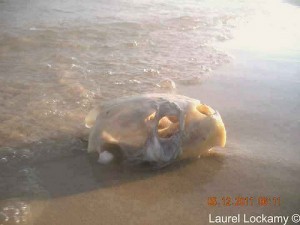
Photo: Laurel Lockamy
Rushing to drill more wells won’t help the price of seafood. And despite the political rhetoric, it won’t reduce the price of gas or our dependency on foreign oil. Drilling faster and further on the heels of the BP oil disaster is sort of like trying to chase an alligator after it just ate your foot. We need to recover first and make sure the safety measures are in place. Here’s what fishing guide and Louisiana Charter Boat Association Director Ryan Lambert has to say:
So, now Congress wants to give oil companies free reign to drill in our Gulf waters as fast as possible, with little thought to the disaster that still unfolds here. I don’t get that. And I especially don’t understand they’re reasoning. It will do little to reduce gas prices and make us energy independent.
As the president’s national oil spill commission recommended earlier this year, we need to establish an independent drilling safety and environment office to make sure this disaster doesn’t happen again. And as the commission suggested, we should expand the role of the National Oceanic and Atmospheric Administration to ensure decisions about offshore drilling are based on sound science.
But this still has not happened. Instead, lawmakers are following the advice of the oil industry that lines their pockets”. We still need to drill for oil, but we need to do it carefully while our country invests in new sources of energy that are cleaner, safer and that provide more jobs. That’s what Congress should be doing , not pushing reckless oil drilling that could put our coastlines at greater risk.
But it’s not just fishermen who are worried about the blind rush by Congress to mandate more drilling off our coastlines, including the arctic. Residents along the oil-impacted coasts have been hit hard by losses in the tourist industry and some are suffering from health problems they say are related to airborne contaminants from the massive slicks of oil and chemical dispersants. Robin Young of the Orange Beach, AL, group Guardians of the Gulf has this to say in an draft op-ed about the drilling proposals:
While lawmakers are focused more on making money for oil companies, I will be trying to figure out how to help people make ends meet after the disastrous BP blowout ruined many people’s lives in my community.
Perhaps members of Congress have forgotten that people down here are sick, or that birds, dolphins and sea turtles are still washing in dead on our beaches. Perhaps they don’t realize that the oil industry’s callous disregard to safety continues to impose pain and suffering on many people’s lives in the Gulf.
It’s unfathomable to me that Congress would even consider passing these bills that ignore the recommendations of the presidential commission on the BP oil spill. These proposals would just make the rest of our country’s coastline vulnerable to the same sort of nightmare we’re living here.
Even if we put a thousand more oil wells in the Gulf and suck every barrel of oil out of the seabed, it won’t put much of a dent in the price of gas or reduce our dependency on foreign oil. And done helter-skelter, it will threaten the livelihoods of generations of residents throughout the Gulf.
What we need in the Gulf isn’t more drilling, it’s more health clinics and doctors who can tend to people damaged by dangerous oil company practices so far. Instead, politicians seem to be focused on the oil industry’s bottom line, not the health and wellbeing of residents in the Gulf.
Many Gulf residents are no longer satisfied with the same pat answers from the oil industry.The BP oil disaster proved the status quo does not serve the public’s best interest. People like Ryan Lambert and Robin Young say it’s time to put the well-being of residents and the environment first. Rushing to drill faster, further and more dangerously won’t change the price of gas at the pump, and it will put even more coastal regions in jeopardy. Does that make sense?
So wake up America. It’s really happening. And it’s time to do something about it.
Pensacola News Journal: Sick fish in Gulf are alarming scientists
http://www.pnj.com/article/20110508/NEWS01/105080328/Sick-fish-Gulf-alarming-scientists
PNJ.com
Unusual number a ‘huge red flag’ to scientists, fishermen
12:00 AM, May. 8, 2011 |
Red snapper with abnormal stripes caught by a local commercial fisherman. Scientists are seeing a growing number of Gulf fish with lesions and other health problems and are conducting tests to determine whether they are related to the BP oil spill. / Special to the News Journal
Written by
Kimberly Blair
kblair@pnj.com
ZOOM
Red snapper with a skin lesion and fin rot caught by a local commercial fisherman. / Special to the News Journal
Fish health
Some of illnesses scientists are concerned about may be signs of compromised immune systems and include:
» Fin rot: When bacteria eats away the fins of a fish.
» Skin lesions: Ulcers or infections on the skin of a fish that may be caused by a wound not healing properly.
» Skin pigmentation: Fishermen are finding red snapper with odd black pigmentation.
» Parasites: Fungus, bacteria, worm or crustaceans.
» Liver damage: Blood clots where liver is hemorrhaging.
What’s next?
Preliminary results of UWF’s research may take months. Research will continue until enough data is collected to better understand what is happening, and if there is a real problem or if the occurrences of sick fish are random. Data collected will go through scientific review and be published.
Scientists are alarmed by the discovery of unusual numbers of fish in the Gulf of Mexico and inland waterways with skin lesions, fin rot, spots, liver blood clots and other health problems.
“It’s a huge red flag,” said Richard Snyder, director of the University of West Florida Center for Environmental Diagnostics and Bioremediation. “It seems abnormal, and anything we see out of the ordinary we’ll try to investigate.”
Are the illnesses related to the BP oil spill, the cold winter or something else?
That’s the big question Snyder’s colleague, UWF biologist William Patterson III, and other scientists along the Gulf Coast are trying to answer. If the illnesses are related to the oil spill, it could be a warning sign of worse things to come.
In the years following the 1989 Exxon Valdez oil spill in Alaska’s Prince William Sound, the herring fishery collapsed and has not recovered, according to an Exxon Valdez Oil Spill Trustee report. The herring showed similar signs of illness – including skin lesions – that are showing up in Gulf fish.
Worried that same scenario could play out along the Gulf Coast, Patterson is conducting research on the chronic effects of the BP oil spill on Gulf fish. And he sees troubling signs consistent with oil exposure: fish with lesions, external parasites, odd pigmentation patterns, and diseased livers and ovaries. These may be signs of compromised immune systems in fish that are expending their energy dealing with toxins, Patterson said.
“I’ve had tens of thousands of fish in my hands and not seen these symptoms in so many fish before,” said Patterson, who has been studying fish, including red snapper, for 15 years. “All those symptoms have been seen naturally before, but it’s a matter of them all coming at once that we’re concerned about.”
He’s conducting the research with some of the $600,000 in BP money distributed to UWF from $10 million the oil company gave to the Florida Institute of Oceanography in Tampa to study the impact of the spill.
Higher scrutiny
As part of his studies, Patterson is collecting samples at targeted sites in the Gulf and from commercial fishermen. Samples from his targeted sites have shown fewer problems than those from fishermen.
While Patterson is alarmed, he’s quick to point that the Gulf’s ecosystem never before has been scrutinized as closely as it is now, or by so many scientists.
“Are we looking more closely, or are these unusual?” he said.
Sick fish have been reported from offshore and inshore waters from Northwest Florida to Louisiana, he said. Scientists are trying to figure out how prevalent these abnormalities are and their cause.
In that pursuit:
» Patterson and Florida A&M University scientists are conducting toxicology tests to find out if the fish were exposed to hydrocarbons or oil. Results are not final.
» Scientists at Louisiana State University’s veterinarian school are in the Gulf looking into what microbes might be causing the diseases.
» Pensacola marine biologist Heather Reed is studying red snapper for a private client using broader testing methods than mandated by the federal government, which she says are not adequate.
“I’ve been testing different organs in game fish that have been brought to me, and I’m seeing petroleum hydrocarbons in the organs,” said Reed, the environmental adviser for the City of Gulf Breeze. “I was shocked when I saw it.”
She is trying to secure grants to continue that research and is talking to federal and state officials about her findings, she said.
All the studies are aimed at one goal: “To find out what is really going on and get things back to normal,” Reed said.
Solving the mystery
But both Reed and Patterson say it’s hard to determine just how many fish are being found sick because many commercial fishermen are reluctant to report their findings to state and federal officials out of fear fishing grounds will be closed and their livelihoods will be put at risk.
But at the same time, to protect the future of the Gulf, Patterson said, the fishermen quietly are asking scientists to look into what is happening.
Clay Palmgren, 38, of Gulf Breeze-based Bubble Chaser Dive Services, is an avid spear fisherman who has about 40 pounds of Gulf fish in his freezer. He has not seen sick fish so far, but he said many of his angler friends, both recreational and commercial, are talking about catching fish that appear abnormal.
“I’m 100 percent glad scientists are looking at this,” he said. “I’m concerned with the health of fish, and I think it will take a couple of years for the (toxins) to work up the food chain. I think that’s a shame.”
Patterson’s studies and those of other scientists delving into this mystery of the sick fish are not trying to determine whether the seafood is safe for public consumption.
“There is fish health and human health, and we’re concerned about the sublethal effects of the oil spill on communities of fish,” he said.
Findings so far demonstrate that studies need to continue far into the future, he said.
The $500 million BP has provided for long-range research on the Gulf oil spill will ensure “people will be examining the impacts for the next decade,” Patterson said.
The cause of the fish illnesses may be hard to nail down, Snyder said.
“Cause and effect is a huge problem for environmental work,” Snyder said. “You see anomalies in fish. Is it oil-related? How do we prove it? We can make the connection with economic stuff. But after the oil is gone, how do you definitely say the fish are sick because of the oil spill?
“We may never know, and that’s the frustrating thing.”
Special thanks to Richard Charter