Guardian, UK: Fossil fuel subsidies and tax breaks are still rising

http://www.guardian.co.uk/environment/blog/2013/feb/08/fossil-fuel-subsidies-tax-breaks

New OECD data reveals a system of fossil fuel subsidies and taxes that is horribly overcomplicated and illogical

Duncan Clark
guardian.co.uk, Friday 8 February 2013 07.39 EST

Miners at Hungary’s last remaining deep-cast coal mine at Markushegy, 70 km west of Budapest, January 23, 2013. Photograph: LASZLO BALOGH/REUTERS

Last week the OECD published two new reports which shine a light on our complex and confused relationship with fossil fuels. The first looks at how we subsidise them, the second at how we tax them. The picture they paint can be summed up in two words: tangled mess.

Looking first at subsidies, the principle take-out is that government support for oil, coal and natural gas is still increasing across the developed world, despite promises to turn the situation around. Indeed, after dipping with the wider economy in 2009, the total value of subsidies or tax breaks received by those extracting or burning fossil fuels climbed relatively steeply and by 2011 was approaching the pre-crash peak of more than $80 billion.

Government support for fossil fuels
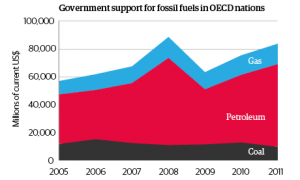
As the graph shows, coal subsidies are gradually waning, but increases in oil and gas support have more than made up for that.

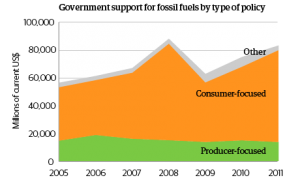
In some cases, governments directly help the oil, coal and gas sector through policies such as wage subsidies, liability limitation or below-market-rate access to government goods and services. But much of the support included in the OECD’s analysis consists of fossil fuels being sold at a lower tax rate than is charged on other goods. Examples include ‘red diesel’ used in agriculture and VAT discounts for domestic electricity and heating fuel. The graph below shows that these consumer-focused forms of support make up the majority of the total. (The split is more even in countries with big fossil fuel sectors.)

Government support for fossil fuels by type of policy
If heating fuels and home electricity currently receive tax breaks in many countries, the situation is quite different for vehicle fuels. The OECD’s second report – Taxing Energy Use – shows that on average transport accounts for a remarkable 85% of energy-related tax revenue despite making up just 23% of total energy use and 27% of CO2 emissions.

Transport fuels in OECD nations

But these averages conceal a huge disparity in the actual rates applied in different countries. The graph below shows the average tax rate on transport fuels across the 34 OECD nations, expressed as an effective carbon tax – i.e. the tax rate paid by consumers relative to each unit of CO2 that the fuels will release.

Two things jump out here. One is the remarkable difference between those at the top and the bottom of the table. The rate in the UK, for example, is around 15 to 20 times higher than the federal rate applied in North America. The gap would close a bit if American state taxes were included but from a quick glance at the figures, it looks like the difference would still be almost an order of magnitude between the US and UK.

Tax rates for vehicle fuels

The other thing that jumps out from this graph is that many countries are already charging an effective carbon tax of more than ¤200 per tonne on their vehicle fuels. In Britain it’s closer to ¤300 – way more than almost anyone is talking about in terms of climate policy. On one level, that’s a positive story, as it illustrates that when it’s introduced incrementally and combined with energy-efficiency improvements, a very high carbon tax doesn’t have to be scary.

On the other hand, it’s worrying to see that North Americans are used to paying almost no fuel tax. It’s a reminder how crucial it is to start upping carbon taxes now, because there’s such a long way to go and the increase will be much more politically plausible and economically manageable if introduced gradually. (As Nigeria showed at the beginning of last year, big overnight increases in fuel tax can lead to social breakdown and policy U-turns.)

While the difference in fuel tax between nations is striking, also interesting is the gap between specific fuels within nations. Across the OECD, for example the tax per unit of CO2 is a huge 37% lower for diesel than it is for petrol. Yes, diesel engines are more efficient and achieve more miles per unit of carbon emitted, but that’s not a good reason for taxing those emissions any less. (If anything, it’s a reason for taxing them higher, because for each unit of carbon emitted, a diesel car will create more local air pollution and road use.)

But even diesel looks heavily regulated next to aviation fuel, which is exempt for most international travel and subject to a low rate even for domestic flights in most countries. The OECD estimates a typical rate of just ¤23 per tonne of CO2 emissions – approximately a tenth of the figure for petrol. (The rate would be lower still if the global warming impacts of vapour trails and other non-CO2 impacts were factored into the equation.)

Looking at both reports, the picture that emerges is a horribly overcomplicated and illogical system, both within and between nations. Things would be a lot clearer, greener, less distorting and fairer if a single carbon tax was applied across all fuels, sectors and – ultimately – countries. There’s no reason someone on a low income in a rural area making an unavoidable trip by car should pay a higher tax rate than a wealthy person heating a mansion, a banker hopping between meetings in a plane or indeed a farmer growing out-of-season tomatoes in a heated greenhouse.

As James Hansen and others have argued, the simplest and most complete approach to taxing carbon would be for nations to apply a consistent tax at the point where the fuel comes out of the ground or gets imported from overseas. If that happened, it would need to be introduced in parallel with greater efforts to insulate homes and protect vulnerable householders from higher heating bills. But under Hansen’s plan – which involves sharing the revenues of the carbon tax equally between citizens – those who don’t use much fuel would end up better off anyway.

It took 700 pages for the OECD to map out the developed world’s fiscal relationship with fossil fuels. A better system could be expressed in a few sentences.

Special thanks to Richard Charter

Guardian UK: Al Gore backs growing fossil fuel divestment campaign

http://www.guardian.co.uk/environment/2013/feb/08/al-gore-fossil-fuel-divestment

A US campaign to encourage universities and cities to drop their investments in fossil fuel companies is gaining momentum

Carey L. Biron for IPS, part of the Guardian Environment Network
guardian.co.uk, Friday 8 February 2013 05.19 EST


Al Gore is backing a US campaign of divestment in fossil fuel companies. Photograph: Mark Lennihan/AP

A months-old national campaign to convince U.S. colleges, universities and city governments to withdraw investments from the world’s largest oil and gas companies has seen some notable initial successes.

On Tuesday, a city supervisor in San Francisco introduced resolutions calling on the city’s retirement fund to “divest” all money it has in fossil fuel companies and gun manufacturers. That followed a significant recent decision by the city of Seattle’s two-billion-dollar retirement fund to actively shed its stocks in companies that contribute to climate change.

And Wednesday, former U.S. vice-president Al Gore, a prominent climate activist and Harvard alum, sided with a strengthening campaign to get that school to back out of its oil and gas investments.

“If I were a student, I would support what you’re doing,” Gore told students, speaking on campus at Harvard. “But if I were a board member I would do what I did when we took up the Apartheid issue. This is an opportunity for learning and the raising of awareness, for the discussion of sustainable capitalism.”

In fact, the divestment movement here in the U.S., which has burgeoned following the November presidential election, took its inspiration from the anti-Apartheid experience.

“During the 1980s, 155 schools came out against the South African Apartheid, and so we’re modelling a lot of what we’re doing now on that,” Jamie Henn, communications director for 350.org, an advocacy group that has spearheaded the divestment push, told IPS.

“So, it made perfect sense for us to start with universities, as these institutions have a special responsibility to make their investments live up to their missions. Many have publicly committed to sustainability and solving the big issues of the day, yet many are still putting tens of millions of dollars into companies that are wreaking havoc on the planet.”

Hampshire College, a small school in Massachusetts, was the first to follow the campaign’s lead; in 1979, it was also the first school in the United States to divest from South African holdings. Two more colleges have now followed suit.

While these are each small and notably progressive schools, Henn reports that student groups have sprung up around the issue on the campuses of at least 230 schools, including at each of the elite Ivy League schools and several large state schools. At least 20 institutions have now started processes to look at divestment options.

“We’ve been blown away by how quickly the campaign has spread – right now it’s the fastest-moving student environmental campaign of the past decade, maybe ever,” Henn says.

“And an increasing number of students are also increasing pressure on politicians to take action. Look at these numbers – Harvard’s endowment is 32 billion dollars. That perks up the ears of a lot of people.”

The Harvard administration was initially cold on the idea of divestment, however, reportedly refusing for months to agree to a meeting between the school president and student representatives on the issue. But following a concerted campaign – and a campus-wide referendum in which nearly three-quarters of students voted in favour of divestment – recent weeks have seen a significant softening of tone.

“Finally, at the end of the semester, the administration felt enough pressure to agree to a meeting with a couple of members of the school’s board, and that took place last Friday,” Alli Welton, a co-coordinator of Divest Harvard, a student group, told IPS.

“In that meeting, the board members said they were very concerned about climate change, but questioned whether divestment would have a significant impact on the issue. However, they also noted that doing so wouldn’t have a large impact on the school’s endowment.”

Indeed, that latter contention is supported by a recent report by Aperio Group, an investment management firm, which found that divesting of climate change-related holdings would bring with it remarkably little risk for university endowments.

Welton notes that negotiations between students and the administration are going to continue (“That’s pretty good after a semester of not talking to us”), with a decision slated for February 15. While she says she’s “very encouraged” by the administration’s new willingness to talk, Welton refers to a far larger impact on the student body.

“I’ve never seen anything like this happen around climate change on campus – it seems like students know a lot more about this issue and are feeling its urgency,” she says. “It really feels as though divestment is a very clear way that we can effect change.”

Critically for such a large issue as climate change – and one on which many activists have repeatedly felt let down by failures at the national and international levels to agree on substantive long-term solutions – Welton notes that organising around investments makes a massive issue feel more immediate.

“These local-level initiatives make climate change more accessible for people, and make it more possible for them to get involved,” she says. “We can see very clearly that we’re part of something gigantic, and that definitely creates identity for a national and even international movement.”

According to 350.org’s Henn, the second phase of the organisation’s divestment strategy will focus on city governments and pension funds. In this, Seattle’s actions have already become a model of sorts.

Led by the city’s mayor, Mike McGinn, in turn responding to exhortations by 350.org, last month Seattle’s retirement and pension funds reported that they had some 17 million dollars invested in oil and gas companies. On Jan. 31, those funds moved to create a mechanism to look into how potential divestments could take place.

“This was a critical first step, as there was no such mechanism even in existence,” Aaron Pickus, a spokesperson for the mayor, told IPS.

While no decision has yet been made on how that money should now be used, Pickus says, “There has been a general request that it not be re-invested in companies that are polluting our climate.”

The public response has been positive, he notes, even while constituents understand that the city is at the beginning of a process that could span the next half-decade.

“There is a rapidly growing sense that something – in fact, many concrete things – need to start happening to change the trend on how we approach climate change,” Pickus says.

“That includes how we invest – not just in pensions but also, more generally, how we’re spending taxpayer money. For instance, are we going to invest in new, wider highways or in green transit options?”

Special thanks to Richard Charter

Petroleum News: Questions over Arctic dispersant use

http://www.petroleumnews.com/pntruncate/575533357.shtml

Environmental consultant questions feasibility of using oil dispersant chemicals in responding to an Arctic offshore oil spill
by Alan Bailey

Lauded by some as a major contributor to the cleanup of spilled oil following the 2010 Deepwater Horizon disaster in the Gulf of Mexico and slammed by others as environmentally dangerous, the use of chemicals to disperse oil slicks has become a controversial topic.

The concept behind dispersant use is simple. The dispersant chemicals, acting a bit like dishwashing liquid, break the oil into tiny particles, greatly increasing the surface area of oil exposed to water and hence greatly accelerating the rate at which oil-consuming microbes devour the oil, causing the oil to disappear.

But do dispersants, demonstrated in laboratory conditions, work in the hurly-burly of a real spill response situation? And, more particularly, would dispersants work, were there to be an oil spill catastrophe in the Arctic offshore?

Skeptical
Jeffrey Short, an environmental consultant working for Oceana, a marine conservation organization, is very skeptical about the potential effectiveness of dispersants in the Arctic. Short, who worked as a research chemist for the National Oceanic and Atmospheric Administration for 31 years and has published more than 60 scientific papers on Arctic pollution, spoke at the Alaska Forum on the Environment on Feb. 4, giving his views regarding the problems associated with dispersant use in the Arctic.

Short, who said he had been involved in the Deepwater Horizon response, working for private entities, said that claims about the effectiveness of dispersants during that response had been overstated, and that there was a lack of evidence for dispersant chemicals having had any impact in boosting the natural biodegradation of oil that had spewed from the out-of-control, seafloor well. For example, no one observed the milky appearance of dispersed oil in the water, he said.

And, although the government-published oil budget calculator for the Deepwater Horizon response indicated that dispersants had been somewhat effective, the technical underpinnings of that conclusion, as expressed in the budget calculator report, appear far short of convincing, he said.

Goldilocks circumstances
The effective use of dispersants requires a “Goldilocks” set of circumstances, in which the wind is strong enough to cause the necessary wave action for mixing oil with dispersant chemicals, but not so strong as to blow away the fine spray of dispersant, normally applied from an aircraft, Short said. And seas that are too rough can cause dispersants to escape into underlying water, rather than mix with an oil slick on the surface, he said.
Also, there is typically a relatively short time window following an oil spill, during which dispersants can be used, as evaporation and emulsification of the oil eventually renders the oil unresponsive to dispersant chemicals.

Given seasonal ice, the frequency of strong winds and the prevalence of sea fog in the Arctic Ocean, the appropriate conditions for the application of dispersants in Arctic seas may only occur for 10 percent of the time, Short said.

Lab tests
Short said that 10 years ago he had conducted some laboratory tests for the Prince William Sound Regional Citizens’ Advisory Council, testing the effect of a commonly used oil dispersant on Alaska North Slope crude oil in sub-Arctic conditions. Those tests demonstrated that the dispersant did not work well in cold water, with dispersant effectiveness dropping with reduced water temperatures and with low water salinity, Short said. These results do not bode well for dispersant effectiveness in the Arctic – in addition to the effect of low water temperatures on dispersant action, melting ice in the Arctic seas tends to create a layer of low salinity water near the sea surface, he said.
Compounding the technical issues relating to the potential effectiveness of dispersants in the Arctic is the sparse transportation architecture for the resupply of dispersant chemicals to field responders, Short said.

Asked about the possibility that low water temperatures would slow oil degradation, thus extending the time window within which dispersants would be effective, Short responded that the weathering of oil is less sensitive to temperature than to wind, of which there is plenty in the Arctic. The rate of incorporation of water into the oil, a phenomenon that takes place quite quickly, depends on the composition of the oil, he said.

Continuing debate
Short’s comments come amid a continuing debate over the realistic feasibility of conducting an offshore oil spill response in the Arctic. And a report, issued in November by the U.S. Arctic Research Commission and the U.S. Army Corps of Engineers, after overviewing the considerable body of research already done into oil spill response in the Arctic offshore made a number of recommendations for further research, including a recommendation that people evaluate the effectiveness of dispersants in Arctic conditions.

A joint industry program, known as SINTEF and based in Norway, conducted a series of large-scale field experiments in the mid-2000s, testing the use of various response techniques, including dispersants, using oil deliberately spilled in the sea under carefully controlled conditions at an Arctic location. SINTEF reported that it had found rates of oil weathering in broken ice conditions to be considerably lower than rates observed for the same oil in open water. The final report for the program also said that researchers had experienced success in dispersing oil in water around ice floes, by applying the dispersants from spray arms deployed from vessels and using the prop wash or jet motors of response boats to mix the dispersant with the oil.

Oil budget
A read of the technical documentation for the Deepwater Horizon oil budget calculator makes it clear that there was a wide range of expert opinion and no general agreement on the effectiveness of dispersants in the response to that disaster. A December 2012 paper in the Proceedings of the National Academy of Science presents an overview of the scientific findings from Deepwater Horizon. Written by senior officials from several federal agencies, including the U.S. Geological Survey and the National Oceanic and Atmospheric Administration, the paper says that monitoring of oil in the water through a variety of techniques had provided oil particle size data consistent with expectations from chemical oil dispersion. The oil budget calculator subsequently concluded that chemical dispersion accounted for about 16 percent of the oil that had escaped from the well, the paper says.

Special thanks to Richard Charter
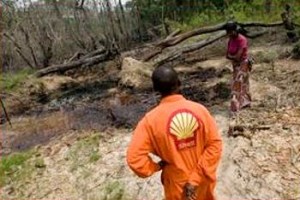
Environment News Service: Dutch Court Finds Shell Liable for Nigeria Oil Damages

http://ens-newswire.com/2013/01/30/dutch-court-finds-shell-liable-for-nigeria-oil-damages/

Posted by News Editor in Energy, Latest News, RSS on January 30, 2013 8:27 am / no comments

THE HAGUE, The Netherlands, January 30, 2013 – A Dutch court ruled today that Shell is responsible for not preventing the pollution of farmlands at Ikot Ada Udo in Nigeria’s Akwa Ibom State and ordered the company to pay compensation for the damage.

The case was brought by Friends of the Earth Netherlands and four Nigerian farmers in 2008 against the Shell Petroleum Development Company of Nigeria Ltd. and its parent company Royal Dutch Shell.

This is the first time that Shell has been ordered by a court to pay compensation for damage caused by its operations. The Nigerian justice system has never produced such a ruling.


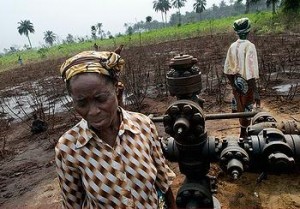
Women at a leaking oil wellhead near the community of Ikot Ada Udo in the Niger Delta, (Photo by Kadir van Lohuizen/NOOR courtesy FOE Netherlands)

The case is unique because it is the first time that a Dutch multinational corporation has been brought before the court in its home country for environmental damage caused abroad.

The case focused on just three of the thousands of oil leaks in Nigeria. The plaintiffs demanded that Shell clean up the oil pollution in the villages, compensate the farmers for the damages suffered and maintain the oil pipelines better in the future.

“This win for the farmers of Ikot Ada Udo has set a precedent as it will be an important step that multinationals can more easily be made answerable for the damage they do in developing countries. We anticipate other communities will now demand that Shell pay for the assault on their environment,” said Friends of the Earth Nigeria’s Executive Director Nnimmo Bassey, who played a pivotal role in bringing to light the havoc wreaked by Shell in the Niger Delta.

The ruling is a victory for Nigerian people and the environment, said Geert Ritsema of Friends of the Earth Netherlands, or Milieudefensie in Dutch. “This verdict is great news for the people in Ikot Ada Udo who started this case together with Milieudefensie. But the verdict also offers hope to other victims of environmental pollution caused by multinationals,” he said.

“At the same time, the verdict is a bitter disappointment for the people in the villages of Oruma and Goi – where the court did not rule to hold Shell liable for the damage,” said Ritsema. “Fortunately, this can still change in an appeal.”

Friends of the Earth Netherlands and the Nigerian farmers will appeal the decision in the Goi and Oruma cases.

The plaintiffs will also appeal the principle point of the liability of the Royal Dutch Shell parent company.

The reason that the court did not decide to hold the parent company liable for damage done in Nigeria was that Friends of the Earth Netherlands was denied access to evidence proving that Royal Dutch Shell, based in the Netherlands, determines the daily affairs of its Nigerian subsidiary, Royal Dutch Shell owns 100 percent of Shell Nigeria shares, while Shell Nigeria profits estimated at 1.8 billion euros annually, are deposited in the Netherlands.

Nevertheless, under existing laws, Royal Dutch Shell cannot be held liable for the damage done on the basis of these facts alone. The plaintiffs must prove that governance actually comes from the corporate headquarters in the Netherlands.

Because Shell has not been ordered by the court to allow access to internal company documents which would expose this governance, it has been very difficult to prove this.

Paul de Clerck of Friends of the Earth Europe, said, “Many European companies are involved in similar situations to that of Shell and are causing environmental damage outside Europe. We see a clear gap in European legislation. It allows European parent companies such as Royal Dutch Shell to pocket the profits from a foreign subsidiary, but these parents cannot be held liable for the damage they cause while making those profits.”

Friends of the Earth Europe is urging the European Commission to ensure that parent companies are automatically held liable for the actions of their foreign subsidiaries.

Next week, on February 6, the European Commission will discuss with stakeholders steps it can take to limit the adverse human rights and environmental impacts of business.

Friends of the Earth Netherlands finds it “incomprehensible” that the court ruled that Shell proved sabotage was involved in two of the three villages. The court has allowed itself be convinced by a number of blurry Shell photos and poor quality video images.

The environmental group remains convinced that poor maintenance is the cause of the spills. But even in oil spills where sabotage is involved, the group believes that Shell bears responsibility and is liable for the damage.

“An oil giant cannot leave 7,000 kilometres of pipeline and hundreds of installations unprotected and unguarded in a politically unstable and economically underdeveloped region,” said Ritsema.

Plaintiff Chief Eric Dooh lost his farm and fish ponds due to an oil spill from a Shell Nigeria pipeline.


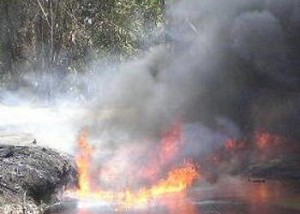
Shell oil spill into Chief Eric Dooh’s creek caught fire. (Photo courtesy FOE Netherlands)

“In September 2004, a leak occurred along the Trans-Niger pipeline, which is owned by Shell,” says Chief Dooh. “The spilled oil streamed from the leak into the creeks. A large fire quickly developed. It spread out over the oil slick in rapid tempo, and the whole creek was ablaze.”

“We gathered together a group of people as quickly as possible to take up contact with Shell,” recounts Chief Dooh. “Shell came here the following day with firemen, police officers and soldiers. For three days they tried to put out the fire, but when they were unable to do so, they simply let the fire burn itself out and all the mangrove trees were burned.”

“Because of the spill, I’ve lost everything,” he says. “The embankments around my fish ponds were destroyed by the fire, so oil streamed into my ponds and killed all my fish. The five canoes I owned burned, my cassava farm burned down and the trees I had planted have gone up in smoke. I have nothing left. All the money I saved, all my hard work, it was all for nothing.”
An oil disaster has been ongoing in Nigeria for decades. Tens of millions of barrels of oil have been spilled there since the 1950s.

Friends of the Earth Netherlands says that Nigeria’s oil spill disaster does not receive the attention it deserves, in contrast to other oil disasters such as the Exxon Valdez tanker in Prince William Sound Alaska or the Deepwater Horizon in the Gulf of Mexico, where there was massive public outrage that resulted in an emergency plan. The group said today, “The Nigerian disaster is a silent one, which has disastrous consequences for people, wildlife, nature and the environment, but little is being done about it.”

The Niger is the third-largest river in Africa and the oil-rich Niger Delta region, with its mangrove forests, is one of the world’s largest wetland areas. But now a black layer of oil covers many of the Niger Delta’s creeks, ponds, mangroves and rivers. Many of the region’s animals are threatened, including chimpanzees, leopards and elephants.

Niger Delta residents experience the burdens of oil extraction, but reap no benefits. Most are dependent on agriculture, fishing and fish farming and gathering snails and other products from the forests. For them, oil pollution means a lack of drinking water, inedible fish, agricultural fields that must lie fallow for years and crops that never grow.

In August 2011, the UN Environment Programme issued the results of its 14-month investigation covering more than 200 locations, 122 kilometres of pipeline rights of way, more than 5,000 medical records and talks with 23,000 people at local community meetings.

UNEP found that control and maintenance of oilfield infrastructure “has been and remains inadequate. The Shell Petroleum Development Company’s own procedures have not been applied, creating public health and safety issues.”

UNEP concluded that environmental restoration of the section of the Niger Delta known as Ogoniland “could prove to be the world’s most wide-ranging and long term oil clean-up exercise ever undertaken if contaminated drinking water, land, creeks and important ecosystems such as mangroves are to be brought back to full, productive health.”


A Niger Delta resident shows a Shell Nigeria worker a pool of spilled oil. (Photo courtesy FOE Netherlands)

Copyright Environment News Service (ENS) 2013. All rights reserved.

Environment News Service (http://s.tt/1z9qT)

Special thanks to Richard Charter

Oil and Gas Journal: Senate Democrats oppose Atlantic offshore seismic tests

http://www.ogj.com/articles/2013/01/senate-democrats-oppose-atlantic-offshore-seismic-tests.html?cmpid=EnlDailyJanuary312013

Oil and Gas Journal: Senate Democrats oppose Atlantic offshore seismic tests
WASHINGTON, DC, Jan. 31
01/31/2013
By Nick Snow
OGJ Washington Editor

Seven other US Senate Democrats joined Frank R. Lautenberg (NJ) in expressing concern over Atlantic offshore seismic tests planned as part of the Obama administration’s 2012-17 Outer Continental Shelf management program.

“While we support your administration’s decision not to allow lease sales for offshore oil and gas drilling in the Atlantic Ocean, the proposed seismic testing poses a serious threat to our coastal economy, environment, and marine life,” they said in a Jan. 30 letter to US President Barack Obama.

Seismic testing off the US Atlantic coast from Delaware to the middle of Florida “could injure or kill thousands of marine mammals and fish, including endangered speciesŠin addition to moving the region closer to risky offshore oil drilling,” the letter noted.

In addition to Lautenberg, Sens. Sheldon Whitehouse (RI), Patrick J. Leahy (Vt.), Robert Menendez (NJ), Benjamin L. Cardin (Md.), Barbara A. Mikulski (Md.), Barbara Boxer (Calif.), and Maria E. Cantwell (Wash.) signed the letter.

Contact Nick Snow at nicks@pennwell.com.

Special thanks to Richard Charter

"Be the change you want to see in the world." Mahatma Gandhi