Common Dreams: David vs. Goliath: Keystone XL Multinational Bullies Pipeline Protestors into Settlement

http://www.commondreams.org/headline/2013/01/29-1

I can’t believe the court sided with Transcanada. Sad comment on our civil liberties. dv

Published on Tuesday, January 29, 2013 by
Tar sands activists vow to keep fighting despite repressive tactics
– Lauren McCauley, staff writer

Transcanada, the multinational giant behind the proposed Keystone XL tar sands pipeline, has followed a new corporate strategy by filing crushing lawsuits against individual activists and financially vulnerable organizations that have tried to halt to the construction of the controversial project.
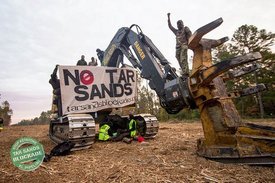
(Photo: Tar Sands Blockade) Despite the repressive tactics designed to censor opposition and intimidate others from joining such activities, those targeted vow to continue the fight to protect “their homes and futures from toxic tar sands.”

The suit’s defendants, which included several environmental groups including anti-pipeline coalition Tar Sands Blockade and 19 individual protesters, “were threatened with losing their homes and life’s savings if the lawsuit went forward,” Tar Sands Blockade said a press statement.

Kevin Gosztola of FireDogLake explains:

The suit brought was what is known as a Strategic Lawsuit Against Public Participation (SLAPP). Such lawsuits enable fascism by providing a mechanism for a corporation to go after individuals or groups engaged in protest or freedom of speech. They are often used against people who lack resources or cannot afford to pay the legal expenses necessary to stand up to a corporation in court.

Despite the legal setback, members of Tar Sands Blockade vowed to keep fighting.

“TransCanada is dead wrong if they think a civil lawsuit against a handful of Texans is going to stop a grassroots civil disobedience movement,” said spokesperson and defendant Ramsey Sprague. “This is nothing more than another example of TransCanada repressing dissent and bullying Texans who are defending their homes and futures from toxic tar sands.”

Tammie Carson, another target of the lawsuit and grandmother from Arlington, TX, said she took the action to protect her grandkids’ future. “I couldn’t sit idly by and watch as a multinational corporate bully abused eminent domain to build a dirty and dangerous tar sands pipeline right through Texans’ backyards,” she said. “I had no choice but to settle or lose my home and everything I’ve worked for my entire life.”

Citing one court’s opinion of the SLAPP lawsuit, the Civil Liberties Defense Center (CLDC) writes, “Short of a gun to the head, a greater threat to First Amendment expression can scarcely be imagined.”

In reaction to the settlement, Lauren Regan, veteran attorney with CLDC who helped coordinate legal representation for the activists, said:

This is a David versus Goliath situation, where an unethical, transnational corporation is using its weight to crush First Amendment rights of people speaking out and resisting the irreparable destruction that will result from construction of this highly controversial XL Pipeline…But the resistance to the pipeline is growing, not shrinking; it’s coming from everywhere. This is a national and global issue that will effect us all.

Lawyers from the CLDC represented the Tar Sands Blockade, Rising Tide North America and Rising Tide North Texas as well as the other targeted individuals. As part of the settlement, the activists agreed to no longer trespass or cause damage to Keystone XL property throughout the pipeline’s entire southern leg, including any demonstrations “aimed at interfering with pipeline construction,” the Toronto Star reports.

However, as Gosztola adds, “what it does not do is stop individuals unknown to TransCanada and groups other than Tar Sands Blockade or Rising Tide chapters from engaging in nonviolent civil disobedience or disruptive activity.”

Common Dreams: You Ain’t Gonna Frack Near Maggie’s Farm: Action Blockades Shell Site

http://www.commondreams.org/headline/2013/01/28-4

Published on Monday, January 28, 2013

In fight against fracking, activists say: ‘Our voices and our numbers are growing’
– Andrea Germanos, staff writer

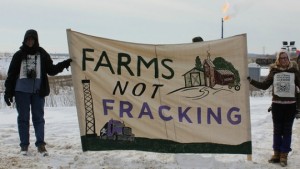
Anti-fracking activists in Bessemer, Penn. on Sunday. A flare from Shell’s drilling is visible in the background. (Photo: Shadbush Collective)

We need farms, not fracking.

This was the message from a group of concerned activists on Sunday afternoon as they blocked a Shell fracking site in Pennsylvania in part of the wave of rising actions against fossil fuels.

Wearing signs reading “Fracking Threatens Food” and “Protect Farms for Our Future,” members of the Shadbush Environmental Justice Collective rallied behind the passionate Maggie Henry, whose organic pork and poultry farm is less than 4,000 feet from Shell’s drilling site.


“People buy my food because they know that it is literally the purest that you can get. My animals run around out on ground, in pasture. They’re not cooped up in cages,” said Henry, who’s been farming for 35 years. “Agriculture, not fracking, is the number one industry in Pennsylvania. This threatens my air, my water, my farm, my livelihood.”

She’s put her blood and sweat into her “beyond organic” farm, she said. “Every single penny we’ve earned we’ve invested into this farm.”

With her farm, water and environment potentially ruined from Shell’s fracking, Henry asked, “How is this different from Shell sticking their hand in my pocket and stealing from me?”

Devon Cohen, one of the protesters involved in the day’s action, added, “Why are we willing to risk so much at the hands of multinational corporations like Shell who have shown their hand in the past as human rights abusers and irresponsible parties of environmental destruction?”Photo: Shadbush Collective

Hundreds of abandoned oil wells make the site a particularly risky place to frack, the group says. Hydro-geologist Daniel Fisher, who has studied the area, warned, “Each of these abandoned wells is a potentially direct pathway or conduit to the surface should any gas or fluids migrate upward from the wells during or after fracking.”

Four of the protesters locked themselves to a large papier-mâché pig named Henrietta, which blocked traffic to the site for three hours. Henrietta was made to symbolize the farm as well as “the gas industry [which] is piggish about the carbon-based fuel in the ground and are taking it at our expense,” Henry said.

When the protesters locked in the “pig” agreed to disperse and avoid arrest after several hours, Shell took it. In Henry’s words, “They stole Henrietta.”

Nick Lubecki, one of the protesters who was locked to Henrietta, started his own farm this year in Pittsburgh and said, “It is extremely disturbing as a young farmer to have to worry about the safety of the water supply and a chaotically changing climate while these out of state drillers have the red carpet rolled out for them. In a few years the drillers will all be gone when this boom turns to bust like these things always do. I don’t want to be stuck with their mess to clean up.”

The group stated, “Henrietta’s fate is in Shell’s hands, but we’re free to fight another day, our voices and our numbers are growing, and we won’t stop until we win.”

Maggie Henry is not about to stop fighting, either. “We’re not giving up until they give up,” she said.

Farmer Maggie Henry and activists locked to Henrietta. (Photo: Shadbush Collective)

Common Dreams: More Threats From Fracking: Radioactive Waste

http://www.commondreams.org/headline/2013/01/25-6

Published on Friday, January 25, 2013 by Common Dreams

Pennsylvania’s DEP begins study on radioactivity from oil, gas development; follows other studies showing high levels of radium, boron
by- Andrea Germanos, staff writer

The controversial drilling practice known as fracking is under renewed scrutiny, this time for producing radioactive waste.

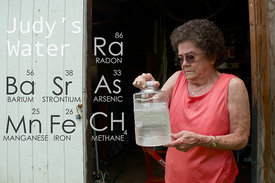
A resident holds up contaminated water from her well, located near a fracking site. (Photo: Public Herald)

Pennsylvania’s Department of Environmental Protection announced Thursday it was embarking on a year-long study of radioactivity in by-products from oil and natural gas development.

But findings and any action from the study may come too late for people like Portage, Pennsylvania resident Randy Moyer, who is suffering from a flurry of health problems he believes are the result of radiation exposure from his work transporting fracking wastefluids. Pennsylvania’s Beaver County Times reports:

Moyer said he began transporting brine, the wastewater from gas wells that have been hydraulically fractured, for a small hauling company in August 2011. He trucked brine from wells to treatment plants and back to wells, and sometimes cleaned out the storage tanks used to hold wastewater on drilling sites. By November 2011, the 49-year-old trucker was too ill to work. He suffered from dizziness, blurred vision, headaches, difficulty breathing, swollen lips and appendages, and a fiery red rash that covered about 50 percent of his body.

“They called it a rash,” he said of the doctors who treated him during his 11 trips to the emergency room. “A rash doesn’t set you on fire.”

Moyer spent most of last year in his Portage apartment, lying on the floor by the open screen door because his skin burned so badly, while doctors scrambled to reach a diagnosis.

Rather than putting the brakes on fracking, the DEP study appears to cement the industry’s foothold. John Hurdle writes in the New York Times’ Green blog:

Kevin Sunday, a spokesman for the department, said the new study, which covers both conventional oil and gas development and hydraulic fracturing, was not a response to any evidence of excessive radiation levels at drilling sites. Rather, he said, it is a “forward-looking” exercise that anticipates the long-term expansion of the industry.

“We recognize that the industry is here to stay, and we want the public to be protected,” Mr. Sunday said.

A recent study out of Penn State looking at wastewater, also called flowback, from fracking in the Marcellus shale found high levels of radioactive radium and barium.

“Improper disposal of the flowback can lead to unsafe levels of these and other constituents in water, biota and sediment from wells and streams,” the researchers said.

A 2011 study from the U.S. Geological Survey also found that fracking wastewater can be highly radioactive.

Despite numerous studies on fracking’s dangers, the NRDC (Natural Resources Defense Council), in a release on its May 2012 report that looked at how Pennsylvania gas companies dealt with the waste from fracking, stated:

All currently available options for dealing with contaminated wastewater from fracking inadequate to protect human health and the environment.

Santa Rosa Press Democrat: Marine sanctuary expansion praised at hearing

http://www.pressdemocrat.com/article/20130124/ARTICLES/130129719/1350?Title=Marine-sanctuary-expansion-praised-at-hearing

Santa Rosa, California

By GUY KOVNER
THE PRESS DEMOCRAT
Published: Thursday, January 24, 2013 at 8:36 p.m.
Last Modified: Thursday, January 24, 2013 at 8:36 p.m.

BODEGA BAY – No contrary words were heard at a public meeting that filled Bodega Bay’s Grange Hall with about 70 citizens, federal officials and fishing industry representatives on Thursday night concerning a plan to protect an additional 2,770 square miles of the ocean off the rugged North Coast.

“There’s celebration in the air,” said Sonoma County Supervisor Efren Carrillo, who attended the first of three hearings on the proposed expansion of two national marine sanctuaries that have been in place since the 1980s.

“It was great,” said Norma Jellison of Bodega Bay, who sat at one of five tables where residents gave feedback to sanctuary officials.

Jellison said she’d like to see sanctuary officials establish an office in Sonoma County, possibly at the Bodega Marine Lab. “The sanctuary office in San Francisco is kind of far away.”

All the comments at her table were supportive of the proposed expansion, which will move the sanctuaries’ northern border from Bodega Bay more than 60 miles north to Alder Creek, near Point Arena in southern Mendocino County.

Oil, gas and mineral development are prohibited within the sanctuaries, which are managed by the National Oceanic and Atmospheric Administration.

The expansion plan, announced last month, brings to an apparent end the four-decade battle to preserve the Sonoma Coast from offshore oil drilling.

Sanctuary officials said they expect to complete the approval process by July 2014.
Former Rep. Lynn Woolsey of Petaluma, who retired this month after 20 years in Congress, got hearty applause and credit for establishing the coastal protection she had sought since 2004.

“We want to protect our fishing industry and we want to protect our environment. That’s it in a nutshell,” Woolsey said.

Two more public hearings on the sanctuary expansion plan are scheduled, at Point Arena on Feb. 12 and Gualala on Feb. 13, and written comments will be accepted through March

You can reach Staff Writer Guy Kovner at 521-5457 or guy.kovner@pressdemocrat.com.

Special thanks to Richard Charter

Santa Rosa Press Democrat: First hearing Thursday on plans to expand ocean sanctuaries

http://www.pressdemocrat.com/article/20130122/ARTICLES/130129868/1350?p=1&tc=pg

Santa Rosa, California

By BRETT WILKISON
THE PRESS DEMOCRAT
Published: Tuesday, January 22, 2013 at 4:01 p.m.
Last Modified: Tuesday, January 22, 2013 at 4:01 p.m.

Plans to expand two ocean sanctuaries and put all of Sonoma County’s coast and a third of Mendocino’s off limits to oil drilling are set to get their first public airing Thursday in Bodega Bay.

Federal officials are scheduled to hold a 6 p.m. hearing at the town’s Grange Hall to discuss the proposed expansion of the protected ocean areas, announced by the Obama administration and congressional representatives last month.

Under the proposal, the Gulf of the Farallones and Cordell Bank national marine sanctuaries would take in an additional 2,770 square miles, including more than 60 miles of coast from Bodega Bay to Point Arena, in southern Mendocino County.

The two protected areas currently span about 1,800 square miles, stretching more than 50 miles off the coast in some spots from San Francisco Bay to Bodega Bay. The sanctuaries allow fishing but restrict other activities, including energy development, seafloor disturbance and discharges by ocean liners.

Thursday’s hearing, the first of three planned on the North Coast, will unveil the proposal and allow public comment on the expansion. The other two meetings are planned next month for Mendocino County, in Point Arena Feb. 12 and in Gualala Feb. 13. Written comments will be accepted through March 1.

“Our main goal is to get everyone sitting down at the table and make sure we’re hearing what their concerns are and what their suggestions are,” said Mary Jane Schramm, spokeswoman for the Gulf of the Farallones National Marine Sanctuary.

At least one additional round of public comment is envisioned once the federal government completes its draft environmental study. The new borders could be finalized in 18 to 24 months, according to the National Oceanic and Atmospheric Administration, which oversees marine sanctuaries.

The action by the Obama administration would put an apparent end to the four-decade battle to prevent oil drilling off the Sonoma coast.

Previous efforts to achieve a permanent ban and expand the sanctuaries through congressional action have come up short. Rep. Lynn Woolsey, the now-retired Petaluma Democrat, saw her sanctuary bill die in the Senate in 2008 before being thwarted recently by oil-friendly House Republicans.

Environmentalists, commercial fishing representatives and others have hailed the new plans, saying they protect an important resource, and not just for wildlife.

“Sanctuaries are known allies to the economic interests that depend on a clean coast,” said Richard Charter, a veteran anti-drilling lobbyist and Jenner area resident who serves as senior fellow of the Ocean Foundation.

Given the large North Coast crowds that have turned out in the past to oppose drilling proposals, Thursday’s hearing on enhanced protection for the coast could mark a historic turning point, Charter said.

“People have been waiting for this opportunity for a long time,” he said. “It’s finally something we can avidly support.”

You can reach Staff Writer Brett Wilkison at 521-5295 or Brett.wilkison@pressdemocrat.com.

____________

Facts
Hearings on marine sanctuary expansion
Thursday, 6 p.m., Grange Hall, Bodega Bay
Feb. 12, 6 p.m., Point Arena High School, Point Arena
Feb. 13, 6 p.m., Gualala Community Center, Gualala
Public comment will be accepted through March 1. For more information, visit http://farallones.noaa.gov/manage/northern_area.html

Special thanks to Richard Charter

"Be the change you want to see in the world." Mahatma Gandhi