Common Dreams: Sanders Welcomes Obama Statement on Global Warming

FOR IMMEDIATE RELEASE
January 22, 2013
4:46 PM

CONTACT: Senator Bernie Sanders

Michael Briggs (202) 228-6492

WASHINGTON – January 22 – Sen. Bernie Sanders (I-Vt.) today issued the following statement welcoming President Barack Obama’s support for action to combat climate change:

“The president is right to make action on global warming a central goal of his administration. The overwhelming scientific consensus is clear. Unless we take bold action soon the temperature of our planet could rise by up to 8 degrees Fahrenheit. That would be catastrophic. The Senate is about to vote on more than $50 billion in aid to help recover from Hurricane Sandy and insurers tell us that is only a fraction of the price we will continue to pay for extreme natural disasters made worse by our warming planet.

“While the president can, and must, move aggressively to use executive powers to reduce pollution and reject harmful projects like the Keystone XL pipeline, he also must help lead an effort to pass strong legislation that moves our nation away from polluting fossil fuels and toward energy efficiency and sustainable energy.

“Next month, I will introduce comprehensive legislation that will charge the fossil fuel corporations a fee for their carbon pollution. My legislation will end fossil fuel subsidies, and as the president called for, make historic investments in energy efficiency and sustainable energy technologies such as wind, solar, geothermal and biomass. This bill will also ensure that all Americans receive a rebate to offset any efforts by the fossil fuel companies to jack up their prices.

“The president and Congress have made some good progress in his first term, including significant investments in clean energy and strong new fuel economy standards for cars and trucks. To put meaning into the words he eloquently expressed in his Inaugural Address, and to protect our planet for our children and grandchildren, we must do much, much more. We must do nothing less than transform our energy system away from fossil fuels into energy efficiency and sustainable energy. When we do that we will not only lead the world in a new direction but create millions of jobs in the United States.”
###

United States Senator for Vermont

Common Dreams: Outrage as “Public” Locked Out of “Public Hearings” on Tar Sands Pipeline

Published on Tuesday, January 15, 2013
Environmentalist and indigenous groups rally against Northern Gateway and unfair proceedings in British Columbia
– Lauren McCauley, staff writer

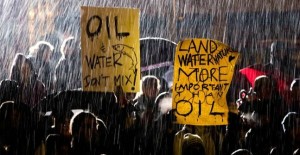
Protesters braved a rare, wet snow as they demonstrated against the Enbridge Northern Gateway Pipeline in Vancouver on Monday Jan. 14. (Photo:Darryl Dyck/The Canadian Press)Thousands of activists marched on downtown Vancouver Monday to protest the nature of public hearings on the proposed Northern Gateway pipeline, claiming that “the public” opponents of the pipeline are being locked out while industry backers are given special access.

Buoyed by the recent vigor of the Idle No More campaign, environmental activists, indigenous groups and other opponents of the proposed tar sands pipeline condemned the public portion of the National Energy Board (NEB) panel hearings on the basis that they limit public comment.

“They’re constraining the dialogue,” said protest organizer Suresh Fernando, explaining that the presenters are being restrained in what they can say. For example, they “can’t make reference …to the oilsands and the bigger picture.”

Despite being heralded as “public”, the hearings are restricted to presenters, members of the NEB panel, industry backers including Enbridge representatives; members of the community are secluded to a seperate venue where they watch the proceedings via live stream.

According to a blog post on the Pipe Up Against Enbridge site, “the process set up to review the proposed Enbridge Northern Gateway pipeline and tankers project, is keeping the public out of the public process.”

They continue:

Anyone who wishes to witness the proceedings can only do so at a separate hotel, three kilometres away, via a video feed.

This separation of public from public process is happening only for the community hearings in Victoria and Vancouver. These hearings are the only substantive opportunity for concerned citizens to share their concerns with the panel. They should also be the opportunity for us to witness our friends, neighbours, and community members, to watch and listen to the diversity of voices, the diversity of reasons for opposing tankers and pipelines.

Because it is through bearing witness, through listening to each other, that we build community and can work together to take whatever steps are needed to protect our coast.

But we are being denied witness.

In an address to the crowd outside, Eddie Gardner of the Stó:lo Nation blasted Stephen Harper, the Canadian Prime Minister, and other conservatives for recent changes made to environental laws declaring, “the Harper government has one of the most aggressive, high-carbon strategies in the world.”

He continued:

[Harper] implemented that legislation, it has become law, and he did it with crass and ruthless disregard for the environment.

Stephen Harper is hell bent to expand the tar sands.

Canada is coming alive to Harper’s real agenda… He is one of the biggest enemies of the environment.

The Canadian Press reports that the protests were “bolstered” by the “nationwide Idle No More campaign, which brought First Nations from as far as the Haisla Nation on the North Coast, near the would-be tanker port of Kitimat, B.C.”

The joint review panel is canvassing communities throughout B.C. and Alberta for comment on the proposed pipeline and has scheduled eight days of community hearings in Vancouver in the coming weeks. According to NEB spokeswoman Kristen Higgins, “(Whatever) information is on the public record is the information the panel can use to write their reports and make their recommendations.”

_____________________

Those who did make it in to the hearings did so with great effort. According to Pipe Up Against Enbridge, presenters had to register 18 months ago and schedule a presentation six months ago, “all without knowing when or where you would be speaking.” Reporting on some of the pipeline opponents testimonies, they wrote:

Dr. Gerald Graham, trained in marine response by the Canadian Coast Guard, said “the consequences of a major spill could be catastrophic and irreversible.” Reverend Ken Gray, an Anglican priest, reminded us to not treat others—including First Nations and all of creation—as we do not wish to be treated. This project, he said, “will injure us all and provide a shameful heritage for generations to come.”

A tar sands worker, Lliam Hildebrand, said that he would rather be using his trade to work in renewable energy. He shared with the panel a survey he conducted with his coworkers, “the hands and feet of our energy future.” A strong majority of these workers support a moratorium on raw oil exports and the transition of oil and gas subsidies to the renewable energy sector. “Workers in the oil sands understand that this project doesn’t make sense to Canada.”

_____________________

Outside of the hotel where the panel is taking place, a group of local multi-media artists erected a 25-foot-long installation called Hope the Whale. Twitter posts (#hopethewhale), videos and photos are projected onto the white whale’s skin, “to symbolize the expansive and growing community of people with a vision of an oil-free coast in BC,” wrote the group Pipe Up Against Enbridge.

Common Dreams: Climate Scientists to Obama: Heed the Planet’s Warnings, Reject the Tar Sands Pipeline

http://www.commondreams.org/headline/2013/01/15-5

Published on Tuesday, January 15, 2013
Letter issued Tuesday from 18 leading scientists urges Obama to show “climate convictions”
– Andrea Germanos, staff writer

Some of the nation’s leading climate scientists on Tuesday are urging President Obama to show his “climate convictions” and reject the tar sands-carrying Keystone XL pipeline.

(Photo: Emma Cassidy / Tar Sands Action) In an open letter, the 18 scientists, including noted climate scientist James Hansen, Ralph Keeling of Scripps CO2 Program Scripps Institution of Oceanography and James Box of the Byrd Polar Research Center, write that rejecting the pipeline would be a “relatively easy” step to take to address the planet’s rising temperature.

The letter reads, in part:

“As you may know, the U.S. has just recorded the hottest year in its history, beating the old mark by a full degree; the same year that saw the deep Midwest drought, and the fury of Hurricane Sandy, also witnessed the rapid and unprecedented melt of the Arctic ice pack. ” […]

“Eighteen months ago some of us wrote you about the proposed Keystone XL tar sands pipeline, explaining why in our opinion its construction ran counter to both national and planetary interests. Nothing that has happened since has changed that evaluation; indeed, the year of review that you asked for on the project made it clear exactly how pressing the climate issue really is.”

The Keystone XL, which would carry tar sands crude out of Alberta into the US, has met fierce resistance by climate activists and members of communities in the pipeline’s path.

In a call for civil disobedience at the White House in Aug. of 2011, Hansen, author Naomi Klein and 350.org’s Bill McKibben were among those who called the Keystone XL “a fifteen hundred mile fuse to the biggest carbon bomb on the continent, a way to make it easier and faster to trigger the final overheating of our planet, the one place to which we are all indigenous. ”

To make sure “the fuse to the biggest carbon bomb” is put out, climate activists are mobilizing for another mass action in DC on the February 17. Organizers write:

Just over a year ago, 15,000 people surrounded the White House — and President Obama listened, delaying the Keystone XL tar sands pipeline. This is our best chance to show the President how strong this movement has become since then — sign up today.

The application for the pipeline by its company, TransCanada, is under review from the State Department with a decision likely by the end of the first quarter of 2013.

Skytruth: Shell’s grounded rig

http://blog.skytruth.org/2013/01/shells-grounded-drill-rig-seen-from.html

Lots of folks lately, us included, have chronicled Shell’s confidence-shaking series of missteps, bad decisions and outright failures associated with their years-long, multi-billion-dollar campaign (technical and political) to drill for oil in the Arctic Ocean off the coast of Alaska. Shell has decided to downplay their latest mishap — losing control of their multimillion dollar drill rig, the Kulluk, while it was being towed to Seattle from the drilling site in the Chukchi Sea — as no big deal since the rig wasn’t actually drilling at the time.

Uhhh…so we’re supposed to feel better? Because they can’t get the simple stuff right? Understand that nothing is “simple” in these often wild waters, but in the scheme of things, if you can’t even move your equipment around without mishap, then how can you be trusted with the relatively complex and challenging processes of drilling and completing offshore oil wells in these waters? Or mounting a swift and effective oil spill response in ice-choked seas?
High-resolution satellite image showing the drill rig Kulluk aground off the coast of Alaska on January 4, 2013. Image courtesy DigitalGlobe. Subscribe to their WorldView report to see more great images.
It’s not just technology failures that lead to major disasters. Bad / risky decisionmaking plays a major part too. This November 9 news report said the Kulluk had been scheduled to spend the winter downtime in Dutch Harbor. So why was it being moved? Ostensibly for maintenance work that couldn’t be done in Dutch, but Shell admitted they were towing the Kulluk into the teeth of a major winter storm system in part to avoid paying taxes to the sate of Alaska. Shell said the storm was unexpected. This analysis of the forecasts for the area by meteorologist Cliff Mass suggests otherwise, raising the possibility that Shell risked personnel and very pricey hardware to dodge a $6 million tax bill; about 1/10th of 1 percent of the total project investment. And guess who came to the rescue of the crew and the stranded Kulluk? The US Coast Guard, courtesy of US taxpayers. What a deal.

Shell was allowed to start shallow “tophole” work on two of their planned wells in the Chukchi and Beaufort seas last summer, but they still need to secure Federal approval to continue drilling these wells to their full target depths. This disturbing pattern of technical and decisionmaking failures suggests the kind of corporate culture that investigators have implicated as the underlying cause of the catastrophic BP oil spill in the Gulf in 2010.

That approval needs to be withheld until investigators, regulators and the public have enough information to confidently make the correct decision. There’s no rush. The oil ain’t going anywhere. And after all, down here in the Lower 48, Shell is producing so much oil they want permission to export it to Canada.

Let’s slow down and make sure we get this right.


Posted By John Amos to SkyTruth at 1/11/2013 12:27:00 PM

John Amos – President, SkyTruth
John@skytruth.org
P.O. Box 3283
Shepherdstown, WV 25443-3283
(o) 304.885.4581 (m) 304.260.8886
skype: skytruth.amos
******************************************************************
Satellite images and digital mapping for environmental protection,
education and advocacy – a 501(c)(3) nonprofit organization
Visit us on the Web at http://www.skytruth.org
Follow us on Twitter, Facebook, Flickr and Blogger
******************************************************************

Special thanks to Richard Charter

SarasotaPatch: Mote Study: BP Oil Spill Cleaning Chemical Kills Coral

http://sarasota.patch.com/articles/mote-study-bp-oil-spill-cleaning-chemical-kills-coral?ncid=newsltuspatc00000001

Dr. Ritchie is right on target with this analysis. Dispersants and especially Corexit should be banned in fragile coral reef ecosystems. DV

SarasotaPatch
Sarasota, Florida

A Mote Marine Laboratory study of the cleaning agent Corexit 9500 showed that the cleaning agent in BP oil spill disaster also caused great harm to coral.

By Charles Schelle
January 9, 2013

A new report from Mote Marine Laboratory in Sarasota released Wednesday reports that cleanup efforts from the Deepwater Horizon oil rig disaster could be causing a real threat to fragile coral reefs.

The study focused on studying coral larvae and seeing how a dispersant that is used to cling to oil slicks and diffuse it from reaching shores could actually be just as toxic. The findings are published in the peer-reviewed journal PLOS ONE.

The 2010 BP disaster spilled more than 200 million gallons of oil into the Gulf of Mexico and responders used these dispersants, one called Corexit 9500, to prevent the oil from reaching beaches.

“Overall, these findings indicate that exposure of coral larvae to the dispersant Corexit 9500 is toxic and will result in loss of coral recruitment,” the study states.
It turns out that the dispersant is just as harmful to certain marine life as the oil itself.

“Dispersant, and the mixture of oil and dispersant, may be highly toxic to coral larvae and prevent them from building new parts of the reef,” said Dr. Kim Ritchie, principal investigator on the emergency Protect Our Reefs grant supporting this study and manager of the Marine Microbiology Program at Mote. “In addition, our results support the growing knowledge that certain coral species may fare worse than others during oil spills.”

Mote scientists looked to study the effects of two Florida Keys coral species-mustard hill coral and mountainous star coral-and placing larvae of these corals in different sets of solutions.

The test solutions include saltwater plus Dissolved Deepwater Horizon oil from the rig, weathered oil, Corexit 9500 and a final one with the oil and the Corexit 9500. The coral larvae was placed in various concentrations of solutions for 72 hours while the mountainous star coral larvae was tested in slowly diluted solutions during a 96-hour period, according to Mote.

As expected, the larvae exposed to oil died sooner than ones only in seawater, and the mountainous star coral had a lower chance of surviving in the lowest oil concentration tested of .49 parts per million diluted over that 96-hour window, according to the study.
Even worse was the Corexit 9500-the very chemical that many hoped would clean up the oil and save marine life.

No mountainous star coral larvae settled or survived at the medium and high concentrations of 50 and 100 parts per million and no mustard hill coral larvae settled or survived at 100 parts per million.

The study says that most of the mountainous star coral didn’t even survive the lowest concentration test of .86 parts per million.

What do these scientific measurements mean to the naked eye?

“Depending on the concentration, the higher the concentration of oil and dispersant, the more opaque it becomes. With the dispersant only (Corexit 9500), there was little cloudiness and with the water soluble oil mixture (WAF) it was perfectly clear,” said Dr. Dana Wetzel, manager of Mote’s Environmental Laboratory for Forensics. So it’s not exactly water that humans would be fond of interacting with either.

The water soluble oil mixture is the chemicals from the oil that are able to dissolve in water; oil has many different chemical components, Wetzel continued to explained.
Fresh oil from Deepwater Horizon also started killing the larvae within the first 24 hours, according to the study.

Ritchie led the investigation along with Wetzel, Dr. Gretchen Goodbody-Gringley, former Mote postdoctoral researcher who is now an instructor at Bermuda Institute of Ocean Sciences, and were conducted both in Sarasota and at the Mote Tropical Research Laboratory on Summerland Key.

“The decision to use dispersant chemicals poses trade-offs for oil spill responders. While a dispersed surface oil slick is rendered less likely to reach the shore, treatment of major oil spills with dispersant chemicals has been shown to result in significant environmental degradation as a result of increased hydrocarbon dissolution and surfactant toxicity,” the team wrote in their study.

Wetzel said what this study does is provide information on how oil and dispersants effect coral larvae because that wasn’t available before. Scientists have known how fish and shellfish were damaged though.

The Florida Keys coral were not directly affected by Deepwater Horizon, according to the study, but these types of coral are also found in the Northwestern Gulf closer to the oil rig, but those coral were not directly affected either, according to the study.

Scientists believe, however, that oil exploration near Cuba could pose further harm.

“To understand how oil and dispersant could affect wild corals, more research is needed on their complex natural life cycles,” Ritchie said. “Coral larvae seem to settle with help from landing pads called ‘biofilms’ that are formed by microbes like marine bacteria. This delicate natural process might be interrupted by dispersant and its mixture with oil, so it’s important to know how it works in detail.”

BP settled in November with the federal government in for $4.5 billion for its role in the spill. Sarasota County hopes it can claim $5.25 million from the case.

The owner of the rig itself, Transocean Ltd., was due in New Orleans federal court Wednesday to pay a $400 million settlement with the Justice Department for violating the Clean Water Act, the Associated Press reported.

Special thanks to Richard Charter
"Be the change you want to see in the world." Mahatma Gandhi