Nola.com: Federal appeals court in New Orleans hands rare win to environmental group in BP oil spill case

http://www.nola.com/news/gulf-oil-spill/index.ssf/2013/01/federal_appeals_court_in_new_o.html#incart_m-rpt-2

Times-Picayune

Fireboats try to extinguish the blaze on the Deepwater Horizon oil rig south of Venice after an explosion on Wednesday, April 21, 2010. The explosion killed 11 workers on the rig. (Photo by Michael DeMocker, NOLA.com | The Times-Picayune)
By Mark Schleifstein, NOLA.com | The Times-Picayune
on January 09, 2013 at 8:01 PM, updated January 10, 2013 at 7:31 AM

BP and its partners in the Macondo well that released an estimated 4.9 million gallons of oil over three months beginning in April 2010 should be required to inform state officials — and the public — of the toxic materials included in the spill, and the potential health effects of those materials, a three-judge appellate panel ruled in New Orleans on Wednesday. In winning the unanimous decision, the Center for Biological Diversity environmental group scored a rare partial victory before the U.S. 5th Circuit Court of Appeals in its attempts to pry more compliance with federal environmental laws out of BP in the aftermath of the Deepwater Horizon oil spill.

The federal appeals court agreed with U.S. District Court Judge Carl Barbier that most of the center’s efforts to require BP to pay additional fines or otherwise be penalized for violations of the Clean Water Act; Comprehensive Environmental Response,
Compensation and Liability Act; and Emergency Planning and Community Right-to-Know Act (EPCRA) under provisions of those laws allowing individuals to enforce them became moot when federal officials declared BP’s Macondo well to be capped on July 15, 2010, and effectively “killed” on Sept. 19, 2010, by cementing its wellhole after being intercepted by a relief well.

“It’s a very important victory that BP could be finally forced to publicly disclose all the toxic components it spilled into the waters, but we’re disappointed by the dismissal of our Clean Water Act claims,” said Miyoko Sakashita, oceans director for the center.
“Throughout it all, we’ve insisted that those responsible for one of the worst environmental disasters in America’s history should be held fully accountable for the profound damage they caused. The Gulf needs to be fully restored, both for the sake of its wildlife and for the people who depend on it for survival. We’re certainly not there yet.”

BP and other companies responsible for the spill still face a civil court proceeding over environmental fines and other actions required under the federal environmental laws, as part of the complex combination of lawsuits that have the federal government and attorneys representing private plaintiffs opposing them in court on Feb. 25.

But the court also ruled that Barbier incorrectly found to be moot a provision of the Right-to-Know Act that required BP to report what hazardous substances were released during the spill to state and local government authorities, including local emergency planning committees, with the information then made available to the public.

In opposing the appeal, BP attorneys argued that such information was being made available in the aftermath of the spill at various government web sites, but the three-judge panel was not persuaded by that argument.

“Our review of those web sites reveals a voluminous amount of information about the spill and the government’s response, but the specific information required by EPCRA is not immediately apparent.”

The ruling could require BP to reveal the hazardous materials involved in the spill and their health effects, and make the information public.

They found that the Right-to-Know Act specifically required the company to include “the name and estimated quantity of any substance involved in the release, the medium or media into which the release occurred, any known or anticipated acute or chronic health risks associated with the release, and the precautions to take as a result of the release.”

Those notices are required to be maintained by the state’s emergency response commission and must be made available to the public, they said.

In its suit, the center provided affidavits from members saying they’d been exposed to substances from the disaster, either through direct physical contact in the Gulf of Mexico or onshore, or through contact with fish and other wildlife.

“Those members averred that they were concerned about breathing air or ingesting water exposed to the substances and wanted to know what types of substances were involved in the Deepwater Horizon release so that they could assess the possible health effects of exposure,” said the ruling.

“Here, however, BP has never claimed that it has at any time complied with EPCRA’s reporting requirements for a written notice,” the ruling said, and the company’s failure to do so was a continuing violation of the law.

“An order from the district court that the defendants comply with EPCRA’s reporting requirement for that release could therefore redress the center’s claimed informational injury.”

The ruling, written by Judge Carolyn Dineen King of Houston, Texas, and agreed to by Chief Judge Carl Stewart of Shreveport and Priscilla Owen of Austin, Texas, sends the case back to Barbier for further action. King was appointed by President Jimmy Carter, Stewart by President Bill Clinton, and Owen by President George W. Bush.

Special thanks to Richard Charter
Richard Charter: Sanctuary Expansion: Permanent Protection for Our Sonoma and Mendocino Coastlines is Within Reach

http://SanctuaryExpansion.org

Check out this link; it explains how the expansion of our National Marine Sanctuaries will grant permanent protection from offshore drilling to one of California’s most iconic stretches of coastline, the dates and locations of the fast-approaching public hearings, and contains links for submitting written comments by the March 1, 2013 deadline.

Thanks very much.

Nola.com: Oiled pelican photo in “HOLD BP ACCOUNTABLE” ad greets Justice employees at Washington Metro station

http://www.nola.com/environment/index.ssf/2013/01/oiled_pelican_photo_in_hold_bp.html#incart_m-rpt-2

Times-Picayune
By Mark Schleifstein, NOLA.com | The Times-Picayune
on January 07, 2013 at 11:40 AM, updated January 07, 2013 at 1:42 PM

A photo of a struggling pelican coated with oil floating in the Gulf of Mexico now greets workers arriving at the Navy Archives Metro station, close to the Department of Justice’s Pennsylvania Avenue headquarters building. The photo is part of a National Wildlife Federation advertising placard demanding “HOLD BP ACCOUNTABLE.”

They’ve been placed at the station just weeks before the Feb. 25 beginning of the first phase of a federal trial that will determine the size of fines BP will face for violating the federal Clean Water Act. But they’re also aimed at urging Justice officials not to reduce the amount BP should be fined, if a settlement is reached before trail.

“Americans from all walks of life reeled in horror as BP’s negligence sent more than 200 million gallons of crude oil into the Gulf of Mexico,” said Aileo Weinmann, associate communications director for the National Wildlife Federation, in a news release announcing the new ad campaign. “We’re sending a signal to staff at the Department of Justice to hold BP fully accountable for up to $50 billion in civil fines and penalties.

“These Metro ads are a cost-effective way to press Department of Justice staff about the proper size of any BP settlement,” Weinmann said. “We used the famous AP/Charlie Riedel photo of an oiled pelican because it is such a distressing image that we knew it would be hard to ignore.”

Most estimates of BP fines focus on the company’s violation of the Clean Water Act, which would fall within $5 billion to $21 billion, based on how much the company would pay per gallon under the Clean Water Act, based on the release of 4.1 million barrels of oil during the spill, with the higher amount being paid if the company was found to be grossly negligent in its actions concerning the spill.

However, BP also faces significant liability under the Oil Pollution Act’s Natural Resource Damage Assessment provisions, which requires it to pay for any projects aimed at restoring natural resources and compensating the public for the loss of those resources during and after the spill. The federation estimates BP’s liability under the act to be at least $31 billion, based on the costs of natural resource damage restoration following the Exxon Valdez oil spill in Alaska in 1989.

And the company may also face additional fines for violation of other federal laws governing damage to natural resources, including the Migratory Bird Treaty Act and the Marine Mammal Protection Act.

The ad also includes a link to a page on the federation’s web site that allows people to send their own written message to Attorney Gen. Eric Holder requesting BP be held fully accountable.

View full size
This National Wildlife Federation advertising placard is in a Washington Metro stop used by Justice Department employees.
National Wildlife Federation

BPplackardWWFsm.jpg BPplackardWWFsm.jpg
Special thanks to Richard Charter

Common Dreams: Tar Sands Blockaders Take Over TransCanada Offices in Texas, Elsewhere

Published on Monday, January 7, 2013 by Common Dreams

Actions in Texas, Massachusetts and Maine target pipeline company and its financial backers
– Jon Queally, staff writer

Update (3:15 PM):

Members and supporters of the group Tar Sands Blockade staged public actions in Texas, Massachusetts, Maine and elsewhere on Monday in a series of independent protests at offices of the Transcanada Corporation—which is building the Keystone XL pipeline—and financial institutions supportive of tar sands infrastructure projects, such as TD Bank.

The largest action took place in Houston, Texas (see below), but others sprang up as the day progressed.

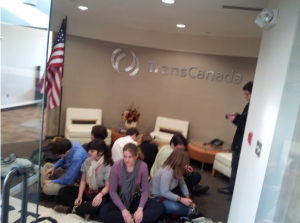
Campaigners in Westborough, Massachusetts—reportedly students—occupied the inside the entryway at the company’s offices and refused to leave.

The group explained their motivations in a prepared statement, which read in part:

“Our actions today aim to raise awareness and build momentum to halt the destruction that fossil fuel corporations knowingly cause. Science, and economics and logic provide an obvious imperative for action. However, even overwhelming factual evidence has not compelled our political leaders to stand up to these corporations. Our elected representatives have not yet found the courage to draw a clear line in the sand and prevent the construction of the Keystone XL pipeline.”

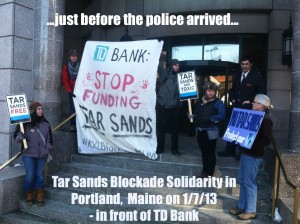
Meanwhile, citing the financial institution’s investment in the the Keystone XL pipeline project, several activists in Portland, Maine, blocked the entrance to a local branch of TD Bank and sent out this image:

A gathering was also reported in Detroit, Michigan.

Earlier:

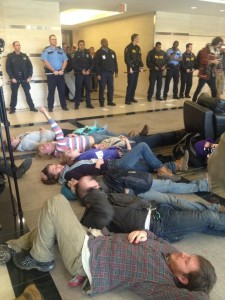
Members of the Tar Sands Blockade have staged a mass action in the Houston offices of the company behind the Keystone XL pipeline, TransCanada.


Tar Sands Blockaders take over TransCanada offices in Houston. (Photo: via Twitpic)

According to Tar Sands Blockade—a group of environmentalists and landowners working to stop the Keystone XL tar sands pipeline—more than one hundred protesters gathered to confront the Canadian-based pipeline company at its US headquarters in downtown Houston.

Citing land rights abuses, toxic legacy and climate change connected to TransCanada’s Keystone XL pipeline, some of the protesters staged a die-in in the lobby and are refusing to leave.

“This action kicks off a new phase of the Tar Sands Blockade targeting the corporate and financial infrastructure behind the Keystone XL pipeline,” the group said in a statement. “TransCanada’s pipeline uses seized land to transport toxic tar sands oil through Texas and Oklahoma communities, in order to export it from Houston ports. These dangerous business practices and the backlash from communities across the country make this pipeline a toxic investment for our state and TransCanada’s corporate lenders.”

Several arrests were reported.

The group also posted a request for supporters of their action in Houston to call TranCanada’s office and voice support for those currently in the lobby.

“You can help shut down work in TransCanada’s offices by flooding the phone lines all today to tell them we don’t want their dirty pipeline in anyone’s backyard,” the message said.

“Can you call TransCanada’s Keystone XL headquarters now to tell them you stand with your fellow Blockaders inside and outside their office today?” the group asked. The group also provided suggested names and numbers to call.

The group has been staging ongoing actions in Texas against the pipeline since last year, including an eighty-five day blockade in Winnsboro, Texas which saw a series of actions and numerous arrests surrounding a centralized encampent that resulted in a re-routing of the pipeline’s route. A more a recent tree-sit protest last week that ended in the arrest of several activists in Diboll, Texas.

Special thanks to Common Ground.

Grist: Surprise: Shell’s rig ran aground in Alaska because the company was trying to avoid taxes

http://grist.org/news/surprise-shells-rig-ran-aground-in-alaska-because-the-company-was-trying-to-avoid-taxes/

Why am I not surprised????? Drilling in the Artic should be banned given the oil & gas industry’s inability to deal responsibly with their operations.
DV

By Philip Bump

On New Year’s Eve, in the middle of a storm, Shell was trying to tow its Kulluk drilling rig from Alaska to Seattle. Why then? Why risk the bad weather, which, as it turned out, caused the rig to break free from its tugboats and run aground on Kodiak Island?

To avoid paying state taxes, of course. From Alaska Dispatch:
A Shell spokesman last week confirmed an Unalaska elected official’s claim that the Dec. 21
departure of the Kulluk from Unalaska/Dutch Harbor involved taxation.

City councilor David Gregory said Shell would pay between $6 million and $7 million in state
taxes if the Kulluk was still in Alaska on Jan. 1.

Ah, but the weather had other plans, sorry to say. Shell will end up having to pay that money after all, and then some.

Gregory said the departure of the Kulluk took money away from local small businesses servicing the rig. He predicted the maritime mishap will prove very costly to the oil company.

“It will cost them more than that $6 million in taxes. Maybe they should have just stayed here,” Gregory said.

The Kulluk grounding is costing taxpayers too. The 630 people working on the unified relief effort include employees of the state of Alaska and the U.S. Coast Guard. Twenty-one vessels are on the scene or nearby, and that doesn’t include aircraft.

Last night, the unified command held a press conference to update reporters on the status of the recovery. In short: Not much has changed. The Kulluk remains where it ran aground. Efforts to determine damage are still incomplete. The tens of thousands of gallons of fuel onboard don’t appear to be leaking.

One reporter asked a pointed question about how forthcoming Shell will be in sharing its assessment of the accident. You can guess the response.

Margie Bauman [reporter from Fishermans News Seattle]: [G]iven the seriousness of this
incident, why would Shell’s own investigation of this not be made public along with the Coast
Guard investigation? Thank you.

Sean Churchfield [Incident Commander and the Operations Manager for Shell Alaska]: OK. So
I think the main point I’d like to make on the investigation is Shell will collaborate, completely
cooperate-collaborate-collaborate completely with the Coast Guard and other investigations that are required.

Margie Bauman: Yes. But I’d like to know (cross talking)Š
Captain Paul Mehler [Coast Guard Federal On Scene Coordinator]: (Inaudible). But the Coast
Guard investigation, as I say, we’re bringing up investigators from the Center of Excellence, and we have our investigators working that. And of course the results of those findings will be made public.

Margie Bauman: And would that include Shell’s Š
Amy Midget [unified command representative]: And we will have those said (ph) remarks posted online for anybody who-on the phone system who is not able to hear them.
In other words, don’t hold your breath for Shell to be forthcoming.

There is some good news in all of this, for Shell anyway: The U.S. government shows no indication that it will reconsider the company’s permit to drill in the Arctic.

“The administration understands that the Arctic environment presents unique challenges and
that’s why the [interior] secretary has repeatedly made clear that any approved drilling activities will be held to the highest safety and environmental standards,” Salazar spokesman Blake Androff said Thursday. “The department will continue to carefully review permits for any activity and all proposals must meet our rigorous standards.”

Salazar has not given Shell permission to drill deep enough to actually hit oil. The company
hopes to get that approval this summer.

Shell didn’t get that permission last year because it was unable to demonstrate to the government that its spill-containment system would work, even after repeated testing.
All this mess so Shell could avoid $6 million in state taxes – an amount equal to 0.1 percent of its profits in the third quarter of 2012. Good to know that Shell puts money over safety. Bodes well.

Philip Bump writes about the news for Gristmill. He also uses Twitter a whole lot.

Special thanks to Richard Charter

"Be the change you want to see in the world." Mahatma Gandhi