http://www.aljazeera.com/indepth/features/2012/04/201241682318260912.html
Eyeless shrimp and fish with lesions are becoming common, with BP oil pollution believed to be the likely cause.
Dahr Jamail Last Modified: 18 Apr 2012 03:16
New Orleans, LA – “The fishermen have never seen anything like this,” Dr Jim Cowan told Al Jazeera. “And in my 20 years working on red snapper, looking at somewhere between 20 and 30,000 fish, I’ve never seen anything like this either.”
Dr Cowan, with Louisiana State University’s Department of Oceanography and Coastal Sciences started hearing about fish with sores and lesions from fishermen in November 2010.
Cowan’s findings replicate those of others living along vast areas of the Gulf Coast that have been impacted by BP’s oil and dispersants.
Gulf of Mexico fishermen, scientists and seafood processors have told Al Jazeera they are finding disturbing numbers of mutated shrimp, crab and fish that they believe are deformed by chemicals released during BP’s 2010 oil disaster.
Along with collapsing fisheries, signs of malignant impact on the regional ecosystem are ominous: horribly mutated shrimp, fish with oozing sores, underdeveloped blue crabs lacking claws, eyeless crabs and shrimp – and interviewees’ fingers point towards BP’s oil pollution disaster as being the cause.
Eyeless shrimp
Tracy Kuhns and her husband Mike Roberts, commercial fishers from Barataria, Louisiana, are finding eyeless shrimp.
“At the height of the last white shrimp season, in September, one of our friends caught 400 pounds of these,” Kuhns told Al Jazeera while showing a sample of the eyeless shrimp.
According to Kuhns, at least 50 per cent of the shrimp caught in that period in Barataria Bay, a popular shrimping area that was heavily impacted by BP’s oil and dispersants, were eyeless. Kuhns added: “Disturbingly, not only do the shrimp lack eyes, they even lack eye sockets.”
image001 6769.jpg 2 2
Eyeless shrimp, from a catch of 400 pounds of eyeless shrimp, said to be caught September 22, 2011, in Barataria Bay, Louisiana [Erika Blumenfeld/Al Jazeera]
“Some shrimpers are catching these out in the open Gulf [of Mexico],” she added, “They are also catching them in Alabama and Mississippi. We are also finding eyeless crabs, crabs with their shells soft instead of hard, full grown crabs that are one-fifth their normal size, clawless crabs, and crabs with shells that don’t have their usual spikes Š they look like they’ve been burned off by chemicals.”
On April 20, 2010, BP’s Deepwater Horizon oilrig exploded, and began the release of at least 4.9 million barrels of oil. BP then used at least 1.9 million gallons of toxic Corexit dispersants to sink the oil.
Keath Ladner, a third generation seafood processor in Hancock County, Mississippi, is also disturbed by what he is seeing.
“I’ve seen the brown shrimp catch drop by two-thirds, and so far the white shrimp have been wiped out,” Ladner told Al Jazeera. “The shrimp are immune compromised. We are finding shrimp with tumors on their heads, and are seeing this everyday.”
While on a shrimp boat in Mobile Bay with Sidney Schwartz, the fourth-generation fisherman said that he had seen shrimp with defects on their gills, and “their shells missing around their gills and head”.
“We’ve fished here all our lives and have never seen anything like this,” he added.
Ladner has also seen crates of blue crabs, all of which were lacking at least one of their claws.
Darla Rooks, a lifelong fisherperson from Port Sulfur, Louisiana, told Al Jazeera she is finding crabs “with holes in their shells, shells with all the points burned off so all the spikes on their shells and claws are gone, misshapen shells, and crabs that are dying from within Š they are still alive, but you open them up and they smell like they’ve been dead for a week”.
Rooks is also finding eyeless shrimp, shrimp with abnormal growths, female shrimp with their babies still attached to them, and shrimp with oiled gills.
“We also seeing eyeless fish, and fish lacking even eye-sockets, and fish with lesions, fish without covers over their gills, and others with large pink masses hanging off their eyes and gills.”
Rooks, who grew up fishing with her parents, said she had never seen such things in these waters, and her seafood catch last year was “ten per cent what it normally is”.
“I’ve never seen this,” he said, a statement Al Jazeera heard from every scientist, fisherman, and seafood processor we spoke with about the seafood deformities.
Given that the Gulf of Mexico provides more than 40 per cent of all the seafood caught in the continental US, this phenomenon does not bode well for the region, or the country.
image002 3851.jpg 2 2
BP’s chemicals?
“The dispersants used in BP’s draconian experiment contain solvents, such as petroleum distillates and 2-butoxyethanol. Solvents dissolve oil, grease, and rubber,” Dr Riki Ott, a toxicologist, marine biologist and Exxon Valdez survivor told Al Jazeera. “It should be no surprise that solvents are also notoriously toxic to people, something the medical community has long known”.
The dispersants are known to be mutagenic, a disturbing fact that could be evidenced in the seafood deformities. Shrimp, for example, have a life-cycle short enough that two to three generations have existed since BP’s disaster began, giving the chemicals time to enter the genome.
Pathways of exposure to the dispersants are inhalation, ingestion, skin, and eye contact. Health impacts can include headaches, vomiting, diarrhea, abdominal pains, chest pains, respiratory system damage, skin sensitisation, hypertension, central nervous system depression, neurotoxic effects, cardiac arrhythmia and cardiovascular damage. They are also teratogenic – able to disturb the growth and development of an embryo or fetus – and carcinogenic.
Cowan believes chemicals named polycyclic aromatic hydrocarbons (PAHs), released from BP’s submerged oil, are likely to blame for what he is finding, due to the fact that the fish with lesions he is finding are from “a wide spatial distribution that is spatially coordinated with oil from the Deepwater Horizon, both surface oil and subsurface oil. A lot of the oil that impacted Louisiana was also in subsurface plumes, and we think there is a lot of it remaining on the seafloor”.
Marine scientist Samantha Joye of the University of Georgia published results of her submarine dives around the source area of BP’s oil disaster in the Nature Geoscience journal.
Her evidence showed massive swathes of oil covering the seafloor, including photos of oil-covered bottom dwelling sea creatures.
While showing slides at an American Association for the Advancement of Science annual conference in Washington, Joye said: “This is Macondo oil on the bottom. These are dead organisms because of oil being deposited on their heads.”
Dr Wilma Subra, a chemist and Macarthur Fellow, has conducted tests on seafood and sediment samples along the Gulf for chemicals present in BP’s crude oil and toxic dispersants.
“Tests have shown significant levels of oil pollution in oysters and crabs along the Louisiana coastline,” Subra told Al Jazeera. “We have also found high levels of hydrocarbons in the soil and vegetation.”
According to the US Environmental Protection Agency, PAHs “are a group of semi-volatile organic compounds that are present in crude oil that has spent time in the ocean and eventually reaches shore, and can be formed when oil is burned”.
“The fish are being exposed to PAHs, and I was able to find several references that list the same symptoms in fish after the Exxon Valdez spill, as well as other lab experiments,” explained Cowan. “There was also a paper published by some LSU scientists that PAH exposure has effects on the genome.”
The University of South Florida released the results of a survey whose findings corresponded with Cowan’s: a two to five per cent infection rate in the same oil impact areas, and not just with red snapper, but with more than 20 species of fish with lesions. In many locations, 20 per cent of the fish had lesions, and later sampling expeditions found areas where, alarmingly, 50 per cent of the fish had them.
“I asked a NOAA [National Oceanic and Atmospheric Administration] sampler what percentage of fish they find with sores prior to 2010, and it’s one tenth of one percent,” Cowan said. “Which is what we found prior to 2010 as well. But nothing like we’ve seen with these secondary infections and at this high of rate since the spill.”
“What we think is that it’s attributable to chronic exposure to PAHs released in the process of weathering of oil on the seafloor,” Cowan said. “There’s no other thing we can use to explain this phenomenon. We’ve never seen anything like this before.”
Official response
Questions raised by Al Jazeera’s investigation remain largely unanswered.
Al Jazeera contacted the office of Louisiana governor Bobby Jindal, who provided a statement that said the state continues to test its waters for oil and dispersants, and that it is testing for PAHs.
“Gulf seafood has consistently tested lower than the safety thresholds established by the FDA for the levels of oil and dispersant contamination that would pose a risk to human health,” the statement reads. “Louisiana seafood continues to go through extensive testing to ensure that seafood is safe for human consumption. More than 3,000 composite samples of seafood, sediment and water have been tested in Louisiana since the start of the spill.”
image003 2158.jpg 2 2
Signs of the impact on the regional ecosystem are ominous: mutated shrimp, fish with oozing sores, underdeveloped blue crabs lacking claws, eyeless crabs and shrimp – and scientists and fishermen point fingers towards BP’s oil as being the cause [Keath Ladner]
At the federal government level, the Food and Drug Administration and Environmental Protection Agency – both federal agencies which have powers in the this area – insisted Al Jazeera talk with the National Oceanic and Atmospheric Administration (NOAA).
NOAA won’t comment to the media because its involvement in collecting information for an ongoing lawsuit against BP.
BP refused Al Jazeera’s request to comment on this issue for a television interview, but provided a statement that read:
“Seafood from the Gulf of Mexico is among the most tested in the world, and, according to the FDA and NOAA, it is as safe now as it was before the accident.”
BP claims that fish lesions are common, and that prior to the Deepwater Horizon accident there was documented evidence of lesions in the Gulf of Mexico caused by parasites and other agents.
The oil giant added:
“As part of the Natural Resource Damage Assessment, which is led by state and federal trustees, we are investigating the extent of injury to natural resources due to the accident.
“BP is funding multiple lines of scientific investigation to evaluate potential damage to fish, and these include: extensive seafood testing programs by the Gulf states; fish population monitoring conducted by the Louisiana Department of Wildlife and Fisheries, Auburn University and others; habitat and water quality monitoring by NOAA; and toxicity tests on regional species. The state and federal Trustees will complete an injury assessment and the need for environmental restoration will be determined.”
Before and after
But evidence of ongoing contamination continues to mount.
Crustacean biologist Darryl Felder, in the Department of Biology with the University of Louisiana at Lafayette is in a unique position.
Felder has been monitoring the vicinity of BP’s blowout Macondo well both before and after the oil disaster began, because, as he told Al Jazeera, “the National Science Foundation was interested in these areas that are vulnerable due to all the drilling”.
“So we have before and after samples to compare to,” he added. “We have found seafood with lesions, missing appendages, and other abnormalities.”
Felder also has samples of inshore crabs with lesions. “Right here in Grand Isle we see lesions that are eroding down through their shell. We just got these samples last Thursday and are studying them now, because we have no idea what else to link this to as far as a natural event.”
According to Felder, there is an even higher incidence of shell disease with crabs in deeper waters.
“My fear is that these prior incidents of lesions might be traceable to microbes, and my questions are, did we alter microbial populations in the vicinity of the well by introducing this massive amount of petroleum and in so doing cause microbes to attack things other than oil?”
One hypothesis he has is that the waxy coatings around crab shells are being impaired by anthropogenic chemicals or microbes resulting from such chemicals.
“You create a site where a lesion can occur, and microbes attack. We see them with big black lesions, around where their appendages fall off, and all that is left is a big black ring.”
Felder added that his team is continuing to document the incidents: “And from what we can tell, there is a far higher incidence we’re finding after the spill.”
“We are also seeing much lower diversity of crustaceans,” he said. “We don’t have the same number of species as we did before [the spill].”
[Continues below the slideshow]
Felder has tested his samples for oil, but not found many cases where hydrocarbon traces tested positive. Instead, he believes what he is seeing in the deepwater around BP’s well is caused from the “huge amount” of drilling mud used during the effort to stop the gushing well.
“I was collecting deepwater shrimp with lesions on the side of their carapace. Under the lesions, the gills were black. The organ that propels the water through the gills, it too was jet-black. That impairs respiratory ability, and has a negative effect on them. It wasn’t hydrocarbons, but is largely manganese precipitates, which is really odd. There was a tremendous amount of drilling mud pumped out with Macondo, so this could be a link.”
Some drilling mud and oil well cement slurries used on oil extraction rigs contains up to 90 per cent by weight of manganomanganic (manganese) oxide particles.
Felder is also finding “odd staining” of animals that burrow into the mud that cause stain rings, and said: “It is consistently mineral deposits, possibly from microbial populations in [overly] high concentrations.”
A direct link
Dr Andrew Whitehead, an associate professor of biology at Louisiana State University, co-authored the report Genomic and physiological footprint of the Deepwater Horizon oil spill on resident marsh fishes that was published in the journal Proceedings of the National Academy of Sciences in October 2011.
Whitehead’s work is of critical importance, as it shows a direct link between BP’s oil and the negative impacts on the Gulf’s food web evidenced by studies on killifish before, during and after the oil disaster.
“What we found is a very clear, genome-wide signal, a very clear signal of exposure to the toxic components of oil that coincided with the timing and the locations of the oil,” Whitehead told Al Jazeera during an interview in his lab.
According to Whitehead, the killifish is an important indicator species because they are the most abundant fish in the marshes, and are known to be the most important forage animal in their communities.
“That means that most of the large fish that we like to eat and that these are important fisheries for, actually feed on the killifish,” he explained. “So if there were to be a big impact on those animals, then there would probably be a cascading effect throughout the food web. I can’t think of a worse animal to knock out of the food chain than the killifish.”
But we may well be witnessing the beginnings of this worst-case scenario.
Whitehead is predicting that there could be reproductive impacts on the fish, and since the killifish is a “keystone” species in the food web of the marsh, “Impacts on those species are more than likely going to propagate out and effect other species. What this shows is a very direct link from exposure to DWH oil and a clear biological effect. And a clear biological effect that could translate to population level long-term consequences.”
Back on shore, troubled by what he had been seeing, Keath Ladner met with officials from the US Food and Drug Administration and asked them to promise that the government would protect him from litigation if someone was made sick from eating his seafood.
“They wouldn’t do it,” he said.
“I’m worried about the entire seafood industry of the Gulf being on the way out,” he added grimly.
‘Tar balls in their crab traps’
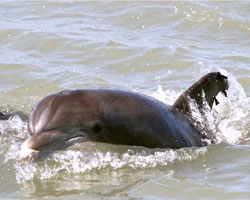
Ed Cake, a biological oceanographer, as well as a marine and oyster biologist, has “great concern” about the hundreds of dolphin deaths he has seen in the region since BP’s disaster began, which he feels are likely directly related to the BP oil disaster.
“Adult dolphins’ systems are picking up whatever is in the system out there, and we know the oil is out there and working its way up the food chain through the food web – and dolphins are at the top of that food chain.”
Cake explained: “The chemicals then move into their lipids, fat, and then when they are pregnant, their young rely on this fat, and so it’s no wonder dolphins are having developmental issues and still births.”
Cake, who lives in Mississippi, added: “It has been more than 33 years since the 1979 Ixtoc-1 oil disaster in Mexico’s Bay of Campeche, and the oysters, clams, and mangrove forests have still not recovered in their oiled habitats in seaside estuaries of the Yucatan Peninsula. It has been 23 years since the 1989 Exxon Valdez oil disaster in Alaska, and the herring fishery that failed in the wake of that disaster has still not returned.”
Cake believes we are still in the short-term impact stage of BP’s oil disaster.
“I will not be alive to see the Gulf of Mexico recover,” said Cake, who is 72 years old. “Without funding and serious commitment, these things will not come back to pre-April 2010 levels for decades.”
The physical signs of the disaster continue.
“We’re continuing to pull up oil in our nets,” Rooks said. “Think about losing everything that makes you happy, because that is exactly what happens when someone spills oil and sprays dispersants on it. People who live here know better than to swim in or eat what comes out of our waters.”
Khuns and her husband told Al Jazeera that fishermen continue to regularly find tar balls in their crab traps, and hundreds of pounds of tar balls continue to be found on beaches across the region on a daily basis.
Meanwhile Cowan continues his work, and remains concerned about what he is finding.
“We’ve also seen a decrease in biodiversity in fisheries in certain areas. We believe we are now seeing another outbreak of incidence increasing, and this makes sense, since waters are starting to warm again, so bacterial infections are really starting to take off again. We think this is a problem that will persist for as long as the oil is stored on the seafloor.”
Felder wants to continue his studies, but now is up against insufficient funding.
Regarding his funding, Cowan told Al Jazeera: “We are up against social and economic challenges that hamper our ability to get our information out, so the politics have been as daunting as the problem [we are studying] itself. But my funding is not coming from a source that requires me to be quiet.”
Follow Dahr Jamail on Twitter: @DahrJamail
Read more about the scientists in this article, and their findings:
Dr Darryl Felder, Department of Biology, University of Louisiana, Lafayette. Runs a research lab that studies the biology of marine crustaceans. Dr Felder has been monitoring the seafloor in the vicinity of BP’s blow-out Macondo oil-well both before and after the oil disaster began. He was studying samples from the seafloor in the Macondo area pre-spill via funding from the National Science Foundation, which provided him a grant to log the effects of all the drilling in the area. His funding now comes from the Gulf Research Initiative (GRI), which is funded by BP. Read his full biography here.
Dr Jim Cowan with Louisiana State University’s Department of Oceanography and Coastal Sciences has been studying Gulf seafood, specifically red snapper, for more than 20 years. Funding is primarily via LSU, although LSU has also received funding via GRI. Read his full biography here.
Dr Andrew Whitehead, LSU, his lab conducts experiments and studies on Evolutionary and Ecological Genomics. He recently published “Genomic and physiological footprint of the Deepwater Horizon oil spill on resident marsh fishes” in the National Academy of Sciences. Much of his funding also comes from the Gulf Research Initiative. Read his full biography here.
Brief summary of scientists’ findings/studies:
Felder: Studies carried out from January 2010 to present in BP’s Macondo well area. Found abnormalities in shrimp post-spill, whereas pre-spill found none.
Cowan: Studies carried out from Nov 2010-present, from west Louisiana to west Florida, from coast to 250km out. Found lesions/sores/infections in 20 species of fish, as many as 50 per cent fish in some samples impacted. Pre spill levels were 1/10 of one per cent of fish.
Whitehead: Species such as the Gulf Killifish, in and around the Gulf of Mexico, will continue to be subject to negative effects of the BP oil spill disaster of 2010. The Killifish, which researchers consider a good indicator of water quality in the Gulf of Mexico, is showing signs that the oil spill is having a negative impact on its health. Tracked killifish for the first four months after spill across oil-impacted areas of Louisiana and Mississippi.
Special thanks to Richard Charter