Wall Street Journal: Experts Weigh Spill’s Lasting Effects

http://online.wsj.com/article/SB10001424052702303624004577339943866694420.html

April 12, 2012, 7:47 p.m. ET

Marine Studies Raise Fresh Concern After Early Fears of Environmental Catastrophe From BP Disaster Failed to Materialize

By TOM FOWLER

Rush Jagoe for The Wall Street Journal
David Farizo fishes in Lafitte, a community in Louisiana’s wetlands. New research points out possible ill effects on dolphins, plankton and coral after 2010’s oil spill in the Gulf of Mexico.

HOUSTON-Scientists studying the environmental impact of the Deepwater Horizon oil spill in the Gulf of Mexico are raising fresh concerns about the effect of the leaked crude on a range of sea life, from tiny animal plankton to dolphins.

So far, studies have not uncovered the ecological apocalypse that some feared after the Deepwater Horizon drilling rig exploded two years ago this month, unleashing the biggest offshore oil spill in U.S. history. But hopes that the Gulf would be relatively unaffected are dimming.

“The death and destruction that many predicted hasn’t come through for a lot of reasons,” said Robert Haddad, head of the National Oceanic and Atmospheric Administration’s assessment and restoration effort. “But everywhere we look throughout the Gulf things are just a little bit out of kilter.”

Zooplankton-microscopic organisms that are a source of food for many fish-were found to have ingested hazardous components of the specific oil from the spill, according to a study released last month by researchers at East Carolina University and other colleges and funded by the National Science Foundation. The study didn’t speculate on whether the oil may have harmed the zooplankton nor did it say what the effect could be on larger organisms.

A large coral formation on the sea floor several miles from the well site appears to be dying because of a coating of oil from the spill, according to a study by Pennsylvania State University, Haverford College and other institutions, also funded by a National Science Foundation grant.

And a study of dozens of dolphins in Barataria Bay, La., where some of the heaviest oil slicks came ashore, concluded many of them are showing serious illnesses similar to animals that have been in contact with oil. The dolphins were underweight, anemic and suffering from low blood sugar as well as liver and lung ailments.

Dolphin deaths and strandings in the northern Gulf of Mexico have been much higher than historic averages since the spill, but a surge in unexplained deaths also predated the accident.

The dolphin study, released by NOAA, was careful not to say the illnesses are directly linked to the spill. The official assessment of the spill’s environmental impact, which the agency is overseeing for the government and well owner BP BP.LN -0.81% PLC, is in its early stages of reviewing data from some 160 studies.

But the preliminary findings were serious enough, NOAA said, that groups that take part in rescues of stranded dolphins and other ocean mammals needed the information.

The Gulf, which has long been the site of oil and gas production, has suffered through many minor spills and accidents. On Thursday, government officials were monitoring a 10-square-mile oil slick, known as a sheen, about 130 miles southeast of New Orleans and searching for the source.

But the Deepwater Horizon incident dwarfed previous spills. For 87 days, oil flowed from the BP well that lay 5,000 feet below the ocean surface about 40 miles off the Louisiana coast. Slicks fanned out across 68,000 miles of open water and fouled more than 1,000 miles of coastline.

The impact could have been worse, experts say. A mitigating factor was the spill was located far offshore and nearly a mile underwater. The flow of the Mississippi River, meantime, kept much of the oil out at sea, and chemical dispersants broke up crude both below the surface and on it, as did naturally occurring oil-eating microbes.

BP agreed to pay the upfront cleanup costs and the costs of restoring oil-damaged habitats, which so far have topped about $14 billion. The British company pledged up to $1 billion for further restoration projects and $500 million for research.

The ultimate environmental price tag for BP, however, will come through the NOAA-led process known as a Natural Resource Damage Assessment, which includes a range of scientific studies. If the studies, some of which could come out later this year, find links between the spill and the damage, BP would be expected to pay compensation or fund the cost of restoration.

Outside studies such as the one on zooplankton could be incorporated into the NRDA through the peer-review process, but BP or NOAA could contest their inclusion if they don’t believe they are relevant or meet rigorous scientific standards. Disagreements could end up being adjudicated by federal judges who are overseeing the massive collection of civil complaints that BP faces in U.S. District Court in New Orleans.

BP expects to finalize a civil settlement worth an estimated $7.8 billion with thousands of Gulf businesses and individuals in the next few days. Civil and criminal settlements with the government, which could reach the tens of billions of dollars by some estimates, are pending.

The company is committed to working with NOAA and the Gulf Coast states to assess the damages from the spill, spokesman Tom Mueller said.

It is likely any final assessment or settlement of damages with the government will include a “re-opener” clause, which would give plaintiffs the right to ask the courts to revisit the terms if the damages turn out to be greater than originally believed, said David Uhlmann, a University of Michigan law professor and former head of the Justice Department’s Environmental Crimes Section.

Doug Inkley, a senior scientist with the National Wildlife Federation, said even though the environmental damage scientists are finding is subtle, it is serious.
“The oil spill is to the Gulf what smoking is to a human,” he said. “You’re still able to function overall, but not nearly as well.”

Write to Tom Fowler at tom.fowler@wsj.com
A version of this article appeared April 13, 2012, on page A3 in some U.S. editions of The Wall Street Journal, with the headline: Experts Weigh Spill’s Lasting Effects.

Special thanks to Richard Charter

FuelFix: Industry asks for more time to comply with drilling pollution mandates

http://fuelfix.com/blog/2012/04/12/industry-asks-for-more-time-to-comply-with-drilling-pollution-mandates/

Posted on April 12, 2012 at 2:21 pm by Jennifer A. Dlouhy

API President Jack Gerard speaks at an October 2011 news conference in Washington, D.C. (AP Photo/Jacquelyn Martin)

Two of the oil industry’s leading trade groups today implored federal regulators for more time to comply with a looming rule for cutting air pollution from hydraulic fracturing and natural gas wells.

There isn’t enough emission-cutting equipment to go around and satisfy the mandates slated to be imposed next week, said American Petroleum Institute president Jack Gerard in a letter to Environmental Protection Agency Administrator Lisa Jackson.

About 25,000 new wells are completed each year, but just 300 sets of emissions-reducing equipment are available for “green completion” that cuts pollution from natural gas drilling in accordance with the proposed rule, Gerard said.

“The equipment required to reduce these emissions is not produced on an assembly line where someone can instantly ramp up production. It must be carefully built one-by-one in machine shops, and this takes time,” said Howard Feldman, API’s director of regulatory and scientific affairs, in a conference call with reporters. “EPA needs to adjust the time frame for implementation because enough equipment will simply not be available in time to comply with the proposed rule schedule.”

Separately, Independent Petroleum Association of America Vice President Lee Fuller sent a letter to House senior adviser Valerie Jarrett asking the administration to delay the rulemaking until better data is collected about the amount of gas that can be recovered from green completions. Fuller said the EPA’s initial estimates were based on “flawed data” that “has led to grossly overestimated emissions and has ultimately resulted in a distortion of the agency’s required cost-benefit analysis.:

At issue is the Environmental Protection Agency’s proposed rule for reining in smog-forming emissions from a range of natural gas operations – including the initial drilling of wells, production at the sites and the eventual transportation of the fossil fuel. The mandates would be the first federal air standards for wells that are stimulated through hydraulic fracturing, a technique that involves blasting mixtures of water, sand and chemicals deep underground.

The rule would require the use of green completion equipment at new and updated gas wells that are hydraulically fractured. That equipment is designed to trap and separate natural gas from other fluids and solids that flow back from a well after it is fractured.
While the measure focuses on cutting emissions of ozone-forming volatile organic compounds, complying with the mandates also is projected to pare methane emissions by about 26 percent and toxic air emissions by 30 percent, according to the EPA.

The EPA is facing a court-ordered April 17 deadline to formalize the rule. The underlying emissions rules for gas drilling operations were last modified in 1985.

Environmental groups say the measure is necessary to protect the public from high ozone levels amid a surge in hydraulic fracturing that is being blamed for causing so much smog in some parts of the West that it rivals Los Angeles and Houston.

But industry officials insist that the rule could discourage natural gas production throughout the U.S., by raising costs and making some operations off limits until enough emission-cutting equipment can be produced and installed.

Environmental advocates who support the rule say the industry’s argument doesn’t wash.
“This isn’t super complicated equipment,” said Meleah Geertsma, with the Natural Resources Defense Council. “This is an industry that has shown over the past 10 years it is very good” at getting infrastructure out to wells.

In addition to requiring emission-cutting equipment at the wellhead, the proposed rule would require changes throughout the natural gas production process.

“The fact is, every step in the gas production process, there’s air pollution associated with that,” said Joe Osborne, with the Pennsylvania-based Group Against Smog and Pollution. If wells and compressor stations are considered in isolation, the pollution from them can seem insignificant, Osborne said, but with all of the drilling and activity surrounding the natural gas boom, it adds up fast.

Although ozone levels have been going down nationwide, shale development “has the potential to halt that progress or even reverse it,” Osborne added.

Most of the covered emissions come from completions of hydraulically fractured wells. But the rule also would require changes to pneumatic devices throughout the system. When that equipment is added or updated, companies would be required to use low- and no-bleed options. To curb the leakage of VOCs, companies also would be required to use a different sealing mechanism in centrifugal compressors and periodically replace packing material surrounding the moving parts in reciprocating compressors.

The API and other industry trade groups have been asking regulators to exempt facilities in which 10 percent or less of their total emissions are from VOCs. It isn’t cost effective to require emission-cutting technology when there are few of these compounds to control, Feldman said.

But rule supporters say that 10 percent threshold is too high. The pollution from most wells falls below that level, environmentalists argue, but in large operations, even 10 percent can mean tremendous escaping emissions.

The carve-out “would exempt a huge portion of the sources we’re talking about today,” Geertsma said. Thousands of wells producing even 5 percent VOCs would create significant pollution, she said.

Industry leaders have previously signaled they could challenge the rule in court and have refused to say litigation is off the table. They could challenge the rule as unworkable, based on the apparent lack of green completion equipment that would be required to comply with the mandate. Gerard hinted at this possible strategy in his letter to Jackson:

“If EPA requires immediate compliance with the REC requirement, the rule will cause substantial delays in most oil and gas development projects. Not only is this bad energy and economic policy, such an outcome is not supported by the law (e.g., a standard that cannot be met by most affected sources plainly cannot be shown to be achievable).”

Another avenue for a challenge is based in the data EPA used to analyze its propose rule. Fuller said the EPA used limited emission estimates provided by some producers working “a very limited number of wells.” That may have thrown off the agency’s required cost-benefit analysis. Fuller adds:

“Reports have shown that, in some cases, the EPA overstated emissions estimates by over 1,400 percent. When these numbers are corrected, EPA’s proposed requirements grossly fail its own cost-effectiveness standards.”

O&GAdministratorLtr

Special thanks to Richard Charter

TampaBay.com: Oil from Deepwater Horizon spill still causing damage in gulf 2 years later, scientists find & Gulf Today: Najmedin Meshkati: Lessons of the BP accident

http://www.tampabay.com/news/environment/water/oil-from-deepwater-horizon-spill-still-causing-damage-in-gulf-2-years/1225134

TampaBay.com: Oil from Deepwater Horizon spill still causing damage in gulf 2 years later, scientists find
By Craig Pittman, Times Staff Writer
In Print: Sunday, April 15, 2012

Geologist Rip Kirby examined the skin of a graduate student who swam in the gulf and then showered. Under regular light, his skin seemed clean, but ultraviolet light revealed orange blotches – dispersant-mixed oil.

Loading Video…

On Florida’s Panhandle beaches, where local officials once fretted over how much oil washed in with each new tide, everything seems normal. The tourists have returned. The children have gone back to splashing in the surf and hunting for shells.

Every now and then, a tar ball as big as a fist washes ashore. That’s the only apparent sign that the worst environmental disaster in U.S. history tainted these sugar-white sands two years ago.

But with an ultraviolet light, geologist James “Rip” Kirby has found evidence that the oil is still present, and possibly still a threat to beachgoers.

Tiny globs of it, mingled with the chemical dispersant that was supposed to break it up, have settled into the shallows, mingling with the shells, he said.

When Kirby shines his light across the legs of a grad student who’d been in the water and showered, it shows orange blotches where the globs still stick to his skin.

“If I had grandkids playing in the surf, I wouldn’t want them to come in contact with that,” said Kirby, whose research is being overseen by the University of South Florida. “The dispersant accelerates the absorption by the skin.”

As those blotches show, the gulf and its residents are still coping with the aftermath of the Deepwater Horizon disaster, which began with a fiery explosion aboard an offshore drilling rig on April 20, 2010.

Even before BP managed to shut off the undersea flow on July 16, 2010, observers ranging from Time magazine to Rush Limbaugh insisted that the ecological damage from the 4.9 million barrels of oil that spilled seemed far less severe than everyone had predicted.

Now, after his company has spent $14 billion on cleanup and restoration in two years, BP spokesman Craig Savage said this month, “the beaches are open, the tourists are back and commercial fishing is rebounding.”

But biologists are finding signs of lingering – and perhaps growing – damage throughout the gulf, from the bottom of the food chain to the top:

* Scientists have confirmed that tiny creatures called zooplankton accumulated toxic compounds from coming in contact with the Deepwater Horizon oil. Because small fish and crustaceans eat the zooplankton and are then eaten by larger fish, that means those compounds could now be working their way up the food chain, they said.
* Three months after BP shut off the flow of oil, scientists searching the floor of the gulf found a colony of deep sea corals that were covered in what they described as “frothy gunk.” They were in the area where undersea plumes of oil had been spotted. Nearly half were dead. Extensive tests resulted in a finding, released just last month, that the culprit was in fact oil from Deepwater Horizon.
* This month, crews from the U.S. Fish and Wildlife Service fanned out to rivers across the coast to catch and take samples from sturgeon swimming upstream from the gulf to spawn. The reason: When scientists examined the sturgeon that swam upriver last year, they found “significant levels” of DNA fragmentation in the 300-pound fish that could have been caused by exposure to the oil spill, said wildlife service chief investigator Glenn Constant.
“It can lead to a number of abnormalities, such as cancer, tumors, challenges to their immune systems,” Constant said. Reproduction could falter, too, he said.
* A survey last summer by USF scientists found that the highest frequency of fish diseases occurred in the area where the oil spill was. While scientists were initially cautious about attributing the lesions on red snapper and other fish to Deepwater Horizon, subsequent laboratory tests have all but eliminated everything other than the oil from the spill as the cause.
“It would be hard to argue otherwise,” USF scientist David Hollander said this month.
* Biologists have become alarmed about how many bottlenose dolphins are washing ashore sick or dead across the gulf, from Texas to Florida – more than 600 during a time when the normal average is 74 a year. In Louisiana’s Barataria Bay, where waves of thick oil washed in throughout the spill, dozens of dolphins have been found suffering symptoms of liver and lung disease and possible immune system failures.
Savage, of BP, points out that the jury is still out on most of those findings, and that much of the research being done on the impact of the spill is being funded by $500 million that his company donated to make up for the damage. Kirby’s study is an exception – his funding comes from the Surfrider Foundation, a group founded by surfers to work on ocean protection issues.
Some good news has emerged since the spill. For instance, sperm whales apparently avoided contact with the oil, swimming clear of that section of the gulf. Biologists say bluefin tuna, which were spawning during the spill, appear to have suffered only minimal effects. And a “dirty blizzard” that USF scientists discovered littering the gulf’s bottom with dead organic matter after the spill has now mostly dissipated, Hollander said.

Still, serious questions remain. A massive study of everyone who came in contact with the oil began last year, overseen by the National Institutes of Health. So far, thanks in part to an offer of a $50 gift card for participants, the study has signed up 8,000 people, half of them from Florida, said Dr. Dale Sandler, who’s in charge. She hopes to have 40,000 by the end of the year and to follow the fluctuations of their health for a decade.

“People are concerned,” Sandler said. “There are pockets of people there who have poor health and came into contact with the oil. Putting two and two together, they think the oil spill is responsible for their illness. Our job is to sort that out.”

Kirby, the USF geologist, is concerned too, based on what his ultraviolet light has shown him.

The oil he found lies in what’s called the swash zone, just below where the waves lap against the sand. When a “plunge step” forms there, small flakes of weathered oil or even large tar patties settle there, mingled with shell debris, he found.

Studies have found that the dispersant used to break up the oil slick, Corexit, can be toxic to the bacteria that would normally gobble up oil in the gulf. That’s why the oil is still showing up two years later, he said. When Corexit bound with the oil, it prevented bacteria from consuming it.

The concentrations of toxic hydrocarbons in the flakes and patties are above the level considered to be dangerous under federal standards, he said. That’s what makes him so concerned about how quickly the dispersant-mixed oil absorbs into human skin.

Kirby consulted with three toxicologists about it. Two recommended an immediate study of what level of toxic oil might be absorbed. The third, a state employee, was less concerned, he said.

According to Savage, only 8 miles of gulf beaches are still undergoing cleanup paid for by BP. Kirby thinks someone should be surveying every beach’s swash zone every morning to check for the little oil-and-dispersant globs he found.

Given how toxic those globs might be, he said, “would you let your kid play in the shallow water and absorb toxic tar product? Wouldn’t you rather have a sign that told you the beach was hazardous in certain spots?”

Information from the New Orleans Times-Picayune was used in this report. Craig Pittman can be reached at craig@tampabay.com.

_______________________________

http://gulftoday.ae/portal/08ee3957-25c0-4d9a-b849-ab82ee24e0b2.aspx

Gulf Today: Najmedin Meshkati: Lessons of the BP accident
April 15, 2012

As the second anniversary of the BP Deepwater Horizon offshore platform accident approaches on April 20, the sky rocketing gasoline prices at the pumps have fuelled calls of “drill, baby, drill” to increase domestic oil production. The prospect of extensive deepwater oil and gas drilling in the Gulf of Mexico, the Arctic waters, and elsewhere is now stronger than ever. Exploiting deepwater offshore oil and gas fields is the future of the fossil fuel industry around the world.

According to a recent statement by the head of the International Energy Agency of the OECD, about 30 per cent of the world’s oil production presently comes from offshore projects and it will increase to about 50 per cent in 2015. In addition to the growing deepwater drilling in the Gulf of Mexico (by the United States, Mexico and Cuba) and possibly the Atlantic Ocean (from Delaware Bay to Cape Canaveral, Fla.), it is expected to grow substantially in the Mediterranean, Caspian Sea, the Arabian Gulf, North Slope of Alaska, as well as off the coasts of China, India, Brazil and Angola.

For instance, seven of the 10 largest hydrocarbon fields discovered in the past decade in the world are in deepwater off the coast of Brazil.

The recent major gas leak on the Elgin offshore platform in the North Sea, which forced ships and aircrafts to stay miles away from the site and caused an international uproar, heightened the attention to offshore drilling safety, especially for wells on high-pressure, high-temperature and other types of more complex fields.

This event echoed the BP Deepwater Horizon drilling rig accident, which killed 11 workers and spilled millions of gallons of oil in the Gulf of Mexico in 2010. Despite the recent announcement that BP and most of its plaintiffs have agreed to settle the lawsuits concerning the explosion and fire, its lessons haven’t still been adequately learned and disseminated. Nevertheless, there are still plenty of opportunities to do a much better job, when it comes to offshore drilling safety; as world’s people and ecosystems should not have to experience another accident and oil spill anywhere.

A published report by a 15-member interdisciplinary experts Committee of the National Academy of Engineering and National Research Council (NAE/NRC), “Macondo Well-Deepwater Horizon Blowout: Lessons for Improving Offshore Drilling Safety” (Dec 2011), was able to identify and assess the principal direct and root causes of this accident and developed a series of recommendations that would provide suitable and cost-effective corrective actions, materially reducing the likelihood of a similar event in the future.

It recommended to reduce the risk of another accident as catastrophic as the Deepwater Horizon explosion and oil spill, companies involved in offshore drilling should take a “system safety” approach to anticipating and managing possible dangers at every level of operation – from ensuring the integrity of wells to designing blowout preventers that function “under all foreseeable conditions,” including the cold Arctic waters.

The committee’s five major categories of recommendations that attempt to address all the primary components or the life cycle of deepwater drilling are: (1) Well Design and Construction, (2) Blowout Preventer System, (3) Mobile Offshore Drilling Units, (4) Industry Management of Offshore Drilling, to (5) Regulatory oversight.

Thus, it is expected that the committee’s universally applicable recommendations should be addressed in their entirety by the companies and countries who would like to engage in safe and environmentally conscious deepwater drilling.

As the committee’s report concluded, the need to maintain domestic sources of oil is great, but so is the need to protect the lives of those who work in this industry, and to protect the Gulf of Mexico and other waters and the many other industries that depend on it. Additionally, an enhanced regulatory approach should ensure strong industry safety culture with mandatory regulatory oversight at critical points during drilling operations.

Safety culture is typically defined as the assembly of characteristics and attitudes in organisations and individuals, which establishes that as an overriding priority, safety issues receive the attention warranted by their significance. Creating and nurturing a positive safety culture basically means to instill thinking and attitudes in organisations and individual employees that ensure safety issues are treated as high priorities.

An organisation fostering a safety culture would encourage employees to cultivate a questioning attitude and a rigorous and prudent approach to all aspects of their job, and would set up necessary open communications between line workers and mid-and upper management.

These safety culture characteristics are equally applicable both to the operating companies as well as to their cognizant/designated governmental regulatory safety agency.

This global industry should strive for higher universal safety standards and closer co-operation among its members and regulators. Companies and countries engaging in deepwater drilling should proactively and voluntarily pledge to address the institutionalisation of safety culture, not only at rig level but also at higher levels of company and regulatory agency in their countries. If not for the sake of the public, at least for the sake of their own survival and bottom line.

Influential industry trade associations such as the American Petroleum Institute and the International Association of Drilling Contractors should join forces and forge alliances with their counterparts in other countries and develop codes of best practices and “enforce” or ensure their voluntary implementations.

Stakeholder countries should start devising a balance between national sovereignty over their territorial waters and international responsibility towards their neighbours and region, when it comes to the safety of their deepwater drilling rigs.

This can start at the regional level. For starts, the Gulf of Mexico littoral countries – the United States, Mexico and Cuba – should be entitled and enabled to learn about and ascertain the adequacy of the specific safety considerations and practices of all operating platforms.

As in the context of the Gulf of Mexico, at the end of the day, all those countries will be affected by water contamination from an accidental spill, anywhere on the coasts of this small pond.

The vital importance of this project for many countries around the world cannot be emphasised further.

This initiative will “force” these neighbouring countries to engage in a mutually beneficial practice of engineering diplomacy. One of the byproducts and unintended (positive) consequences of these safety-centric confidence building collaborative efforts could be eventual better relations, for instance between the United States and Cuba.

As the American philosopher William James once said, “Great emergencies and crises show us how much greater our vital resources are than we had supposed.” We should learn from the Macondo Well blowout, and we shouldn’t give up, as we can do better than what happened on the Deepwater Horizon rig.
More important, we, along with companies and countries engaging in deepwater drilling owe taking these bold safety improvement initiatives to the memory of the 11 people who lost their lives onboard the Deepwater Horizon on April 20, 2010.

MCT

Special thanks to Richard Charter
Guardian, UK: Activists accuse BP of ‘cutting corners’ in Gulf oil spill clean-up

Protesters at the London AGM criticise the company’s use of a chemical dispersant and say the ecological disaster is far from over

Madeleine Cuff
guardian.co.uk, Thursday 12 April 2012 11.07 EDT

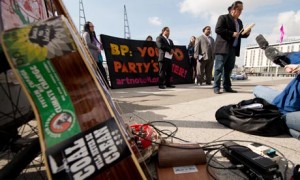
Clayton Thomas-Muller of the Indigenous Environmental Network at a protest outside the BP annual general meeting at the ExCel Centre in London. Photograph: Leon Neal/AFP/Getty Images

Activists protesting at BP’s annual general meeting in London on Thursday accused the oil company of “cutting corners” in its clean-up of the huge oil spill in the Gulf of Mexico two years ago.

Around a dozen protesters gathered outside the Excel Centre in London’s Docklands to raise awareness of the plight of those living in the wake of the spill and BP’s involvement in the Canadian tar sands.

Derrick Evans, a managing adviser from Gulf Port Mississippi for the Gulf Coast Fund, said the ecological disaster is not over. “The oil is not gone. It is very evident to me that the general perception is that BP made a big mess and BP did a big clean-up, and that normalcy has returned. I’m here to tell you nothing could be further from the truth,” he said.

He criticised BP’s use of the chemical dispersant Corexit to break up oil spills into globules, which then sink to the bottom of the seabed. “With temperature changes in the water we still continue to see that sunken oil rise and make its way to shore,” he said.

Activists are concerned about the potential health effects of the chemical as hurricane season approaches. “One of our fears is that if there is a storm, another hurricane Katrina or Ike, that this could really cause a devastating health epidemic because of what is now in the sediment,” said Bryan Parras, a representative for the Gulf Coast Fund from Houston.

“This company has a history of cutting corners to save money. Not only financial corners but safety corners and we see that has resulted in the death of American citizens, of hardworking individuals and families,” he added.

A BP spokesman rejected the claims: “BP’s efforts to help restore the Gulf Coast region have not only been significant, they are unprecedented. BP has spent more than $22bn, including paying out over $6.6bn in claims to individuals and businesses, about $1.4bn in claims and advances to government entities, and approximately $14bn for response efforts”

He added: “We intend to operate in the Gulf of Mexico for many years to come. So we have committed $500m to fund long-term, independent scientific research to enhance the understanding of the ecosystem and improve society’s ability to respond to and mitigate potential impacts of a future oil spill anywhere.”

Protesters at last year’s event caused substantial disruption to proceedings, with security ejecting campaigners who had bought BP shares to gain entry to the meeting. Many community members were refused entry.

This year only around a dozen activists were outside the building, but during the meeting, nine protesters were carried out after staging “climate change deaths”.
The oil company was also criticised by protesters over its involvement in Candian tar sands mining.

Tar sands are a mixture of clay, sand, water and bitumen – heavy black oil. The oil can only be extracted through mining, and refining tar sands is more complex than traditional crude oil, requiring a large amount of water.

Communities living near the tar sands have launched a law suit against BP and the Canadian government, claiming encroachment on their territories is in violation of their treaty rights.

Clayton Thomas-Muller, an indigenous American from the Mathias Colomb Cree Nation and activist from the Indigenous Environmental Network, urged BP to pull out of the tar sands development. “We’re here today to confront BP over the ongoing crimes of ecocide they’re committing in the continent of North America. Our message from BP has been clear from the get-go,” he said. “BP need to get out of the tar sands.”

Special thanks to Richard Charter

Energy & Environment: OFFSHORE DRILLING:Gulf spill commission members slam Congress, raise concerns over Arctic drilling

http://www.eenews.net/Greenwire/2012/04/17/3

Phil Taylor, E&E reporter
Published: Tuesday, April 17, 2012

While federal agencies and industry have made significant safety reforms after the worst oil spill in the nation’s history, Congress has failed to pass a single bill that would help prevent another catastrophe, according to a report from the former members of a presidential spill commission.

The report released this morning by the Oil Spill Commission Action — which includes the seven members of the BP oil spill commission charged with issuing recommendations in the wake of the Deepwater Horizon accident — also questions the government and industry’s ability to respond to a spill in Arctic waters, where drilling is set to commence in July.

The report slams Congress’ failure to implement a range of recommendations made in the commission’s January 2011 report. Those include ensuring dependable resources for federal agencies such as the National Oceanic and Atmospheric Administration, raising the oil spill liability cap significantly and codifying the changes to the Interior Department’s regulatory structure designed to eliminate conflicts of interest.

By contrast, the House has passed several bills to fast-track drilling that “run contrary” to steps that panel members warn are necessary to ensure safe production of oil and gas.

“Although the administration and industry have made significant progress, Congress has not,” said Bob Graham, one of the commission’s co-chairs. “Two years have passed since the explosion on the Deepwater Horizon killed 11 workers, and Congress has yet to enact one piece of legislation to make drilling safer.”

The only recommendation Congress is close to implementing is a proposal to dedicate 80 percent of the Clean Water Act penalties paid by BP to environmental restoration in the Gulf of Mexico. Even so, only the Senate has passed such a plan, and the House’s proposal is slightly different.

In addition, while Congress has approved significant funding increases for the Interior Department agencies tasked with overseeing leasing and development, lawmakers have not implemented cost-recovery measures to ensure the agencies receive sustainable funding in the future.

“Congress did approve an increase in inspection fees, but has no legislation pending to establish a more robust, dedicated funding source,” the report said.

In contrast, the report speaks highly of the Obama administration’s scope and pace of reform following the spill, lauding Interior’s new workplace safety rule, a drilling safety rule, the appointment of a chief scientist and the separation of leasing and safety functions into two separate agencies, among other steps.

But the report urged the department to follow through on the commission’s recommendation that National Environmental Policy Act reviews during planning, leasing, exploration and development be strengthened.

“They’re paying much more attention to site-specific environmental risks,” said former commission member Donald Boesch. “They’re not using categorical exclusions anymore. However, this is still a work in progress.”

The report also recommends federal agencies adequately test the capability of new containment systems to deal with large, deep and high-pressure spills. It urges Interior to issue new standards to correct deficiencies in blowout preventers, the last line of defense against a runaway well.

“The improvements have yet to be adequately tested, and the Department has not yet issued rules to correct the BOP design flaw identified as a principle reason why the Macondo well BOP failed to operate properly,” the report notes.

Industry received a lower grade than the federal government, though it exceeded the accomplishments of Congress, the report said. Its grade of C+ was due in part to three oil and gas spills off China, Brazil and in the North Sea in the past 10 months, the former commissioners said.

“I think insofar as I’m aware, every company has taken stock of where it is, [and] has upgraded its safety,” said Bill Reilly, former co-chair of the commission. The establishment of two companies to provide capping stacks in the Gulf should enable blowouts to be staunched in a few weeks, rather than the three months it took to quell the Macondo well, he said.

In addition, the newly established Center for Offshore Safety housed at the American Petroleum Institute is “well led” by Royal Dutch Shell PLC scientist Charlie Williams, Reilly said.

But while the center will help hold companies accountable, it must eventually become independent of API to gain credibility, the report said.
Arctic concerns
Today’s progress report did not judge Interior’s proposal to allow Shell to begin exploratory drilling this summer in the Beaufort and Chukchi seas, but it does note “substantial controversy” surrounding the adequacy of spill response in frigid Arctic waters as well as the government’s understanding of the region’s marine ecosystem.
“Although a great deal of Arctic research has been undertaken over the last several decades, many central unanswered questions remain about the unique and complex ecosystems, and how climate change is impacting those systems,” the report notes.

It adds that while industry has conducted experiments to use in-situ burning and mechanical recovery of oil in ice conditions both in Norwegian waters and in labs, “these techniques have not been successfully tested in the extreme weather conditions that are often present in Arctic waters nor they been evaluated in any significant way by government entities.”

Marilyn Heiman, director of the U.S. Arctic Program at Pew, said she is pleased the commission released its report but said its C grade for the Arctic should give regulators and industry pause.

“A C grade in the Arctic is just not good enough,” Heiman said. “Because of the extreme and remote conditions and the resources at stake in the Arctic Ocean, we should strive to be the world’s leader in safety and response.”

While Interior has made “great strides” on safety standards for drilling, it has not made any improvements to oil spill response and cleanup since the Gulf spill, she said.

“In addition, no Arctic-specific safety and response standards have been put in place for the extreme conditions that occur there, including sub-zero temperatures, hurricane-force winds, shifting sea ice, high seas and long periods of fog,” she said.

Special thanks to Richard Charter

"Be the change you want to see in the world." Mahatma Gandhi