Miami Herald: BP settles with maker of failed blowout preventer & Bloomberg: Transocean Asks Judge to Force BP to Indemnify Gulf Oil-Spill Damages

http://www.miamiherald.com/2011/12/16/2548990/bp-settles-with-maker-of-failed.html

Miami Herald

Posted on Friday, 12.16.11

BP settles with maker of failed blowout preventer

ASSOCIATED PRESS
NEW ORLEANS — Cameron International, the maker of the Deepwater Horizon blowout preventer that failed to stop last year’s massive oil spill in the Gulf of Mexico, has agreed to pay $250 million to BP under a legal settlement, BP said Friday.

BP said it was “in their mutual best interests, and the agreement is not an admission of liability by either party.” The companies are dropping all claims against one another, they said.

The settlement comes in advance of a federal trial over the catastrophic Gulf oil spill. The non-jury trial is slated to begin in February and determine fault in the April 20, 2010, explosion and subsequent oil spill off the Louisiana coast of more than 200 million gallons of oil.

The settlement with Cameron does not end the legal fighting over the blowout of the Macondo well, which was owned by London-based BP and two partners, MOEX and Anadarko. BP has already settled claims with those two companies and a third company, Weatherford, the maker of a part used in the well.

“Today’s settlement allows BP and Cameron to put our legal issues behind us and move forward to improve safety in the drilling industry,” said Bob Dudley, BP group chief executive.

“Unfortunately, other companies persist in refusing to accept responsibility for their roles in the accident and for contributing to restoration efforts,” Dudley said in a swipe at Halliburton Corp. and Transocean Ltd. Halliburton supplied critical cement to seal the well and Transocean was the company drilling the well.

Probes of the Deepwater Horizon explosion by the federal government and independent scientists and engineers have found all three companies were at fault for a series of decisions and actions that led to the Macondo well blowout, the nation’s largest offshore oil spill.

BP is engaged in an intense legal fight with Halliburton Corp. and Transocean. Earlier this month, BP went so far as to accuse Halliburton employees of covering up damaging evidence about a cement mixture Halliburton used in drilling the well.

BP said it would use the $250 million from Cameron to pay for the cost of cleaning up from the spill and paying individual damages claims by people, businesses and government entities hurt by the spill. BP said it has spent about $7.5 billion so far of those claims. But the British company faces billions of dollars in additional damages and fines.

Under the agreement, BP said Houston-based Cameron is no longer responsible for any additional cleanup costs related to the spill. But BP said the agreement does not cover civil, criminal and administrative fines and other penalties that might arise out of the court proceedings.

Jack Moore, the chairman and CEO Cameron, said the agreement with BP “removes uncertainty facing Cameron” as litigation intensifies over the Deepwater Horizon explosion.

“This eliminates all significant exposure to historical and future claims related to this incident,” Moore said.

Moore said Cameron does not expect to have to pay much for possible court fines and penalties. “We do not consider these items to represent a significant risk to Cameron,” he said.

Cameron said its insurers were expected to fund at least $170 million of the $250 million payment the company agreed to make to BP.

BP and Cameron also pledged to “improve safety in the drilling industry” and do more to improve blowout preventers.

Read more: http://www.miamiherald.com/2011/12/16/2548990/bp-settles-with-maker-of-failed.html#ixzz1gjNzh3E3

FILE – In a Sept. 13, 2010 file photo, the bottom of the blowout preventer stack, from the Deepwater Horizon explosion and oil spill, which is being examined as evidence for federal investigations, is seen at the NASA Michaud Assembly facility in New Orleans. BP PLC said Friday, Dec. 16, 2011, it will be paid $250 million by the maker of the blowout preventer that failed to halt oil spewing from BP’s busted well in the Gulf of Mexico.
Gerald Herbert, File / AP Photo
BY CAIN BURDEAU

___________

http://www.bloomberg.com/news/2011-12-16/transocean-asks-judge-to-force-bp-to-indemnify-gulf-oil-spill-damages.html

Bloomberg

Transocean Asks Judge to Force BP to Indemnify Gulf Oil-Spill Damages

By Margaret Cronin Fisk and Allen Johnson Jr. – Dec 16, 2011 9:33 AM PT

Transocean Ltd. (RIG)’s drilling contract with BP Plc (BP/) promised indemnification for damages from oil spilled below the surface of the Gulf of Mexico and should be enforced for claims over the Deepwater Horizon accident, the rig owner told a judge.

Claiming the drilling contractor shares blame for the disaster, London-based BP sued Transocean in April to recover part of more than $40 billion in damages and costs from the 2010 spill. Transocean accused BP of breaching their contract by failing to defend the rig owner and hold it harmless against claims.

“What Transocean seeks is to hold BP to its promise,” John M. Elsley, a lawyer for Transocean, told U.S. District Judge Carl Barbier at a hearing in New Orleans federal court today. “BP does not want that to happen.”

BP has argued that Transocean’s conduct voided the agreement. Transocean, based in Vernier, Switzerland, denies willful misconduct and claims the indemnity provision requires BP to pay virtually all damages and cleanup costs because it was a subsurface spill.

The April 2010 Macondo well blowout and the explosion that followed killed 11 workers and set off the worst offshore oil spill in U.S. history. The sinking of Transocean’s Deepwater Horizon drilling rig and spill led to hundreds of lawsuits against BP and its partners and contractors.

The case is In Re Oil Spill by the Oil Rig Deepwater Horizon in the Gulf of Mexico on April 20, 2010, MDL-2179, U.S. District Court, Eastern District of Louisiana (New Orleans).

To contact the reporters on this story: Margaret Cronin Fisk in Detroit at mcfisk@bloomberg.net; Allen Johnson Jr. in New Orleans at allenmct@gmail.com
To contact the editor responsible for this story: Michael Hytha at mhytha@bloomberg.net

Special thanks to Richard Charter
EPA: Texas Oil Company Sentenced to Pay $12 Million for Clean Air Act Violations and Obstruction Crimes in Louisiana

CONTACT: Stacy Kika
Kika.stacy@epa.gov 202-564-0906 202-564-4355

FOR IMMEDIATE RELEASE
December 16, 2011

Sentence is the largest ever criminal fine in Louisiana for air pollution

WASHINGTON – Pelican Refining Company LLC, was sentenced to pay $12 million for felony violations of the Clean Air Act and to obstruction of justice charges in federal court in Lafayette, La. announced Cynthia Giles, assistant administrator for the U.S. Environmental Protection Agency’s Office of Enforcement and Compliance Assurance, and Ignacia S. Moreno, assistant attorney general of the Environment and Natural Resources Division of the Department of Justice.

“Facilities have a responsibility to protect their employees and local residents by following our nation’s environmental laws,” said Cynthia Giles, assistant administrator for EPA’s Office of Enforcement and Compliance Assurance. “Corporations that choose to cut corners and ignore these critical safeguards will face significant consequences.”

“This corporation operated without even the most basic requirements of an environmental compliance plan and endangered the public and its own employees by implementing unsafe practices in violation of its permit and reporting requirements,” said Ignacia S. Moreno, assistant attorney general for the Environment and Natural Resources Division of the Department of Justice. “Today’s plea demonstrates that the Justice Department will continue to vigorously prosecute those who violate environmental and workplace safety laws.”

Pelican was sentenced to pay a $12 million penalty, which includes a $10 million criminal fine and $2 million in community service payments that will go toward various environmental projects in Louisiana, including air pollution monitoring. The criminal fine is the largest ever in Louisiana for violations of the Clean Air Act. Pelican is also prohibited from future operations unless it implements an environmental compliance plan, which includes independent quarterly audits by an outside firm and oversight by a court-appointed monitor.

In a joint factual statement filed in court, Pelican, headquartered in Houston, Texas, admitted that the company had knowingly committed criminal violations of its operating permit at the refinery located in Lake Charles, La. The violations were discovered during a March 2006 inspection by the Louisiana Department of Environmental Quality (LDEQ) and the Environmental Protection Agency (EPA), which identified numerous unsafe operating conditions. Pelican also pleaded guilty to obstruction of justice for submitting materially false deviation reports to LDEQ, the agency that administers the federal Clean Air Act in Louisiana.

Pelican admitted to the following:

* Pelican had no company budget, no environmental department and no environmental manager;

* In order to comply with a permit issued under the Clean Air Act, the refinery was required to use certain key pollution prevention equipment, but that equipment was either not functioning, poorly maintained, improperly installed, improperly placed into service and/or improperly calibrated;

* It was a routine practice for over a year to use an emergency flare gun to re-light the flare tower at the refinery designed to burn off toxic gasses and provide for the safe combustion of potentially explosive chemicals; because the pilot light was not functioning properly, employees would take turns trying to shoot the flare gun to relight the explosive gasses;

* Sour crude oil was stored in a tank that was not properly placed into service and remained in the tank after the roof sank;

* A caustic scrubber designed to remove hydrogen sulfide from emissions was bypassed;

* A continuous emission monitoring system (CEMS) designed to measure the hydrogen sulfide levels in refinery emissions was not working properly, and

* Pelican provided false information to the State of Louisiana and the State of Texas concerning the laboratory testing of asphalt.

Byron Hamilton, the Pelican vice-president who oversaw operations at the Lake Charles refinery since 2005 from an office in Houston, Texas pleaded guilty on July 6, 2011, to negligently placing persons in imminent danger of death and serious bodily injury as a result of negligent releases at the refinery. Hamilton faces up to one year in prison and a $200,000 fine for each of the two Clean Air Act counts. On Oct. 31, 2011, Pelican’s former asphalt facilities manager, Mike LeBleu, also pleaded guilty to a negligent endangerment charge under the Clean Air Act.

The government’s investigation of the Pelican Refinery continues. Under the Crime Victims’ Rights Act, crime victims are afforded certain statutory rights, including the opportunity to attend all public hearings and provide input to the prosecution. Any person adversely impacted is encouraged to learn more about the case and the Crime Victims’ Rights Act or contact the Victim Witness Coordinator for the U.S. Attorney’s Office, Western District of Louisiana.

The criminal investigation is being conducted by the EPA Criminal Investigation Division in Baton Rouge and the Louisiana State Police, with assistance from the Louisiana Department of Environmental Quality. The case is being prosecuted by U.S. Attorney Stephanie Finley, Richard A. Udell, Senior Trial Attorney of the Environmental Crimes Section of the Environment and Natural Resources Division of the U.S. Department of Justice, Trial Attorney Christopher Hale with the Environmental Crimes Section.

More information on EPA’s criminal enforcement program:
http://www.epa.gov/compliance/criminal/index.html

Read the joint factual statement: http://www.epa.gov/compliance/criminal/investigations/pelican-jfs-10-21-11.pdf

Photos: http://www.epa.gov/compliance/criminal/investigations/pelican-exhibits.pdf

Special thanks to Richard Charter

Nola.com: Moving forward on repairs to spill’s damage: An editorial

http://www.nola.com/opinions/index.ssf/2011/12/moving_forward_on_repairs_to_s.html

Times-Picayune

Published: Saturday, December 17, 2011, 7:09 AM
By Editorial page staff, The Times-Picayune

The first projects covered by BP’s pledge to provide $1 billion for early restoration from the 2010 oil spill will include creating 104 acres of marsh, placing oyster cultch on six public seed beds and upgrading a Grand Isle oyster hatchery. That’s fitting, since wetlands and oyster beds are both important natural resources in Louisiana that took serious blows in the disaster.

It’s also encouraging that Louisiana is getting $28 million of the first $57 million in projects that was approved this week. A committee of trustees representing the five Gulf Coast states, the federal departments of Interior and Commerce and BP gave the OK for the projects, which represent only a fraction of what BP will pay. The oil giant may ultimately have to fork over as much as $20 billion to compensate for damage done to natural resources in the blowout of the Macondo oil well.

The Louisiana wetlands project will create 104 acres of unbroken marsh. The $13.2 million effort is an expansion of an existing project in Lake Hermitage in Plaquemines Parish and replaces plans to create 70 acres of marsh terraces.

The fact that $14.9 million in oyster projects for Louisiana are included is especially significant since BP had been opposed to paying for damage to beds. The company’s argument was that freshwater from Mississippi River diversions that the state opened up after the spill were responsible for wiping them out, not oil.

But some beds were damaged by oil, and Louisiana opened up freshwater diversions to prevent oil from moving into the wetlands and doing even more damage. Clearly, the freshwater impact on oyster beds was a direct consequence of the spill.

Louisiana officials and the oyster industry were pushing to include oyster bed projects, and rightly so. Louisiana oysters are a natural resource that suffered great harm. Production this year is down 65 percent, according to Mike Voisin, who is a member of the Louisiana Oyster Task Force.

The projects approved by the committee include placing oyster cultch on 850 acres of public seed beds at 3-Mile Bay and Drum Bay in St. Bernard Parish, Lake Fortuna and South Black Bay on the east bank of Plaquemines Parish, Hackberry Bay in Lafourche Parish and Sister or Caillou Lake in Terrebonne Parish. The work also includes an upgrade to the oyster hatchery.

“This is the trustees recognizing that damage to the oyster industry (from the spill) is an important issue, and BP also concurring that it’s an important issue,” Mr. Voisin said.

That’s progress, especially considering BP’s previous unwillingness to take responsibility for freshwater damage to oyster beds.

Special thanks to Richard Charter.

Bloomberg.net: Chevron’s Crude-Oil Spill in Brazil Prompts $10.6 Billion Lawsuit

http://www.bloomberg.com/news/2011-12-15/chevron-s-oil-spill-in-brazil-prompts-10-6-billion-lawsuit.html

By Peter Millard and Adriana Brasileiro – Dec 15, 2011 12:00 AM ET

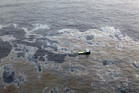
This photo taken Nov. 18, 2011 and released by Rio de Janeiro’s government, shows an aerial view of a boat crossing an area of the oil spill in an offshore field operated by Chevron at the Bacia de Campos, in Rio de Janeiro state, Brazil. Photographer: Rio de Janeiro’s government,Rogerio Santana/AP Photo

A Brazilian lawsuit that seeks to halt Transocean Ltd. (RIG) and Chevron Corp. (CVX) operations after an oil spill would reduce the country’s offshore drilling at a time when it wants to double output in ten years.

Federal prosecutors in Campos, in the oil region of Rio de Janeiro state, are suing both companies for 20 billion reais ($10.6 billion) in environmental and social damages and asked a court to suspend their operations, according to a statement yesterday. Chevron, based in San Ramon, California, and Transocean, based in Vernier, Switzerland, said they haven’t been notified and are cooperating with authorities.

The case imperils Brazil’s plan to boost crude output because Transocean operates 10 out of the 61 rigs working in the country and it would be hard to replace them in a tight market for oil equipment, said Judson Bailey, an analyst at Jefferies & Co Inc. Brazilian oil production growth has slowed after the country increased safety requirements following the spill at BP Plc’s Macondo well in the Gulf of Mexico last year.

“The rig market is pretty tight, so if Transocean were banned, the oil companies wouldn’t be happy at all,” Bailey said in a phone interview from Houston. “Chevron and Petrobras can’t get a rig elsewhere, so it messes with the state-owned oil company.”

Chevron, Brazil’s third-largest producer behind state- controlled Petroleo Brasileiro SA (PETR4) and Royal Dutch Shell Plc, will see production wane in Brazil until the government lets it drill again, said Cleveland Jones, an oil specialist and professor at Rio de Janeiro State University.
‘Opening Shot’

Chevron fell 3 percent to $100.53 at the close in New York yesterday. Transocean declined 3.9 percent to $40.19.

Chevron has come under increased scrutiny in Brazil after 3,000 barrels of oil leaked last month from an oil field in deep waters of the Campos Basin. The company underestimated the amount of pressure at an oil deposit it was exploring, and crude leaked from the reservoir for about eight days, George Buck, the head of Chevron for Brazil, said on Nov. 20.

BP has booked more than $40 billion in losses related to the April 2010 blowout of the Macondo well in the Gulf of Mexico. The accident killed 11 workers aboard Transocean’s Deepwater Horizon well and spilled 4.9 million barrels of crude. That’s about $8,163 per barrel spilled, compared to $3.57 million per barrel if the Brazilian fine were to hold.
Still Operating

“Ultimately this is an opening shot, Chevron’s attorneys are probably not at all fazed by this,” said Jones. “The prosecutor’s office will be a positive development for Chevron, because they will ensure that the letter of the law is followed and the letter of the law is reasonable.”

Chevron said in an e-mailed statement that it “responded responsibly to the incident at its Frade Field and has dealt transparently with all Brazilian authorities.” Guy Cantwell, a Transocean spokesman, said the company’s rigs are operating in Brazilian waters and the company continues to cooperate with the government.

Chevron holds a 51.74 percent stake in Frade. Petrobras holds a 30 percent stake, and Frade Japao Petroleo Ltda., a joint venture including Inpex Corp. and Sojitz Corp, holds 18.26 percent. Frade is about 230 miles (370 kilometers) northeast of Rio de Janeiro in the Campos Basin and produced 76,000 barrels a day of oil and natural gas in October.
Criminal Lawsuit

In the next few weeks, prosecutors will probably file a criminal lawsuit against Chevron for alleged environmental crime, said Romulo Sampaio, a law professor at Brazil’s Getulio Vargas Foundation.

“In this case, everything conspires against the company: it’s a foreign company, drilling for oil in Brazilian waters. That may bring about emotional responses,” Sampaio, who coordinates the university’s Environmental Law program, said in a telephone interview.

Prosecutors’ track record in lawsuits against companies involving environmental issues has been at best mixed. Federal prosecutors twice this year sought to halt construction of the Belo Monte hydroelectric dam in the Amazon, and on both occasions federal judges ruled that the project should proceed.

Federal prosecutors in 2009 convinced Brazilian cattle ranchers in Para, the state that has lost the most forestland to illegal logging, to halt Amazon forest destruction and replant trees to avoid an international ban on meat after prosecutors took action.

Brazil’s five largest meatpackers — JBS SA, the world’s largest beef producer, Marfrig Alimentos SA, Bertin SA, Minerva SA and Frigol Comercial Ltda. — agreed to stop buying cattle from suppliers that contributed to stripping the Amazon forest.

A lawsuit against Alcoa Inc. is still pending after six years of legal haggling. Federal and state prosecutors sued Alcoa’s Brazilian mining subsidiary in 2005 in an effort to block construction of the Juruti bauxite mine in the state of Para, saying the company had circumvented the law by not applying for a federal permit and instead seeking a license from the state of Para.

To contact the reporters on this story: Peter Millard in Rio de Janeiro at pmillard1@bloomberg.net; Rodrigo Orihuela in Rio de Janeiro at rorihuela@bloomberg.net Adriana Brasileiro in Rio de Janeiro at abrasileiro@bloomberg.net

To contact the editor responsible for this story: Carlos Caminada at ccaminada1@bloomberg.net

Special thanks to Craig Quirolo

"Be the change you want to see in the world." Mahatma Gandhi