Common Dreams: Independent/UK:

Published on Wednesday, October 12, 2011 by The Independent/UK

Internal report warns of ecological disaster if new well bursts
by Michael McCarthy

BP is making contingency plans to fight the largest oil spill in history, as it prepares to drill more than 4,000 feet down in the Atlantic in wildlife-rich British waters off the Shetland Islands.

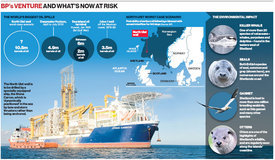
Internal company documents seen by The Independent show that the worst-case scenario for a spill from its North Uist exploratory well, to be sunk next year, would involve a leak of 75,000 barrels a day for 140 days – a total of 10.5 million barrels of oil, comfortably the world’s biggest pollution disaster.

This would be more than double the amount of oil spilled from its Deepwater Horizon well in the Gulf of Mexico last year, which had a maximum leak rate of 62,000 barrels a day in an incident lasting 88 days – and triggered a social, economic and environmental catastrophe in the US which brought the giant multinational to the brink of collapse.

The North Uist well, in a seabed block named after the Hebridean island but located 80 miles north-west of Shetland, is part of BP’s ongoing attempts to open up the West of Shetland sea area, sometimes referred to as the “Atlantic Frontier”, as a rich new oil province to replace the dwindling productivity of the North Sea.

The project appeared to have been shelved by the former BP chief executive Tony Hayward last year in the aftermath of Deepwater Horizon and the barrage of criticism directed at the company for its safety record. But it is now going ahead, and the well will be drilled by a drilling ship, the Stena Caron, some time from January onwards, as long as it is given a licence by the Energy Secretary, Chris Huhne.

The company already has three West of Shetland wells producing oil, at depths from 140 to 500 metres (460 to 1,640ft). But North Uist, described by BP as “stepping out, in terms of depth”, will be nearly three times as deep, at 1,290m below the surface, in immensely testing conditions similar to those of its ill-fated Gulf well, which was located 1,500 metres down, and began its unprecedented “gusher” leak in April last year.

The difficulty of capping a gushing well at such depths, vividly illustrated by the three months it took for Deepwater Horizon to be staunched, is greatly concerning British environmentalists who point out that the waters which might be affected by a North Uist spill are among the most wildlife-rich in all the UK.

Seabirds including many rare species are found in enormous concentrations on Shetland, the nearest landmass to any spill, and in the surrounding waters, which also contain large numbers of whales, dolphins and seals, as well as substantial fish stocks.

A major destination for wildlife tourism, Shetland has already been badly affected by a previous oil spill, that of the tanker MV Braer, which ran aground on Shetland in January 1993. BP documents referring to the North Uist project themselves list more than 20 vulnerable Shetland nature sites, including eight Special Protection Areas, two Special Conservation Areas and 12 Sites of Special Scientific Interest, which involve the breeding grounds of otters and rare birds such as the great skua, the red-throated diver and Leach’s petrel.

“This project is so risky that even BP is quietly planning for the possibility of the world’s worst ever oil spill happening off Scotland’s precious coastline,” said John Sauven, executive director of Greenpeace UK.

“It would be utterly reckless for Chris Huhne to approve this plan as if the Deepwater Horizon disaster never happened.

“Instead of chasing the last drops of oil from one of our country’s most sensitive and important natural environments, ministers should be developing a comprehensive plan to get us off the oil hook.”

A spokesman for BP said that the company was legally obliged to model the worst-case scenario, “but the reality is, the chances of a spill are very unlikely”. Since Deepwater Horizon, he added, BP had invested “a huge amount of time and resources strengthening procedures, investing in additional safety equipment and further improving our oil spill response capability”.

In particular, a major new well-capping device, designed for use at depths of up to 10,000ft, has been constructed, tested and made available, and could quickly be deployed, and any leak from North Uist is likely to be at a much lower pressure than that in the Gulf.

“We are confident that the improvements that have been made provide the level of assurance necessary against the risks,” the BP spokesman said.

North Uist: The story so far

In the storm of criticism of its safety record that followed the Deepwater Horizon blow-out, BP blew hot and cold about drilling the North Uist well. After confirming that it would go ahead, in August 2010, the company faced more criticism that such a similar deep well was inappropriate in the aftermath of the disaster in the Gulf of Mexico. Tony Hayward, BP’s chief executive at the time, hinted to the House of Commons Energy Select Committee in September 2010 that BP would hold its plans for deep water drilling off the Shetlands. He left the company shortly afterwards, and a final decision was taken to go ahead with North Uist, although more than a year later than originally intended.

BP has held a public consultation about the project, which ended last week. However, it was not widely advertised, had virtually no publicity, and a BP spokesman said there had been “no responses” from the public.

New York Times: Gulf Shrimp Are Scarce This Season; Answers, Too

October 10, 2011

By CAMPBELL ROBERTSON
LAFITTE, La. – The dock at Bundy’s Seafood is quiet, the trucks are empty and a crew a fraction of the normal size sits around a table waiting for something to do. But the most telling indicator that something is wrong is the smell. It smells perfectly fine.

“There’s no shrimp,” explained Grant Bundy, 38. The dock should smell like a place where 10,000 pounds of shrimp a day are bought off the boats. Not this year. In all of September, Bundy’s Seafood bought around 41,000 pounds.

White shrimp season began in late August, and two months in, the shrimpers here say it is a bad one, if not the worst in memory. It is bad not just in spots but all over southeastern Louisiana, said Jules Nunez, 78, calling it the worst season he had seen since he began shrimping in 1950. Some fishermen said their catches were off by 80 percent or more.

“A lot of people say it’s this, it’s that, it’s too hot, it’s too cold, it’s BP,” Mr. Nunez said. “We just don’t know.”
There is plenty that is not known. Louisiana’s Department of Wildlife and Fisheries has not compiled landings data for the season, so at this point it is hard to measure with any certainty the degree to which it is abnormal.

Even if the reports of a dismal season prove true, any forensic work is complicated by the oddities of this year’s weather, with a severe drought in the states along the Gulf of Mexico interrupted by spring flooding on the Mississippi River that brought millions of gallons of fresh water into the marshes. In addition, white shrimp crops have fluctuated over the decades for various reasons. (A BP spokesman said in a statement that some preliminary sampling indicated that the 2011 white shrimp population was within the historical range of variability.)

“We’re going to have to look at all of those different things and come up with reasons why it’s down, if it is down,” said Jim Nance, a shrimp biologist at the National Marine Fisheries Service. But while all scientists acknowledge the difficulty of determining a cause for a reported decline in the shrimp crops, some say there is evidence that is at the very least suggestive of a culprit.

Joris L. van der Ham, a researcher at Louisiana State University who has been studying white shrimp, said he had found more white shrimp than usual last winter in estuaries that were affected by the BP oil spill. That abundance might have been due in part, he said, to a decrease in the number of people out shrimping last year, but a significant decline in this year’s season would undercut that assumption. While cautioning that his study is incomplete, Dr. van der Ham speculated that certain compounds in the oil may have stunted the shrimp’s growth rate, and that the large numbers he found last year might have never made it out into the gulf to spawn, thus explaining a missing generation.

“There are numerous lines of evidence now that are sort of lining up that chronic exposure to this material could be problematic,” said James Cowan, a professor in L.S.U.’s department of oceanography and coastal sciences. Those who work in the gulf seafood industry, as well as their lawyers, have watched closely for signs of a species collapse similar to the one that decimated the herring fishery four years after the 1989 Exxon Valdez spill in Alaska. The causes of even that collapse remain a matter of dispute, but it is often cited as an example of the delayed disaster that shrimpers and others fear.

This concern was stoked further by a recent study by L.S.U. researchers that reported that a species of fish abundant in Gulf marshes was showing signs of cellular damage, problems typically due to exposure to oil. The functions of the fish, a minnow called the killifish, have been affected in ways that could harm reproduction, the study found.

Seafood industry representatives say there is enough uncertainty to raise doubts that the shrimp harvest will recover by 2012, a supposition in a report that Kenneth R. Feinberg, the administrator of the $20 billion compensation fund for victims of the spill, used in his formula for determining final settlements. Mr. Feinberg, in an interview, pointed out that he had, all along, described his report as preliminary and open to revision depending on new findings.

“We are monitoring this, and we are sensitive to these concerns,” he said. “We reserve the right to change the formula if anecdotal and empirical evidence justifies it.” Concerns about the lack of shrimp are different from concerns about the state of shrimp that are found. Repeated studies have shown gulf seafood is safe to eat, a fact trumpeted by industry representatives and government officials, who launched a gulf seafood safety Web site last week to reassure consumers.

All of this demonstrates just how hard it has become to make a living on shrimp boats, said David Veal, the executive director of the American Shrimp Processors Association. Mr. Veal has heard the anxieties about the white shrimp season, but while “clearly something is going on,” it is too early to say whether it is the worst in memory, he said. Whether it is the worst or just very bad is almost immaterial, Mr. Veal said; it is still another blight on the shrimping life, compounded by the decline in the domestic market, the steep rise in fuel prices and the battery of hurricanes over the last decade. “The fact that anybody is still in this business is a testament to their tenacity,” he said.

Special thanks to Richard Charter

Huffington Post: Concern Grows Over Plan to Drill for Oil Near Florida Keys

http://www.huffingtonpost.com/michael-deibert/florida-oil-drilling-_b_990183.html

by Michael Deibert

Posted: 10/4/11 12:44 PM ET

The news that the Spanish oil giant, Repsol, intends to begin exploratory drilling in the waters directly north of Cuba, has set off a chorus of criticism in Cuba’s neighbor to the north: the United States.

Repsol, which has a presence in more than 35 countries, has announced that an immense, semi-submersible oil rig constructed by the Italian company Saipem, is currently speeding its way from Singapore to the Florida Straits between Key West and Cuba, with a goal of beginning exploratory drilling sometime in December.

With analysts believing that Cuba’s coastal waters may contain up to 20 billion barrels of oil, Repsol — which also drilled offshore in Cuba in 2004 — is set to partner with Norway’s Statoil and India’s ONGC in the drilling of a pair of wells as per an agreement with the Cuban government.

Perhaps unsurprisingly, with memories throughout the region still fresh with images of the April 2010 explosion of BP’s Deepwater Horizon oil rig in the Gulf Of Mexico, there has been an outcry at Repsol’s plans.

The Deepwater Horizon incident killed 11 workers and loosed a gusher of oil that leaked an estimated 53,000 barrels a day into the Gulf for three months, fouling beaches in Florida, Alabama, Mississippi, Louisiana, and killing fish and wildlife.

Following a 17-month investigation, a report last month on the disaster issued by the the Bureau of Ocean Energy Management, Regulation and Enforcement leveled withering criticism at well owner and operator BP, rig owner Transocean Ltd. and cementing operator Halliburton Co.

“From the Deepwater Horizon incident, we have seen clearly that deepwater offshore drilling is inherently risky,” says Dr. Susan D. Shaw, director of the Maine-based Marine Environmental Research Institute. “Even in U.S. waters with the resources, infrastructure and equipment that we have, we watched a massive failure on many counts.”

In a rare moment of bipartisanship in the rancorous U.S. political landscape, a Sept. 28 letter to Repsol by 34 members of the U.S. Congress — including the Cuban-born Republican chairwoman of the House Foreign Affairs Committee Ileana Ros-Lehtinen and Florida Democrat Debbie Wasserman Schultz — wrote that the “oil drilling scheme endangers the environment, and enriches the Cuban tyranny” and urged the company to “walk away from the project.”

The U.S. maintains a trade embargo with Cuba, and Cuban-Americans make up a powerful voting bloc in the state of Florida, which counts for 27 electoral votes in the U.S.’s electoral college system.

Political considerations aside, however, it is the patch of sea where Repsol proposes to work that has caused the most concern.

The location of the proposed drilling is only 65 miles from the Marquesas Keys, an uninhabited group of islands near Key West, in an area of strong 4-6 mile per hour currents that come from the Gulf of Mexico, shoot through the Florida Straits and then churn northwards up the Atlantic Coast of the continental U.S.

A wide swath of protected areas could be threatened, including the Florida Keys National Marine Sanctuary — which spans some 2,800-square-nautical-miles and includes important repositories of coral reefs, seagrass and 1,600 miles of mangrove shoreline — and Biscayne National Park, an area that contains the beginning of the third-largest coral reef in the world and mangrove areas along its shore. The million-plus acre Everglades National Park — a subtropical wilderness that has famously been described as a “river of grass” — is also nearby.

“It’s such an ecologically rich area that any oil in the marine environment could seriously impact the entire ecosystem,” asserts Daniel O. Suman, professor of marine affairs and policy at the University of Miami’s Rosenstiel School of Marine and Atmospheric Science.

Repsol’s safety record could best be described as mixed.

In February 2008, a spill by the company let free an estimated 100 barrels of crude near the 2.4 million-acre Yasuni National Park in Ecuador. The park, home to populations of jaguars, harpy eagles and other fauna, is also the ancestral home of the Huaorani people, the region’s native inhabitants. This was followed by another spill in Ecuador in February 2009. In December 2010, a Repsol petrol platform in Nigeria’s Ebro Delta region spilled 180,000 litres of crude into the ocean off that country’s coast.

On its website, Repsol — which did not respond to requests for comment — states that the drilling equipment to be used “complies with all the technical requirements and all the limitations established by the US administration for drilling operations in Cuba.”

Residents of the Florida Keys — one of the more beguiling corners of the United States with its vistas of blue-green ocean water and endless sky — remain apprehensive.

“We’re very concerned,” says Key West mayor Craig Cates. “And because of the embargo (with Cuba) we can’t even send any equipment over if anything starts leaking. We just have to wait until it gets into our waters. ”

This article was first published in slightly different form in collaboration with Panos Caribbean.

NOLA.com: Presidential Gulf Coast task force outlines restoration strategies

http://www.nola.com/environment/index.ssf/2011/10/presidential_gulf_coast_task_f.html

I’m glad to see this process moving along. The reduction in nutrient run-off is an excellent strategy for improving Gulf water quality. DV

Published: Wednesday, October 05, 2011, 8:30 AM Updated: Wednesday, October 05, 2011, 12:17 PM
The Times-Picayune By Mark Schleifstein

The federal-state Gulf Coast Ecosystem Restoration Task Force today released a wide-ranging list of strategies for repairing damage done to Gulf of Mexico ecosystems by the BP Deepwater Horizon oil spill and by other long-term threats. The main report contains mostly policy-level recommendations, leaving more specific prescriptions to an appendix of existing and proposed projects recommended by each of the five states bordering the Gulf.

However, Louisiana’s appendix page is not included. State officials expected it to be released on Friday.

The report endorses using the majority of Clean Water Act fine money resulting from the oil spill, which could be as much as $5 billion to $20 billion, for Gulf recovery efforts, in addition to current funding for such projects.

“This strategy is designed to prepare the region for transitioning from a response to the spill into a long-term recovery that supports the vital ecosystem and the people who depend on it,” said Environmental Protection Agency Administrator Lisa Jackson, chairwoman of the task force.

“The health of the Gulf of Mexico ecosystem starts and ends with its people and its communities,” she said. “The individuals and families who visit the Gulf, who work in the region, who depend on its resources, and especially those who call it home, know its needs and challenges best. They will be integral to creating and executing this long-term strategy.

State officials are happy with the report’s key points, especially language calling for the Army Corps of Engineers to increase the amount of sediment dredged from the Mississippi River that is used to rebuild wetlands, speeding the process for approving and building restoration projects, and elevating restoration goals to the same importance as navigation and flood control in decisionmaking by the corps and other agencies, all of which they’ve requested from federal officials for several years.

“The Task Force’s draft strategy identifies fundamental obstacles that have plagued restoration and protection efforts in Louisiana and other states for decades. The report attempts to begin reversing 80 years of mismanagement,” said Garret Graves, senior coastal advisor to Gov. Bobby Jindal and co-chairman of the task force.

But Graves said he was disappointed that the report didn’t recommend more specific projects and goals, such as requiring the corps to use 50 percent of dredged material for restoration projects, and instead delays such recommendations for inclusion in a second task force report.

“We took a year to write a report that recommends another report,” he said. “I would rather be in a position where we are advancing as much as we can now.

“We’re going to continue working through this task force process through the public comment period (on the draft report) to try to add more specificity and more tangible actions to the report,” he said.

Jackson said elevating Gulf restoration efforts that address ecosystem impacts on coastal residents and the coastal economy to national prominence is the key accomplishment of the new report.

“Providing (restoration) an equal footing with navigation and flood damage risk reduction is a very important goal and it hasn’t been said before by all five states together,” she said. “Having the Gulf speak, as (New Orleans Women of the Storm leader) Ann Milling said, together with one voice is powerful.”

The task force adopted four broad goals for its strategy:

Restore and conserve habitat, including wetlands, coastal prairies and forests, estuaries, seagrass beds, natural beaches, dunes and barrier islands.
Restore water quality, in particular reducing the excess nutrients flowing down the Mississippi River system that create an annual low-oxygen “dead zone” covering an average 6,700 square miles along the coasts of Louisiana and Texas.
Replenish and protect living coastal and marine resources, including depleted populations of fish and wildlife species and their degraded habitats.
Enhance community resilience to a variety of threats, including storm risk, sea-level rise, land loss, natural-resource depletion and compromised water quality.

To accomplish those goals, the task force said it will rely largely on voluntary programs and increased cooperation among coastal states and their inland neighbors, and between the states and the federal agencies that enforce natural resource laws.

It also will work with several regional organizations, including the Gulf of Mexico Alliance, a regional partnership that includes the governors of Louisiana, Alabama, Florida, Mississippi and Texas; the federal-state Hypoxia Task Force, created to reduce nutrient flow into the Mississippi River; the federal-state Natural Resource Damage Assessment Trustee Council, formed under the Oil Pollution Act of 1990 to deal with environmental threats from the oil spill; and the National Ocean Council, established by President Obama to address broad, environmental ocean policies.

“The mission of the task force was not to develop another ‘new’ plan,” the report said. “Rather, the task force set out to build on existing work, learn from those who are actively involved in ecosystem restoration, and craft an agenda that would provide unified and strategic direction for restoration activities across the Gulf.”

The task force acknowledged that the national economic downturn presents challenges for restoration.

“In this time of severe fiscal constraint across all levels of government, task force member agencies are committed to finding common ground, establishing priorities, and working together to achieve them,” the report said. “This may involve reassessing budgets and agency activities to collaboratively align resources to the highest priority Gulf Coast restoration work.”

Jackson said significant cost savings will result from coordination of restoration projects, including permitting, regulation and administrative functions, among the five states and 11 federal agencies on the task force.

Equally important, however, will be reserving a significant portion of any oil spill fine money for those restoration efforts, she said.

Within six months of the approval of the draft strategy, the task force will move to develop more specific short-term, medium-term and long-term tasks aimed at implementing its goals. In creating the task force, Obama said it would remain in place until Congress approved a similar body, but there’s been no move by Congress to do so.

To meet its habitat restoration and conservation goal, the task force will put “river management” — the use of the sediment and water resources of the Mississippi and other Gulf Coast rivers — on par with navigation and flood damage risk reduction priorities in federal and state decision-making.

That would mean working to maximize the use of river sediment for coastal restoration.

It also would find ways to increase the use of “dedicated dredging,” such as that being used in Louisiana to build wetlands with material piped from the river, through the use of permanent pipelines dedicated to restoration work.

The task force also would assist in expediting construction of river diversions that already have been authorized, planned and designed. Several such projects are awaiting financing in Louisiana.

The strategy also endorses Mississippi River hydrodynamic and delta management studies just announced by the corps and Louisiana, which are designed to help define the future of the lower river’s wetlands and determine how best to use the river’s water and sediment.

The report said coastal communities have relied on flood protection levees and navigation structures that “created unintended consequences … by accelerating wetland and barrier island erosion and restricting the flow of vital sediments that had sustained the ecosystem over time.”

In Louisiana, the combination of river and hurricane levees with navigation channels and oil and gas canals has played a large part in the state’s loss of 1,883 square miles of coastal land from 1932 to 2010, the report said.

The task force recommends the expansion of conservation areas to ensure a landscape that supports both the Gulf ecosystem and the human economy.

Included in that strategy would be collaboration between federal, state, local and private organizations to form habitat corridors for key species. Targeted resources would include seagrasses, mangroves, coastal forests and marshes, and they could be protected by buffer zones.

To address the dead zone and other water-quality issues, the task force recommends a variety of measures aimed at reducing the use of nutrients by farmers upriver and capturing nutrient runoff. It also endorses the Hypoxia Task Force goal of reducing the average size of the dead zone to less than 1,931 square miles, or less than a third of the present average.

The report relies largely on voluntary measures to meet that goal. But it also suggests that states adopt regulations limiting the amount of phosphorus contained in lawn fertilizer used in urban areas, a strategy already adopted in states bordering the Chesapeake Bay.

While a recent National Research Council report found that new federal financial support for development of biofuels has resulted in the reuse of marginal farmland in the Midwest to grow corn and other crops, which has increased nutrients in the Mississippi, Jackson said she doesn’t expect to see a reduction in that support.

“I don’t think you’re going to see anyone asking the Midwest give up on a new economic growth engine,” she said. “That would be like asking the Gulf to give up on energy production.”

Instead, Jackson said the report’s emphasis on methods of reducing the use of fertilizers and projects to capture nutrients before they enter the Mississippi will eventually meet the dead zone reduction goal.

To restore depleted fisheries and wildlife populations, the report recommends revising fishery management plans and better enforcing them.

As part of that effort, it recommends creating data collection programs independent of the existing system of relying on commercial and recreational fishery landings.

“The lack of data is frequently cited as a major challenge in achieving sustainability and maximizing economic benefits to recreational and commercial fisheries,” the report said.

The report also recommended looking at ways to reintroduce species in areas with depleted populations, including the use of aquaculture to restock native species.

For offshore areas, the report recommends better protection of key habitat areas, including coral reefs, sea grass beds and Sargassum seaweed patches. In some areas, oyster and coral reefs would be recreated, restored or enhanced, and artificial reefs could also be incorporated.

So-called “sentinel” species and sites — such as Atlantic bluefin tuna and their spawning grounds, and important deepwater coral reefs — would be identified and studied, the report said.

The task force also recommended a greater emphasis on controlling a variety of invasive species that threaten native species, including nutria, lionfish, giant salvinia, Asian tiger shrimp and several species of tilapia.

Public comments on the report are being accepted until midnight eastern time on Oct. 26. Comments can be submitted on the web at http://www.epa.gov/gulfcoasttaskforce/, by e-mail at oei.docket@epa.gov, by fax at (202) 566-9744, or can be mailed to U.S. Environmental Protection Agency, EPA Docket Center; Office of Environmental Information Docket, Mail Code 28221T; 1200 Pennsylvania Ave. NW; Washington, DC 20460.
St. Pete Times: A Times Editorial: Government must continue to build on oil drilling safety efforts

http://www.tampabay.com/opinion/editorials/article1193341.ece

TampaBay.com
In Print: Sunday, September 25, 2011

The federal government has moved remarkably fast in the year since the BP oil spill to make offshore drilling safer. The new requirements for training and equipment will better enable crews to avoid a disaster and to respond if one occurs. And the government has rounded out this new commitment to safety with an aggressive effort to resume drilling in the Gulf of Mexico. But there is work still ahead to raise industry standards and restore the gulf’s ecosystem and economy. The White House and Congress need to keep the reforms and recovery a national priority.

The blown-out Macondo well was permanently sealed one year ago last week, and officials marked the anniversary with a flurry of reports on how far the government and industry have come since the worst oil spill in U.S. history. The short answer is far, but not far enough. A joint investigation by the Coast Guard and the federal agency that oversees offshore drilling faulted all three main companies involved at Macondo with violating federal safety regulations in the run-up to the April 20, 2010, disaster. Officials blamed a lack of training and attention for “a series of decisions that increased risk,” ultimately resulting in a blowout that spewed more than 200 million gallons of oil into the gulf.

While the report echoes the findings of earlier investigations, it provides a solid baseline for the government as it apportions blame and financial penalties and examines whether to charge the companies criminally. And it underscores again the divide between the regulatory structure that exists on paper and what is practiced on the offshore rigs.

It is worth remembering that the principal players at Macondo are also industry leaders. BP, which owned the lease, holds more active leases in the gulf than any other company. Transocean, which owned the Deepwater Horizon rig, is the world’s largest offshore drilling contractor. And Halliburton, hired to cement the Macondo well, is a leading oil services provider. Washington must hold the biggest players to the highest standards if it hopes to change the safety culture across the industry.

That requires the government to step up its game, too. New rules imposed since the disaster have strengthened everything from well design and emergency training to workplace safety and corporate accountability. This month, the government held its first surprise drill to test the sub-sea containment capabilities of a deepwater well. On Saturday, the offshore regulatory agency splits into two new branches, one focused on safety and spill response and the other focused on managing offshore energy development. The move will sharpen the government’s focus; already, the new agencies have hired 122 new engineers and other specialists to bring more technical skill to the oversight process.

The administration needs to build on these improvements and challenge any complaints by Congress or the industry that the reforms are killing the oil sector. If anything, the new permitting guidelines have simplified the process for the oil companies. Since the new safety rules took effect, regulators have approved 180 permits for deepwater wells; only 25 applications are pending.

Congress can help by directing that 80 percent of any fines from the BP spill be directed toward cleaning up the gulf; a Senate committee advanced that effort by passing the bill Wednesday. The federal government and the states also need to ensure that those harmed by the spill are fairly compensated by BP and the other responsible parties. The progress over the past year has been a good start, but the safety and recovery effort will require a sustained commitment.

[Last modified: Sep 23, 2011 07:03 PM]

Click here for reuse options!
Copyright 2011 St. Petersburg Times

Special thanks to Richard Charter

"Be the change you want to see in the world." Mahatma Gandhi