Gulf Restoration Network blog: Which Projects Will Make the Cut?

http://healthygulf.org/201107111694/blog/storm-protection-/-coastal-issues/which-projects-will-make-the-cut

I vote to research the effect of dispersants in the Gulf-since areas of the Gulf benthos is covered by it and it may be preventing the fragile thread of life from occurring at the planktonic level. I hope we learn enough to ban the cavalier widespread use of it in the ocean ever again. DeeVon

Blog – Storm Protection / Coastal Issues
Monday, 11 July 2011 13:10

The NRDA Early Restoration Project Selection is Underway –Which Candidates Will Make the Cut?

Our natural resource trustees are drafting a restoration plan for the Gulf Coast that will be paid for by BP and the other polluters through the Natural Resources Damages Assessment (NRDA) process. Many projects have been submitted, and many are posted online by NOAA, and Florida. For Louisiana, where much of the natural resource injury from BP’s disaster has occurred, and where there is a legacy of oil damage as well as restoration, there are over 400 projects listed.

NRDA money is separate from damages to property, damages to commercial enterprises, and other injuries to individuals as a result of oil spills. NRDA money is also separate from whatever Clean Water Act fines Congress allocates towards long-term ecosystem restoration, as determined by the president’s Gulf Task Force. NRDA money is supposed to go toward projects that restore natural resources to their pre-oil spill conditions, and to compensate the public for lost ecosystem services like shoreline protection, and to restore public access to nature for recreation. The NRDA process is lengthy because it involves a thorough assessment of all the damages caused by the oil spill, and is guided by the trustees (representatives from state and federal agencies), who have the ultimate authority to decide the course of restoration efforts. Right now, the trustees are working to select “early restoration” projects – those that can be implemented before the entire NRDA injury assessment process is complete.

Cracking Open the Black Box

Federal laws set general criteria for selecting projects; and Louisiana has additional criteria due the regularity of oil spills in the state. Beyond these guidelines, the trustees have not shared the specific criteria, like the Gulf Future or Oxfam guidelines (note: link to documents), that will be used to select projects .

Our worry is that the trustees won’t explain how they are going to evaluate restoration projects, and they’ll be free to choose projects that do not accomplish restoration goals, or worse – are bad for the Gulf coast.

The goal of early restoration projects is to stop damage and restore ecosystem services as soon as possible. An acre of saline marsh built in 2011 instead of 2021 not only restores ecosystem functions and provides habitat for wildlife, but staves off further damage to wildlife and coastal marshes that only become more difficult to counteract as time passes.

For the public, early restoration projects are good news, because it means that environmental damage can be minimized, without waiting for the full injury assessment. Although BP has allocated $1 billion to early restoration efforts, this funding is only a down payment. But each project will generate offsets against BP’s future payments, so there is a possibility the early restoration projects would be the only ones ever implemented with BP’s NRDA funding.

NOAA posted some recommendations on the website of the types of projects that would be appropriate, including marsh creation, seagrass restoration, hydrologic restoration, beach renourishment, land conservation, oyster reef restoration, and improvements to recreational infrastructure. Louisiana has stated that the implementation of its “early” projects should happen within 18 months, which would exclude all Diversion projects.

Scoping the Scoping List

We at Gulf Restoration Network have scanned the project ideas (Excel file) submitted for Natural Resource Damage Assessment (NRDA) funding, and found that several of them aren’t restoration projects at all. On the NOAA site alone, there are 153 projects (64%) that in some way restore or maintain ecosystem services, 36 that will bring people into nature for “recreation,” 30 projects that are just good ideas, and 20 projects (8%) that are actually purely destructive.

On the one hand, it’s great that a full two-thirds of the projects on the NOAA site actually look like restoration—on the other, we’ve got to stop the absurdity of spending restoration monies on projects that injure the Gulf Coast.

What restoration looks like –integrated ecosystem services

Restoration should involve projects that work, that work with coastal communities, and work together to repair different kinds of injury. For example, here are examples of projects that could be implemented quickly and work to restore the Mississippi Gulf Coast:

1. Create a Beneficial Use Trust Fund to use dredged sediments beneficially, to build

back Barrier Islands like Deer Island and Ship Island.

2. Oyster reef restoration: Restore historic upthrusting reefs or place designed reefs

for habitat in Mississippi Sound.

3. Seagrass restoration: Restore to historic levels Mississippi’s seagrass beds.

4. Create a Coastal Preserve Trust Fund to acquire private marshes and shorelines or to

manage public lands for preservation of their services.

What does it cost to plant a rock?

In Louisiana there are many projects that, rather than rebuilding ecosystem services themselves, “armor” the working marshes we have left with rocks and rip-rap. Although the best practices for shoreline protection build “Living Shorelines” that protect while providing habitat, carbon sequestration, and primary productivity, there are many projects that only provide the meager amount of protection that rocks give. For the tens of millions of dollars and years spent on the rock armoring of shorelines, the Trustees could build actual marshes and oyster reefs that would protect shores, provide habitat, and grow with the rising sea level, while the rocks sink.

If the trustees are scoring projects by the amount of ecosystem services they provide, a living shoreline project would rank above a rock armoring project. But we do not know the criteria for selecting projects.

Public service, but not ecosystem services

Some projects do nothing to restore ecosystem services or recreation, and even injure the natural resources further. The City of Mobile has proposed to construct a police headquarters and to rebuild fire stations. A number of projects on the list – proposals to improve drainage or to repair roads – also fall far off the mark. While these projects provide a public service, they certainly do not provide ecosystem services or clean water. If they are built in wetlands, these projects will only cause further injury.

Project Pastiches

More worrisome are the projects that seem to be restoration. One project combines a restoration project with road construction. Another in Mississippi calls for building a massive Aquarium that would intercept passing wild dolphins, temporarily detaining them for view by the visiting public. Although an aquarium would educate people about nature, it would do nothing for recreation, the footprint of the building could impair coastal wetlands, and the capture of wild dolphins will only further injure their natural population.

Without a specific statement of their evaluation criteria, the trustees are free to pick useless or even destructive projects.

The process of choosing among the hundreds of projects will be a difficult one. So it is critical that the trustees’ decisions are guided by specific criteria, and that these criteria are made available to the public. The trustees owe it to the public to make their selection process as transparent as possible, to do their best to restore the Gulf with limited NRDA funding.

Scott Eustis is the Coastal Wetland Specialist for the Gulf Restoration Network. Kara McQueen-Borden is a Healthy Waters Intern.
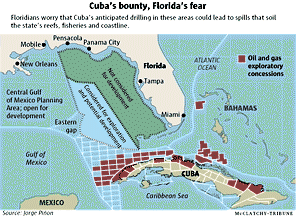
Energy Tribune.com:Drill, Cuba, Drill By Andres Cala

http://www.energytribune.com/articles.cfm/7910/Drill-Cuba-Drill#
Posted on Jul. 07, 2011
Drill, Cuba, Drill
By Andres Cala
Posted on Jul. 07, 2011

Drill, Cuba, Drill

A brand new, top of the line, Italian owned and Chinese-made semisubmersible rig is on its way to Cuba to start drilling several exploratory wells this year once hurricane season is over. Its target are deep waters in the Gulf of Mexico just a few dozen miles from Florida that could hold proven oil reserves believed to be at least as big as Oman’s and perhaps comparable to those of Brazil. The latter are massive.

Cuban drilling should be a US bipartisan no-brainer. Democrats want the embargo softened and Republicans want to give oil companies more access to offshore oil. And all will agree a lot of new production bordering the US would be welcome news, especially if American oil companies are eventually allowed to take a stake and if environmental safeguards against spills are improved in the process.

Yet there is a great deal of noise coming from Congress compounded by some White House acquiescence that threatens safe oil exploration in Cuban waters. The argument is the Castro regime will be propped up if oil is found and the US should impede anything that might make it more powerful.

Seriously? Will Cuban-American hawks with disproportional political clout impose their outdated Cold War mentality that has harmed US interests at least as much as the Castro regime? The vast majority of Americans, including Republicans, frankly stopped caring about Cuba decades ago and even a majority of the mostly Floridian Cuban community now favors more rapprochement to influence an unstoppable democratic transition in Cuba.

The US should be cheering, not just because any significant oil find will contribute directly and immediately to American energy security. Assuming lifting the embargo is still too politically risky (and it shouldn’t be), Congress should seize the imminent arrival of the rig, the Norwegian designed Scarabeo 9, to relax the embargo on the communist island to allow US energy companies to partake in Cuban exploration and production.

Forget the fact that being communist or anti-democratic is no deterrent to American energy industry elsewhere. The US already imports almost 10 percent of its oil from Cuba’s closest ally Venezuela. Should the US now also penalize all companies investing there, including American ones?

It makes no sense to thwart Cuban efforts to increase oil output perhaps in as little as three years, especially considering oil prices that will remain stubbornly high because demand growth is rising faster than supply growth.

Washington should prioritize the broader interest of Floridians and Americans over local political mavericks and sign all the necessary protocols to allow US companies and organizations to help out in case of any spill. It’s in America’s interest that Cuba get access to the best spill containment technology and knowhow, which is American, not surprisingly.

Besides, Cuba will proceed with exploration regardless of what the US does. Bills in Congress that will likely fail are calling for companies involved to be punished with the loss of US oil leased acreage if they go ahead with exploration. They might, best case scenario, delay production for some time, without scratching the Castro regime. It would simply serve no purpose.

The only company that would be affected would be Spanish Repsol, also an important player in deep offshore drilling and production in the Gulf of Mexico and Brazil. It will be the first to drill. No law is being broken as the rig was tailored made to make sure that less than 10 percent of the parts were American. And Repsol has offered to let US officials inspect it and has given assurances that its operations will follow American safety guidelines.

Repsol “has volunteered to comply with all United States regulations while drilling in the Gulf of Mexico,” said US Interior Secretary Ken Salazar in June in Madrid after meeting company executives. Salazar’s visit followed letters from Congress to Secretary of State Hillary Clinton demanding pressure on Spain to delay the drilling.

That in itself is unwelcome geopolitical meddling at any level and harms American efforts to get access to oil elsewhere. It also gives legitimacy to unfounded concerns over Cuba drilling. Even the Cuban government is cooperating with American officials. The International Association of Drilling Contractors met in Havana with Cuban energy officials drafting offshore regulation, which reportedly is based on US safety standards after the BP spill.

“They know what they’re doing, and they’re very credible about what they’re putting in place,” Lee Hunt, president of the IADC was quoted as saying. “They conducted in-depth research on both offshore drilling regulations and safety practices, and have gone largely to Northwest Europe, specifically Norway and the United Kingdom, as well as to IADC for the structure of their regulations.”

The Scarabeo 9 is designed to operate at more than twice the depth that Repsol and other oil companies waiting for their turn at the rig will drill. Other players include Norway’s StatoilHydro, India’s ONGC, Russia’s Gazprom, Malaysia’s Petronas, Venezuela’s PdVSA, Angola’s Sonagol, and apparently China’s CNPC.

The deepest planned exploratory well will be drilled below 5000 feet of water, at the same depth as the Macondo Deepwater Horizon accident. Companies are all well reputed companies that will not risk relations with the US over safety concerns. Repsol has been involved in off shore drilling in the Gulf of Mexico a lot deeper than the ones it’s planning.

Reason enough, one might believe, for the Obama administration to heed advice from the co-chairman of the panel that made a series of recommendation on offshore drilling after Macondo. Instead, his advice is being hushed.

“I have been causing grief to the State Department,” William Reilly, the former EPA chief under President George H.W. Bush. Cuba’s drilling is “something that’s very important to us, I think, given that they’re drilling 50 miles off Key West, so I’ve asked to be invited to Cuba to talk about the report and have had my wrist slapped by the administration for raising the sensitive Cuban issue. I had to say, ‘I don’t work for you.’

Also, any unilateral US punitive measures against investment in Cuba’s oil sector could risk reciprocal policies that undermine US companies’ interests in other countries. Worse yet, it would heighten risks of environmental damage off the Florida coasts and all but kill any hope of US companies getting a piece of what could be an oil bonanza.

There are anywhere between 5 and 20 billion barrels of recoverable oil in Cuba’s seabed, this according to both US and Cuban estimates. It will take years to develop this and Americans are on paper the best placed to profit from this oil bonanza, as producers and consumers.

I’m no fan of the Castro regime. But the embargo continues to be a useless firewall. And as exploratory drilling starts near Key West, Washington should be strategizing how to use this to America’s advantage.

This is probably the best chance the US has had since Fidel Castro took over in 1959 to influence Cuban policy and its democratic future.

And it’s also the best argument to finally overcome Florida’s banana republic politics to the benefit of American companies. Ending the embargo, at least gradually, would have bipartisan support, seconded by both environmental groups and oil companies.

Or would the Obama administration and Congress prefer waiting until international competitors have divvied up Cuban oil production and supplies?

Andres Cala is coauthoring a book with Michael Economides about US energy security in the American continent called “The Blind Spot: Chavez, Oil, and US Energy Security” that will be published this year.

San Francisco Chronicle: China offshore oil spill spreads 320 square miles

http://www.sfgate.com/cgi-bin/article.cgi?f=/c/a/2011/07/05/MN891K6L0O.DTL

Andrew Jacobs, New York Times
Wednesday, July 6, 2011
Beijing —
Oil that spewed from an offshore drilling rig in northeastern China for two weeks last month has spread over 320 square miles, government officials acknowledged Tuesday, amid uproar over why it took so long for fishermen, local residents and environmental groups to be informed of the spill.

News of the accident emerged in late June on the microblogging site Sina Weibo and was not confirmed by the state-owned operator until Friday. The government sought to play down the leak’s significance, saying the environmental repercussions were likely insignificant and blaming the rig’s Western operator.

“There is no visible floating oil on the sea and the leak is now under control,” said a spokesman for the State Oceanic Administration, according to a transcript of a news conference posted on its website, although another official acknowledged that a small slick could be seen from the two platforms involved in the accident.

Officials at the agency said ConocoPhillips China, a subsidiary of the Houston-based energy giant that operates the rigs with a Chinese state-owned company, “should take the blame” for the accident, which occurred in the mouth of the Bohai Sea, a largely enclosed body of water that touches on three provinces and the city of Tianjin.

Speaking at a news conference Tuesday, an official at the oceanic agency’s Beihai branch said the minimum fine would be about $30,000, a figure that could rise depending on the extent of the economic and ecological damage.

ConocoPhillips officials did not immediately respond to requests for comment Tuesday, but in an earlier e-mailed statement, the company said it was still investigating the scope of the leak and that there had been no reported impact on wildlife, fishing or shipping activities.

The company owns a 49 percent stake in the venture, Penglai 19-3, which is the country’s largest offshore oil discovery, reportedly producing 150,000 barrels a day. It operates the rig with China’s National Offshore Oil Corp.

In recent days, several Chinese media outlets have reported die-offs among fish farmed in ocean enclosures, but such accounts could not be verified Tuesday.

According to the oceanic agency’s website, a leak was first detected June 4 and then again June 17. It said the spills occurred during the drilling process, when water is forced into the earth’s crust. By June 19, the problem was under control, the agency said, and by Monday, 40 cubic meters of oily water had been removed from the sea.

Yang Fuqiang, a senior adviser on climate and energy at the Beijing offices of the U.S.-based Natural Resources Defense Council, an environmental group, said that even if the environmental damage turned out to be minimal, the long delay in publicizing the accident erodes public trust in the government and its state-run energy companies.

“According to the regulations, any oil spill has to be reported to the public,” he said. “People who live in coastal areas have a right to know so they can make preparations.”

This article appeared on page A – 4 of the San Francisco Chronicle
Read more at : http://www.sfgate.com/cgi-bin/article.cgi?f=/c/a/2011/07/05/MN891K6L0O.DTL#ixzz1RNhzf2B

Special Thanks to Richard Charter

Miami Herald: Cuba’s oil hunt, our potential mess

http://www.miamiherald.com/2011/06/12/2285003/cubas-oil-our-potential-mess.html#storylink=misearch

Originally published July 3, 2011 at 5:58 PM | Page modified July 3, 2011 at 10:27 PM

Cuba’s oil hunt, our potential mess
In about five months, Spanish oil giant Repsol is to begin a risky offshore exploration in Cuba’s North Basin, about 60 to 70 miles from Key West and even closer to ecologically fragile waters of the Florida Keys National Marine Sanctuary.

By Cammy Clark
The Miami Herald

KEY WEST, Fla. –
In about five months, Spanish oil giant Repsol is to begin a risky offshore exploration in Cuba’s North Basin, about 60 to 70 miles from Key West and even closer to ecologically fragile waters of the Florida Keys National Marine Sanctuary.

From a $750 million semi-submersible rig, Repsol will drill through 5,600 feet of seawater with strong currents and an additional 14,000 or so feet of layered rock at high pressure.
It’s the start of Cuba’s big push to find and produce what geologists believe is an energy treasure trove of oil and natural-gas reservoirs. The prospects are so promising that seven international consortiums involving 10 countries have partnered with the communist nation.

In the Florida Keys and up the East Coast, the prospect of potential oil spills so close to precious coral reefs, fisheries and coastal communities is frightening. Federal, state and local agencies have been scrambling to update contingency response plans using the lessons learned from last year’s devastating BP Deepwater Horizon blowout, which took 85 days to contain.

“Deepwater Horizon was 450 miles away, and we saw the impact for the Keys,” said Coast Guard Capt. Pat DeQuattro, commander of Sector Key West. “This is much, much closer, and Cuba is a sovereign nation.”

Cuba also has been embargoed for nearly 50 years, with bitter relations dating to the Kennedy administration.

As it stands, a lot of U.S. containment equipment, technology, chemical dispersants and personnel expertise would not be allowed to respond to a spill where it likely would be needed most – “at the faucet,” said oil-industry expert Jorge Piñon, a visiting research fellow at the Cuban Research Institute at Florida International University.

Politics also would prevent relief wells in Cuban waters from being built by U.S. companies or with U.S. resources.

“The clock is ticking for the U.S. to rethink its policy,” said Dan Whittle, Cuban program director for the nonprofit Environmental Defense Fund. “Hoping [Cuban oil exploration] goes away is not good policy.”

Even the final report issued in January from the National Commission on the BP Deepwater Horizon Oil Spill and Offshore Drilling recommended U.S. cooperation with Cuba’s oil industry to protect “fisheries, coastal tourism and other valuable U.S. natural resources.”

The report said it is in the national interest to negotiate with Cuba on common, rigorous safety standards and regulatory oversight. The countries also should develop a protocol to cooperate on containment and response strategies and preparedness in case of a spill.
But direct discussions have not happened, due primarily to a powerful voting bloc of pro-embargo Cuban Americans. Among them is Rep. Ileana Ros-Lehtinen, a Republican who represents the Florida Keys and Miami-Dade County and is chairwoman of the House Foreign Affairs Committee.

“You can’t trust that evil, awful Castro regime,” she said. “It would be dangerously naive.”
Ros-Lehtinen has spearheaded efforts to stop oil drilling in Cuban waters.

In May, she introduced the Caribbean Coral Reef Protection Act, the third version of legislation she tried to push through previous Congresses. The bill would impose penalties against companies that spend $1 million or more developing Cuba’s offshore petroleum resources and would deny U.S. visas to their foreign principals.

“I know it will be hard to pass; I have no delusions of success,” Ros-Lehtinen said. “But it’s important to take a stand. … We cannot allow the Castro regime to become the oil tycoons of the Caribbean.”

Rep. Vern Buchanan, R-Fla., also is pushing legislation that would deny U.S. oil and gas permits to companies that do business with Cuba. But of 10 companies that have agreements with Cuba to drill offshore, only private company Repsol also has leases in the United States.

Sen. Bill Nelson, D-Fla., has been fighting to stop Cuban oil exploration for years.
Yet, the best the United States has been able to do is push for safety. In May, Interior Secretary Ken Salazar met with Repsol officials in Madrid and reportedly used leases in U.S. waters as leverage to obtain assurances the company would follow the same American safety standards in Cuba. Repsol also has been in contact with the Coast Guard regarding how it would deal with a potential spill.

There is ample reason to believe drilling in Cuban waters will be highly profitable. The U.S. Geological Survey in 2004 estimated Cuba’s North Basin has 5.5 billion barrels of oil and 9.8 trillion cubic feet of natural gas – roughly the same amount as reserves in Ecuador and Colombia.

Cuban geologists also estimate an additional 10 billion to 15 billion barrels of undiscovered oil lies in deeper territorial waters in the middle of the Gulf. The amount of recoverable oil and gas, however, always is much less than what’s available.

On June 5, Cuban President Raul Castro watched as Cuba’s national oil company, Cupet, signed an expanded oil agreement in Havana with China’s state-owned oil company. Cupet also has agreements with state-owned companies from Norway, Russia, India, Vietnam, Malaysia, Canada, Angola and Venezuela.

Coast Guard Rear Adm. William Baumgartner, commander for the Southeast United States, said much effort has gone into planning for a possible spill. But, he added, “The diplomatic situation will make our job more difficult in planning and execution.”

Some companies already have special licenses issued by the Treasury Department and Commerce Department to send staffing and other resources to Cuba in the event of an oil spill.

If those companies did respond to a spill, Baumgartner said the Coast Guard would be “well aware of what they are doing inside Cuban waters and complement what they are doing.”

The National Oceanic and Atmospheric Administration is updating 2004 computer tracking models of a spill coming from Cuban waters.

“Even with what the models tell you, you still want to be prepared for any possibility,” said Sean Morton, superintendent of the FSpec
“We’ve had markers and mooring buoys break lose in Keys waters, and they have ended up as far north as Scotland and also in Alabama,” Morton said.

Special thanks to Richard Charter

Skytruth.org: ‘OIL CONTINUES TO IMPACT -WALTON CO. FL’

Latest report of lingering BP spill impact on Florida panhandle – see pics at http://oilspill.skytruth.org/reports/view/203 – j

Large tar patties have been found along this stretch of beach for several weeks.This is near Topsail Park at Stallworth Lake outflow into the Gulf. Hoping to have dive teams assess this area soon.

Clean up crews have been reduced again and will only be on a certain beach once every week or two and respond to call-ins from NRC/Unified Command. Sad state of affairs for our beaches along 30-A. This is what happened last year, and why we have buried oil on nearly 30 miles of our shoreline.

This current oil has been initially tested with UV light and found to be heavily contaminated.
Extensive lab work has been ordered.


John Amos – President, SkyTruth
John@skytruth.org
P.O. Box 3283
Shepherdstown, WV 25443-3283
(o) 304.885.4581 (m) 304.260.8886
skype: skytruth.amos
******************************************************************
Satellite images and digital mapping for environmental protection,
education and advocacy – a 501(c)(3) nonprofit organization
Visit us on the Web at http://www.skytruth.org
Learn more at the SkyTruth Blog – http://blog.skytruth.org
Browse our image galleries on Flickr – http://tinyurl.com/yd576ep
Follow us on Twitter for the latest – http://twitter.com/skytruth
And yes,we’re on Facebook – http://www.facebook.com/SkyTruth

Special thanks to Richard Charter

"Be the change you want to see in the world." Mahatma Gandhi