opednews.com: Gulf Residents Say No to Congressional Push for Faster, Dangerous Drilling

Gulf Residents Say No to Congressional Push for Faster, Dangerous Drilling

By Rocky Kistner

Sometimes in history there are moments you have to ask yourself; can this really be happening? The fires spreading across the Cuyahoga River near Cleveland, the toxic goo seeping into houses at Love Canal. Each time, the pubic reacted with outrage and politicians got the message. New laws were passed to ensure public health and our environmental resources were better protected.

So wouldn’t you would think that after the largest oil blowout in US history those lawmakers would be falling over themselves to pass new laws and keep this from happening again?

Not this time.

Instead we have a tone deaf Congress that seems bent on ignoring recent history, including the fact their constituents are still suffering economic, emotional and physical harm from the oil disaster. Lawmakers in the House rushed through legislation that would not only speed up more offshore oil drilling, but curtail some of the environmental safeguards designed to keep oil catastrophes from happening again. The Senate is supposed to take up similar bills next week.

That’s absurd thinking to many folks in the Gulf who are still struggling to get their lives back. It’s been a very hard road. With the Louisiana shrimp season set to open next week, the market for seafood is still terrible. Many buyers don’t trust the government’s stamp of approval on Gulf seafood. Customers across the country–and across the world–simply don’t want it.

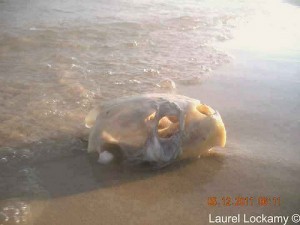
Sea turtle skull, Long Beach MS, May 12th.

Photo: Laurel Lockamy

Rushing to drill more wells won’t help the price of seafood. And despite the political rhetoric, it won’t reduce the price of gas or our dependency on foreign oil. Drilling faster and further on the heels of the BP oil disaster is sort of like trying to chase an alligator after it just ate your foot. We need to recover first and make sure the safety measures are in place. Here’s what fishing guide and Louisiana Charter Boat Association Director Ryan Lambert has to say:

So, now Congress wants to give oil companies free reign to drill in our Gulf waters as fast as possible, with little thought to the disaster that still unfolds here. I don’t get that. And I especially don’t understand they’re reasoning. It will do little to reduce gas prices and make us energy independent.

As the president’s national oil spill commission recommended earlier this year, we need to establish an independent drilling safety and environment office to make sure this disaster doesn’t happen again. And as the commission suggested, we should expand the role of the National Oceanic and Atmospheric Administration to ensure decisions about offshore drilling are based on sound science.

But this still has not happened. Instead, lawmakers are following the advice of the oil industry that lines their pockets”. We still need to drill for oil, but we need to do it carefully while our country invests in new sources of energy that are cleaner, safer and that provide more jobs. That’s what Congress should be doing , not pushing reckless oil drilling that could put our coastlines at greater risk.

But it’s not just fishermen who are worried about the blind rush by Congress to mandate more drilling off our coastlines, including the arctic. Residents along the oil-impacted coasts have been hit hard by losses in the tourist industry and some are suffering from health problems they say are related to airborne contaminants from the massive slicks of oil and chemical dispersants. Robin Young of the Orange Beach, AL, group Guardians of the Gulf has this to say in an draft op-ed about the drilling proposals:

While lawmakers are focused more on making money for oil companies, I will be trying to figure out how to help people make ends meet after the disastrous BP blowout ruined many people’s lives in my community.

Perhaps members of Congress have forgotten that people down here are sick, or that birds, dolphins and sea turtles are still washing in dead on our beaches. Perhaps they don’t realize that the oil industry’s callous disregard to safety continues to impose pain and suffering on many people’s lives in the Gulf.

It’s unfathomable to me that Congress would even consider passing these bills that ignore the recommendations of the presidential commission on the BP oil spill. These proposals would just make the rest of our country’s coastline vulnerable to the same sort of nightmare we’re living here.

Even if we put a thousand more oil wells in the Gulf and suck every barrel of oil out of the seabed, it won’t put much of a dent in the price of gas or reduce our dependency on foreign oil. And done helter-skelter, it will threaten the livelihoods of generations of residents throughout the Gulf.

What we need in the Gulf isn’t more drilling, it’s more health clinics and doctors who can tend to people damaged by dangerous oil company practices so far. Instead, politicians seem to be focused on the oil industry’s bottom line, not the health and wellbeing of residents in the Gulf.

Many Gulf residents are no longer satisfied with the same pat answers from the oil industry.The BP oil disaster proved the status quo does not serve the public’s best interest. People like Ryan Lambert and Robin Young say it’s time to put the well-being of residents and the environment first. Rushing to drill faster, further and more dangerously won’t change the price of gas at the pump, and it will put even more coastal regions in jeopardy. Does that make sense?

So wake up America. It’s really happening. And it’s time to do something about it.

Pensacola News Journal: Sick fish in Gulf are alarming scientists

http://www.pnj.com/article/20110508/NEWS01/105080328/Sick-fish-Gulf-alarming-scientists

PNJ.com

Unusual number a ‘huge red flag’ to scientists, fishermen
12:00 AM, May. 8, 2011 |

Red snapper with abnormal stripes caught by a local commercial fisherman. Scientists are seeing a growing number of Gulf fish with lesions and other health problems and are conducting tests to determine whether they are related to the BP oil spill. / Special to the News Journal
Written by
Kimberly Blair
kblair@pnj.com

ZOOM
Red snapper with a skin lesion and fin rot caught by a local commercial fisherman. / Special to the News Journal
Fish health
Some of illnesses scientists are concerned about may be signs of compromised immune systems and include:

» Fin rot: When bacteria eats away the fins of a fish.

» Skin lesions: Ulcers or infections on the skin of a fish that may be caused by a wound not healing properly.

» Skin pigmentation: Fishermen are finding red snapper with odd black pigmentation.

» Parasites: Fungus, bacteria, worm or crustaceans.

» Liver damage: Blood clots where liver is hemorrhaging.

What’s next?

Preliminary results of UWF’s research may take months. Research will continue until enough data is collected to better understand what is happening, and if there is a real problem or if the occurrences of sick fish are random. Data collected will go through scientific review and be published.

Scientists are alarmed by the discovery of unusual numbers of fish in the Gulf of Mexico and inland waterways with skin lesions, fin rot, spots, liver blood clots and other health problems.

“It’s a huge red flag,” said Richard Snyder, director of the University of West Florida Center for Environmental Diagnostics and Bioremediation. “It seems abnormal, and anything we see out of the ordinary we’ll try to investigate.”

Are the illnesses related to the BP oil spill, the cold winter or something else?
That’s the big question Snyder’s colleague, UWF biologist William Patterson III, and other scientists along the Gulf Coast are trying to answer. If the illnesses are related to the oil spill, it could be a warning sign of worse things to come.

In the years following the 1989 Exxon Valdez oil spill in Alaska’s Prince William Sound, the herring fishery collapsed and has not recovered, according to an Exxon Valdez Oil Spill Trustee report. The herring showed similar signs of illness – including skin lesions – that are showing up in Gulf fish.

Worried that same scenario could play out along the Gulf Coast, Patterson is conducting research on the chronic effects of the BP oil spill on Gulf fish. And he sees troubling signs consistent with oil exposure: fish with lesions, external parasites, odd pigmentation patterns, and diseased livers and ovaries. These may be signs of compromised immune systems in fish that are expending their energy dealing with toxins, Patterson said.

“I’ve had tens of thousands of fish in my hands and not seen these symptoms in so many fish before,” said Patterson, who has been studying fish, including red snapper, for 15 years. “All those symptoms have been seen naturally before, but it’s a matter of them all coming at once that we’re concerned about.”

He’s conducting the research with some of the $600,000 in BP money distributed to UWF from $10 million the oil company gave to the Florida Institute of Oceanography in Tampa to study the impact of the spill.

Higher scrutiny

As part of his studies, Patterson is collecting samples at targeted sites in the Gulf and from commercial fishermen. Samples from his targeted sites have shown fewer problems than those from fishermen.

While Patterson is alarmed, he’s quick to point that the Gulf’s ecosystem never before has been scrutinized as closely as it is now, or by so many scientists.
“Are we looking more closely, or are these unusual?” he said.

Sick fish have been reported from offshore and inshore waters from Northwest Florida to Louisiana, he said. Scientists are trying to figure out how prevalent these abnormalities are and their cause.

In that pursuit:
» Patterson and Florida A&M University scientists are conducting toxicology tests to find out if the fish were exposed to hydrocarbons or oil. Results are not final.

» Scientists at Louisiana State University’s veterinarian school are in the Gulf looking into what microbes might be causing the diseases.

» Pensacola marine biologist Heather Reed is studying red snapper for a private client using broader testing methods than mandated by the federal government, which she says are not adequate.

“I’ve been testing different organs in game fish that have been brought to me, and I’m seeing petroleum hydrocarbons in the organs,” said Reed, the environmental adviser for the City of Gulf Breeze. “I was shocked when I saw it.”

She is trying to secure grants to continue that research and is talking to federal and state officials about her findings, she said.

All the studies are aimed at one goal: “To find out what is really going on and get things back to normal,” Reed said.

Solving the mystery

But both Reed and Patterson say it’s hard to determine just how many fish are being found sick because many commercial fishermen are reluctant to report their findings to state and federal officials out of fear fishing grounds will be closed and their livelihoods will be put at risk.

But at the same time, to protect the future of the Gulf, Patterson said, the fishermen quietly are asking scientists to look into what is happening.

Clay Palmgren, 38, of Gulf Breeze-based Bubble Chaser Dive Services, is an avid spear fisherman who has about 40 pounds of Gulf fish in his freezer. He has not seen sick fish so far, but he said many of his angler friends, both recreational and commercial, are talking about catching fish that appear abnormal.

“I’m 100 percent glad scientists are looking at this,” he said. “I’m concerned with the health of fish, and I think it will take a couple of years for the (toxins) to work up the food chain. I think that’s a shame.”

Patterson’s studies and those of other scientists delving into this mystery of the sick fish are not trying to determine whether the seafood is safe for public consumption.

“There is fish health and human health, and we’re concerned about the sublethal effects of the oil spill on communities of fish,” he said.

Findings so far demonstrate that studies need to continue far into the future, he said.
The $500 million BP has provided for long-range research on the Gulf oil spill will ensure “people will be examining the impacts for the next decade,” Patterson said.

The cause of the fish illnesses may be hard to nail down, Snyder said.

“Cause and effect is a huge problem for environmental work,” Snyder said. “You see anomalies in fish. Is it oil-related? How do we prove it? We can make the connection with economic stuff. But after the oil is gone, how do you definitely say the fish are sick because of the oil spill?

“We may never know, and that’s the frustrating thing.”

Special thanks to Richard Charter

New York Times: Obama Shifts to Speed Oil & Gas Drilling in U.S. and Politico: Obama says Drill

The New York Times May 14, 2011

Obama Shifts to Speed Oil and Gas Drilling in U.S.

By JOHN M. BRODER

WASHINGTON – President Obama, facing voter anger over high gasoline prices and complaints from Republicans and business leaders that his policies are restricting the development of domestic energy resources, announced Saturday that he was taking several steps to speed oil and gas drilling on public lands and waters.

It was at least a partial concession to his critics at a time when consumers are paying near-record prices at the gas pump. The Republican-led House passed three bills in the last 10 days that would significantly expand and accelerate oil development in the United States, saying the administration was driving up gas prices and preventing job creation with antidrilling policies.

Administration officials said the president’s announcement, which included plans for expanded drilling in Alaska and the prospect of new exploration off the Atlantic coast, was intended in part to answer these arguments, signal flexibility and demonstrate Mr. Obama’s commitment to reducing oil imports by increasing domestic production.

But in fact the policies announced Saturday would not have an immediate effect on supply or prices, nor would they quickly open any new areas to drilling.

“These spikes in gas prices are often temporary,” Mr. Obama said, “and while there are no quick fixes to the problem, there are a few steps we should take that make good sense.”

The president’s turn to a domestic pocketbook issue comes after two weeks of intense focus on the killing of Osama bin Laden, terrorism more broadly and the multiple crises in the Middle East.

In his weekly radio and Internet address, the president said the administration would begin to hold annual auctions for oil and gas leases in the Alaska National Petroleum Reserve, a 23-million-acre tract on the North Slope of Alaska. The move comes after years of demands for the auctions by industry executives and Alaska’s two senators, Lisa Murkowski, a Republican, and Mark Begich, a Democrat.

The administration will also accelerate a review of the environmental impact of possible drilling off the southern and central Atlantic coast and will consider making some areas available for exploration. The move is a change from current policy, which puts the entire Atlantic seaboard off limits to drilling until at least 2018.

The president also said he would extend leases already granted for drilling in the Arctic Ocean off Alaska and the Gulf of Mexico that had been frozen after last year’s BP spill. The extension will allow companies time to meet new safety and environmental standards without having to worry about their leases expiring.

And the government will provide incentives for oil companies to more quickly exploit leases they already hold. Tens of millions of acres onshore and offshore are under lease but have not been developed.

The moves come after the House passed a series of bills that would force the administration to move much further and faster to open public lands and waters to oil and gas development. The administration formally opposed the bills as written, but officials said Friday that the White House might accept some provisions in the bills, like extending the frozen leases in the gulf and in Alaska.

Responding to the shift by the administration, Brendan Buck, a spokesman for Speaker John A. Boehner, said, “The president just conceded what his party on Capitol Hill still denies: more American energy production will lower costs and create jobs. This reversal is striking, since his administration has consistently blocked American-made energy.”

Although Mr. Buck characterized the policy changes as “not terribly substantial,” he added that they should “pave the way for legislation, like the bills the House passed in the past two weeks, to reduce the damage from the restrictions he imposed in the past.”

Congressional Democrats, who are largely united in their opposition to the Republican “drill here, drill now” legislation, said the president’s proposals made sense as part of a broader policy that includes revoking tax breaks for the oil industry and encouraging companies to drill on the public land they already control.

Representative Nancy Pelosi, the House Democratic leader, endorsed the measures Mr. Obama proposed on Saturday but also advocated selling some portion of the Strategic Petroleum Reserve, which today contains 727 million barrels of crude oil. The administration has so far resisted tapping the reserve, saying that it would have only a small and temporary effect on prices and was designed for critical supply shortages, which the country is not now experiencing.

The president, in his address, said he supported increased domestic oil and gas development, if done safely and responsibly. “Last year, America’s oil production reached its highest level since 2003,” he said. “But I believe that we should expand oil production in America, even as we increase safety and environmental standards.”

The Alaskan petroleum reserve was set aside in the 1920s as a source of oil for the Navy. There have been fewer than a dozen lease sales there; the most recent one, in 2010, drew only modest industry interest. The government has lowered its estimate of recoverable oil under that vast tract, and the Obama administration is leaving large areas untouched because of their ecological and wildlife value.

Response from environmental advocates was relatively muted. Eric Myers, Alaska policy director for the National Audubon Society, said that conservationists were willing to see an increase in drilling in the Alaskan petroleum reserve as long as it did not threaten wildlife, waters or sensitive lands.

The more environmentally sensitive Arctic National Wildlife Refuge in Alaska will remain off limits to oil and gas drillers, administration officials said Friday.

Senator Mark Begich, Democrat of Alaska, who has been critical of the administration’s cautious approach to drilling in the Arctic, said he was pleased by much of the president’s announcement, including the adoption of his proposal to create a multi-agency task force to streamline decisions about oil development in Alaska and to extend the leases for companies planning to drill there.

The president noted in his address that the Justice Department had formed a task force to look into potential market manipulation or excessive speculation in oil, and he repeated his call for a repeal of the $4 billion a year in tax incentives the oil industry receives.

“In the last few months, the biggest oil companies made about $4 billion in profits each week,” Mr. Obama said. “And yet, they get $4 billion in taxpayer subsidies each year. Four billion dollars at a time when Americans can barely fill up their tanks. Four billion dollars at a time when we’re trying to reduce our deficit.”
Next week, the Senate will take up a Democratic bill to remove a portion of those subsides, but it is not expected to become law because of united Republican opposition in both chambers of Congress.

_______________________

Read more: http://www.politico.com/news/stories/0511/54969_Page2.html#ixzz1MMHnNgAS

POLITICO
Obama says drill
By: Darren Goode
May 14, 2011 07:03 AM EDT

President Barack Obama is looking to bolster U.S. oil drilling, announcing Saturday a preemptive strike against bolder efforts from Capitol Hill as consumer unrest deepens over the price at the pump.

The White House will move forward without congressional action on a set of ideas espoused by Republicans and oil-state Democrats to expand oil and gas drilling in the Gulf of Mexico, Alaska and potentially parts of the Atlantic seaboard.

It’s the closest Obama has come to rivaling his short-lived pro-drilling stance that ended with the BP oil spill.

At the same time, Obama is also firing up the liberal Democratic base by urging Congress to repeal billions of dollars in oil-industry tax incentives and to raise fees against companies that do not act quickly on drilling leases they own.

“Without a doubt, one of the biggest burdens over the last few months has been the price of gasoline,” Obama said in his fourth weekly address in a row and fifth in seven weeks to touch on energy issues.

Gas prices are now averaging more than $4 a gallon in many areas ahead of the start of the summer driving season, when prices usually peak.

The situation is precarious for Obama, who must balance the need to work with a starkly divided Congress against his own effort to win a second term.

“These spikes in gas prices are often temporary, and while there are no quick fixes to the problem, there are a few steps we should take that make good sense,” Obama said.

Attorney General Eric Holder is leading a task force investigating possible fraud, manipulation and illegal activity by traders and speculators that might be leading to the spike in prices.

But drilling is where the political problems lie for the White House. Republicans and oil-state Democrats have continued to criticize Obama and the Interior Department for what they say is a dramatic slowdown in new permits off and on shore.

“[W]e should increase safe and responsible oil production here at home,” Obama said. “Last year, America’s oil production reached its highest level since 2003. But I believe that we should expand oil production in America – even as we increase safety and environmental standards.”

Obama is now looking to give a blanket extension to all oil and gas leases in the Gulf of Mexico due to the disruption caused by last year’s Gulf spill and subsequent administration ban and slow-down of drilling permits. By doing so, Obama is at least touching on an idea advocated by Republicans as part of a three-part offshore drilling package the House approved this month.

A senior administration official told reporters Friday that the administration is also looking to complete by the end of the year the first new lease sale in the Gulf since the BP spill – and to have two combined sales finished in the western and central Gulf of Mexico by the middle of next year.

But the GOP-passed bills go further and would require lease sales off the coast of Virginia that the administration canceled in the wake of the BP spill. The measures would also require more areas off the Eastern Seaboard and the California and Alaska coastlines be opened to new drilling.

House Natural Resources Chairman Doc Hastings (R-Wash.) – the lead sponsor of the House-passed drilling bills – called Obama’s actions “baby steps.”

“One weekend address announcing minor policy tinkering, while positive, does not erase the administration’s long, job-destroying record of locking-up America’s energy resources,” Hastings said in a statement.

Obama received a more favorable initial response from a critic in his own party.

“I’m cautious, implementation will be the key,” Sen. Mark Begich (D-Alaska) told POLITICO Friday. “It’s preemptive but I think he’s hearing Š from his own folks in his own party.”

Begich and Sen. Mary Landrieu (D-La.) have been highly vocal in criticizing the administration for its pace of expanding production in both the Gulf and the Arctic.

Obama is now expediting the completion of an initial environmental analysis of potential oil and gas resources in the mid-Atlantic and southern Atlantic coastline.

The review is on schedule to be finished in a little over a year and would be a first step in determining where production could be viable and worthwhile, a senior administration official said. “We want to get that answer as quickly as possible,” the official said.

It is possible that this could lead to areas off the Atlantic coast to be added at some point to the administration’s still evolving leasing strategy that runs through 2017, the official said.

Obama also announced he is directing the Interior Department to conduct annual lease sales in Alaska’s National Petroleum Reserve “while respecting sensitive areas.” The idea is to “regularize” what have been periodic lease sales there, a senior administration official said.

Alaska’s Arctic National Wildlife Refuge – long a symbolic centerpiece over the fight to expand domestic drilling – remains “off the table, and we do not support development there,” a senior administration official said.

The administration also will put together what one senior official deemed a “high-level interagency group” to expedite permitting off the coastline of Alaska.

Begich has offered legislation that would establish a federal coordinator to expedite permitting of offshore leases in the icy Arctic waters off Alaska.

But in a move sure to rankle Republicans and some Democrats, Obama is continuing his push to add pressure on companies to use existing leases they own, considering a new “graduated fee” structure that essentially rewards those who act on their leases quickly, a senior administration official said.

Final details were not provided and may not be settled. “There could be a sliding scale of royalties” companies would have to pay, the official said. For instance, companies could pay a lower royalty if they develop their leases within the first three years.

Obama also railed against the need for oil-industry tax incentives ahead of Senate action Wednesday on an effort to repeal $21 billion in incentives over 10 years for the five biggest private integrated oil firms.

“The American people shouldn’t be subsidizing oil companies at a time when they’re making near-record profits,” Obama said. “As a nation, we should be investing in the clean, renewable sources of energy that are the ultimate solution to high-gas prices.”

The Senate Democratic plan would put the money saved toward reducing the deficit and not direct it toward programs aimed at reducing oil dependence.

Despite Obama’s backing, opposition from Republicans and Democrats like Begich and Landrieu is likely to derail the measure in the Senate, and it would be dead on arrival in the GOP-controlled House.

Special thanks to Richard Charter
Los Angeles Times: Behind Chevron’s feel-good, misleading ad campaign

http://www.latimes.com/business/la-fi-lazarus-20110513,1,524134.column

The Chevron ads are blatent lies. Why am I not surprised? DV

John Watson, chief executive officer of Chevron Corp., waits for the start of a Senate Finance Committee hearing. “Don’t punish our industry for doing our job well,” he said. (Andrew Harrer, Bloomberg / May 12, 2011)
In its ‘We Agree’ ads, Chevron takes credit for ‘reinvesting over $7 billion into the state.’ Guess how it got that number.

By David Lazarus
May 12, 2011, 8:10 p.m.

It’s easy to get cheesed about high gas prices when oil companies are raking in billions of dollars in profit. Chevron, for one, wants you to know that it’s thinking the same.
“Oil companies should put their profits to good use,” the company declares in recent newspaper ads. And in response to that laudable sentiment, Chevron’s chief financial officer, Patricia Yarrington, says, “We agree.”

The ads go on to say that “California’s economy needs energy to grow. And we’re providing it. Reinvesting over $7 billion into the state over the past 5 years. Bringing new energy to market, helping support thousands of jobs, and boosting small businesses. We’re making every penny count.”

Considering that Chevron has reported $6.2 billion in profit for the first three months of the year, up 36% from a year earlier – and $19 billion for last year, nearly double its 2009 earnings – that’s a bold statement.

Equally bold was the testimony of oil industry leaders Thursday in Congress. They were making the case for why some $4 billion in annual federal subsidies and tax incentives should remain in place despite the companies’ bulging pockets.

“Don’t punish our industry for doing our job well,” said John Watson, Chevron’s chief exec.

OK, then perhaps Chevron can tell us how exactly it’s reinvested $7 billion into California. Was it in building new facilities and creating new jobs? Was it in developing alternative energy sources? Investing in solar companies? Or was it something as mundane as simply paying its taxes?

I’ll get to what Chevron had to say – and why the company isn’t fooling anyone. But first, let’s take a closer look at this ad campaign the company’s running.

The “We Agree” newspaper ads and radio and TV commercials debuted in October. According to the company, they highlight “the common ground Chevron shares with people around the world on key energy issues.”

The campaign was launched just few months after the BP oil spill in the Gulf of Mexico and four months before Chevron was hit with a $9.5-billion judgment in a long-running lawsuit alleging that the company was responsible for poisoning the Ecuadorian rainforest. The oil giant is appealing the judgment.

Chevron’s ad campaign was spoofed in a video by the website Funny or Die: Actors portraying company execs happily sign on to the “We Agree” concept after realizing they can claim credit for being socially aware while committing to nothing.

So in California’s case, what has Chevron actually done to put its profits to good use?

When I spoke this week with Brent Tippen, a Chevron spokesman, he asked how detailed a response I wanted. Very detailed, I told him. Let the people of California know exactly where that $7 billion went.

The next day, Tippen said by email that the $7 billion cited in the “We Agree” ads “represents our combined capital investments in our business between 2005 and 2009.”

“The majority of those investments went to maintaining and expanding our major business assets in California, including oil and natural gas production in the San Joaquin Valley, as well as our manufacturing centers in El Segundo and Richmond,” he said.

“It also includes smaller capital investments in our technology and service businesses in California. These capital investments help sustain our business in California, which produces jobs, tax revenues and economic output.”

Hmm. Not so detailed after all. Tippen declined to elaborate, saying that “specific capital expenditures are proprietary information.”

I went online to see if I could find any additional info about Chevron pumping billions of dollars into its California oil and gas facilities. All I found were plans for a major expansion of the company’s refinery in Richmond, across the bay from San Francisco.

But that project came to a halt in 2009 when the California 1st District Court of Appeal ruled that Chevron had botched its environmental impact report. The project remains in limbo.

Tippen sent me a Chevron-funded report by the Milken Institute showing that the oil company employed almost 10,000 California workers in 2007 (before the recession hit; there have since been layoffs). Those workers, the report said, earned about $1.2 billion and accounted for about $4.5 billion in productivity.

The report also said that when you factor in state income taxes paid by Chevron workers, plus corporate, property and sales taxes, Chevron accounted for just under $2 billion in total taxes paid in 2007.

Moreover, it said, smaller businesses get a boost from all the money spent not just by Chevron workers but also by workers at stores and restaurants patronized by Chevron workers.

In other words, if a Chevron employee leaves a tip at a restaurant, and the restaurant server then spends that tip elsewhere, that’s an example of Chevron reinvesting in California.

Is that what the company seemed to be implying with its “We Agree” ads when it talked about oil companies putting their profits to good use? No.

The clear implication of the ads is that Chevron believes it has a responsibility to spend its massive profits on good works. Examples of this might include hefty investments in green energy and technology, contributions to schools, social programs and other community resources, even support for the arts.

Maintaining and possibly expanding existing facilities, giving your workers a steady paycheck and paying your taxes – these don’t seem to be examples of a company that’s going above and beyond the call of corporate duty.

I don’t knock Chevron for wanting to burnish its image at a time when oil companies are seen as bloated ticks on the American hide. But if you’re going to spend millions of dollars on an ad campaign centered on being a sensitive and socially conscious member of society, you’d better have the goods to back it up.
Can we agree on that much?

David Lazarus’ column runs Tuesdays and Wednesdays. He also can be seen daily on KTLA-TV Channel 5. Send your tips or feedback to david.lazarus@latimes.com.

Special thanks to Richard Charter

Defenders of Wildlife: Congress serves American coasts to Big Oil on silver platter

Massive giveaway opens pristine waters to drilling at half the price

Summary:

· The U.S.House of Representatives today passed the third bill in a series of three fast-track drilling pieces that favors Big Oil profits over safety of coastal communities and environments.

· H.R. 1231,The Reversing President Obama’s Offshore Moratorium Act, is a massive handout to the oil and gas industry. This legislation forces the federal government to take on 50% of the cost of seismic testing for oil and would require the administration to open up coastal and Arctic offshore drilling areas regardless of economic or environmental consequences. These areas would include the coasts of California, Massachusetts, North Carolina, Virginia, Florida and the fragile Arctic marine ecosystem off the coast of Alaska.

· H.R. 1231 does not solve our gas price problem, but it does put at risk hundreds of thousands of jobs that rely on clean coastal waters. It also threatens thousands of miles of coastal habitat and exposes countless bird and marine species to the dangers of offshore drilling.

WASHINGTON (May 12, 2011) – The following is a statement from Rodger Schlickeisen, president and CEO of Defenders of Wildlife:

“The House today rewarded Big Oil for carelessly causing the worst environmental disaster in U.S. history. After deliberately weakening safety practices on offshore drilling rigs only yesterday,the House’s vote to open America’s most fragile and beloved coasts to polluting drill rigs adds insult to injury.

“Big Oil has hit a trifecta this week. The House of Representatives had three chances to prove to the American public that it had their interests at heart, but instead chose to vote for Big Oil each time. By now there can be no doubt that the House majority’s interests lie not with what is good for the country but what is good for the wealthy and polluting oil industry.”

###

Defenders of Wildlife is dedicated to the protection of all native animals and plants in their natural communities. With more than 1 million members and activists, Defenders of Wildlife is a leading advocate for innovative solutions to safeguard our wildlife heritage for generations to come. For more information, visit www.defenders.org.

Contact: Caitlin Leutwiler, (202) 772-3226, cleutwiler@defenders.org

"Be the change you want to see in the world." Mahatma Gandhi