Common Dreams.org: Institute for Public Accuracy: Pickens’ Gas Fracking Offensive Debunked

http://www.commondreams.org/newswire/2011/04/19-9

FOR IMMEDIATE RELEASE April 19, 2011 2:28 PM

CONTACT: Institute for Public Accuracy (IPA)

WASHINGTON – April 19 – T. Boone Pickens and Ted Turner speak at the National Press Club this afternoon. At 10 a.m. ET, a group of environmentalists and scientists are holding a conference call to expose what’s behind Pickens’ plans. For more information, contact: Kate Fried, Food & Water Watch

Food & Water Watch reports: “Congress’s upcoming consideration of the NAT GAS Act (H.R. 1380) … would funnel $5 billion in subsidies to the natural gas industry, while making the U.S. dependent on shale gas drilling for a generation to come. … The process of injecting shale rock with water to extract gas for energy, fracking has been shown to contaminate water supplies. To date, there have been more than 1,000 documented cases of water contamination near drilling sites around the country.”

A.R. INGRAFFEA
Ingraffea will participate in the conference call and is one of the Cornell University researchers who co-authored the recently-published study “Methane and the greenhouse-gas footprint of natural gas from shale formations.” He said today: “We have a preliminary conclusion that it is possible that the life cycle of natural gas produces more greenhouse gases than the life cycle of other fossil fuels. … ‘Natural gas’ basically means methane.” See: “Study: Fracking May Be More Harmful Than Coal Use.” PDF of study

JOSH FOX
Fox made the film “Gaslands,” which has won numerous awards. He and will also be on the 10 a.m. conference call. He said today: “T. Boone Pickens is an just an oil baron turned gas baron trying to game the system into subsidizing his business interests. The Pickens plan does nothing to reduce emissions and would push unregulated toxic gas drilling into overdrive, further contaminating huge areas of the United States. His plan won’t work, not just because it is costly and toxic, but because there are literally millions of Americans living in the drill zones in 34 states who are not willing to have their health, water and air put at risk by drilling. I have seen the strength of the movement against gas drilling all across the United States, it is resilient, smart, democratic, non-violent and adamant in opposing this massive drilling plan.

“Pickens promotes his plan under the guise of clean energy and independence from foreign oil. But his plan is dirty as any fossil fuel and just means more dependence on T. Boone Pickens and his oil and gas buddies. Renewable energy and biofuels are a much better way to go. There are numerous plans that exist today that don’t include risking the permanent contamination of the water supply.”

For a map of all the areas that T. Boone Pickens would like to drill go to the homepage of gaslandthemovie.com

MAURA STEPHENS
Stephens is a co-founder of the Coalition to Protect New York. She just wrote the piece “Meet the Gas Geezers,” which traces the interests of both Pickens and Turner — whose talk together today is billed as a “debate” — regarding gas and water.
.
###

A nationwide consortium, the Institute for Public Accuracy (IPA) represents an unprecedented effort to bring other voices to the mass-media table often dominated by a few major think tanks. IPA works to broaden public discourse in mainstream media, while building communication with alternative media outlets and grassroots activists.

The Independent/UK: Secret Memos Expose Link Between Oil Firms and Invasion of Iraq

Published on Tuesday, April 19, 2011 by The Independent/UK
http://www.commondreams.org/headline/2011/04/19-5

I always thought that the Bush invasion was all about Iraq’s oil; this is the first I’ve read of it from the British viewpoint. DV

by Paul Bignell

Plans to exploit Iraq’s oil reserves were discussed by government ministers and the world’s largest oil companies the year before Britain took a leading role in invading Iraq, government documents show.

A British Army soldier investigates a large fire near Basra’s Shuiba refinery. Whereas BP was insisting in public that it had “no strategic interest” in Iraq, in private it told the Foreign Office that Iraq was “more important than anything we’ve seen for a long time”. (Reuters) Graphic: Iraq’s burgeoning oil industry

The papers, revealed here for the first time, raise new questions over Britain’s involvement in the war, which had divided Tony Blair’s cabinet and was voted through only after his claims that Saddam Hussein had weapons of mass destruction.

The minutes of a series of meetings between ministers and senior oil executives are at odds with the public denials of self-interest from oil companies and Western governments at the time.

The documents were not offered as evidence in the ongoing Chilcot Inquiry into the UK’s involvement in the Iraq war. In March 2003, just before Britain went to war, Shell denounced reports that it had held talks with Downing Street about Iraqi oil as “highly inaccurate”. BP denied that it had any “strategic interest” in Iraq, while Tony Blair described “the oil conspiracy theory” as “the most absurd”.

But documents from October and November the previous year paint a very different picture.

Five months before the March 2003 invasion, Baroness Symons, then the Trade Minister, told BP that the Government believed British energy firms should be given a share of Iraq’s enormous oil and gas reserves as a reward for Tony Blair’s military commitment to US plans for regime change.

The papers show that Lady Symons agreed to lobby the Bush administration on BP’s behalf because the oil giant feared it was being “locked out” of deals that Washington was quietly striking with US, French and Russian governments and their energy firms.

Minutes of a meeting with BP, Shell and BG (formerly British Gas) on 31 October 2002 read: “Baroness Symons agreed that it would be difficult to justify British companies losing out in Iraq in that way if the UK had itself been a conspicuous supporter of the US government throughout the crisis.”

The minister then promised to “report back to the companies before Christmas” on her lobbying efforts.

The Foreign Office invited BP in on 6 November 2002 to talk about opportunities in Iraq “post regime change”. Its minutes state: “Iraq is the big oil prospect. BP is desperate to get in there and anxious that political deals should not deny them the opportunity.”

After another meeting, this one in October 2002, the Foreign Office’s Middle East director at the time, Edward Chaplin, noted: “Shell and BP could not afford not to have a stake in [Iraq] for the sake of their long-term future… We were determined to get a fair slice of the action for UK companies in a post-Saddam Iraq.”

Whereas BP was insisting in public that it had “no strategic interest” in Iraq, in private it told the Foreign Office that Iraq was “more important than anything we’ve seen for a long time”.

BP was concerned that if Washington allowed TotalFinaElf’s existing contact with Saddam Hussein to stand after the invasion it would make the French conglomerate the world’s leading oil company. BP told the Government it was willing to take “big risks” to get a share of the Iraqi reserves, the second largest in the world.

Over 1,000 documents were obtained under Freedom of Information over five years by the oil campaigner Greg Muttitt. They reveal that at least five meetings were held between civil servants, ministers and BP and Shell in late 2002.

The 20-year contracts signed in the wake of the invasion were the largest in the history of the oil industry. They covered half of Iraq’s reserves – 60 billion barrels of oil, bought up by companies such as BP and CNPC (China National Petroleum Company), whose joint consortium alone stands to make £403m ($658m) profit per year from the Rumaila field in southern Iraq.

Last week, Iraq raised its oil output to the highest level for almost decade, 2.7 million barrels a day – seen as especially important at the moment given the regional volatility and loss of Libyan output. Many opponents of the war suspected that one of Washington’s main ambitions in invading Iraq was to secure a cheap and plentiful source of oil.

Mr Muttitt, whose book Fuel on Fire is published next week, said: “Before the war, the Government went to great lengths to insist it had no interest in Iraq’s oil. These documents provide the evidence that give the lie to those claims.

“We see that oil was in fact one of the Government’s most important strategic considerations, and it secretly colluded with oil companies to give them access to that huge prize.”

Lady Symons, 59, later took up an advisory post with a UK merchant bank that cashed in on post-war Iraq reconstruction contracts. Last month she severed links as an unpaid adviser to Libya’s National Economic Development Board after Colonel Gaddafi started firing on protesters. Last night, BP and Shell declined to comment.

www.fuelonthefire.com

Not about oil? what they said before the invasion

* Foreign Office memorandum, 13 November 2002, following meeting with BP: “Iraq is the big oil prospect. BP are desperate to get in there and anxious that political deals should not deny them the opportunity to compete. The long-term potential is enormous…”

* Tony Blair, 6 February 2003: “Let me just deal with the oil thing because… the oil conspiracy theory is honestly one of the most absurd when you analyse it. The fact is that, if the oil that Iraq has were our concern, I mean we could probably cut a deal with Saddam tomorrow in relation to the oil. It’s not the oil that is the issue, it is the weapons…”

* BP, 12 March 2003: “We have no strategic interest in Iraq. If whoever comes to power wants Western involvement post the war, if there is a war, all we have ever said is that it should be on a level playing field. We are certainly not pushing for involvement.”

* Lord Browne, the then-BP chief executive, 12 March 2003: “It is not in my or BP’s opinion, a war about oil. Iraq is an important producer, but it must decide what to do with its patrimony and oil.”

* Shell, 12 March 2003, said reports that it had discussed oil opportunities with Downing Street were ‘highly inaccurate’, adding: “We have neither sought nor attended meetings with officials in the UK Government on the subject of Iraq. The subject has only come up during conversations during normal meetings we attend from time to time with officials… We have never asked for ‘contracts’.”

ENN: BP Blowout OneYear Later: Drilling Safety an Explosive Issue

http://www.ens-newswire.com/ens/apr2011/2011-04-18-02.html

Environmental News Service

WASHINGTON, DC, April18, 2011 (ENS) – Hundreds of activists protesting fossil fuels marched to the Department of the Interior’s headquarters today and swarmed inside, calling for the abolition of offshore oil drilling, coalmining and tar sands extraction. The demonstration was timed to mark the one year anniversary of the BP Deepwater Horizon blowout on April 20, 2010 that killed 11 workers and spilled 4.9 million barrels of crude oil into the Gulf of Mexico.

Police report 21 people were arrested, including residents of California, Georgia, Texas, Utah, Vermont, Wyoming, and Washington,DC.

“For all practical purposes, Louisiana and the Gulf Coast function as a third world resource colony within the U.S. For a hundred years, our people and ecosystems have been sacrificed to provide cheap energy and big profits,” said Devin Martin, a native Cajun from southern Louisiana.

“We pay for the hidden costs of oil and gas with our health and our lives through air pollution, oil spills, and a completely corrupted state government. We already lose a football field of coastal marsh every 38 minutes, and now rising sea levels from climate change will put my home, including New Orleans, under water permanently.”

Today’s march and sit-in are a preview of Rising Tide North America’s “Day of Action against Extraction” set for April 20. Protests by Gulf Coast residents fighting offshore drilling, Appalachians resisting mountaintop removal coal mining, Texas, Pennsylvania and New York residents opposing natural gas hydrofracking, Canadians fighting tar sands mining in Alberta, are planned. Protests also are slated for the UK, New Zealand, and Australia.

On the government side, the new Ocean Energy Safety Advisory Committee held its first meeting today, setting deepwater drilling safety, oil spill source containment and cleanup as its top priorities. Chaired by former Sandia National Laboratory Director Dr. Tom Hunter, the committee is made up of 15 scientific, engineering and technical experts from federal agencies, the offshore oil and gas industry, universities and research organizations.

The committee will advise the Secretary of the Interior through the Director of the Interior Department’s Bureau of Ocean Energy Management, Regulation and Enforcement, BOEMRE. This is the agency that once was the Minerals Management Service until internal corruption was exposed in a report by the U.S. Inspector General last May, about a month after the BP well blowout.

The IG’s report probed a culture of complacency and arrogance, where MMS executives accepted gifts, money, sports tickets, drugs,vacations, and jobs from oil corporations, including BP.

Renamed and reorganized last year under the leadership of Michael Bromwich, a former federal prosecutor and inspector general for the Department of Justice, BOEMRE is refocused on safety, says Bromwich.

“The Safety Committee is an important part of our continuing efforts to reduce the risks associated with offshore energy productionon the U.S. Outer Continental Shelf,” Bromwich said today.”I look forward to the committee’s recommendations as we continue to move toward safer, more environmentally responsible offshore energy development and production.”

But environmentalists say the agency has made only surface changes and remains too cozy with the people it is charged with regulating.

Interior officials admit there is much more to do before deepwater drilling is truly safe, but meanwhile, the federal government will contine to review drilling applications and issue permits.

In a speech Thursday in Washington, Bromwich said, “We will implement reforms necessary to make offshore oil and gas production safer. The processing of drilling permit applications and proposed drilling plans will not be delayed while these additional reforms are developed.”

Interior Secretary Ken Salazar today urged committee members to work together to help strengthen the nation’s offshore drilling safety, well containment, and spill response “as we explore new energy frontiers.”

“In the aftermath of the Deepwater Horizon oil spill, many have recognized the need for more collaboration among government, industry and academia to develop cutting-edge, effective, and easily deployable technologies for prevention, containment and response,” Salazar said. “This committee, with some of the nation’s brightest minds from all three areas, will facilitate future cooperation and assist the Department in implementing our offshore drilling safety reform agenda,” he said.

Last week Salazar and Bromwich toured the first deepwater drilling project permitted since the Obama administration imposed a deepwater drilling moratorium in the wake of the Deepwater Horizon blowout -Houston-based Noble Energy’s Santiago prospect 70 miles southeast of Venice, Louisiana, in which BP is a non-operating partner.

Noble spent two months drilling 13,580 feet below the sea surface before it had to plug the well under the moratorium.

Noble was the first operator to demonstrate in a permit application that it is capable of containing a subsea blowout if it were to occur. During a tour of the Ensco 8501 rig about to begin drilling the bypass well for Noble Energy, the two officials examined new testing systems and checked out a blowout preventer.

“The deepwater operations that are resuming in the Gulf of Mexico are meeting the stronger safety and environmental protection requirements we have set, including the requirement that companies show they are prepared to respond to subsea blowouts and spills,” said Salazar.

The Ocean Energy Safety Advisory Committee is intended as a first step toward establishing the proposed Ocean Energy Safety Institute, which would facilitate collaborative research and development, training and execution in these and other areas relating to offshore energy safety going forward.

The committee will provide advice on how best to establish the institute, and on what role OESC should play as the institute takes shape.

The group’s first meeting included presentations from three expert panels: on the findings and recommendations of the President’s Commission on the BP Oil Spill, the investigations into the causes of the Deepwater Horizon blowout by the National Academy of Engineering/National Research Council Committee and the Chief Counsel of the President’s Commission, and the lessons learned from the Deepwater Horizon containment and response efforts.

Deepwater drilling companies are multinational corporations with operations around the world. To engage other countries in reducing the risks of oil spills from offshore deepwater drilling, the Interior Department held a Ministerial Forum last week to share lessons learned from the Deepwater Horizon oil spill and promote collaborative solutions.

Ministers and senior officials attended from: Angola, Australia,Brazil, Canada, India, Mexico, Netherlands, New Zealand, Norway, the United Kingdom, Russia, and the European Union as well as the United States.

“As Interior works to set the gold standard for our deepwater development, we look forward to collaborating with offshore oil producing nations on the development of cutting-edge projects and common standards,” said Interior Deputy Secretary David Hayes,who moderated one of the sessions.

“It is important that we work together with our international colleagues to learn from each other and develop global containment capabilities,” said Bromwich. “Today was an important first step in this effort, and I hope that we continue this conversation in the future.”

James Dupree, BP regional president, Gulf of Mexico, was among those at the Ministerial Forum as part of the company’s ongoing effort to learn from its costly mistakes.

“Last autumn we made an ongoing commitment to share what we’ve learned and the experience we gained during the Deepwater Horizon incident response with the world,” said Dupree. “We have shared our insights with regulators, participated in public forums, worked directly with industry bodies and published our lessons learned.”

In February, BP joined the newly formed Marine Well Containment Company, MWCC. Headquartered in Houston, Texas, the not-for-profit, independent organization is staging state-of-the-art equipment in the gulf to contain spills.

Chevron, ConocoPhillips ExxonMobil and Shell founded MWCC, which now also includes Anadarko, Apache, BHP Billiton and Statoil – all companies with operations in the Gulf of Mexico. “Joining the MWCC and bringing our capabilities and equipment to an interim response system is another important part of that commitment,” said Dupree.

MWCC’s chief executive officer is Marty Massey, formerly with ExxonMobil Production. “Our objective is to ensure that the well containment response system is in a state of continuous operational readiness to facilitate rapid deployment and response in the event that it is required,” Massey said.

MWCC’s interim containment system is engineered to be used in deepwater down to 8,000 feet and has capacity to contain 60,000 barrels per day of liquid and 120 million standard cubic feet per day of gas with potential for expansion. It includes capping valves and dispersant injection capability. BOEMRE has reviewed the functional specifications of the interim containment system, and its input has been included in the final specification.

BP will bring to the MWCC the riser, manifold and containment systems used during the Deepwater Horizon response. In addition to the transfer of equipment, BP will contribute the company’s information and supporting records, drawings, permits, licenses and other technical information it developed throughout the spill response.

Oil production in the Gulf ofMexico accounts for 30 percent of U.S. oil and gas production and supports more than 170,000 American jobs.

Special thanks to Richard Charter
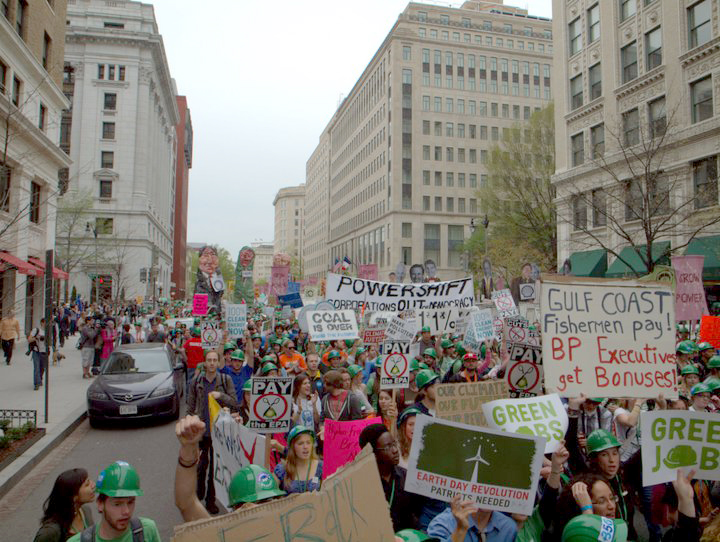
thinkprogress.org: PowerShift 2011 Flashmob Shuts Down BP: ‘Don’t Forget The BP Oil Disaster!’ image & text

http://wonkroom.thinkprogress.org/2011/04/17/power-shift-bp-flashmob/

This afternoon, hundreds of youth climate activists shut down a BP gas station with people power. The flash mob contrasted a joyous and cheerful celebration of the beauty of the Gulf Coast – beach balls, beachchairs, and palm trees – with the devastation caused by the BP oil disaster. In an exclusive interview with ThinkProgress during the protest, Tulane University student Stephanie Stefanski explains why she drove 20 hours from Louisiana to the 2011 Power Shift conference to help to shut down BP and make them pay to restore the Gulf:

There’s still oil on our coast. I saw it two weeks ago, Itouched it, I smelled it. It’s still causing massive die offs with dolphins, sea turtles, crustaceans and fish. It’s causing public health issues. I’m here to tell everyone this problem is still here one year later. The beaches are still oiled. They’re trying to”make it right” by paying off the community, but it’s still destroyed. The fisheries are damaged. There’s no money in, people still don’t trust the seafood. They’re not paying up for their damages.

Stefanski is with the Gulf Restoration Network, which has a national petition to hold President Obama accountable and implement the Oil Spill Commission recommendations to ensure Louisiana and its sister states come back stronger.

One year after the Deepwater Horizon drilling rig exploded, sending 11 men to a fiery grave, BP’s crude and dispersants are still impacting the Gulf and its communities. BP has scored a $10 billion taxrefund for itspart in cleaning up its toxic crime. On Tax Day, Monday, April 18th, the Gulf Coast Power Shift contingent will take action in front of BP’s lobbying headquarters, and meet with their members of Congress to demand that Congress and the President act now to stop the crisis on America’s Gulf Coast, and make BP truly pay for their disaster.

“Don’t forget the BP oil disaster!” Stefanski concluded.

UPDATE

Think Progress hasl earned that Power Shift 2011 participants are mobilizing to stage protests across the nation on Wednesday, April 20, to boycott and shut down BP gas stations in their communities to tell President Obama to make BP pay to restore the Gulf.

Special thanks to Richard Charter

"Be the change you want to see in the world." Mahatma Gandhi