Miami Herald: Efforts to clean up Gulf oil continue in Louisiana

Read more: http://www.miamiherald.com/2010/09/21/v-print/1835106/oil-spill-response-head-tours.html#ixzz10FkRSWeU

Posted on Tue, Sep. 21, 2010

By KEVIN McGILL
Associated Press Writer

Crews on fishing boats with giant vacuums sucked up pools of oil near a small Louisiana barrier island Tuesday as officials sought to reassure residents that the cleanup continues even though no crude has leaked in two months.

Coast Guard Rear Adm. Paul Zukunft, who is overseeing the cleanup, said about 23,000 workers are still employed in the effort, about 80 percent of them in Louisiana.

No oil has leaked from the BP PLC well in the Gulf of Mexico since July 15. The well was declared dead Sunday after engineers pumped in cement from to stop up the bottom.

While oil has not been gushing into the Gulf, it continues to come ashore on coastal islands and wetlands in Louisiana. Local officials are worried cleanup efforts won’t be maintained to catch as much of it as possible.

Last week, BP said it was ending a program that employed boat captains as scouts for oil in Alabama, Florida and Mississippi.

The company called the vessels of opportunity program a success, although it was criticized for hiring recreational boats and out-of-state craft while some local commercial boats sat idle.

The boats looked for oil on the coast and helped in the cleanup by skimming for oil and deploying oil barriers.

Later Tuesday, Zukunft told reporters during a conference call that crews continue to respond to pockets of oil washing up along 600 miles of coastline. Besides oil in marshes and on beaches, officials also are focused on monitoring what is below the surface of the water, he said.

While acknowledging oil continues to come ashore in some areas, Zukunft and other Coast Guard officials said that marsh grasses appeared to be recovering. Oil making its way to shore is lighter and sparser.

The BP-leased rig Deepwater Horizon exploded off the Louisiana coast on the night of April 20, killing 11 workers and setting off a massive spill that ultimately led to more than 200 million gallons of oil spewing from BP’s undersea well.

Crude first washed ashore near the mouth of the Mississippi River on April 29. It fouled marshes, caused the closing of fishing grounds and sparked an intense environmental debate over long-term impact of oil in the water and at the bottom of the Gulf.

So far, BP said the effort to shut down the well and clean up the spill has cost $9.5 billion, not including a $20 billion fund the London-based company established to handle claims from individuals and businesses claiming damage from the spill.

On Tuesday, Zukunft reflected on the massive cleanup effort.

“If you were here in June or July you’d have been in thick black oil,” Zukunft said as the fishing boat he was aboard floated on oil free water.

Zukunft estimated that about 900 Vessels of Opportunity are still operating in Louisiana waters, deploying boom where needed or hauling in boom that is damaged or contaminated with oil. He said it was too early to estimate when or how quickly that number would be reduced, saying it will depend on weather and the condition and amount of oil that comes in. Vessels of Opportunity is a BP program that pays boat operators knocked out of work by the spill to assist with response activities.

A few feet away the oil spill effect was still evident. Strands of absorbent boom washed inland by rough weather littered the edge of the island, laying amid dead brown grass lining the perimeter of the lining the island.

Zukunft’s tour came a day after the Unified Area Command that was formed in response to the Deepwater Horizon oil spill announced that it was consolidating command Posts in Houma, La., and Mobile, Ala., into a single Gulf Coast Incident Management Team in New Orleans. Zukunft said that would result in a staff reduction of about 1,800 people.

© 2010 Miami Herald Media Company. http://www.miamiherald.com

Special thanks to Richard Charter
UK Financial Times: BP leak just a bump in road for oil industry

http://www.ft.com/cms/s/0/a10d9c1e-c428-11df-b827-00144feab49a.html

By Ed Crooks in New York
Published: September 19 2010 22:13 | Last updated: September 19 2010 22:13

Workers vacuum up oil from the Gulf of Mexico spill. Heavy oiling remains in Louisiana

For the people of the Gulf of Mexico region, the Deepwater Horizon disaster has been a nightmare of polluted coastlines and threatened livelihoods.

For BP, the crisis has been shattering, putting the future of the company in jeopardy.
For the global oil industry, it looks like being no more than a bump in the road towards further exploitation of deepwater oil reserves, even in the Gulf of Mexico.

Oil companies worldwide have reviewed their practices following the spill, but have generally insisted that their systems remain safe and robust, and that no fundamental changes are needed.

After the big flaws in the US offshore regulatory system exposed by the Deepwater Horizon disaster, the regulation of the Gulf of Mexico will inevitably become tighter, but industry executives believe the US will not be willing to shut off such an important source of future domestic oil production.

Christophe de Margerie, the chief executive of Total of France, one of the ?western world’s five biggest oil groups, said last week that oil exploration in the Gulf of Mexico was likely to take 20 per cent longer and cost 20 per cent more as a result of new US regulations, but that the development of the deepwater reserves of the region would continue.

Globally, countries such as Libya, Greenland, Ghana and the UK have all said that they plan to press ahead with the exploitation of their own deepwater resources.

A typical view was set out last week by Khalid al-Falih, the chief executive of Saudi Aramco, in an interview with the Financial Times.

The company, the world’s biggest oil producer, has looked at the lessons it can learn from BP, but concluded that there is no reason to delay or modify its plans to drill for gas and oil in the deep waters of the Red Sea in 2012.

At last week’s World Energy Congress in Montreal, some executives called for new global safety standards for the industry in order to restore public confidence.

Miguel Martínez, chief operating officer of Repsol YPF, the Spanish oil group that is an important player in the development of Brazil’s deepwater reserves, suggested the leading companies might be able to agree such new standards between themselves.

One area in which companies have already begun to make progress is in developing systems for responding to a spill, which were shown to be manifestly inadequate for BP and the industry as a whole in the Gulf of Mexico.

Tony Hayward, BP’s chief executive, admitted in June that the company did not have all the tools available to stop a blow-out on the seabed in 5,000 feet of water.

Four of the world’s biggest oil companies, pointedly excluding BP, in July announced a plan to set up a new $1bn joint venture to develop a new oil spill response and containment system for the Gulf of Mexico, and the industry is likely to be asked to put similar arrangements in place in other countries as well. Again, however, these new precautions are unlikely to hold back deepwater old production for long.

The greatest test of the longer-term impact of the spill may be in the US Congress, where it will become clear whether or not the disaster has assisted the passage of new legislation aimed at supporting renewable energy.

Special thanks to Richard Charter

Livescience: Environment: Degraded Oil From BP Spill Coats Gulf Seafloor

http://www.livescience.com/environment/gulf-oil-spill-underwater-plumes-100921.html

By Brett Israel
posted: 21 September 2010 05:45 pm ET
NEW YORK – Now that BP’s Deepwater Horizon oil well has been sealed, the long, hard work of assessing the damage begins even as the oil is dispersing throughout the Gulf.
A research team from Columbia University in New York returned this past weekend (Sept. 17 to 19) from a tour of duty in the Gulf of Mexico with new data to attempt to measure the location and magnitude of subsurface oil plumes, and their effects on the marine ecosystem, which have recently been the focus of much debate.
They found oil on the seafloor, evidence that it may be in the food chain, and signs that it may be hidden in large marine mammals. In spots, the “oily snow” — degraded oil and other organic material that clings to it — was up to 6 inches (15 centimeters) deep on the seafloor, said Columbia oceanographer Ajit Subramaniam.
“The idea that the oil is degraded and therefore doesn’t matter is something we have to think about differently,” Subramaniam said at a talk here today. “This is one of the first findings that showed degraded oil material collected on the seafloor.”
When this gunk starts to pile up on the sea floor, the entire food web is at risk, the researchers said. The oceanographers also discovered discolored zooplankton, which eat the food chain’s primary producers °©– phytoplankton – near oily clouds, Subramaniam said. The full analysis of the effects to the food chain, however, will take several months.
While the deep-ocean effects are largely out of sight, the Gulf’s large mammals — including whales and dolphins — were also hit hard by the oil spill. Yet the true impact may take years to uncover.
“We really don’t know much about the effect of the oil spill in cetaceans, because the effects are likely to be long term,” said marine mammal expert Martin Mendez of the American Museum of Natural History in New York.
Scientists have found 89 dead dolphins and one dead whale in the Gulf since the oil began pouring into the Gulf, Mendez said.
Of the dolphins, one-quarter will undergo necropsies so scientists can say for sure whether or not they died because of the oil. The whale was found floating far from the wellhead and was degraded to the point that a necropsy could not be performed. Something has clearly gone wrong however, because 89 dead dolphins is about 10 times the amount typically found in the Gulf over a similar time period.
The Columbia oceanographers’ data will help researchers track the physical and ecological impact of the Deepwater Horizon oil spill. When BP’s oil rig exploded off the coast of Louisiana on April 22, the ruptured oil well began emptying an estimated 136.4 tons of oil a day into the Gulf of Mexico, resulting in the largest oil spill in U.S. history.
After a relief well was drilled to intercept the well, the gusher was finally sealed on Sept. 18 with a blast of cement to cap the busted pipe.
An estimated 4.4 million barrels of oil (205 million gallons) have leaked into the Gulf since the spill began, but little oil has squirted out since July 15, when a cap was installed and sealed on the wellhead.

Brett Israel is a staff writer for OurAmazingPlanet, a sister site of LiveScience.

Special thanks to Richard Charter

American Institute of Biological Sciences: Joint Society Statement on Public Access to Independent Scientific Research Assessments of the Gulf of Mexico

http://www.aibs.org/position-statements/20100915_september_2010.html
September 15, 2010

*AMERICAN INSTITUTE OF BIOLOGICAL SCIENCES * AMERICAN SOCIETY OF AGRONOMY * AMERICAN SOCIETY OF LIMNOLOGY AND OCEANOGRAPHY * COASTAL & ESTUARINE RESEARCH FEDERATION * COUNCIL OF ENVIRONMENTAL DEANS AND DIRECTORS * CROP SCIENCE SOCIETY OF AMERICA * ECOLOGICAL SOCIETY OF AMERICA * NATIONAL COUNCIL FOR SCIENCE AND THE ENVIRONMENT * NATURAL SCIENCE COLLECTIONS ALLIANCE * NORTH AMERICAN BENTHOLOGICAL SOCIETY * ORNITHOLOGICAL COUNCIL * SOCIETY FOR CONSERVATION BIOLOGY * SOCIETY OF WETLAND SCIENTISTS * SOIL SCIENCE SOCIETY OF AMERICA

——————————————————————————–

Re: Public access to independent scientific research assessments of the Gulf

Dear Senator:

As scientific organizations, we are concerned with the issue of intellectual property rights and ownership of research results that arise in the aftermath of incidents caused by industry, most recently, the BP oil disaster in the Gulf of Mexico. The public needs access to results and conclusions not affected by legal wrangling or private ownership. We are writing specifically to request that a source of independent funding for research on actual or potential industry impacts be available and dispersed from an independent source.

After the Alaska oil spill in 1989, researchers studying its effects on natural systems were prevented from publishing or reporting on their findings, because the responsible company (Exxon) owned the research. Some steps towards a solution were taken since the Valdez spill. One is the Natural Resource Damage Assessment (NRDA) fund, administered by trustees in state and federal government agencies, usually resource agencies. Another is the Oil Pollution Trust Fund, established by the 1990 Oil Pollution Act and administered by the Coast Guard.

While these two funds do not directly place an embargo on scientists’ data, there are cases where government attorneys may want to sequester data, for example, while court cases are being litigated. In addition, provisions in both funds can be overridden if court settlements between the responsible parties (the companies) and the government agencies allow restrictions on release of the data. All the legal maneuvering leads to a stringent cap on what information is released to the public until such time as the case is resolved. This should be avoided. While confidentiality agreements play an important role in a fair legal process, researchers are equally deserving of the right to an open exchange of scientific data and analysis.

Letting the research community have access to external funding through a competitive research program will help the nation develop new understanding and approaches. The National Science Foundation’s (NSF) Rapid Response Research grants program (RAPID) is one such program that provides researchers with funds to study the impacts of the Gulf oil disaster on coastal and marine life in the Gulf of Mexico with quick turnaround. NSF, which has a peer-review system in place and encourages dissemination of results, has made more than 153 awards totaling $17.8 million to track the effects of the oil and oil dispersants.

S. 3663, the Clean Energy Jobs Oil Accountability Act, would help fund research to better understand and manage the nation’s waters and marine and aquatic resources, including the Gulf of Mexico. The bill proposes an independent panel composed of a mix of federal agency representatives, academics and others to review grant proposals to gain greater understanding of ocean and coastal ecosystems and marine resources.

We encourage you to support the preservation of the Senate bill provisions as well as additional statutes as needed to ensure that scientists retain their right to independent peer-reviewed study. Maintaining public access to candid, comprehensive and qualitative impact assessments will ultimately encourage better management, restoration and stewardship of all our nation’s ecosystems and natural resources.

Thank you for considering these points.

Sincerely,

American Institute of Biological Sciences
American Society of Agronomy
American Society of Limnology and Oceanography
Coastal & Estuarine Research Federation
Council of Environmental Deans and Directors
Crop Science Society of America
Ecological Society of America
National Council for Science and the Environment
Natural Science Collections Alliance
North American Benthological Society
Ornithological Council
Society for Conservation Biology Society of Wetland Scientists Soil Science Society of America

Special thanks to Erika Biddle and Tina Johnson

Greenpeace: Going Beyond Oil Blogpost 9/21/10


© Will Rose / Greenpeace

http://www.greenpeace.org/usa/en/news-and-blogs/campaign-blog/going-beyond-oil/blog/26454
Blogpost by Philip_Radford – September 21, 2010 at 19:32 PM 2 comments

Despite the overwhelming evidence that Big Oil’s reckless pursuit of the last remaining oil reserves (and ever-more exorbitant profits) is disastrous for the planet, governments of the world are still greenlighting dangerous deepwater drilling projects.

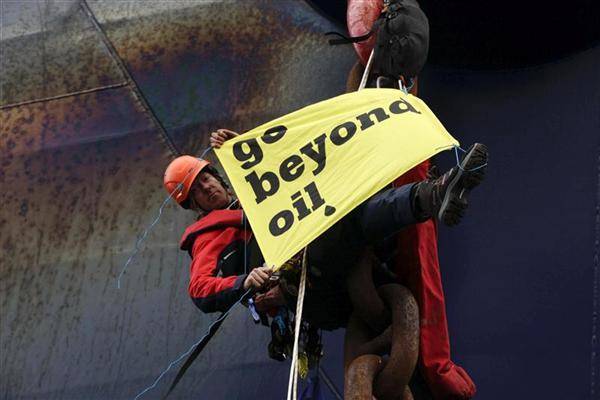
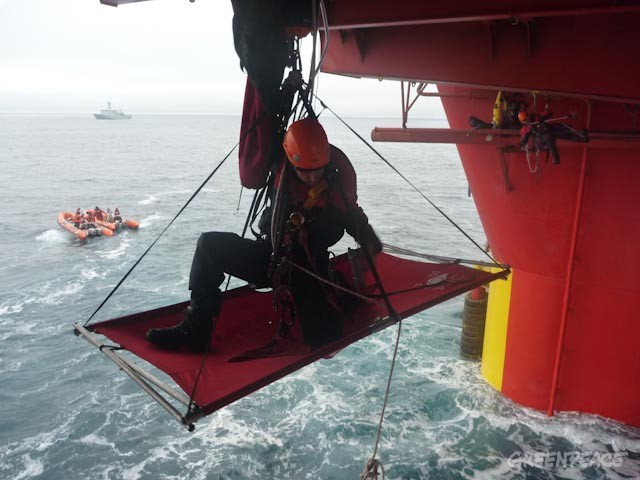
That’s why this morning two Greenpeace activists locked down the anchor chain of Chevron’s drill ship the Stena Carron, which was scheduled to depart for a deepwater drilling site north of Scotland’s Shetland Islands. While our activists physically prevent one more irresponsible drilling project from getting underway, we’re calling on all governments to ban deepwater drilling once and for all.

The action was launched from the Greenpeace ship Esperanza, which was also the base of operations for the activists who staged a 40-hour occupation of Cairn Energy’s Stena Don oil rig off the coast of Greenland earlier this month. There is real danger that the Stena Don could spark an Arctic oil rush, which would pose a huge threat to the climate and put the fragile Arctic environment at risk. So, for nearly two days, Greenpeace activists prevented this dangerous drilling operation from proceeding to threaten any more marine life and coastal ecosystems with catastrophic oil spills.

© Greenpeace

This is as much a moral issue as an environmental issue. We don’t fully understand the long-term effects of oil spills like the BP Deepwater Disaster in the Gulf of Mexico. We need independent science to find out what those will be. All we do know for certain is that the oil and its impacts will persist for decades. Surely we can all agree that we owe our children a healthy planet to live on? And unfortunately, as is now all-too clear, expanding offshore drilling operations is incompatible with keeping our planet healthy enough to support future generations.

That’s why we’re not only working to stop more dangerous drilling, we’re also seeking to get to the truth about the impacts of oil spills. Our ship, the Arctic Sunrise, is now halfway through its three-month expedition in the Gulf and has hosted several teams of independent scientists who are working to understand where all of BP’s oil has gone and what it’s doing to marine wildlife and ecosystems in the Gulf. You can stay up do date with the crew’s findings via our Google Earth map, which is tracking blog posts, pictures, and videos coming from the crew onboard the ship.

If you want to know even more about the long-term effects of oil spills and how we can prevent future oil spills from happening, tune in this Friday to the blogger briefing Greenpeace is hosting as part of UN Week. Greenpeace USA’s Kert Davies is onboard the Arctic Sunrise in the Gulf right now and will be participating in the briefing as well as answering your questions live via video Skype.

We’re not just against oil, we’re for clean, sustainable energy. Sven Teske, the author of our Energy [R]evolution report, will be taking part in the briefing to discuss how expanding our offshore drilling operations is not only dangerous, but unnecessary. We can get to 80 percent renewable energy globally by 2050, and we’d be creating 12 million jobs by 2030 in the process.

A clean energy revolution would not only help stop global warming and get our ailing economy back on track, but it is also the only 100 percent fail-safe method for preventing oil spills. That’s because the only way to stop oil spills is to leave the oil in the ground (or hundreds of feet under the sea, as the case may be). We can’t do that until we move beyond oil and other fossil fuels as our primary energy sources.

Greenpeace will continue to confront reckless new oil drilling operations and bring attention to the issue, but we need to build a widespread movement that demands we go beyond oil as soon as possible. Join us on the blogger briefing this Friday to find out how you can help get us there.

"Be the change you want to see in the world." Mahatma Gandhi