Los Angeles Times: Gulf Oil Spill: Bacteria mainly ate the gas, not the oil

http://latimesblogs.latimes.com/greenspace/2010/09/gulf-oil-spill-bacteria-mainly-ate-the-gas-not-the-oil.html

Greenspace
ENVIRONMENTAL NEWS FROM CALIFORNIA AND BEYOND

September 16, 2010 | 9:33 pm
Bacteria that attacked the plumes of oil and gas from the Deepwater Horizon gusher in the Gulf of Mexico mainly digested natural gas spewing from the wellhead – propane, ethane and butane – rather than oil, according to a study published in the journal Science.

The paper doesn’t rule out the possibility that bacteria also are consuming oil from the spill, the authors said. Instead, it suggests that natural gas primed the growth of bacteria that may have gone on to digest “more complex hydrocarbons” – oil – as the spill aged and propane and ethane were depleted.

Still, lead author David L. Valentine, a professor of microbial geochemistry at UC Santa Barbara, said the findings temper hopes that microorganisms detected by scientists in the gulf have eaten up most of the oil there, as other scientists had recently suggested. “It’s hard to imagine these bacteria are capable of taking down all components of oil,” he said. “These stories about superbugs taking down all the oil – it’s more complex than that.”

Valentine and his team conducted their research in the gulf during 10 days in June. Lowering an array of sensors over the side of their ship, they analyzed ocean water to determine the presence of oil, then collected water samples at 31 locations 0.6 to 7.7 miles from what was then the active spill site.

Comparing samples collected close to the leak’s origin with older samples collected farther away, the researchers detected declining proportions of propane and ethane the older the sample. As levels of propane and ethane declined, the number of bacteria believed to be capable of digesting those chemicals – Cycloclasticus, Colwellia and Oceanospirillaceae – grew.

The team observed other chemical changes that suggested the bacteria were at work digesting gas. They saw that types of propane and ethane that bacteria prefer to digest – ones containing carbon-12, a lighter isotope of carbon – were depleted in samples.

And they found that the levels of oxygen (which bacterial populations consume as they grow) in the water fell in step with the falling levels of propane and ethane. They concluded that 70% of oxygen depletion was the result of microbial digestion of these natural gas chemicals, suggesting that most of the bacterial action was against gas, not oil.

Richard Camilli, an associate scientist at the Woods Hole Oceanographic Institution in Massachusetts, said that these findings are the first to establish that the observed biodegradation in the deep plumes was limited mostly to natural gas.

“This paper is opening the door to other questions,” said Camilli, who was not involved with this research but published a paper in an August edition of Science on the size of the gulf spill’s oil plume. “If it’s disproportionately natural gas that’s being degraded, what’s going on with the crude oil components?”

But Terry Hazen, head of Lawrence Berkeley National Laboratory’s ecology department and lead author of another August paper in Science that documented growth of hydrocarbon-eating bacteria in the deep-sea plume and suggested microbes could consume much of the oil, said that “the three papers are complementary. All show different pieces of the puzzle.”

Valentine said he will now investigate whether the bacteria began eating the spilled oil, or some component of it, as time passed. “We know there’s gas consumption; we know these organisms are here. How did that transition over time?” he said. “Did they move to oil over time, or did they bias which components of the oil [were consumed] next? We don’t know yet.”
He noted that many organisms that consume propane and butane can also consume other components of oil. But, he said, these longer, more complex hydrocarbons can be harder to digest.

— Eryn Brown

Special thanks to Richard Charter
Los Angeles Times: Scientists allege oil commission attempted to stifle research

http://www.theind.com/news/6946-scientists-allege-oil-commission-trying-to-stifle-research

This is really troubling, together with the older info that Obama and the Defense Dept are secretly still spraying coastal areas with dispersant under cover of darkness. This is not the transparency we expected of our president and his oil commission. DV

The Independent, Written by Nathan Stubbs
Friday, 17 September 2010

Two scientists, hired by a New Orleans law firm to conduct independent research in the Gulf, say they recently received some intimidating phone calls from attorneys representing the National Commission on the BP Deepwater Horizon Oil Spill and Offshore Drilling. WWL-TV in New Orleans reports that Dr. William Sawyer, a Florida-based toxicologist, and Marco Kaltofen, a scientist and head of Boston Chemical Data in Massachusetts, began receiving calls from the commission after posting data online that showed alarming levels of toxic hydrocarbons in water column. The researchers were both hired to conduct their studies by the New Orleans-based Smith Stag law firm, which specializes in environmental and personal injury law and has been assisting landowners and commercial fishermen in filing claims against BP. Sawyer and Kaltofen claim the commission attorneys asked if there research was meant to disprove findings by the federal government or impugn the commission and then began questioning whether the scientists had all the necessary permits to continue their work.

The oil spill commission was established by President Obama in the wake of the Deepwater Horizon tragedy to study the cause and impact of the spill, and make policy recommendations based on their findings. In response to the accusations, Commission Press Secretary Dave Cohen released a statement to WWL noting that Sawyer was “…One of many experts with whom we were having discussions to gain insights and possibly serve as expert panelists before the commission…. We deeply regret if any question we may have asked created a misunderstanding.”

The incident has already prompted Congressman Joseph Cao of New Orleans to call for a Congressional investigation into the matter. Cao released the following statement in a press release last night:
Today, I was informed that attorneys from the President’s oil spill commission were contacting independent researchers who are studying the Gulf’s toxicity and possibly attempting to suppress their findings by questioning the researchers’ permit status. I also found out WWL-TV has uncovered information which appears to contradict statements made just yesterday by federal representatives that there is no contamination in Gulf seafood. The public has a right to know whether or not the water and our seafood are safe based on the best data available. I’m concerned the Administration is not taking this issue as seriously as it should be. So I have decided to call for an investigation by the House Committee on Oversight and Government Reform, on which I sit.

_____________________

http://latimesblogs.latimes.com/greenspace/2010/09/gulf-oil-spill-bacteria-mainly-ate-the-gas-not-the-oil.html

Special thanks to Richard Charter

Washington Post: BP Macondo Well Successfully Capped

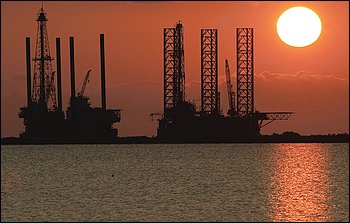
Two offshore oil platforms near Port Fourchon, La. under construction in June, 2010. photo by Saul Loeb

http://www.washingtonpost.com/wp-dyn/content/article/2010/09/17/AR2010091706725.html

By David A. Fahrenthold and Steven Mufson
Saturday, September 18, 2010; 1:48 AM

At last, the well is dead.

BP’s Macondo oil well is physically incapable of leaking another drop, according to the head of the U.S. government’s response effort. Retired Coast Guard Adm. Thad W. Allen said Friday that this discovery was made after a “relief well” finally broke through into the Macondo well more than 17,000 feet below the Gulf of Mexico floor.

This Story
BP Macondo oil well successfully capped
Steps that killed the well
Officials had worried that they would find oil between the pipe and the shaft’s rock wall. But they found none – a discovery that shows that the well is capped and also could provide new clues to what made it blow up in the first place.

“The well presents no further threat of discharge,” Allen said.

But just to be sure, BP plugged it a little bit more. About 4 p.m. Friday, authorities began the long-awaited – and now, rather anti-climactic – “bottom kill,” filling in that empty space with cement. The cement should be set by Saturday afternoon, Allen said, and a final pressure test will allow the declaration of death.

After the American people spent the summer watching the fearsome oil well spill, Allen said this last step was as much for our benefit as it was for the gulf’s.

He said the intent was “psychologically, for people in the gulf to understand that there is a stake in the heart of this beast.”

BP’s well spent about three months repelling all attempts to kill it – eventually spilling 4.9 million barrels, or 205.8 million gallons, into the gulf. Then, it spent the next two months dying: The well was sealed off July 15, and cement was forced down its central pipe in a so-called “static kill” in early August.

Through it all, a rig in the gulf was slowly drilling down to provide the final nail in its coffin. The relief well’s progress was slowed by passing storms – which made the gulf too choppy – but also by the depth of its target. Drilling began on the gulf floor a mile down and continued for another 2.4 miles into the earth.

Finally, on Thursday afternoon, the drill hit its target, a seven-inch shaft. It opened a hole into the space between the shaft’s wall and the outer layer of pipe.

There was no camera recording it, but engineers could learn about the outer space around the Macondo well pipe by studying fluid that rose from the other well’s drill pipe. When no oil came up, they knew that the Macondo well was plugged at its source.

That was a good thing for the gulf. But it could also be a good thing for BP’s legal case, because it could be a signal that the blowout was not caused by a problem with BP’s design for the well’s pipes.

Instead, BP’s lawyers could argue that part of the blame lies in the cementing job done by contractor Halliburton, which was supposed to plug those pipes at the bottom.

This Story
BP Macondo oil well successfully capped
Steps that killed the well
“All the information we have gathered to date . . .leads us to believe conclusively that the well design did not contribute to this accident and the well has complete integrity,” Daren Beaudo, a BP spokesman, said in a statement Friday.

This denouement about four miles down will not do much to alter the way the spill is still affecting life in the gulf, in the oil-smeared states on its shore and in oil-company boardrooms from Houston to London.

In the Louisiana marshes, fishermen have reported patches of peanut-butter-thick oil rising to the surface as the water warms. In Pass a Loutre, La., near the Mississippi River mouth, state officials were grappling with a patch of submerged oil several acres wide.

And even in areas where the oil has disappeared, the spill is still hurting Louisiana’s shrimp business by scaring off its customers.

“Can’t find nobody to take it. Can’t find nobody that wants to eat it,” said David Chauvin, a seafood dealer in Chauvin, La. He said that three-quarters of his boats haven’t returned from helping with BP’s cleanup. “My fear is that, if we have 100 percent of these boats come back, we’d flat out have to tell the boats ‘Look, you have to quit fishing.’ Because we could not sell it at any price.”

For BP, the spill has forced the resignation of its chief executive, Tony Hayward, who steps down Oct. 1. The company is waiting to see if the Justice Department – which is examining equipment such as the “blowout preventer” – will file criminal charges. If not, the financial burden will be immense but more easily within the company’s means.

Already, the spill has washed away more than $70 billion of BP’s market share. The stock is up about 50 percent from its post-spill low point but is down 37 percent from its April 20 close, hours before the Macondo blowout. BP’s stock closed down slightly Friday at $38.03 a share.

And, for those on the Gulf Coast who lost money during the spill, the next step is to wait for Kenneth Feinberg, the administrator of BP’s $20 billion compensation fund. The difficulty of his job, sorting out claims from fishermen, beach resorts and the far-flung businesses that support them, was made clear this week in a series of meetings along the coast.

Feinberg said that 3,000 claims had no documentation and an additional 12,000 had “documentation so inadequate that no one would pay those claims.” After facing angry claimants in Louisiana on Monday and Florida on Tuesday, Feinberg said he felt like “a moving pinata.”

“I must say I underestimated the problems in processing these claims,” Feinberg said. He added: “I never thought it would be easy. But there’s a serious proof problem with some of these claims.”

fahrenthold@washpost.com mufsons@washpost.com

Oil and Gas Journal: Relief well intercepts BP Macondo well in gulf

http://www.ogj.com/index/article-display/8639520373/articles/oil-gas-journal/general-interest-2/hse/2010/09/relief-well_intercepts/QP129867/cmpid=EnlDailySeptember172010.html

Sep 17, 2010
Paula Dittrick
OGJ Senior Staff Writer
HOUSTON, Sept. 17 — A relief well drilled by crews on Transocean Ltd.’s Development Driller III semisubmersible intercepted the annulus of the deepwater Macondo well on Sept. 16, and BP PLC expects crews will completely seal the Macondo well on Sept. 18.

Engineers and scientists from across the oil industry have worked with government scientists for months to reach this point. An Apr. 20 blowout of the Macondo well in 5,000 ft of water and subsequent oil spill prompted the development of new technology and equipment to handle a seabed spill.

An estimated 4.9 million bbl leaked from the well, of which BP estimates it captured 800,000 bbl. No oil has leaked into the gulf since a capping stack was installed on July 15. BP operates the well on Mississippi Canyon Block 252 off Louisiana.

The Macondo well blowout triggered an explosion and fire on Transocean’s Deepwater Horizon semi, which killed 11 people. The Deepwater Horizon sank on Apr. 22. Cause of the accident remains under investigation by a number of government agencies and others.

After replacing the Deepwater Horizon’s failed blowout preventer earlier this month, relief well drilling resumed at 7:15 a.m. CDT on Sept. 15, and crews completed drilling the final 45 ft of hole. Interception of the annulus was confirmed at 4:30 p.m. on Sept. 16. Total measured depth on the DDIII for the annulus intercept point was 17,977 ft.

“Operations conducted bottoms up circulation, which returned the contents of the well’s annulus to the rig for evaluation,” BP said. “Testing of the drilling mud recovered from the well indicated that no hydrocarbons or cement were present at the intersect point. Therefore, no annulus kill is necessary, and the annulus cementing will proceed as planned.”

Once cementing operations are complete, the DDIII will begin standard plugging and abandonment procedures for the relief well.

The Development Driller II semi continues gathering additional data from the Macondo well in efforts to determine the location of the drill pipe in the well during the Apr. 20 accident. DDII’s BOP is latched onto the wellhead.

Subsequently plug and abandonment activities will commence in accordance with the approved procedure, BP said.

National Incident Commander and retired US Coast Guard Adm. Thad Allen issued a news release late Sept. 16 saying he received extensive briefings over the last 24 hr as BP engineers and federal scientists confirmed the relief well intersected the Macondo well.

“The aggregate data available supports the conclusion that the two wells are joined,” Allen said. “It is also important to note that none of the measurements supported a scenario where the annulus of the well is in communication with the reservoir. Accordingly, we intend to proceed with preparation to cement the annulus and complete the bottom kill of the well.”

Contact Paula Dittrick at paulad@ogjonline.com.

Special thanks to Richard Charter

Sept 27-28 Next Oil Spill Commission Hearings in D.C.

SAVE THE DATE
NATIONAL OIL SPILL COMMISSION HOLDS
THIRD PUBLIC HEARING IN WASHINGTON, DC
SEPTEMBER 27 – 28, 2010
FOCUS ON OIL SPILL RESPONSE & RESTORATION ISSUES

The National Commission on the BP Deepwater Horizon Oil Spill and Offshore Drilling (“Oil Spill Commission”) is holding a public hearing regarding response to the BP Deepwater Horizon oil spill, environmental impacts, and approaches to restoration.

Among the panelists:

· The Honorable Ken Salazar, US Secretary of the Interior
· The Honorable Lisa Jackson, US-EPA Administrator
· The Honorable Mary Landrieu, US Senator, Louisiana
· The Honorable Haley Barbour, Governor of Mississippi
· Retired Admiral Thad Allen, National Incident Commander for the Unified Command
· Doug Suttles, Chief Operating Officer for Exploration & Production, BP
· Pete Slaiby, Vice President for Exploration & Production, Shell Alaska
· Mayor Edward Itta, North Slope Borough, Alaska

WHERE: Marriott Wardman Park
2660 Woodley Park Road, NW
Washington, DC 20008

WHEN: Monday & Tuesday, September 27th & 28th, 2010
9:00 am – 5:30 pm Public hearing

Registration begins 8:00 am on both days
Public comment period: 5:00 pm – 5:30 pm for both days

The meeting is open to the public, with a 30 minute public comment period held during both days. Public comment participants are chosen on a first-come, first-serve basis. Time allotted per public comment will be 3 minutes. Registration for those wishing to participate in the public comment period opens on-site at 8:00 am.

For further information: www.oilspillcommission.gov

Andrea Yank
Special Assistant
National Commission on the BP Deepwater Horizon Oil Spill and Offshore Drilling
One Thomas Circle, 4th floor
Washington, DC 20005
202-254-2662

Special thanks to Richard Charter

"Be the change you want to see in the world." Mahatma Gandhi