USF: Gulf of Mexico Oil Spill Conference Feb. 9-11 in St Pete Fl.

Subject: FW: Gulf of Mexico Oil Spill Conference

Planned for February 9-11, 2011, in St. Petersburg, the meeting will address a broad spectrum of questions relating to the aftermath of the Deepwater Horizon event of earlier this year. Topics will include: Geotechnical Engineering, Regional Oceanography, Chemical Weathering – Biological Consumption, Dispersants, Ecological Consequences and Toxicity, Economic and Social Impacts, Human Health Issues, and Stakeholders, Science and Policy.

October 1, 2010 is the deadline for receipt of abstracts for presentation consideration at the upcoming Gulf of Mexico Oil Spill Conference. I ask that you please share this Call for Abstracts with interested colleagues and students.

More information can be found at: http://www.oilspill.usf.edu/

Special thanks to Richard Charter

AP/Washington Times: Allen: Blown-out Gulf well to be sealed by Sunday & New York Times: BP Well May Be Sealed Soon & more…

http://www.washingtontimes.com/

By Harry R. Weber

Associated Press

Updated: 2:56 p.m. on Wednesday, September 15, 2010

KENNER, La. (AP) – The U.S. government’s point man on the Gulf of Mexico oil spill said Wednesday that BP’s blown-out well is expected to be sealed permanently and declared dead by Sunday, nearly five months after a rig explosion set off the disaster.
Retired U.S. Coast Guard Adm. Thad Allen, the national incident commander, told reporters gathered at a seafood distributor in Kenner that a relief well is expected to intersect the blown-out well within 24 hours. He said workers then will pump in mud and cement, which is expected to seal the well within four days.

“We are within a 96-hour window of killing the well,” Adm. Allen said.

The April 20 explosion killed 11 workers and led to 206 million gallons of oil spewing from the deepwater well.

No fresh oil has spewed into the Gulf since a temporary cap was successfully fitted to the top of the well in mid-July. Mud and cement later were pushed down through the top of the well, allowing the cap to be removed. The relief well is being drilled so the well that blew out also can be sealed from the bottom, ensuring that it never causes a problem again.

Appearing with Adm. Allen, National Oceanic and Atmospheric Administration chief Jane Lubchenco said that monitoring continues of oil that remains in the Gulf. Ms. Lubchenco stood by earlier government estimates that 50 percent of the oil that spilled is gone from the water system.

Scientists said earlier this week that they had found thick patches of oil coating the sea floor, raising questions about government conclusions that much of the oil from the spill was gone. Testing is under way this week for chemical fingerprints that would conclusively link that oil to the BP spill.

Still, Adm. Allen and Ms. Lubchenco sought to reassure hesitant diners from outside the region that Gulf seafood is safe to eat during their appearance outside the Louisiana Fish House. Adm. Allen noted that he has eaten Gulf seafood every day for the past several days.

“In short, folks want to know if it is safe to eat, swim and fish, and that is the kind of information we are committed to identifying answers to those questions,” Ms. Lubchenco said.

Gulf shrimpers currently are producing only 20 percent of their normal production for this time of year – because demand is down sharply and because supply is not where it should be in part because of the fact that some shrimpers are wary of taking on the expense of fishing if they can’t sell their catch, according to Ewell Smith, executive director of the Louisiana Seafood Promotion & Marketing Board.

Adm. Allen also said he plans to step down as incident commander on Oct. 1 – the same day BP PLC installs American Bob Dudley as its new chief executive to replace Tony Hayward. Adm. Allen will be replaced by Coast Guard Rear Adm. Paul Zukunft. The move is not a surprise: Adm. Allen said previously that he would transition out of his current rule by late September or early October.

Adm. Allen said in an interview after the news conference that the timing of the transition is not connected to BP’s leadership change.

“I worked well with Tony Hayward, and I work well with Bob Dudley,” Adm. Allen said. “I like to think I work well with anybody.”

BP is the majority owner of the well that blew out, and it was leasing the rig that exploded from owner Transocean Ltd.

Copyright 2010 The Associated Press.

September 15, 2010

By THE NEW YORK TIMES
With BP close to intercepting its stricken Gulf of Mexico well with a relief well, the government said Wednesday that the final sealing of the once-gushing well might occur this weekend.

Thad W. Allen, the retired Coast Guard admiral who is leading the federal response effort, said in a briefing in Kenner, La., that the relief well was within 25 feet of the interception point, nearly 13,000 feet below the seabed. Drilling resumed on Monday after being suspended for several weeks while the company replaced pressure-control equipment atop the well.

Once the interception occurs, engineers will assess the condition of the stricken well’s annulus, the space between the casing pipe and the surrounding rock. Admiral Allen said it was expected that a decision would then be made to pump cement into the annulus to create a final seal.

“Four days from now, it could be all done,” he said.

The well leaked an estimated 4.9 million barrels, or about 205 million gallons, of oil into the gulf after the Deepwater Horizon drill rig exploded and sank in late April. No appreciable amount of oil or gas has leaked since July 15, when valves on a newly installed cap at the wellhead were closed.

Joint Investigation – RMI letter re DWH documentation

The Joint Investigation of the Deepwater Horizon (DWH) marine casualty posted a copy of the letter received from the Maritime Administrator of the Republic of the Marshall Islands (RMI) relating to documentation of the DWH. The letter states that, while the erroneous document issued to the DWH might have allowed it to not have a master on board when the unit was “on location”, the evidence shows that the DWH had both a master and an offshore installation manager (OIM) on board at all times relevant to the investigation. (9/14/10).

National Commission – meeting

The National Commission on the BP Deepwater Horizon Oil Spill and Offshore Drilling, sponsored by the Department of Energy, will conduct an opening meeting in Washington, DC on September 27 and 28. Topics on the agenda include the response following the oil spill, impacts on the Gulf, and approaches to long-term restoration. 75 Fed. Reg. 56526 (September 16, 2010).

House – bill introduced to restore Gulf coastal areas

Representative Scalise (R-LA) introduced the Gulf Coast Restoration Act (H.R. 6112) to provide for restoration of the coastal areas of the Gulf of Mexico affected by the Deepwater Horizon oil spill, and for other purposes. (9/14/10).

House – bill introduced re use of dispersants in oil spills

Representative Pallone (D-NJ) introduced a bill (H.R. 6119) to amend the Federal Water Pollution Control Act to ensure the safe and proper use of dispersants in the event of an oil spill or release of hazardous substances, and for other purposes. Official text of this bill is not yet available. (9/14/10).

House – bill introduced re export and import of natural gas

Representative Wu (D-OR) introduced a bill (H.R. 6124) to amend certain provisions of the Natural Gas Act relating to exportation or importation of natural gas, and for other purposes. Official text of this bill is not yet available. (9/14/10).

Courtesy: Bryant’s Maritime Blog – 16 September 2010

Homepage


BP ending oil-spotting program in 3 Gulf states
Posted on Thursday, September 16th, 2010 at 12:00 am.

By Associated Press

MOBILE (AP) – BP is ending the program that hired coastal boats to scout for oil in Alabama, Florida and Mississippi during the Gulf of Mexico spill.

Administrators in Mobile said Wednesday they were shutting down the vessel of opportunity program in the three states. It continues operating in coastal Louisiana, where officials say oil is still hitting the shore.

BP calls the program highly successful, although it was widely criticized during the summer for hiring recreational boats and out-of-state craft while some local commercial boats sat idle.

The company says almost 3,500 boats worked in the program, which cost some $500 million across the Gulf region. Boat operators both looked for oil on the coast and helped in the cleanup by skimming for oil and deploying oil barriers.

Houston Business Journal – September 16, 2010
/houston/stories/2010/09/13/daily35.html

Thursday, September 16, 2010, 7:45am CDT | Modified: Thursday, September 16, 2010, 7:45am

Transocean sued by Louisiana over Gulf oil spill
Houston Business Journal
Transocean Ltd. and subsidiary Triton Asset Leasing GmbH are being sued by the state of Louisiana, according to news reports.

The state is asking a federal judge out of New Orleans to rule that Transocean (NYSE: RIG) be liable for damages resulting from the Gulf oil spill.

In the filing, the state said: “The state has incurred and will continue to incur costs and certain damages including cleanup and removal costs, costs of increased public services, loss of state revenue, property damages and natural resource damages.”

For now, the state is only seeking for Transocean to be deemed liable. It is not yet seeking to recover any costs or damages.

Transocean has maintained responsibility only for oil that may have leaked from its Deepwater Horizon rig, which was leased by BP Plc when it exploded on April 20, killing 11 people and resulting in the largest oil spill in U.S. history.

But the state of Louisiana argues that the company violated state and federal environmental laws, according to the Wall Street Journal.

“Transocean’s denial of liabilityĆ is also at odds with the State of Louisiana as it affects Louisiana’s ability to seek recovery of costs and damages related to this oil spill from the responsible parties,” it said in the filing.

Switzerland-based Transocean has a significant presence in Houston.

On Wednesday, the company pulled a second rig out of the Gulf of Mexico due to the federal moratorium on deepwater drilling.

The Houston Business Journal is providing continuous coverage of the Gulf oil spill.

Special thanks to Richard Charter

Houston Chronicle:Government gives notice on abandoned platforms: Rule tells industry to dismantle ‘idle iron’ and plug old oil, gas wells & Don’t Blame BP Alone for spill, Hayward tells UK lawmakers

September 16, 2010

http://www.chron.com/disp/story.mpl/business/energy/7203039.html

DISASTER IN THE GULF

By JENNIFER A. DLOUHY
Sept. 15, 2010, 11:08PM

WASHINGTON The Obama administration on Wednesday launched plans to clean up “idle iron” in the Gulf of Mexico, requiring companies to dismantle deserted platforms and permanently plug thousands of abandoned oil and gas wells – including some that are decades old.

The mandate will affect nearly 3,500 nonproducing wells and require the decommissioning of about 650 unused oil and gas production platforms.

Interior Secretary Ken Salazar said the move is part of a broader push to boost environmental protections and the safety of offshore energy production.

“We have placed the industry on notice that they will be held to the highest standards of planning and operations in developing leases,” Salazar added.
For years, environmentalists and industry analysts have been highlighting the problem of “idle iron” – the glut of abandoned rigs, platforms and wells in the Gulf that are no longer in use. And the new rule was in the works long before the April 20 explosion of the Deepwater Horizon rig.

But the disaster inspired fresh scrutiny of the problem and spurred concerns that the aging infrastructure poses environmental risks, especially during hurricanes.

Michael Bromwich, the director of the new Bureau of Ocean Energy Management, Regulation and Enforcement, said the rule responds to that threat.

“This initiative is the product of careful thought and analysis,” he said, “and requires that these wells, platforms and pipelines are plugged and dismantled correctly and in a timely manner to substantially reduce such hazards.”

The mandate – set to go into effect Oct. 15 – represents a change in the government’s handling of abandoned platforms and wells.

Until now, federal decommissioning requirements forced companies to remove infrastructure and plug wells within a year after their individual offshore oil and gas leases expire.

Historically, that policy gave companies plenty of time and freedom to use once-abandoned platforms and other infrastructure to support future wells and other projects.

But the “notice to lessees” issued by the Interior Department Wednesday would require the decommissioning of any well that has been idle for the past five years, along with any associated platforms and pipelines – even if they are part of an active offshore lease.

Under the rule, current offshore lease owners will have four months to outline their plans for breaking down and securing the facilities.

Most operators will have no problem complying with the mandate, American Petroleum Institute spokesman Cathy Landry said.

But industry officials said the speed of the cleanup depends on the pace of environmental reviews and the approval of necessary permits.

Randall Luthi, president of the National Ocean Industries Association, stressed the importance of the government swiftly reviewing and approving permits to take down some of the structures.

So-called “rigs to reefs” programs that would allow decommissioned structures to find new life as marine habitats also hang in the balance.

“Industry is ready to meet its obligations with respect to offshore structures,” Luthi said. “We ask only that the federal government meet us halfway by approving the actual work.”

To ensure the cleanup is done quickly, “the administration must also assist in clearing the path,” Luthi said.

The administration’s move could create more business for some offshore contractors that do decommissioning work in the Gulf.

Rep. Raul Grijalva, D-Ariz., who had pushed for such a cleanup of offshore drilling debris, said the rule will benefit the environment and the economy.

“These structures are not producing resources or creating jobs by just sitting there,” and the risk of leaking, abandoned facilities “is something we’ve overlooked long enough,” Grijalva said. “This announcement should put thousands of laborers back to work in short order cleaning up the Gulf.”

jennifer.dlouhy@chron.com

xxxxxxxxxxxxxxxxxxxxxxx

http://www.chron.com/disp/story.mpl/business/7203042.html

Don’t blame BP alone for spill, Hayward
tells U.K. lawmakers
‘I understand why people feel the way they do’
By DAVID STRINGER Associated Press
Sept. 15, 2010, 11:02PM

LONDON Outgoing BP CEO Tony Hayward said Wednesday that he understood anger directed at the energy giant in the wake of the Gulf of Mexico oil spill but insisted his company had a strong safety record and was not solely to blame for the disaster.

Testifying before a British parliamentary committee, Hayward acknowledged BP had failed both to stop the spill and to plan adequately to respond to an accident of that scale.

“I understand why people feel the way they do, and there is little doubt that the inability of BP, and the industry, to intervene to seal the leak … was unacceptable,” Hayward told the hearing at London’s Parliament.

Hayward appeared relaxed and confident addressing lawmakers in his native Britain, unlike at a testy hearing before the U.S. House Energy and Commerce Committee in June, when he faced angry accusations that he was stonewalling.

‘Devastating to me’

He said the explosion at the Macondo well on April 20, which killed 11 workers and triggered the massive spill, was “devastating to me personally,” and insisted that standards on safety and training would improve industrywide.

But he said it would be wrong to attach blame only to BP.

“No single factor caused the accident, and multiple parties including BP, Halliburton and Transocean were involved,” he said.

Hayward, who will be replaced Oct. 1 by Bob Dudley, an American, told Parliament’s Energy and Climate Change Committee that the extent of the spill’s environmental impact is also unclear.

“No one knows today the environmental impact of this,” he said.

The British committee’s chairman, Tim Yeo, a Conservative and former environment minister, challenged Hayward about his claim on taking his post in 2007 that he would focus “laserlike on safety.”

“On your watch as chief executive, in that three years, now we’ve had the biggest-ever oil spill in U.S. waters,” Yeo said.

Unfair U.S. response?

Though the British panel largely eschewed the combative style of the U.S. committee, Hayward was repeatedly pressed on whether he believed the response in the U.S. toward BP had been unfair.

“There was an enormous amount of emotion and anger, and it was very understandable,” Hayward said, declining to criticize the reaction from the White House or American public.

Hayward said BP had an “entirely constructive relationship” with the White House during the crisis and insisted the U.S. had not influenced BP’s decision to suspend dividend payments after the spill.

Oil and Gas Journal–Bromwich: Industry to determine when deepwater drilling resumes

http://www.ogj.com/index/article-display/5698220450/articles/oil-gas-journal/general-interest-2/government/2010/09/bromwich_-industry/QP129867/cmpid=EnlDailySeptember152010.html

Sep 14, 2010
Nick Snow
OGJ Washington Editor
WASHINGTON, DC, Sept. 14 — US Bureau of Ocean Energy Management, Regulation, and Enforcement Director Michael R. Bromwich said he had received no suggestions in public forums that the Obama administration’s deepwater drilling moratorium should go beyond its scheduled Nov. 30 expiration date. But the oil and gas industry will determine when deepwater drilling actually resumes, he added.

Permits won’t be issued until applicants have satisfied the requirements, not all of which have been formulated, he told reporters during a Sept. 14 teleconference. “This is a dynamic ongoing process,” he said. “We have not only BP’s internal investigation, but also those by the National Academy of Engineering, the president’s commission, and the joint BOE-Coast Guard effort. I’m sure they’ll make recommendations which will require us to tweak our regulations.

“Our actions won’t be complete overnight. It will take some significant period of time to figure out what needs to be done,” Bromwich said. “These are not a set of regulatory standards that are frozen in time. There are a lot of changes being made now, and more will be made in the future. I think the industry will need to get ready for them.”

Bromwich said most of the initial questions have centered on two notices to deepwater lessees that BOE issued on June 8, which implemented seven safety requirements US Interior Sec. Ken Salazar recommended in his May 27 report to President Barack Obama following the Apr. 20 Macondo blowout and oil spill in the Gulf of Mexico. “There has been some confusion and uncertainty particularly with NTL-6 and its worst-case discharge estimates. We found shallow-water drillers were uncertain and confused, as were several people in our agency,” he said.

“I don’t want to extend the point where drilling can resume,” Bromwich said. “We’ll try and be as clear as we possibly can about what the requirements are, and communicate that to people in the industry. We’ll continue to have open discussions to clear questions up as they arise, although we won’t always be able to supply answers or answer individual questions immediately.”

Report by Sept. 30
He said that while he has been given until the end of October, he hopes to have his report on recommendations from the eight public forums BOE held about the moratorium to Salazar around Sept. 30. “I think we’ll be ironing out details of the report over the next couple of weeks,” he said. “An enormous volume of information was presented at the forums, with about 100 presenters. We want to do justice to it.” Bromwich said that he also hopes to make the Safety and Environmental Management Systems rule, which has been in the formulation process for a longer period, final at the same time.

He held his teleconference a day after Obama sent recommendations for amendments to Interior’s fiscal 2011 budget to US House Speaker Nancy Pelosi (D-Calif.) which would add $66.4 million to BOE’s budget to hire more inspectors and facilitate reorganization of what formerly was the US Minerals Management Service.

“The majority of the additional resources would be used to strengthen core programs within [BOE] to address safety and environmental concerns highlighted by the Deepwater Horizon oil spill,” Jeffrey D. Zients, acting director of the White House’s Office of Management Budget, said in materials which accompanies Obama’s letter. “The additional resources would also be used to address known deficiencies in federal mineral collection activities, including those raised in a recent Government Accountability Office review, and establish an investigation and review unit within the agency.”

The amendment also would provide another $25 million in revenue in conjunction with another amendment which would more than double offshore oil and gas inspection fees collected in fiscal 2011 to $45 million from $20 million. “As a result, [BOE] would have available an additional $91 million in total resources,” Zients said. The White House also proposed raising BOE’s oil spill research budget request by $8.6 million to $14.9 million, and permanently canceling $25 million of unobligated balances in the Royalty and Offshore Minerals Management to partially fund BOE’s reorganization.
Bromwich said he had not been directly involved in developing the proposed budget amendments, but would welcome the additional money because the agency hasn’t had enough resources. “We are developing plans to hire new inspectors. Ads have been placed and active recruitment is ongoing,” he said. “Clearly, we need to step up our efforts to get at pools of qualified people to bolster our ranks we haven’t reached before to bolster our ranks. We’re going to be involved in a full-court press.”

Special thanks to Richard Charter

Truthout: Evidence Mounts of BP Spraying Toxic Dispersants


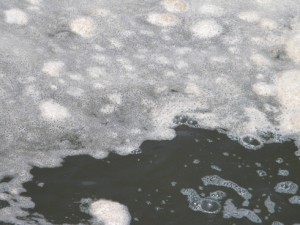
Dispersant remnant, June 26, 2010. (Photo: Shirley Tillman)
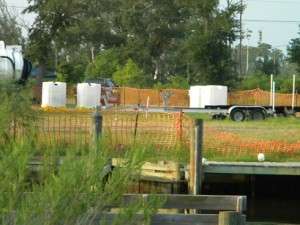

Corner of Canal Road and I-10, in Gulfport, at the Gulfport site used as a BP staging area. (Photo: Shirley Tillman)
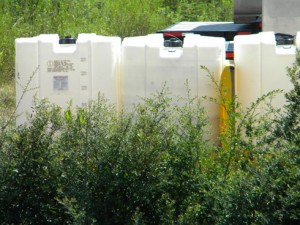

Corexit tanks, September 1, 2010. (Photo: Shirley Tillman)
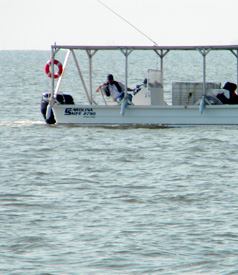
Private contractor in Carolina Skiff with tank of Corexit dispersant, August 10, south of Pass Christian Harbor, 9:30 AM. (Photo: Don Tillman)

http://www.truth-out.org/evidence-mounts-bp-spraying-toxic-dispersants63219

Monday 13 September 2010
by: Dahr Jamail, t r u t h o u t | Report

Shirley and Don Tillman, residents of Pass Christian, Mississippi, have owned shrimp boats, an oyster boat and many pleasure boats. They spent much time on the Gulf of Mexico before working in BP’s Vessels Of Opportunity (VOO) program looking for and trying to clean up oil.
Don decided to work in the VOO program in order to assist his brother, who was unable to do so due to health problems. Thus, Don worked on the boat and Shirley decided to join him as a deckhand most of the days.

“We love the Gulf, our life is here and so when this oil disaster happened, we wanted to do what we could to help clean it up,” Shirley explained to Truthout.

However, not long after they began working in BP’s response effort in June, what they saw disturbed them. “It didn’t take long for us to understand that something was very, very wrong about this whole thing,” Shirley told Truthout. “So that’s when I started keeping a diary of what we experienced and began taking a lot of pictures. We had to speak up about what we know is being done to our Gulf.”

Shirley logged what they saw and took hundreds of photos. The Tillmans confirm, both with what they logged in writing as well as in photos, what Truthout has reported before: BP has hired out-of-state contractors to use unregistered boats, usually of the Carolina Skiff variety, to spray toxic Corexit dispersants on oil located by VOO workers.

Shirley provided Truthout with key excerpts from the diary she kept of her experiences out on the water with her husband while they worked in the VOO program before they, like most of the other VOO workers in Mississippi, were laid off because the state of Mississippi, along with the US Coast Guard, has declared there is no more “recoverable oil” in their area.

“The first day I went, I noticed a lot of foam on the water,” reads her entry from June 26. “My husband said he had been seeing a lot of it. At that time, we were just looking for ‘Oil.’ We would go out in groups of normally, five boats. The Coast Guard was over the VOO operation. There was always a Coast Guard on at least one of the boats. They would tell us when to leave the harbor, where to go and how fast to go. They had flags on each of the VOO boats and also a transponder. Sometimes we would have one or more National Guardsmen in our group too, as well as an occasional safety man to monitor the air quality and procedures on the boat. If we found anything, the Coast Guard in our group would call it in to ‘Seahorse’ and they would determine what action would be taken.”

Along with giving a clear description of how the Coast Guard was thus always aware of the findings of the VOO workers, her diary provides, at times, heart-wrenching descriptions of what is happening to the marine life and wildlife of the Gulf of Mexico.

“Before we went to work, I went down by the beach,” reads her entry from July 4. “There were dead jellyfish everywhere. Some of them were surrounded by foam. A seagull was by the waters edge, as the foamy stuff continued to wash up. There was also a crane that appeared to be sick. It didn’t look like it had any oil on it, but it just stood there, no matter how close I got.”

On the morning of August 5, Shirley describes spotting a dead young dolphin floating in the water. “As we waited for the VOO Wildlife boat to come pick it up, we noticed a pod of dolphins close by,” she writes. “Even with all the boats around, they did not leave until the dead one was removed from the water. It was very emotional, for all of us.”

The next day, August 6, found her logging more death. “Last night on the news, they reported a fish kill. Before we went to work, I went to the beach by the harbor. The seagulls were everywhere. As for the dead fish, the only ones on the beach, were ones that the tide had left when it went back out. The rest of the ‘Fish Kill,’ was laying underwater, on the bottom. It was mainly flounder and crab. We only spotted two dead flounder floating that day. I can only imagine how many were on the bottom … I went back to the beach after work. The tide had gone out and the seagulls were eating all the dead fish that had been exposed. You could still see dead fish underwater, still on the bottom. Dead fish don’t float anymore?”

The Tillman’s primary concern is the rampant use of toxic dispersants by what they described as private contractors working in unregistered boats, that regularly were going out into the Gulf as they and other VOO teams were coming in from their days’ work. There was, oftentimes, so much dispersant on top of the water, their boat left a trail.

“The first thing I noticed, was the ‘trail’ the boat was leaving in the water,” her log from July 10 reads. “You could see exactly where we had been, as far back as you could see. Around 11:00, we were in oil sheen and brownish clumps. We were North of Cat and Ship Island when the Coast Guard told us to drop the boom over. When you pick the boom up, you have to wear ‘protective gear.'”

Her log from August 1 describes, in detail, an incident of the Coast Guard not allowing them to collect oil and his proceeding to deny what they found was even oil:
“Around 2:00 p.m., we started noticing a lot of oil sheen. We were North of the East end of Cat Island, but South of the Inter Coastal channel. There was, as usual, a Coast Guard on one of the boats in our team. He called in to report it, but we were told not to drop the boom, it was just ‘Fish Oil.’ In the beginning of the clean-up operation, if something was floating on the water and it looked like oil, it was oil or oil sheen. Later they would sometimes say it was just ‘Fish Oil.’ Also, if it was heavy foam with a brown or rust color, originally it was ‘Oil Mousse.’ Later it was called ‘Algae.’ We were then told to head Northwest. The further we went, the worse the ‘Fish Oil’ got.

Then, the foam was mixed in with the oil. It was at least the size of a football field, around our boat alone. My husband got on the radio and asked if they could put the boom over.” The Coast Guard, again, told them no. “We were then headed West, back towards Pass Christian. A pleasure boat flagged one of the boats in our group down and told him that there was oil all over. The Coast Guard said to tell him that they were aware of the situation … On the way back to the Pass Harbor, I asked my husband, ‘Just exactly what are we even doing out here?’ He told me that he was beginning to think that it was all just for show. I can only imagine what the people on the pleasure boat had to say when they got back home that day. Probably, that they had seen a lot of oil on the water and the VOO boats were out there just riding around in it and not doing anything to clean it up. That is exactly what happened. We decided then to start documenting as much as we could. I believe it was the very next day, Thad Allen was on TV saying that they were scaling operations back due to the fact that, ‘No oil has been seen in the Gulf in almost two weeks.’ Now, if we had pulled boom on Sunday and unloaded a bunch of dirty boom in the Pass harbor, it might have been a problem for him later.”

On August 5, she describes a rare instance of their being allowed to drop boom in order to collect oil. “We had a Coast Guard and two Safety Men on our boat. We went to the West of the Pass Harbor. The water looked black in places. Lots of bubbles, not foam, just bubbles. Around 8:30, we were in oil sheen and mousse and were told to drop the boom. The more we pulled the boom, it appeared the more was coming up. The Pass [Christian] Harbor was closed because the oil was coming in so bad. We pulled boom back and forth the rest of the afternoon.”
By early August, the total number of VOO boats operating out of Pass Christian Harbor, where Shirley and Don worked, was down to 26.

On August 8, Shirley wrote, “talk at the harbor was that airplanes were spraying dispersants on the water at night, out by the islands. There was also talk of skiffs, from Louisiana, with white tanks on them, that were spraying [dispersants] too. We had seen the skiffs before. They would pass us up in the mornings and head towards the Bay St. Louis Bridge. We were told that they were working out of an area at Henderson Point. Henderson Point has a county-owned area with a boat launch & piers. It was closed to the public after the oil spill and a BP sub-contractor staging area was set up. It always appeared that these boats were finishing up their work day, just as we were going to start ours. Most of these skiffs were Carolina Skiffs.”

Later that same morning, Shirley and her husband headed out of the harbor with a member of the National Guard on their boat, heading west, while a member of the Coast Guard and another member of the National Guard were on another boat in their VOO team. After boating for an hour, they turned back to the east, at which point Don spotted five of the Carolina Skiffs.
“I got my camera and started taking pictures of them,” Shirley writes. “As I was zooming in as close as I could, I saw one of them spraying something onto the water. I did not get a picture of it, I was too busy telling my husband to tell the Coast Guard on the other boat. The skiffs had turned North and were scattered out, zigzagging South of the train bridge. The Coast Guard called the incident in and sent one of our boats to follow the skiffs. The skiffs immediately left. When I saw the boat spraying, it was upwind from our boat. Within a few minutes, my nose started drying out. Later my throat and eyes did the same thing. A Coast Guard helicopter was dispatched along with a Coast Guard boat. We saw the helicopter about twenty minutes later, but I never saw the Coast Guard boat.”

Back at Pass Christian Harbor, her team reported the Carolina Skiffs actively spraying dispersants. She was told by the contracting company, Parson’s, that managed their VOO team, to bring in her photographs.

Her entry from the next day, August 9, reads:

“I took the pictures, 8×10’s to Parson’s. A short time later, my husband called and said the Coast Guard wanted me to make a disc of the pictures. I took the disc and turned it over to the Coast Guard. I was told, in the presence of others, that the incident had been investigated and the boats in question had been located at the Henderson Point site. He said that these boats were in the VOO program as skimmer boats, but it had not yet been verified. He said that he had questioned them about spraying something on the water. They told him that if I had seen them spraying anything, they were probably just rinsing out their tanks. He also asked me, ‘Don’t you think if they were spraying dispersants, they would be wearing respirators?’ I told him, ‘You would think so, but nothing surprises me around here anymore.’ We basically left after that. I knew all they had really wanted was to see exactly what I had gotten pictures of. There is of course the question, ‘Why would a skimmer boat need to rinse out his tanks?’ If he had been skimming oil, why dump it back over? If he hadn’t been skimming oil, what was he rinsing out? I know what I saw and I know how I felt afterwards. I also know that in one of the pictures I took, you can see a helicopter over those boats. BP has spotters looking for oil. Could it be he was telling them where to ‘Touch Up’ before they called it a day? One thing I did learn from Coast Guard guy that day, evidently these so-called skimmer boats, also have the ability to spray!”
The Tillman’s curiosity drove them to investigate further, given the inconsistencies they were seeing in the Coast Guard’s actions regarding the dispersant being sprayed from contractors in the Carolina Skiffs.

“My husband came home and said that they had seen the ‘Skiffs’ again today,” reads Shirley’s entry from August 10. “He took pictures of them and a jack-up-rig. The rig moves around in the sound and is suppose to be a de-contamination station. However, some Captains have said when they went there, they were told it wasn’t in operation at the time. After thinking about the tank skiffs and the Coast Guard for two days, I could not make any sense of this whole situation. The Coast Guard is supposedly over the VOO Program, but it knows nothing about the skiffs at the site, so close to the Pass Harbor. They not only tell us every move to make, but they are always with us when we make the moves. Our boats are flagged and have transponders on them. Those boats have no flags, we have not seen a transponder, nor a Coast Guard member on one of them telling them what to do.”

That afternoon, the Tillmans visited the Henderson Point staging area. Though it was guarded, what they found shocked them:

“There were probably more boats there than in the entire Pass [Christian] VOO program at the time,” reads her entry. “There were only a couple of regular skimmer boats. All appeared to have Louisiana registrations. Almost all of the skiffs had the white tanks on them. A few of the tanks looked like they could have had something in them at one time, but nothing like the oily, sticky mess we had been dealing with. If we got something on our boat, it was almost impossible to get it off. I don’t see how they could have gotten it out of the tanks and still looked like they did. Also, there was a Harrison County Sheriffs Department car, right by the boats and some large, plastic, white containers with yellow bases.”

On August 13, the VOO boat that Shirley and Don were running was deactivated. Still very concerned, the next day they visited the BP staging area in Hancock County.

“They had evacuated this site,” she writes. “Same setup though, a guard and a Sheriff’s car. We then went to a site in Gulfport. Evidently, this is a main BP storage site. There were all kinds of boats, including the tank skiffs. The Sheriffs Department was there also and so was those large, plastic tanks with the yellow bases.”

Other reports, of a very similar nature, have been reported about other BP staging areas along the Gulf of Mexico. The tanks are clearly used to store and transport Corexit dispersant. The Carolina Skiffs are clearly used to spray it atop oil.
Her August 16 entry details her discovery:

“Over the next few days, I continued to go by the Henderson Point site and the Gulfport site. The Henderson Point site brought back a few boats, but none of the tank skiffs or the large plastic tanks. The Gulfport site stayed the same, full of everything. On August 25, I received an email with a link to an article about dispersants. It had a picture of the tanks that dispersants come in, with the label ‘Nalco Corexit EC9005A.’ They were 330 gallon, large, plastic, white tanks with a yellow base. These were the same tanks that I had been seeing at the Henderson Point site and the Gulfport site. I was able to get the name of the manufacturer of the tanks, off a picture I took and compared it to the picture in the article. It was the same manufacturer. I researched this company on the internet and found the 330 gal tanks. They are marketed as: ‘The only manufacturer in the industry to offer portable tanks certified for hazardous goods transport by the United Nations and the U.S. Department of Transportation.'”

Shirley and Don are, like tens of thousands of other VOO workers and Gulf residents, left with more questions than answers.

“While working on the boats, if you pull boom back onto the boat, you not only had to wear Tyvek suits, protective glasses and gloves, you also had to put tape around the gloves and suit sleeves, as well as around your boots and the suit.” Shirley asks, “Why would it be safe for people to get into the same water that all of this hazardous stuff was coming out of?”

For the Coast Guard, she aks:

“How can you not know there are boats in the VOO program if you are in charge of the VOO program? The Coast Guard was supposedly over the VOO program, but they acted like they don’t know anything about the Carolina Skiffs. The boats were in either a task force or strike force. Every VOO boat has a flag. We all had transponders. This was VOO and Coast Guard regulations. But these skiffs didn’t have flags and we never saw transponders on them, nor did they have Coast Guard with them and supposedly every group had at least one Coast Guard in each group. Sometimes we would have two. But the Skiffs didn’t have any.”

Local media in Pass Christian and Gulfport, Mississippi, are now reporting that BP hopes to have the VOO program in that area completed by September 19.

Shirley is incredulous. “Why would anyone bring their children here and put them in water that has had millions of gallons of toxic chemicals dumped into it, not counting the oil itself?” she asks. “Why would you want to eat seafood that has been living and dying in the water, with all those contaminates?”

Truthout has earlier reported on other fisherman in the area, James “Catfish” Miller and Mark Stewart, who have reported being eyewitnesses to the contractors in the Carolina Skiffs spraying dispersant as well.

Meanwhile, local, state and federal authorities continue to claim that dispersant was only used south of Mississippi’s barrier islands and that the Carolina Skiffs and the large tanks they carry are only used to “skim” oil.

“If dispersants were only being sprayed South of the islands, why would these 330 gallon hazardous goods tanks be located at two different work sites, right by the tank skiffs?” Shirley asks. “Why would the skiffs tanks be so clean if they were really skimming oil?”

The Tillmans and thousands of other fishermen and residents along the Gulf of Mexico are deeply concerned about local, state and federal government complicity in what they see as a massive cover-up of the oil disaster by using toxic dispersants to sink any and all oil that is located.

Dr. Riki Ott, a toxicologist and marine biologist, is a survivor of the 1989 Exxon Valdez oil disaster in Alaska. She recently submitted an open letter to the US Environmental Protection Agency expressing many of these same concerns.

Ongoing government denials of this problem neither fool nor dissuade Shirley. “I know what I have seen,” she told Truthout. “I know what I have been told. I know what I have experienced. I know what I have documented. I also know that I have taken hundreds of pictures to verify what I am saying.”

Special thanks to Richard Charter

"Be the change you want to see in the world." Mahatma Gandhi