
Oceana hosts Key West meeting Thursday Sept 16th

I encourage Keys residents to get involved with Oceana–an effective organization! DV

RSVP to: http://oceanakeys.eventbrite.com/

What: Oceana Florida Keys Orientation & Meet Up
When: Thursday Sept 16th 6–7pm
Where: Sippin Cafe, 424 Eaton Street, Key West, FL 33040

The oil disaster in the Gulf may be capped, but the drilling continues. We need to protect our oceans from this happening again. Join us in our effort to put an end to offshore drilling.

On Thursday, September 16th, we’ll be hosting an Oceana volunteer orientation and meet-up. Come meet one another and learn about Oceana’s campaign to End Offshore Oil Drilling and Protect Ocean Health for future generations to come.

Share your perspective in thoughtful conversation about Ocean welfare and the legacy we’re leaving our kids. We are going to brainstorm actions that we can take in days ahead and talk about how we can take a strong stand against offshore drilling and support offshore wind.

We will be meeting Thursday, September 16th 6-7 pm, at Sippin Cafe, 424 Eaton Street downtown Key West.

This is a great opportunity to connect with other folks interested in making a difference! Hope to see you there.

Special thanks to: Amanda Gambill, Climate and Energy Campaign, Oceana
www.oceana.org

New York Times: The Oil Spill’s Money Squeeze


Lee Celano for The New York Times
Harriet M. Perry of the Gulf Coast Research Laboratory in Ocean Springs, Miss., has found oil in larvae samplings, but her testing money has run out.

Lee Celano for The New York Times
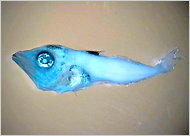
The image of a larval blue tuna that scientists tested for evidence of oil from the gulf spill.

In May, Harriet M. Perry, the director of the fisheries program at the Gulf Coast Research Laboratory, was asked to examine some mysterious droplets found on blue crab larvae by scientists at Tulane University. An early test indicated that the droplets were oil, and she has continued to find similar droplets on fresh larvae samples taken all along the northern Gulf of Mexico.

Despite the potential significance of the discovery, Dr. Perry does not have research money to cover further tests. And like other scientists across the Gulf Coast who are racing to sketch out the contours of the BP oil spill’s effects, she has few places to turn for help.

The only federal agency to distribute any significant grant money for oil spill research, the National Science Foundation, is out of money until the next fiscal year begins Oct. 1. The Environmental Protection Agency, which has only $2 million to give out, is still gearing up its program. A $500 million initiative for independent research promised by BP, which was to be awarded by an international panel of scientists, has become mired in a political fight over control. State agencies, too, are stymied.

“We have met with every possible person we can regarding this issue, built the templates, sent in the requests, and we are waiting to see,” said Hank M. Bounds, the Mississippi commissioner of higher education, speaking of the needs of Ms. Perry and other scientists.

There is plenty of science being done on the spill, but most of it is in the service of either the response effort, the federal Natural Damage Resource Assessment that will determine BP’s liability, or BP’s legal defense. Scientists who participate in those efforts may face restrictions on how they can use or publish their data. More important, they do not have a free hand in determining the scope of their studies.

“Independent research is being squeezed by federal agencies on one side and BP on the other,” said Dr. Perry, whose only offer of help has come from BP (she declined). “It’s difficult for the fishing community and the environmentalists to understand why we are not receiving the money that we need.”

Scientists view the situation as urgent because the environmental picture in the gulf region changes daily, as the plume of undersea oil disperses and degrades, fish eggs hatch and crabs molt.

“Time is of the essence,” said Lisa Suatoni, a senior scientist at the Natural Resources Defense Council, an environmental group. “Knowing the answers to basic questions like how much oil is below the surface, where is it going and what is its fate – those are answers that are slipping through our fingers.”

John H. Paul, a biological oceanographer at the University of South Florida, has found evidence of stress and even genetic damage in plankton exposed to the spill. “Everything that I’ve done, I’ve not had funding for,” he said. “I’ve had to pull people off my other projects and say, ‘Here, let’s do this for two weeks.’ ”

Ralph Portier, an environmental scientist at Louisiana State University, said earlier grants would have meant earlier answers to key questions like how long it will take for the oil in the marshes to break down. “We could have had a much better answer to that by now if we had started in the summer,” he said.

But, Dr. Portier said, there was no mechanism set up to provide research money in the event of an oil spill. “We always seem to be reacting and reacting and reacting, rather than being proactive,” he said.

Dr. Suatoni said the federal agencies that scientists normally looked to might not get significant allotments from Congress for spill research. “The government is afraid it’s going to look like we’re asking taxpayers to pay to study a spill that was a result of BP’s actions,” she said.

Right after the spill, gulf research institutions exhausted their budgets, spending hundreds of thousands of dollars to pay for sea voyages and sampling. Scientists used their personal credit cards to begin research projects.

After complaints about the scarcity of research dollars, BP announced that it would spend $500 million over 10 years in a program it called the Gulf Research Initiative. The original structure of the initiative, with an international panel of scientists appointed to review proposals, was applauded by many scientists, who were persuaded that BP genuinely intended to distance itself from the choice of projects and would set no limits on the publication of results.

But gulf scientists and state officials expressed fears that the process would take too long and that the money would go to large, well-financed research institutions outside the gulf region.

So BP wrote checks for $30 million to research centers in the region for “high-priority studies” – $10 million to the Florida Institute of Oceanography, $10 million to the Northern Gulf Institute, and $5 million to the Dauphin Island Sea Lab in Alabama, all university consortiums, and another $5 million to Louisiana State University. Last week, BP announced that $10 million of the initiative money had been awarded to the National Institutes of Health.

The money was in high demand – the Florida Institute of Oceanography, for example, received 233 proposals and gave awards to only 27.

BP promised that guidelines for disbursing the rest of the money were imminent, but politics intervened. Governors of the Gulf States still wanted more local control of the money, and in mid-June the White House backed them up, announcing, “As a part of this initiative, BP will work with governors, and state and local environmental and health authorities to design the long-term monitoring program to assure the environmental and public health of the gulf region.”

A White House spokesman said that statement was never intended to delay the financing process, but the announcement forced BP to rethink its plans and caused anxiety among scientists. Some feared that the delay would extend indefinitely, and that as the spill receded from the public eye, the money would never materialize. Others divined a money grab by governors for their own cash-starved environmental departments. BP has said little, other than that it is following the “White House directive” to consult with the states.

At least three of the governors have signed on to a proposal that a group called the Gulf of Mexico Alliance, a partnership led by state natural resource and environmental agencies, administer the money. Under the plan now being worked out, BP would appoint 10 members of the peer review board and each governor would appoint two members, said William W. Walker, the director of the Mississippi Department of Marine Resources and the co-chairman of the alliance. In Mississippi’s case, he said, there would most likely be one appointee from a state agency and one from a research institution.

But scientists are skeptical of the gulf alliance, in part because it is controlled by agencies rather than universities, and the public silence surrounding the negotiations has raised suspicions.

“It looks like maybe BP caved,” said Gary M. King, a microbial ecologist at Louisiana State University. “There’s no sense of trust that a group of governors are actually going to do the right thing and ensure that there will be good science.”

New York Times: Panel Urges Tougher Offshore Regulation & US Interior Dept: Salazar: OCS Safety Board Report a “Blueprint” for Next Steps on Internal Reforms of Offshore Energy Oversight

New York Times
September 8, 2010

September 8, 2010, 4:37 pm

By JOHN M. BRODER

Regulators who are supposed to police offshore oil and gas drilling are spread too thinly, poorly trained and hampered by outdated technology, according to a study
http://www.doi.gov/news/pressreleases/Salazar-OCS-Safety-Board-Report-a-Blueprint-for-Next-Steps-on-Internal-Reforms-of-Offshore-Energy-Oversight.cfm
by an Interior Department review board appointed after the BP oil disaster in the Gulf of Mexico.

The Outer Continental Shelf Safety Oversight Board noted in a
report http://www.doi.gov/news/pressreleases/loader.cfm?csModule=security/getfile&PageID=43677
on Wednesday that oil and gas leasing off the nation’s coastlines had nearly tripled since 1982, while the size of the regulatory staff had declined by a third. Off the West Coast, there are five inspectors for 23 offshore production platforms. In the Gulf of Mexico, there are 55 inspectors for 3,000 facilities, the report states.

The study also found that overworked inspectors came under constant pressure from operators not to cite them for violations of rules, complaining that they could lead to fines or costly work stoppages. Inspectors said that they were unable to perform unannounced inspections because of the difficulty of reaching offshore platforms and because of Coast Guard security rules.
The report recommended hiring dozens of new inspectors and giving additional training to those already on the job. It also urged a more robust system of enforcement, including greater authority to cite violations and impose fines.

“I tasked the O.C.S. Safety Board with taking a hard, thorough look top to bottom at how this department regulates and oversees offshore oil and gas operation and provide me their honest and unvarnished recommendations for reform,” said Ken Salazar, the interior secretary. “The report is what I was looking for: it is honest; it doesn’t sugarcoat challenges we know are there; it provides a blueprint for solving them; and it shows that we are on precisely the right track with our reform agenda.”

Many of the panel’s recommendations, including an overhaul of the enforcement of the Minerals Management Service (the agency now reconstituted as the Bureau of Ocean Energy Management, Regulation and Enforcement),
http://www.doi.gov/news/pressreleases/loader.cfm?csModule=security/getfile&PageID=43676
are already being put in place. Under its new leader, Michael R. Bromwich, a former Justice Department inspector general, the agency has already issued a new conflict-of-interest policy and set up an internal investigations unit.

“To a substantial degree, we fully concur with the recommendations,” Mr. Bromwich said in a telephone briefing for reporters. “Without knowing them in advance, we’re moving to implement the bulk of them.”

Mr. Salazar and Mr. Bromwich said that the revamping of offshore regulation was proceeding independently of the moratorium on deepwater drilling that was imposed in July. That suspension is scheduled to end on Nov. 30, whether or not all of the policies and practices recommended by the safety board are in place, they said.

“They don’t all need to be met for the moratorium to be lifted,” Mr. Bromwich said. “There are a cascading series of reforms under way to raise the bar to be met by industry to make deepwater drilling ever more safe. This is simply a recognition it will take time for all of this to be in place.”

__________________

News Release
September 8, 2010

http://www.doi.gov/news/pressreleases/Salazar-OCS-Safety-Board-Report-a-Blueprint-for-Next-Steps-on-Internal-Reforms-of-Offshore-Energy-Oversight.cfm?renderforprint=1 &

US Dept of Interior

——————————————————————————–

Bromwich Develops Implementation Plan for Recommendations
09/08/2010
Contact: Kate Kelly, DOI (202) 208-6416

WASHINGTON Secretary of the Interior Ken Salazar today announced that a team led by senior officials in the Department of the Interior, including Interior’s Inspector General, have completed a review of offshore oil and gas oversight and regulation and have delivered a set of recommendations that reinforce and expand on ongoing reforms being carried out by Bureau of Ocean Energy Management, Regulation, and Enforcement (BOEMRE) Director Michael R. Bromwich.

The report of the Outer Continental Shelf (OCS) Safety Oversight Board, which Secretary Salazar established immediately following the explosion of the Deepwater Horizon rig, provides recommendations to strengthen permitting, inspections, enforcement and environmental stewardship. Director Bromwich announced today that BOEMRE has developed an implementation plan for the recommendations, many of which are already underway or planned.

“I tasked the OCS Safety Board with taking a hard, thorough look top to bottom – at how this department regulates and oversees offshore oil and gas operations and provide me their honest and unvarnished recommendations for reform,” said Secretary Salazar. “The report is what I was looking for: it is honest; it doesn’t sugarcoat challenges we know are there; it provides a blueprint for solving them; and it shows that we are on precisely the right track with our reform agenda. We are absolutely committed to building a regulatory agency that has the authorities, resources, and support to provide strong and effective regulation and oversight and we are on our way to accomplishing that goal.”

“The goal of our efforts is a culture of safety, in which protecting human life and preventing environmental disasters are the highest priorities, while making leasing and production safer and more sustainable,” said Assistant Secretary Wilma Lewis, who chaired the Safety Oversight Board. Mary L. Kendall, Acting Inspector General of Interior and Rhea S. Suh, Assistant Secretary for Policy, Management and Budget, also served as members of the Board.

“My mandate from the President and Secretary was explicit reform the way the agency does business in managing and regulating offshore energy development on the nation’s Outer Continental Shelf,” said BOEMRE Director Bromwich, who noted that the initiatives are consistent with the reform agenda he has been developing and implementing. “Many of the Board’s recommendations will be addressed through initiatives and programs that are already in process and are central to our reform agenda.”

The Safety Oversight Board’s findings and recommendations provide a framework to build upon reforms to create more accountability, efficiency and effectiveness in the Interior agencies that carry out the Department’s offshore energy management responsibilities. The recommendations address both short- and long-term efforts that complement other ongoing reports and reviews, such as the Secretary’s May 27 report to the President, the Presidential inquiry into the Deepwater Horizon oil spill and the U.S. Coast Guard-Interior investigation into the causes of the incident.

The recommendations range from improved consistency and communication of BOEMRE’s operational policies to technology improvements and day-to-day management in the field. Strengthening inspections and enforcement from personnel training to the deterrent effect of fines and civil penalties is a major focus of the recommendations.

BOEMRE’s implementation plan outlines the initiatives and programs that the Bureau is undertaking which address the report’s recommendations, including: reorganizing MMS to address real and perceived conflicts between resource management, safety and environmental oversight and enforcement, and revenue collection responsibilities; seeking additional resources in the form of funding, personnel, equipment and information systems; ethics reforms that include the establishment of an Investigations and Review Unit and a new recusal policy to address potential conflicts of interests within BOEMRE and industry; and Inter-Agency coordination with federal agencies related to oil spill response and the mitigation of environmental effects of offshore energy development.

The OCS Safety Oversight Board Report is online at http://www.doi.gov/news/pressreleases/loader.cfm?csModule=security/getfile&PageID=43677

The BOEM Implementation Plan is online at http://www.doi.gov/news/pressreleases/loader.cfm?csModule=security/getfile&PageID=43676 (signed) and http://www.doi.gov/news/pressreleases/loader.cfm?csModule=security/getfile&PageID=43879 (text-PDF)

Special thanks to Richard Charter

Times-Picayune: New Wave of oil comes ashore west of Mississippi River

http://www.nola.com/outdoors/index.ssf/2010/09/new_wave_of_oil_comes_ashore_w.html

By Bob Marshall, The Times-Picayune
September 12, 2010

A new wave of black oil suddenly came ashore west of the Mississippi River on Friday and Saturday, coating beaches and fouling interior marshes, according to anglers’ reports. Ryan Lambert, owner of Buras-based Cajun Fishing Adventures, said about 16 miles of coastal beaches in Plaquemines Parish from Sandy Point to Chalon Pass were lined with black oil and tar balls. Meanwhile anglers returning to Lafitte told Sidney Bourgeois, of Joe’s Landing, that new oil was surfacing on the eastern side of Barataria Bay in the Bay Jimmie, Bay Wilkerson, and in Bay Baptiste areas.

The Louisiana Department of Wildlife and Fisheries confirmed the following oil sightings in Plaquemines Parish on Friday:

— Half mile of oil located in the marsh of an unnamed marsh island on the southwest side of Bay Jimmy.

— One-mile-long by 20-yard-wide area of tar patties located in West Bay 2.15 miles northwest of Outlet W-2.

— Large area of 6-foot to 12-foot-diameter tar balls locate in Scott Bay 0.8 mile north-northwest of Double Bayou.

— A 2,500-foot-long by 300-foot-wide area of heavy oil sheen with surface oil droplets and submerged oil located offshore 0.85 mile west of the Southwest Pass East Jetty.

“It’s just suddenly came up Friday and it’s along the beach for mile and miles, and drifting inside in some spots,” Lambert said. “There were quite a few dead red fish on the beach, and just thousands of dead pogies (menhaden) inside the bays. And there a really big areas of sheen right off the beach.
“Everyone thinks this is over, but it’s not — not if we can still get soakings like this.”

Special thanks to Frank Jackalone, Senior Field Organizing Manager/ FL & PR
Sierra Club, 111 Second Avenue, Suite 1001
St. Petersburg, FL 33701
(727)824-8813 frank.jackalone@sierraclub.org

Keep In Mind What Happened and Do Not Let It Go By Joel Biddle

Joel is the former Educational Director for Reef Relief and a dear friend. His perspective is right on. DV

While government agencies and BP congratulate themselves on their “success,” we should not overlook
what happened. Even if most of us didn’t want to recognize it, during the Gulf Oil catastrophe we saw exposed the extent of corporate power over our government and our government agencies— agencies that were originally intended to protect us and our environment.

Throughout the unfolding of the drama, this was all too painfully apparent: How unprotected we the people are against corporate money. All of you, NOAA, the EPA, the DEP, The National Marine Park Program* the United States Coast Guard and all you other agencies directly or indirectly involved in this catastrophe, you have let us down. You did it when you looked the other way during the permitting process that allowed drilling in the first place, when what was then the Minerals and Management Service waived the required geological, ecological and economic surveys required by law. You did it by not monitoring BP, a company with an outrageous history of cost-cutting, infractions and disasters.

Incredibly, none of you were prepared for a worst-case scenario. You also let us down when you refused foreign vessels and help. One example of many was the three Swedish Coast Guard Skimmers that were refused, which could have removed 350 barrels of oil per hour. Instead of your constant underestimation, just think what those Swedish vessels could have meant to the Panhandle. Instead of removing oil at the source of the spill, using tankers and barges and reusing recovered oil to recover costs, you allowed unprecedented amounts of poisonous chemical dispersants to be poured into the Mexican Gulf to hide the oil, making it impossible to retrieve and causing oil plumes and unknowable damage for years to come.

Additionally, in hiding the extent of oil wasted, you aided and abetted BP by imposing media and public blackouts. According to many reports, you helped them dispose of uncounted numbers of murdered wildlife and wasted oil. In so doing, you robbed us of the true knowledge of the extent of what was done. You also robbed us of literally billions of dollars in fines that could have restituted families, businesses and the environment into the future.

The Environmental Protection Agency, in a preliminary hearing, said it allowed dispersants because there weren’t enough vessels to retrieve the oil. Yet many available vessels were refused by BP, the Coast Guard and the EPA.

One reason given by the EPA was its regulation that every vessel removing oily water from the ocean must meet EPA standards when the water is put back in. But EPA regulations are often overlooked in emergency situations such as when a hurricane hits and massive amounts of untreated farm runoff enters Shark River Slew and other outlets into Florida Bay and onto our reefs. Why weren’t these regulations eased in this case?

The EPA was protecting BP and not us. Now the Unified Command has declared the Gulf oil disaster virtually over, claiming that about 75 percent of the oil has been cleaned up or has disappeared. Independent scientists not on BP or the government’s payroll have a different opinion on the BP Deepwater Horizon oil spill.

Researchers at the University of South Florida conclude that oil has settled at the bottom of the Gulf farther east than previously suspected and at levels toxic to marine life. A team from Georgia Sea Grant and the University of Georgia has released a report estimating 70 to 79 percent of the oil that gushed from the well “has not been recovered and remains a threat to the ecosystem.” Researchers at Woods Hole Oceanographic Institute report a plume of hydrocarbons at least 22 miles long and more than 3,000 feet below the surface of the Gulf of Mexico. The 1.2-mile-wide, 650-foot-high plume of trapped hydrocarbons provides a clue to where the oil has gone as oil slicks on the surface disappear.

All of us living here want to find solutions, we all want to help if tar balls and other threats come to our shores. But the sad fact is that we’ll have no real solutions if, in the end, it’s business as usual. Business as usual is not good enough. It’s up to each and every government agency to rid itself of the corporate influence that keeps it from doing its sworn duty. Only then will it be able to perform its true mission, to protect the environment and to protect us, the people of the United States of America. Otherwise, why trust anything any agency says?

Sources for this article include The Atlantic Monthly, Huffington Post,, CNN, Science and The New York Times.

* Joel may be referring to the National Park Service at Interior

Special thanks to Joel Biddle.

"Be the change you want to see in the world." Mahatma Gandhi